


Ezekiel 3:26
Bible text: King James Version (1769 Blayney text) · Public domain
Bible text: Berean Standard Bible · Public domain
Bible text: American Standard Version (1901) · Public domain
Bible text: World English Bible, Messianic edition · Public domain
Bible text: Geneva Bible (1599) · Public domain
Bible text: Young's Literal Translation · Public domain
- וּלְשׁוֹנְךָu·le·shon·Khaand your tongueH3956Conj-w ¦ N-csc ¦ 2msNoun Singular common gender Constructוּandלְשׁוֹנְtongueךָyour
- אַדְבִּיק'ad·BikI will make stickH1692V-Hiphil-Imperf-1csVerb Hiphil Imperfect 1st Singular common gender
- אֶל'eltoH413PrepPreposition
- חִכֶּךָchi·Ke·khayour palateH2441N-msc ¦ 2msNoun Singular Masculine Constructחִכֶּpalateךָyour
- וְנֶאֱלַמְתָּve·ne·'e·Lam·taand you will be dumbH481Conj-w ¦ V-Niphal-ConsecPerf-2msVerb Niphal Consecutive Perfect 2nd Singular Masculineוְandנֶאֱלַמְתָּyou will be dumb
- וְלֹאve·lo'and notH3808Conj-w ¦ NegParticle Negativeוְandלֹאnot
- תִהְיֶהtih·Yehyou will becomeH1961V-Qal-Imperf-2msVerb Qal Imperfect 2nd Singular Masculine
- לָהֶםla·Hemto themPrep-l ¦ 3mpSuffix Personal 3rd Plural Masculineלָtoהֶםthem
- לְאִישׁle·'Ish<into> a personH376Prep-l ¦ N-msNoun Singular Masculine Absoluteלְ<into>אִישׁa person
- מוֹכִיחַmo·Khi·ach[who] reprovesH3198V-Hiphil-Prtcpl-msVerb Hiphil Participle Singular Masculine Absolute
- כִּיkiforH3588PrtParticle Conditional
- בֵּיתbeit[are] a house ofH1004N-mscNoun Singular Masculine Construct
- מְרִיme·RirebellionH4805N-msNoun Singular Masculine Absolute
- הֵמָּהHe·mahtheyH1992Pro-3mpPronoun Personal 3rd Plural Masculine
English is a literal word-by-word gloss of the Hebrew, not the KJV's wording. Why?
This is the original text the KJV's translators worked from — each Hebrew word with its own literal English meaning in this verse, prepared by scholars at Tyndale House, Cambridge. The KJV translates whole sentences, not word by word, so its wording differs: one Hebrew word can become several English words, and the KJV may choose “the LORD” where the gloss reads “Yahweh”. Both are faithful — they answer different questions. For the KJV's own rendering, switch to the KJV text.
Details
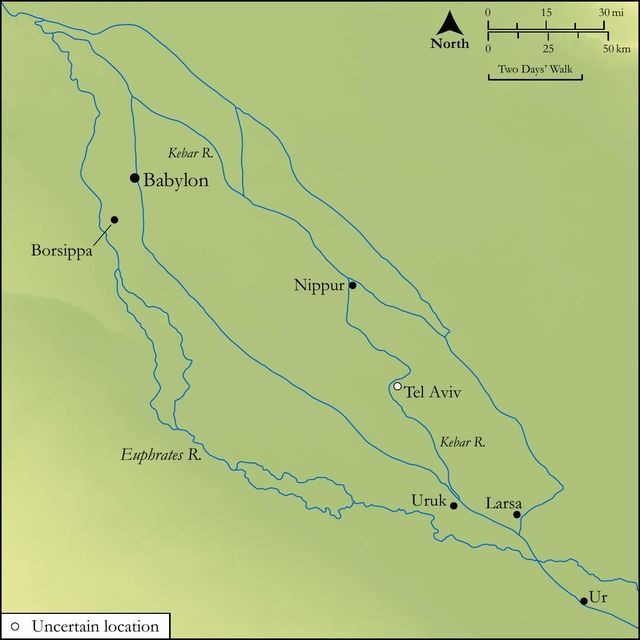
See on the biblical-era map
Study this verse
Public-domain commentary
Matthew Henry
From his Commentary on the Whole Bible. Henry comments on passages, not single verses — this entry covers Ezekiel 3:22–27. His two-level outline is real structure in the source text, so it is rendered as structure.
After all this large and magnificent discovery which God had made of himself to the prophet, and the full instructions he had given him how to deal with those to whom he sent him with an ample commission, we should have expected presently to see him preaching the word of God to a great congregation of Israel; but here we find it quite otherwise. his work here, at first, seems not at all proportionable to the pomp of his call.
I.We have him here retired for further learning.
By his unwillingness to go it should seem as if he were not so thoroughly convinced as he might have been of the ability of him that sent him to bear him out; and therefore, to encourage him against the difficulties he foresaw, God will favour him with another vision of his glory, which (if any thing) would put life into him and animate him for his work. In order for this, God calls him out to the plain (Eze 3:22) and there he will have some talk with him. See and admire the condescension of God in conversing thus familiarly with a man, a son of man, a poor captive, nay, with a sinful man, who, when God sent him went in bitterness of spirit, and was at this time out of humour with his work. And let us own ourselves for ever indebted to the mediation of Christ for this blessed intercourse and communion between God and man, between heaven and earth. See here the benefit of solitude, and how much it befriends contemplation. It is very comfortable to be alone with God, withdrawn from the word for converse with him, to hear from him, to speak to him; and a good man will say that he is never less along than when thus alone. Ezekiel went forth into the plain more willingly than he went among those of the captivity (Eze 3:15); for those that know what it is to have communion with God cannot but prefer that before any converse with this world, especially such as is commonly met with. He went out into the plain, and there he saw the same vision that he had seen by the river of Chebar; for God is not tied to places. Note, Those who follow God shall meet with his consolations, wherever they go. God called him out to talk with him, but did more than that: he showed him his glory, Eze 3:23. We are not now to expect such visions, but we must own that we have a favour done us no way inferior if we so by faith behold the glory of the Lord as to be changed into the same image, by the Spirit of the Lord; and this honour have all his saints. Praise you the Lord, Co2 3:18.
II.We have him here restrained from further teaching for the present.
When he saw he fell on his face, being struck with an awe of God's majesty and a dread of his displeasure; but the Spirit entered into him to raise him up, and then he recovered himself and got upon his feet and heard what the Spirit whispered to him, which is very surprising. One would have expected now that God would send him directly to the chief place of concourse, would give him favour in the eyes of his brethren, and make him and his message acceptable to them, that he would have a wider door of opportunity opened to him and that God would give him a door of utterance to open his mouth boldly; but what is here said to him is the reverse of all this.
1.Instead of sending him to a public assembly, he orders him to confine himself to his own lodgings: Go, shut thyself within thy house, Eze 3:24. He was not willing to appear in public, and, when he did, the people did not regard him, nor show him the respect he deserved, and as a just rebuke both to him and them, to him for his shyness of them and to them for their coldness towards him, God forbids him to appear in public. Note, Our choice is often made our punishment; and it is a righteous thing with God to remove teachers into corners when they, or their people, or both, grow indifferent to solemn assemblies. Ezekiel must shut up himself, some think, to give a sign of the besieging of Jerusalem, in which the people should be closely shut up as he was in his house, and which he speaks of in the next chapter. He must shut himself within his house, that he might receive further discoveries of the mind of God and might abundantly furnish himself with something to say to the people when he went abroad. We find that the elders of Judah visited him and sat before him sometimes in his house (Eze 8:1), to be witnesses of his ecstasies; but it was not till Eze 11:25 that he spoke to those of the captivity all the things that the Lord had shown him. Note, Those that are called to preach must find time to study, and a great deal of time too, must often shut themselves up in their houses, that they may give attendance to reading and meditation, and so their profiting may appear to all.
2.Instead of securing him an interest in the esteem and affections of those to whom he sent him he tells him that they shall put bands upon him and bind him (Eze 3:25), either (1.) As a criminal. They shall bind him in order to the further punishing of him as a disturber of the peace; though they were themselves sent into bondage in Babylon for persecuting the prophets, yet there they continue to persecute them. Or, rather, (2.) As a distracted man. They would go about to bind him as one beside himself; for to that they imputed his violent motions in his raptures. The captains asked Jehu, Wherefore came this mad fellow unto thee? Festus said to Paul, Thou art beside thyself; and so the Jews said of our Lord Jesus, Mar 3:21. Perhaps this was the reason why he must keep within doors, because otherwise they would bind him, under pretence of his being mad, and therefore he must not go out among them. Justly are prophets forbidden to go to those that will abuse them.
3.Instead of opening his lips that his mouth might show forth God's praise, God silence him, made his tongue cleave to the roof of his mouth, so that he was dumb for a considerable time, Eze 3:26. The pious captives in Babylon used this imprecation upon themselves, that, if they should forget Jerusalem, there tongue might cleave to the roof of their mouth, Psa 137:6. Ezekiel remembers Jerusalem more than any of them, and yet his tongue cleaves to the roof of his mouth, and he that can speak best is forbidden to speak at all; and the reason given is because they are a rebellious house to whom he is sent, and they are not worthy to have him for a reprover. He shall not give them instructions and admonitions, for they are lost and thrown away upon them. he is before commanded to speak boldly to them because they are most rebellious (Eze 2:7); but, since that proves to no purpose, he is now for that reason enjoined silence and shall not speak at all to them. Note, Those whose hearts are hardened against conviction are justly deprived of the mans of conviction. Why should not the reprovers be dumb, if, after long trials, it be found that the reproved resolve to be deaf? If Ephraim be joined to idols, let him alone. Thou shalt be dumb, and not be a reprover, implying that unless he were dumb he would be reproving; if he could speak at all, he would witness against the wickedness of the wicked. But when God speaks with him, and designs to speak by him, he will open his mouth, Eze 3:27. Note, Though God's prophets may be silenced awhile, there will come a time when God will give them the opening of the mouth again. And, when God speaks to his ministers, he not only opens their ears to hear what he says, but opens their mouth to return an answer. Moses, who had a veil on his face when he went down to the people, took it off when he went up again to God, Exo 34:34.
4.Instead of giving him assurance of success when he should at any time speak to the people, he here leaves the matter very doubtful, and Ezekiel must not perplex and disquiet himself about it, but let it be as it will. He that hears, let him hear, and he is welcome to the comfort of it; let him hear, and his soul shall live; but he that forbears, let him forbear at his peril, and take what comes. If thou scornest, thou alone shalt bear it; neither God nor his prophet shall be any losers by it; but the prophet shall be rewarded for his faithfulness in reproving the sinner, and God will have the glory of his justice in condemning him for not taking the reproof.
Historical interpretation
Two Centuries of Reception
4 surviving comments on this verse. Each one is dated, so this reads as a timeline rather than a list.
Select a marker to jump to its quote. Markers stagger vertically where authors wrote within a few decades of each other.
(Verse 25, 26.) And you, son of man: behold, chains have been placed upon you, and they will bind you with them, and you shall not go out from among them, and I will make your tongue stick to the roof of your mouth (or throat), and you shall be mute, not speaking as a man who reproaches them: for the house is rebellious. What is enclosed in a house, what is bound with chains, what does not go out to those among whom it dwells, but suffers the solitude of a prison among a multitude of captives, is a sign of siege, as I have said before, that Jerusalem, closed and surrounded by the army of the Chaldeans, will not allow any of its inhabitants to go out. This is the pot about which Jeremiah speaks (Jeremiah I), and he himself as the Prophet in the following words; in which the flesh of the people is consumed. That the language of the Prophet cleaves to the palate or throat and becomes mute is not the result of a reproachful authority, but has a clear cause: for he says, the house is provoking. And the meaning is: They are of such bitterness, and of such contention against God, that they do not deserve to hear the reproacher. From this it is clear that where there is a multitude of sins, sinners are unworthy to correct those who are corrected by the Lord.
And again, because of the fault of those subject to them, the voice of preachers is forbidden, as the Lord says to Ezekiel: "I will make your tongue cleave to your palate, and you shall be mute, and not as a man who rebukes, because it is a provoking house." As if he were to say openly: Therefore the word of preaching is taken from you, because while the people provoke me in their actions, they are not worthy to receive the exhortation of truth. From whose fault, therefore, the word is withdrawn from the preacher is not easily known. But it is known most certainly that the silence of the Pastor sometimes harms himself, but always harms those subject to him.
This is what is meant: The word of preaching is taken away from you. As the people provoke me by their deeds, they are not worthy to have the encouragement of the truth. We cannot easily recognize whose vice causes the word to be withdrawn from the preacher. We know indeed that the shepherd’s silence is sometimes harmful to him, but that it is always harmful to those subject to him.
"And I will make your tongue cleave to the roof of your mouth, and you shall be mute, not like a man who rebukes, because it is a rebellious house."
Therefore, the knowledge of the preachers is then compelled to be silent to the reprobate. Hence it is also added here: "And I will make your tongue cleave to the roof of your mouth, and you shall be mute, and not as a man who rebukes, because it is a provoking house." But because, when Enoch and Elijah preach, many of those who then remain from the Jews in unbelief return to the knowledge of truth, just as it is said of the same Elijah: "Elijah will come, and he will restore all things," who are both called through Zechariah two olive trees, and through John two candlesticks, rightly here also it is added: "But when I shall have spoken to you, I will open your mouth, and you shall say to them: Thus says the Lord God."
Hence here also it is fittingly added: "And I will make your tongue cling to your palate, and you shall be mute, and not as a man who rebukes, because it is a provoking house."
Sometimes indeed the Lord also kindles the hearts of preachers with zeal for Himself against the tongues of those who resist, so that they may not be silent, but may press down the sayings of the deceitful with words of truth.
But the words which are immediately added require great consideration: "And I will make your tongue cleave to your palate, and you will be mute, nor like a man rebuking, because it is a provoking house." For we must discern whether the word of preaching is withdrawn only on account of evil hearers, or sometimes also on account of the fault of the one preaching.
For this matter, when considered, is distinguished by four qualities. For sometimes the word is taken away from good teachers on account of bad hearers. Sometimes, however, the word is given even to bad teachers on account of good hearers. Sometimes, moreover, for the justification of both those teaching and those hearing, the word is given to good teachers, so that they themselves may grow through merit, and their hearers may advance in understanding and life. Sometimes, however, because neither are those worthy to receive to whom the word of teaching is brought forth, nor are those worthy to bring forth the word of teaching who hold the position of teaching, the word of preaching is taken away, so that both parties may be strictly judged. For on account of bad hearers the word is taken away from good teachers, just as it is now said to Ezekiel: "I will make your tongue cling to the roof of your mouth, and you will be mute, not like a man who rebukes, because it is a rebellious house." And as it is said to Paul: "Make haste and go out quickly from Jerusalem, because they will not receive your testimony concerning me." And as when the apostles wished to preach in Asia, it is written that the Spirit of Jesus forbade them. On account of good hearers the word is given even to bad teachers, just as the Lord says of the Pharisees: "Whatever they tell you, observe and do, but do not act according to their works; for they speak and do not act." For the merit of those teaching and the justification of those hearing, the word of teaching is also granted, just as it is said to the holy apostles: "Go and teach all nations." But on account of bad hearers and the unworthy life of those who ought to have taught, the word of teaching is withdrawn, just as Eli did not have a word of strict rebuke for correcting his sons, because both his negligence and the life of his sons demanded that the people should fall along with them, and the ark of the Lord, captured, should pass over to the foreigners. For it is a great grace of almighty God when a harsh word of rebuke is brought forth by teachers against those acting wickedly. Against which it is now said: "And you will be mute, not like a man who rebukes." For he would have rebuked the transgressors if they had been worthy of that grace of rebuke itself.
But since there is such great diversity of merits in teaching and in silence that it cannot easily be known whether the word of teaching is withdrawn because of the fault of the hearer or of him who seems to hold the place of teaching, what else are we commanded but to always preserve humility in doubtful matters? So that when we are able to speak we are not exalted, lest perhaps this very grace of our speaking was bestowed not on us but on our hearers; and again when we are not able to speak, those who have been committed to us should by no means judge us, lest perhaps we are unable to speak not because of our own sin but because of the sin of the hearers. Therefore all things concerning our merits are uncertain to us for this purpose: that we may hold fast to one certain grace—humility—so that when we speak, we may consider this to be from the gift of almighty God and your merit. And when we fall silent from the word of teaching, although it may be our fault, yet you should believe this to be especially yours, so that when we mutually attribute evils to ourselves and goods to others, through this very grace of humility it may come about that the word of teaching which had been taken away may return.
Continue studying Ezekiel 3:26 across the web’s major study libraries — every link below opens this exact verse, chapter, or book on the destination site.
Read & Compare
 BibleGatewayThis verse in more than 200 translations and 70 languages.
 Bible.comThe YouVersion reader — hundreds of translations, reading plans, and highlights.
 ESV.orgCrossway's official English Standard Version reader.
 NET BibleThe NET translation with 60,000+ translators' notes on every rendering decision.
 STEP BibleTyndale House's free study tool — original text, vocabulary, and scholarly resources.
 BibliaLogos Bible Software's free web reader.
 USCCBThe New American Bible (Revised Edition) with the U.S. bishops' study notes.
Commentaries
 BibleHub CommentariesDozens of classic commentaries on this verse, gathered on one page.
 StudyLightMore than 100 commentary sets — the largest collection on the web.
 BibleRefPlain-English commentary on what this verse means, verse by verse.
 Enduring WordDavid Guzik's free commentary on this chapter, widely used by Bible teachers.
 Bible Study ToolsVerse commentary alongside Greek and Hebrew study aids.
Original Language & Research
- BibleHub InterlinearThe verse word by word — original language, transliteration, and English.
- BibleHub LexiconEvery word's original-language definition and Strong's entry.
 Blue Letter BibleDeep-study tools — Strong's numbers, concordance, and word studies.
 SefariaThe Hebrew text with Rashi and centuries of Jewish commentary.
Sermons, Hymns & Audio


TrulyRandomVerse is not affiliated with these sites and doesn’t control their content. They’re linked because they’re genuinely useful.
Summary
Ezekiel 3:26 records a profound divine intervention where God temporarily silences the prophet Ezekiel, causing his tongue to cleave to the roof of his mouth. This strategic muteness prevents Ezekiel from acting as a public "reprover" to the house of Israel, a direct consequence of their unyielding and persistent rebellion. The verse underscores God's absolute sovereignty over prophetic communication and His measured response to a people who have consistently refused to heed His warnings, shifting from verbal admonition to a period of symbolic silence and impending judgment.
Context
ShowHideLiterary Context
This verse is strategically placed early in Ezekiel's prophetic call, immediately following his commissioning as a "watchman" for Israel in Ezekiel 3:17. The narrative flow preceding this verse describes Ezekiel's overwhelming encounter with the glory of the Lord (Ezekiel 3:22-23), leading to his prostration and subsequent divine instruction to return to his house and be "shut in" (Ezekiel 3:24). The divine act of binding Ezekiel with cords (Ezekiel 3:25) and subsequently silencing him (Ezekiel 3:26) signifies a period of enforced isolation and restricted public ministry. This muteness is not an isolated event but part of a larger divine strategy that includes Ezekiel's symbolic actions, such as lying on his side for prolonged periods (e.g., Ezekiel 4:4-8). The silencing thus marks a transition from initial verbal warnings to a phase where the prophet's very person and actions become a living message, communicating God's judgment and the severity of Israel's rebellion more powerfully than words alone could.
Historical & Cultural Context
Ezekiel prophesied to the Jewish exiles residing by the Chebar Canal in Babylon, following the first deportation of Judah in 597 BC. This period was marked by profound national crisis, as the people struggled to reconcile their covenant identity with their captivity. In ancient Israel, a prophet's ability to speak was directly tied to divine empowerment; therefore, to be silenced by God was an extraordinary and deeply symbolic event, signifying a withdrawal of direct verbal communication or a specific divine purpose. The "house of Israel" refers to the entire covenant community, though in Ezekiel's immediate context, it primarily addresses the exiles who, despite their displacement, continued in their spiritual rebellion, clinging to false hopes and idolatry. Their "rebellious" nature was deeply ingrained, stemming from centuries of covenant disobedience, as vividly recounted in historical books like 2 Kings 17 and Jeremiah 7. God's decision to silence Ezekiel was a direct, targeted response to this persistent spiritual obstinacy.
Key Themes
ShowHideEzekiel 3:26 powerfully illuminates several core themes within the book. Firstly, it emphasizes Divine Sovereignty over Prophetic Communication. God is not merely the source of the message but also the absolute controller of its delivery, including the timing, manner, and even the physical capacity of His messenger. Ezekiel's muteness underscores that his voice is entirely God's to grant or withhold, highlighting God's ultimate authority over His word and its impact. Secondly, the recurring phrase "a rebellious house" (e.g., Ezekiel 2:5) highlights the pervasive and persistent Nature of Israel's Rebellion. This rebellion is not merely a series of isolated sins but a deep-seated spiritual condition of stubbornness, defiance, and resistance to God's will and covenant. Finally, Ezekiel's Silence as a Divine Act of Judgment or Sign is a crucial theme. When God's warnings are consistently ignored and His grace spurned, He may withdraw His direct verbal reproof, allowing the people to experience the full, unmitigated consequences of their unheeded rebellion. This foreshadows a "famine of hearing the words of the Lord" (e.g., Amos 8:11), where God's direct communication becomes scarce, intensifying the sense of impending doom and the gravity of their sin.
Exposition and Analysis
ShowHideKey Word Analysis
ShowHideFrom a primitive root meaning "to impinge, i.e. cling or adhere." In this context, it vividly describes the physical sensation of the tongue being stuck fast to the roof of the mouth, rendering speech impossible. It conveys a strong sense of being bound or stuck, not by external force, but by an internal, divinely imposed condition. This word is often used to describe intimate attachment (e.g., a man cleaving to his wife in Genesis 2:24), making its application here to the tongue a stark reversal—an inability to attach to words and speak.
A primitive root meaning "to tie fast; hence (of the mouth) to be tongue-tied." This word directly signifies the state of being mute or speechless. It implies a divinely induced inability to articulate, highlighting the complete cessation of Ezekiel's vocal prophetic function during this period. The prophet is rendered incapable of producing sound, directly correlating with the divine purpose of preventing him from being a reprover.
Derived from a root meaning "bitterness," this word figuratively means "rebellion." It describes a concrete state of being "bitter" or "rebellious," indicating a deep-seated, persistent, and unyielding resistance to authority, specifically God's authority. This term is a consistent descriptor of Israel throughout Ezekiel, emphasizing their stubborn refusal to repent and obey, which is the direct cause of God's action to silence Ezekiel.
Verse Breakdown
ShowHide"And I will make thy tongue cleave to the roof of thy mouth"
This opening clause describes a direct, supernatural intervention by God upon Ezekiel. It is an active, intentional act by the Lord to physically incapacitate Ezekiel's ability to speak. The imagery of the tongue cleaving to the palate powerfully conveys a complete and involuntary cessation of vocal function, emphasizing the divine sovereignty over the prophet's very physiology and his prophetic utterance.
"that thou shalt be dumb"
This specifies the immediate consequence and intended purpose of the tongue cleaving. Ezekiel will be rendered speechless, utterly unable to utter any sound. This state of muteness is not a natural affliction but a divinely imposed condition, directly serving God's larger prophetic agenda for this specific period, shifting the mode of divine communication.
"and shalt not be to them a reprover"
This clause clarifies the primary spiritual and ministerial purpose behind Ezekiel's physical muteness. His customary role as a "reprover"—one who rebukes, warns, or corrects the people regarding their sins—is temporarily suspended. God is intentionally withholding the direct, verbal warnings and challenges that Ezekiel would typically deliver, indicating a profound shift in divine strategy concerning the rebellious people.
"for they are a rebellious house"
This final clause provides the divine rationale and justification for God's severe action. The people's persistent, ingrained, and unyielding rebellion is the direct, explicit cause of God's decision to silence His prophet. Their hardened hearts and consistent refusal to heed previous warnings have led to this specific, temporary withdrawal of verbal reproof, allowing their rebellion to run its course, perhaps to highlight its futility, to intensify their awareness of impending judgment, or to prepare them for a different, more severe form of divine communication.
Literary Devices
ShowHideEzekiel 3:26 employs several potent literary devices to convey its powerful message. Metonymy is evident in "tongue" representing the act of speaking or prophesying, with God's action upon the tongue signifying His absolute control over Ezekiel's entire prophetic utterance. The phrase "make thy tongue cleave to the roof of thy mouth" is a vivid Idiom or Metaphor for being rendered speechless, conveying a sense of physical constraint and direct divine intervention. This physical muteness serves as profound Symbolism, representing God's temporary withdrawal of direct verbal warning from a people who have consistently refused to listen and obey. The description of Israel as "a rebellious house" is a recurring Epithet or Leitwort throughout the book of Ezekiel, serving as a constant, stark reminder of their spiritual condition and the underlying reason for God's judgments and actions against them. The entire scenario also demonstrates Divine Sovereignty, where God's absolute control over His prophet and the timing and nature of His message is powerfully underscored through this dramatic act of silencing.
Theological and Thematic Connections
ShowHideEzekiel's divinely imposed silence highlights a profound theological truth: God's communication is always purposeful and strategic, even when it involves the withholding of words. It underscores that the prophetic word is not merely human utterance but a divinely empowered message, subject entirely to God's timing and will. When a people become so hardened in their rebellion that they consistently reject divine warnings and spurn His grace, God may, in His sovereign wisdom, withdraw those warnings. This allows the consequences of their sin to unfold, serving as a form of judgment, a period for reflection, or a prelude to a new, often more severe, phase of divine action. This demonstrates that God's patience is not infinite, and His justice will ultimately prevail. It also teaches us about the gravity of persistent sin and the perilous danger of ignoring God's voice, leading to a "famine of the word."
Reflection and Application
ShowHideEzekiel's experience of divinely imposed silence offers profound lessons for believers today, challenging us to deeply consider our own responsiveness to God's word and the potential consequences of persistent spiritual rebellion. Just as God temporarily silenced Ezekiel because of Israel's hardened hearts, there may be times when God's direct warnings or clear guidance seem to diminish in our lives or in the broader culture. This is not because He is absent or indifferent, but often because He is allowing us to experience the natural consequences of our unheeded choices, or He is preparing us for a new season of His work that requires a different form of communication. This verse calls us to cultivate a heart that is eager to hear and obey God's voice, to value the prophetic word when it is spoken, and to recognize that even in periods of apparent divine silence, God remains sovereignly at work, often allowing our circumstances to speak His truth. It reminds us that true repentance involves not just hearing, but actively heeding and transforming our lives according to His will, lest we find ourselves among those from whom divine reproof is eventually withdrawn.
Questions for Reflection
ShowHideFAQ
ShowHideWas Ezekiel's muteness permanent?
ShowHideNo, Ezekiel's muteness, as described in Ezekiel 3:26, was a temporary and strategic divine act. The text indicates that God would later "open" Ezekiel's mouth again (e.g., Ezekiel 24:27). This period of silence was specifically linked to the initial phase of Israel's rebellion and the impending fall of Jerusalem. After Jerusalem's destruction, Ezekiel's prophetic role shifted, and his ability to speak publicly was restored to deliver messages of hope, comfort, and restoration.
Why did God choose to silence Ezekiel rather than have him continue to warn the people?
ShowHideGod's decision to silence Ezekiel was a direct, sovereign response to the profound and persistent rebellion of the house of Israel, as explicitly stated in the verse: "for they are a rebellious house." Their hearts were so hardened that continued verbal reproof would have been futile and ineffective. This divine act served multiple purposes: it was a sign of impending judgment, allowing the people to experience the consequences of their unheeded rebellion; it powerfully emphasized God's sovereign control over His message and messenger; and it prepared for a new phase of Ezekiel's ministry where his symbolic actions and physical state would communicate God's truth more profoundly than words, until the time was right for renewed verbal prophecy. It mirrors the principle where God "gives people over" to their own desires when they refuse to acknowledge Him (e.g., Romans 1:24).
What does "rebellious house" signify in the context of Ezekiel?
ShowHideThe term "rebellious house" (Hebrew: beth meri) is a recurring and highly significant epithet for Israel throughout the book of Ezekiel (e.g., Ezekiel 2:5). It signifies not merely isolated acts of sin, but a deep-seated, pervasive, and stubborn disposition of resistance to God's will, His covenant, and His prophets. It characterizes the fundamental unfaithfulness and defiance that marked the nation, leading to their exile and the severe judgments pronounced by Ezekiel. This phrase underscores the gravity of their spiritual condition and provides the theological justification for God's drastic actions, including the silencing of His prophet.
Christ-Centered Fulfillment
ShowHideEzekiel's temporary silencing by God, a direct consequence of Israel's profound rebellion, powerfully foreshadows aspects of Christ's ministry and the ultimate divine response to humanity's deep-seated sin. While Ezekiel's muteness was a specific, temporary prophetic act, Jesus, the ultimate Prophet and the very Word of God incarnate (e.g., John 1:1), faced a far more profound and persistent rejection of His divine words and person. The "rebellious house" of Israel, in its spiritual descendants, ultimately rejected the Son of God Himself, leading to His crucifixion. In His passion, Jesus, the Lamb of God who takes away the sin of the world, stood largely silent before His accusers, fulfilling prophecies like Isaiah 53:7, where "He was oppressed and He was afflicted, yet He opened not His mouth." This silence was not a divine imposition of muteness but a voluntary, redemptive act of humility and submission, bearing the full weight of humanity's rebellion and securing salvation. Furthermore, just as Ezekiel's silence was a prelude to judgment and a shift in divine communication, Christ's crucifixion, resurrection, and ascension marked a monumental shift from direct prophetic utterance to the indwelling of the Holy Spirit (e.g., John 16:7), and a period where the "word" is no longer confined to a single prophet's mouth but is proclaimed globally through His body, the Church, until His glorious return. The ultimate "reprover" of the world is now the Holy Spirit, convicting of sin, righteousness, and judgment (e.g., John 16:8), a divine reproof that continues to call humanity out of its rebellious state into the light and life found in Christ.