


Ezekiel 3:25
Bible text: King James Version (1769 Blayney text) · Public domain
Bible text: Berean Standard Bible · Public domain
Bible text: American Standard Version (1901) · Public domain
Bible text: World English Bible, Messianic edition · Public domain
Bible text: Geneva Bible (1599) · Public domain
Bible text: Young's Literal Translation · Public domain
- וְאַתָּהve·'a·Tahand youH859Conj-w ¦ Pro-2msPronoun Personal 2nd Singular Masculineוְandאַתָּהyou
- בֶןvenO son ofH1121N-mscNoun Singular Masculine Construct
- אָדָם'a·DamhumankindH120N-msNoun Singular Masculine Absolute
- הִנֵּהhi·Nehthere!H2009PrtParticle Interjection
- נָתְנוּna·te·Nupeople will putH5414V-Qal-Perf-3cpVerb Qal Perfect 3rd Plural common gender
- עָלֶיךָ'a·Lei·khaon youH5921Prep ¦ 2msPrepositionעָלֶיonךָyou
- עֲבוֹתִיםa·vo·TimropesH5688N-mpNoun Plural Masculine Absolute
- וַאֲסָרוּךָva·'a·sa·Ru·khaand they will bind youH631Conj-w ¦ V-Qal-ConsecPerf-3cp ¦ 2msVerb Qal Consecutive Perfect 3rd Plural common genderוַandאֲסָרוּthey will bindךָyou
- בָּהֶםba·Hemwith themPrep-b ¦ 3mpSuffix Personal 3rd Plural Masculineבָּwithהֶםthem
- וְלֹאve·Lo'and notH3808Conj-w ¦ NegParticle Negativeוְandלֹאnot
- תֵצֵאte·Tze'you will go outH3318V-Qal-Imperf-2msVerb Qal Imperfect 2nd Singular Masculine
- בְּתוֹכָםbe·to·Khamin midst of themH8432Prep-b ¦ N-msc ¦ 3mpNoun Singular Masculine Constructבְּinתוֹכָmidst ofםthem
English is a literal word-by-word gloss of the Hebrew, not the KJV's wording. Why?
This is the original text the KJV's translators worked from — each Hebrew word with its own literal English meaning in this verse, prepared by scholars at Tyndale House, Cambridge. The KJV translates whole sentences, not word by word, so its wording differs: one Hebrew word can become several English words, and the KJV may choose “the LORD” where the gloss reads “Yahweh”. Both are faithful — they answer different questions. For the KJV's own rendering, switch to the KJV text.
Details
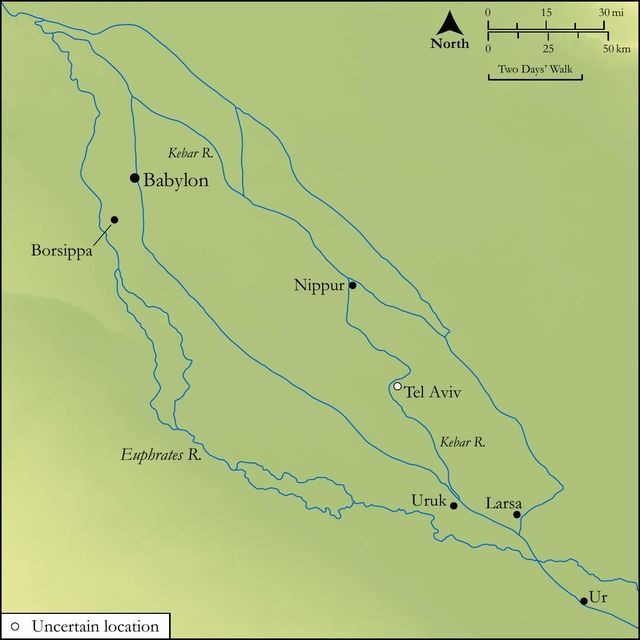
See on the biblical-era map
Study this verse
Public-domain commentary
Matthew Henry
From his Commentary on the Whole Bible. Henry comments on passages, not single verses — this entry covers Ezekiel 3:22–27. His two-level outline is real structure in the source text, so it is rendered as structure.
After all this large and magnificent discovery which God had made of himself to the prophet, and the full instructions he had given him how to deal with those to whom he sent him with an ample commission, we should have expected presently to see him preaching the word of God to a great congregation of Israel; but here we find it quite otherwise. his work here, at first, seems not at all proportionable to the pomp of his call.
I.We have him here retired for further learning.
By his unwillingness to go it should seem as if he were not so thoroughly convinced as he might have been of the ability of him that sent him to bear him out; and therefore, to encourage him against the difficulties he foresaw, God will favour him with another vision of his glory, which (if any thing) would put life into him and animate him for his work. In order for this, God calls him out to the plain (Eze 3:22) and there he will have some talk with him. See and admire the condescension of God in conversing thus familiarly with a man, a son of man, a poor captive, nay, with a sinful man, who, when God sent him went in bitterness of spirit, and was at this time out of humour with his work. And let us own ourselves for ever indebted to the mediation of Christ for this blessed intercourse and communion between God and man, between heaven and earth. See here the benefit of solitude, and how much it befriends contemplation. It is very comfortable to be alone with God, withdrawn from the word for converse with him, to hear from him, to speak to him; and a good man will say that he is never less along than when thus alone. Ezekiel went forth into the plain more willingly than he went among those of the captivity (Eze 3:15); for those that know what it is to have communion with God cannot but prefer that before any converse with this world, especially such as is commonly met with. He went out into the plain, and there he saw the same vision that he had seen by the river of Chebar; for God is not tied to places. Note, Those who follow God shall meet with his consolations, wherever they go. God called him out to talk with him, but did more than that: he showed him his glory, Eze 3:23. We are not now to expect such visions, but we must own that we have a favour done us no way inferior if we so by faith behold the glory of the Lord as to be changed into the same image, by the Spirit of the Lord; and this honour have all his saints. Praise you the Lord, Co2 3:18.
II.We have him here restrained from further teaching for the present.
When he saw he fell on his face, being struck with an awe of God's majesty and a dread of his displeasure; but the Spirit entered into him to raise him up, and then he recovered himself and got upon his feet and heard what the Spirit whispered to him, which is very surprising. One would have expected now that God would send him directly to the chief place of concourse, would give him favour in the eyes of his brethren, and make him and his message acceptable to them, that he would have a wider door of opportunity opened to him and that God would give him a door of utterance to open his mouth boldly; but what is here said to him is the reverse of all this.
1.Instead of sending him to a public assembly, he orders him to confine himself to his own lodgings: Go, shut thyself within thy house, Eze 3:24. He was not willing to appear in public, and, when he did, the people did not regard him, nor show him the respect he deserved, and as a just rebuke both to him and them, to him for his shyness of them and to them for their coldness towards him, God forbids him to appear in public. Note, Our choice is often made our punishment; and it is a righteous thing with God to remove teachers into corners when they, or their people, or both, grow indifferent to solemn assemblies. Ezekiel must shut up himself, some think, to give a sign of the besieging of Jerusalem, in which the people should be closely shut up as he was in his house, and which he speaks of in the next chapter. He must shut himself within his house, that he might receive further discoveries of the mind of God and might abundantly furnish himself with something to say to the people when he went abroad. We find that the elders of Judah visited him and sat before him sometimes in his house (Eze 8:1), to be witnesses of his ecstasies; but it was not till Eze 11:25 that he spoke to those of the captivity all the things that the Lord had shown him. Note, Those that are called to preach must find time to study, and a great deal of time too, must often shut themselves up in their houses, that they may give attendance to reading and meditation, and so their profiting may appear to all.
2.Instead of securing him an interest in the esteem and affections of those to whom he sent him he tells him that they shall put bands upon him and bind him (Eze 3:25), either (1.) As a criminal. They shall bind him in order to the further punishing of him as a disturber of the peace; though they were themselves sent into bondage in Babylon for persecuting the prophets, yet there they continue to persecute them. Or, rather, (2.) As a distracted man. They would go about to bind him as one beside himself; for to that they imputed his violent motions in his raptures. The captains asked Jehu, Wherefore came this mad fellow unto thee? Festus said to Paul, Thou art beside thyself; and so the Jews said of our Lord Jesus, Mar 3:21. Perhaps this was the reason why he must keep within doors, because otherwise they would bind him, under pretence of his being mad, and therefore he must not go out among them. Justly are prophets forbidden to go to those that will abuse them.
3.Instead of opening his lips that his mouth might show forth God's praise, God silence him, made his tongue cleave to the roof of his mouth, so that he was dumb for a considerable time, Eze 3:26. The pious captives in Babylon used this imprecation upon themselves, that, if they should forget Jerusalem, there tongue might cleave to the roof of their mouth, Psa 137:6. Ezekiel remembers Jerusalem more than any of them, and yet his tongue cleaves to the roof of his mouth, and he that can speak best is forbidden to speak at all; and the reason given is because they are a rebellious house to whom he is sent, and they are not worthy to have him for a reprover. He shall not give them instructions and admonitions, for they are lost and thrown away upon them. he is before commanded to speak boldly to them because they are most rebellious (Eze 2:7); but, since that proves to no purpose, he is now for that reason enjoined silence and shall not speak at all to them. Note, Those whose hearts are hardened against conviction are justly deprived of the mans of conviction. Why should not the reprovers be dumb, if, after long trials, it be found that the reproved resolve to be deaf? If Ephraim be joined to idols, let him alone. Thou shalt be dumb, and not be a reprover, implying that unless he were dumb he would be reproving; if he could speak at all, he would witness against the wickedness of the wicked. But when God speaks with him, and designs to speak by him, he will open his mouth, Eze 3:27. Note, Though God's prophets may be silenced awhile, there will come a time when God will give them the opening of the mouth again. And, when God speaks to his ministers, he not only opens their ears to hear what he says, but opens their mouth to return an answer. Moses, who had a veil on his face when he went down to the people, took it off when he went up again to God, Exo 34:34.
4.Instead of giving him assurance of success when he should at any time speak to the people, he here leaves the matter very doubtful, and Ezekiel must not perplex and disquiet himself about it, but let it be as it will. He that hears, let him hear, and he is welcome to the comfort of it; let him hear, and his soul shall live; but he that forbears, let him forbear at his peril, and take what comes. If thou scornest, thou alone shalt bear it; neither God nor his prophet shall be any losers by it; but the prophet shall be rewarded for his faithfulness in reproving the sinner, and God will have the glory of his justice in condemning him for not taking the reproof.
Historical interpretation
Four Centuries of Reception
3 surviving comments on this verse. Each one is dated, so this reads as a timeline rather than a list.
Select a marker to jump to its quote. Markers stagger vertically where authors wrote within a few decades of each other.
“And look, they will bind you with chains and fetters.” That is, the chains that will bind him, so that he might not go out and walk among them, are the Babylonians who encircle Jerusalem and its inhabitants and prevent them from going out and coming in.
(Verse 25, 26.) And you, son of man: behold, chains have been placed upon you, and they will bind you with them, and you shall not go out from among them, and I will make your tongue stick to the roof of your mouth (or throat), and you shall be mute, not speaking as a man who reproaches them: for the house is rebellious. What is enclosed in a house, what is bound with chains, what does not go out to those among whom it dwells, but suffers the solitude of a prison among a multitude of captives, is a sign of siege, as I have said before, that Jerusalem, closed and surrounded by the army of the Chaldeans, will not allow any of its inhabitants to go out. This is the pot about which Jeremiah speaks (Jeremiah I), and he himself as the Prophet in the following words; in which the flesh of the people is consumed. That the language of the Prophet cleaves to the palate or throat and becomes mute is not the result of a reproachful authority, but has a clear cause: for he says, the house is provoking. And the meaning is: They are of such bitterness, and of such contention against God, that they do not deserve to hear the reproacher. From this it is clear that where there is a multitude of sins, sinners are unworthy to correct those who are corrected by the Lord.
"And you, son of man, behold, chains have been placed upon you, and they shall bind you with them, and you shall not go out into their midst."
If we follow these words through the order of typological exposition, the prophet receives bonds in his house and is bound, because in the last days, when Judea shall have believed, she will experience the most grievous persecutions in the time of Antichrist, so that the ministers of iniquity will not receive his preaching, but by resisting will press it down with the bonds of sorrows. And he does not go out into their midst, because preaching does not reach the hearts of the wicked, while the tongue of the good, bound by tribulations, is silent. For there will be at that time many of the unbelieving Jews who will persecute those very ones from among the Jews who shall have believed. Hence it should be noted that here too it is said that the prophet endures bonds in his own house: so that it may be signified that Judea, even from her own people, when she shall have become faithful, will bear the tribulation of persecution. For as long as it is not believed that the Only-Begotten of the Most High Father, having become incarnate and died, rose again and ascended to the heavens, as is preached through the pages of Sacred Scripture, prophecy will certainly be bound among the Jews. If it had flowed into their understanding just as it was spoken, it would have had, as it were, the free steps of its preaching.
Hence it is also added: "And you, son of man, behold, bonds are placed upon you, and they shall bind you in them, and you shall not go out into the midst of them."
For when any preacher is brought back to the conscience of his own house, bonds are placed upon him, and he is bound in them, because the more he examines himself in thought, the more the soul of the just man recognizes how many infirmities of his mortality it is bound by. For unless Paul had seen himself bound, he would never have said: "Having a desire to be dissolved and to be with Christ." Hence it is said through the Psalmist: "That he might hear the groaning of those in bonds, and loose the children of the slain." And again: "Let the groaning of the fettered come before your sight." Often, however, when the soul now desires to go forth to contemplate the appearance of its Redeemer, when it sighs to be present among heavenly joys, it beholds and groans at the very bonds of its mortality by which it is still held bound in the present world. Hence it is that Jeremiah, beholding the subtle judgment of almighty God, says: "He has built against me so that I cannot go out; he has made heavy my fetters." For we have fetters, the very weakness and corruption of our mortality; but when tribulation and groaning are added to us, our very fetters are made heavier. And indeed, as long as the just man endures delays in this life, by speaking good things he hastens to benefit others; but when he beholds hardened minds and considers them occupied with contentions, he withholds the word of preaching. And he does not go forth in the midst of them, because he falls silent from the good things he could have spoken, as it is said through Paul: "Nothing through contention." And again: "If anyone wishes to be contentious, we have no such custom."
For what more is commended to us through the very words of the history than the virtue of obedience? When the prophet is commanded now to proceed to the transmigration by the river Chobar, now to go out to the plain, now to return from the plain to his house? So that first going forth by command, and a little later going out, and again returning home, and shutting himself in, he might always break the judgment of his own will according to the precept of the divine word, so that, suspended in the heavenly command, he might fulfill not his own will, but that of his Creator? To whom it is said: "And you, son of man, behold, bonds have been placed upon you, and they will bind you in them, and you will not go out in their midst." In this matter it should be noted that the prophet foreknows adversities, so that he may be prepared against all things. For evils prevail less against the mind which do not come unexpectedly; and yet while contrary things are foreknown, how great is the virtue of obedience in him is shown, who both knows that he is about to suffer adversities, and yet is not disobedient to the Lord's voice.
Continue studying Ezekiel 3:25 across the web’s major study libraries — every link below opens this exact verse, chapter, or book on the destination site.
Read & Compare
 BibleGatewayThis verse in more than 200 translations and 70 languages.
 Bible.comThe YouVersion reader — hundreds of translations, reading plans, and highlights.
 ESV.orgCrossway's official English Standard Version reader.
 NET BibleThe NET translation with 60,000+ translators' notes on every rendering decision.
 STEP BibleTyndale House's free study tool — original text, vocabulary, and scholarly resources.
 BibliaLogos Bible Software's free web reader.
 USCCBThe New American Bible (Revised Edition) with the U.S. bishops' study notes.
Commentaries
 BibleHub CommentariesDozens of classic commentaries on this verse, gathered on one page.
 StudyLightMore than 100 commentary sets — the largest collection on the web.
 BibleRefPlain-English commentary on what this verse means, verse by verse.
 Enduring WordDavid Guzik's free commentary on this chapter, widely used by Bible teachers.
 Bible Study ToolsVerse commentary alongside Greek and Hebrew study aids.
Original Language & Research
- BibleHub InterlinearThe verse word by word — original language, transliteration, and English.
- BibleHub LexiconEvery word's original-language definition and Strong's entry.
 Blue Letter BibleDeep-study tools — Strong's numbers, concordance, and word studies.
 SefariaThe Hebrew text with Rashi and centuries of Jewish commentary.
Sermons, Hymns & Audio


TrulyRandomVerse is not affiliated with these sites and doesn’t control their content. They’re linked because they’re genuinely useful.
Summary
Ezekiel 3:25 describes a profound and divinely imposed restriction upon the prophet Ezekiel, where he is physically or symbolically bound and prevented from freely moving and interacting with the exiled Israelites. This confinement serves as a powerful, non-verbal sign from God to a rebellious and obstinate people, mirroring their spiritual bondage and their inability to receive and respond to the divine word. The verse highlights God's absolute sovereignty over His prophet and the prophetic message, using Ezekiel's personal circumstances as a vivid object lesson to underscore the gravity of Israel's spiritual condition and the impending judgment.
Context
ShowHideLiterary Context
This verse is strategically placed immediately following Ezekiel's solemn commissioning as a "watchman for the house of Israel" in Ezekiel 3:17-21. After a powerful encounter with the glory of the Lord on the plain, where he is commanded to return to his house (Ezekiel 3:22-23), Ezekiel receives the divine directive for his symbolic binding. This imposition of "bands" and the subsequent inability to "go out among them" in verse 25 directly precedes and sets the stage for the prophet's period of divinely imposed muteness, detailed in Ezekiel 3:26-27. This sequence signifies a shift in Ezekiel's early ministry from potential public proclamation to a period dominated by symbolic action and silence, serving as a potent, non-verbal message to a people resistant to verbal warnings. The restriction emphasizes God's direct control over every aspect of Ezekiel's prophetic function, even his physical freedom.
Historical & Cultural Context
Ezekiel prophesied during the critical period of the Babylonian exile, specifically among the Jewish captives settled by the Chebar Canal. The exiles, often clinging to false prophets and illusory hopes of a swift return to Jerusalem, were deeply resistant to the true prophetic message of prolonged judgment and the necessity of repentance. In Israel, prophets frequently employed dramatic symbolic acts to convey divine messages, a practice well-understood by the populace. The imagery of being bound or confined was a universally recognized symbol of captivity, helplessness, and divine judgment, particularly poignant for a people already in exile. For Ezekiel, a priest by lineage, such a physical restriction would have been an extraordinary and deeply disruptive departure from his expected role, powerfully amplifying the unique and severe nature of his prophetic calling and God's uncompromising message to a people who had repeatedly violated His covenant.
Key Themes
ShowHideEzekiel 3:25 significantly contributes to several profound themes woven throughout the book of Ezekiel. Firstly, it powerfully illustrates Divine Sovereignty and Control, emphasizing that God is not merely the originator of the prophetic word but also the meticulous orchestrator of the prophet's very circumstances, including his confinement, to achieve His specific purposes for Israel. Secondly, the verse highlights the theme of Prophetic Isolation and Suffering, as Ezekiel's binding and inability to "go out among them" underscore the often solitary, difficult, and misunderstood path of a true prophet, especially when delivering unpopular truths to a resistant audience. This isolation serves to validate that his messages are purely divinely sourced, not humanly contrived. Lastly, and perhaps most importantly, the verse conveys the theme of Symbolic Action as Divine Communication. Ezekiel's physical restriction is not merely a personal hardship but a profound object lesson, a living parable mirroring Israel's spiritual bondage and their self-imposed inability to truly hear or respond to God's word. They are, in essence, bound by their sins and rebellion, unable to "go out" from their spiritual captivity, much like the prophet's own physical constraint. This aligns with other powerful prophetic symbolic acts, such as Jeremiah wearing a wooden yoke (Jeremiah 27:2) or Isaiah walking naked and barefoot (Isaiah 20:3).
Exposition and Analysis
ShowHideKey Word Analysis
ShowHideFrom בָּנָה (banah), meaning "a son (as a builder of the family name), in the widest sense." In the recurring address "son of man" (Hebrew: ben-adam), this term emphasizes Ezekiel's humanity and frailty in stark contrast to the overwhelming divine power and majesty of God. It underscores his role as a mortal representative, a human being standing before the divine, tasked with communicating God's word to other human beings, highlighting the vast chasm between the divine speaker and the human recipient.
Meaning "something intwined, i.e. a string, wreath or foliage; band, cord, rope." This word denotes literal physical restraints, such as ropes or cords. Its use here strongly suggests a tangible, physical binding, reinforcing the imagery of confinement and limitation imposed upon Ezekiel. This binding, whether directly by divine power or through human agents under divine orchestration, serves as a concrete manifestation of God's control and the symbolic message being conveyed.
A primitive root meaning "to go (causatively, bring) out, in a great variety of applications, literally and figuratively, direct and proxim." In this context, it specifically signifies the cessation of free movement and public interaction. Ezekiel's inability to "go out among them" implies a severe restriction on his public ministry and direct engagement with the people, emphasizing his enforced isolation and the divine control over his movements and prophetic activity as a powerful, non-verbal sign.
Verse Breakdown
ShowHide"But thou, O son of man,"
This is God's characteristic and frequently repeated address to Ezekiel, appearing over ninety times throughout the book. It serves as a constant, humbling reminder of Ezekiel's mortal, human nature in the face of God's overwhelming divine glory and power. It sets the stage for a divine directive given to a human agent, emphasizing the authority of the speaker and the humility required of the recipient.
"behold, they shall put bands upon thee, and shall bind thee with them,"
This clause vividly describes the imposition of physical or symbolic restraints upon Ezekiel. The "bands" (Hebrew: ʻăbôth) and the act of "binding" (Hebrew: ʼâçar) strongly suggest a literal physical restraint, perhaps ropes or chains. While the identity of "they" is debated (whether rebellious Israelites or divine agents), the broader context of God's absolute control over Ezekiel's actions (e.g., his subsequent muteness) points to this as a divinely orchestrated event, designed to achieve God's specific purposes.
"and thou shalt not go out among them:"
This final clause states the direct consequence of the binding: Ezekiel's complete inability to move freely and interact publicly with the people. This restriction on his mobility and public ministry is the central element of the symbolic act. It signifies a period of enforced isolation, preventing him from engaging in the typical prophetic role of public proclamation, thereby serving as a powerful, non-verbal sign to the rebellious exiles of their own spiritual paralysis.
Literary Devices
ShowHideThe verse employs several significant literary devices to convey its profound message. Symbolism is paramount, as Ezekiel's physical binding and confinement serve as a potent symbol of Israel's spiritual bondage and their self-imposed inability to "go out" from their sin and rebellion. The prophet's restricted movement directly mirrors the nation's spiritual paralysis and their obstinate unwillingness to hear or respond to God's word. The repeated address "O son of man" functions as a direct apostrophe, specifically addressing Ezekiel and highlighting his humanity in contrast to the divine speaker, while also serving as a pervasive motif that recurs throughout the book, emphasizing the vast chasm between God's transcendent nature and humanity's mortal state. The entire scenario functions as an object lesson, where the prophet's personal experience becomes a living parable for the people, designed to convey a message more powerfully and tangibly than words alone, forcing them to confront their spiritual reality.
Theological and Thematic Connections
ShowHideEzekiel 3:25 profoundly illustrates God's sovereign control over His prophets and His message, even when it involves periods of restriction, suffering, or apparent inactivity. It underscores that divine communication is not limited to verbal proclamation but can also occur powerfully through the prophet's very life and circumstances, serving as a living parable. This verse highlights the theme of divine judgment and the severe consequences of rebellion, as Ezekiel's confinement mirrors Israel's spiritual captivity and their self-imposed inability to respond to divine truth due to their obstinacy. It also speaks to the often challenging and isolating nature of true prophetic ministry, which frequently involves hardship and misunderstanding, yet remains entirely under God's direction for His redemptive purposes, even amidst a people who stubbornly refuse to listen.
Reflection and Application
ShowHideEzekiel's experience in this verse offers profound and enduring insights for believers today, serving as a powerful reminder that God's sovereign hand is at work even in periods of personal restriction, limitation, or perceived inactivity. Just as Ezekiel was bound for a specific divine purpose, our own seasons of waiting, isolation, or even opposition can be divinely ordained, not as hindrances to our spiritual growth or ministry, but as instruments for God's greater plan. These challenging moments can serve to deepen our reliance on Him, refine our character, cultivate patience, or even become powerful, non-verbal testimonies to others about God's faithfulness and control. Our faithfulness and obedience, even when circumstances seem to restrict our outward activity or public ministry, can be a potent witness to God's will and power. This verse encourages us to seek God's purpose in all seasons of life, understanding that He can use our endurance, quiet trust, and steadfastness as powerfully as our active service, much like the apostle Paul, who recognized that his imprisonment ultimately served to further the gospel rather than hinder it (Philippians 1:12-14).
Questions for Reflection
ShowHideFAQ
ShowHideWas Ezekiel's binding a literal physical restraint or a symbolic vision?
ShowHideThe text describes the "bands" (Hebrew: ʻăbôth) and the act of "binding" (Hebrew: ʼâçar) in very physical terms, leading many scholars to conclude that Ezekiel was indeed literally bound by ropes or chains. This interpretation aligns with the common prophetic practice in Israel, where prophets often performed physically real symbolic acts to convey divine messages (e.g., Isaiah walking naked, Jeremiah wearing a yoke). While the primary meaning is undoubtedly symbolic—representing the spiritual bondage of Israel and God's sovereign control over Ezekiel's ministry—a literal physical binding would have dramatically underscored the message to a rebellious nation. The subsequent description of Ezekiel's muteness in Ezekiel 3:26 further supports the idea of divinely imposed, tangible restrictions on his prophetic activity, designed to be a powerful, living sign.
Christ-Centered Fulfillment
ShowHideEzekiel's binding and restriction, though a sign of judgment and spiritual bondage for Israel, also powerfully foreshadow a deeper truth about God's redemptive plan, ultimately fulfilled in the person and work of Jesus Christ. Ezekiel, the "son of man," is bound and isolated, a poignant mirror reflecting the spiritual captivity and helplessness of humanity under the dominion of sin. Yet, in the New Testament, the ultimate "Son of Man," Jesus Christ, willingly submitted to being bound and led away (Matthew 27:2) to suffer isolation, rejection, and death for the sins of the world. Unlike Ezekiel, whose binding was a sign to a rebellious people, Christ's voluntary binding, crucifixion, and burial were acts for a rebellious humanity, breaking the spiritual bands of sin and death that held creation captive. His temporary inability to "go out among them" during His passion and burial was a voluntary confinement that led to ultimate liberation and spiritual freedom for all who believe. Through His perfect sacrifice, Jesus, the true Lamb of God, who takes away the sin of the world, sets captives free from the spiritual bondage that Ezekiel's experience so vividly symbolized (Luke 4:18). He is the one who, though bound for a time, now possesses all authority in heaven and on earth, empowering His disciples to "go out among them" with the message of freedom, reconciliation, and the Great Commission (Matthew 28:18-20).