


Ezekiel 3:24
Bible text: King James Version (1769 Blayney text) · Public domain
Bible text: Berean Standard Bible · Public domain
Bible text: American Standard Version (1901) · Public domain
Bible text: World English Bible, Messianic edition · Public domain
Bible text: Geneva Bible (1599) · Public domain
Bible text: Young's Literal Translation · Public domain
- וַתָּבֹאva·ta·vo'and it cameH935Conj-w ¦ V-Qal-ConsecImperf-3fsVerb Qal Consecutive Imperfect 3rd Singular Feminineוַandתָּבֹאit came
- בִיviin mePrep-b ¦ 1csSuffix Personal 1st Singular common genderבִinיme
- רוּחַRu·acha spiritH7307N-fsNoun Singular Feminine Absolute
- וַתַּעֲמִדֵנִיva·ta·'a·mi·De·niand it made stand up meH5975Conj-w ¦ V-Hiphil-ConsecImperf-3fs ¦ 1csVerb Hiphil Consecutive Imperfect 3rd Singular Feminineוַandתַּעֲמִדֵit made stand upנִיme
- עַל'alonH5921PrepPreposition
- רַגְלָיrag·Laimy feetH7272N-fdc ¦ 1csNoun Dual Feminine Constructרַגְלָfeetיmy
- וַיְדַבֵּרvay·da·Berand he spokeH1696Conj-w ¦ V-Piel-ConsecImperf-3msVerb Piel Consecutive Imperfect 3rd Singular Masculineוַandיְדַבֵּרhe spoke
- אֹתִי'o·Tiwith meH854Prep ¦ 1csPrepositionאֹתִwithיme
- וַיֹּאמֶרvai·Yo·merand he saidH559Conj-w ¦ V-Qal-ConsecImperf-3msVerb Qal Consecutive Imperfect 3rd Singular Masculineוַandיֹּאמֶרhe said
- אֵלַי'e·Laito meH413Prep ¦ 1csPrepositionאֵלַtoיme
- בֹּאbo'goH935V-Qal-Imp-2msVerb Qal Imperative 2nd Singular Masculine
- הִסָּגֵרhi·sa·Gershut yourself upH5462V-Niphal-Imp-2msVerb Niphal Imperative 2nd Singular Masculine
- בְּתוֹךְbe·Tokhin [the] midst ofH8432Prep-b ¦ N-mscNoun Singular Masculine Constructבְּinתוֹךְ[the] midst of
- בֵּיתֶךָbei·Te·khayour houseH1004N-msc ¦ 2msNoun Singular Masculine Constructבֵּיתֶhouseךָyour
English is a literal word-by-word gloss of the Hebrew, not the KJV's wording. Why?
This is the original text the KJV's translators worked from — each Hebrew word with its own literal English meaning in this verse, prepared by scholars at Tyndale House, Cambridge. The KJV translates whole sentences, not word by word, so its wording differs: one Hebrew word can become several English words, and the KJV may choose “the LORD” where the gloss reads “Yahweh”. Both are faithful — they answer different questions. For the KJV's own rendering, switch to the KJV text.
Details
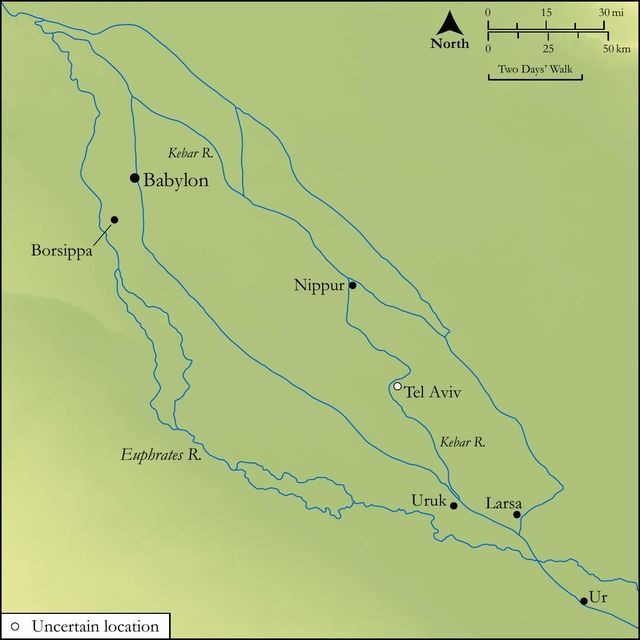
See on the biblical-era map
Study this verse
Public-domain commentary
Matthew Henry
From his Commentary on the Whole Bible. Henry comments on passages, not single verses — this entry covers Ezekiel 3:22–27. His two-level outline is real structure in the source text, so it is rendered as structure.
After all this large and magnificent discovery which God had made of himself to the prophet, and the full instructions he had given him how to deal with those to whom he sent him with an ample commission, we should have expected presently to see him preaching the word of God to a great congregation of Israel; but here we find it quite otherwise. his work here, at first, seems not at all proportionable to the pomp of his call.
I.We have him here retired for further learning.
By his unwillingness to go it should seem as if he were not so thoroughly convinced as he might have been of the ability of him that sent him to bear him out; and therefore, to encourage him against the difficulties he foresaw, God will favour him with another vision of his glory, which (if any thing) would put life into him and animate him for his work. In order for this, God calls him out to the plain (Eze 3:22) and there he will have some talk with him. See and admire the condescension of God in conversing thus familiarly with a man, a son of man, a poor captive, nay, with a sinful man, who, when God sent him went in bitterness of spirit, and was at this time out of humour with his work. And let us own ourselves for ever indebted to the mediation of Christ for this blessed intercourse and communion between God and man, between heaven and earth. See here the benefit of solitude, and how much it befriends contemplation. It is very comfortable to be alone with God, withdrawn from the word for converse with him, to hear from him, to speak to him; and a good man will say that he is never less along than when thus alone. Ezekiel went forth into the plain more willingly than he went among those of the captivity (Eze 3:15); for those that know what it is to have communion with God cannot but prefer that before any converse with this world, especially such as is commonly met with. He went out into the plain, and there he saw the same vision that he had seen by the river of Chebar; for God is not tied to places. Note, Those who follow God shall meet with his consolations, wherever they go. God called him out to talk with him, but did more than that: he showed him his glory, Eze 3:23. We are not now to expect such visions, but we must own that we have a favour done us no way inferior if we so by faith behold the glory of the Lord as to be changed into the same image, by the Spirit of the Lord; and this honour have all his saints. Praise you the Lord, Co2 3:18.
II.We have him here restrained from further teaching for the present.
When he saw he fell on his face, being struck with an awe of God's majesty and a dread of his displeasure; but the Spirit entered into him to raise him up, and then he recovered himself and got upon his feet and heard what the Spirit whispered to him, which is very surprising. One would have expected now that God would send him directly to the chief place of concourse, would give him favour in the eyes of his brethren, and make him and his message acceptable to them, that he would have a wider door of opportunity opened to him and that God would give him a door of utterance to open his mouth boldly; but what is here said to him is the reverse of all this.
1.Instead of sending him to a public assembly, he orders him to confine himself to his own lodgings: Go, shut thyself within thy house, Eze 3:24. He was not willing to appear in public, and, when he did, the people did not regard him, nor show him the respect he deserved, and as a just rebuke both to him and them, to him for his shyness of them and to them for their coldness towards him, God forbids him to appear in public. Note, Our choice is often made our punishment; and it is a righteous thing with God to remove teachers into corners when they, or their people, or both, grow indifferent to solemn assemblies. Ezekiel must shut up himself, some think, to give a sign of the besieging of Jerusalem, in which the people should be closely shut up as he was in his house, and which he speaks of in the next chapter. He must shut himself within his house, that he might receive further discoveries of the mind of God and might abundantly furnish himself with something to say to the people when he went abroad. We find that the elders of Judah visited him and sat before him sometimes in his house (Eze 8:1), to be witnesses of his ecstasies; but it was not till Eze 11:25 that he spoke to those of the captivity all the things that the Lord had shown him. Note, Those that are called to preach must find time to study, and a great deal of time too, must often shut themselves up in their houses, that they may give attendance to reading and meditation, and so their profiting may appear to all.
2.Instead of securing him an interest in the esteem and affections of those to whom he sent him he tells him that they shall put bands upon him and bind him (Eze 3:25), either (1.) As a criminal. They shall bind him in order to the further punishing of him as a disturber of the peace; though they were themselves sent into bondage in Babylon for persecuting the prophets, yet there they continue to persecute them. Or, rather, (2.) As a distracted man. They would go about to bind him as one beside himself; for to that they imputed his violent motions in his raptures. The captains asked Jehu, Wherefore came this mad fellow unto thee? Festus said to Paul, Thou art beside thyself; and so the Jews said of our Lord Jesus, Mar 3:21. Perhaps this was the reason why he must keep within doors, because otherwise they would bind him, under pretence of his being mad, and therefore he must not go out among them. Justly are prophets forbidden to go to those that will abuse them.
3.Instead of opening his lips that his mouth might show forth God's praise, God silence him, made his tongue cleave to the roof of his mouth, so that he was dumb for a considerable time, Eze 3:26. The pious captives in Babylon used this imprecation upon themselves, that, if they should forget Jerusalem, there tongue might cleave to the roof of their mouth, Psa 137:6. Ezekiel remembers Jerusalem more than any of them, and yet his tongue cleaves to the roof of his mouth, and he that can speak best is forbidden to speak at all; and the reason given is because they are a rebellious house to whom he is sent, and they are not worthy to have him for a reprover. He shall not give them instructions and admonitions, for they are lost and thrown away upon them. he is before commanded to speak boldly to them because they are most rebellious (Eze 2:7); but, since that proves to no purpose, he is now for that reason enjoined silence and shall not speak at all to them. Note, Those whose hearts are hardened against conviction are justly deprived of the mans of conviction. Why should not the reprovers be dumb, if, after long trials, it be found that the reproved resolve to be deaf? If Ephraim be joined to idols, let him alone. Thou shalt be dumb, and not be a reprover, implying that unless he were dumb he would be reproving; if he could speak at all, he would witness against the wickedness of the wicked. But when God speaks with him, and designs to speak by him, he will open his mouth, Eze 3:27. Note, Though God's prophets may be silenced awhile, there will come a time when God will give them the opening of the mouth again. And, when God speaks to his ministers, he not only opens their ears to hear what he says, but opens their mouth to return an answer. Moses, who had a veil on his face when he went down to the people, took it off when he went up again to God, Exo 34:34.
4.Instead of giving him assurance of success when he should at any time speak to the people, he here leaves the matter very doubtful, and Ezekiel must not perplex and disquiet himself about it, but let it be as it will. He that hears, let him hear, and he is welcome to the comfort of it; let him hear, and his soul shall live; but he that forbears, let him forbear at his peril, and take what comes. If thou scornest, thou alone shalt bear it; neither God nor his prophet shall be any losers by it; but the prophet shall be rewarded for his faithfulness in reproving the sinner, and God will have the glory of his justice in condemning him for not taking the reproof.
Historical interpretation
Two Centuries of Reception
2 surviving comments on this verse. Each one is dated, so this reads as a timeline rather than a list.
Select a marker to jump to its quote. Markers stagger vertically where authors wrote within a few decades of each other.
(Verse 24.) And I fell upon my face, and the spirit entered into me, and set me upon my feet: and he spoke to me, and said to me: Go in, and shut thyself up in the midst of thy house. Unable to bear the weight of the glory of the Lord standing, he fell on his face, so that he could be lifted up by the entering spirit. The spirit stood him upon his feet, and spoke to him, saying: Enter and shut thyself up in the midst of thy house. And this is the meaning: Because you have been strengthened by the vision of the Lord's majesty, you should not fear anyone or be afraid of anything; but rather return to your home or tend to the needs of the body, as some think, or as a sign of the future siege. And just as Isaiah, barefoot and naked (Isaiah 20), proclaimed the captivity of three years and the nakedness of the people, so you, confined to your home, by the action itself, foretell the imminent siege of the city of Jerusalem.
"And the spirit entered into me and set me upon my feet."
When we humble ourselves before God, when we recognize that we are dust and ashes, when, weighing the weakness of our own condition, we do not maintain a state of rigidity and pride, almighty God lifts us up through His Spirit and sets us upon our feet, so that we who have lain and lie humbly within ourselves from the thought of our weakness may stand upright, as it were upon our feet, in good works afterward. Why is this done to the prophet in a plain, unless to specially designate that the Holy Spirit was also to be given to the elect of the Gentiles, who would first cast down from their state of pride those whom He would take up, and afterward establish them upon their feet, that is, upon good works? As it is said through Paul: "Lift up the hands which hang down, and the feeble knees, and make straight paths for your feet."
"And He spoke to me and said to me: Enter and shut yourself in the midst of your house."
What does it mean that the prophet is led out from the midst of the Israelite people to the plain, and afterward called back from the plain to the house, except that the grace of preaching was taken away from the Jewish people and spread abroad in the breadth of the Gentiles? Yet at the end of the world, when the Jews return to faith, the prophet is, as it were, led back to the house, so that preaching may again dwell among his people—preaching which now shines forth among diverse nations as if in a plain. For it is written: "Until the fullness of the Gentiles should enter in, and so all Israel should be saved." And through another prophet it is said: "If the number of the children of Israel be as the sand of the sea, a remnant shall be saved." Therefore let the prophet go out from the midst of the people to the plain, and let him return from the plain to the house, so that the preaching which was done in Judea may go forth to the Gentiles, and when the Gentiles have been filled with faith, let Judea receive back the gifts of spiritual teaching which she lost. Moreover, the prophet is commanded to be shut in the midst of his house, because in the time of Antichrist the converted people of the Jews will be constrained by harsh persecutions from those Gentiles who remain in unbelief. Hence it is written: "But the court which is outside the temple, cast out and do not measure it, because it has been given to the Gentiles, and they shall trample the holy city for forty-two months."
But because a preacher must always return to his mind, guarding humility and purity within, after the plain it is necessary that he return to his house, so that in those things which he says he may also recognize what kind of person he himself is within his conscience. For if he either fails to keep what he says, or seeks temporal glory from those things which he speaks, he indeed goes out to the plain by speaking, but by not thinking he scorns to return to his house. For having received the Spirit, we are enclosed in the midst of the house, when through his grace we are called back to examine the secrets of our mind, so that the soul may rest in God within itself, and may no longer run about through exterior desires in pursuit of praise and glory through the restlessness of thought.
Concerning this house of the heart, Truth Himself says to a certain man who was healed: "Take up your bed and go to your house." For by the bed in which the flesh finds rest, the flesh itself is signified; by the house, however, the conscience is represented. And because when we are dead in mind we lie in vices, we rest in the delight of the flesh, and when sick we are carried on a bed; but when we have been healed in mind, so that we may now resist the vices of the flesh that assail us, it is necessary that we also endure the insults of temptations from our flesh. Therefore it is commanded to the sick man restored to health: "Take up your bed," that is, carry the bed in which you were carried, because it is necessary that everyone who has been healed carry the insult of the flesh in which he previously lay sick. What then does it mean to say: "Take up your bed and go to your house," except: carry the temptations of the flesh in which you have lain until now, and return to your conscience, so that you may see what you have done? Therefore the prophet, after the plain, is commanded to be enclosed in a house, so that the preacher may always, after the grace of teaching which he ministers to his neighbors, return to his conscience and examine himself with careful scrutiny, lest concerning those things which he preaches outwardly he himself inwardly seek any passing praise.
Hence it is also said through Solomon: "Drink water from your own cistern, and the streams of your own well. Let your fountains be dispersed abroad, and divide your waters in the streets; have them for yourself alone, and let not strangers be partakers with you." But what he says seems very contradictory: "Let your fountains be dispersed abroad, and divide your waters in the streets," when he immediately adds: "Have them for yourself alone, and let not strangers be partakers with you." For how will he be able to have the water of knowledge alone, if he divides it in the streets? How are strangers not partakers of his water, if his fountains are dispersed abroad? But when we preach to the people, we certainly divide the waters in the streets, because we spread the words of knowledge to the multitude of hearers. But when, with divine grace assisting, we guard ourselves inwardly, and with watchful care look around lest the evil spirits—who are rightly strangers to us because they have lost the lot of blessedness—steal upon us through pride, we alone have the waters that we divide in the streets, so that strangers may not be partakers with us in them. These indeed are they of whom it is written: "Strangers have risen up against me, and the mighty have sought my soul." Therefore he both divides the waters in the streets and has them alone, who through the fact that he preaches to many does not exalt himself in the thought of temporal glory. For then a man possesses what he teaches, when he rejoices not in being known, but in being of benefit. Therefore the prophet is led back from the field to the house, so that he who speaks from God, after he has gone forth by speaking for the benefit of his neighbors, may always be called back through humility to examine the secrets of his own heart.
Continue studying Ezekiel 3:24 across the web’s major study libraries — every link below opens this exact verse, chapter, or book on the destination site.
Read & Compare
 BibleGatewayThis verse in more than 200 translations and 70 languages.
 Bible.comThe YouVersion reader — hundreds of translations, reading plans, and highlights.
 ESV.orgCrossway's official English Standard Version reader.
 NET BibleThe NET translation with 60,000+ translators' notes on every rendering decision.
 STEP BibleTyndale House's free study tool — original text, vocabulary, and scholarly resources.
 BibliaLogos Bible Software's free web reader.
 USCCBThe New American Bible (Revised Edition) with the U.S. bishops' study notes.
Commentaries
 BibleHub CommentariesDozens of classic commentaries on this verse, gathered on one page.
 StudyLightMore than 100 commentary sets — the largest collection on the web.
 BibleRefPlain-English commentary on what this verse means, verse by verse.
 Enduring WordDavid Guzik's free commentary on this chapter, widely used by Bible teachers.
 Bible Study ToolsVerse commentary alongside Greek and Hebrew study aids.
Original Language & Research
- BibleHub InterlinearThe verse word by word — original language, transliteration, and English.
- BibleHub LexiconEvery word's original-language definition and Strong's entry.
 Blue Letter BibleDeep-study tools — Strong's numbers, concordance, and word studies.
 SefariaThe Hebrew text with Rashi and centuries of Jewish commentary.
Sermons, Hymns & Audio


TrulyRandomVerse is not affiliated with these sites and doesn’t control their content. They’re linked because they’re genuinely useful.
Summary
Ezekiel 3:24 marks a profound turning point in the prophet's commissioning, where the divine Spirit powerfully indwells him, physically enabling him to stand and receive a direct, imperative command from the Lord. This instruction to "Go, shut thyself within thine house" initiates a significant phase of Ezekiel's ministry, characterized by periods of confinement and focused divine communication, preparing him for the unique symbolic actions and challenging messages he was to deliver to the exiled Israelites.
Context
ShowHideLiterary Context
This verse immediately follows Ezekiel's overwhelming encounter with the manifest glory of the Lord, which caused him to fall prostrate in awe and humility (Ezekiel 3:23). It is deeply embedded within the narrative of Ezekiel's initial call and commissioning (Ezekiel 1-3). Prior to this, God had appointed Ezekiel as a "watchman" over the house of Israel (Ezekiel 3:17) and had him symbolically consume a scroll inscribed with lamentations, mourning, and woe, signifying the bitter message he was to convey (Ezekiel 2:8-10). The command in Ezekiel 3:24, particularly the directive to remain confined and later to be mute (explicitly stated in Ezekiel 3:26), sets the stage for the highly symbolic acts and periods of speechlessness that define much of Ezekiel's early prophetic ministry, especially as detailed in Ezekiel 4-5.
Historical & Cultural Context
Ezekiel ministered during the tumultuous period of the Babylonian exile (c. 597-587 BC), a time of immense national trauma and theological crisis for the Jewish people. Uprooted from their homeland, their temple destroyed, and their covenant relationship with God seemingly shattered, they grappled with questions of God's presence, power, and faithfulness. In this context, prophets like Ezekiel served as crucial intermediaries, interpreting divine judgment and offering glimmers of future hope. The command for Ezekiel to isolate himself within his home was highly unconventional for a prophet, whose role typically involved public proclamation in city gates or temple courts. This unusual confinement would have underscored the severity of Israel's spiritual rebellion and God's absolute sovereignty over the prophetic word, even to the point of restricting its public delivery to emphasize the people's stubbornness and the divine origin of the message.
Key Themes
ShowHideEzekiel 3:24 powerfully contributes to several overarching themes within the book of Ezekiel. It highlights Divine Empowerment, as the Spirit's direct entry enables Ezekiel to stand and receive revelation, emphasizing that true prophetic ministry is not a human endeavor but a divinely initiated and sustained work. The immediate, direct communication from God reinforces the theme of Divine Sovereignty and Communication, illustrating God's active engagement with His chosen instruments and His meticulous control over His message. The subsequent command to "shut thyself within thine house" introduces the significant theme of Prophetic Confinement and Symbolic Action, where the prophet's personal circumstances become an integral part of his message. This foreshadows the periods of speechlessness and the dramatic symbolic acts God would command Ezekiel to perform, such as lying on his side for extended periods to symbolize the siege of Jerusalem (Ezekiel 4:4-8). This confinement also underscores the theme of Divine Control over the Message and Messenger, demonstrating that God dictates not only the content of His word but also the timing, method, and even the physical posture of its delivery, often in ways that defy human expectation.
Exposition and Analysis
ShowHideKey Word Analysis
ShowHideThis term denotes wind, breath, or spirit. In this profound context, "the spirit" unequivocally refers to the divine Spirit of God, signifying a powerful, tangible, and empowering presence. Its entry into Ezekiel is not merely an intellectual inspiration but a literal, enabling force that physically restores him to a state of readiness and prepares him for direct divine communication. This "spirit" is the animating power behind all of Ezekiel's subsequent prophetic actions, visions, and pronouncements.
Meaning "to stand," "to establish," or "to appoint." When the Spirit "set me upon my feet," it signifies a divine act of physical restoration and empowerment. Ezekiel, having fallen on his face in overwhelming awe (Ezekiel 3:23), is now divinely raised to a posture of readiness, receptivity, and authority. This act implies stability, confirmation of his calling, and preparation for active service in receiving and executing God's commands.
Meaning "to shut up," "to enclose," or "to surrender." The imperative "shut thyself within thine house" is a direct divine command for Ezekiel to isolate himself. This act of confinement is not a punishment but a strategic and symbolic directive, serving to separate Ezekiel from public interaction. It facilitates a period of intense, focused divine revelation and prepares him for specific symbolic acts of ministry that would unfold within the privacy of his home, under God's explicit instruction.
Meaning "a house" (in various applications, including family, dwelling, palace, temple). In this context, "thine house" refers to Ezekiel's personal dwelling. The command to confine himself within his own home transforms this private space into a stage for divine communication and symbolic action, shifting the locus of prophetic activity from public squares to a more intimate, controlled environment.
Verse Breakdown
ShowHide"Then the spirit entered into me,"
This clause describes a direct, supernatural infusion of divine power and presence. The "spirit" (רוּחַ, rûwach) is the Holy Spirit, the very breath and active power of God, which overtly indwells Ezekiel. This entry signifies a profound spiritual transformation and empowerment, absolutely essential for the prophet to bear the weight of God's glory, receive His word, and carry out His demanding assignments.
"and set me upon my feet,"
Following the Spirit's powerful entry, Ezekiel is physically lifted from his prostrate position of awe and humility. This act symbolizes not only physical restoration but also divine empowerment and readiness for service. To stand before God signifies a posture of receptivity, obedience, and preparedness to receive and execute divine commands, contrasting sharply with his previous state of overwhelming prostration.
"and spake with me, and said unto me,"
These phrases emphasize the direct, personal, and authoritative nature of God's communication with Ezekiel. The Spirit's entry and the physical setting upon his feet are immediate prerequisites for this intimate dialogue. This highlights that divine revelation to Ezekiel is not merely conceptual or visionary but audibly conveyed, leaving no doubt as to the source or clarity of the subsequent instruction.
"Go, shut thyself within thine house."
This is the specific, imperative command. "Go" (בּוֹא, bôw') is an immediate call to action, while "shut thyself within thine house" (סָגַר, çâgar... בַּיִת, bayith) dictates a period of isolation and confinement. This instruction is counter-intuitive for a public prophet, signaling a unique phase of Ezekiel's ministry where God would meticulously control his public appearances and messages, often through symbolic actions performed in the privacy of his dwelling.
Literary Devices
ShowHideEzekiel 3:24 employs several significant literary devices that amplify its theological impact. Anthropomorphism is evident in the description of the "spirit" (God's Spirit) "entering" Ezekiel and "setting him upon his feet," attributing physical actions and a tangible presence to the divine. This makes the divine power and immediate intervention palpable to the reader. Symbolism is richly present: being "set upon my feet" symbolizes not only physical restoration from a state of awe but also readiness, empowerment, and a posture of obedience and authority for divine service. Conversely, the command to "shut thyself within thine house" is a powerful symbol of isolation, divine control over the prophetic message, and a dramatic shift in the mode of ministry from public proclamation to a more restricted, often symbolic, form of communication. The entire verse functions as a Divine Command or Imperative, highlighting God's absolute authority and Ezekiel's required submission, thereby setting the stage for a ministry uniquely defined by God's specific, often unusual, directives.
Theological and Thematic Connections
ShowHideEzekiel 3:24 profoundly underscores the truth that authentic prophetic ministry, and indeed any Spirit-empowered service for God, originates from and is entirely sustained by divine enablement. The Spirit's sovereign entry and the subsequent direct command reveal God's absolute control over His messengers and His message, often preparing His servants in unconventional, even counter-intuitive, ways. This period of confinement for Ezekiel was not a punitive withdrawal but a strategic, divinely appointed preparation, allowing for deeper communion with God and the reception of specific, often difficult, messages for a rebellious people. It highlights that God's empowerment is always for His purposes, even when those purposes involve seasons of apparent inactivity, isolation, or restricted public engagement.
Reflection and Application
ShowHideEzekiel 3:24 offers profound insights into the nature of divine calling, preparation, and obedience. Just as the Spirit powerfully empowered Ezekiel for his arduous and unique prophetic task, God continues to equip and enable believers for the specific ministries and callings He places upon their lives. This verse reminds us that true spiritual service is never self-generated or sustained by human effort alone but is entirely Spirit-empowered, requiring a posture of profound humility, receptivity, and immediate readiness to obey. Furthermore, Ezekiel's command to "shut thyself within thine house" serves as a powerful reminder that God's methods of preparation and deployment may not always align with our expectations or conventional wisdom. Seasons of quiet, isolation, or restricted public activity, though seemingly counterproductive to outward ministry, can be divinely appointed times for deeper spiritual formation, clearer reception of God's word, and intensive preparation for future, often more impactful, ministry. Our willingness to embrace these seasons, trusting implicitly in God's sovereign and often mysterious plan, is a testament to our faith and obedience.
Questions for Reflection
ShowHideFAQ
ShowHideWhy did God command Ezekiel to shut himself within his house?
ShowHideThe command for Ezekiel to "shut thyself within thine house" (Ezekiel 3:24) was a specific divine directive with multifaceted purposes. Primarily, it served as a period of intense, focused preparation and concentrated divine communication, allowing God to reveal specific messages and symbolic actions to Ezekiel without public interruption. This confinement also powerfully symbolized the spiritual state of Israel—isolated from God due to their profound rebellion—and underscored God's sovereign control over the prophetic word, often restricting its public dissemination to emphasize its divine origin and the people's stubbornness. It was not a punishment for Ezekiel but a strategic and integral part of his unique prophetic ministry, as evidenced by the significant symbolic acts he was commanded to perform within the privacy of his house in subsequent chapters (e.g., Ezekiel 4).
What does "the spirit entered into me, and set me upon my feet" signify?
ShowHideThis phrase signifies a profound and tangible act of divine empowerment and restoration. "The spirit" (Hebrew: rûwach) refers to the Holy Spirit, the very power, presence, and animating force of God. When the Spirit "entered" Ezekiel, it was a direct, supernatural infusion of divine ability, enabling him to stand upright after having fallen prostrate in overwhelming awe before the glory of the Lord (Ezekiel 3:23). Being "set upon my feet" symbolizes not only physical strength and recovery but also spiritual readiness, divine authority, and a posture of receptivity to God's commands. It indicates that Ezekiel was divinely equipped and prepared to receive, comprehend, and faithfully deliver God's message, despite the overwhelming nature of the divine encounter. This act highlights that authentic prophetic ministry is entirely dependent on God's enabling power and initiative.
Christ-Centered Fulfillment
ShowHideEzekiel 3:24, with its depiction of the Spirit empowering a prophet for a unique, often isolating, ministry, finds profound Christ-centered fulfillment. Just as the Spirit "entered" Ezekiel to prepare him for his prophetic task, the Holy Spirit descended upon Jesus at His baptism (Matthew 3:16), empowering Him for His public ministry as the ultimate Prophet, Priest, and King. The command for Ezekiel to "shut thyself within thine house" can be seen as a foreshadowing of Christ's own deliberate periods of withdrawal and isolation for prayer and intimate communion with the Father (Mark 1:35; Luke 5:16), preparing Him for the monumental work of redemption. Ultimately, Ezekiel's Spirit-enabled obedience to a difficult and unconventional command points to the perfect, unwavering obedience of Christ, who, though tempted in every way, never deviated from His Father's will, even to the point of suffering and death on a cross (Philippians 2:8). Through Christ's finished work, the Spirit is poured out on all believers (Acts 2:17), empowering them not for physical confinement but for the spiritual mission of bearing witness to the gospel and becoming "living stones" in the spiritual house of God (1 Peter 2:5), thereby fulfilling the prophetic call in a new covenant reality.