


Ezekiel 2:2
Bible text: King James Version (1769 Blayney text) · Public domain
Bible text: Berean Standard Bible · Public domain
Bible text: American Standard Version (1901) · Public domain
Bible text: World English Bible, Messianic edition · Public domain
Bible text: Geneva Bible (1599) · Public domain
Bible text: Young's Literal Translation · Public domain
- וַתָּבֹאva·Ta·vo'and it cameH935Conj-w ¦ V-Qal-ConsecImperf-3fsVerb Qal Consecutive Imperfect 3rd Singular Feminineוַandתָּבֹאit came
- בִיviin mePrep-b ¦ 1csSuffix Personal 1st Singular common genderבִinיme
- רוּחַRu·acha spiritH7307N-fsNoun Singular Feminine Absolute
- כַּאֲשֶׁרka·'a·Sherjust whenH834Prep-k ¦ RelParticle Relativeכַּjustאֲשֶׁרwhen
- דִּבֶּרdi·Berhe spokeH1696V-Piel-Perf-3msVerb Piel Perfect 3rd Singular Masculine
- אֵלַי'e·Laito meH413Prep ¦ 1csPrepositionאֵלַtoיme
- וַתַּעֲמִדֵנִיva·ta·'a·mi·De·niand it made stand up meH5975Conj-w ¦ V-Hiphil-ConsecImperf-3fs ¦ 1csVerb Hiphil Consecutive Imperfect 3rd Singular Feminineוַandתַּעֲמִדֵit made stand upנִיme
- עַל'alonH5921PrepPreposition
- רַגְלָיrag·Laimy feetH7272N-fdc ¦ 1csNoun Dual Feminine Constructרַגְלָfeetיmy
- וָאֶשְׁמַעva·'esh·Ma'and I heardH8085Conj-w ¦ V-Qal-ConsecImperf-1csVerb Qal Consecutive Imperfect 1st Singular common genderוָandאֶשְׁמַעI heard
- אֵת'et<obj.>H853DirObjMParticle Object Indicator
- מִדַּבֵּרmi·da·Ber[one who] spokeH1696V-Hithpael-Prtcpl-msVerb Hithpael Participle Singular Masculine Absolute
- אֵלָי'e·Laito meH413Prep ¦ 1csPrepositionאֵלָtoיme
English is a literal word-by-word gloss of the Hebrew, not the KJV's wording. Why?
This is the original text the KJV's translators worked from — each Hebrew word with its own literal English meaning in this verse, prepared by scholars at Tyndale House, Cambridge. The KJV translates whole sentences, not word by word, so its wording differs: one Hebrew word can become several English words, and the KJV may choose “the LORD” where the gloss reads “Yahweh”. Both are faithful — they answer different questions. For the KJV's own rendering, switch to the KJV text.
Details
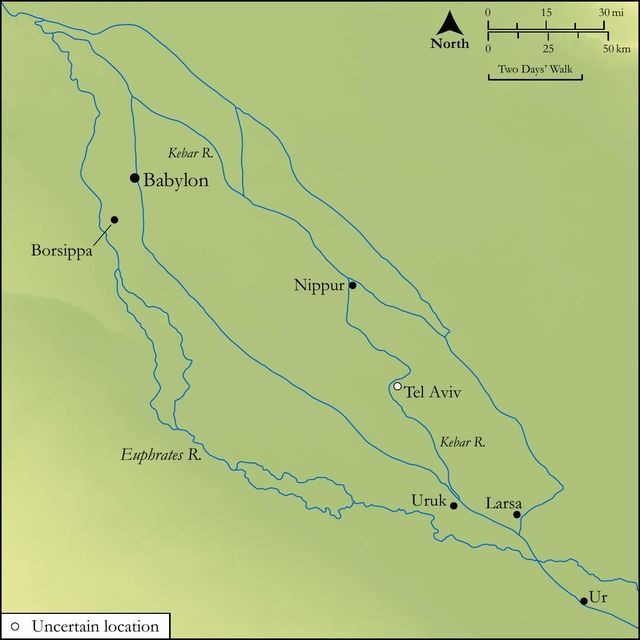
See on the biblical-era map
Study this verse
Public-domain commentary
Matthew Henry
From his Commentary on the Whole Bible. Henry comments on passages, not single verses — this entry covers Ezekiel 2:1–5. His four-level outline is real structure in the source text, so it is rendered as structure.
The title here given to Ezekiel, as often afterwards, is very observable. God, when he speaks to him, calls him, Son of man (Eze 2:1, Eze 2:3), Son of Adam, Son of the earth. Daniel is once called so (Dan 8:17) and but once; the compellation is used to no other of the prophets but to Ezekiel all along. We may take it, 1. As a humble diminishing title. Lest Ezekiel should be lifted up with the abundance of the revelations, he is put in mind of this, that sill he is a son of man, a mean, weak, mortal creature. Among other things made known to him, it was necessary he should be made to know this, that he was a son of man, and therefore that it was wonderful condescension in God that he was pleased thus to manifest himself to him. Now he is among the living creatures, the angels; yet he must remember that he is himself a man, a dying creature. What is man, or the son of man, that he should be thus visited, thus dignified? Though God had here a splendid retinue of holy angles about his throne, who were ready to go on his errands, yet he passes them all by, and pitches on Ezekiel, a son of man, to be his messenger to the house of Israel; for we have this treasure in earthen vessels, and God's messages sent us by men like ourselves, whose terror shall not make us afraid nor their hand be heavy upon us. Ezekiel was a priest, but the priesthood was brought low and the honour of it laid in the dust. It therefore became him, and all of his order, to humble themselves, and to lie low, as sons of men, common men. he was now to be employed as a prophet, God's ambassador, and a ruler over the kingdoms (Jer 1:10), a post of great honour, but he must remember that he is a son of man, and, whatever good he did, it was not by any might of his own, for he was a son of man, but in the strength of divine grace, which must therefore have all the glory. Or, 2. We may take it as an honourable dignifying title; for it is one of the titles of the Messiah in the Old Testament (Dan 7:13, I saw one like the Son of man come with the clouds of heaven), whence Christ borrows the title he often calls himself by, The Son of man. The prophets were types of him, as they had near access to God and great authority among men; and therefore as David the king is called the Lord's anointed, or Christ, so Ezekiel the prophet is called son of man.
I.Ezekiel is here set up, and made to stand, that he might receive his commission, Eze 2:1, Eze 2:2. He is set up,
1.By a divine command: Son of man, stand upon thy feet. His lying prostrate was a posture of greater reverence, but his standing up would be a posture of greater readiness and fitness for business. Our adorings of God must not hinder, but rather quicken and excite, our actings for God. He fell on his face in a holy fear and awe of God, but he was quickly raised up again; for those that humble themselves shall be exalted. God delights no in the dejections of his servants, but the same that brings them low will raise them up; the same that is a Spirit of bondage will be a Spirit of adoption. Stand, and I will speak to thee. Note, We may expect that God will speak to us when we stand ready to do what he commands us.
2.By a divine power going along with that command, Eze 2:2. God bade him stand up; but, because he had not strength of his own to recover his feet nor courage to face the vision, the Spirit entered into him and set him upon his feet. Note, God is graciously pleased to work that in us which he requires of us and raises those whom he bids rise. We must stir up ourselves, and then God will put strength into us; we must work out our salvation, and then God will work in us. He observed that the Spirit entered into him when Christ spoke to him; for Christ conveys his Spirit by his word as the ordinary means and makes the word effectual by the Spirit. The Spirit set the prophet upon his feet, to raise him up from his dejections, for he is the Comforter. Thus, in a similar case, Daniel was strengthened by a divine touch (Dan 10:18) and John was raised by the right hand of Christ laid upon him, Rev 1:17. The Spirit set him upon his feet, made him willing and forward to do as he was bidden, and then he heard him that spoke to him. He heard the voice before (Eze 1:28), but now he heard it more distinctly and clearly, heard it and submitted to it. The Spirit sets us upon our feet by inclining our will to our duty, and thereby disposes the understanding to receive the knowledge of it.
II.Ezekiel is here sent, and made to go, with a message to the children of Israel (Eze 2:3):
I send thee to the children of Israel. God had for many ages been sending to them his servants the prophets, rising up betimes and sending them, but to little purpose; they were now sent into captivity for abusing God's messengers, and yet even there God sends this prophet among them, to try if their ears were open to discipline, now that they were holden in the cords of affliction. As the supports of life, so the means of grace, are continued to us after they have been a thousand times forfeited. Now observe,
1.The rebellion of the people to whom this ambassador is sent; he is sent to reduce them to their allegiance, to bring back the children of Israel to the Lord their God. let the prophet know that there is occasion for his going on this errand, for they are a rebellious nation (Eze 2:3), a rebellious house, Eze 2:5. They are called children of Israel; they retain the name of their pious ancestors, but they have wretchedly degenerated, they have become Goim - nations, the word commonly used for the Gentiles. The children of Israel have become as the children of the Ethiopian (Amo 9:7), for they are rebellious; and rebels at home are much more provoking to a prince than enemies abroad. Their idolatries and false worships were the sins which, more than any thing, denominated them a rebellious nation; for thereby they set up another prince in opposition to their rightful Sovereign, and did homage and paid tribute to the usurper, which is the highest degree of rebellion that can be.
(1.)They had been all along a rebellious generation and had persisted in their rebellion: They and their fathers have transgressed against me. Note, Those are not always in the right that have antiquity and the fathers on their side; for there are errors and corruptions of long standing: and it is so far from being an excuse for walking in a bad way that our fathers walked in it that it is really an aggravation, for it is justifying the sin of those that have gone before us. They have continued in their rebellion even unto this very day; notwithstanding the various means and methods that have been made use of to reclaim them, to this day, when they are under divine rebukes for their rebellion, they continue rebellious; many among them, like Ahaz, even in their distress, trespass yet more; they are not the better for all the changes that have befallen them, but still remain unchanged.
(2.)They were now hardened in their rebellion. They are impudent children, brazen-faced, and cannot blush; they are still-hearted, self-willed, and cannot bend, cannot stoop, neither ashamed nor afraid to sin; they will not be wrought upon by the sense either of honour or duty. We are willing to hope this was not the character of all, but of many, and those perhaps the leading men. Observe,
[1.]God knew this concerning them, how inflexible, how incorrigible, they were. Note, God is perfectly acquainted with every man's true character, whatever his pretensions and professions may be.
[2.]He told the prophet this, that he might know the better how to deal with them and what handle to take them by. He must rebuke such men as those sharply, cuttingly, must deal plainly with them, though they call it dealing roughly. God tells him this, that it might be no surprise or stumbling-block to him if he found that his preaching should not make that impression upon them, which he had reason to think it would.
2.The dominion of the prince by whom this ambassador is sent.
(1.)He has authority to command him whom he sends: "I do send thee unto them, and therefore thou shalt say thus and thus unto them," Eze 2:4. Note, it is the prerogative of Christ to send prophets and ministers and to enjoin them their work. St. Paul thanked Christ Jesus who put him into the ministry (Ti1 1:12); for, as he was sent of the Father, ministers are sent by him; and as he received the Spirit without measure he gives the Spirit by measure, saying, Receive you the Holy Ghost. They are impudent and rebellious, and yet I send thee unto them. Note, Christ gives the means of grace to many who he knows will not make a good use of those means, puts many a price into the hand of fools to get wisdom, who not only have no heart to it, but have their hearts turned against it. Thus he will magnify his own grace, justify his own judgment, leave them inexcusable, and make their condemnation more intolerable.
(2.)He has authority by him to command those to whom he sends him: Thou shalt say unto them, Thus saith the Lord God. All he said to them must be spoken in God's name, enforced by his authority, and delivered as from him. Christ delivered his doctrines as a Son - Verily, verily, I say unto you; the prophets as servants - Thus saith the Lord God, our Master and yours. Note, The writings of the prophets are the word of God, and so are to be regarded by every one of us.
(3.)He has authority to call those to an account to whom he sends his ambassadors. Whether they will hear or whether they will forbear, whether they will attend to the word or turn their backs upon it, they shall know that there has been a prophet among them, shall know by experience.
[1.]If they hear and obey, they will know by comfortable experience that the word which did them good was brought to them by one that had a commission from God and a divine power going along with him in the execution of it. Thus those who were converted by St. Paul's preaching are said to be the seals of his apostleship, Co1 9:2. When men's hearts are made to burn under the word, and their wills to bow to it, then they know and bear the witness in themselves that it is not the word of men, but of God.
[2.]If they forbear, if they turn a deaf ear to the word (as it is to be feared they will, for they are a rebellious house), yet they shall be made to know that he whom they slighted was indeed a prophet, by the reproaches of their own consciences and the just judgments of God upon them for refusing him; they shall know it to their cost, know it to their confusion, know it by sad experience, what a pernicious dangerous thing it is to despise God's messengers. They shall know by the accomplishment of the threatenings that the prophet who denounced them was sent of God; thus the word will take hold of men, Zac 1:6. Note, First, Those to whom the word of God is sent are upon their trial whether they will hear or whether they will forbear, and accordingly will their doom be. Secondly, Whether we be edified by the word or no, it is certain that God will be glorified and his word magnified and made honourable. Whether it be a savour of life unto life or of death unto death, either way it will appear to be of divine original.
Historical interpretation
Two Centuries of Reception
3 surviving comments on this verse. Each one is dated, so this reads as a timeline rather than a list.
Select a marker to jump to its quote. Markers stagger vertically where authors wrote within a few decades of each other.
(Vers. 2.) And the Spirit entered into me after He spoke to me and set me on my feet. And I heard Him speaking to me, saying: Son of man. LXX: And the Spirit came upon me, and took me up, and raised me, and set me on my feet: and I heard Him speaking to me, and He said to me: Son of man. The divine word had commanded the prophet and had said: Stand on your feet (Psalm XXXIX, 3); but he could not stand without the help of God and the coming of the Holy Spirit: therefore, the Spirit enters into him, or assumes and raises him up, so that he may stand firmly and be able to say: He set my feet on a rock (Ephesians VI, 14). We do not read of any sinner standing, but it is said to the saints: Therefore, gird your loins. However, the sinner deserves to hear what is written in Deuteronomy: The sole of your foot shall have no steadiness (Deut. XXVIII, 56) . It is frequently said to Ezekiel: Son of man (Matth. VIII, 20) , and rarely to Daniel: both referring to the one who said: The Son of Man has nowhere to lay His head, He consoles the captive people, and draws them towards repentance.
"And the spirit entered into me after he spoke to me, and set me upon my feet." Behold, the divine voice commanded the prophet lying down to rise. But he could not rise at all unless the spirit of almighty God had entered into him, because from the grace of almighty God we can indeed strive toward good works, but we cannot fulfill them unless he who commands also helps. Thus Paul, when he admonished his disciples, saying, "Work out your own salvation with fear and trembling," immediately added who was working these very good things in them, saying: "For it is God who works in you both to will and to accomplish according to his good pleasure." Hence it is that the Truth itself says to the disciples: "Without me you can do nothing."
But in these matters concerning "the spirit entered into me and set me upon my feet" it must be considered that if our good deeds are gifts of almighty God in such a way that there is nothing of ours in them, why do we seek eternal reward as if for merits? But if they are ours in such a way that they are not gifts of almighty God, why do we give thanks to almighty God for them? But it must be known that our evil deeds are ours alone; our good deeds, however, are both almighty God's and ours, because he by inspiring goes before us so that we may will, and by helping follows after so that we may not will in vain, but may be able to fulfill what we will. Therefore, with grace going before and good will following, that which is the gift of almighty God becomes our merit. Paul explains this well in a brief statement, saying: "I labored more than all of them." Lest he seem to have attributed to his own virtue what he had done, he added: "Yet not I, but the grace of God with me." For because he was preceded by the heavenly gift, he recognized himself as if a stranger to his own good work, saying: "Yet not I." But because the preceding grace had made his free will inclined to good, and by that free will he followed that same grace in his work, he added: "But the grace of God with me." As if he were saying: In good work I labored, not I, but also I. For in this respect, that I was preceded by the Lord's gift alone, not I; but in this respect, that I followed the gift with my will, also I. Therefore, having briefly said these things against Pelagius and Coelestius, let us return to the order of exposition.
Continue studying Ezekiel 2:2 across the web’s major study libraries — every link below opens this exact verse, chapter, or book on the destination site.
Read & Compare
 BibleGatewayThis verse in more than 200 translations and 70 languages.
 Bible.comThe YouVersion reader — hundreds of translations, reading plans, and highlights.
 ESV.orgCrossway's official English Standard Version reader.
 NET BibleThe NET translation with 60,000+ translators' notes on every rendering decision.
 STEP BibleTyndale House's free study tool — original text, vocabulary, and scholarly resources.
 BibliaLogos Bible Software's free web reader.
 USCCBThe New American Bible (Revised Edition) with the U.S. bishops' study notes.
Commentaries
 BibleHub CommentariesDozens of classic commentaries on this verse, gathered on one page.
 StudyLightMore than 100 commentary sets — the largest collection on the web.
 BibleRefPlain-English commentary on what this verse means, verse by verse.
 Enduring WordDavid Guzik's free commentary on this chapter, widely used by Bible teachers.
 Bible Study ToolsVerse commentary alongside Greek and Hebrew study aids.
Original Language & Research
- BibleHub InterlinearThe verse word by word — original language, transliteration, and English.
- BibleHub LexiconEvery word's original-language definition and Strong's entry.
 Blue Letter BibleDeep-study tools — Strong's numbers, concordance, and word studies.
 SefariaThe Hebrew text with Rashi and centuries of Jewish commentary.
Sermons, Hymns & Audio


TrulyRandomVerse is not affiliated with these sites and doesn’t control their content. They’re linked because they’re genuinely useful.
Summary
Ezekiel 2:2 captures a pivotal moment in the prophet's commissioning, immediately following his overwhelming vision of God's glory. Having fallen prostrate in awe, this verse describes the divine Spirit's active intervention: entering Ezekiel, physically raising him to a standing posture, and enabling him to fully comprehend the divine voice that was about to deliver his challenging prophetic mandate to a rebellious nation. It powerfully underscores the foundational truth that divine empowerment is absolutely essential for responding to and fulfilling God's call, transforming a state of reverent submission into one of active readiness for service.
Context
ShowHideLiterary Context
This verse serves as a crucial transition point, immediately following Ezekiel's profound and awe-inspiring encounter with the glory of God, meticulously detailed in Ezekiel 1. After witnessing the majestic chariot throne and the radiant appearance of God's likeness, Ezekiel's natural and appropriate response was to fall on his face in reverence, fear, and utter humility, as recorded in Ezekiel 1:28. Ezekiel 2:2 marks the divine initiative to move Ezekiel from this state of prostration and overwhelmed awe to a posture of active readiness and receptivity. The Spirit's action of setting him on his feet is indispensable for the subsequent divine address, which commences in Ezekiel 2:3, where God directly commissions Ezekiel and outlines the formidable nature of his mission to a stubbornly rebellious house of Israel. Thus, this verse functions as the essential preparatory bridge, linking the overwhelming vision of God's majesty to the arduous prophetic commission.
Historical & Cultural Context
Ezekiel, a priest, was among the Jewish exiles forcibly deported to Babylon by Nebuchadnezzar in 597 BC, finding himself by the Chebar Canal, as noted in Ezekiel 1:1. This period was marked by profound national humiliation, spiritual disillusionment, and a crisis of faith for the Judahite exiles, who grappled with questions of God's presence, faithfulness, and justice far from their homeland and the Temple in Jerusalem. In this context of despair and rebellion, God raises Ezekiel to be His prophet to a people consistently described as "rebellious," "impudent," and "stiff-necked" (Ezekiel 2:3-4). The act of falling on one's face was a universally recognized posture of worship, profound humility, or overwhelming fear in the presence of a superior, especially deity, throughout the ancient Near East. Conversely, being "set upon one's feet" was a symbolic act, signifying being raised to a position of attention, respect, and readiness to receive instruction or perform a task, often in the presence of a king, a divine messenger, or the deity itself, indicating a shift from passive reception to active engagement.
Key Themes
ShowHideEzekiel 2:2 powerfully contributes to several overarching themes within the book of Ezekiel and the broader biblical narrative. Firstly, it emphatically highlights Divine Empowerment, asserting that prophetic ministry, and indeed any true spiritual service, is not initiated or sustained by human capability or will, but by the direct, sovereign intervention and enabling power of God's Spirit. This theme is pervasive throughout Ezekiel, evident in instances where the Spirit physically transports Ezekiel or grants him visionary experiences (e.g., Ezekiel 3:12 and Ezekiel 8:3). Secondly, the theme of Readiness for Service is profoundly expressed. The physical act of being raised to his feet symbolizes a crucial spiritual transformation: from a state of overwhelmed awe and reverence to an active, attentive posture, prepared to receive, internalize, and faithfully deliver God's word, no matter how daunting or unpopular the message. Finally, the verse underscores the critical theme of Divine Communication and Reception, as the ultimate purpose of the Spirit's action is "that I heard him that spake unto me." It stresses the absolute necessity of spiritual enablement to truly hear, comprehend, and respond to God's voice, which is a fundamental prerequisite for faithful obedience and effective proclamation, a concept echoed in other significant prophetic calls, such as that of Samuel in 1 Samuel 3:10.
Exposition and Analysis
ShowHideKey Word Analysis
ShowHideH7307 refers to "wind," "breath," or "spirit." In this context, it unequivocally denotes the Spirit of God, indicating a powerful, life-giving, and empowering divine force. The "entry" of the Spirit signifies a supernatural infusion of divine energy, presence, and authority, essential for Ezekiel to transition from a state of prostration to fulfilling his demanding prophetic office. It is the very essence of God's active power, enabling the impossible.
H5975 means "to stand," "to establish," or "to appoint." Here, it describes the Spirit's direct action of firmly placing Ezekiel on his feet. This is far more than a mere physical repositioning; it is a symbolic act of establishing, confirming, and empowering Ezekiel for his specific task. It sharply contrasts with his previous state of prostration, signifying a divine transition from passive awe to active readiness and a divinely ordained posture for service.
H8085 means "to hear intelligently," often implying attention, understanding, and obedience. The Spirit's action enables Ezekiel not merely to perceive sound, but to truly comprehend, internalize, and respond to the divine message. This "hearing" is active, spiritual, and discerning, preparing him to accurately receive and transmit God's word, highlighting the critical link between divine enablement and the effective reception of revelation.
Verse Breakdown
ShowHide"And the spirit entered into me"
This initial clause immediately establishes the source of Ezekiel's transformation: the direct, profound, and supernatural intervention of God's Spirit. It signifies a deep spiritual indwelling and empowerment, fundamentally altering Ezekiel's inner state and equipping him with the necessary divine authority and strength to undertake his challenging prophetic calling. This indwelling is the wellspring of all his subsequent capabilities.
"when he spake unto me"
This phrase precisely defines the timing and the immediate purpose of the Spirit's entry. It indicates that the divine empowerment was concurrent with God's very act of communication, ensuring Ezekiel was in the optimal state—both physically and spiritually—to receive and process the divine word. The Spirit's action is thus directly and intrinsically linked to the act of divine revelation itself.
"and set me upon my feet"
This clause details the immediate physical and profound symbolic consequence of the Spirit's indwelling. From a posture of prostration, indicative of overwhelming reverence or fear, Ezekiel is divinely raised to a standing position. This signifies a transition to active readiness, attentiveness, and the capacity to stand respectfully and confidently before God as His chosen messenger, prepared to listen, obey, and engage. It is a posture of active, commissioned engagement.
"that I heard him that spake unto me"
This final clause articulates the ultimate outcome and the overarching purpose of the Spirit's work. The Spirit's entry and the physical act of being raised were entirely for the sake of enabling Ezekiel to truly hear, understand, and internalize the divine voice. This emphasizes the critical importance of spiritual discernment and enablement in receiving God's word, ensuring the prophet could fully grasp the profound and often difficult message he was commissioned to deliver.
Literary Devices
ShowHideThe verse employs several significant Literary Devices to convey its profound theological message. The most prominent is Symbolism, where the physical action of being "set... upon my feet" powerfully symbolizes a spiritual transformation. It represents a shift from a state of overwhelmed awe, humility, or even incapacitation, to a posture of divine commissioning, readiness, attentiveness, and capacity for active divine service. This physical act functions as a Metonymy for spiritual empowerment and the formal initiation of Ezekiel's prophetic office. The phrase "the spirit entered into me" utilizes Personification, attributing active agency to the Spirit, portraying it not merely as an abstract force but as a distinct, powerful entity capable of entering and acting upon a human being. The entire sequence demonstrates Divine Action as the primary mover, with God, through His Spirit, initiating, enabling, and preparing Ezekiel for his arduous prophetic role, thus underscoring the sovereign nature of God's call and the absolute necessity of His empowering presence.
Theological and Thematic Connections
ShowHideEzekiel 2:2 profoundly illustrates the foundational biblical principle of divine enablement for divine service. Just as God's Spirit supernaturally empowered Ezekiel for his challenging and often confrontational prophetic task, so too does the Holy Spirit equip, empower, and enable believers across all generations for their unique callings and ministries within God's kingdom. This verse teaches that all true spiritual work and effective ministry flow not from inherent human strength, intellectual prowess, or natural ability, but from the indwelling, active, and empowering presence of God's Spirit. This divine enablement prepares us to hear, understand, and obediently respond to His voice, regardless of the daunting nature of the task or the resistance we may inevitably face. It is a foundational truth that God never calls an individual to a task without also providing the necessary spiritual resources and empowerment to accomplish it.
Reflection and Application
ShowHideEzekiel 2:2 offers profound and enduring lessons for contemporary believers navigating their faith journeys and discerning their unique callings in the world. In an age that often glorifies self-reliance, personal achievement, and human capability, this verse powerfully reorients us to the essential truth that genuine divine service is utterly predicated on divine empowerment. We, much like Ezekiel, may at times find ourselves overwhelmed by the sheer majesty of God, the weighty nature of His call, or the formidable challenges presented by a resistant and skeptical world. Yet, the Spirit's decisive action of setting Ezekiel on his feet serves as a timeless reminder that God's grace always meets our weakness, transforming our incapacitation into capability. It encourages us to cultivate a posture of spiritual readiness, not merely in moments of crisis, but as a continuous disposition, actively seeking and yielding to the Holy Spirit's indwelling and enablement. This posture of readiness allows us to truly hear God's voice amidst the clamor and distractions of daily life, to discern His will with clarity, and to obediently step into the divine purposes He has for us, confident that He provides all that is needed to accomplish His work through us. Our primary task, then, is to remain attentive and yielded, allowing the Spirit to raise us up for His glory and for the advancement of His kingdom.
Questions for Reflection
ShowHideFAQ
ShowHideWhat is the significance of Ezekiel falling on his face before the Spirit entered him?
ShowHideEzekiel's prostration on his face, as described in Ezekiel 1:28, signifies a profound and appropriate response of overwhelming awe, reverence, humility, and even fear in the immediate presence of God's unapproachable glory. It is a posture of complete submission before divine majesty. The subsequent action of the Spirit entering him and setting him on his feet (Ezekiel 2:2) then marks a crucial transition from this state of overwhelmed worship to one of active readiness for prophetic engagement. It demonstrates that while profound reverence is essential, God also desires His servants to be prepared to stand, listen, and receive His word, fully equipped and enabled by His Spirit for the task ahead.
Does "the spirit" in Ezekiel 2:2 refer to Ezekiel's human spirit or the Holy Spirit?
ShowHideIn the context of Ezekiel's divine commissioning and the powerful, supernatural actions described—the Spirit "entered into me," "set me upon my feet," and enabled me to "hear"—"the spirit" (Hebrew: rûwach) unequivocally refers to the Holy Spirit, the very Spirit of God. This interpretation is consistent with its usage throughout the Old Testament, where the Spirit of God is consistently depicted as empowering individuals for specific divine tasks, particularly prophetic ministry (e.g., the Spirit coming upon the elders in Numbers 11:25, or the promise of God's Spirit poured out on all flesh in Joel 2:28). The Spirit's active and transformative role here is to divinely enable Ezekiel, far beyond any natural human capacity, to fulfill his extraordinary calling.
Christ-Centered Fulfillment
ShowHideEzekiel 2:2, with its profound emphasis on divine empowerment for prophetic service, finds its ultimate and richest Christ-centered fulfillment in the person and redemptive work of Jesus Christ, and subsequently, in the church empowered by His Spirit. Jesus Himself was uniquely and perfectly anointed by the Holy Spirit for His messianic mission; the Spirit descended upon Him in bodily form at His baptism (Matthew 3:16), empowering Him to inaugurate the kingdom of God, preach the good news to the poor, heal the sick, and cast out demons, as He Himself declared in Luke 4:18-19. Just as the Spirit set Ezekiel on his feet to hear and proclaim God's word, so too did the Spirit enable Jesus to perfectly embody, articulate, and fulfill the Father's will in every aspect of His earthly ministry. Furthermore, Christ's finished work culminates in the promised outpouring of the Holy Spirit on all believers at Pentecost (Acts 2:1-4), thereby fulfilling the ancient covenant promises of a new heart and God's Spirit dwelling within His people (Ezekiel 36:27). Through Christ, we, as His followers, now receive the very same Spirit that empowered Ezekiel, enabling us to stand firm in faith, hear God's voice, and actively participate in His ongoing mission to a world desperately in need, bearing witness to the resurrected Lord and His saving power (Acts 1:8). Thus, Ezekiel's singular experience of divine empowerment profoundly foreshadows the universal availability of the Holy Spirit's enabling presence for all who are called to follow Christ and participate in His redemptive purposes.