


Ezekiel 3:12
Bible text: King James Version (1769 Blayney text) · Public domain
Bible text: Berean Standard Bible · Public domain
Bible text: American Standard Version (1901) · Public domain
Bible text: World English Bible, Messianic edition · Public domain
Bible text: Geneva Bible (1599) · Public domain
Bible text: Young's Literal Translation · Public domain
- וַתִּשָּׂאֵנִיva·ti·sa·'E·niand it lifted up meH5375Conj-w ¦ V-Qal-ConsecImperf-3fs ¦ 1csVerb Qal Consecutive Imperfect 3rd Singular Feminineוַandתִּשָּׂאֵit lifted upנִיme
- רוּחַRu·acha spiritH7307N-fsNoun Singular Feminine Absolute
- וָאֶשְׁמַעva·'esh·Ma'and I heardH8085Conj-w ¦ V-Qal-ConsecImperf-1csVerb Qal Consecutive Imperfect 1st Singular common genderוָandאֶשְׁמַעI heard
- אַחֲרַי'a·cha·Raibehind meH310Adj-mpc ¦ 1csAdjective Numerical Plural Masculine Constructאַחֲרַbehindיme
- קוֹלKola sound ofH6963N-mscNoun Singular Masculine Construct
- רַעַשׁRa·'ashrumblingH7494N-msNoun Singular Masculine Absolute
- גָּדוֹלga·DolgreatH1419Adj-msAdjective Singular Masculine Absolute
- בָּרוּךְba·Rukh[be] blessedH1288V-Qal-PassPrtcpl-msVerb Qal Participle Passive Singular Masculine Absolute
- כְּבוֹדke·Vod[the] glory ofH3519N-mscNoun Singular Masculine Construct
- יְהוָהYah·wehYahwehH3068N-properNoun Proper Title
- מִמְּקוֹמוֹmi·me·ko·Mofrom its placeH4725Prep-m ¦ N-msc ¦ 3msNoun Singular Masculine Constructמִfromמְּקוֹמplaceוֹits
English is a literal word-by-word gloss of the Hebrew, not the KJV's wording. Why?
This is the original text the KJV's translators worked from — each Hebrew word with its own literal English meaning in this verse, prepared by scholars at Tyndale House, Cambridge. The KJV translates whole sentences, not word by word, so its wording differs: one Hebrew word can become several English words, and the KJV may choose “the LORD” where the gloss reads “Yahweh”. Both are faithful — they answer different questions. For the KJV's own rendering, switch to the KJV text.
Details
See on the biblical-era map
Study this verse
Public-domain commentary
Matthew Henry
From his Commentary on the Whole Bible. Henry comments on passages, not single verses — this entry covers Ezekiel 3:1–15. His four-level outline is real structure in the source text, so it is rendered as structure.
These verses are fitly joined by some translators to the foregoing chapter, as being of a piece with it and a continuation of the same vision. The prophets received the word from God that they might deliver it to the people of God, furnished themselves that they might furnish them with the knowledge of the mind and will of God. Now here the prophet is taught,
I.How he must receive divine revelation himself, Eze 3:1.
Christ (whom he saw upon the throne, Eze 1:26) said to him, "Son of man, eat this roll, admit this revelation into thy understanding, take it, take the meaning of it, understand it aright, admit it into thy heart, apply it, and be affected with it; imprint it in thy mind, ruminate and chew the cud upon it; take it as it is entire, and make no difficulty of it, nay, take a pleasure in it as thou dost in thy meat, and let thy soul be nourished and strengthened by it; let it be meat and drink to thee, and as thy necessary food; be full of it, as thou art of the meat thou hast eaten." Thus ministers should in their studies and meditations take in that word of God which they are to preach to others. Thy words were found, and I did eat them, Jer 15:16. They must be both well acquainted and much affected with the things of God, that they may speak of them both clearly and warmly, with a great deal of divine light and heat. Now observe,
1.How this command is inculcated upon the prophet. In the foregoing chapter, Eat what I give thee; and here (Eze 3:1), "Eat that thou findest, that which is presented to thee by the hand of Christ." Note, Whatever we find to be the word of God, whatever is brought to us by him who is the Word of God, we must receive it without disputing. What we find set before us in the scripture, that we must eat. And again (Eze 3:3), "Cause thy belly to eat, and fill thy bowels with this roll; do not eat it and bring it up again, as that which is nauseous, but eat it and retain it, as that which is nourishing and grateful to the stomach. Feast upon this vision till thou be full of matter, as Elihu was, Job 32:18. Let the word have a place in thee, the innermost place." We must take pains with our own hearts, that we may cause them duly to receive and entertain the word of God, that every faculty may do its office, in order to the due digesting of the word of God, that it may be turned in succum et sanguinem - into blood and spirits. We must empty ourselves of worldly things, that we may fill our bowels with this roll.
2.How this command is explained (Eze 3:10): "All my words that I shall speak unto thee, to be spoken unto the people, thou must receive in thy heart, as well as hear with thy ears, receive them in the love of them." Let these sayings sink down into your ears, Luk 9:44. Christ demands the prophet's attention not only to what he now says, but to all that he shall at any time hereafter speak: Receive it all in thy heart; meditate on these things and give thyself wholly to them, Ti1 4:15.
3.How this command was obeyed in vision. He opened his mouth and Christ caused him to eat the roll, Eze 3:2. If we be truly willing to receive the word into our hearts, Christ will by his Spirit bring it into them and cause it to dwell in us richly. If he that opens the roll, and by his Spirit, as a Spirit of revelation, spreads it before us, did not also open our understanding, and by his Spirit, as a Spirit of wisdom, give us the knowledge of it and cause us to eat it, we should be for ever strangers to it. The prophet had reason to fear that the roll would be an unpleasant morsel and a sorry dish to make a meal of, but it proved to be in his mouth as honey for sweetness. Note, if we readily obey even the most difficult commands, we shall find that comfort in the reflection which will make us abundant amends for all the hardships we meet with in the way of our duty. Though the roll was filled with lamentations, and mourning, and woe, yet it was to the prophet as honey for sweetness. Note, Gracious souls can receive those truths of God with great delight which speak most terror to wicked people. We find St. John let into some part of the revelation by such a sign as this, Rev 10:9, Rev 10:10. He took the book out of the angel's hand, and ate it up, and it was, as this, in his mouth sweet as honey; but it was bitter in the belly; and we shall find that this was so too, for (Eze 3:14) the prophet went in bitterness.
II.How he must deliver that divine revelation to others which he himself had received (Eze 3:1):
Eat this roll, and then go, speak to the house of Israel. He must not undertake to preach the things of God to others till he did himself fully understand them; let him not go without his errand, nor take it by the halves. But when he does himself fully understand them he must be both busy and bold to preach them for the good of others. We must not conceal the words of the Holy One (Job 6:10), for that is burying a talent which was given us to trade with. He must go and speak to the house of Israel; for it is their privilege to have God's statutes and judgments made known to them; as the giving of the law (the lively oracles), so prophecy (the living oracles) pertains to them. He is not sent to the Chaldeans to reprove them for their sins, but to the house of Israel to reprove them for theirs; for the father corrects his own child if he do amiss, not the child of a stranger.
1.The instructions given him in speaking to them are much the same with those in the foregoing chapter.
(1.)He must speak to them all that, and that only, which God spoke to him. he had said before (Eze 2:7): Thou shalt speak my words to them; here he says (Eze 3:4), Thou shalt speak with my words unto them, or in my words. He must not only say that which for substance is the same that God had said to him, but as near as may be in the same language and expressions. Blessed Paul, though a man of a very happy invention, yet speaks of the things of God in the words which the Holy Ghost teaches, Co1 2:13. Scripture truths look best in scripture language, their native dress; and how can we better speak God's mind than with his words?
(2.)He must remember that they are the house of Israel whom he is sent to speak to, God's house and his own; and therefore such as he ought to have a particular concern for and to deal faithfully and tenderly with. They were such as he had an intimate acquaintance with, being not only their countryman, but their companion in tribulation; they and he were fellow-sufferers, and had lately been fellow-travellers, in very melancholy circumstances, from Judea to Babylon, and had often mingled their tears, which could not but knit their affections to each other. It was well for the people that they had a prophet who knew experimentally how to sympathize with them, and could not but be touched with the feeling of their infirmities. It was well for the prophet that he had to do with those of his own nation, not with a people of strange speech and a hard language, deep of lip, so that thou canst not fathom their meaning, and heavy of tongue, whom it is intolerable and impossible to converse with. Every strange language seems to us to be deep and heavy. "Thou art not sent to many such people, whom thou couldst neither speak to nor hear from, neither understand nor be understood among but by an interpreter." The apostles indeed were sent to many people of a strange speech, but they could not have done any good among them if they had not had the gift of tongues; but Ezekiel was sent only to one people, those but a few, and his own, whom having acquaintance with he might hope to find acceptance with.
(3.)He must remember what God had already told him of the bad character of those to whom he was sent, that, if he met with discouragement and disappointment in them, he might not be offended. They are impudent and hard-hearted (Eze 3:7), no convictions of sin would make them blush, no denunciations of wrath would make them tremble. Two things aggravated their obstinacy: - [1.] That they were more obstinate than their neighbours would have been if the prophet had been sent to them. had God sent him to any other people, though of a strange speech, surely they would have hearkened to him; they would at least have given him a patient hearing and shown him that respect which he could not obtain of his own countrymen. The Ninevites were wrought upon by Jonah's preaching when the house of Israel, that was compassed about with so great a cloud of prophets, was unhumbled and unreformed. But what shall we say to these things? The means of grace are given to those that will not improve them and withheld from those that would have improved them. We must resolve this into the divine sovereignty, and say, Lord, thy judgments are a great deep. [2.] That they were obstinate against God himself: "They will not hearken unto thee, and no marvel, for they will not hearken unto me;" they will not regard the word of the prophet, for they will not regard the rod of God, by which the Lord's voice cries in the city. If they believe not God speaking to them by a minister, neither would they believe though he should speak to them by a voice from heaven; nay, therefore they reject what the prophet says, because it comes from God, whom the carnal mind is enmity to. They are prejudiced against the law of God, and for that reason turn a deaf ear to his prophets, whose business it is to enforce his law.
(4.)He must resolve to put on courage, and Christ promises to steel him with it, Eze 3:8, Eze 3:9. He is sent to such as are impudent and hard-hearted, who will receive no impressions nor be wrought upon either by fair means or foul, who will take a pride in affronting God's messenger and confronting the message. It will be a hard task to know how to deal with them; but,
[1.]God will enable him to put a good face on it: "I have made thy face strong against their faces, endued thee with all the firmness and boldness that the case calls for." Perhaps Ezekiel was naturally bashful and timorous, but, if God did not find him fit, yet by his grace he made him fit, to encounter the greatest difficulties. Note, The more impudent wicked people are in their opposition to religion the more openly and resolutely should God's people appear in the practice and defence of it. let the innocent stir up himself against the hypocrite, Job 17:8. When vice is daring let not virtue be sneaking. And, when God has work to do, he will animate men for it and give them strength according to the day. If there be occasion, God can and will by his grace make the foreheads of faithful ministers as an adamant, so that the most threatening powers shall not dash them out of countenance. The Lord God will help men, therefore have I set my face like a flint, Isa 50:7.
[2.]He is therefore commanded to have a good heart on it, and to go on in his work with a holy security, not valuing either the censures or the threats of his enemies: "Fear not, neither be dismayed at their looks; let not the menaces of their impotent malice cast either a damp upon thee or a stumbling-block before thee." Bold sinners must have bold reprovers; evil beasts must be rebuked cuttingly (Tit 1:12, Tit 1:13), must be saved with fear, Jde 1:23. Those that keep closely to the service of God may be sure of the favour of God, and then they need not be dismayed at the proud looks of men. Let not the angry countenance that drives away a back-biting tongue give any check to a reproving tongue.
(5.)He must continue instant with them in his preaching, whatever the success was, Eze 3:11. he must go to those of the captivity, who, being in affliction, it was to be hoped would receive instruction; he must look upon them as the children of his people, to whom he was nearly allied, and for whom he therefore ought to have a very tender concern, as Paul for his kinsmen, Rom 9:3. And he must tell them not only what the Lord said, but that the Lord said it; let him speak in God's name, and back what he said with his authority: Thus saith the Lord God; tell them so, whether they will hear or whether they will forbear. Not that it may be indifferent to us what success our ministry has, but, whatever it be, we must go on with our work and leave the issue to God. We must not say "Here are some so good that we do not need to speak to them," or, "Here are others so bad that it is to no purpose to speak to them;" but, however it be, deliver thy message faithfully, tell them, The Lord God saith so and so, let them reject it at their peril.
2.Full instructions being thus given to the prophet, pursuant to his commission, we are here told,
(1.)With what satisfaction this mission of his was applauded by the holy angels, who were very well pleased to see one of a nature inferior to their own thus honourable employed and entrusted. He heard a voice of a great rushing (Eze 3:12), as if the angels thronged and crowded to see the inauguration of a prophet; for to them is known by the church (that is, by reflection from the church) the manifold wisdom of God, Eph 3:10. They seemed to strive who should get nearest to this great sight. he heard the noise of their wings that touched, or (as the word is) kissed one another, denoting the mutual affections and assistances of the angels. He heard also the noise of the wheels of Providence moving over-against the angels and in concert with them. All this was to engage his attention and to convince him that the God who sent him, having such a glorious train of attendants, no doubt had power sufficient to bear him out in his work. But all this noise ended in the voice of praise. He heard them saying, Blessed be the glory of the Lord from his place.
[1.]From heaven, his place above, whence his glory was now in vision descending, or whither perhaps it was now returning. Let the innumerable company of angels above join with those employed in this vision in saying, Blessed be the glory of the Lord. Praise you the Lord from the heavens. Praise him, all his angels, Psa 148:1, Psa 148:2.
[2.]From the temple, his place on earth, whence his glory was now departing. They lament the departure of the glory, but adore the righteousness of God in it: however it be, yet God is blessed and glorious, and ever will be so. The prophet Isaiah heard God thus praised when he received his commission (Isa 6:3); and a comfort it is to all the faithful servants of God, when they see how much God is dishonoured in this lower world, to think how much he is admired and glorified in the upper world. The glory of the Lord has many slights from our place, but many praises from his place.
(2.)With what reluctance of his own spirit, and yet with what a mighty efficacy of the Spirit of God, the prophet was himself brought to the execution of his office. The grace given to him was not in vain; for,
[1.]The Spirit led him with a strong hand. God bade him go, but he stirred not till the Spirit took him up. The Spirit of the living creatures that was in the wheels now was in the prophet too, and took him up, first to hear more distinctly the acclamations of the angels (Eze 3:12), but afterwards (Eze 3:14) lifted him up, and took him away to his work, which he was backward to, being very loth either to bring trouble upon himself or foretel it to his people. he would gladly have been excused, but must own, as another prophet does (Jer 20:7), Thou was stronger than I, and hast prevailed. Ezekiel would willingly have kept all he heard and saw to himself, that it might go no further, but the hand of the Lord was strong upon him and overpowered him; he was carried on contrary to his own inclinations by the prophetical impulse, so that he could not but speak the things which he had heard and seen, as the apostles, Act 4:20. Note, Those whom God calls to the ministry, as he furnishes their heads for it, so he bows their hearts to it.
[2.]He followed with a sad heart: The Spirit took me away, says he, and then I went, but it was in bitterness, in the heat of my spirit. He had perhaps seen what a hard task Jeremiah had at Jerusalem when he appeared as a prophet, what pains he took, what opposition he met with, how he was abused by hand and tongue, and what ill treatment he met with, and all to no purpose. "And" (thinks Ezekiel) "must I be set up for a mark like him?" The life of a captive was bad enough; but what would the life of a prophet in captivity be? Therefore he went in this fret and under this discomposure. Note, There may in some cases be a great reluctance of corruption even where there is a manifest predominance of grace. "I went, not disobedient to the heavenly vision, or shrinking from the work, as Jonah, but I went in bitterness, not at all pleased with it." When he received the divine revelation himself, it was to him sweet as honey (Eze 3:3); he could with abundance of pleasure have spent all his days in meditating upon it; but when he is to preach it to others, who, he foresees, will be hardened and exasperated by it, and have their condemnation aggravated, then he goes in bitterness. Note, It is a great grief to faithful ministers, and makes them go on in their work with a heavy heart, when they find people untractable and hating to be reformed. he went in the heat of his spirit, because of the discouragements he foresaw he should meet with; but the hand of the Lord was strong upon him, not only to compel him to his work, but to fit him for it, to carry him through it, and animate him against the difficulties he would meet with (so we may understand it); and, when he found it so, he was better reconciled to his business and applied himself to it: Then he came to those of the captivity (Eze 3:15), to some place where there were many of them together, and sat where they sat, working, or reading, or talking, and continued among them seven days to hear what they said and observe what they did; and all that time he was waiting for the word of the Lord to come to him. Note, Those that would speak suitably and profitably to people about their souls must acquaint themselves with them and with their case, must do as Ezekiel did here, must sit where they sit, and speak familiarly to them of the things of God, and put themselves into their condition, yea, though they sit by the rivers of Babylon. But observe, He was there astonished, overwhelmed with grief for the sins and miseries of his people and overpowered by the pomp of the vision he had seen. he was there desolate (so some read it); God showed him no visions, men made him no visit. Thus was he left to digest his grief, and come to a better temper, before the word of the Lord should come to him. Note, Those whom god designs to exalt and enlarge he first humbles and straitens for a time.
Historical interpretation
Two Centuries of Reception
5 surviving comments on this verse. Each one is dated, so this reads as a timeline rather than a list.
Select a marker to jump to its quote. Markers stagger vertically where authors wrote within a few decades of each other.
Did you see how great is the holy dread in heaven and how great the arrogant presumption here below? The angels in heaven give him glory; these heretics on earth carry on meddlesome investigations. In heaven they honor and praise him; on earth we find curious busybodies. In heaven they veil their eyes; on earth the busybodies are obstinate and shamelessly try to hold their eyes fixed on his ineffable glory. Who would not groan, who would not weep for them because of this ultimate madness and folly of theirs?
(Verse 12). And the spirit took me, and I heard behind me a voice of a great commotion: Blessed be the glory of the Lord from his place. The God of whom it is written: The Lord lifts up the meek (Psalm 146:6), he Himself lifted up the prophet, who was not in the flesh but in the spirit, and walking in the spirit, he did not fulfill the works of the flesh; for the Spirit of God was in him. Therefore, despising earthly things, he is caught up by the spirit and hears behind him the voice of a great commotion, forgetting the past and extending himself into the future, leaving the snares of his enemies behind him. We read about this in Exodus (Exod. XXIV) when Pharaoh and all his army pursued Israel, and the angel in the pillar of cloud left the front of the camp; and he came behind them, and stood all night between Israel and the Egyptians: so as to frighten the enemies, and the Israelites might hear: Blessed be the glory of the Lord who came from his place. But the place of the Lord is wherever he finds hospitality. Or rather, the Son is the place of the Father, just as the Father is the place of the Son, as the Lord and Savior says: I am in the Father, and the Father is in me (Joan. XIV, 11). This same thing also signifies Michael: Behold, the Lord shall come forth out of his place, and will come down upon the high places of the earth. And the mountains shall be melted under him, and the valleys shall be as wax melting before the fire, and as waters that run down into a steep place (Mich. I, 3, 4). For when the Lord, the Savior, came down and set forth from the Father, the high places of the earth and the mountains were moved, and the lower parts of the valleys were melted. The place can be the glory of the Lord and the inaccessible light, of which the Apostle speaks: Who alone has immortality and inhabits unapproachable light (I Tim. VI, 16). When we recall the past judgments of the Lord, we hear the voice of a great upheaval from behind. When we ponder the future in our hearts, a voice is heard from what came before, and from what is to come.
But let us hear what the voice itself says: "Blessed be the glory of the Lord from His place." For the hearts of sinners had been the place of the malignant spirit; but when, angry with themselves, they return to life through repentance, they become a place for the glory of the Lord. For now they rise up against themselves, now they pursue with tears of repentance the evils they have committed. Therefore the blessing of glory in praise of the Lord is heard from the very place where previously the injury to the Creator resounded through love of the present age. And the hearts of the penitent, which formerly, set in sins, had been a foreign place, now become the Lord's own place. Moreover, those who are converted from their sins to the Lord not only wash away with tears the perverse things they have done, but also advance to lofty heights through wonderful works, so that they become holy living creatures of almighty God, so that they fly up to the heights with signs and powers, so that they utterly forsake the earth, and having received gifts, suspend themselves toward heavenly things through desire.
But why do we linger on these matters, we who are able, by the Lord's bounty, to understand these words of the prophet through another and more subtle sense, and to speak more clearly? For he says: "And the spirit took me up." The spirit takes up a preacher when it renders his mind, elevated in love of almighty God, now estranged from earthly desires, so that nothing pleases him to do except those things by which he may gather spiritual gains and carry the fruit of his daily work to the heavenly kingdoms. Hence it is also commanded to us preachers: "Labor not for the food that perishes, but for that which endures unto eternal life."
And it is well added: "And I heard behind me the voice of a great commotion." The prophet, filled with the Holy Spirit, narrates as past events what he foresees will happen, because in predestination those things are already done which still follow in their accomplishment. Hence also in the old translation it is said through Isaiah: "Who has done the things that are to come." What is it therefore that the prophet heard behind him the voice of a great commotion, except that after the word of preaching, which is directed to the hearts of sinners, the lamentations of the penitent follow?
The perverse, indeed, while they do wicked things and do not hear right things from the righteous, do not know how grave are the things they commit, and from their very ignorance they are secure in their stupor; and lying in their faults, they rest as if softly, just as it is said of a certain sinful and secure people: "He has settled on his dregs," because he lay secure in his sins.
When the perverse begin to hear the word of preaching—what the eternal punishments are, what the terror of judgment is, how subtle the examination of each and every sin—immediately they tremble, they are filled with groans, and they are distressed by sighs they cannot contain, and, shaken by great fear, they break forth into mourning and weeping. Therefore the voice of great commotion follows the prophet; because after the word of preaching, the mourning of the converted and penitent is heard. For those who previously lay quiet in their wound, afterward touched by the hand of medicine, return to health with pain. Concerning this commotion of the penitent it is said through another prophet: "His feet stood still, and the earth was moved," because when the footsteps of truth are fixed in the mind of the hearers, the mind itself, disturbed in the consideration of itself, is moved. Hence the Psalmist prays for sinners, saying: "You who sit upon the cherubim, let the earth be moved." Hence, praying for the afflicted and penitent, he says: "You have moved the earth and troubled it; heal its fractures, for it has been shaken." For the earth moved and troubled is the sinner anxious from the knowledge of his guilt and brought to the lamentations of penance. For to the sinning man it was said: "You are earth, and into earth you shall go." Let him therefore pray that the brokenness of the earth may be healed, because it has been moved, so that the sinner who is afflicted on account of his faults may be consoled by the joy of heavenly mercy. This therefore is the voice of great commotion, when each one, judging his own deeds, is disturbed in the affliction of penance.
"And the spirit lifted me up, and I heard behind me the voice of a great commotion: Blessed be the glory of the Lord from His place."
What is this, that after the prophet is sent to the captivity of the sons of the people, he hears behind him a voice of great commotion, saying: "Blessed be the glory of the Lord from his place"? For he had been turned toward the sinners of Babylon, and he was hearing the voice of the glory of the Lord from his place behind his back. For the place of God is Jerusalem, that is, the vision of peace, because indeed those hearts see the things that are of God which do not descend to the captivity of Babylon, that is, to the vices of confusion. For God dwells there where true peace is sought, where the glory of interior contemplation is loved. For those who flow down to perversity disdain to be the place of God. Therefore the place of the glory of God is either every holy soul, or each angelic spirit remaining in the heavens. And the glory of the Lord is blessed from his place, when eternal praise is sung to the author of all things either by elect men or by holy angels. Therefore in this, that the just think about converting sinners, because by considering their vices they direct their eye to carnal acts, they look toward Babylon, as it were. Yet because of the condition of their righteousness, since they never cease to consider the good things of the saints in praise of God, although they direct their thought elsewhere, they hear, as it were, behind them the voice of the glory of the Lord from Jerusalem, that is, from his place.
Continue studying Ezekiel 3:12 across the web’s major study libraries — every link below opens this exact verse, chapter, or book on the destination site.
Read & Compare
 BibleGatewayThis verse in more than 200 translations and 70 languages.
 Bible.comThe YouVersion reader — hundreds of translations, reading plans, and highlights.
 ESV.orgCrossway's official English Standard Version reader.
 NET BibleThe NET translation with 60,000+ translators' notes on every rendering decision.
 STEP BibleTyndale House's free study tool — original text, vocabulary, and scholarly resources.
 BibliaLogos Bible Software's free web reader.
 USCCBThe New American Bible (Revised Edition) with the U.S. bishops' study notes.
Commentaries
 BibleHub CommentariesDozens of classic commentaries on this verse, gathered on one page.
 StudyLightMore than 100 commentary sets — the largest collection on the web.
 BibleRefPlain-English commentary on what this verse means, verse by verse.
 Enduring WordDavid Guzik's free commentary on this chapter, widely used by Bible teachers.
 Bible Study ToolsVerse commentary alongside Greek and Hebrew study aids.
Original Language & Research
- BibleHub InterlinearThe verse word by word — original language, transliteration, and English.
- BibleHub LexiconEvery word's original-language definition and Strong's entry.
 Blue Letter BibleDeep-study tools — Strong's numbers, concordance, and word studies.
 SefariaThe Hebrew text with Rashi and centuries of Jewish commentary.
Sermons, Hymns & Audio


TrulyRandomVerse is not affiliated with these sites and doesn’t control their content. They’re linked because they’re genuinely useful.
Summary
Ezekiel 3:12 captures a profound, Spirit-empowered moment in the prophet's commissioning, where he is supernaturally lifted, accompanied by an overwhelming, roaring sound that declares a blessing upon the manifest glory of the LORD emanating from His transcendent dwelling. This pivotal experience not only underscores the divine origin and supernatural empowerment of Ezekiel's prophetic ministry but also powerfully affirms God's majestic presence and inherent worthiness of praise, even amidst the desolation and spiritual apathy of the Babylonian exile, preparing Ezekiel to deliver God's weighty message to a rebellious people.
Context
ShowHideLiterary Context
This verse is situated immediately after Ezekiel's intense and awe-inspiring commissioning. The preceding chapters detail his initial vision of God's majestic throne-chariot in Ezekiel 1, establishing the overwhelming nature of divine presence. Ezekiel 2 then recounts his call to prophesy to a "rebellious house" (Israel), emphasizing the difficulty and divine authority of his task. Crucially, in Ezekiel 3:1-3, Ezekiel symbolically consumes a scroll filled with messages of "lamentations, mourning, and woe," signifying his internalization of God's often-harsh message. Ezekiel 3:4-11 further reiterates his mission and the necessity of his unwavering obedience. Ezekiel 3:12 then describes the Spirit's physical transportation of Ezekiel, signaling the commencement of his active prophetic work and the continuation of the awe-inspiring divine presence that began in chapter 1. The "voice of a great rushing" echoes the sounds associated with the divine chariot in Ezekiel 1:24, reinforcing the continuity of God's active, dynamic presence.
Historical & Cultural Context
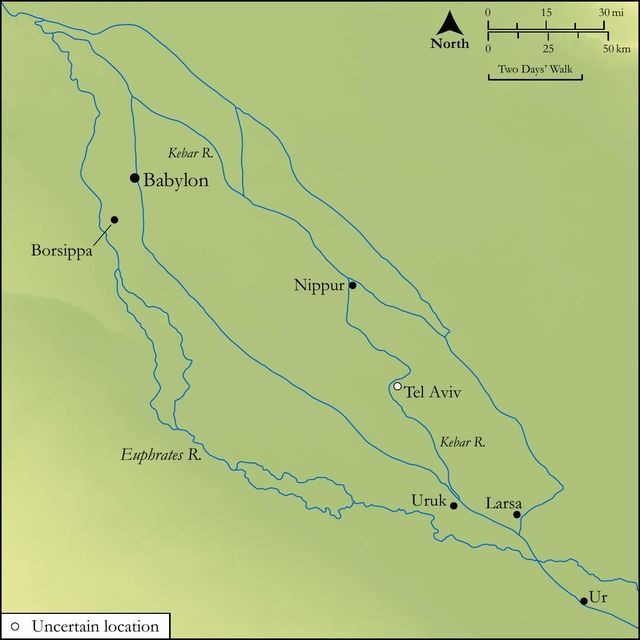
Ezekiel ministered during a period of profound national crisis for Israel. He was among the exiles deported to Babylon in 597 BC, alongside King Jehoiachin, a significant event that marked the second wave of Babylonian deportations. His prophetic ministry took place from Tel-abib, by the Chebar Canal, likely near the city of Nippur in modern-day Iraq, far removed from the sacred precincts of the Jerusalem Temple. The exiles were gripped by despair, often clinging to false hopes of a swift return to Jerusalem, while simultaneously struggling with spiritual apathy and questioning God's justice and presence in their captivity. Against this backdrop of national trauma and spiritual malaise, Ezekiel's vivid encounters with God's glory and his forceful pronouncements served to remind Israel of God's absolute sovereignty, holiness, and unwavering commitment to His covenant, even when administering judgment in a foreign land. The concept of God's "glory" appearing to Ezekiel in exile, especially given its later departure from the Temple (as detailed in Ezekiel 10), was profoundly significant, demonstrating that God was not confined to Jerusalem but was powerfully present with His people, even in their brokenness and captivity.
Key Themes
ShowHideEzekiel 3:12 powerfully contributes to several overarching themes within the book of Ezekiel. Firstly, Divine Empowerment and Sovereignty is paramount; Ezekiel's entire ministry is depicted as God-initiated and Spirit-driven, emphasizing that true prophetic utterance flows solely from divine impulse, not human will or ambition. The Spirit "taking him up" highlights God's absolute control over His chosen instrument and the supernatural nature of the prophetic office. Secondly, the Glory of the LORD (כָּבֹוד YHWH) is a central and recurring motif throughout Ezekiel. This manifest presence of God, first encountered in Ezekiel 1, is here reaffirmed as the object of blessing, underscoring God's inherent majesty, holiness, and transcendent power, which is not bound by geographical location or human circumstances. The "great rushing" and the accompanying voice signify the Overwhelming Nature of Divine Presence, a common biblical theme where encounters with the Almighty are accompanied by awe-inspiring sensory phenomena, much like the divine manifestations at Mount Sinai in Exodus 19. Finally, this event serves as a powerful Prophetic Confirmation and Validation, indelibly imprinting upon Ezekiel the gravity and divine authority of his calling, thereby preparing him for the weighty and often unpopular task of confronting a stubborn and rebellious people.
Exposition and Analysis
ShowHideKey Word Analysis
ShowHideThis term, frequently appearing in Ezekiel, refers to the active, animating Spirit of God. In this context, it signifies the divine power and agency that initiates and sustains Ezekiel's prophetic experience and ministry. It is the very breath and life-force of God, demonstrating His direct involvement in the prophet's life and message, enabling supernatural actions like physical transportation.
This word denotes an act of adoration, praise, and kneeling before God. Here, it is a declaration of God's inherent worthiness and majesty, an acclamation acknowledging the glory of the LORD as something to be honored, exalted, and revered. It is not merely a wish but a profound affirmation of divine truth and splendor.
Derived from a root meaning "weight," this term denotes the manifest presence, splendor, and copiousness of God. In Ezekiel, the kâbôwd YHWH represents the visible, weighty manifestation of God's divine character, power, and holiness, often associated with overwhelming light, fire, and majesty. Its blessing signifies its inherent, eternal worth and the profound reverence it commands.
Verse Breakdown
ShowHide"Then the spirit took me up"
This phrase describes a supernatural, physical transportation or elevation of Ezekiel by the divine Spirit. It highlights the complete divine initiative and control over the prophet, emphasizing that his movements and ministry are not self-willed but entirely directed by God's omnipotent power. This is a common motif in prophetic literature, signifying a direct and undeniable divine intervention in the prophet's life and mission.
"and I heard behind me a voice of a great rushing"
As Ezekiel is lifted, he perceives an overwhelming auditory phenomenon. The "voice" (Hebrew: qôwl) suggests a distinct, articulate sound, while "great rushing" (Hebrew: raʻash) implies a powerful, perhaps even violent, vibration, commotion, or thunderous noise. This sound is reminiscent of the "noise of their wings" and the "sound of the wheels" described in Ezekiel 1:24 and Ezekiel 3:13, indicating the continued presence and dynamic movement of God's glorious chariot-throne. It signifies the immense power, majesty, and awe accompanying the divine presence.
"saying, Blessed be the glory of the LORD from his place."
The "voice of a great rushing" is not merely noise but carries a profound, articulate message of praise. It is an acclamation of adoration for "the glory of the LORD." The phrase "from his place" underscores God's transcendence—His glory originates from His sovereign, unassailable heavenly dwelling or the source of His divine authority—yet it is actively manifested and acknowledged in the earthly realm. This blessing serves as a divine confirmation of the awe-inspiring vision and affirms God's inherent majesty and active presence, even in the midst of exile and impending judgment.
Literary Devices
ShowHideEzekiel 3:12 employs several potent literary devices to convey its profound theological message and sensory impact. Personification is clearly evident in "the spirit took me up," where the abstract concept of the Spirit is endowed with the active capacity to physically transport the prophet, emphasizing direct divine agency and control over Ezekiel's movements. The phrase "voice of a great rushing" utilizes powerful Auditory Imagery, creating a vivid and immersive sensory experience for the reader and reinforcing the overwhelming power and majesty of the divine encounter. This sound itself functions as Symbolism, representing the dynamic, awe-inspiring, and often terrifying nature of God's presence, frequently associated in biblical literature with wind, thunder, or the movement of His celestial chariot. Finally, the declaration "Blessed be the glory of the LORD from his place" serves as a profound Doxology or a declaration of praise, spoken by a celestial or divine entity, which underscores the inherent worthiness, majesty, and eternal splendor of God's manifest presence.
Theological and Thematic Connections
ShowHideEzekiel 3:12 profoundly illustrates the active and sovereign presence of God, even in the midst of His people's exile and spiritual rebellion. The Spirit's physical transportation of Ezekiel demonstrates that prophetic ministry is not a human endeavor but a divinely initiated and empowered work, highlighting God's absolute control over His chosen instruments. The acclamation "Blessed be the glory of the LORD from his place" emphasizes God's transcendence—His glory originates from His unassailable, heavenly abode—yet it is simultaneously immanent, actively manifesting and interacting with His creation. This passage affirms God's unwavering majesty and His commitment to His covenant people, even when they are disciplined, ensuring that His glory is acknowledged and His word is delivered through His chosen instruments, regardless of the circumstances.
Reflection and Application
ShowHideEzekiel 3:12 offers profound lessons for contemporary believers, reminding us that true spiritual service and effective ministry are always initiated and empowered by the Holy Spirit. Just as the Spirit "took up" Ezekiel, God continues to call and equip individuals for His purposes, often in ways that transcend human understanding or ability. This calls us to a posture of radical dependence on the Holy Spirit, recognizing that our strength, wisdom, and direction must flow from Him, not from our own efforts or intellect. The overwhelming "voice of a great rushing" and the blessing of God's glory should cultivate within us a deep sense of awe and reverence for God's majestic presence. In a world that often seeks to diminish God or confine Him to human categories, this verse reasserts His transcendent power and inherent worthiness of all praise. It encourages us to seek His manifest presence, to bless His glory in all circumstances, and to allow His Spirit to direct our lives, just as He directed His prophet. Our lives, like Ezekiel's, are meant to be instruments through which God's glory is revealed and His truth proclaimed, serving as living testimonies to His sovereign power and abiding presence.
Questions for Reflection
ShowHideFAQ
ShowHideWhat does "the spirit took me up" mean in this context?
ShowHideIn Ezekiel 3:12, "the spirit took me up" signifies a supernatural, physical transportation or elevation of the prophet by the divine Spirit. This is a common motif in prophetic literature, indicating that the prophet's movements and experiences are not self-initiated but are entirely under God's direct control and empowerment. It emphasizes the divine origin and authority of Ezekiel's prophetic ministry, demonstrating that he is an instrument moved by God's own power, rather than acting on his own accord. This echoes similar experiences of divine transportation seen in other biblical figures, such as Philip being carried away by the Spirit in Acts 8:39, highlighting God's ability to supernaturally direct His servants for His purposes.
What is the significance of the "voice of a great rushing"?
ShowHideThe "voice of a great rushing" describes an overwhelming and awe-inspiring auditory phenomenon accompanying the Spirit's movement and the manifestation of God's glory. This sound is not merely noise but is intrinsically linked to the powerful, dynamic presence of God, reminiscent of the sounds associated with the divine chariot-throne in Ezekiel 1:24 and Ezekiel 3:13. It serves to reinforce the immense power, majesty, and holiness of the divine encounter, often signaling a profound divine revelation or action, much like the "sound like a violent rushing wind" that accompanied the outpouring of the Holy Spirit at Pentecost in Acts 2:2, signifying the powerful, active presence of God.
Why is the "glory of the LORD" blessed "from his place"?
ShowHideThe blessing of "the glory of the LORD from his place" is a profound declaration of praise and adoration. "The glory of the LORD" (Hebrew: kâbôwd YHWH) represents God's manifest presence, splendor, and inherent majesty. The phrase "from his place" underscores God's transcendence; His glory originates from His sovereign, heavenly dwelling, His unassailable abode. Yet, it is actively manifested and acknowledged in the earthly realm. This blessing affirms God's inherent worthiness and active presence, even in the midst of the exile, signifying that His glory is not confined to the Jerusalem Temple but emanates from His eternal, sovereign position, deserving of all praise wherever it is revealed. It is a divine acclamation of God's unchangeable nature and supreme authority.
Christ-Centered Fulfillment
ShowHideEzekiel 3:12, with its emphasis on the Spirit's empowerment, the overwhelming presence of God's glory, and the divine utterance of blessing, finds profound Christ-centered fulfillment in the New Testament. The Spirit who "took up" Ezekiel foreshadows the Spirit's anointing and empowerment of Jesus, who was "full of the Holy Spirit" (Luke 4:1) and whose entire ministry, from His baptism to His resurrection, was entirely Spirit-driven. The "glory of the LORD" that is blessed from His place is ultimately revealed and embodied in Jesus Christ, for He is "the radiance of God's glory and the exact representation of his being" (Hebrews 1:3). John testifies that "we have seen his glory, the glory as of the only Son from the Father, full of grace and truth" (John 1:14). The "great rushing" that accompanies the divine presence in Ezekiel anticipates the powerful, awe-inspiring manifestation of God's Spirit at Pentecost (Acts 2:2), empowering the Church to continue Christ's mission and proclaim His glory to the ends of the earth. Ultimately, the blessing of God's glory from His place points to Christ as the one through whom God's glory is fully revealed and eternally praised, for it is through Him that we, too, can approach the Father and join the heavenly chorus in declaring, "Blessed be the glory of the LORD!" (Revelation 5:13).