


Exodus 4:17
- וְאֶתve·'Etand <obj.>H853Conj-w ¦ DirObjMParticle Object Indicatorוְandאֶת<obj.>
- הַמַּטֶּהha·ma·Tehthe staffH4294Art ¦ N-msNoun Singular Masculine Absoluteהַtheמַּטֶּהstaff
- הַזֶּהha·Zeh<the> thisH2088Art ¦ PrtParticle Demonstrativeהַ<the>זֶּהthis
- תִּקַּחti·Kachyou will takeH3947V-Qal-Imperf-2msVerb Qal Imperfect 2nd Singular Masculine
- בְּיָדֶךָbe·ya·De·khain your handH3027Prep-b ¦ N-csc ¦ 2msNoun Singular common gender Constructבְּinיָדֶhandךָyour
- אֲשֶׁר'a·SherwhichH834RelParticle Relative
- תַּעֲשֶׂהta·'a·sehyou will doH6213V-Qal-Imperf-2msVerb Qal Imperfect 2nd Singular Masculine
- בּוֹbowith <the> itPrep-b ¦ 3msSuffix Personal 3rd Singular Masculineבּwith <the>וֹit
- אֶת'et<obj.>H853DirObjMParticle Object Indicator
- הָאֹתֹתha·'o·Totthe signsH226Art ¦ N-fpNoun Plural Feminine Absoluteהָtheאֹתֹתsigns
English is a literal word-by-word gloss of the Hebrew, not the KJV's wording. Why?
This is the original text the KJV's translators worked from — each Hebrew word with its own literal English meaning in this verse, prepared by scholars at Tyndale House, Cambridge. The KJV translates whole sentences, not word by word, so its wording differs: one Hebrew word can become several English words, and the KJV may choose “the LORD” where the gloss reads “Yahweh”. Both are faithful — they answer different questions. For the KJV's own rendering, switch to the KJV text.
Details
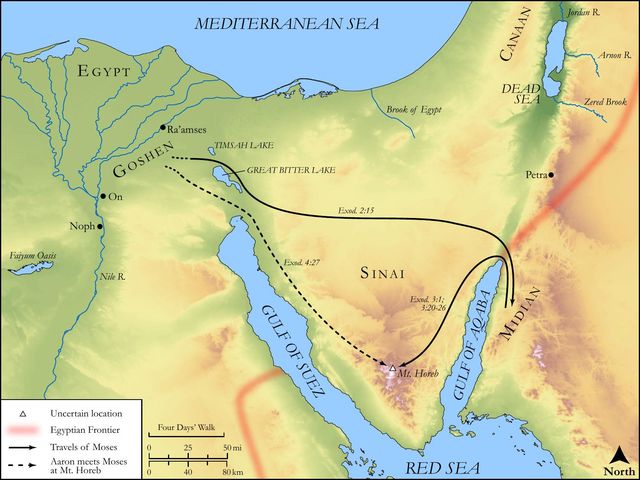
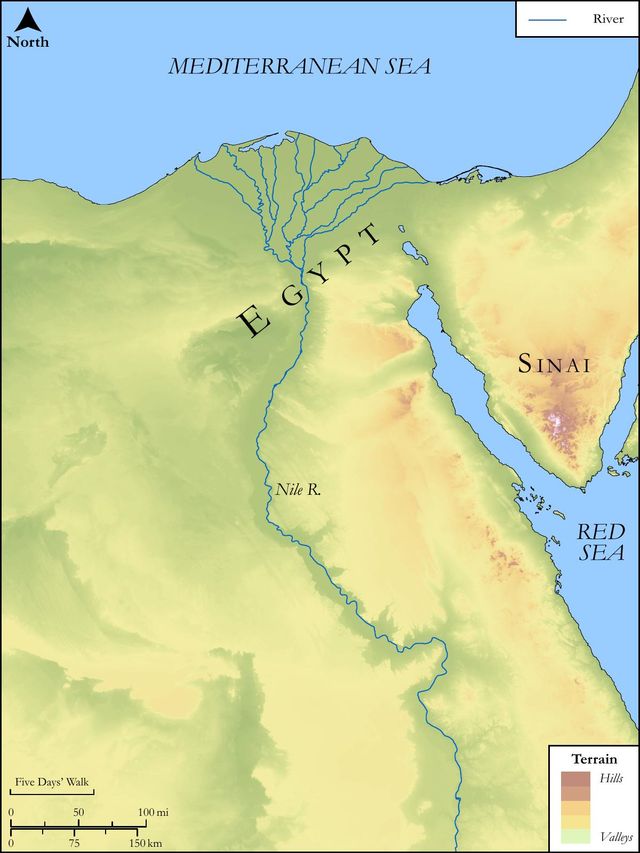
See on the biblical-era maps

Study this verse
Public-domain commentary
Matthew Henry
From his Commentary on the Whole Bible. Henry comments on passages, not single verses — this entry covers Exodus 4:10–17. His four-level outline is real structure in the source text, so it is rendered as structure.
Moses still continues backward to the service for which God had designed him, even to a fault; for now we can no longer impute it to his humility and modesty, but must own that here was too much of cowardice, slothfulness, and unbelief in it. Observe here,
I.How Moses endeavours to excuse himself from the work.
1.He pleads that he was no good spokesman: O my Lord! I am not eloquent, Exo 4:10. He was a great philosopher, statesman, and divine, and yet no orator; a man of a clear head, great thought, and solid judgment, but had not a voluble tongue, or ready utterance, and therefore he thought himself unfit to speak before great men about great affairs, and in danger of being run down by the Egyptians. Observe,
(1.)We must not judge of men by the readiness and fluency of their discourse. Moses was mighty in word (Act 7:22), and yet not eloquent: what he said was strong and nervous, and to the purpose, and distilled as the dew (Deu 32:2), though he did not deliver himself with that readiness, ease, and elegance, that some do, who have not the tenth part of his sense. St. Paul's speech was contemptible, Co2 10:10. A great deal of wisdom and true worth is concealed by a slow tongue.
(2.)God is pleased sometimes to make choice of those as his messengers who have fewest of the advantages of art or nature, that his grace in them may appear the more glorious. Christ's disciples were no orators, till the Spirit made them such.
2.When this plea was overruled, and all his excuses were answered, he begged that God would send somebody else on this errand and leave him to keep sheep in Midian (Exo 4:13): "Send by any hand but mine; thou canst certainly find one much more fit." Note, An unwilling mind will take up with a sorry excuse rather than none, and is willing to devolve those services upon others that have any thing of difficulty or danger in them.
II.How God condescends to answer all his excuses.
Though the anger of the Lord was kindled against him (Exo 4:14), yet he continued to reason with him, till he had overcome him. Note, Even self-diffidence, when it grows into an extreme - when it either hinders us from duty or clogs us in duty, or when it discourages our dependence upon the grace of God - is very displeasing to him. God justly resents our backwardness to serve him, and has reason to take it ill; for he is such a benefactor as is before-hand with us, and such a rewarder as will not be behind-hand with us. Note further, God is justly displeased with those whom yet he does not reject: he vouchsafes to reason the case even with his froward children, and overcomes them, as he did Moses here, with grace and kindness.
1.To balance the weakness of Moses, he here reminds him of his own power, Exo 4:11.
(1.)His power in that concerning which Moses made the objection: Who has made man's mouth? Have not I the Lord? Moses knew that God made man, but he must be reminded now that God made man's mouth. An eye to God as Creator would help us over a great many of the difficulties which lie in the way of our duty, Psa 124:8. God, as the author of nature, has given us the power and faculty of speaking; and from him, as the fountain of gifts and graces, comes the faculty of speaking well, the mouth and wisdom (Luk 21:15), the tongue of the learned (Isa 50:4); he pours grace into the lips, Psa 45:2.
(2.)His power in general over the other faculties. Who but God makes the dumb and the deaf, the seeing and the blind?
[1.]The perfections of our faculties are his work, he makes the seeing; he formed the eye (Psa 94:9); he opens the understanding, the eye of the mind, Luk 24:45.
[2.]Their imperfections are from him too; he make the dumb, and deaf, and blind. Is there any evil of this kind, and the Lord has not done it? No doubt he has, and always in wisdom and righteousness, and for his own glory, Joh 9:3. Pharaoh and the Egyptians were made deaf and blind spiritually, as Isa 6:9, Isa 6:10. But God knew how to manage them, and get himself honour upon them.
2.To encourage him in this great undertaking, he repeats the promise of his presence, not only in general, I will be with thee (Isa 3:12), but in particular, "I will be with thy mouth, so that the imperfection in thy speech shall be no prejudice to thy message." It does not appear that God did immediately remove the infirmity, whatever it was; but he did that which was equivalent, he taught him what to say, and then let the matter recommend itself: if others spoke more gracefully, none spoke more powerfully. Note, Those whom God employs to speak for him ought to depend upon him for instructions, and it shall be given them what they shall speak, Mat 10:19.
3.He joins Aaron in commission with him. He promises that Aaron shall meet him opportunely, and that he will be glad to see him, they having not seen one another (it is likely) for many years, Exo 4:14. He directs him to make use of Aaron as his spokesman, Exo 4:16. God might have laid Moses wholly aside, for his backwardness to be employed; but he considered his frame, and ordered him an assistant. Observe,
(1.)Two are better than one, Ecc 4:9. God will have his two witnesses (Rev 11:3), that out of their mouths every word may be established.
(2.)Aaron was the brother of Moses, divine wisdom so ordering it, that their natural affection one to another might strengthen their union in the joint execution of their commission. Christ sent his disciples two and two, and some of the couples were brothers.
(3.)Aaron was the elder brother, and yet he was willing to be employed under Moses in this affair, because God would have it so.
(4.)Aaron could speak well, and yet was far inferior to Moses in wisdom. God dispenses his gifts variously to the children of men, that we may see our need one of another, and each may contribute something to the good of the body, Co1 12:21. The tongue of Aaron, with the head and heart of Moses, would make one completely fit for this embassy.
(5.)God promises, I will be with thy mouth, and with his mouth. Even Aaron, that could speak well, yet could not speak to purpose unless God was with his mouth; without the constant aids of divine grace the best gifts will fail.
4.He bids him take the rod with him in his hand (Exo 4:17), to intimate that he must bring about his undertaking rather by acting than by speaking; the signs he should work with this rod might abundantly supply the want of eloquence; one miracle would do him better service than all the rhetoric in the world. Take this rod, the rod he carried as a shepherd, that he might not be ashamed of that mean condition out of which God called him. This rod must be his staff of authority, and must be to him instead both of sword and sceptre.
Continue studying Exodus 4:17 across the web’s major study libraries — every link below opens this exact verse, chapter, or book on the destination site.
Read & Compare
 BibleGatewayThis verse in more than 200 translations and 70 languages.
 Bible.comThe YouVersion reader — hundreds of translations, reading plans, and highlights.
 ESV.orgCrossway's official English Standard Version reader.
 NET BibleThe NET translation with 60,000+ translators' notes on every rendering decision.
 STEP BibleTyndale House's free study tool — original text, vocabulary, and scholarly resources.
 BibliaLogos Bible Software's free web reader.
 USCCBThe New American Bible (Revised Edition) with the U.S. bishops' study notes.
Commentaries
 BibleHub CommentariesDozens of classic commentaries on this verse, gathered on one page.
 StudyLightMore than 100 commentary sets — the largest collection on the web.
 BibleRefPlain-English commentary on what this verse means, verse by verse.
 Enduring WordDavid Guzik's free commentary on this chapter, widely used by Bible teachers.
 Bible Study ToolsVerse commentary alongside Greek and Hebrew study aids.
Original Language & Research
- BibleHub InterlinearThe verse word by word — original language, transliteration, and English.
- BibleHub LexiconEvery word's original-language definition and Strong's entry.
 Blue Letter BibleDeep-study tools — Strong's numbers, concordance, and word studies.
 SefariaThe Hebrew text with Rashi and centuries of Jewish commentary.
Sermons, Hymns & Audio


TrulyRandomVerse is not affiliated with these sites and doesn’t control their content. They’re linked because they’re genuinely useful.
Summary
Exodus 4:17 delivers a crucial divine instruction to Moses, commissioning him to wield his ordinary shepherd's rod as the conduit for performing miraculous "signs." This verse marks a profound transformation of a mundane object into a sacred instrument, destined to authenticate Moses' divine mandate before the Israelites and Pharaoh, thereby demonstrating God's sovereign power and His active intervention in human history to deliver His people.
Context
ShowHideLiterary Context
This verse is situated within the pivotal burning bush narrative, following God's initial call to Moses to lead Israel out of Egyptian bondage. Moses, overwhelmed by the daunting task and his own perceived inadequacies, expresses profound doubt regarding his credibility with the Israelites and Pharaoh, as seen in his question, "But, behold, they will not believe me, nor hearken unto my voice" Exodus 4:1. In response to Moses' skepticism, God graciously provides a series of three miraculous signs: the rod turning into a serpent and back Exodus 4:2-5, Moses' hand becoming leprous and then healed Exodus 4:6-7, and water from the Nile turning to blood Exodus 4:9. Exodus 4:17 serves as the culminating directive regarding the rod, designating it as the primary instrument through which Moses will perform all subsequent, larger-scale "signs" that will validate his mission and God's power.
Historical & Cultural Context
In ancient Near Eastern cultures, a shepherd's staff was an indispensable tool, used for guiding, protecting, and counting sheep. It was a symbol of the shepherd's authority and care over his flock. By choosing Moses' personal staff, God elevates an everyday object, demonstrating that His power is not limited to grand, pre-made instruments but can imbue the ordinary with divine significance. Furthermore, the Egyptian context was rife with magic and sorcery, often employed by pharaohs and their magicians to assert power. God's use of the rod to perform genuine "signs" (miracles) would directly challenge and ultimately overcome the deceptive acts of Egyptian magic, proving the supremacy of Yahweh over all false gods and human power, as vividly depicted in the later plague narratives.
Key Themes
ShowHideExodus 4:17 contributes significantly to several overarching themes within the book of Exodus and broader biblical theology. Firstly, it underscores the theme of Divine Commission and Authentication, as God provides irrefutable proof of Moses' calling to both the Israelites and Pharaoh. Secondly, it highlights God's Sovereignty and Omnipotence, demonstrating His absolute control over creation and His ability to intervene directly in human affairs through seemingly simple means. The rod becomes a tangible representation of God's active presence and power. Thirdly, it reinforces the theme of God's Empowerment of the Ordinary, showing that God often chooses to work through common individuals and objects to accomplish His extraordinary purposes, ensuring that all glory redounds to Him, not to the instrument or the person. This prepares the reader for the subsequent mighty acts of deliverance and judgment that will unfold throughout Exodus 1:1-40:38.
Exposition and Analysis
ShowHideKey Word Analysis
ShowHideThis verb signifies "to take (in the widest variety of applications); accept, bring, buy, carry away, receive." In this context, it implies an active appropriation and acceptance by Moses. It's not merely a passive possession of the rod, but an intentional act of receiving it as an instrument for divine purpose, indicating Moses' compliance and readiness to wield it under God's command.
This word refers to "a branch (as extending); figuratively, a tribe; also a rod, whether for chastising, ruling, throwing, or walking (a staff; figuratively, a support of life)." The term highlights the rod's ordinary function as a shepherd's staff, a common tool for guidance and support. However, its designation here transforms it from a mundane object into an extension of divine authority, capable of both judgment and provision, embodying the power of the One who commands its use.
Derived from a root suggesting "appearing," this noun denotes "a signal (literally or figuratively), as a flag, beacon, monument, omen, prodigy, evidence, etc.; mark, miracle, (en-) sign, token." These "signs" are not mere magic tricks but divinely ordained demonstrations of power that serve as undeniable evidence. They are intended to convey a specific message, authenticate a divine messenger, or confirm a divine act, proving God's presence, power, and the truth of His word.
Verse Breakdown
ShowHide"And thou shalt take this rod in thine hand"
This clause emphasizes Moses' direct and personal involvement in the divine commission. The rod is not merely given to him, but he is commanded to "take" it—an active verb signifying ownership, responsibility, and the intention to use it. The phrase "in thine hand" highlights the intimate connection between Moses, the instrument, and the power that will flow through it. It signifies that while the power is God's, the physical action and representation will be through Moses' agency, making him the visible conduit of God's miraculous intervention. This ordinary shepherd's staff, now in the hand of God's chosen servant, is consecrated for extraordinary purposes.
"wherewith thou shalt do signs"
This second clause reveals the purpose and function of the rod. The word "wherewith" explicitly links the rod to the performance of "signs," indicating it is the designated instrument for God's miraculous works. These "signs" are not random displays of power but purposeful acts intended to authenticate Moses' message and God's presence. They serve to convince both the skeptical Israelites of God's faithfulness and the stubborn Pharaoh of God's supremacy, ultimately paving the way for Israel's liberation. The rod, therefore, becomes a tangible symbol of God's active, intervening power in the world.
Literary Devices
ShowHideThe verse employs several significant literary devices. Symbolism is prominent, as Moses' ordinary shepherd's rod transforms into a potent symbol of divine power and authority. It represents God's ability to imbue the mundane with sacred purpose and to work through seemingly insignificant means. Foreshadowing is also powerfully present; this initial designation of the rod hints at its crucial role in the mighty acts to come, including the plagues upon Egypt and the parting of the Red Sea, where it will be the instrument of both judgment and deliverance. Furthermore, the passage demonstrates Divine Mandate, as the direct command from God to Moses establishes his authority and confirms his divine commission. The rod, therefore, becomes a tangible extension of God's own will and power, making the invisible God's presence visible through its actions.
Theological and Thematic Connections
ShowHideExodus 4:17 establishes a foundational principle of divine operation: God often chooses to empower ordinary individuals and objects to accomplish His extraordinary will, demonstrating that true power resides solely in Him. This verse sets the stage for a series of miraculous interventions that will underscore God's sovereignty over creation and His unwavering commitment to His covenant people. The rod, initially a tool of a shepherd, becomes "the rod of God" Exodus 4:20, signifying its sacred status and its role as an extension of divine authority.
Reflection and Application
ShowHideExodus 4:17 offers profound lessons for contemporary believers. Just as God chose Moses' ordinary shepherd's rod, He often chooses to work through our seemingly ordinary lives, talents, resources, and positions. This verse challenges us to consider what "rod" God has placed in our hands—be it our profession, our relationships, our spiritual gifts, or our material possessions—and how we might yield it to His service. Our effectiveness in God's kingdom is not dependent on our inherent greatness or extraordinary abilities, but on our willingness to be available and on God's power working through us. This passage encourages us to trust in God's empowerment, recognizing that He can transform the mundane into the miraculous when consecrated to His purposes. It invites us to surrender our "rods" to the Divine Hand, allowing Him to use them for His glory, to perform "signs" of His presence and power in a world that desperately needs to see them.
Questions for Reflection
ShowHideFAQ
ShowHideWhat is the significance of the rod being an "ordinary" object?
ShowHideThe rod's ordinary nature is profoundly significant because it highlights God's ability to use any instrument, no matter how humble or common, to display His extraordinary power. It ensures that the focus remains entirely on God as the source of the miraculous, rather than on any inherent magical properties of the object itself. This principle serves as a powerful encouragement to believers, demonstrating that God can use anyone, regardless of their perceived limitations or lack of special qualifications, to accomplish His divine will. It underscores that God's power is perfected in weakness, and His glory is magnified through the unexpected.
What does the Hebrew word for "signs" (אֹתוֹת, 'otot') imply?
ShowHideThe Hebrew term 'otot (H226) implies much more than a mere magical trick or wonder. It refers to a divinely ordained token, wonder, or miracle that serves as undeniable evidence or a signal. These "signs" were meant to convey a specific message, confirm a divine truth, or authenticate a divine messenger. In the context of Exodus, they proved God's active presence, His supreme power over all creation and false gods, and the authenticity of His messenger, Moses, to both the skeptical Israelites and the resistant Egyptians. They were purposeful demonstrations of God's will and power in history.
Why did God need to provide Moses with signs?
ShowHideGod provided Moses with signs for several crucial reasons. Primarily, it was to overcome Moses' own deep-seated doubts and insecurities about his calling and his ability to convince the Israelites and Pharaoh. The signs served as concrete, irrefutable evidence that Moses was indeed sent by the Almighty God, not acting on his own accord. For the Israelites, these signs were meant to build their faith and assure them that God was truly intervening for their deliverance. For Pharaoh, the signs were a demonstration of Yahweh's unparalleled power, intended to compel him to release God's people and to reveal God's glory to all of Egypt.
Christ-Centered Fulfillment
ShowHideExodus 4:17, with its emphasis on a divinely empowered instrument performing "signs," finds its ultimate and perfect fulfillment in the person of Jesus Christ. While Moses' rod was an external tool through which God's power flowed, Christ Himself is the very embodiment of God's power, authority, and presence among humanity. He is the ultimate "sign" of God's kingdom, as prophesied in Isaiah 7:14. His miracles—healing the sick, casting out demons, calming storms, and raising the dead—were not performed through an external object but flowed directly from His inherent divine nature and authority as the Son of God John 2:11. Just as the rod authenticated Moses' mission, Christ's works authenticated His identity as the promised Messiah and the revelation of God's will John 10:38. The rod pointed to God's power to deliver Israel from physical bondage; Christ's life, death, and resurrection demonstrated His ultimate power to deliver humanity from the bondage of sin and death, establishing His eternal kingdom and fulfilling all the promises of God's covenant Hebrews 9:11-14. He is the true "Rod of God," through whom all divine power, redemption, and revelation are perfectly manifested Revelation 19:15.