


Exodus 40:2
- בְּיוֹםbe·yomon [the] day ofH3117Prep-b ¦ N-mscNoun Singular Masculine Constructבְּonיוֹם[the] day of
- הַחֹדֶשׁha·Cho·deshthe monthH2320Art ¦ N-msNoun Singular Masculine Absoluteהַtheחֹדֶשׁmonth
- הָרִאשׁוֹןha·ri·Shon<the> firstH7223Art ¦ Adj-msAdjective Numerical Position Singular Masculine Absoluteהָ<the>רִאשׁוֹןfirst
- בְּאֶחָדbe·'e·Chadon [day] oneH259Prep-b ¦ Adj-fsAdjective Numerical Singular Feminine Absoluteבְּonאֶחָד[day] one
- לַחֹדֶשׁla·Cho·deshof the monthH2320Prep-l ¦ N-msNoun Singular Masculine Absoluteלַof theחֹדֶשׁmonth
- תָּקִיםta·Kimyou will set upH6965V-Hiphil-Imperf-2msVerb Hiphil Imperfect 2nd Singular Masculine
- אֶת'et<obj.>H853DirObjMParticle Object Indicator
- מִשְׁכַּןmish·Kan[the] tabernacle ofH4908N-mscNoun Singular Masculine Construct
- אֹהֶל'O·hel[the] tent ofH168N-mscNoun Singular Masculine Construct
- מוֹעֵדmo·'EdmeetingH4150N-msNoun Singular Masculine Absolute
English is a literal word-by-word gloss of the Hebrew, not the KJV's wording. Why?
This is the original text the KJV's translators worked from — each Hebrew word with its own literal English meaning in this verse, prepared by scholars at Tyndale House, Cambridge. The KJV translates whole sentences, not word by word, so its wording differs: one Hebrew word can become several English words, and the KJV may choose “the LORD” where the gloss reads “Yahweh”. Both are faithful — they answer different questions. For the KJV's own rendering, switch to the KJV text.
Details
See on the biblical-era map

Study this verse
Public-domain commentary
Matthew Henry
From his Commentary on the Whole Bible. Henry comments on passages, not single verses — this entry covers Exodus 40:1–15.
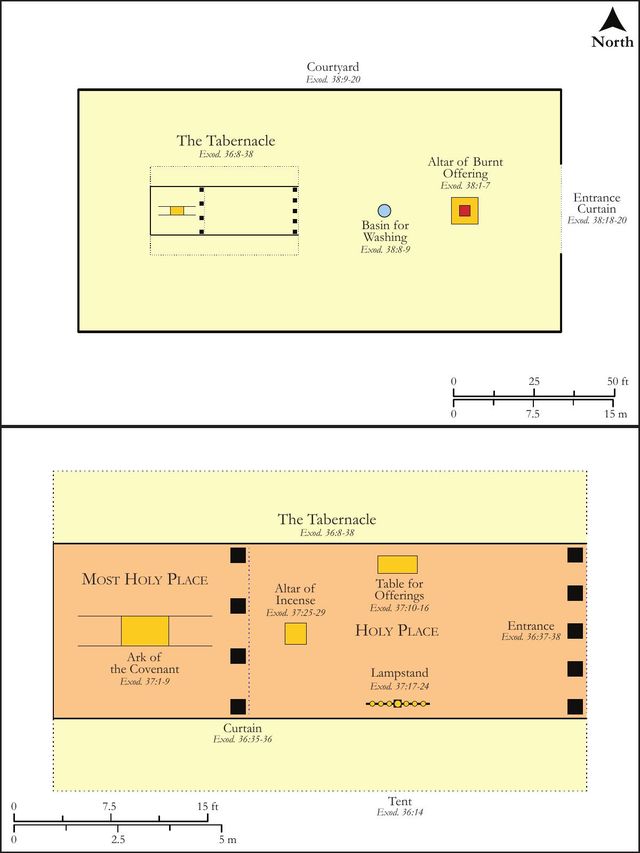
The materials and furniture of the tabernacle had been viewed severally and approved, and now they must be put together. 1. God here directs Moses to set up the tabernacle and the utensils of it in their places. Though the work of the tabernacle was finished, and every thing ready for rearing, and the people, no doubt, were very desirous to see it up, yet Moses will not erect it till he has express orders for doing so. It is good to see God going before us in every step, Psa 37:23. The time for doing this is fixed to the first day of the first month (Exo 40:2), which wanted but fourteen days of a year since they came out of Egypt; and a good year's work there was done in it. Probably the work was made ready but just at the end of the year, so that the appointing of this day gave no delay, or next to none, to this good work. We must not put off any necessary duty under pretence of waiting for some remarkable day; the present season is the most convenient. But the tabernacle happening to be set up on the first day of the first month intimates that it is good to begin the year with some good work. Let him that is the first have the first; and let the things of his kingdom be first sought. In Hezekiah's time we find they began to sanctify the temple on the first day of the first month, Ch2 29:17. The new moon (which by their computation was the first day of every month) was observed by them with some solemnity; and therefore this first new moon of the year was thus made remarkable. Note, When a new year begins, we should think of serving God more and better than we did the year before. Moses is particularly ordered to set up the tabernacle itself first, in which God would dwell and would be served (Exo 40:2), then to put the ark in its place, and draw the veil before it (Exo 40:3), then to fix the table, and the candlestick, and the altar of incense, without the veil (Exo 40:4, Exo 40:5), and to fix the hanging of the door before the door. Then in the court he must place the altar of burnt offering, and the laver (Exo 40:6, Exo 40:7); and, lastly, he must set up the curtains of the court, and a hanging for a court-gate. And all this would be easily done in one day, many hands no doubt being employed in it under the direction of Moses. 2. He directs Moses, when he had set up the tabernacle and all the furniture of it, to consecrate it and them, by anointing them with the oil which was prepared for the purpose, Exo 30:25, etc. It was there ordered that this should be done; here it was ordered that it should be done now, Exo 40:9-11. Observe, Every thing was sanctified when it was put in its proper place, and not till then, for till then it was not fit for the use to which it was to be sanctified. As every thing is beautiful in its season, so is every thing in its place. 3. He directs him to consecrate Aaron and his sons. When the goods were brought into God's house, they were marked first, and then servants were hired to bear the vessels of the Lord; and those must be clean who were put into that office, Exo 40:12-15. The law which was now ordered to be put in execution we had before, ch. 29. Thus in the visible church, which is God's tabernacle among men, it is requisite that there be ministers to keep the charge of the sanctuary, and that they receive the anointing.
Historical interpretation
Historical reception
1 surviving comment on this verse from the historical church.
Why did God command Moses to erect the tabernacle on the first day of the first month? Because at that time he created the world. The sprouting of the trees attests to this fact. For Scripture says, “Let the earth sprout forth grass for fodder, and sow seed according to its kind and its likeness, and fruit-bearing trees that produce fruit, with its seed within it in its likeness, according to its kind upon the earth.” When spring begins, the meadows bloom, the fields grow like waves, and the trees germinate their fruit. So too in this very season God set Israel free from slavery under the Egyptians and the archangel Gabriel brought the holy virgin the good news of her mysterious childbearing. In this same season the Lord Christ underwent his saving passion. Most fittingly, the Lord God of all ordered the tabernacle to be erected on the first day of the first month because it was the image of the entire world, and also so that the people would prepare for the feast of Passover, which the law commanded the Jews to celebrate as the first feast. At that time, they were going to celebrate this feast for the first time in the desert, for this was the second year after their deliverance from slavery.
Continue studying Exodus 40:2 across the web’s major study libraries — every link below opens this exact verse, chapter, or book on the destination site.
Read & Compare
 BibleGatewayThis verse in more than 200 translations and 70 languages.
 Bible.comThe YouVersion reader — hundreds of translations, reading plans, and highlights.
 ESV.orgCrossway's official English Standard Version reader.
 NET BibleThe NET translation with 60,000+ translators' notes on every rendering decision.
 STEP BibleTyndale House's free study tool — original text, vocabulary, and scholarly resources.
 BibliaLogos Bible Software's free web reader.
 USCCBThe New American Bible (Revised Edition) with the U.S. bishops' study notes.
Commentaries
 BibleHub CommentariesDozens of classic commentaries on this verse, gathered on one page.
 StudyLightMore than 100 commentary sets — the largest collection on the web.
 BibleRefPlain-English commentary on what this verse means, verse by verse.
 Enduring WordDavid Guzik's free commentary on this chapter, widely used by Bible teachers.
 Bible Study ToolsVerse commentary alongside Greek and Hebrew study aids.
Original Language & Research
- BibleHub InterlinearThe verse word by word — original language, transliteration, and English.
- BibleHub LexiconEvery word's original-language definition and Strong's entry.
 Blue Letter BibleDeep-study tools — Strong's numbers, concordance, and word studies.
 SefariaThe Hebrew text with Rashi and centuries of Jewish commentary.
Sermons, Hymns & Audio


TrulyRandomVerse is not affiliated with these sites and doesn’t control their content. They’re linked because they’re genuinely useful.
Summary
Exodus 40:2 delivers the culminating divine directive for the erection of the Tabernacle, Israel's portable sanctuary, on a profoundly significant date. This command marks the triumphant conclusion of God's intricate architectural blueprints and the dedicated labor of the Israelites, signifying the imminent establishment of God's tangible, dwelling presence at the very heart of His covenant people. This pivotal moment inaugurates a new era in Israel's journey, where the divine presence would visibly guide, sanctify, and define their communal life.
Context
ShowHideLiterary Context
Exodus 40:2 functions as the climactic instruction at the very end of the Book of Exodus, bringing to fruition the extensive divine directives given since Exodus 25. The preceding chapters meticulously detail the intricate blueprints for the Tabernacle and its furnishings, as outlined in Exodus 25-31, followed by a thorough account of the skilled artisans, led by Bezalel and Oholiab, faithfully executing every aspect of God's divine design in Exodus 35-39. This verse, therefore, is not merely a final command but the ultimate step in a prolonged process of divine revelation and human obedience, setting the stage for the visible and tangible dwelling of God among His chosen people.
Historical & Cultural Context
The specified date, "the first day of the first month," carries profound historical and symbolic weight. This timing places the Tabernacle's erection approximately one year after the momentous Passover and the subsequent exodus from Egyptian bondage. In the ancient Near East, the new year often symbolized new beginnings, divine favor, and the re-establishment of cosmic order. For Israel, this date marked a spiritual new year, signifying a fresh phase in their covenant relationship with Yahweh. It was a visible declaration that, despite their recent failures (e.g., the golden calf incident in Exodus 32), God remained committed to dwelling in their midst as they prepared to embark on their journey through the wilderness, with His tangible presence as their guide and protector.
Key Themes
ShowHideThis verse contributes significantly to several overarching themes within Exodus and the Pentateuch. Foremost is the theme of Divine Presence and Immanence, as God fulfills His promise to dwell among His people, making Himself accessible. It underscores the theme of Obedience and Faithfulness, highlighting Moses' and Israel's meticulous adherence to God's detailed instructions, a stark contrast to their earlier rebellion. The timing also emphasizes New Beginnings and Covenant Renewal, as the Tabernacle's inauguration marks a fresh start for the nation after the golden calf idolatry, reaffirming God's commitment to His covenant with Israel. Finally, it reinforces the theme of Holiness and Separation, as the Tabernacle served as a sacred space where the holy God could dwell amidst an unholy people, requiring specific protocols for approach and interaction, foreshadowing the need for perfect atonement.
Exposition and Analysis
ShowHideKey Word Analysis
ShowHideDerived from a root meaning "head" or "beginning," this term signifies not only chronological precedence ("first") but also preeminence and importance. In the context of "the first day of the first month," it emphasizes the inaugural and foundational nature of this event, marking a new, divinely ordained beginning for Israel's calendar and their relationship with God.
This primitive root verb carries a rich array of meanings, including "to rise," "to establish," "to confirm," and "to make firm." Beyond merely assembling the structure, the command to "set up" the Tabernacle implies its permanent establishment as the central and enduring locus of God's presence among His people, signifying stability, divine authority, and the fulfillment of God's purpose.
From the root shakan, meaning "to dwell" or "to settle," mishkân literally translates to "dwelling place" or "residence." This term profoundly emphasizes the Tabernacle's primary function: to be the tangible, earthly abode where God Himself would take up residence among His people. It signifies the divine condescension and intimate presence of Yahweh in the midst of Israel, a visible sign of His covenant faithfulness.
Literally "tent of meeting" or "tent of appointment." This phrase highlights the Tabernacle's dual role as both a portable dwelling (ʼôhel, "tent") and the designated place where God would "meet" (môwʻêd, "appointment," "fixed time," "assembly") with His people. It was the appointed location for divine revelation, communication of God's will, and the reception of Israel's worship, sacrifices, and petitions, underscoring the relational aspect of God's presence where He would interact directly with His covenant community.
Verse Breakdown
ShowHide"On the first day of the first month"
This precise temporal marker is highly significant. It refers to the month of Abib (later Nisan), which was established as the beginning of the religious year for Israel at the time of the Passover (Exodus 12:2). The choice of this specific date, approximately one year after the Exodus, symbolizes a new beginning for the nation, a spiritual reset, and the inauguration of a new phase in their relationship with God, marked by His central, tangible presence.
"shalt thou set up"
This is a direct, imperative command from God to Moses, indicating divine authority and the necessity of precise obedience. The verb "set up" (Hebrew: qûwm) implies not just assembly but also establishing, erecting, and making firm. It underscores the divine authority behind the instruction and Moses' role as the faithful executor of God's will, emphasizing the importance of meticulous adherence in matters of divine worship and the establishment of God's presence.
"the tabernacle of the tent of the congregation"
This phrase identifies the specific sacred structure to be erected. "Tabernacle" (mishkân) denotes God's dwelling place, while "tent of the congregation" (ʼôhel môwʻêd) emphasizes its function as the designated "tent of meeting" where God would commune with His people. The combination highlights both the sacred indwelling of God and the relational purpose of His presence, providing a tangible locus for worship, atonement, and divine communication.
Literary Devices
ShowHideExodus 40:2 employs several potent literary devices. Symbolism is profoundly evident in the precise timing, "the first day of the first month," which signifies a new spiritual year and a fresh beginning for Israel, aligning with their liberation from Egypt and the establishment of a new covenantal phase. The Tabernacle itself is a powerful symbol of God's tangible presence, His covenant faithfulness, and His desire to dwell intimately with humanity. The direct and unqualified command, "shalt thou set up," functions as a divine imperative, underscoring God's absolute authority and the non-negotiable necessity of human obedience in matters of worship and sacred space. Furthermore, the culmination of the meticulous detailing of the Tabernacle's construction throughout Exodus, leading to this final instruction, highlights God's attribute of order and His sovereign control over every minute detail of His redemptive plan.
Theological and Thematic Connections
ShowHideExodus 40:2 encapsulates profound theological themes, most notably God's profound desire to dwell intimately with His people. The erection of the Tabernacle was the physical manifestation of God's promise to be present in the midst of Israel, a theme that reverberates throughout the entire biblical narrative. It underscores the principle of divine initiative—God chooses to make Himself accessible—and the necessity of human obedience in establishing the conditions for that presence. This moment also signifies a new covenantal phase, where God's holiness and His people's journey are inextricably linked by His central dwelling place. It foreshadows a greater reality where God's presence will be fully realized, not in a temporary structure, but in an eternal, perfect communion.
Reflection and Application
ShowHideExodus 40:2 offers timeless insights for contemporary believers, inviting us to reflect on the centrality of God's presence in our lives. Just as the Tabernacle was the physical and spiritual epicenter of Israel's camp, our lives are called to be centered on God's indwelling Spirit. This requires intentionality in cultivating a relationship with Him through prayer, worship, diligent engagement with His Word, and active participation in the community of faith. Furthermore, Moses' precise obedience to the divine command serves as a powerful reminder of the importance of heeding God's instructions, whether explicitly revealed in Scripture or discerned through the Holy Spirit's guidance. The symbolism of the "first day of the first month" encourages us to embrace new beginnings, recognizing that God, in His grace, offers fresh starts and opportunities for renewed commitment and deeper intimacy, regardless of past failures or spiritual setbacks. This verse calls us to create "space" for God's presence in our daily routines and priorities.
Questions for Reflection
ShowHideFAQ
ShowHideWhat is the significance of the "first day of the first month" in Exodus 40:2?
ShowHideThe "first day of the first month" held profound significance as it marked the beginning of the religious year for the Israelites, a calendar established by God at the time of the Passover. This timing, approximately one year after their liberation from Egyptian bondage, symbolized a new beginning and a fresh start for the nation. It signified the inauguration of a new era in their covenant relationship with God, where His tangible presence, embodied in the Tabernacle, would now be centrally established among them, guiding their journey and sanctifying their community. It underscored God's faithfulness despite Israel's recent failures, offering a renewed opportunity for covenant communion.
Why was the Tabernacle also referred to as "the tent of the congregation"?
ShowHideThe phrase "tent of the congregation" is a translation of the Hebrew ʼôhel môwʻêd, which more accurately means "tent of meeting" or "tent of appointment." This designation emphasized the Tabernacle's primary function as the divinely appointed place where God would "meet" with His people. It was the designated location for Him to communicate His will, receive their worship, sacrifices, and prayers, and renew His covenant with them. It highlighted the relational aspect of God's presence, providing a specific locus for divine-human interaction, as seen in passages like Exodus 25:22, where God promised to meet with Moses above the mercy seat.
Christ-Centered Fulfillment
ShowHideExodus 40:2, with its focus on the Tabernacle as God's dwelling place among His people, finds its ultimate and glorious fulfillment in Jesus Christ. The earthly Tabernacle, a temporary and symbolic structure, foreshadowed the greater reality of God's presence fully embodied in the person of Jesus. John 1:14 declares that "the Word became flesh and dwelt among us," using the Greek word eskēnōsen, which literally means "tabernacled" or "pitched His tent." Christ is the true and perfect "tent of meeting," the ultimate place where God meets humanity, not through rituals and sacrifices performed in an earthly structure, but through His own perfect life, atoning death, and resurrection. He is the Lamb of God who takes away the sin of the world, the eternal High Priest who perpetually intercedes for us (Hebrews 7:25), and the one through whom we gain access to the Father. Through Him, believers become living temples of the Holy Spirit (1 Corinthians 6:19), and ultimately, in the new heavens and new earth, God's dwelling will be fully and eternally with His redeemed people (Revelation 21:3), a reality made possible only through Christ's perfect fulfillment of all that the Tabernacle symbolized.