


1 Chronicles 21:29
Bible text: King James Version (1769 Blayney text) · Public domain
Bible text: King James Version with Strong's numbers · Public domain
Bible text: Berean Standard Bible · Public domain
Bible text: American Standard Version (1901) · Public domain
Bible text: World English Bible, Messianic edition · Public domain
Bible text: Geneva Bible (1599) · Public domain
Bible text: Young's Literal Translation · Public domain
- וּמִשְׁכַּןu·mish·Kanand [the] tabernacle ofH4908Conj-w ¦ N-mscNoun Singular Masculine Constructוּandמִשְׁכַּן[the] tabernacle of
- יְהוָהYah·wehYahwehH3068N-properNoun Proper Title
- אֲשֶׁר'a·SherwhichH834RelParticle Relative
- עָשָׂה'a·Sahhe had madeH6213V-Qal-Perf-3msVerb Qal Perfect 3rd Singular Masculine
- מֹשֶׁהmo·ShehMosesH4872N-proper-mNoun Proper Masculine
- בַמִּדְבָּרva·mid·Barin the wildernessH4057Prep-b ¦ N-msNoun Singular Masculine Absoluteבַin theמִּדְבָּרwilderness
- וּמִזְבַּחu·miz·Bachand [the] altar ofH4196Conj-w ¦ N-mscNoun Singular Masculine Constructוּandמִזְבַּח[the] altar of
- הָעוֹלָהha·'o·Lahthe burnt offeringH5930Art ¦ N-fsNoun Singular Feminine Absoluteהָtheעוֹלָהburnt offering
- בָּעֵתba·'Etat the timeH6256Prep-b ¦ N-csNoun Singular common gender Absoluteבָּat theעֵתtime
- הַהִיאha·Hi'<the> thatH1931Art ¦ Pro-3fsPronoun Personal 3rd Singular Feminineהַ<the>הִיאthat
- בַּבָּמָהba·ba·Mah[were] in the high placeH1116Prep-b ¦ N-fsNoun Singular Feminine Absoluteבַּ[were] in theבָּמָהhigh place
- בְּגִבְעוֹןbe·giv·'onat GibeonH1391Prep-b ¦ N-properNoun Proper LocationבְּatגִבְעוֹןGibeon
English is a literal word-by-word gloss of the Hebrew, not the KJV's wording. Why?
This is the original text the KJV's translators worked from — each Hebrew word with its own literal English meaning in this verse, prepared by scholars at Tyndale House, Cambridge. The KJV translates whole sentences, not word by word, so its wording differs: one Hebrew word can become several English words, and the KJV may choose “the LORD” where the gloss reads “Yahweh”. Both are faithful — they answer different questions. For the KJV's own rendering, switch to the KJV text.
Details
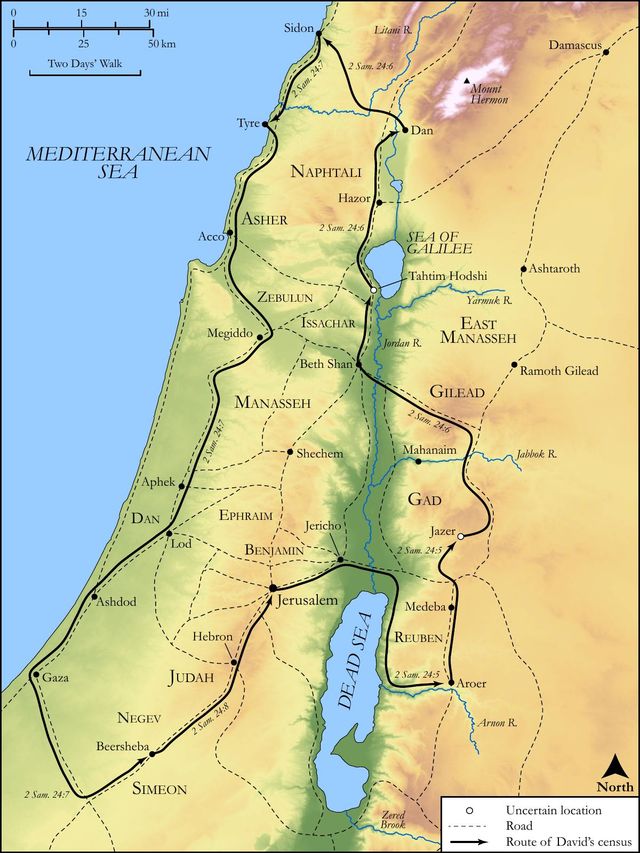
See on the biblical-era map
Study this verse
Public-domain commentary
Matthew Henry
From his Commentary on the Whole Bible. Henry comments on passages, not single verses — this entry covers 1 Chronicles 21:18–30.
We have here the controversy concluded, and, upon David's repentance, his peace made with God. Though thou wast angry with me, thy anger is turned away. 1. A stop was put to the progress of the execution, Ch1 21:15. When David repented of the sin God repented of the judgment, and ordered the destroying angel to stay his hand and sheath his sword, Ch1 21:27. 2. Direction was given to David to rear an altar in the threshing-floor of Ornan, Ch1 21:18. The angel commanded the prophet Gad to bring David this direction. The same angel that had, in God's name, carried on the war, is here forward to set on foot the treaty of peace; for angels do not desire the woeful day. The angel could have given this order to David himself; but he chose to do it by his seer, that he might put an honour upon the prophetic office. Thus the revelation of Jesus Christ was notified by the angel to John, and by him to the churches. The commanding of David to build an altar was a blessed token of reconciliation; for, if God had been pleased to kill him, he would not have appointed, because he would not have accepted, a sacrifice at his hands. 3. David immediately made a bargain with Ornan for the threshing-floor; for he would not serve God at other people's charge. Ornan generously offered it to him gratis, not only in complaisance to the king, but because he had himself seen the angel (Ch1 21:20), which so terrified him that he and his four sons hid themselves, as unable to bear the brightness of his glory and afraid of his drawn sword. Under these apprehensions he was willing to do anything towards making the atonement. Those that are duly sensible of the terrors of the Lord will do all they can, in their places, to promote religion, and encourage all the methods of reconciliation for the turning away of God's wrath. 4. God testified his acceptance of David's offerings on this altar; He answered him from heaven by fire, Ch1 21:26. To signify that God's anger was turned away from him, the fire that might justly have fastened upon the sinner fastened upon the sacrifice and consumed that; and, upon this, the destroying sword was returned into its sheath. Thus Christ was made sin and a curse for us, and it pleased the Lord to bruise him, that through him God might be to us, not a consuming fire, but a reconciled Father. 5. He continued to offer his sacrifices upon this altar. The brazen altar which Moses made was at Gibeon (Ch1 21:29), and there all the sacrifices of Israel were offered; but David was so terrified at the sight of the sword of the angel that he could not go thither, Ch1 21:30. The business required haste, when the plague was begun. Aaron must go quickly, nay, he must run, to make atonement, Num 16:46, Num 16:47. And the case here was no less urgent; so that David had not time to go to Gibeon: nor durst he leave the angel with his sword drawn over Jerusalem, lest the fatal stroke should be given before he came back. And therefore God, in tenderness to him, bade him build an altar in that place, dispensing with his own law concerning one altar because of the present distress, and accepting the sacrifices offered on this new altar, which was not set up in opposition to that, but in concurrence with it. The symbols of unity were not so much insisted on as unity itself. Nay, when the present distress was over (as it should seem), David, as long as he lived, sacrificed there, though the altar at Gibeon was still kept up; for God had owned the sacrifices that were here offered and had testified his acceptance of them, Ch1 21:28. On those administrations in which we have experienced the tokens of God's presence, and have found that he is with us of a truth, it is good to continue our attendance. "Here God had graciously met me, and therefore I will still expect to meet with him."
Continue studying 1 Chronicles 21:29 across the web’s major study libraries — every link below opens this exact verse, chapter, or book on the destination site.
Read & Compare
 BibleGatewayThis verse in more than 200 translations and 70 languages.
 Bible.comThe YouVersion reader — hundreds of translations, reading plans, and highlights.
 ESV.orgCrossway's official English Standard Version reader.
 NET BibleThe NET translation with 60,000+ translators' notes on every rendering decision.
 STEP BibleTyndale House's free study tool — original text, vocabulary, and scholarly resources.
 BibliaLogos Bible Software's free web reader.
 USCCBThe New American Bible (Revised Edition) with the U.S. bishops' study notes.
Commentaries
 BibleHub CommentariesDozens of classic commentaries on this verse, gathered on one page.
 StudyLightMore than 100 commentary sets — the largest collection on the web.
 BibleRefPlain-English commentary on what this verse means, verse by verse.
 Enduring WordDavid Guzik's free commentary on this chapter, widely used by Bible teachers.
 Bible Study ToolsVerse commentary alongside Greek and Hebrew study aids.
Original Language & Research
- BibleHub InterlinearThe verse word by word — original language, transliteration, and English.
- BibleHub LexiconEvery word's original-language definition and Strong's entry.
 Blue Letter BibleDeep-study tools — Strong's numbers, concordance, and word studies.
 SefariaThe Hebrew text with Rashi and centuries of Jewish commentary.
Sermons, Hymns & Audio


TrulyRandomVerse is not affiliated with these sites and doesn’t control their content. They’re linked because they’re genuinely useful.
Summary
1 Chronicles 21:29 functions as a critical explanatory note, providing the essential logistical and theological rationale for King David's extraordinary actions in offering sacrifices at the threshing floor of Ornan the Jebusite, rather than at the established tabernacle. This verse clarifies that the divinely ordained sanctuary, constructed by Moses in the wilderness, along with its altar for burnt offerings, was situated at the high place in Gibeon during that specific period. It thus underscores the urgency and divine authorization that necessitated David's immediate, on-site atonement in response to the devastating plague, highlighting a pivotal moment in Israel's worship trajectory.
Context
ShowHideLiterary Context
This verse serves as a crucial parenthetical explanation within the narrative of 1 Chronicles 21. The preceding verses detail King David's sin in conducting a census, which incurs divine judgment in the form of a severe plague upon Israel. When the angel of the LORD is seen poised to destroy Jerusalem, David is commanded by the prophet Gad to erect an altar on the threshing floor of Ornan the Jebusite (1 Chronicles 21:18). David promptly acquires the site, offers burnt and peace offerings, and the plague ceases (1 Chronicles 21:26). Verse 29 provides the indispensable background, explaining why David performed these sacrifices at Ornan's threshing floor instead of journeying to the tabernacle. It reveals David's profound fear of the angel and the immediate, overwhelming need for atonement, justifying the divinely sanctioned deviation from the normal place of worship. This clarification is vital for validating David's actions and setting the stage for the future Temple site.
Historical & Cultural Context
The "tabernacle of the LORD, which Moses made in the wilderness" refers to the portable sanctuary designed by God and constructed by Moses during the Exodus (Exodus 40:2). This sacred structure, along with its associated altar for burnt offerings, had been the central, divinely appointed locus of Israelite worship, sacrifice, and divine encounter for centuries. Following Israel's entry into Canaan, the tabernacle was moved to various significant locations, including Shiloh and Nob, before being established at Gibeon during the early monarchy. Gibeon was recognized as a "great high place" (1 Kings 3:4), indicating its legitimate status as a prominent site for Israelite worship, predating the exclusive centralization of worship in Jerusalem. At this point in David's reign, Jerusalem had become the political capital, but Gibeon remained the primary cultic center housing the tabernacle. The events described in this chapter, culminating in the selection of Ornan's threshing floor, mark a divinely orchestrated transition, foreshadowing the permanent establishment of God's dwelling place in Jerusalem.
Key Themes
ShowHideThis verse significantly contributes to several overarching themes within the book of Chronicles and the broader biblical narrative. Firstly, it underscores the Centrality of Atonement and Righteous Worship, emphasizing that reconciliation with God, particularly in response to sin and judgment, requires specific, divinely appointed acts of sacrifice. Secondly, it highlights Divine Sovereignty and Provisional Guidance, demonstrating that while God establishes norms for worship, He retains the absolute prerogative to direct His people to new, specific locations for urgent acts of atonement, overriding conventional practices when necessary. David's profound fear and immediate obedience to the divine command, rather than adherence to the tabernacle's location, exemplify this principle. Thirdly, the verse subtly points to the Transition in Worship Location, marking a crucial step in the shift from the mobile tabernacle tradition to the future, permanent Temple in Jerusalem. The threshing floor of Ornan, where the plague ceased, would ultimately become the site for Solomon's Temple (2 Chronicles 3:1), establishing Jerusalem as the enduring center of Israelite worship and a place where God's presence would dwell.
Exposition and Analysis
ShowHideKey Word Analysis
ShowHideThis term refers to the portable sanctuary, also known as the Tent of Meeting, meticulously constructed by Moses under God's precise instructions (as detailed in Exodus 25-40). It served as the physical manifestation of God's dwelling place among His people, housing the Ark of the Covenant, and functioning as the central hub for Israelite worship, sacrifice, and communion with the Divine. Its mention here emphasizes the established, divinely ordained nature of Israel's worship system, even as extraordinary circumstances necessitated a temporary deviation from its location.
Derived from a root meaning "to be high," this term denotes an elevation or elevated site. While "high place" often carries negative connotations in later biblical contexts, referring to illicit pagan worship sites (e.g., 1 Kings 14:23 or 2 Kings 17:9), in this specific instance, "the high place at Gibeon" refers to a legitimate, elevated site where the tabernacle and altar of burnt offering were legitimately situated. This indicates that not all bamot were inherently evil; some were simply elevated locations, often naturally suited for public assembly and worship, that were utilized for legitimate Israelite worship before the centralization of worship in Jerusalem. The text clarifies that Gibeon was the current and legitimate central sanctuary.
A significant city in the territory of Benjamin, known for its size and its inhabitants, the Hivites (Joshua 9). Historically, it was a prominent cultic site even before the tabernacle was placed there, as evidenced by Solomon's grand sacrifice there (1 Kings 3:4). Its importance in this verse lies in its role as the temporary, yet official, location of the tabernacle and the altar of burnt offering during David's reign, preceding the construction of the permanent Temple in Jerusalem.
Verse Breakdown
ShowHide"For the tabernacle of the LORD, which Moses made in the wilderness,"
This clause establishes the profound identity and historical pedigree of the central worship site. It is not merely any tabernacle, but the tabernacle—the sacred, divinely ordained structure meticulously constructed under Moses's leadership during the formative wilderness journey. This detail emphasizes its unparalleled sacred and authoritative status as the legitimate, God-appointed place for His people to meet with Him and offer prescribed worship.
"and the altar of the burnt offering,"
This specifies the primary instrument for atonement, consecration, and communion within the tabernacle complex. The altar was the focal point where sacrifices, particularly burnt offerings, were made to reconcile with God, express devotion, and seek forgiveness. Its explicit mention underscores that the core sacrificial system, essential for Israel's covenant relationship with God, was fully operational and located at Gibeon, thereby highlighting the extraordinary nature of David's alternative sacrifice at Ornan's threshing floor.
"[were] at that season in the high place at Gibeon."
This final clause precisely pinpoints the geographical and temporal context of the tabernacle's location. "At that season" indicates the specific period during David's reign when the events of the plague and atonement occurred. The location "in the high place at Gibeon" clarifies where the legitimate, established worship apparatus was situated. This crucial detail provides the necessary background for understanding why David did not go there, but rather acted on the immediate, terrifying divine command to build an altar elsewhere, a command that superseded the conventional location due to the extreme urgency of the plague and the direct divine intervention.
Literary Devices
ShowHideThe verse primarily employs Explanatory Parenthesis, functioning as an interpretive aside to provide crucial background information that justifies David's deviation from the established protocol of worship at Gibeon. This explanatory function highlights the Chronicler's concern for Historical Detail and Verisimilitude, ensuring the reader understands the theological rationale behind David's actions. By implicitly contrasting the established, legitimate location of worship with the divinely appointed, temporary site for atonement, the verse subtly uses Anticipation or Foreshadowing. The threshing floor of Ornan, chosen by God as the site for the cessation of the plague, would later become the permanent location for Solomon's Temple (2 Chronicles 3:1), thus foreshadowing the divine selection of Jerusalem as the enduring center of Israelite worship.
Theological and Thematic Connections
ShowHide1 Chronicles 21:29 profoundly illustrates God's ultimate sovereignty over location and ritual, prioritizing immediate obedience to His direct command, especially in times of crisis and urgent need for atonement. While the tabernacle at Gibeon represented the established, proper place for worship, the dire circumstances of the plague and the terrifying appearance of the angel of the LORD necessitated an immediate, divinely-appointed response that transcended normal protocols. This demonstrates that God's presence and redemptive work are not strictly confined to a physical structure or a prescribed location, but manifest where and when He chooses to act for the salvation of His people. The verse subtly prepares the reader for the eventual shift of worship from the portable tabernacle to the permanent Temple in Jerusalem, emphasizing that the divine initiative and human obedience are paramount, even over long-standing traditions.
Reflection and Application
ShowHideThis verse offers a powerful reminder that while established forms, structures, and places of worship are important and divinely ordained for order and instruction, God's redemptive work and His call to obedience can transcend rigid adherence to location, especially in times of crisis or direct divine command. David's profound fear and immediate obedience to build an altar where the angel appeared, rather than traveling to the distant tabernacle at Gibeon, was paramount for the cessation of the plague. This teaches us the critical importance of discerning and responding to God's direct leading, even if it deviates from conventional practice or personal preference, particularly when seeking urgent reconciliation, deliverance, or a deeper encounter with His presence. It challenges us to consider whether our reverence for established traditions sometimes overshadows our readiness to obey God's present, active voice, and to remember that God values a repentant heart and immediate obedience above all else. True worship is not merely about where we worship, but how and why—with a heart fully yielded to God's will.
Questions for Reflection
ShowHideFAQ
ShowHideWhy was the tabernacle at Gibeon and not Jerusalem at this time?
ShowHideAt the time of David's reign, Jerusalem had recently been captured and established as the political capital, but it was not yet the unified religious center with a permanent Temple. The tabernacle, which had served as the central place of worship since the Exodus, had a history of being moved to various locations (e.g., Shiloh, Nob). By David's time, it had been situated in Gibeon, a prominent "high place" that was a legitimate site for Israelite worship. However, David had already brought the Ark of the Covenant, the most sacred item from the tabernacle, to Jerusalem and placed it in a tent there (2 Samuel 6:17), creating a temporary dual center for worship. The events at Ornan's threshing floor ultimately paved the way for the unified worship center in Jerusalem with the building of Solomon's Temple.
Was it wrong for David to offer sacrifices at Ornan's threshing floor instead of the tabernacle at Gibeon?
ShowHideNo, it was not wrong; in fact, it was divinely commanded and absolutely necessary. While the tabernacle at Gibeon was the established place for sacrifices, 1 Chronicles 21:29 explicitly explains that David was overwhelmed by the terrifying presence of the angel of the LORD and the urgency of the plague. The prophet Gad delivered a direct command from God to build an altar on Ornan's threshing floor (1 Chronicles 21:18). In this extraordinary circumstance, God's immediate directive superseded the normal protocol, demonstrating His sovereignty over location and His priority for immediate obedience in seeking atonement and deliverance. David's action was an act of faith and obedience, leading to the cessation of the plague (1 Chronicles 21:26).
Christ-Centered Fulfillment
ShowHide1 Chronicles 21:29, by highlighting the temporary nature of the tabernacle and the divinely appointed shift in worship location, powerfully foreshadows the ultimate fulfillment of God's dwelling place and sacrificial system in Jesus Christ. The tabernacle, and later the Temple, served as a tangible representation of God's presence among His people and the means by which atonement was made. However, these were but shadows of the greater reality to come. Jesus Christ is the true "tabernacle" of God, the very embodiment of God dwelling among us, as John proclaims, "The Word became flesh and made his dwelling among us" (John 1:14). The altar of burnt offering, where sacrifices were made for sin, points to Christ as the ultimate and perfect sacrifice, the "Lamb of God, who takes away the sin of the world!" (John 1:29). His single, perfect offering on the cross, a divinely appointed "high place" outside the city gates, completely and eternally atoned for sin, rendering all prior sacrifices obsolete (Hebrews 9:11-14). Furthermore, just as the worship location shifted from Gibeon to Ornan's threshing floor and then to the Temple in Jerusalem, Christ's coming signifies that true worship is no longer bound by physical location or specific structures, but is offered "in spirit and truth" by those who have been reconciled to God through Him (John 4:23-24). He is our access to God, our permanent dwelling place, and the fulfillment of every shadow.