


1 Chronicles 21:30
Bible text: King James Version (1769 Blayney text) · Public domain
Bible text: Berean Standard Bible · Public domain
Bible text: American Standard Version (1901) · Public domain
Bible text: World English Bible, Messianic edition · Public domain
Bible text: Geneva Bible (1599) · Public domain
Bible text: Young's Literal Translation · Public domain
- וְלֹאve·lo'and notH3808Conj-w ¦ NegParticle Negativeוְandלֹאnot
- יָכֹלya·Kholhe was ableH3201V-Qal-Perf-3msVerb Qal Perfect 3rd Singular Masculine
- דָּוִידda·VidDavidH1732N-proper-mNoun Proper Masculine
- לָלֶכֶתla·Le·khetto goH1980Prep-l ¦ V-Qal-InfVerb Qal Infinitive Constructלָtoלֶכֶתgo
- לְפָנָיוle·fa·Nav<to> before itH6440Prep-l ¦ N-mpc ¦ 3msNoun Plural Masculine Constructלְ<to>פָנָיbeforeוit
- לִדְרֹשׁlid·Roshto seekH1875Prep-l ¦ V-Qal-InfVerb Qal Infinitive Constructלִtoדְרֹשׁseek
- אֱלֹהִים'E·lo·HimGodH430N-mpNoun Plural Masculine Absolute
- כִּיkiforH3588PrtParticle Conditional
- נִבְעַתniv·'Athe was terrifiedH1204V-Niphal-Perf-3msVerb Niphal Perfect 3rd Singular Masculine
- מִפְּנֵיmi·pe·Neiof <the face of>H6440Prep-m ¦ N-mpcNoun Plural Masculine Constructמִofפְּנֵי<the face of>
- חֶרֶבChe·rev[the] sword ofH2719N-fscNoun Singular Feminine Construct
- מַלְאַךְmal·'Akh[the] angel ofH4397N-mscNoun Singular Masculine Construct
- יְהוָהYah·wehYahwehH3068N-properNoun Proper Title
English is a literal word-by-word gloss of the Hebrew, not the KJV's wording. Why?
This is the original text the KJV's translators worked from — each Hebrew word with its own literal English meaning in this verse, prepared by scholars at Tyndale House, Cambridge. The KJV translates whole sentences, not word by word, so its wording differs: one Hebrew word can become several English words, and the KJV may choose “the LORD” where the gloss reads “Yahweh”. Both are faithful — they answer different questions. For the KJV's own rendering, switch to the KJV text.
Details
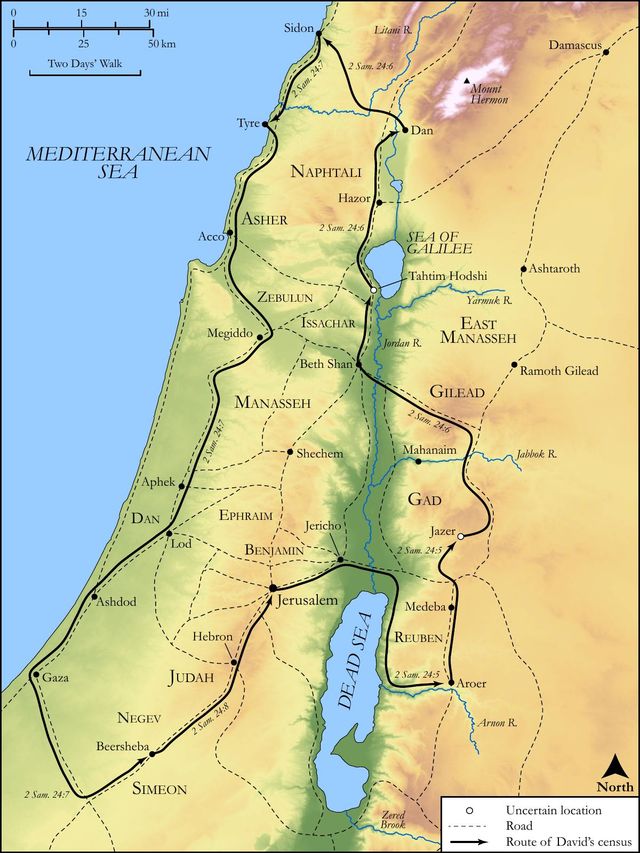
See on the biblical-era map
Study this verse
Public-domain commentary
Matthew Henry
From his Commentary on the Whole Bible. Henry comments on passages, not single verses — this entry covers 1 Chronicles 21:18–30.
We have here the controversy concluded, and, upon David's repentance, his peace made with God. Though thou wast angry with me, thy anger is turned away. 1. A stop was put to the progress of the execution, Ch1 21:15. When David repented of the sin God repented of the judgment, and ordered the destroying angel to stay his hand and sheath his sword, Ch1 21:27. 2. Direction was given to David to rear an altar in the threshing-floor of Ornan, Ch1 21:18. The angel commanded the prophet Gad to bring David this direction. The same angel that had, in God's name, carried on the war, is here forward to set on foot the treaty of peace; for angels do not desire the woeful day. The angel could have given this order to David himself; but he chose to do it by his seer, that he might put an honour upon the prophetic office. Thus the revelation of Jesus Christ was notified by the angel to John, and by him to the churches. The commanding of David to build an altar was a blessed token of reconciliation; for, if God had been pleased to kill him, he would not have appointed, because he would not have accepted, a sacrifice at his hands. 3. David immediately made a bargain with Ornan for the threshing-floor; for he would not serve God at other people's charge. Ornan generously offered it to him gratis, not only in complaisance to the king, but because he had himself seen the angel (Ch1 21:20), which so terrified him that he and his four sons hid themselves, as unable to bear the brightness of his glory and afraid of his drawn sword. Under these apprehensions he was willing to do anything towards making the atonement. Those that are duly sensible of the terrors of the Lord will do all they can, in their places, to promote religion, and encourage all the methods of reconciliation for the turning away of God's wrath. 4. God testified his acceptance of David's offerings on this altar; He answered him from heaven by fire, Ch1 21:26. To signify that God's anger was turned away from him, the fire that might justly have fastened upon the sinner fastened upon the sacrifice and consumed that; and, upon this, the destroying sword was returned into its sheath. Thus Christ was made sin and a curse for us, and it pleased the Lord to bruise him, that through him God might be to us, not a consuming fire, but a reconciled Father. 5. He continued to offer his sacrifices upon this altar. The brazen altar which Moses made was at Gibeon (Ch1 21:29), and there all the sacrifices of Israel were offered; but David was so terrified at the sight of the sword of the angel that he could not go thither, Ch1 21:30. The business required haste, when the plague was begun. Aaron must go quickly, nay, he must run, to make atonement, Num 16:46, Num 16:47. And the case here was no less urgent; so that David had not time to go to Gibeon: nor durst he leave the angel with his sword drawn over Jerusalem, lest the fatal stroke should be given before he came back. And therefore God, in tenderness to him, bade him build an altar in that place, dispensing with his own law concerning one altar because of the present distress, and accepting the sacrifices offered on this new altar, which was not set up in opposition to that, but in concurrence with it. The symbols of unity were not so much insisted on as unity itself. Nay, when the present distress was over (as it should seem), David, as long as he lived, sacrificed there, though the altar at Gibeon was still kept up; for God had owned the sacrifices that were here offered and had testified his acceptance of them, Ch1 21:28. On those administrations in which we have experienced the tokens of God's presence, and have found that he is with us of a truth, it is good to continue our attendance. "Here God had graciously met me, and therefore I will still expect to meet with him."
Continue studying 1 Chronicles 21:30 across the web’s major study libraries — every link below opens this exact verse, chapter, or book on the destination site.
Read & Compare
 BibleGatewayThis verse in more than 200 translations and 70 languages.
 Bible.comThe YouVersion reader — hundreds of translations, reading plans, and highlights.
 ESV.orgCrossway's official English Standard Version reader.
 NET BibleThe NET translation with 60,000+ translators' notes on every rendering decision.
 STEP BibleTyndale House's free study tool — original text, vocabulary, and scholarly resources.
 BibliaLogos Bible Software's free web reader.
 USCCBThe New American Bible (Revised Edition) with the U.S. bishops' study notes.
Commentaries
 BibleHub CommentariesDozens of classic commentaries on this verse, gathered on one page.
 StudyLightMore than 100 commentary sets — the largest collection on the web.
 BibleRefPlain-English commentary on what this verse means, verse by verse.
 Enduring WordDavid Guzik's free commentary on this chapter, widely used by Bible teachers.
 Bible Study ToolsVerse commentary alongside Greek and Hebrew study aids.
Original Language & Research
- BibleHub InterlinearThe verse word by word — original language, transliteration, and English.
- BibleHub LexiconEvery word's original-language definition and Strong's entry.
 Blue Letter BibleDeep-study tools — Strong's numbers, concordance, and word studies.
 SefariaThe Hebrew text with Rashi and centuries of Jewish commentary.
Sermons, Hymns & Audio


TrulyRandomVerse is not affiliated with these sites and doesn’t control their content. They’re linked because they’re genuinely useful.
Summary
1 Chronicles 21:30 serves as a profound conclusion to the narrative of King David's unauthorized census and the ensuing divine plague. This verse vividly explains David's overwhelming and reverential fear in the immediate aftermath of God's judgment, detailing why he remained at the threshing floor of Ornan the Jebusite rather than returning to the established tabernacle at Gibeon. His profound terror, directly caused by the visible manifestation of the "sword of the angel of the LORD," underscored the gravity of his sin and the immediate necessity of seeking and receiving divine appeasement at the precise site where God's wrath had been stayed.
Context
ShowHideLiterary Context
This verse brings to a dramatic close the account of King David's sin in numbering Israel and Judah, a transgression explicitly stated to have been incited by Satan in 1 Chronicles 21:1. Following this act of disobedience, God presented David with three choices of judgment, from which David wisely chose to "fall into the hand of the LORD" (1 Chronicles 21:13). A devastating plague then swept through Israel, claiming seventy thousand lives. The narrative reaches its climax when the angel of the LORD, poised to destroy Jerusalem, is seen by David (1 Chronicles 21:16). Through the prophet Gad, David is commanded to build an altar on the threshing floor of Ornan the Jebusite (1 Chronicles 21:18). David promptly obeys, purchases the site, and offers burnt and peace offerings. When God answers by fire from heaven upon the altar (1 Chronicles 21:26), the plague ceases. Verse 30 then provides the crucial explanation for David's subsequent inability to depart from this sacred, yet terrifying, location.
Historical & Cultural Context
At the time of this pivotal event, the tabernacle of Moses, with its bronze altar, was located at Gibeon (1 Chronicles 21:29), serving as the primary site for national worship and sacrifice in Israel. Kings, priests, and prophets would typically go there to "enquire of God" or offer sacrifices according to established Mosaic law. Threshing floors, like Ornan's, were common agricultural sites, typically elevated and open to the wind for winnowing grain. Their public and often elevated nature made them suitable for significant events, but it was highly unusual for such a place to become a site of direct divine encounter and sacrifice, especially when a designated tabernacle existed. David's fear, therefore, was not merely personal panic but a profound, culturally understood response to a direct, terrifying manifestation of divine judgment, which superseded the normal protocols of worship and compelled him to remain. The concept of divine plagues as a response to national sin was also a well-established understanding among the nations round about, though the specific details of God's intervention in Israel were unique to His covenant relationship with His people.
Key Themes
ShowHideThe narrative of 1 Chronicles 21 powerfully illustrates several core themes. Firstly, it underscores the seriousness of sin and divine judgment, demonstrating that even a king like David is subject to God's righteous wrath for disobedience. Secondly, it highlights God's profound mercy and provision for atonement, as He provides a specific means (the altar and sacrifice at Ornan's threshing floor) to halt the destruction and avert further wrath. Thirdly, the account emphasizes the reverential fear of God, a deep and overwhelming awe in the presence of God's holiness and power, which is a foundational aspect of true worship and wisdom, as seen in David's response to the visible angel (Proverbs 9:10). Finally, the narrative establishes the significance of location, transforming a common threshing floor into a sacred site, which would later be consecrated as the chosen place for the building of Solomon's Temple (2 Chronicles 3:1), the permanent dwelling place of God's presence.
Exposition and Analysis
ShowHideKey Word Analysis
ShowHideThis primitive root signifies to fear, affright, be (make) afraid, terrify, or trouble. In David's context, it describes an overwhelming, deep-seated terror and dread induced by the immediate, visible manifestation of divine wrath. This was not a casual apprehension but a profound, existential fear that compelled him to remain in the place where judgment had been stayed, recognizing the ultimate authority and terrifying holiness of God.
Derived from a root meaning drought or desolation, this term refers to a cutting instrument like a knife or sword, often associated with its destructive effect. In biblical imagery, especially when wielded by an angel or by God Himself, the sword is a potent symbol of divine judgment, wrath, and the execution of God's justice. The visible "sword of the angel of the LORD" was a terrifying, tangible sign of God's active, immediate, and potentially ongoing wrath, demanding an immediate response of atonement.
This specific phrase often denotes a unique divine messenger who embodies God's presence, authority, and sometimes, even God Himself in a visible, pre-incarnate form. In this context, the angel is the direct agent of God's judgment, having carried out the plague and standing poised to destroy Jerusalem. David's fear was not merely of the angel as a created being, but of the Holy God whose presence, power, and righteous judgment the angel directly represented and executed.
Verse Breakdown
ShowHide"But David could not go before it to enquire of God:"
The pronoun "it" refers to the tabernacle at Gibeon, which housed the bronze altar and the tent of meeting, serving as the established, divinely sanctioned place where one would typically go to "enquire of God" (seek divine counsel, offer sacrifices, or make supplication). David's inability to go was not a physical impediment but a profound spiritual and psychological paralysis. He was overwhelmed by the immediate, terrifying presence of God's judgment at Ornan's threshing floor, compelling him to remain precisely where God's wrath had been appeased, rather than seeking a more familiar or "proper" place of worship.
"for he was afraid"
This clause provides the direct and compelling reason for David's immobility and his deviation from established worship protocol. His fear was not a casual apprehension but a profound, existential dread induced by the direct, terrifying encounter with divine holiness and judgment. This fear was appropriate and necessary, leading him to fully commit to the immediate act of atonement at the divinely appointed location rather than attempting to return to Gibeon.
"because of the sword of the angel of the LORD."
This final clause specifies the terrifying visual stimulus that generated David's overwhelming fear. The visible sword, poised over Jerusalem, was a stark and undeniable manifestation of God's active judgment and the potential for continued destruction. It was a direct, tangible sign of God's power and wrath, compelling David to remain in the place where mercy had been shown and where further appeasement was possible, underscoring the gravity of his sin and the immediacy of God's response.
Literary Devices
ShowHideThe verse employs several potent Literary Devices. Symbolism is profoundly evident with the "sword of the angel of the LORD," which powerfully symbolizes divine judgment, wrath, and the execution of God's justice. The angel itself is a Symbol of God's immediate presence and active intervention in human affairs, serving as a terrifying embodiment of His righteous anger. There is also an element of Foreshadowing in this narrative, as the very location where David's fear kept him—Ornan's threshing floor—would later become the divinely chosen site of Solomon's Temple, the permanent dwelling place of God's presence and the central locus of atonement for Israel. The narrative also exhibits Dramatic Irony and Contrast: David, who presumptuously numbered the people, is now utterly humbled and consumed by a terrifying, yet ultimately redemptive, fear of the very God whose authority he had implicitly challenged. This fear, paradoxically, leads him to the very place where God's mercy is revealed and where the nation finds salvation from the plague.
Theological and Thematic Connections
ShowHide1 Chronicles 21:30 profoundly underscores the holiness and justice of God, revealing that sin carries severe consequences and elicits divine judgment. David's fear, far from mere panic, was a reverential awe in the face of God's terrifying holiness, a necessary response that led to immediate and obedient action. This narrative highlights that true atonement requires a direct encounter with God's wrath and a humble submission to His prescribed means of reconciliation. It demonstrates that even in judgment, God provides a path to mercy, transforming a place of impending destruction into a site of divine appeasement. This pivotal moment on Ornan's threshing floor, marked by David's fear and God's intervention, prefigures the ultimate and perfect sacrifice that would fully reconcile humanity to a holy God.
Reflection and Application
ShowHideThe profound fear experienced by David in 1 Chronicles 21:30 serves as a powerful reminder of the awesome holiness of God and the gravity of sin. In a world that often trivializes sin or reduces God to a mere benevolent figure, this passage reasserts His righteous judgment and the serious consequences of disobedience. David's response teaches us the urgency of immediate repentance and humble obedience when confronted with our sin. His fear was not paralyzing but motivating, driving him to seek God's prescribed way of atonement. For us today, while we do not face a visible angel with a drawn sword, the spiritual reality of God's holiness and the need for reconciliation remain. This passage calls us to cultivate a healthy, reverential fear of the Lord, one that fosters humility, prompts confession, and deepens our appreciation for the grace that has been extended to us through Christ. It reminds us that true worship flows from an understanding of who God is—both merciful and just—and our proper place before Him.
Questions for Reflection
ShowHideFAQ
ShowHideWhy couldn't David simply go to the tabernacle at Gibeon to "enquire of God," which was the established place of worship?
ShowHideDavid's inability to go to Gibeon was not a physical impediment but a profound spiritual and psychological one. He was overwhelmed by the terrifying presence of God's judgment manifested through the "sword of the angel of the LORD" at Ornan's threshing floor. The immediate and visible threat of divine wrath, which had just claimed 70,000 lives and was poised over Jerusalem, compelled him to remain precisely where God had halted the plague and where mercy had been revealed. His fear was so great that he dared not leave the site where God's wrath had been appeased, recognizing that this was the specific, divinely appointed location for atonement in that moment, superseding the usual protocols of worship at Gibeon.
What is the significance of the "sword of the angel of the LORD" in this verse?
ShowHideThe "sword of the angel of the LORD" is a powerful symbol of divine judgment and the execution of God's wrath. In biblical imagery, a sword often represents the instrument of divine justice, bringing about punishment and destruction. Here, it is a visible, terrifying manifestation of God's active and immediate judgment against David's sin and the sin of Israel. Its presence signifies that God's wrath was real, tangible, and ongoing, only halted by David's obedience in offering sacrifice at the specific location God commanded. It underscores the seriousness of sin and the awesome power of God's righteous anger.
How does this event at Ornan's threshing floor relate to the future Temple in Jerusalem?
ShowHideThe threshing floor of Ornan the Jebusite, where David offered sacrifices and the plague ceased, became the divinely chosen site for the building of Solomon's Temple (2 Chronicles 3:1). This event thus consecrated the location, transforming an ordinary agricultural site into the most sacred place in Israel. It became the permanent dwelling place for God's presence among His people and the central locus for national atonement and worship. The fact that God's wrath was appeased and mercy was shown at this specific spot foreshadowed its future role as the place where sin would be dealt with and communion with God restored.
Christ-Centered Fulfillment
ShowHideThe terror David experienced before the "sword of the angel of the LORD" in 1 Chronicles 21:30 powerfully foreshadows the ultimate confrontation with divine wrath, which was fully borne by Jesus Christ. David's fear kept him at the place of sacrifice, where temporary atonement was made. In Christ, we find the definitive and eternal sacrifice that truly appeases God's wrath. The "sword" of divine judgment, which stood poised over humanity due to sin, was not merely sheathed but fell upon the Lamb of God, who took away the sin of the world. Jesus became our ultimate "place" of atonement, the true temple (John 2:19-21), where God's holiness and justice are fully satisfied, and His mercy is perfectly revealed. We no longer need to go to a physical tabernacle or a specific threshing floor to "enquire of God" or find atonement; rather, through faith in Christ, we have direct access to the Father (Ephesians 2:18) and are reconciled to God (Romans 5:10-11). The reverential fear that drove David to sacrifice is now transformed into a loving awe and worship of the One who, by His blood, has delivered us from the wrath to come (1 Thessalonians 1:10).