


Joshua 10:2
Bible text: King James Version (1769 Blayney text) · Public domain
Bible text: King James Version with Strong's numbers · Public domain
Bible text: Berean Standard Bible · Public domain
Bible text: American Standard Version (1901) · Public domain
Bible text: World English Bible, Messianic edition · Public domain
Bible text: Geneva Bible (1599) · Public domain
Bible text: Young's Literal Translation · Public domain
- וַיִּירְאוּvai·yi·re·'Uand they were afraidH3372Conj-w ¦ V-Qal-ConsecImperf-3mpVerb Qal Consecutive Imperfect 3rd Plural Masculineוַandיִּירְאוּthey were afraid
- מְאֹדme·'OdveryH3966Adj-msAdjective Numerical Singular Masculine Absolute
- כִּיkiforH3588PrtParticle Conditional
- עִיר'ir[was] a cityH5892N-fsNoun Singular Feminine Absolute
- גְּדוֹלָהge·do·LahgreatH1419Adj-fsAdjective Singular Feminine Absolute
- גִּבְעוֹןgiv·'onGibeonH1391N-properNoun Proper Location
- כְּאַחַתke·'a·Chatlike one ofH259Prep-k ¦ Adj-fscAdjective Numerical Singular Feminine Constructכְּlikeאַחַתone of
- עָרֵי'a·Rei[the] cities ofH5892N-mpcNoun Plural Masculine Construct
- הַמַּמְלָכָהha·mam·la·Khah<the> royaltyH4467Art ¦ N-fsNoun Singular Feminine Absoluteהַ<the>מַּמְלָכָהroyalty
- וְכִיve·Khiand forH3588Conj-w ¦ PrtParticle Conditionalוְandכִיfor
- הִיאhi'itH1931Pro-3fsPronoun Personal 3rd Singular Feminine
- גְדוֹלָהge·do·Lah[was] greatH1419Adj-fsAdjective Singular Feminine Absolute
- מִןminmore thanH4480PrepPreposition
- הָעַיha·'Ai<the> AiH5857Art ¦ N-properNoun Proper Locationהָ<the>עַיAi
- וְכָלve·kholand allH3605Conj-w ¦ N-mscNoun Singular Masculine Constructוְandכָלall
- אֲנָשֶׁיהָ'a·na·Shei·haits menH582N-mpc ¦ 3fsNoun Plural Masculine Constructאֲנָשֶׁיmenהָits
- גִּבֹּרִיםgi·bo·Rim[were] warriorsH1368N-mpNoun Plural Masculine Absolute
English is a literal word-by-word gloss of the Hebrew, not the KJV's wording. Why?
This is the original text the KJV's translators worked from — each Hebrew word with its own literal English meaning in this verse, prepared by scholars at Tyndale House, Cambridge. The KJV translates whole sentences, not word by word, so its wording differs: one Hebrew word can become several English words, and the KJV may choose “the LORD” where the gloss reads “Yahweh”. Both are faithful — they answer different questions. For the KJV's own rendering, switch to the KJV text.
Details
See on the biblical-era maps
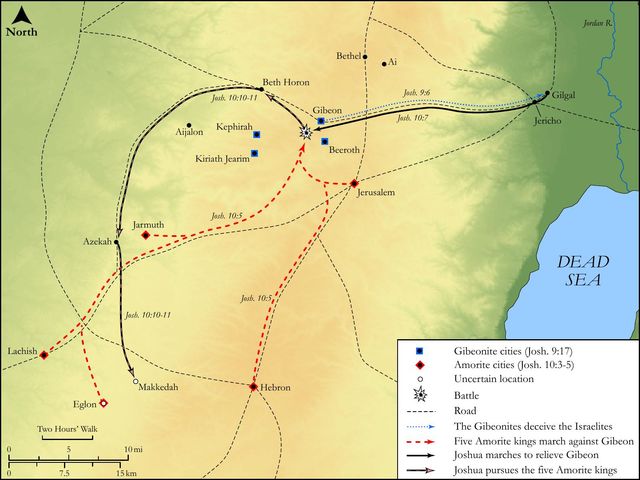
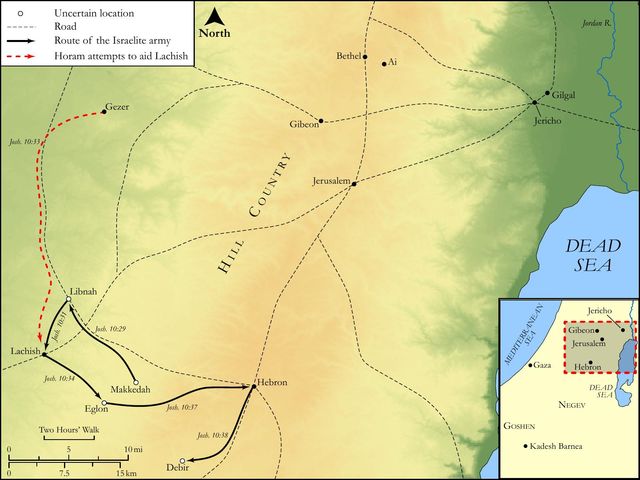
Study this verse
Public-domain commentary
Matthew Henry
From his Commentary on the Whole Bible. Henry comments on passages, not single verses — this entry covers Joshua 10:1–6.
Joshua and the hosts of Israel had now been a good while in the land of Canaan, and no great matters were effected; they were made masters of Jericho by a miracle, of Ai by stratagem, and of Gibeon by surrender, and that was all; hitherto the progress of their victories had not seemed proportionable to the magnificence of their entry and the glory of their beginnings. Those among them that were impatient of delays, it is probable, complained of Joshua's slowness, and asked why they did not immediately penetrate into the heart of the country, before the enemy could rally their forces to make head against them, why they stood trifling, while they were so confident both of their title and of their success. Thus Joshua's prudence, perhaps, was censured as slothfulness, cowardice, and want of spirit. But, 1. Canaan was not to be conquered in a day. God had said that by little and little he would drive out the Canaanites, Exo 23:30. He that believeth will not make haste, or conclude that the promise will never be performed because it is not performed so soon as he expected. 2. Joshua waited for the Canaanites to be the aggressors; let them first make an onset upon Israel, or the allies of Israel, and then their destruction will be, or at least will appear to be, the more just and more justifiable. Joshua had warrant sufficient to set upon them, yet he stays till they strike the first stroke, that he might provide for honest things in the sight, not only of God, but of men; and they would be the more inexcusable in their resistance, now that they had seen what favour the Gibeonites found with Israel. 3. It was for the advantage of Israel to sit still awhile, that the forces of these little kings might unite in one body, and so might the more easily be cut off at one blow. This God had in his eye when he put it into their hearts to combine against Israel; though they designed thereby to strengthen one another, that which he intended was to gather them as sheaves into the floor, to fall together under the flail, Mic 4:12. Thus oftentimes that seeming paradox proves wholesome counsel, Stay awhile, and we shall have done the sooner.
After Israel had waited awhile for an occasion to make war upon the Canaanites, a fair one offers itself. 1. Five kings combine against the Gibeonites. Adoni-zedec king of Jerusalem was the first mover and ring-leader of this confederacy. He had a good name (it signifies lord of righteousness), being a descendant perhaps from Melchizedek, king of righteousness; but, notwithstanding the goodness of his name and family, it seems he was a bad man, and an implacable enemy to the posterity of that Abraham to whom his predecessor, Melchizedek, was such a faithful friend. He called upon his neighbours to join against Israel either because he was the most honourable prince, and had the precedency among these kings (perhaps they had some dependence upon him, at least they paid a deference to him, as the most public, powerful, and active man they had among them), or because he was first or most apprehensive of the danger his country was in, not only by the conquest of Jericho and Ai, but the surrender of Gibeon, which, it seems, was the chief thing that alarmed him, it being one of the most considerable frontier towns they had. Against Gibeon therefore all the force he would raise must be leveled. Come, says he, and help me, that we may smite Gibeon. This he resolves to do, either, (1.) In policy, that he might retake the city, because it was a strong city, and of great consequence to this country in whose hands it was; or, (2.) In passion, that he might chastise the citizens for making peace with Joshua, pretending that they had perfidiously betrayed their country and strengthened the common enemy, whereas they had really done the greatest kindness imaginable to their country, by setting them a good example, if they would have followed it. Thus Satan and his instruments make war upon those that make peace with God. Marvel not if the world hate you, and treat those as deserters who are converts to Christ. 2. The Gibeonites send notice to Joshua of the distress and danger they are in, Jos 10:6. Now they expect benefit from the league they had made with Israel, because, though it was obtained by deceit, it was afterwards confirmed when the truth came out. They think Joshua obliged to help them, (1.) In conscience, because they were his servants; not in compliment, as they had said in their first address (Jos 9:8), We are thy servants, but in reality made servants to the congregation; and it is the duty of masters to take care of the poorest and meanest of their servants, and not to see them wronged when it is in the power of their hand to right them. Those that pay allegiance may reasonably expect protection. Thus David pleads with God (Psa 119:94), I am thine, save me; and so may we, if indeed we be his. (2.) In honour, because the ground of their enemies' quarrel with them was the respect they had shown to Israel, and the confidence they had in a covenant with them. Joshua cannot refuse to help them when it is for their affection to him, and to the name of his God, that they are attacked. David thinks it a good plea with God (Psa 69:7), For thy sake I have borne reproach. When our spiritual enemies set themselves in array against us, and threaten to swallow us up, let us, by faith and prayer, apply to Christ, our Joshua, for strength and succour, as Paul did, and we shall receive the same answer of peace, My grace is sufficient for thee, Co2 12:8, Co2 12:9.
Historical interpretation
Historical reception
1 surviving comment on this verse from the historical church.
There is no doubt that when a human soul associates itself with the Word of God, it is immediately going to have enemies, and that those it once considered friends will be changed into adversaries. The soul should not only expect to suffer this from humans, but it should also know that such will likewise be forthcoming from opposing powers and spiritual iniquities. Thus it happens that whoever longs for friendship with Jesus knows he must tolerate the hostilities of many.…Even now, therefore, the Gibeonites, such as they are, are assaulted because of friendship with Jesus [Joshua], even though they are “hewers of wood and carriers of water.” That is, although you are the least worthy in the church, nevertheless, because you belong to Jesus, you will be assailed by five kings.
The Gibeonites, however, are not abandoned or scorned by Jesus [Joshua] or by the leaders and elders of the Israelites; instead they offer help for their weakness.
Continue studying Joshua 10:2 across the web’s major study libraries — every link below opens this exact verse, chapter, or book on the destination site.
Read & Compare
 BibleGatewayThis verse in more than 200 translations and 70 languages.
 Bible.comThe YouVersion reader — hundreds of translations, reading plans, and highlights.
 ESV.orgCrossway's official English Standard Version reader.
 NET BibleThe NET translation with 60,000+ translators' notes on every rendering decision.
 STEP BibleTyndale House's free study tool — original text, vocabulary, and scholarly resources.
 BibliaLogos Bible Software's free web reader.
 USCCBThe New American Bible (Revised Edition) with the U.S. bishops' study notes.
Commentaries
 BibleHub CommentariesDozens of classic commentaries on this verse, gathered on one page.
 StudyLightMore than 100 commentary sets — the largest collection on the web.
 BibleRefPlain-English commentary on what this verse means, verse by verse.
 Enduring WordDavid Guzik's free commentary on this chapter, widely used by Bible teachers.
 Bible Study ToolsVerse commentary alongside Greek and Hebrew study aids.
Original Language & Research
- BibleHub InterlinearThe verse word by word — original language, transliteration, and English.
- BibleHub LexiconEvery word's original-language definition and Strong's entry.
 Blue Letter BibleDeep-study tools — Strong's numbers, concordance, and word studies.
 SefariaThe Hebrew text with Rashi and centuries of Jewish commentary.
Sermons, Hymns & Audio


TrulyRandomVerse is not affiliated with these sites and doesn’t control their content. They’re linked because they’re genuinely useful.
Summary
Joshua 10:2 vividly portrays the profound dread that seized the Amorite kings upon learning of Gibeon's peace treaty with Israel. This fear was rooted in Gibeon's significant strategic standing—described as a formidable urban center comparable to royal cities, demonstrably larger and more powerful than Ai, and inhabited by a populace renowned for its military prowess. This unexpected alliance dramatically altered the regional balance of power, compelling the Amorite coalition to launch a preemptive strike against Gibeon, thereby orchestrating a pivotal confrontation with Israel that would further God's conquest of Canaan.
Context
ShowHideLiterary Context
This verse serves as the immediate consequence and explanatory foundation for the Amorite kings' actions detailed in Joshua 10:3-5. It directly follows Joshua 10:1, which reports King Adoni-zedek of Jerusalem's reaction to the Gibeonite alliance. The preceding narrative in Joshua 9 meticulously recounts how the Gibeonites, through cunning deception, secured a peace treaty with Israel, despite Israel's divine mandate to utterly destroy the Canaanite inhabitants. Once the deception was uncovered, Israel, bound by its solemn oath, honored the covenant, effectively extending its protection over Gibeon. This unforeseen alliance was not merely a diplomatic incident but a seismic geopolitical shift. It created a powerful Israelite-allied enclave deep within Canaanite territory, directly threatening the remaining independent city-states, particularly the Amorite confederation in the southern highlands. The "great fear" articulated in Joshua 10:2 is therefore the direct psychological and strategic catalyst for the Amorite kings' decision to attack Gibeon, which, in turn, precipitates the major battle described throughout the remainder of Joshua 10.
Historical & Cultural Context
Canaan in the days of Joshua was characterized by a fragmented political landscape, comprising numerous independent city-states, each governed by its own king and controlling a specific sphere of influence. Alliances were frequently formed out of strategic necessity, often in response to perceived threats or opportunities for expansion. The Amorites were a prominent Semitic people who had established several formidable city-states in the southern highlands of Canaan, including Jerusalem, Hebron, Jarmuth, Lachish, and Eglon. Gibeon, though not explicitly led by a "king" in the same manner as its neighbors, clearly functioned as a significant, self-governing urban center, likely a regional capital or a dominant city among a cluster of associated towns. Its description as "one of the royal cities" underscores its substantial political, economic, and military prominence. The Amorite kings' fear was profoundly rational within this context: Israel, already a formidable invading force that had conquered Jericho and Ai, had now gained a powerful and strategically vital foothold in the heart of their territory through the Gibeonite alliance, effectively outflanking them and consolidating Israel's control over a crucial central region.
Key Themes
ShowHideThis verse powerfully illuminates several recurring themes within the book of Joshua. Firstly, it highlights the strategic importance of Gibeon; its considerable size, inherent strength, and pivotal location made its alliance with Israel a transformative event, signaling Israel's accelerating territorial and military dominance. Secondly, the theme of fear is pervasive throughout the conquest narratives, frequently serving as a divine instrument to demoralize Israel's adversaries or to provoke them into actions that ultimately serve God's overarching plan (Exodus 23:27 and Deuteronomy 2:25). The "greatly feared" response of the Amorite kings is a testament to Israel's divinely-backed might and the palpable presence of the Lord. Thirdly, the verse subtly points to divine orchestration, even amidst human fallibility. While the Gibeonite covenant was secured through a clever deception (Joshua 9:15), God masterfully used this unexpected development to draw out the southern Canaanite kings, setting the stage for a decisive confrontation where He would spectacularly intervene on behalf of Israel, as dramatically showcased in Joshua 10:14, thereby demonstrating His unwavering faithfulness to His covenant promises.
Exposition and Analysis
ShowHideKey Word Analysis
ShowHideThis primitive root signifies "to fear," but also "to revere" or "to dread." In this context, it denotes an intense, overwhelming terror that can either paralyze or provoke an extreme reaction. The Amorite kings' fear is not mere apprehension but a deep-seated dread, often in biblical narratives, a recognition of divine power at work, foreshadowing impending judgment or defeat.
This word describes something "great in any sense," encompassing size, importance, power, or influence. Applied to Gibeon, it emphasizes its substantial urban scale, its significant population, and its overall prominence as a major city. This "greatness" made Gibeon's alignment with Israel particularly alarming and strategically impactful for the Amorite coalition.
This term describes someone "powerful," often implying a "warrior," "champion," or "valiant man." The declaration that "all the men thereof were mighty" highlights the Gibeonites' collective military capability, their reputation for strength, and their fighting spirit. This formidable military asset, now allied with Israel, presented a terrifying prospect to the Amorite kings.
Verse Breakdown
ShowHide"That they feared greatly"
This initial clause directly articulates the intense emotional response of the Amorite kings (specifically Adoni-zedek and his confederates, as introduced in Joshua 10:1). Their fear was not a minor apprehension but a profound and overwhelming dread ("greatly"), indicating a deep sense of alarm, vulnerability, and impending threat. This intense fear serves as the primary psychological motivator for their subsequent military actions.
"because Gibeon [was] a great city"
This provides the first and foundational reason for the Amorite kings' fear. Gibeon's substantial size, population, and overall importance as an urban center meant it was a significant asset. Its alliance with Israel was not a minor diplomatic gain but a major strategic acquisition, fundamentally altering the regional balance of power in Israel's favor.
"as one of the royal cities"
This phrase further elaborates on Gibeon's elevated status and prominence. While Gibeon did not have a "king" in the same direct sense as Jerusalem or Hebron, this descriptor suggests it held a comparable level of political and economic significance, perhaps functioning as a regional capital or a dominant self-governing city with considerable influence over surrounding towns. Its high status made its defection to Israel's side particularly impactful and threatening.
"and because it [was] greater than Ai"
This clause offers a direct and potent comparison, underscoring Gibeon's superior strength and magnitude relative to Ai. Ai, though initially a formidable challenge for Israel, was ultimately conquered and utterly destroyed (Joshua 8). The fact that Gibeon surpassed Ai in size and power highlighted the immense strategic advantage Israel had now gained, making the perceived threat even more palpable and alarming to the Amorite kings.
"and all the men thereof [were] mighty"
This final clause emphasizes the formidable military strength of the Gibeonite population. Their men were not merely numerous but were described as "mighty," implying they were skilled, valiant, and powerful warriors. This meant Israel had gained not just a strategically vital location but also a potent military ally, further amplifying the existential threat perceived by the Amorite coalition.
Literary Devices
ShowHideThe verse masterfully employs Emphasis and Contrast to convey the gravity of the situation for the Amorite kings. The repeated use of powerful descriptors such as "great city," "royal cities," and the explicit comparison "greater than Ai" serves to emphasize Gibeon's formidable status and the profound shift in regional power dynamics. The direct Contrast with Ai, a city Israel had already decisively defeated, highlights Gibeon's superior strength, thereby providing a clear justification for the Amorite kings' "great fear." Furthermore, the phrase "all the men thereof were mighty" utilizes a form of Hyperbole or strong generalization to powerfully convey the collective military prowess of the Gibeonites, reinforcing the overwhelming nature of the perceived threat. This cumulative detailing paints a vivid and alarming picture of Gibeon's strength and the deep alarm it instilled among Israel's enemies.
Theological and Thematic Connections
ShowHideJoshua 10:2 powerfully illustrates God's sovereign hand at work, even through unexpected means. The "great fear" of the Amorite kings is a recurring motif in the conquest narratives, often serving as a divine sign that the Lord is fighting for Israel and that the inhabitants of the land are being divinely disarmed and prepared for judgment. This fear is not merely a psychological reaction but a spiritual one, a recognition of the overwhelming power of the God of Israel, whose reputation preceded His people (Exodus 15:15-16 and Deuteronomy 2:25). The Gibeonite alliance, though born of human deception, became a strategic pivot point in God's plan, drawing out the remaining southern kings for a decisive confrontation where God would display His miraculous power. This demonstrates that God can use even human machinations and unforeseen circumstances to advance His purposes and fulfill His covenant promises to His people, ultimately leading to their triumph and the establishment of His kingdom.
Reflection and Application
ShowHideThe profound fear that gripped the Amorite kings in Joshua 10:2 serves as a powerful reminder that when God's people walk in obedience and trust, His formidable presence and power can precede them, causing even their adversaries to tremble. This verse challenges believers today to consider the spiritual impact of their alignment with God. When we are genuinely committed to God's will and purposes, our lives, individually and corporately, can become a formidable force for His kingdom, inspiring awe in some and fear in others who actively oppose His ways. It also highlights God's incredible ability to weave even human error, deception, or unforeseen circumstances into His grand tapestry of redemption. The Gibeonites' trickery, though problematic, led to an alliance that God sovereignly used to set the stage for a major victory for Israel. This teaches us that God is not limited by our imperfections, our missteps, or the unexpected turns of life; rather, He can redeem and repurpose any situation for His ultimate glory. We are called to trust in His absolute sovereignty, knowing that He is always working, often behind the scenes and through means we could never have imagined, to accomplish His perfect and redemptive plan.
Questions for Reflection
ShowHideFAQ
ShowHideWhy were the Amorite kings so afraid of Gibeon's alliance with Israel, specifically?
ShowHideThe Amorite kings' fear stemmed from a confluence of factors directly related to Gibeon's inherent strategic importance and Israel's rapidly expanding power. Firstly, Gibeon was described as a "great city" and "one of the royal cities," indicating it was a substantial urban center, likely functioning as a regional capital or a prominent, self-governing entity with significant resources and influence. Its sheer size, population, and infrastructure made it a formidable power in its own right. Secondly, the verse explicitly states it was "greater than Ai," a city Israel had already conquered and utterly destroyed (Joshua 8:28). This direct comparison underscored that Israel was now gaining an ally even stronger than a city they had already decisively defeated, highlighting the escalating threat. Finally, the phrase "all the men thereof were mighty" conveyed that Gibeon possessed a strong, valiant, and militarily capable fighting force. The alliance meant that Israel, already a terrifying invading force with a reputation for divine backing, had now gained a powerful, strategically located, and militarily potent ally right in the heart of Amorite territory. This dramatic shift in the regional balance of power was perceived as an existential threat, directly provoking their decision to launch a preemptive strike against Gibeon.
Christ-Centered Fulfillment
ShowHideThe "great fear" that gripped the Amorite kings in Joshua 10:2 serves as a powerful foreshadowing of the ultimate fear and trembling that will seize the enemies of God's kingdom in the face of Christ's unstoppable and eternal reign. Just as the nations of Canaan trembled before Israel, the true people of God, so too will all earthly powers and spiritual adversaries ultimately bow before the King of kings and Lord of lords. The Gibeonite alliance, though born of human deception, was sovereignly used by God to draw out the enemies of His people, setting the stage for a decisive victory. This mirrors God's grand redemptive plan, where even the machinations of sinful humanity, culminating in the crucifixion of Christ, were paradoxically used by God to achieve the greatest victory over sin, death, and the powers of darkness (Acts 2:23). The "mighty men" of Gibeon, joining Israel, point to the diverse multitude from every tribe, tongue, and nation who, through faith in Christ, are made mighty in Him and join His spiritual army, expanding His kingdom not through physical conquest of land but through the peaceful yet powerful spread of the Gospel (Ephesians 6:10-17). Ultimately, the fear of Israel's enemies gives way to the glorious triumph of the Lamb, whose kingdom will have no end, and before whom every knee will one day bow and every tongue confess that Jesus Christ is Lord, to the glory of God the Father (Philippians 2:10-11).