


Matthew 1:16
- ἸακὼβIakōbJacobG2384N-NSM-PNoun Nominative Singular Masculine Individual
- δὲdethenG1161CONJConjunction
- ἐγέννησενegennēsenbegatG1080V-AAI-3SVerb Aorist Active Indicative 3rd Singular
- τὸνton<the>G3588T-ASMDefinite article Accusative Singular Masculine
- ἸωσὴφIōsēphJosephG2501N-ASM-PNoun Accusative Singular Masculine Individual
- τὸνtontheG3588T-ASMDefinite article Accusative Singular Masculine
- ἄνδραandrahusbandG435N-ASMNoun Accusative Singular Masculine
- ΜαρίαςMariasof MaryG3137N-GSF-PNoun Genitive Singular Feminine Individual
- ἐξexout ofG1537PREPPreposition
- ἧςhēswhomG3739R-GSFRelative pronoun Genitive Singular Feminine
- ἐγεννήθηegennēthēwas bornG1080V-API-3SVerb Aorist Passive Indicative 3rd Singular
- ἸησοῦςIēsousJesusG2424N-NSM-PNoun Nominative Singular Masculine Individual
- ὁhowhoG3588T-NSMDefinite article Nominative Singular Masculine
- λεγόμενοςlegomenosis being namedG3004V-PPP-NSMVerb Present Passive Participle Nominative Singular Masculine
- ΧριστόςChristosChristG5547N-NSM-TNoun Nominative Singular Masculine Title
English is a literal word-by-word gloss of the Greek, not the KJV's wording. Why?
This is the original text the KJV's translators worked from — each Greek word with its own literal English meaning in this verse, prepared by scholars at Tyndale House, Cambridge. The KJV translates whole sentences, not word by word, so its wording differs: one Greek word can become several English words, and the KJV may choose “charity” where the gloss reads “love”. Both are faithful — they answer different questions. For the KJV's own rendering, switch to the KJV text.
Details
See on the biblical-era map

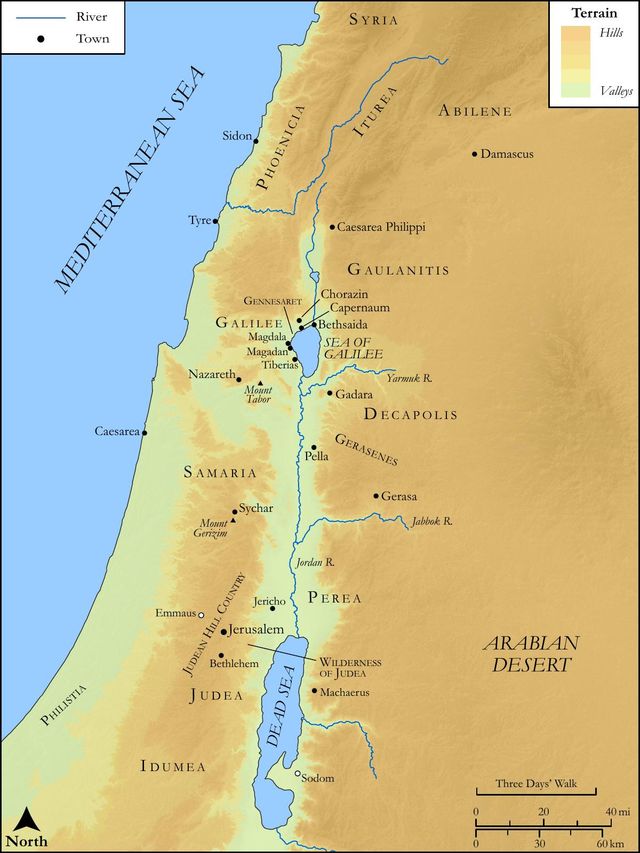
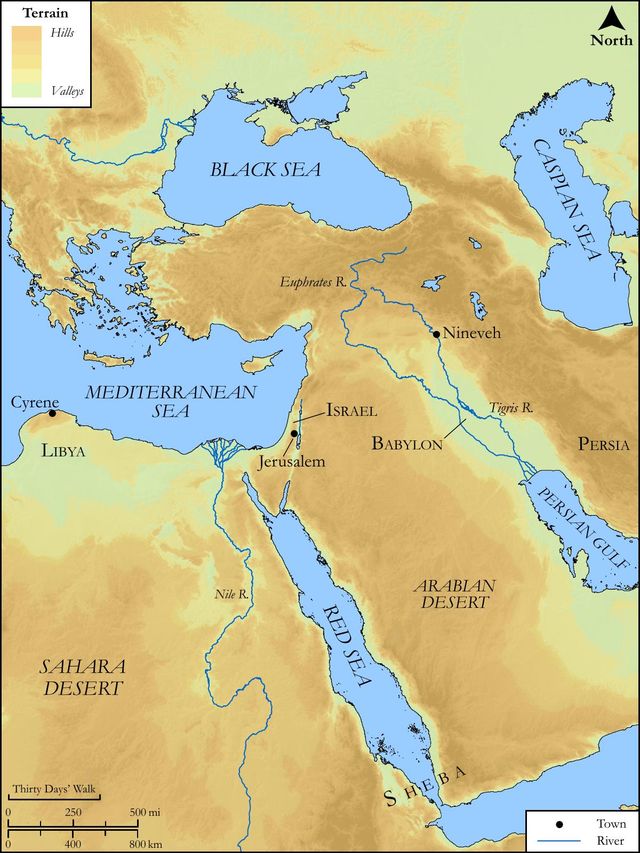
Study this verse
Public-domain commentary
Matthew Henry
From his Commentary on the Whole Bible. Henry comments on passages, not single verses — this entry covers Matthew 1:1–17. His two-level outline is real structure in the source text, so it is rendered as structure.
Concerning this genealogy of our Saviour, observe,
I.The title of it.
It is the book (or the account, as the Hebrew word sepher, a book, sometimes signifies) of the generation of Jesus Christ, of his ancestors according to the flesh; or, It is the narrative of his birth. It is Biblos Geneseōs - a book of Genesis. The Old Testament begins with the book of the generation of the world, and it is its glory that it does so; but the glory of the New Testament herein excelleth, that it begins with the book of the generation of him that made the world. As God, his outgoings were of old, from everlasting (Mic 5:2), and none can declare that generation; but, as man, he was sent forth in the fulness of time, born of a woman, and it is that generation which is here declared.
II.The principal intention of it.
It is not an endless or needless genealogy; it is not a vain-glorious one, as those of great men commonly are. Stemmata, quid faciunt? - Of what avail are ancient pedigrees? It is like a pedigree given in evidence, to prove a title, and make out a claim; the design is to prove that our Lord Jesus is the son of David, and the son of Abraham, and therefore of that nation and family out of which the Messiah was to arise. Abraham and David were, in their day, the great trustees of the promise relating to the Messiah. The promise of the blessing was made to Abraham and his seed, of the dominion to David and his seed; and they who would have an interest in Christ, as the son of Abraham, in whom all the families of the earth are to be blessed, must be faithful, loyal subjects to him as the son of David, by whom all the families of the earth are to be ruled. It was promised to Abraham that Christ should descend from him (Gen 12:3; Gen 22:18), and to David that he should descend from him (Sa2 7:12; Psa 89:3, etc.; Psa 132:11); and therefore, unless it can be proved that Jesus is a son of David, and a son of Abraham, we cannot admit him to be the Messiah. Now this is here proved from the authentic records of the heralds' offices. The Jews were very exact in preserving their pedigrees, and there was a providence in it, for the clearing up of the descent of the Messiah from the fathers; and since his coming that nation is so dispersed and confounded that it is a question whether any person in the world can legally prove himself to be a son of Abraham; however, it is certain that none can prove himself to either a son of Aaron or a son of David, so that the priestly and kingly office must either be given up, as lost for ever, or be lodged in the hands of our Lord Jesus. Christ is here first called the son of David, because under that title he was commonly spoken of, and expected, among the Jews. They who owned him to be the Christ, called him the son of David, Mat 15:22; Mat 20:31; Mat 21:15. Thus, therefore, the evangelist undertakes to make out, that he is not only a son of David, but that son of David on whose shoulders the government was to be; not only a son of Abraham, but that son of Abraham who was to be the father of many nations.
In calling Christ the son of David, and the son of Abraham, he shows that God is faithful to his promise, and will make good every word that he has spoken; and this. 1. Though the performance be long deferred. When God promised Abraham a son, who should be the great blessing of the world, perhaps he expected it should be his immediate son; but it proved to be one at the distance of forty-two generations, and about 2000 years: so long before can God foretel what shall be done, and so long after, sometimes, does God fulfil what has been promised. Note, Delays of promised mercies, though they exercise our patience, do not weaken God's promise. 2. Though it begin to be despaired of. This son of David, and son of Abraham, who was to be the glory of his Father's house, was born when the seed of Abraham was a despised people, recently become tributary to the Roman yoke, and when the house of David was buried in obscurity; for Christ was to be a root out of a dry ground. Note, God's time for the performance of his promises is when it labours under the greatest improbabilities.
III.The particular series of it, drawn in the direct line from Abraham downward, according to the genealogies recorded in the beginning of the books of Chronicles (as far as those go), and which here we see the use of.
Some particulars we may observe in the genealogy.
1.Among the ancestors of Christ who had brethren, generally he descended from a younger brother; such Abraham himself was, and Jacob, and Judah, and David, and Nathan, and Rhesa; to show that the pre-eminence of Christ came not, as that of earthly princes, from the primogeniture of his ancestors, but from the will of God, who, according to the method of his providence, exalteth them of low degree, and puts more abundant honour upon that part which lacked.
2.Among the sons of Jacob, besides Judah, from whom Shiloh came, notice is here taken of his brethren: Judas and his brethren. No mention is made of Ishmael the son of Abraham, or of Esau the son of Isaac, because they were shut out of the church; whereas all the children of Jacob were taken in, and, though not fathers of Christ, were yet patriarchs of the church (Act 7:8), and therefore are mentioned in the genealogy, for the encouragement of the twelve tribes that were scattered abroad, intimating to them that they have an interest in Christ, and stand in relation to him as well as Judah.
3.Phares and Zara, the twin-sons of Judah, are likewise both named, though Phares only was Christ's ancestor, for the same reason that the brethren of Judah are taken notice of; and some think because the birth of Phares and Zara had something of an allegory in it. Zara put out his hand first, as the first-born, but, drawing it in, Phares got the birth-right. The Jewish church, like Zara, reached first at the birthright, but through unbelief, withdrawing the hand, the Gentile church, like Phares, broke forth and went away with the birthright; and thus blindness is in part happened unto Israel, till the fulness of the Gentiles become in, and then Zara shall be born - all Israel shall be saved, Rom 11:25, Rom 11:26.
4.There are four women, and but four, named in this genealogy; two of them were originally strangers to the commonwealth of Israel, Rachab a Canaanitess, and a harlot besides, and Ruth the Moabitess; for in Jesus Christ there is neither Greek, nor Jew; those that are strangers and foreigners are welcome, in Christ, to the citizenship of the saints. The other two were adulteresses, Tamar and Bathsheba; which was a further mark of humiliation put upon our Lord Jesus, that not only he descended from such, but that is decent from them is particularly remarked in his genealogy, and no veil drawn over it. He took upon him the likeness of sinful flesh (Rom 8:3), and takes even great sinners, upon their repentance, into the nearest relation to himself. Note, We ought not to upbraid people with the scandals of their ancestors; it is what they cannot help, and has been the lot of the best, even of our Master himself. David's begetting Solomon of her that had been the wife of Urias is taken notice of (says Dr. Whitby) to show that the crime of David, being repented to, was so far from hindering the promise made to him, that it pleased God by this very woman to fulfil it.
5.Though divers kings are here named, yet none is expressly called a king but David (Mat 1:6), David the king; because with him the covenant of royalty was made, and to him the promise of the kingdom of the Messiah was given, who is therefore said to inherit the throne of his father David, Luk 1:32.
6.In the pedigree of the kings of Judah, between Joram and Ozias (Mat 1:8), there are three left out, namely, Ahaziah, Joash, and Amaziah; and therefore when it is said, Joram begat Ozias, it is meant, according to the usage of the Hebrew tongue, that Ozias was lineally descended from him, as it is said to Hezekiah that the sons which he should beget should be carried to Babylon, whereas they were removed several generations from him. It was not through mistake or forgetfulness that these three were omitted, but, probably, they were omitted in the genealogical tables that the evangelist consulted, which yet were admitted as authentic. Some give this reason for it: - It being Matthew's design, for the sake of memory, to reduce the number of Christ's ancestors to three fourteens, it was requisite that in this period three should be left out, and none more fit than they who were the immediate progeny of cursed Athaliah, who introduced the idolatry of Ahab into the house of David, for which this brand is set upon the family and the iniquity thus visited to the third and fourth generation. Two of these three were apostates; and such God commonly sets a mark of his displeasure upon in this world: they all three had their heads brought to the grave with blood.
7.Some observe what a mixture there was of good and bad in the succession of these kings; as for instance (Mat 1:7, Mat 1:8), wicked Roboam begat wicked Abia; wicked Abia begat good Asa; good Asa begat good Josaphat; good Josaphat begat wicked Joram. Grace does not run in the blood, neither does reigning sin. God's grace is his own, and he gives or withholds it as he pleases.
8.The captivity of Babylon is mentioned as a remarkable period in this line, Mat 1:11, Mat 1:12. All things considered, it was a wonder that the Jews were not lost in that captivity, as other nations have been; but this intimates the reason why the streams of that people were kept to run pure through that dead sea, because from them, as concerning the flesh, Christ was to come. Destroy it not, for a blessing is in it, even that blessing of blessings, Christ himself, Isa 65:8, Isa 65:9. It was with an eye to him that they were restored, and the desolations of the sanctuary were looked upon with favour for the Lord's sake, Dan 9:17.
9.Josias is said to beget Jechonias and his brethren (Mat 1:11); by Jechonias here is meant Jehoiakim, who was the first-born of Josias; but, when it is said (Mat 1:12) that Jechonias begat Salathiel, that Jechonias was the son of that Jehoiakim who was carried into Babylon, and there begat Salathiel (as Dr. Whitby shows), and, when Jechonias is said to have been written childless (Jer 22:30), it is explained thus: No man of his seed shall prosper. Salathiel is here said to beget Zorobabel, whereas Salathiel begat Pedaiah, and he begat Zorobabel (Ch1 3:19): but, as before, the grandson is often called the son; Pedaiah, it is likely, died in his father's lifetime, and so his son Zorobabel was called the son of Salathiel.
10.The line is brought down, not to Mary the mother of our Lord, but to Joseph the husband of Mary (Mat 1:16); for the Jews always reckoned their genealogies by the males: yet Mary was of the same tribe and family with Joseph, so that, both by his mother and by his supposed father, he was of the house of David; yet his interest in that dignity is derived by Joseph, to whom really according to the flesh he had no relation, to show that the kingdom of the Messiah is not founded in a natural descent from David.
11.The centre in whom all these lines meet is Jesus, who is called Christ, Mat 1:16. This is he that was so importunately desired, so impatiently expected, and to whom the patriarchs had an eye when they were so desirous of children, that they might have the honour of coming into the sacred line. Blessed be God, we are not now in such a dark and cloudy state of expectation as they were then in, but see clearly what these prophets and kings saw as through a glass darkly. And we may have, if it be not our own fault, a greater honour than that of which they were so ambitious: for they who do the will of God are in a more honourable relation to Christ than those who were akin to him according to the flesh, Mat 12:50. Jesus is called Christ, that is, the Anointed, the same with the Hebrew name Messiah. He is called Messiah the Prince (Dan 9:25), and often God's Anointed (Psa 2:2). Under this character he was expected: Art thou the Christ - the anointed one? David, the king, was anointed (Sa1 16:13); so was Aaron, the priest (Lev 8:12), and Elisha, the prophet (Kg1 19:16), and Isaiah, the prophet (Isa 61:1). Christ, being appointed to, and qualified for, all these offices, is therefore called the Anointed - anointed with the oil of gladness above his fellows; and from this name of his, which is as ointment poured forth, all his followers are called Christians, for they also have received the anointing.
Lastly. The general summary of all this genealogy we have, Mat 1:17, where it is summed up in three fourteens, signalized by remarkable periods. In the first fourteen, we have the family of David rising, and looking forth as the morning; in the second, we have it flourishing in its meridian lustre; in the third, we have it declining and growing less and less, dwindling into the family of a poor carpenter, and then Christ shines forth out of it, the glory of his people Israel.
Historical interpretation
Eleven Centuries of Reception
18 surviving comments on this verse. Each one is dated, so this reads as a timeline rather than a list.
Select a marker to jump to its quote. Markers stagger vertically where authors wrote within a few decades of each other.
But to what shifts you resort, in your attempt to rob the syllable ex (of) of its proper force as a preposition, and to substitute another for it in a sense not found throughout the Holy Scriptures! You say that He was born through a virgin, not of a virgin, and in a womb, not of a womb, because the angel in the dream said to Joseph, "That which is born in her" (not of her) "is of the Holy Ghost." But the fact is, if he had meant "of her," he must have said "in her; "for that which was of her, was also in her. The angel's expression, therefore, "in her," has precisely the same meaning as the phrase "of her." It is, however, a fortunate circumstance that Matthew also, when tracing down the Lord's descent from Abraham to Mary, says, "Jacob begat Joseph the husband of Mary, of whom was born Christ."
(Hist. Eccles. 1.7.) For Matthan and Melchi at different periods had each a son by one and the same wife Jesca. Matthan, who traced through Solomon, first had her, and died leaving one son, Jacob by name. As the Law forbade not a widow, either dismissed from her husband, or after the death of her husband, to be married to another, so Melchi, who traced through Matthan, being of the same tribe but of another race, took this widow to his wife, and begat Heli his son. Thus shall we find Jacob and Heli, though of a different race, yet by the same mother, to have been brethren. One of whom, namely Jacob, after Heli his brother was deceased without issue, married his wife, and begat on her the third, Joseph, by nature indeed and reason his own son; whereupon also it is written, And Jacob begat Joseph. But by the Law, he was the son of Heli; for Jacob, being his brother, raised up seed to him. Thus the genealogy, both as recited by Matthew, and by Luke, stands right and true; Matthew saying, And Jacob begot Joseph; Luke saying, Which was the son, as it was supposed, (for he adds this withal,) of Joseph, which was the son of Heli, which was the son of Melchi. Nor could he have more significantly or properly expressed that way of generation according to the Law, which was made by a certain adoption that had respect to the dead, carefully leaving out the word begetting throughout even to the end.
(ubi sup.) Neither does this lack good authority; nor has it been suddenly devised by us for this purpose. For the kinsmen of our Saviour according to the flesh, either out of desire to show forth this their so great nobility of stock, or simply for the truth's sake, have delivered it unto us.
Hist. Eccles. i, 7: For Mat than and Mel chi at different periods had each a sonby one and the same wife Jesca. Mat than, who traced through Solomon, first hadher, and died leaving one son, Jacob by name. As the Law forbade not a widow, either dismissed from her husband, or after the death of her husband, to be married to another, so Mel chi, who traced through Mat than, being of the same tribe but of another race, took this widow to his wife, and begat Heli his son. Thus shall we find Jacob and Heli, though of a different race, yet by the same mother, to have been brethren. One of whom, namely Jacob, after Heli his brother was deceased without issue, married his wife, and begat on her the third, Joseph, by nature indeed and reason his own son. Whereupon also it is written, “And Jacob begat Joseph.” But by the Law, he was the son of Heli; for Jacob, being his brother, raised up seed tohim.Nor could he have more significantly or properly expressed that way of generation according to the Law, which was made by a certain adoption that had respect to the dead, carefully leaving out the word “begetting” throughout even to the end.
Neither does this lack good authority; nor has it been suddenly devised by us for this purpose. For the kinsmen of our Saviour according to the flesh, either out of desire to show forth this their so great nobility of stock, or simply for the truth’s sake, have delivered it unto us.
Quaest. Nov. et Vet. Test. q. 49: What God conveyed by the anointing of oil to those who were anointed to be kings, this the Holy Spirit conveyed upon the man Christ, adding thereto the expiation; wherefore when born He was called Christ; and thus it proceeds, “who is called Christ.”
(Quæst. Nov. et Vet. Test. q. 49.) What God conveyed by the anointing of oil to those who were anointed to be kings, this the Holy Spirit conveyed upon the man Christ, adding thereto the expiation; wherefore when born He was called Christ; and thus it proceeds, who is called Christ.
(Hom. iv.) Having gone through all the ancestry, and ended in Joseph, he adds, The husband of Mary, thereby declaring that it was for her sake that he was included in the genealogy.
Having then mentioned all His forefathers, and ending with Joseph, he did not stop at this, but added, "Joseph the husband of Mary;" intimating that it was for her sake he traced his genealogy also. Then, lest when thou hast heard of the "husband of Mary," thou shouldest suppose that Christ was born after the common law of nature, mark, how he sets it right by that which follows. "Thou hast heard," saith he, "of an husband, thou hast heard of a mother, thou hast heard a name assigned to the child, therefore hear the manner too of the birth."
This passage is objected to us by the Emperor Julian in his Discrepancy of the Evangelists. Matthew calls Joseph the son of Jacob, Luke makes him the son of Heli. He did not know the Scripture manner, one was his father by nature, the other by law. For we know that God commanded by Moses, that if a brother or near kinsman died without children, another should take his wife, to raise up seed to his brother or kinsman. (Deut. 25.) But of this matter Africanus the chronologistp, and Eusebius of Cæsarca, have disputed more fully.
When you hear this word husband, do not straight bethink you of wedlock, but remember the Scripture manner, which calls persons only betrothed husband and wife.
The attentive reader may ask, Seeing Joseph was not the father of the Lord and Saviour, how does his genealogy traced down to him in order pertain to the Lord? We will answer, first, that it is not the practice of Scripture to follow the female line in its genealogies; secondly, that Joseph and Mary were of the same tribe, and that he was thence compelled to take her to wife as a kinsman, and they were enrolled together at Bethlehem, as being come of one stock.
(Ver. 16) But Jacob begot Joseph. Here Julianus Augustus has presented to us the disagreement of the Evangelists, why the evangelist Matthew called Joseph the son of Jacob, and Luke called him the son of Heli; not understanding the custom of the Scriptures, that one is according to nature, the other according to the Law his father. For we know this by the command of God given through Moses, that if a brother or relative without children dies, another should take his wife to raise up offspring for his brother or relative (Deut. II). Both Africanus, a historian of the time, and Eusebius of Caesarea extensively debated in their books the discrepancies in the Gospels.
(De Cons. Evang. ii. 2.) He is more properly called his son, by whom he was adopted, than had he been said to have been begotten of him of whose flesh he was not born. Wherefore Matthew, in saying Abraham begot Isaac, and continuing the same phrase throughout down to Jacob begot Joseph, sufficiently declares that he gives the father according to the order of nature, so as that we must hold Joseph to have been begotten, not adopted, by Jacob. Though even if Luke had used the word begotten, we need not have thought it any serious objection; for it is not absurd to say of an adopted son that he is begotten, not after the flesh, but by affection.
(De Cons. Evang. ii. 4.) And suitably does Luke, who relates Christ's ancestry not in the opening of his Gospel, but at his baptism, follow the line of adoption, as thus more clearly pointing Him out as the Priest that should make atonement for sin. For by adoption we are made the sons of God, by believing in the Son of God. But by the descent according to the flesh which Matthew follows, we rather see that the Son of God was for us made man. Luke sufficiently shows that he called Joseph the son of Heli, because he was adopted by Heli, by his calling Adam the son of God, which he was by grace, as he was set in Paradise, though he lost it afterwards by sinning.
(De Hæres. ii.) This is said against Valentinus, who taught that Christ took nothing of the Virgin Mary, but passed through her as through a channel or pipe.
Wherefore it pleased Him to take flesh of the womb of a woman, is known in His own secret counsels; whether that He might confer honour on both sexes alike, by taking the form of a man, and being born of a woman, or from some other reason which I would not hastily pronounce on.
(De Cons. Evang. ii. 1.) It was not lawful that he should think to separate himself from Mary for this, that she brought forth Christ as yet a Virgin. And herein may the faithful gather, that if they be married, and preserve strict continence on both sides, yet may their wedlock hold with union of love only, without carnal; for here they see that it is possible that a son be born without carnal embrace.
(De Nupt. et Concup. i. 11.) In Christ's parents was accomplished every good benefit of marriage, fidelity, progeny, and a sacrament. The progeny we see in the Lord Himself; fidelity, for there was no adultery; sacrament, for there was no divorce.
(ubi sup.) Also, the line of descent ought to be brought down to Joseph, that in wedlock no wrong might be done to the male sex, as the more worthy, provided only nothing was taken away from the truth; because Mary was of the seed of David.
(Id. non occ.) Hence then we believe that Mary was in the line of David; namely, because we believe the Scripture which affirms two things, both that Christ was of the seed of David according to the flesh, and that He should be conceived of Mary not by knowledge of man, but as yet a virgin.
Since he thus related that Christ was born from Mary as a virgin and not as a result of intercourse with Joseph, for what reason does Matthew call him his father, if not because we understand Joseph to be truly the husband of Mary, not through intercourse of the flesh but in virtue of the genuine spiritual union of marriage?… All this suggests that Luke’s phrase, “as was supposed,” was inserted with a view of correcting those of the opinion that he was born from Joseph in the same way that others are born.
Matthew relates the human lineage of Christ in this way: After recounting the fathers from Abraham, he continues to Joseph, the husband of Mary, from whom Jesus was born. It is not fitting to think of Joseph apart from his marriage to Mary, who bore Christ as a virgin and not from intercourse with him. For by his example an incomparable commendation is made to faithful married persons of the principle that even when by common consent they maintain their continence, the marital relation can still remain steadfast and still be rightly called one of wedlock, not by virtue of physical intercourse but by the heart’s affection. This is especially so because it was possible for a son to be born to them without bodily embrace, which is intended within the purpose of procreation. Furthermore, Joseph should not have been denied being called Christ’s father on the basis that he did not beget him through intercourse. For if he had adopted a child from another, he would have rightly been the father of one who was not even born from his own wife.Indeed, Christ was even considered by some to be the son of Joseph, just as if he had been simply born of his flesh. But this was believed by those who did not know of Mary’s virginity. Luke says, “Jesus, when he began his ministry, was about thirty years of age, being the son (as was supposed) of Joseph.” Instead of naming Mary his only parent, he had not the slightest hesitation in also speaking of both parties as his parents when he says, “And the child grew and became strong, filled with wisdom; and the favor of God was upon him. Now his parents went to Jerusalem every year at the feast of the Passover.” Lest any imagine that by the “parents” here was meant only Mary and her blood relations, we do well to recall that preceding word of Luke: “And his father and mother marveled at what was said about him.”
Herein we must beware of the error of Nestorius, who thus speaks; "When Divine Scripture is to speak either of the birth of Christ which is of the Virgin Mary, or His death, it is never seen to put God, but either, Christ, or Son, or Lord; since these three are significative of the two natures, sometimes of this, sometimes of that, and sometimes of both this and that together. And here is a testimony to this, Jacob begot Joseph the husband of Mary, of whom was born Jesus, who is called Christ. For God the Word needed not a second birth of a woman."
(Vigil. Cont. Fel. 12. ap. Aug. t. 8. p. 45.) But not one was the Son of God, and another the son of a man; but the same Christ was the Son of both God and man. And as in one man, the soul is one and the body is another, so in the mediator between God and man, the Son of God was one, and the son of man another; yet of both together was one Christ the Lord. Two in distinction of substance, one in unity of Person. But the heretic objects; "how can you teach Him to have been born in time whom you say was before coeternal with His Father? For birth is as it were a motion of a thing not in being, before it be born, bringing about this, that by benefit of birth it come into being. Whence it is concluded, that He who was in being cannot be born; if He could be born He was not in being." (To this it is replied by Augustine;) Let us imagine, as many will have it, that the universe has a general soul, which by some unspeakable motion gives life to all seeds, so as that itself is not mixed up with the things it produces. When this then passes forth into the womb to form passible matter to its own uses, it makes one with itself the person of that thing which it is clear has not the same substance. And thus, the soul being active and the matter passive, of two substances is made one man, the soul and the flesh being distinct; thus it is that our confession is, that that soul is born of the womb which in coming to the womb we say conferred life on the thing conceived. He, I say, is said to be born of His mother, who shaped to Himself a body out of her, in which He might be born; not as though before He was born, His mother might, as far as pertained to Him, not have been in being. In like manner, yea in a manner yet more incomprehensible and sublime, the Son of God was born, by taking on Him perfect manhood of his Mother. He who by his singular almighty power is the cause of their being born to all things that are born.
(De Eccles. Dog. 2.) The Son of God was born of human flesh, that is of Mary, and not by man after the way of nature, as Ebion says; and accordingly it is significantly added, Of her Jesus was born.
But let us see what moral signification these names contain. After Jeconias, which means 'the preparation of the Lord,' follows Salathiel, i. e. 'God is my petition,' for he who is rightly prepared, prays not but of God. Again, he becomes Zorobabel, 'the master of Babylon,' that is, of the men of the earth, whom he makes to know concerning God, that He is their Father, which is signified in Abiud. Then that people rise again from their vices, whence follows Eliacim, 'the resurrection;' and thence rise to good works, which is Azor, and becomes Sadoch, i. e. 'righteous;' and then they are taught the love of their neighbour. He is my brother, which is signified in Achim; and through love to God he says of Him, 'My God,' which Eliud signifies. Then follows Eleazar, i. e. 'God is my helper;' he recognizes God as his helper. But whereto he tends is shown in Matthan, which is interpreted 'gift,' or 'giving;' for he looks to God as his benefactor; and as he wrestled with and overcame his vices in the beginning, so he does in the end of life, which belongs to Jacob, and thus he reaches Joseph, that is, 'The increase of virtues.'
Why does he give the genealogy of Joseph and not of Mary, the Theotokos? What participation did Joseph have in that seedless birth giving? Surely Joseph was not the true father of Jesus, so that Matthew could give Christ’s genealogy through Joseph? Listen then: Joseph truly had no share in the birth of Christ; and therefore the genealogy of the Theotokos ought to have been given. But as it was not lawful to reckon ancestry through the mother, he did not give the genealogy of the Virgin. And yet, by giving the genealogy of Joseph, Matthew gave her genealogy as well. For it was the law that a woman was not to be taken as wife by a man who was of a different tribe and who was not of her father’s lineage (Num. 36:8-9). This being the law, it is obvious that Joseph’s genealogy includes that of the Theotokos, for she was of the same tribe and the same lineage. If she were not, she could not have been betrothed to him. So the evangelist both kept the law which forbade the reckoning of ancestry through the mother, and at the same time provided the genealogy of the Theotokos by giving the genealogy of Joseph. He calls Joseph "the husband of Mary," according to the common practice. For we are accustomed to call the man who is betrothed the "husband" of her who is betrothed, even before the marriage has taken place.
In the last place, after all the patriarchs, he sets down Joseph the husband of Mary, for whose sake all the rest are introduced, saying, But Jacob begot Joseph.
Continue studying Matthew 1:16 across the web’s major study libraries — every link below opens this exact verse, chapter, or book on the destination site.
Read & Compare
 BibleGatewayThis verse in more than 200 translations and 70 languages.
 Bible.comThe YouVersion reader — hundreds of translations, reading plans, and highlights.
 ESV.orgCrossway's official English Standard Version reader.
 NET BibleThe NET translation with 60,000+ translators' notes on every rendering decision.
 STEP BibleTyndale House's free study tool — original text, vocabulary, and scholarly resources.
 BibliaLogos Bible Software's free web reader.
 USCCBThe New American Bible (Revised Edition) with the U.S. bishops' study notes.
Commentaries
 BibleHub CommentariesDozens of classic commentaries on this verse, gathered on one page.
 StudyLightMore than 100 commentary sets — the largest collection on the web.
 BibleRefPlain-English commentary on what this verse means, verse by verse.
 Enduring WordDavid Guzik's free commentary on this chapter, widely used by Bible teachers.
 Bible Study ToolsVerse commentary alongside Greek and Hebrew study aids.
Original Language & Research
- BibleHub InterlinearThe verse word by word — original language, transliteration, and English.
- BibleHub LexiconEvery word's original-language definition and Strong's entry.
 Blue Letter BibleDeep-study tools — Strong's numbers, concordance, and word studies.
 CNTR CollationThe earliest Greek manuscripts of this verse, collated letter by letter.
Sermons, Hymns & Audio


TrulyRandomVerse is not affiliated with these sites and doesn’t control their content. They’re linked because they’re genuinely useful.
Summary
Matthew 1:16 serves as the climactic verse in Matthew's opening genealogy, meticulously tracing the lineage of Jesus Christ through Joseph, His legal father, back to Abraham. This verse uniquely pivots from the repetitive "begat" formula to highlight the miraculous birth of Jesus "of whom" (Mary), thereby affirming both Jesus' legal claim to the Davidic throne through Joseph and His divine origin through the virgin birth. It culminates the ancestral record by definitively identifying Jesus as the long-awaited Messiah, the Christ, setting the stage for the unfolding narrative of His life, ministry, and redemptive work.
Context
ShowHideLiterary Context
Matthew 1:16 stands as the culminating point of Matthew's meticulously structured genealogy, which began in Matthew 1:1. The preceding verses, from Matthew 1:2 through Matthew 1:15, consistently employ the Greek verb egennēsen ("begat") to denote direct paternal lineage. However, verse 16 introduces a crucial grammatical and theological shift. While it states that "Jacob begat Joseph," it deliberately avoids saying Joseph begat Jesus. Instead, it uses the passive voice and a prepositional phrase, "of whom was born Jesus," to emphasize Mary's unique role and the non-biological fatherhood of Joseph, subtly yet powerfully affirming the virgin birth. This careful phrasing prepares the reader for the detailed account of Jesus' miraculous conception and birth that immediately follows in Matthew 1:18-25. The genealogy itself is structured into three sets of fourteen generations, a mnemonic device that underscores Jesus' identity as the fulfillment of God's covenant promises, particularly to David.
Historical & Cultural Context
Genealogies were profoundly significant in ancient Jewish culture, serving as vital records of identity, inheritance, and tribal affiliation. To be recognized as a legitimate heir or to hold a particular office (like king or priest), one's lineage had to be verifiable. Matthew's genealogy, therefore, establishes Jesus' credentials within this cultural framework, demonstrating His rightful claim to the throne of David, a crucial requirement for the Messiah. The mention of Joseph as "the husband of Mary" is key, as Jewish law recognized the legal fatherhood of the husband, even in cases of non-biological paternity, thereby securing Jesus' legal Davidic lineage. The expectation of a Messiah, an "Anointed One" from the line of David, was deeply ingrained in Jewish hope, fueled by centuries of prophetic utterances (e.g., 2 Samuel 7:12-16). Matthew's deliberate inclusion of women in the genealogy (Tamar, Rahab, Ruth, and the wife of Uriah) also foreshadows the inclusive nature of God's redemptive plan, culminating in Mary, through whom salvation comes to all.
Key Themes
ShowHideThis verse encapsulates several pivotal theological and narrative themes central to Matthew's Gospel. Firstly, it underscores the Messianic Identity of Jesus. By explicitly calling Him "Christ" (Greek for "Anointed One," equivalent to the Hebrew "Messiah"), Matthew declares that Jesus is the long-awaited deliverer and King, fulfilling the prophecies concerning the promised redeemer, particularly the Davidic covenant found in 2 Samuel 7. Secondly, it highlights the Virgin Birth and the divine origin of Jesus. The distinct phrasing "of whom was born Jesus" (rather than "Joseph begat Jesus") subtly yet powerfully points to a unique, supernatural conception, setting Jesus apart from all human lineage. This truth is foundational to Christian theology and is further elaborated in Matthew 1:18-25 and Luke 1:34-35. Thirdly, it affirms Jesus' Legal Lineage to David. Despite the virgin birth, Joseph's role as Mary's husband provides the crucial legal link, ensuring that Jesus fulfills the requirement that the Messiah be a descendant of King David, solidifying His claim as the rightful heir to the throne of Israel. This meticulous record emphasizes God's faithfulness in bringing His redemptive plan to fruition through human history.
Exposition and Analysis
ShowHideKey Word Analysis
ShowHideThis verb, used extensively throughout the preceding genealogy (G1080), signifies procreation, typically of a father. Its use for Jacob begetting Joseph maintains the pattern. However, its deliberate omission in relation to Joseph and Jesus, replaced by a passive construction, is profoundly significant. It highlights that Joseph did not biologically father Jesus, thus emphasizing the unique, divine conception of Jesus through Mary. The shift from active "begat" to passive "was born" (also gennáō in a different form) is a grammatical pivot that carries immense theological weight, signaling a break in the natural chain of human procreation.
This term (G435) specifically denotes a male spouse. Joseph's identification as "the husband of Mary" is crucial for establishing Jesus' legal lineage to David. In Jewish custom, the husband of the mother was considered the legal father of the child, regardless of biological paternity. This legal connection ensured that Jesus, through Joseph, was legitimately part of the Davidic line, fulfilling the Old Testament prophecies concerning the Messiah's ancestry.
Derived from chriō (to anoint), this title (G5547) means "Anointed One." It is the Greek equivalent of the Hebrew "Messiah" (mashiach). By explicitly calling Jesus "Christ" at the culmination of the genealogy, Matthew declares Jesus' identity as the long-awaited, divinely appointed King and Savior, the fulfillment of all messianic hopes and prophecies. This title is not merely a name but a declaration of His office and mission, central to Matthew's entire Gospel.
Verse Breakdown
ShowHide"And Jacob begat Joseph"
This clause continues the genealogical pattern established throughout Matthew 1, indicating the direct paternal lineage from Jacob to Joseph. It maintains the historical continuity and the legal framework through which Jesus would be identified as a descendant of David.
"the husband of Mary,"
This phrase is pivotal. It defines Joseph's relationship to Mary, establishing his legal status as her husband. This legal bond is crucial for understanding Jesus' legal claim to the Davidic throne, as Joseph, being of the house and lineage of David, would legally pass on that right to Jesus, despite not being His biological father.
"of whom was born Jesus,"
This is the theological crux of the verse. The Greek phrase ex hēs egennēthē Iēsous ("of whom was born Jesus") uses a feminine relative pronoun ("of whom," referring to Mary) and a passive verb ("was born"). This deliberate grammatical construction breaks the "begat" pattern and unequivocally indicates that Jesus' birth was not the result of Joseph's biological fatherhood but occurred uniquely through Mary, pointing to the miraculous, virgin conception by the Holy Spirit.
"who is called Christ."
This concluding phrase provides the definitive identity of Jesus. "Christ" (Messiah) is not merely a surname but a title signifying Jesus' role as the Anointed One, the long-promised King and Deliverer. This declaration at the end of the genealogy emphatically states that the historical lineage has culminated in the very person who fulfills all messianic expectations, setting the stage for the narrative of His life and ministry as the Savior of the world.
Literary Devices
ShowHideMatthew 1:16 masterfully employs several literary devices to convey its profound theological message. The most prominent is Contrast and Shift in Pattern. The consistent use of the active verb "begat" (egennēsen) throughout the preceding 15 verses creates an expectation that Joseph would also "beget" Jesus. However, the sudden and deliberate shift to the passive voice ("was born") and the specific reference to Mary ("of whom") creates a stark contrast, drawing immediate attention to the unique nature of Jesus' birth. This linguistic shift is a subtle yet powerful form of Emphasis, highlighting the virgin birth without explicitly detailing it, preparing the reader for the fuller explanation in Matthew 1:18-25. The verse also functions as a Culmination or Climax for the entire genealogy, serving as the grand finale to the ancestral record. By ending with "Jesus, who is called Christ," Matthew uses Appellation to declare Jesus' ultimate identity and purpose, framing the entire Gospel narrative around His messianic role.
Theological and Thematic Connections
ShowHideMatthew 1:16 is a theological cornerstone, linking the historical lineage of Israel to the unique person of Jesus Christ. It meticulously weaves together the themes of divine faithfulness, messianic prophecy, and the miraculous nature of God's redemptive plan. The careful distinction between Joseph "begetting" and Jesus "being born of Mary" underscores the foundational Christian doctrine of the virgin birth, affirming Jesus' dual nature as fully human (through His legal lineage to David via Joseph and Mary) and fully divine (through His unique conception by the Holy Spirit). This verse asserts that Jesus is not merely another descendant in a long line but the climactic fulfillment of God's promises, the very Messiah for whom generations had waited. It sets the stage for understanding Jesus' authority, His mission, and His ultimate sacrifice as the one who comes to save His people from their sins.
Reflection and Application
ShowHideMatthew 1:16, though seemingly a dry genealogical entry, is brimming with profound spiritual truths for contemporary believers. It reminds us that God's plan of salvation is not haphazard but meticulously orchestrated, spanning generations and culminating in the person of Jesus Christ. This verse invites us to marvel at God's faithfulness, demonstrating His unwavering commitment to His promises, even when human circumstances seem to deviate from the expected path. The unique birth of Jesus, highlighted by the linguistic shift, reassures us of His divine nature and unique authority as the Son of God, offering a firm foundation for our faith. It encourages us to trust in God's perfect timing and His sovereign hand in history, knowing that He is working all things together for His ultimate redemptive purposes. Just as every name in the genealogy played a part in God's grand narrative, so too does every aspect of our lives contribute to His unfolding plan. We are called to recognize Jesus as the Christ, the Anointed One, and to live in light of His supreme Lordship, finding our identity and purpose in Him.
Questions for Reflection
ShowHideFAQ
ShowHideWhy is Joseph mentioned in the genealogy if he is not the biological father of Jesus?
ShowHideJoseph is mentioned because, according to Jewish legal custom, he was Mary's husband and therefore Jesus' legal father. This legal connection was crucial for establishing Jesus' legitimate claim to the Davidic lineage, fulfilling the Old Testament prophecies that the Messiah would be a descendant of King David. While Joseph did not biologically "beget" Jesus, his legal fatherhood ensured that Jesus was recognized as the rightful heir to the throne of David, a key requirement for the Messiah (see 2 Samuel 7:12-16). Matthew's genealogy emphasizes this legal lineage, while simultaneously affirming the miraculous nature of Jesus' birth through Mary.
What is the significance of Jesus being "called Christ" in this verse?
ShowHideThe title "Christ" (Greek: Christós) is not a surname but a declaration of Jesus' office and identity. It is the Greek equivalent of the Hebrew term "Messiah" (mashiach), meaning "Anointed One." In ancient Israel, kings, priests, and sometimes prophets were anointed as a sign of their divine appointment. By calling Jesus "Christ," Matthew definitively declares that Jesus is the long-awaited Anointed One, the promised King and Deliverer whom God had foretold through the prophets. This title signifies His unique role as the Savior of the world and the fulfillment of all messianic hopes. It sets the theological framework for understanding Jesus' entire ministry as presented in the Gospel of Matthew.
Christ-Centered Fulfillment
ShowHideMatthew 1:16 stands as a profound Christ-centered fulfillment, serving as the hinge upon which all of redemptive history turns. The meticulously recorded genealogy, culminating in this verse, demonstrates that Jesus is the pre-ordained culmination of God's covenant promises, particularly the Davidic covenant that promised an eternal king from David's lineage (2 Samuel 7:12-16). The unique phrasing, "of whom was born Jesus," subtly yet powerfully points to the virgin birth, signifying that Jesus is not merely a product of human lineage but the God-man, the Incarnate Word (John 1:14). He is the one whose very conception was a divine act, setting Him apart as the sinless Lamb of God (John 1:29) uniquely qualified to bear the sins of the world. His designation as "Christ" declares His office as the Anointed One, the true King of Israel and the Savior of humanity, whose kingdom is not of this world (John 18:36) but extends to all who believe. Thus, Matthew 1:16 is not just a historical record; it is a theological declaration of Jesus' divine identity and His central role as the fulfillment of God's ultimate plan of salvation, through whom all humanity can find redemption and reconciliation with God (2 Corinthians 5:19).