


Matthew 20:31
Bible text: King James Version (1769 Blayney text) · Public domain
Bible text: King James Version with Strong's numbers · Public domain
Bible text: Berean Standard Bible · Public domain
Bible text: American Standard Version (1901) · Public domain
Bible text: World English Bible, Messianic edition · Public domain
Bible text: Geneva Bible (1599) · Public domain
Bible text: Young's Literal Translation · Public domain
- ὉHo<the>G3588T-NSMDefinite article Nominative Singular Masculine
- δὲdeAndG1161CONJConjunction
- ὄχλοςochlosthe crowdG3793N-NSMNoun Nominative Singular Masculine
- ἐπετίμησενepetimēsenrebukedG2008V-AAI-3SVerb Aorist Active Indicative 3rd Singular
- αὐτοῖςautoisthemG846P-DPMPersonal pronoun Dative Plural Masculine
- ἵναinathatG2443CONJConjunction
- σιωπήσωσινsiōpēsōsinthey may be silentG4623V-AAS-3PVerb Aorist Active Subjunctive 3rd Plural
- οἱhoi<the>G3588T-NPMDefinite article Nominative Plural Masculine
- δὲdeButG1161CONJConjunction
- μεῖζονmeizonall the moreG3173A-ASN-CAdjective Accusative Singular Neuter Comparative
- ἔκραξανekraxanthey cried outG2896V-AAI-3PVerb Aorist Active Indicative 3rd Plural
- λέγοντες·legontessayingG3004V-PAP-NPMVerb Present Active Participle Nominative Plural Masculine
- ἐλέησονeleēsondo have mercy onG1653V-AAM-2SVerb Aorist Active Imperative 2nd Singular
- ἡμᾶςhēmasusG3165P-1APPersonal pronoun Accusative 1st Plural
- κύριεkurieLordG2962N-VSM-TNoun Vocative Singular Masculine Person Gentilic
- υἱὸςhuiosSonG5207N-NSMNoun Nominative Singular Masculine
- ΔαυίδDauidof DavidG1138N-GSM-PNoun Genitive Singular Masculine Individual
English is a literal word-by-word gloss of the Greek, not the KJV's wording. Why?
This is the original text the KJV's translators worked from — each Greek word with its own literal English meaning in this verse, prepared by scholars at Tyndale House, Cambridge. The KJV translates whole sentences, not word by word, so its wording differs: one Greek word can become several English words, and the KJV may choose “charity” where the gloss reads “love”. Both are faithful — they answer different questions. For the KJV's own rendering, switch to the KJV text.
Details
See on the biblical-era maps

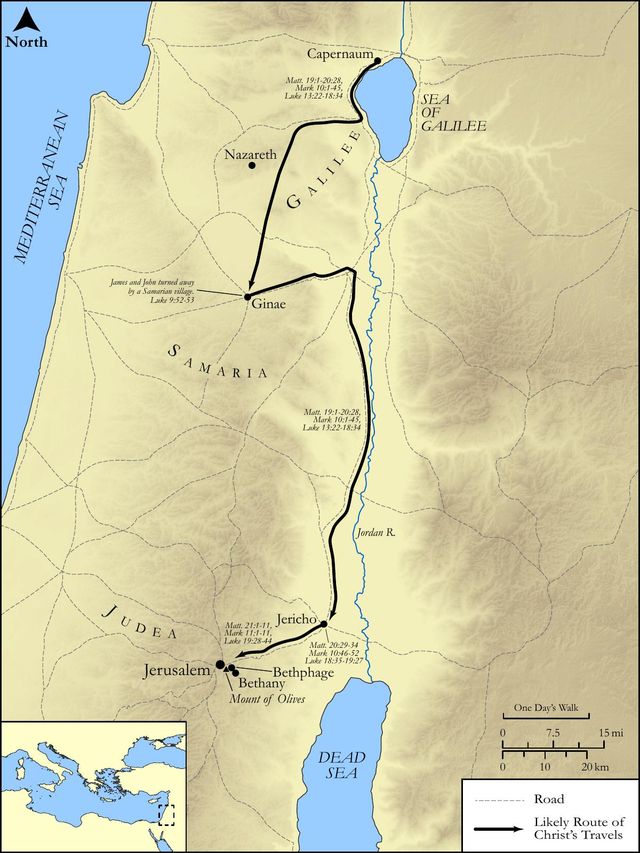
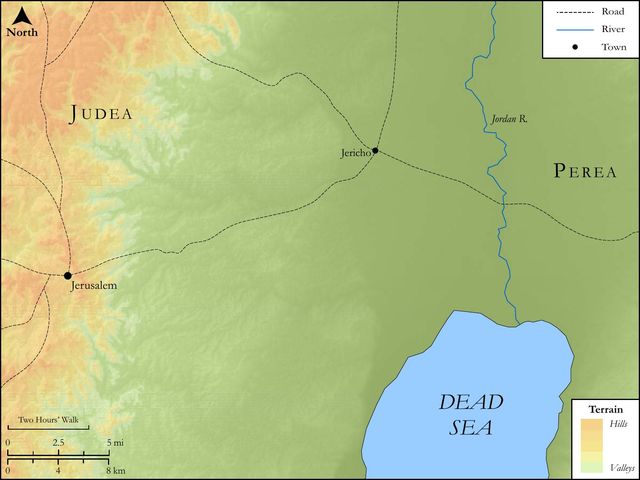
Study this verse
Historical interpretation
Six Centuries of Reception
13 surviving comments on this verse. Each one is dated, so this reads as a timeline rather than a list.
Select a marker to jump to its quote. Markers stagger vertically where authors wrote within a few decades of each other.
Or; Those that believed rebuked them that they should not dishonour Him by styling Him merely Son of David, but should rather say, Son of God, have mercy on us.
Or; Jesus does not pass on, but stands still, that by His standing His goodness may not pass by, but as from an abiding fount mercy may flow forth upon them.
Figuratively, Jericho is taken to be the world, into which Christ came down. They who are in Jericho, know not how to escape from the wisdom of the world, unless they see not Jesus only coming out of Jericho, but also His disciples. This when they saw, great multitudes followed Him, despising the world and all worldly things, that under His guidance they may go up to the heavenly Jerusalem. The two blind men we may call Judah and Israel, who before the coming of Christ were blind, not seeing the true word which was in the Law and the Prophets, yet sitting by the wayside of the Law and the Prophets, and understanding Him only as after the flesh, they cried to Him who was made of the seed of David according to the flesh.
We also now sitting by the wayside of the Scriptures, and understanding wherein we are blind, if we ask with desire, He will touch the eyes of our souls, and the gloom of ignorance shall depart from our minds, that in the light of knowledge we may follow Him, who gave us power to see to no other end than that we should follow Him.
Or, They bid them hold their peace, not from reverence for Christ, but because they were grieved to hear from the blind what they denied, namely, that the Lord was the Son of David.
Wherefore doth He ask them? Lest any one should think that when they wish to receive one thing, He giveth them another thing. For indeed it is usual with Him on every occasion, first to make manifest and discover to all the virtue of those He is healing, and then to apply the cure, for one reason, that He might lead on the others likewise to emulation; and for another, that He might show that they were enjoying the gift worthily. This, for instance, He did with respect to the Canaanitish woman also, this too in the case of the centurion, this again as to her that had the issue of blood, or rather that marvellous woman even anticipated the Lord's inquiry; but not so did He pass her by, but even after the cure makes her manifest. Such earnest care had He on every occasion to proclaim the good deeds of them that come to Him, and to show them to be much greater than they are, which He doth here also.
Then, when they said what they wished, He had compassion on them, and touched them. For this alone is the cause of their cure, for which also He came into the world. But nevertheless, although it be mercy and grace, it seeks for the worthy.
But that they were worthy is manifest, both from what they cried out, and from the fact that, when they had received, they did not hasten away, as many do, being ungrateful after the benefits. Nay, they were not like this, but were both persevering before the gift, and after the gift grateful, for "they followed Him."
But let us keep to the things set before us, and let us listen to these blind men, who were better than many that see. For neither having a guide, nor being able to see Him when come near to them, nevertheless they strove to come unto Him, and began to cry with a loud voice, and when rebuked for speaking, they cried the more. For such is the nature of an enduring soul, by the very things that hinder, it is borne up.
But Christ suffered them to be rebuked, that their earnestness might the more appear, and that thou mightest learn that worthily they enjoy the benefits of their cure. Therefore He doth not so much as ask, "Do ye believe?" as He doth with many; for their cry, and their coming unto Him, sufficed to make their faith manifest.
Hence learn, O beloved, that though we be very vile and outcast, but yet approach God with earnestness, even by ourselves we shall be able to effect whatsoever we ask. See, for instance, these men, how, having none of the apostles to plead with them, but rather many to stop their mouths, they were able to pass over the hindrances, and to come unto Jesus Himself. And yet the evangelist bears witness to no confidence of life in them, but earnestness sufficed them instead of all.
These then let us also emulate. Though God defer the gift, though there be many withdrawing us, let us not desist from asking. For in this way most of all shall we win God to us. See at least even here, how not poverty, not blindness, not their being unheard, not their being rebuked by the multitude, not anything else, impeded their exceeding earnestness. Such is the nature of a fervent and toiling soul.
How much soever you humble yourself, you cannot descend so far as did your Lord.
(Hom. lxvi.) Christ suffered them to be forbidden, that their desire might be the more evidenced. Hence learn that though we be repulsed, yet if we come to God with earnestness, of ourselves, we shall obtain that we ask. It follows, And Jesus stood still, and called them, and said, What will ye that I should do unto you?
But as before this bounty they had been persevering, so after the receiving it they were not ungrateful.
(Verse 19 onwards) And as they were departing from Jericho, a great crowd followed him. And behold, two blind men sitting by the roadside, heard that Jesus was passing by, and they cried out, saying: Lord, have mercy on us, Son of David. But the crowd rebuked them, telling them to be silent. Yet they cried out even more, saying: Lord, have mercy on us, Son of David. There were many robbers in Jericho who used to attack and harm those who were coming in and going out of Jerusalem; therefore the Lord came to Jericho with his disciples, to heal the wounded and to bring a large crowd with him. Finally, after they want to leave from Jericho, a large crowd followed him. If he had stayed in Jerusalem and never descended to the lowly things, the crowd would still be sitting in darkness and in the shadow of death until today. But there were also two blind men by the road. He calls blind those who could not yet speak: In your light we will see light (Ps. XXXV, 10). Along the road, because they seemed to have knowledge of the Law: but they were ignorant of the way, which is Christ: whom most understand as the Pharisees and Sadducees, and others as both the people, the old Testament and the New: because one, following the written Law, was blind without Christ. Because they could not see by themselves, they heard the proclamations of the Savior, and confessed him as the son of David. But if both blind men are referred to the Jewish people, what follows, 'The crowd rebuked them,' should be understood in relation to the Gentiles: whom the Apostle warns not to boast and be arrogant against their own root (Rom. 11); but since they themselves were grafted in by the error of those before them from the wild olive tree into the good olive tree, they should by no means envy the salvation of those before them. Have mercy on us, O son of David. They are reproached by the crowds, and yet they do not remain silent: but rather they repeat the same thing more frequently, so that they may show the desire for the fullness of true light.
He calls them blind because they were not yet able to say, “By your light we shall see the light.” They were ignorant of Christ’s way. They apparently had some knowledge of the law, however inadequately conceived. Some propose a spiritual interpretation here: that the two blind men are to be understood as the Pharisees and Sadducees. Others view one of them as symbolizing the people following natural law without Christ, hence blind, and the other as symbolizing people following the written law of the old covenant in a blinded way. In any event, they were not able to see for themselves. Yet they heard the announcement of the Savior’s coming. They proclaimed him Son of David.But let us suppose that each of the two blind men is blind with respect to the people of the Jews. What might it mean that the crowd rebuked them? It could suggest that the Gentile crowd was rebuking the Jews. Thus let us remember that the apostle advises those of us who are Gentiles not to boast or be haughty against our own roots in the old covenant. For we were the wild olive tree grafted on to a good olive tree. So in no way should we begrudge the salvation of the prior people of the covenant, the Jews.
Jesus stood still, because they being blind could not see their way. About Jericho were many pits, crags, and abrupt precipices; there fore the Lord stands still, that they might come to Him.
He commands that they be called to Him that the multitude may not withhold them; and He asks them what they would, that by their answer, their necessity may be made apparent, and His power be shown in their healing.
The Creator bestows what nature had not given; or at least mercy accords what weakness had withheld.
They then who had sat shut up in Jericho, and knew only to cry with their voice, afterwards follow Jesus, not so much with their feet as in their virtues.
By the two blind men are generally understood the Pharisees and Sadducees.
(Quæst. Ev. i. 28.) The two blind men sitting by the wayside, denote certain of both nations already by faith coming in to that temporal dispensation, according to which Christ is the way, and seeking to be enlightened, that is, to know something concerning the eternity of the Word. This they desired to obtain from the Lord as He passed by, for the merit of that faith by which He is believed to be the Son of God, to have been born man, and to have suffered for us; for in this dispensation, Jesus, as it were, passes by, for all action is of this world. Also it behoved that they should cry out so loud as to overpower the din of the multitude that withstood them; that is, so to fortify their minds by perseverance and prayer, and mortifying continually the usage of fleshly lusts, (which as a crowd ever beset one that is endeavouring to come to the sight of eternal truth,) and by the straitest painfulness to get the better of the multitude of carnal men who hinder spiritual aspirations.
(Serm. 88, 13.) For bad or lukewarm Christians are an hindrance to good Christians, who seek to perform the commandments of God. Notwithstanding these cry and faint not; for every Christian at his first setting about to live well and to despise the world, has to endure at the first the censures of cold Christians; but if he persevere, they will soon comply, who but now withstood him.
As the proof of the husbandman's industry lies in the abundance of his crop, so the fulness of the Church is the evidence of an industrious teacher; so it is here said, And as they departed from Jericho, a great multitude followed him. No one was deterred by the toilsomeness of the journey, for spiritual love feels no fatigue; no one was kept away by the thought of sufferings, for they were going into possession of the kingdom of heaven. For he who has in very deed tasted the reality of heavenly good, has nothing to attach him to earth. In good season these blind men come before Christ, that having their eyes opened, they may go up with Him to Jerusalem as witnesses to His power. They heard the sound of the passers by, but saw not their persons, and having nothing free about them but their voice, because they could not follow Him with their feet, they pursued Him with their voice; When they heard that Jesus passed by, they cried out, saying, Have mercy on us, O Lord, thou Son of David.
For they saw how mean their clothes, and considered not how pure their consciences. See the foolish wisdom of men! They think great men are hurt when they receive the homage of the poor. What poor man dare salute a rich man in public?
They were rather encouraged than repelled by this rebuke. For so faith is quickened by being prohibited; and hence is secure in dangers, and in security is endangered; whence it follows, But they cried out the more, saying, Have mercy upon us, Son of David. They cried out at the first because they were blind, now they rather cried out because they were forbidden to come to the Light.
Or; He asks them on account of their faith, that whereas they who were blind confess Christ to be the Son of God, those who had their sight might be put to shame for their esteeming Him only man. They had indeed called Christ Lord, and they had spoken true; but by calling Him the Son of David, they obliterated this their good confession. For indeed by a misuse of words men are called Lords, but none is truly Lord, but God only. When therefore they say, O Lord, thou Son of David, they thus misapply the term to Christ, as esteeming Him man; had they only called Him Lord, they would have confessed His Godhead. When then He asks them, What would ye? they no longer style Him Son of David, but only Lord; They say unto Him, Lord, that our eyes may be opened. For the Son of David cannot open the eyes of the blind, but the Son of God can. So long then as they cried, O Lord, thou Son of David, their cure was delayed; as soon as they said, Lord, only, healing was shed upon them; for it follows, And Jesus had compassion upon them, and touched their eyes, and straightway they saw. He touched them carnally as man, He healed them as God.
On being healed they rendered a high service to Christ; for it follows, And they followed him. For this the Lord requires of thee, according to the Prophet, that thou be careful to walk with the Lord thy God. (Mic. 6:8).
Some interpret that the two blind men are the Gentiles; one sprung from Cham, the other from Japhet; they sat by the way-side, that is, they walked hard by the truth, but they could not find it out; or they were placed in reason, not having yet received knowledge of the Word.
Accordingly Jesus touched the eyes of the Gentile mind, giving them the grace of the Holy Spirit, and when enlightened they followed Him with good works.
Christ is the way. Therefore, the two blind men [the Gentiles] were sitting on the way [yet without seeing the way]. By straying through idols, they had completely wandered from the way of truth. Degenerated in the obscurity of sins, they destroyed the eyes of the heart. Thus those sitting shouted, “Son of David, have mercy on us.” But the crowd rebuked them to become silent. But they shouted all the more: “Son of David, have mercy on us.” For with the Jews neither believing nor willing, the blinded nations were shouting all the more through faith, saying, “Son of David, have mercy on us.” And for us, dearly beloved, whether envy opposes a man or the devil holds him back in darkness, let us therefore shout the more through faith, “Son of David, have mercy on us.”
Those who precede Jesus as he comes—what do they signify but the crowds of carnal desires and the tumults of vices, which, before Jesus comes to our heart, scatter our thoughts with their temptations and disturb the voice of the heart in prayer? For often when we wish to turn to the Lord after committing sins, when we strive to pray against those very vices we have committed, the phantoms of the sins we have done rush upon the heart, strike back against the vision of our mind, confuse the soul, and suppress the voice of our entreaty. Those who went before, therefore, were rebuking him to be silent, because before Jesus comes to the heart, the evils we have done, thrust upon our thoughts through their images, disturb us in the very midst of our prayer.
But the one whom the crowd rebukes to be silent cries out more and more, because the more heavily we are pressed by the tumult of carnal thoughts, the more ardently we ought to persist in prayer.
But Jericho, which is interpreted 'the moon,' denotes the infirmity of our changefulness.
But recognizing the rumour of Christ, they desired to be made partakers of Him. Many spake against them; first the Jews, as we read in the Acts; then the Gentiles harassed them by persecution; but yet they might not deprive those who were preordained to life of salvation.
Continue studying Matthew 20:31 across the web’s major study libraries — every link below opens this exact verse, chapter, or book on the destination site.
Read & Compare
 BibleGatewayThis verse in more than 200 translations and 70 languages.
 Bible.comThe YouVersion reader — hundreds of translations, reading plans, and highlights.
 ESV.orgCrossway's official English Standard Version reader.
 NET BibleThe NET translation with 60,000+ translators' notes on every rendering decision.
 STEP BibleTyndale House's free study tool — original text, vocabulary, and scholarly resources.
 BibliaLogos Bible Software's free web reader.
 USCCBThe New American Bible (Revised Edition) with the U.S. bishops' study notes.
Commentaries
 BibleHub CommentariesDozens of classic commentaries on this verse, gathered on one page.
 StudyLightMore than 100 commentary sets — the largest collection on the web.
 BibleRefPlain-English commentary on what this verse means, verse by verse.
 Enduring WordDavid Guzik's free commentary on this chapter, widely used by Bible teachers.
 Bible Study ToolsVerse commentary alongside Greek and Hebrew study aids.
Original Language & Research
- BibleHub InterlinearThe verse word by word — original language, transliteration, and English.
- BibleHub LexiconEvery word's original-language definition and Strong's entry.
 Blue Letter BibleDeep-study tools — Strong's numbers, concordance, and word studies.
 CNTR CollationThe earliest Greek manuscripts of this verse, collated letter by letter.
Sermons, Hymns & Audio


TrulyRandomVerse is not affiliated with these sites and doesn’t control their content. They’re linked because they’re genuinely useful.
Summary
Matthew 20:31 captures a pivotal moment in Jesus' journey to Jerusalem, highlighting the persistent faith of two blind men who, despite being silenced by the surrounding multitude, intensified their cries for mercy. Their desperate plea, recognizing Jesus as "O Lord, thou Son of David," underscores their profound understanding of His messianic identity and divine authority, ultimately leading to their healing and serving as a powerful testament to the transformative power of unwavering faith in the face of opposition.
Context
ShowHideLiterary Context
This verse is situated within the broader narrative of Jesus' final journey to Jerusalem, immediately following His third prediction of His passion, death, and resurrection (Matthew 20:17-19). It directly continues the account of two blind men introduced in Matthew 20:29-30, who, upon hearing Jesus was passing by, began to cry out for mercy. The crowd's attempt to silence them in Matthew 20:31 sets up a dramatic contrast with the blind men's determined faith, culminating in Jesus' compassionate response in the subsequent verses (Matthew 20:32-34). This episode serves as a practical illustration of the principles of humility and servanthood that Jesus had just taught His disciples in Matthew 20:20-28, where He emphasized that true greatness lies in serving others, not in being served.
Historical & Cultural Context
The setting is Jericho, a prominent city near the Jordan River, serving as a gateway to Jerusalem. As Jesus and His disciples were departing Jericho, they would have been accompanied by a large crowd, likely pilgrims traveling to Jerusalem for the Passover festival. Blindness was a common affliction in ancient Israel, often leading to a life of poverty and begging, as there were no effective medical treatments. Blind individuals were frequently overlooked and dependent on the charity of others. The act of sitting by the wayside and crying out for alms was a common practice for the destitute. The crowd's rebuke of the blind men reflects a cultural inclination to maintain order and perhaps a belief that such public displays were disruptive or unseemly, especially in the presence of a respected teacher like Jesus. Their attempt to silence the men also highlights a lack of understanding or empathy for the men's desperate need, contrasting sharply with Jesus' immediate compassion.
Key Themes
ShowHideThis passage contributes significantly to several key themes within Matthew's Gospel. It powerfully illustrates the theme of faith and perseverance, as the blind men refuse to be deterred by the crowd's opposition, demonstrating an unwavering belief in Jesus' ability to heal. Their persistent crying out, despite rebuke, models the kind of earnest and unceasing prayer encouraged elsewhere in Scripture, such as in Luke 18:1-8. The repeated address, "Son of David," reinforces the theme of Jesus' messianic identity as the promised King from David's lineage, a central theological thread throughout Matthew, which often emphasizes Jesus' fulfillment of Old Testament prophecy (e.g., Matthew 1:1). Furthermore, the narrative underscores Jesus' compassion and accessibility to the lowly and suffering, a recurring motif in His ministry (e.g., Matthew 9:35-36), contrasting His welcoming nature with the crowd's dismissive attitude.
Exposition and Analysis
ShowHideKey Word Analysis
ShowHideThis verb, derived from "upon" and "to honor/value," literally means "to tax upon" or "to lay a charge upon." In this context, it signifies a strong censure, admonition, or even a prohibition. The multitude was attempting to silence the blind men by forcefully commanding them to be quiet, implying disapproval of their behavior or a desire to control the interaction with Jesus.
This primary verb describes a loud, often desperate, vocalization. It can mean to "croak" or scream, but generally refers to calling aloud, shrieking, exclaiming, or entreating. The use of this word emphasizes the intensity and urgency of the blind men's plea, indicating a profound and uninhibited expression of their dire need and faith, escalating beyond mere speaking.
This title is profoundly significant. "Son" (huiós) denotes not just physical progeny but also a strong connection, representation, or inheritor of qualities. "David" (Dabíd) refers to the Israelite king. Together, "Son of David" is a widely recognized messianic title, linking Jesus directly to the covenant God made with King David in 2 Samuel 7:12-16, promising an eternal kingdom through his descendant. The blind men's use of this title indicates their belief that Jesus was the long-awaited Messiah, the rightful King, possessing the authority and power to bring about their deliverance.
Verse Breakdown
ShowHide"And the multitude rebuked them"
As Jesus and His disciples were leaving Jericho, a large crowd followed. When the two blind men began to cry out to Jesus, this multitude, perhaps annoyed by the disruption or feeling protective of Jesus' time and space, took it upon themselves to silence the men. Their "rebuke" was an authoritative attempt to compel the blind men to cease their cries, reflecting a desire for order or a lack of compassion for the men's desperate situation.
"because they should hold their peace"
The reason for the multitude's rebuke was their expectation that the blind men should remain silent. The phrase "hold their peace" (Greek, siōpáō) implies a command for muteness or stillness. The crowd believed the men were being unruly or disrespectful by their loud pleas and sought to enforce quiet, perhaps to maintain a more solemn or orderly procession.
"but they cried the more, saying"
In stark contrast to the crowd's command, the blind men did not comply. The conjunction "but" (Greek, dé) introduces a strong opposition. Instead of being silenced, they intensified their cries, demonstrating remarkable persistence and an unyielding determination. The phrase "the more" (Greek, meîzon) emphasizes the increased volume and fervor of their pleas, indicating that the rebuke only fueled their desperation and resolve.
"Have mercy on us, O Lord, [thou] Son of David."
This is the substance of their intensified cry. "Have mercy" (Greek, eleéō) is a plea for compassionate intervention, acknowledging their state of need and Jesus' power to alleviate it. The address "O Lord" (Greek, kýrios) signifies respect and recognition of Jesus' authority and mastery. Crucially, the addition of "[thou] Son of David" is a direct and profound recognition of Jesus' messianic identity. By using this royal title, they were not merely asking for pity but appealing to Jesus as the promised King, the one with divine authority to heal and restore, demonstrating a faith that saw beyond their physical blindness to Jesus' true nature.
Literary Devices
ShowHideMatthew 20:31 masterfully employs several literary devices to enhance its impact. Contrast is prominent, highlighting the stark difference between the unfeeling multitude, who seek to silence the suffering, and the persistent, faith-filled blind men. This also sets up a contrast with Jesus' ultimate compassion, which stands apart from the crowd's reaction. Irony is also present, as the physically blind men possess a deeper spiritual insight into Jesus' identity as the "Son of David" than the seeing crowd, who fail to recognize or respect His true nature and mission. Their spiritual blindness is juxtaposed against the physical blindness of those who can truly "see" who Jesus is. Furthermore, the intensified crying of the blind men, despite being rebuked, serves as a powerful instance of hyperbole or escalation, emphasizing their unwavering determination and the urgency of their plea, making their faith all the more striking.
Theological and Thematic Connections
ShowHideThe unwavering persistence of the two blind men in Matthew 20:31 serves as a profound theological statement on the nature of faith and prayer. Despite external opposition from the multitude, their desperate need and deep-seated conviction regarding Jesus' identity compelled them to cry out "the more." This act underscores the biblical principle that true faith is not easily deterred but perseveres in the face of obstacles, trusting in God's power and compassion. Their recognition of Jesus as "Son of David" is a significant theological insight, affirming His messianic lineage and divine authority, which is a cornerstone of Christian theology. This episode illustrates that access to divine mercy is often granted to those who earnestly and persistently seek it, regardless of their social standing or physical condition, revealing Jesus' heart for the lowly and His ultimate authority over all infirmities.
Reflection and Application
ShowHideMatthew 20:31 offers a powerful and enduring lesson for contemporary believers, challenging us to examine the depth and resilience of our own faith. In a world often filled with distractions, discouragement, and voices that seek to silence our spiritual earnestness, the blind men's example calls us to an unyielding persistence in seeking God. Their desperate cry, intensified by the very attempts to quiet them, reminds us that our greatest breakthroughs often come when we press into God most fervently, refusing to let societal pressures, personal doubts, or even the well-meaning but misguided advice of others deter us from the source of our hope. This passage encourages us to cultivate a faith that is not merely intellectual assent but a profound, vocal, and active pursuit of Jesus, acknowledging His full authority and compassion as the "Son of David" who alone can bring healing, deliverance, and true mercy into our lives.
Questions for Reflection
ShowHideFAQ
ShowHideWhy did the multitude rebuke the blind men?
ShowHideThe multitude likely rebuked the blind men for several reasons. They may have viewed the men's loud cries as disruptive to the orderly procession of Jesus and His disciples, especially as they were nearing Jerusalem for the Passover. There could have been a desire to protect Jesus from what they perceived as an annoyance or an attempt to control access to Him. Additionally, in that culture, public displays of desperation, while common for beggars, might have been seen as unseemly or disrespectful in the presence of a revered teacher. Ultimately, their actions reflect a lack of compassion and a failure to understand the profound spiritual need that drove the blind men's cries, contrasting sharply with Jesus' own response.
What is the significance of the blind men calling Jesus "Son of David"?
ShowHideThe title "Son of David" is highly significant because it is a direct and explicit recognition of Jesus' messianic identity. In Jewish tradition, the Messiah was prophesied to be a descendant of King David, who would restore the kingdom of Israel (2 Samuel 7:12-16). By calling Jesus "Son of David," the blind men were not merely asking for a handout; they were declaring their belief that Jesus was the long-awaited King, the one with divine authority to bring healing, justice, and salvation. This demonstrates a remarkable spiritual insight, especially given their physical blindness, and highlights a central theme in Matthew's Gospel: Jesus as the fulfillment of Old Testament prophecies concerning the Messiah.
How does this passage relate to the concept of prayer?
ShowHideThis passage provides a powerful illustration of persistent and earnest prayer. Despite being told to "hold their peace," the blind men "cried the more." This teaches us that effective prayer often requires unwavering determination and a refusal to be silenced by external pressures or internal doubts. It emphasizes that God hears the cries of the desperate and that our access to Him is not dependent on the approval of others. The blind men's example encourages believers to approach God with boldness and sincerity, confident that He is merciful and attentive to the needs of those who call upon Him in faith, as seen in Luke 18:1 and Philippians 4:6-7.
Christ-Centered Fulfillment
ShowHideMatthew 20:31 offers a profound Christ-centered fulfillment, revealing Jesus not merely as a compassionate healer but as the long-awaited "Son of David," the promised Messiah-King. The blind men's persistent cry, acknowledging Jesus' messianic title, foreshadows His ultimate work as the one who brings spiritual sight to the spiritually blind. Just as He opened their physical eyes, His mission, culminating in His death and resurrection, was to open the eyes of humanity to the truth of God's kingdom and to deliver them from the blindness of sin (John 9:39). His willingness to stop and respond to their desperate plea, despite the crowd's attempts to silence them, exemplifies His divine compassion and accessibility, contrasting sharply with the world's tendency to despise the needy. This act of mercy on the road to Jerusalem, where He would ultimately offer Himself as the Lamb of God (John 1:29), underscores that His kingship, though rooted in David's lineage, is one of humble service and sacrificial love, culminating in the ultimate act of mercy on the cross, providing spiritual healing and eternal life for all who cry out to Him in faith (Romans 10:9-10).