


Matthew 20:30
Bible text: King James Version (1769 Blayney text) · Public domain
Bible text: King James Version with Strong's numbers · Public domain
Bible text: Berean Standard Bible · Public domain
Bible text: American Standard Version (1901) · Public domain
Bible text: World English Bible, Messianic edition · Public domain
Bible text: Geneva Bible (1599) · Public domain
Bible text: Young's Literal Translation · Public domain
- καὶkaiAndG2532CONJConjunction
- ἰδοὺidoubeholdG2400INJInterjection
- δύοduotwoG1417A-NUIAdjective
- τυφλοὶtuphloiblind [men]G5185A-NPMAdjective Nominative Plural Masculine
- καθήμενοιkathēmenoisittingG2521V-PNP-NPMVerb Present Middle Or Passive Deponent Participle Nominative Plural Masculine
- παρὰparabesideG3844PREPPreposition
- τὴνtēntheG3588T-ASFDefinite article Accusative Singular Feminine
- ὁδόνhodonroadG3598N-ASFNoun Accusative Singular Feminine
- ἀκούσαντεςakousanteshaving heardG191V-AAP-NPMVerb Aorist Active Participle Nominative Plural Masculine
- ὅτιhotithatG3754CONJConjunction
- ἸησοῦςIēsousJesusG2424N-NSM-PNoun Nominative Singular Masculine Individual
- παράγειparageiis passing byG3855V-PAI-3SVerb Present Active Indicative 3rd Singular
- ἔκραξανekraxancried outG2896V-AAI-3PVerb Aorist Active Indicative 3rd Plural
- λέγοντες·legontessayingG3004V-PAP-NPMVerb Present Active Participle Nominative Plural Masculine
- ἐλέησονeleēsondo have mercy onG1653V-AAM-2SVerb Aorist Active Imperative 2nd Singular
- ἡμᾶςhēmasusG3165P-1APPersonal pronoun Accusative 1st Plural
- κύριεkurieLordG2962N-VSM-TNoun Vocative Singular Masculine Person Gentilic
- υἱὸςhuiosSonG5207N-NSMNoun Nominative Singular Masculine
- ΔαυίδDauidof DavidG1138N-GSM-PNoun Genitive Singular Masculine Individual
English is a literal word-by-word gloss of the Greek, not the KJV's wording. Why?
This is the original text the KJV's translators worked from — each Greek word with its own literal English meaning in this verse, prepared by scholars at Tyndale House, Cambridge. The KJV translates whole sentences, not word by word, so its wording differs: one Greek word can become several English words, and the KJV may choose “charity” where the gloss reads “love”. Both are faithful — they answer different questions. For the KJV's own rendering, switch to the KJV text.
Details
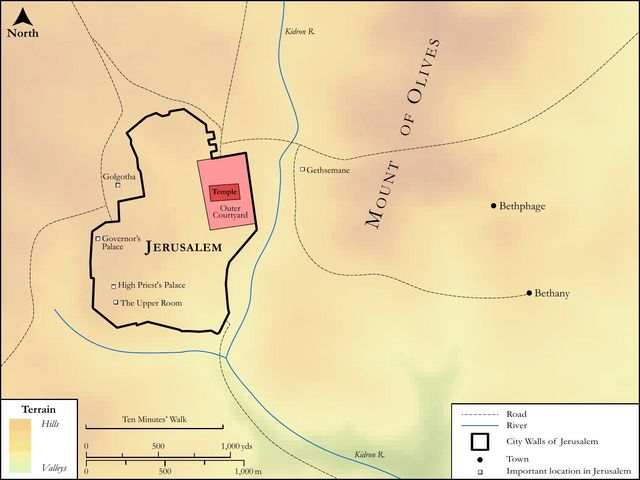
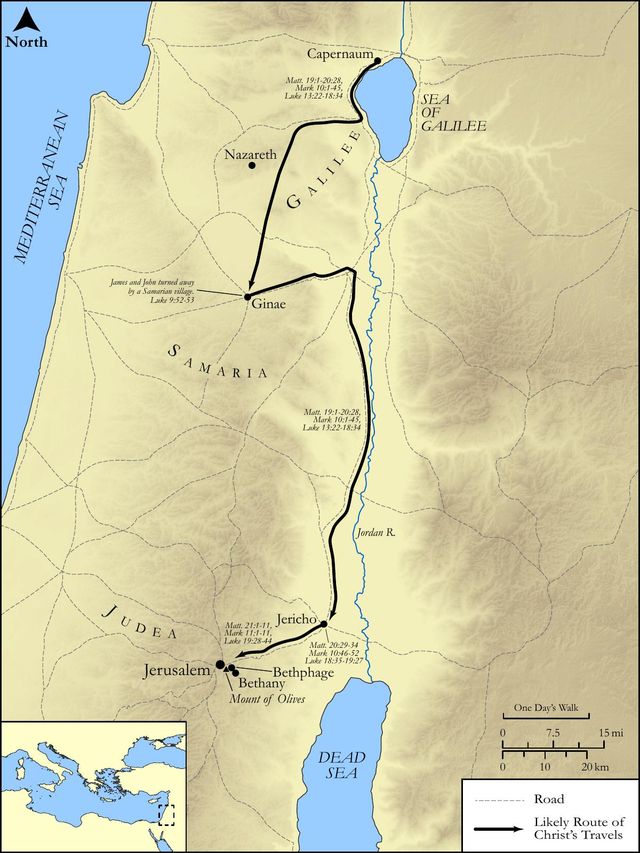
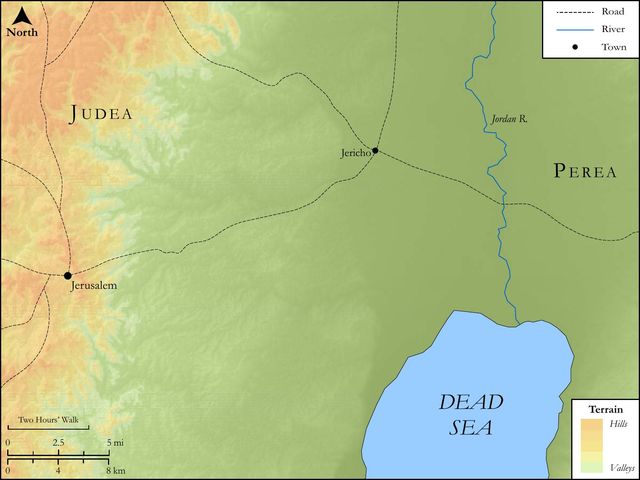
See on the biblical-era maps
Study this verse
Historical interpretation
Six Centuries of Reception
12 surviving comments on this verse. Each one is dated, so this reads as a timeline rather than a list.
Select a marker to jump to its quote. Markers stagger vertically where authors wrote within a few decades of each other.
Or; Those that believed rebuked them that they should not dishonour Him by styling Him merely Son of David, but should rather say, Son of God, have mercy on us.
Or; Jesus does not pass on, but stands still, that by His standing His goodness may not pass by, but as from an abiding fount mercy may flow forth upon them.
Figuratively, Jericho is taken to be the world, into which Christ came down. They who are in Jericho, know not how to escape from the wisdom of the world, unless they see not Jesus only coming out of Jericho, but also His disciples. This when they saw, great multitudes followed Him, despising the world and all worldly things, that under His guidance they may go up to the heavenly Jerusalem. The two blind men we may call Judah and Israel, who before the coming of Christ were blind, not seeing the true word which was in the Law and the Prophets, yet sitting by the wayside of the Law and the Prophets, and understanding Him only as after the flesh, they cried to Him who was made of the seed of David according to the flesh.
We also now sitting by the wayside of the Scriptures, and understanding wherein we are blind, if we ask with desire, He will touch the eyes of our souls, and the gloom of ignorance shall depart from our minds, that in the light of knowledge we may follow Him, who gave us power to see to no other end than that we should follow Him.
Or, They bid them hold their peace, not from reverence for Christ, but because they were grieved to hear from the blind what they denied, namely, that the Lord was the Son of David.
Wherefore doth He ask them? Lest any one should think that when they wish to receive one thing, He giveth them another thing. For indeed it is usual with Him on every occasion, first to make manifest and discover to all the virtue of those He is healing, and then to apply the cure, for one reason, that He might lead on the others likewise to emulation; and for another, that He might show that they were enjoying the gift worthily. This, for instance, He did with respect to the Canaanitish woman also, this too in the case of the centurion, this again as to her that had the issue of blood, or rather that marvellous woman even anticipated the Lord's inquiry; but not so did He pass her by, but even after the cure makes her manifest. Such earnest care had He on every occasion to proclaim the good deeds of them that come to Him, and to show them to be much greater than they are, which He doth here also.
Then, when they said what they wished, He had compassion on them, and touched them. For this alone is the cause of their cure, for which also He came into the world. But nevertheless, although it be mercy and grace, it seeks for the worthy.
But that they were worthy is manifest, both from what they cried out, and from the fact that, when they had received, they did not hasten away, as many do, being ungrateful after the benefits. Nay, they were not like this, but were both persevering before the gift, and after the gift grateful, for "they followed Him."
But let us keep to the things set before us, and let us listen to these blind men, who were better than many that see. For neither having a guide, nor being able to see Him when come near to them, nevertheless they strove to come unto Him, and began to cry with a loud voice, and when rebuked for speaking, they cried the more. For such is the nature of an enduring soul, by the very things that hinder, it is borne up.
But Christ suffered them to be rebuked, that their earnestness might the more appear, and that thou mightest learn that worthily they enjoy the benefits of their cure. Therefore He doth not so much as ask, "Do ye believe?" as He doth with many; for their cry, and their coming unto Him, sufficed to make their faith manifest.
Hence learn, O beloved, that though we be very vile and outcast, but yet approach God with earnestness, even by ourselves we shall be able to effect whatsoever we ask. See, for instance, these men, how, having none of the apostles to plead with them, but rather many to stop their mouths, they were able to pass over the hindrances, and to come unto Jesus Himself. And yet the evangelist bears witness to no confidence of life in them, but earnestness sufficed them instead of all.
These then let us also emulate. Though God defer the gift, though there be many withdrawing us, let us not desist from asking. For in this way most of all shall we win God to us. See at least even here, how not poverty, not blindness, not their being unheard, not their being rebuked by the multitude, not anything else, impeded their exceeding earnestness. Such is the nature of a fervent and toiling soul.
How much soever you humble yourself, you cannot descend so far as did your Lord.
(Hom. lxvi.) Christ suffered them to be forbidden, that their desire might be the more evidenced. Hence learn that though we be repulsed, yet if we come to God with earnestness, of ourselves, we shall obtain that we ask. It follows, And Jesus stood still, and called them, and said, What will ye that I should do unto you?
But as before this bounty they had been persevering, so after the receiving it they were not ungrateful.
(Verse 19 onwards) And as they were departing from Jericho, a great crowd followed him. And behold, two blind men sitting by the roadside, heard that Jesus was passing by, and they cried out, saying: Lord, have mercy on us, Son of David. But the crowd rebuked them, telling them to be silent. Yet they cried out even more, saying: Lord, have mercy on us, Son of David. There were many robbers in Jericho who used to attack and harm those who were coming in and going out of Jerusalem; therefore the Lord came to Jericho with his disciples, to heal the wounded and to bring a large crowd with him. Finally, after they want to leave from Jericho, a large crowd followed him. If he had stayed in Jerusalem and never descended to the lowly things, the crowd would still be sitting in darkness and in the shadow of death until today. But there were also two blind men by the road. He calls blind those who could not yet speak: In your light we will see light (Ps. XXXV, 10). Along the road, because they seemed to have knowledge of the Law: but they were ignorant of the way, which is Christ: whom most understand as the Pharisees and Sadducees, and others as both the people, the old Testament and the New: because one, following the written Law, was blind without Christ. Because they could not see by themselves, they heard the proclamations of the Savior, and confessed him as the son of David. But if both blind men are referred to the Jewish people, what follows, 'The crowd rebuked them,' should be understood in relation to the Gentiles: whom the Apostle warns not to boast and be arrogant against their own root (Rom. 11); but since they themselves were grafted in by the error of those before them from the wild olive tree into the good olive tree, they should by no means envy the salvation of those before them. Have mercy on us, O son of David. They are reproached by the crowds, and yet they do not remain silent: but rather they repeat the same thing more frequently, so that they may show the desire for the fullness of true light.
Jesus stood still, because they being blind could not see their way. About Jericho were many pits, crags, and abrupt precipices; there fore the Lord stands still, that they might come to Him.
He commands that they be called to Him that the multitude may not withhold them; and He asks them what they would, that by their answer, their necessity may be made apparent, and His power be shown in their healing.
The Creator bestows what nature had not given; or at least mercy accords what weakness had withheld.
They then who had sat shut up in Jericho, and knew only to cry with their voice, afterwards follow Jesus, not so much with their feet as in their virtues.
By the two blind men are generally understood the Pharisees and Sadducees.
The Lord acted according to their faith. He restored their eyes. He has been healing sickness within, deafness within and deadness within. Now he is healing blindness within. The eyes of the heart are closed. Jesus is passing by so that we might shout to him.What does it mean that Jesus was passing by? He is coming to us in time. Only for a short time is Jesus passing by us. What does it mean that Jesus is passing by? He is acting in a moment that comes to pass. Note how many things he has now done which have already passed by. He was born of the Virgin Mary in time. Is he being born always? As an infant he was nursed. Is he still being nursed? No, he matured through the successive ages of life until he came to adulthood. Is he always growing physically? After infancy came boyhood, after boyhood came youth; after youth he came to full human stature in several developing stages of growth. Even the very miracles that he did have “passed by.” Now we read about them and believe. They were written about so that they might be read later. But when they were occurring they were passing by like all temporal events. Finally, not to dwell long on this, he was crucified. Is he still hanging on the cross? In a similar temporal flow, he was buried, he rose again, he ascended into heaven. Now “he cannot die again; death no longer has mastery over him.” Now his divinity abides forever; yes, even the immortality of his body now shall never pass away. But nevertheless all those things that were done by him in time have passed by, and having passed by they were written down in order to be read and preached to be believed. In all these things then “Jesus was passing by.”
(de Cons. Ev. ii. 65.) Mark relates this miracle, but speaks of only one blind man. This difficulty is thus explained; of the two blind men whom Matthew has introduced, one was well known in that city, as appears by Mark's mentioning both his name, and that of his father. (Mark 10:46.) Bartimæus the son of Timæus was well known as having sunk from great affluence, and now sitting not only blind, but a beggar. For this reason then it is that Mark chose to mention him alone, because the restoration of his sight procured fame to the miracle, in proportion to the notoriety of the fact of his blindness. Though what Luke relates was done after the same manner, yet his account is to be taken of another though similar miracle. (Luke 18:35.) That which he gives was done as they drew near to Jericho; this in the other two as they came out of Jericho.
As the proof of the husbandman's industry lies in the abundance of his crop, so the fulness of the Church is the evidence of an industrious teacher; so it is here said, And as they departed from Jericho, a great multitude followed him. No one was deterred by the toilsomeness of the journey, for spiritual love feels no fatigue; no one was kept away by the thought of sufferings, for they were going into possession of the kingdom of heaven. For he who has in very deed tasted the reality of heavenly good, has nothing to attach him to earth. In good season these blind men come before Christ, that having their eyes opened, they may go up with Him to Jerusalem as witnesses to His power. They heard the sound of the passers by, but saw not their persons, and having nothing free about them but their voice, because they could not follow Him with their feet, they pursued Him with their voice; When they heard that Jesus passed by, they cried out, saying, Have mercy on us, O Lord, thou Son of David.
For they saw how mean their clothes, and considered not how pure their consciences. See the foolish wisdom of men! They think great men are hurt when they receive the homage of the poor. What poor man dare salute a rich man in public?
They were rather encouraged than repelled by this rebuke. For so faith is quickened by being prohibited; and hence is secure in dangers, and in security is endangered; whence it follows, But they cried out the more, saying, Have mercy upon us, Son of David. They cried out at the first because they were blind, now they rather cried out because they were forbidden to come to the Light.
Or; He asks them on account of their faith, that whereas they who were blind confess Christ to be the Son of God, those who had their sight might be put to shame for their esteeming Him only man. They had indeed called Christ Lord, and they had spoken true; but by calling Him the Son of David, they obliterated this their good confession. For indeed by a misuse of words men are called Lords, but none is truly Lord, but God only. When therefore they say, O Lord, thou Son of David, they thus misapply the term to Christ, as esteeming Him man; had they only called Him Lord, they would have confessed His Godhead. When then He asks them, What would ye? they no longer style Him Son of David, but only Lord; They say unto Him, Lord, that our eyes may be opened. For the Son of David cannot open the eyes of the blind, but the Son of God can. So long then as they cried, O Lord, thou Son of David, their cure was delayed; as soon as they said, Lord, only, healing was shed upon them; for it follows, And Jesus had compassion upon them, and touched their eyes, and straightway they saw. He touched them carnally as man, He healed them as God.
On being healed they rendered a high service to Christ; for it follows, And they followed him. For this the Lord requires of thee, according to the Prophet, that thou be careful to walk with the Lord thy God. (Mic. 6:8).
Some interpret that the two blind men are the Gentiles; one sprung from Cham, the other from Japhet; they sat by the way-side, that is, they walked hard by the truth, but they could not find it out; or they were placed in reason, not having yet received knowledge of the Word.
Accordingly Jesus touched the eyes of the Gentile mind, giving them the grace of the Holy Spirit, and when enlightened they followed Him with good works.
Therefore whoever recognizes the darkness of his own blindness, whoever understands that the light of eternity is what he lacks, let him cry out from the depths of his heart, let him cry out with the voices of his mind, saying: "Jesus, Son of David, have mercy on me."
But Jericho, which is interpreted 'the moon,' denotes the infirmity of our changefulness.
But recognizing the rumour of Christ, they desired to be made partakers of Him. Many spake against them; first the Jews, as we read in the Acts; then the Gentiles harassed them by persecution; but yet they might not deprive those who were preordained to life of salvation.
Continue studying Matthew 20:30 across the web’s major study libraries — every link below opens this exact verse, chapter, or book on the destination site.
Read & Compare
 BibleGatewayThis verse in more than 200 translations and 70 languages.
 Bible.comThe YouVersion reader — hundreds of translations, reading plans, and highlights.
 ESV.orgCrossway's official English Standard Version reader.
 NET BibleThe NET translation with 60,000+ translators' notes on every rendering decision.
 STEP BibleTyndale House's free study tool — original text, vocabulary, and scholarly resources.
 BibliaLogos Bible Software's free web reader.
 USCCBThe New American Bible (Revised Edition) with the U.S. bishops' study notes.
Commentaries
 BibleHub CommentariesDozens of classic commentaries on this verse, gathered on one page.
 StudyLightMore than 100 commentary sets — the largest collection on the web.
 BibleRefPlain-English commentary on what this verse means, verse by verse.
 Enduring WordDavid Guzik's free commentary on this chapter, widely used by Bible teachers.
 Bible Study ToolsVerse commentary alongside Greek and Hebrew study aids.
Original Language & Research
- BibleHub InterlinearThe verse word by word — original language, transliteration, and English.
- BibleHub LexiconEvery word's original-language definition and Strong's entry.
 Blue Letter BibleDeep-study tools — Strong's numbers, concordance, and word studies.
 CNTR CollationThe earliest Greek manuscripts of this verse, collated letter by letter.
Sermons, Hymns & Audio


TrulyRandomVerse is not affiliated with these sites and doesn’t control their content. They’re linked because they’re genuinely useful.
Summary
Matthew 20:30 presents a poignant scene where two blind men, seated by the roadside near Jericho, hear of Jesus' approach. Recognizing His messianic identity, they cry out with persistent faith, appealing to Him as "Lord, Son of David" for mercy. This desperate plea sets the stage for a powerful display of Jesus' compassion and miraculous power, underscoring the spiritual insight of those often overlooked.
Context
ShowHideLiterary Context
This event immediately follows Jesus' third prediction of His Passion and resurrection (Matthew 20:17-19) and the request of James and John's mother for positions of honor in the kingdom (Matthew 20:20-28). The healing of the blind men serves as a powerful demonstration of Jesus' true messianic authority and His servant leadership, contrasting with the disciples' worldly ambitions. It also directly precedes Jesus' triumphal entry into Jerusalem, highlighting His compassion for the needy on the eve of His ultimate sacrifice. The narrative flows seamlessly into Matthew 20:31-34, where the crowd rebukes the men, but Jesus stops to heal them.
Historical & Cultural Context
Jericho was a significant city, strategically located on the main road from Galilee to Jerusalem, making it a common stopping point for pilgrims. As such, it was a place where beggars, including the blind, would congregate by the roadside, relying on the charity of passersby. Blindness in that day often led to extreme poverty and social ostracization, as there were few means of support or medical intervention. The mention of "two blind men" by Matthew, while Mark (10:46) and Luke (18:35) focus on one (Bartimaeus), is not a contradiction but a complementary detail, emphasizing the scope of Jesus' healing. The large crowd following Jesus indicates His widespread popularity and the public nature of His ministry, making the men's cry a bold act of faith amidst many onlookers.
Key Themes
ShowHideThe passage powerfully illustrates several key themes. First, it highlights desperate faith and persistence, as the blind men, despite their physical limitations and the crowd's attempts to silence them (Matthew 20:31), refuse to give up their plea for mercy. Their unwavering cry demonstrates a profound spiritual insight into Jesus' identity and power. Second, it showcases Jesus' profound compassion and accessibility. Despite His urgent journey to Jerusalem and the surrounding throng, Jesus stops to attend to the cries of the lowly and overlooked, embodying the very servant leadership He taught His disciples in Matthew 20:25-28. Finally, the men's address to Jesus as "O Lord, [thou] Son of David" is a pivotal moment of messianic recognition. This title, deeply rooted in Old Testament prophecy, explicitly acknowledges Jesus as the promised Messiah, the rightful heir to David's throne, and the one empowered by God to bring deliverance and healing. This recognition is a testament to their spiritual sight, contrasting sharply with the physical blindness they endure.
Exposition and Analysis
ShowHideKey Word Analysis
ShowHideFrom a root meaning "opaque" or "smoky," this word describes someone physically without sight. Figuratively, it can also refer to spiritual blindness, an inability to perceive spiritual truth. In this context, the physical blindness of the men serves as a powerful metaphor for the spiritual blindness prevalent among many who encountered Jesus, including some of His own disciples.
A primary verb meaning "to croak" or "screaming," indicating a loud, urgent, and often desperate vocalization. It implies a strong, public appeal, not a quiet whisper. This word emphasizes the intensity of the men's plea, reflecting their deep need and unwavering determination to get Jesus' attention.
Apparently a primary word, meaning "a son," used broadly for kinship.
Of Hebrew origin, referring to David, the Israelite king.
This is a highly significant messianic title. By addressing Jesus as "Son of David," the blind men are not merely acknowledging His lineage but are proclaiming their belief in Him as the long-awaited Messiah, the one through whom God's promises to King David (2 Samuel 7:12-16) would be fulfilled. This title carries profound theological weight, signifying Jesus' royal authority and His role as the deliverer of Israel.
Verse Breakdown
ShowHide"And, behold, two blind men sitting by the way side,"
The opening "And, behold" (καὶ ἰδοὺ) serves to draw the reader's immediate attention to a significant event about to unfold. The scene is set with two men, physically sightless, positioned in a common place for beggars – "by the way side" (παρὰ τὴν ὁδόν), indicating their lowly status and reliance on public charity. Their static position contrasts with Jesus' dynamic movement.
"when they heard that Jesus passed by,"
This clause highlights the men's acute hearing, compensating for their lack of sight, and their immediate awareness of Jesus' presence. The verb "passed by" (παράγω) suggests Jesus was moving along, perhaps quickly, making their immediate action crucial. Their hearing is the catalyst for their faith-filled response.
"cried out, saying, Have mercy on us, O Lord, [thou] Son of David."
This is the core of their plea, demonstrating both desperation and profound spiritual insight. "Cried out" (ἔκραξαν) signifies a loud, persistent, and urgent call. Their request, "Have mercy on us" (ἐλέησον ἡμᾶς), is a humble acknowledgment of their need and Jesus' power to alleviate it. Crucially, they address Him as "O Lord" (Κύριε), recognizing His authority, and "Son of David" (υἱὸς Δαυίδ), a direct and unambiguous messianic title. This address reveals their belief in Jesus as the promised deliverer and healer, demonstrating a spiritual perception that many with physical sight lacked.
Literary Devices
ShowHideMatthew employs several powerful Literary Devices in this verse. The most prominent is Symbolism, where the physical blindness of the two men serves as a potent metaphor for spiritual blindness. While they cannot see with their eyes, they possess a profound spiritual insight, recognizing Jesus' true identity as the "Son of David" – a messianic title – something many of the seeing crowds and even the disciples struggled to fully grasp. This creates a powerful Irony: those who are physically blind are spiritually sighted, while many who can see physically remain spiritually blind to who Jesus truly is. The urgent cry itself, "cried out," functions as a form of Exclamation, conveying the desperate, unyielding nature of their faith and their immediate need, cutting through the noise of the crowd and capturing the reader's attention.
Theological and Thematic Connections
ShowHideMatthew 20:30 powerfully underscores the theological truth that true spiritual sight often resides not with the outwardly privileged, but with the humble and desperate. The blind men's recognition of Jesus as "Son of David" is a profound Christological statement, affirming His royal lineage and messianic authority, yet it is uttered by those among the outcasts. This passage highlights God's particular compassion for the vulnerable and overlooked, demonstrating that Jesus is accessible to all who cry out to Him in faith. It teaches that persistent, humble prayer, rooted in a correct understanding of who Jesus is, is heard and answered by a compassionate Lord who delights in showing mercy.
Reflection and Application
ShowHideThe scene of the two blind men crying out to Jesus offers profound lessons for every believer. Like these men, we are often spiritually blind, unable to fully perceive God's truth, His will, or our own desperate need for His grace. This passage serves as a powerful invitation to acknowledge our spiritual deficiencies and to cry out to Jesus with the same urgency and unwavering faith. It reminds us that our Lord is not distant or unconcerned, but actively "passing by," ready to hear and respond to the cries of those who recognize His authority and seek His mercy. Their persistence, even when rebuked by the crowd, teaches us the vital importance of not giving up in prayer, trusting that God hears the desperate and faithful heart. Our spiritual sight, like their physical sight, is a gift from Him, and we are called to continually seek His face, trusting Him to open our eyes to His glorious truth and purpose for our lives.
Questions for Reflection
ShowHideFAQ
ShowHideWhy does Matthew mention two blind men, while Mark and Luke mention only one?
ShowHideThe Gospel accounts are complementary, not contradictory. Matthew's focus on "two blind men" (as in other instances where he mentions two, e.g., the demon-possessed men in Matthew 8:28) simply broadens the scope of the miracle, emphasizing that Jesus' compassion and power extended to multiple individuals. Mark (10:46) and Luke (18:35) highlight a specific individual, Bartimaeus, perhaps because he was well-known in the early Christian community or because his story provided specific details for their narrative purposes. All three accounts agree on the essential elements: blind men crying out to Jesus as "Son of David" near Jericho, and Jesus' compassionate response.
What is the significance of the title "Son of David"?
ShowHideThe title "Son of David" is profoundly significant as a messianic designation. It directly links Jesus to the covenant God made with King David in 2 Samuel 7:12-16, promising an eternal dynasty and kingdom through his lineage. By calling Jesus "Son of David," the blind men are acknowledging Him as the long-awaited Messiah, the rightful heir to David's throne, and the one who would bring salvation and deliverance to Israel. This title implies not only His royal authority but also His divine mission and power to perform miraculous works, such as healing. It is a declaration of faith in Jesus' identity as the Christ.
Why did the blind men cry out so loudly and persistently?
ShowHideTheir loud and persistent crying out stemmed from a combination of desperation, faith, and urgency. As blind beggars, they were overlooked and dependent on the charity of others; this was a unique opportunity to encounter Jesus, their only hope for healing. Their "cried out" (Greek: krázō) suggests a deep, urgent plea, reflecting their unwavering belief that Jesus had the power to heal them. Despite the crowd's attempts to silence them (as seen in Matthew 20:31), their persistence demonstrates a determined faith that refused to be deterred, knowing that their spiritual and physical well-being depended on capturing Jesus' attention.
Christ-Centered Fulfillment
ShowHideThe healing of the two blind men in Matthew 20:30-34 is a powerful prefigurement of Jesus' ultimate mission as the Christ. These men, physically blind and overlooked, represent humanity's spiritual condition apart from God – unable to see the truth, lost in darkness, and dependent on divine mercy. Jesus, by stopping His journey to Jerusalem (where He would ultimately lay down His life), demonstrates His profound compassion and His primary purpose: to bring light to those in darkness. He is the Light of the World, who came to open the eyes of the spiritually blind, fulfilling prophecies such as Isaiah 42:7. Just as He restored their physical sight, He offers spiritual sight, enabling us to perceive God's kingdom, His truth, and His will. This act of mercy foreshadows the ultimate act of mercy on the cross, where Jesus, the "Son of David," secured redemption for all who, like these blind men, cry out to Him in faith for mercy, allowing us to see the glory of God in the face of Christ (2 Corinthians 4:6). Through His sacrifice, He opens our hearts to understanding, illuminating the "eyes of your understanding" (Ephesians 1:18) to comprehend the hope of His calling.