


Daniel 9:25
- וְתֵדַעve·te·Da'so you may knowH3045Conj-w ¦ V-Qal-ConjImperf-2msVerb Qal Conjunction+Imperfect 2nd Singular Masculineוְsoתֵדַעyou may know
- וְתַשְׂכֵּלve·tas·Keland you will understandH7919Conj-w ¦ V-Hiphil-Imperf-2msVerb Hiphil Imperfect 2nd Singular Masculineוְandתַשְׂכֵּלyou will understand
- מִןminfromH4480PrepPreposition
- מֹצָאmo·Tza'[the] going forth ofH4161N-mscNoun Singular Masculine Construct
- דָבָרda·Var[the] wordH1697N-msNoun Singular Masculine Absolute
- לְהָשִׁיבle·ha·Shivto restoreH7725Prep-l ¦ V-Hiphil-InfVerb Hiphil Infinitive Constructלְtoהָשִׁיבrestore
- וְלִבְנוֹתve·liv·Notand to rebuildH1129Conj-w ¦ Prep-l ¦ V-Qal-InfVerb Qal Infinitive Constructוְandלִtoבְנוֹתrebuild
- יְרוּשָׁלִַםye·ru·sha·LimJerusalemH3389N-properNoun Proper Location
- עַד'aduntilH5704PrepPreposition
- מָשִׁיחַma·Shi·achan anointed [one]H4899N-msNoun Singular Masculine Absolute
- נָגִידna·Gida princeH5057N-msNoun Singular Masculine Absolute
- שָׁבֻעִיםsha·vu·'ImsevensH7620N-mpNoun Plural Masculine Absolute
- שִׁבְעָהshiv·'AhsevenH7651Adj-csAdjective Numerical Singular common gender Absolute
- וְשָׁבֻעִיםve·sha·vu·'Imand sevensH7620Conj-w ¦ N-mpNoun Plural Masculine Absoluteוְandשָׁבֻעִיםsevens
- שִׁשִּׁיםshi·ShimsixtyH8346Adj-mpAdjective Numerical Plural Masculine Absolute
- וּשְׁנַיִםu·she·Na·yimand twoH8147Conj-w ¦ Adj-cdAdjective Numerical Dual common gender Absoluteוּandשְׁנַיִםtwo
- תָּשׁוּבta·Shuvit will returnH7725V-Qal-Imperf-3fsVerb Qal Imperfect 3rd Singular Feminine
- וְנִבְנְתָהve·niv·ne·Tahand it will be builtH1129Conj-w ¦ V-Niphal-ConsecPerf-3fsVerb Niphal Consecutive Perfect 3rd Singular Feminineוְandנִבְנְתָהit will be built
- רְחוֹבre·Chovan open placeH7339N-fsNoun Singular Feminine Absolute
- וְחָרוּץve·cha·Rutzand a moatH2742Conj-w ¦ N-msNoun Singular Masculine Absoluteוְandחָרוּץa moat
- וּבְצוֹקuv·Tzokand in [the] distress ofH6695Conj-w ¦ Prep-b ¦ N-mscNoun Singular Masculine Constructוּandבְinצוֹק[the] distress of
- הָעִתִּיםha·'i·Timthe timesH6256Art ¦ N-cpNoun Plural common gender Absoluteהָtheעִתִּיםtimes
English is a literal word-by-word gloss of the Hebrew, not the KJV's wording. Why?
This is the original text the KJV's translators worked from — each Hebrew word with its own literal English meaning in this verse, prepared by scholars at Tyndale House, Cambridge. The KJV translates whole sentences, not word by word, so its wording differs: one Hebrew word can become several English words, and the KJV may choose “the LORD” where the gloss reads “Yahweh”. Both are faithful — they answer different questions. For the KJV's own rendering, switch to the KJV text.
Details
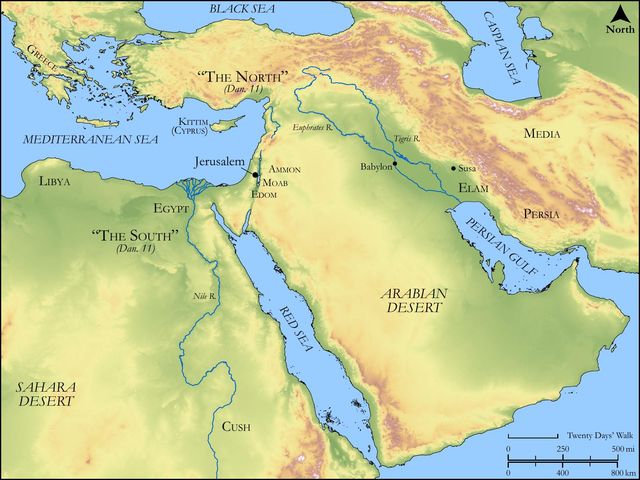
See on the biblical-era map
Study this verse
Public-domain commentary
Matthew Henry
From his Commentary on the Whole Bible. Henry comments on passages, not single verses — this entry covers Daniel 9:20–27. His four-level outline is real structure in the source text, so it is rendered as structure.
We have here the answer that was immediately sent to Daniel's prayer, and it is a very memorable one, as it contains the most illustrious prediction of Christ and gospel-grace that is extant in all the Old Testament. If John Baptist was the morning-star, this was the day-break to the Sun of righteousness, the day-spring from on high. Here is,
I.The time when this answer was given.
1.It was while Daniel was at prayer. This he observed and laid a strong emphasis upon: While I was speaking (Dan 9:20), yea, while I was speaking in prayer (Dan 9:21), before he rose from his knees, and while there was yet more which he intended to say.
(1.)He mentions the two heads he chiefly insisted upon in prayer, and which perhaps he designed yet further to enlarge upon.
[1.]He was confessing sin and lamenting that - "both my sin and the sin of my people Israel." Daniel was a very great and good man, and yet he finds sin of his own to confess before God and is ready to confess it; for there is not a just man upon earth that does good and sins not, nor that sins and repents not. St. John puts himself into the number of those who deceive themselves if they say that they have no sin, and who therefore confess their sins, Jo1 1:8. Good men find it an ease to their consciences to pour out their complaints before the Lord against themselves; and that is confessing sin. He also confessed the sin of his people, and bewailed that. Those who are heartily concerned for the glory of God, the welfare of the church, and the souls of men, will mourn for the sins of others as well as for their own.
[2.]He was making supplication before the Lord his God, and presenting it to him as an intercessor for Israel; and in this prayer his concern was for the holy mountain of his God, Mount Zion. The desolations of the sanctuary lay nearer his heart than those of the city and the land; and the repair of that, and the setting up of the public worship of God of Israel again, were the things he had in view, in the deliverance he was preparing for, more than re-establishment of their civil interests. Now,
(2.)While Daniel was thus employed,
[1.]He had a grant made him of the mercy he prayed for. Note, God is very ready to hear prayer and to give an answer of peace. Now was fulfilled what God had spoken Isa 65:24, While they are yet speaking, I will hear. Daniel grew very fervent in prayer, and his affections were very strong, Dan 9:18, Dan 9:19. And, while he was speaking with such fervour and ardency, the angel came to him with a gracious answer. God is well pleased with lively devotions. We cannot now expect that God should send us answers to our prayer by angels, but, if we pray with fervency for that which God has promised, we may by faith take the promise as an immediate answer to the prayer; for he is faithful that has promised.
[2.]He had a discovery made to him of a far greater and more glorious redemption which God would work out for his church in the latter days. Note, Those that would be brought acquainted with Christ and his grace must be much in prayer.
2.It was about the time of the evening oblation, Dan 9:21. The altar was in ruins, and there was no oblation offered upon it, but, it should seem, the pious Jews in their captivity were daily thoughtful of the time when it should have been offered, and at that hour were ready to weep at the remembrance of it, and desired and hoped that their prayer should be set forth before God as incense, and the lifting up of their hands, and their hearts with their hands, should be acceptable in his sight as the evening-sacrifice, Psa 141:2. The evening oblation was a type of the great sacrifice which Christ was to offer in the evening of the world, and it was in the virtue of that sacrifice that Daniel's prayer was accepted when he prayed for the Lord's sake; and for the sake of that this glorious discovery of redeeming love was made to him. The Lamb opened the seals in the virtue of his own blood.
II.The messenger by whom this answer was sent.
It was not given him in a dream, nor by a voice from heaven, but, for the greater certainty and solemnity of it, an angel was sent on purpose, appearing in a human shape, to give this answer to Daniel. Observe,
1.Who this angel, or messenger, was; it was the man Gabriel. If Michael the archangel be, as many suppose, no other than Jesus Christ, this Gabriel is the only created angel that is named in scripture. Gabriel signifies the mighty one of God; for the angels are great in power and might, Pe2 2:11. It was he whom I had seen in the vision at the beginning. Daniel heard him called by his name, and thence learned it (Dan 8:16); and, though then he trembled at his approach, yet he observed him so carefully that now he knew him again, knew him to be the same that he had seen at the beginning, and, being somewhat better acquainted with him, was not now so terrified at the sight of him as he had been at first. When this angel said to Zacharias, I am Gabriel (Luk 1:19), he intended thereby to put him in mind of this notice which he had given to Daniel of the Messiah's coming when it was at a distance, for the confirming of his faith in the notice he was then about to give of it as at the door.
2.The instructions which this messenger received from the Father of lights to whom Daniel prayed (Dan 9:23): At the beginning of thy supplications the word, the commandment, came forth from God. Notice was given to the angels in heaven of this counsel of God, which they were desirous to look into; and orders were given to Gabriel to go immediately and bring the notice of it to Daniel. By this it appears that it was not any thing which Daniel said that moved God, for the answer was given as he began to pray; but God was well pleased with his serious solemn address to the duty, and, in token of that, sent him this gracious message. Or perhaps it was at the beginning of Daniel's supplications that Cyrus's word, or commandment, went forth to restore and to build Jerusalem, that going forth spoken of Dan 9:25. "The thing was done this very day; the proclamation of liberty to the Jews was signed this morning, just when thou wast praying for it;" and now, at the close of this fast-day, Daniel had notice of it, as, at the close of the day of atonement, the jubilee-trumpet sounded to proclaim liberty.
3.The haste he made to deliver his message: He was caused to fly swiftly, Dan 9:21. Angels are winged messengers, quick in their motions, and delay not to execute the orders they receive; they run and return like a flash of lightning, Eze 1:14. But, it should seem, sometimes they are more expeditious than at other times, and make a quicker despatch, as here the angel was caused to fly swiftly; that is, he was ordered and he was enabled to fly swiftly. Angels do their work in obedience to divine command and in dependence upon divine strength. Though they excel in wisdom, they fly swifter or slower as God directs; and, though they excel in power, they fly but as God causes them to fly. Angels themselves are to us what he makes them to be; they are his ministers, and do his pleasure, Psa 103:21.
4.The prefaces or introductions to his message.
(1.)He touched him (Dan 9:21), as before (Dan 8:18), not to awaken him out of sleep as then, but to give him a hint to break off his prayer and to attend to that which he has to say in answer to it. Note, In order to the keeping up of our communion with God we must not only be forward to speak to God, but as forward to hear what he has to say to us; when we have prayed we must look up, must look after our prayers, must set ourselves upon our watch-tower.
(2.)He talked with him (Dan 9:22), talked familiarly with him, as one friend talks with another, that his terror might not make him afraid. He informed him on what errand he came, that he was sent from heaven on purpose with a kind message to him: "I have come to show thee (Dan 9:23), to tell thee that which thou didst not know before." He had shown him the troubles of the church under Antiochus, and the period of those troubles (Dan 8:19); but now he has greater things to show him, for he that is faithful in a little shall be entrusted with more. "Nay, I have now come forth to give thee skill and understanding (Dan 9:22), not only to show thee these things, but to make thee understand them." (3.) He assured him that he was a favourite of Heaven, else he would not have had this intelligence sent him, and he must take it for a favour: "I have come to show thee, for thou art greatly beloved. Thou art a man of desires, acceptable to God, and whom he has a favour for." Note, Though God loves all his children, yet there are some that are more than the rest greatly beloved. Christ had one disciple that lay in his bosom; and that beloved disciple was he that was entrusted with the prophetical visions of the New Testament, as Daniel was with those of the Old. For what greater token can there be of God's favour to any man than for the secrets of the Lord to be with him? Abraham is the friend of God; and therefore Shall I hide from Abraham that thing which I do? Gen 18:17. Note, Those may reckon themselves greatly beloved of God to whom, and in whom, he reveals his Son. Some observe that the title which this angel Gabriel gives to the Virgin Mary is much the same with this which he here gives to Daniel, as if he designed to put her in mind of it - Thou that art highly favoured; as Daniel, greatly beloved. (4.) He demands his serious attention to the discovery he was now about to make to him: Therefore understand the matter, and consider the vision, Dan 9:23. This intimates that it was a thing well worthy of his regard, above any of the visions he had been before favoured with. Note, Those who would understand the things of God must consider them, must apply their minds to them, ponder upon them, and compare spiritual things with spiritual. The reason why we are so much in the dark concerning the revealed will of God, and mistake concerning it, is want of consideration. This vision both requires and deserves consideration.
III.The message itself.
It was delivered with great solemnity, received no doubt with great attention, and recorded with great exactness; but in it, as is usual in prophecies, there are things dark and hard to be understood. Daniel, who understood by the book of the prophet Jeremiah the expiration of the seventy years of the captivity, is now honourably employed to make known to the church another more glorious release, which that was but a shadow of, at the end of another seventy, not years, but weeks of years. He prayed over that prophecy, and received this in answer to that prayer. He had prayed for his people and the holy city - that they might be released, that it might be rebuilt; but God answers him above what he was able to ask or think. God not only grants, but outdoes, the desires of those that fear him, Psa 21:4.
1.The times here determined are somewhat hard to be understood. In general, it is seventy weeks, that is, seventy times seven years, which makes just 490 years. The great affairs that are yet to come concerning the people of Israel, and the city of Jerusalem, will lie within the compass of these years.
(1.)These years are thus described by weeks,
[1.]In conformity to the prophetic style, which is, for the most part, abstruse, and out of the common road of speaking, that the things foretold might not lie too obvious.
[2.]To put an honour upon the division of time into weeks, which is made purely by the sabbath day, and to signify that that should be perpetual.
[3.]With reference to the seventy years of the captivity; as they had been so long kept out of the possession of their own land, so, being now restored to it they should seven times as long be kept in the possession of it. So much more does God delight in showing mercy than in punishing. The land had enjoyed its sabbaths, in a melancholy sense, seventy years, Lev 26:34. But now the people of the Lord shall, in a comfortable sense, enjoy their sabbaths seven times seventy years, and in them seventy sabbatical years, which makes ten jubilees. Such proportions are there in the disposals of Providence, that we might see and admire the wisdom of him who has determined the times before appointed.
(2.)The difficulties that arise about these seventy weeks are,
[1.]Concerning the time when they commence and whence they are to be reckoned. They are here dated from the going forth of the commandments to restore and to build Jerusalem, Dan 9:25. I should most incline to understand this of the edict of Cyrus mentioned Ezr 1:1, for by it the people were restored; and, though express mention be not made there of the building of Jerusalem, yet that is supposed in the building of the temple, and was foretold to be done by Cyrus, Isa 44:28. He shall say to Jerusalem, Thou shalt be built. That was, both in prophecy and in history, the most famous decree for the building of Jerusalem; nay, it should seem, this going forth of the commandment (which may as well be meant of God's command concerning it as of Cyrus's) is the same with that going forth of the commandment mentioned Dan 9:23, which was at the beginning of Daniel's supplications. And it looks very graceful that the seventy weeks should begin immediately upon the expiration of the seventy years. And there is nothing to be objected against this but that by this reckoning the Persian monarchy, from the taking of Babylon by Cyrus to Alexander's conquest of Darius, lasted but 130 years; whereas, by the particular account given of the reigns of the Persian emperors, it is computed that it continued 230 years. So Thucydides, Xenophon, and others reckon. those who fix it to that first edict set aside these computations of the heathen historians as uncertain and not to be relied upon. But others, willing to reconcile them, begin the 490 years, not at the edict of Cyrus (Ezr 1:1), but at the second edict for the building of Jerusalem, issued out by Darius Nothus above 100 years after, mentioned Ezra 6. Others fix on the seventh year of Artaxerxes Mnemon, who sent Ezra with a commission, Ezr 7:8-12. The learned Mr. Poole, in his Latin Synopsis, has a vast and most elaborate collection of what has been said, pro and con, concerning the different beginnings of these weeks, with which the learned may entertain themselves.
[2.]Concerning the termination of them; and here likewise interpreters are not agreed. Some make them to end at the death of Christ, and think the express words of this famous prophecy will warrant us to conclude that from this very hour when Gabriel spoke to Daniel, at the time of the evening oblation, to the hour when Christ died, which was towards evening too, it was exactly 490 years; and I am willing enough to be of that opinion. But others think, because it is said that in the midst of the weeks (that is, the last of the seventy weeks) he shall cause the sacrifice and the oblation to cease, they end three years and a half after the death of Christ, when the Jews having rejected the gospel, the apostles turned to the Gentiles. But those who make them to end precisely at the death of Christ read it thus, "He shall make strong the testament to the many; the last seven, or the last week, yea, half that seven, or half that week (namely, the latter half, the three years and a half which Christ spent in his public ministry), shall bring to an end sacrifice and oblation." Others make these 490 years to end with the destruction of Jerusalem, about thirty-seven years after the death of Christ, because these seventy weeks are said to be determined upon the people of the Jews and the holy city; and much is said here concerning the destruction of the city and the sanctuary.
[3.]Concerning the division of them into seven weeks, and sixty-two weeks, and one week; and the reason of this is as hard to account for as any thing else. In the first seven weeks, or forty-nine years, the temple and city were built; and in the last single week Christ preached his gospel, by which the Jewish economy was taken down, and the foundations were laid of the gospel city and temple, which were to be built upon the ruins of the former.
(3.)But, whatever uncertainty we may labour under concerning the exact fixing of these times, there is enough clear and certain to answer the two great ends of determining them.
[1.]It did serve them to raise and support the expectations of believers. There were general promises of the coming of the Messiah made to the patriarchs; the preceding prophets had often spoken of him as one that should come, but never was the time fixed for his coming until now. And, though there might be so much doubt concerning the date of this reckoning that they could not ascertain the time just to a year, yet by the light of this prophecy they were directed about what time to expect him. And we find, accordingly, that when Christ came he was generally looked for as the consolation of Israel, and redemption in Jerusalem by him, Luk 2:25, Luk 2:38. There were those that for this reason thought the kingdom of God should immediately appear (Luk 19:11), and some think it was this that brought a more than ordinary concourse of people to Jerusalem, Act 2:5.
[2.]It does serve still to refute and silence the expectations of unbelievers, who will not own that Jesus is he who should come, but still look for another. This prediction should silence them, and will condemn them; for, reckon these seventy weeks from which of the commandments to build Jerusalem we please, it is certain that they have expired above 1500 years ago; so that the Jews are for ever without excuse, who will not own that the Messiah has come when they have gone so far beyond their utmost reckoning for his coming. But by this we are confirmed in our belief of the Messiah's being come, and that our Jesus is he, that he came just at the time prefixed, a time worthy to be had in everlasting remembrance.
2.The events here foretold are more plain and easy to be understood, at least to us now. Observe what is here foretold,
(1.)Concerning the return of the Jews now speedily to their own land, and their settlement again there, which was the thing that Daniel now principally prayed for; and yet it is but briefly touched upon here in the answer to his prayer. Let this be a comfort to the pious Jews, that a commandment shall go forth to restore and to build Jerusalem, Dan 9:25. And the commandment shall not be in vain; for though the times will be very troublous, and this good work will meet with great opposition, yet it shall be carried on, and brought to perfection at last. The street shall be built again, as spacious and splendid as ever it was, and the walls, even in troublous times. Note, as long as we are here in this world we must expect troublous times, upon some account or other. Even when we have joyous times we must rejoice with trembling; it is but a gleam, it is but a lucid interval of peace and prosperity; the clouds will return after the rain. When the Jews are restored in triumph to their own land, yet there they must expect troublous times, and prepare for them. But this is our comfort, that God will carry on his own work, will build up his Jerusalem, will beautify it, will fortify it, even in troublous times; nay, the troublousness of the times may by the grace of God contribute to the advancement of the church. The more it is afflicted the more it multiplies.
(2.)Concerning the Messiah and his undertaking. The carnal Jews looked for a Messiah that could deliver them from the Roman yoke and give them temporal power and wealth, whereas they were here told that the Messiah should come upon another errand, purely spiritual, and upon the account of which he should be the more welcome.
[1.]Christ came to take away sin, and to abolish that. Sin had made a quarrel between God and man, had alienated men from God and provoked God against man; it was this that put dishonour upon God and brought misery upon mankind; this was the great mischief-maker. He that would do God a real service, and man a real kindness, must be the destruction of this. Christ undertakes to be so, and for this purpose he is manifested, to destroy the works of the devil. He does not say to finish your transgressions and your sins, but transgression and sin in general, for he is the propitiation not only for our sins, that are Jews, but for the sins of the whole world. He came, First, To finish transgression, to restrain it (so some), to break the power of it, to bruise the head of that serpent that had done so much mischief, to take away the usurped dominion of that tyrant, and to set up a kingdom of holiness and love in the hearts of men, upon the ruins of Satan's kingdom there, that, where sin and death had reigned, righteousness and life through grace might reign. When he died he said, It is finished; sin has now had its death-wound given it, like Samson's, Let me die with the Philistines. Animamque in vulnere ponit - He inflicts the wound and dies. Secondly, To make an end of sin, to abolish it, that it may not rise up in judgment against us, to obtain the pardon of it, that it may not be our ruin, to seal up sins (so the margin reads it), that they may not appear or break out against us, to accuse and condemn us, as, when Christ cast the devil into the bottomless pit, he set a seal upon him, Rev 20:3. When sin is pardoned it is sought for and not found, as that which is sealed up. Thirdly, To make reconciliation for iniquity, as by a sacrifice, to satisfy the justice of God and so to make peace and bring God and man together, not only as an arbitrator, or referee, who only brings the contending parties to a good understanding one of another, but as a surety, or undertaker, for us. He is not only the peace-maker, but the peace. He is the atonement.
[2.]He came to bring in an everlasting righteousness. God might justly have made an end of the sin by making an end of the sinner; but Christ found out another way, and so made an end of sin as to save the sinner from it, by providing a righteousness for him. We are all guilty before God, and shall be condemned as guilty, if we have not a righteousness wherein to appear before him. Had we stood, our innocency would have been our righteousness, but, having fallen, we must have something else to plead; and Christ has provided us a plea. The merit of his sacrifice is our righteousness; with this we answer all the demands of the law; Christ has died, yea, rather, has risen again. Thus Christ is the Lord our righteousness, for he is made of God to us righteousness, that we might be made the righteousness of God in him. By faith we apply this to ourselves and plead it with God, and our faith is imputed to us for righteousness, Rom 4:3, Rom 4:5. This is an everlasting righteousness, for Christ, who is our righteousness, and the prince of our peace, is the everlasting Father. It was from everlasting in the counsels of it and will be to everlasting in the consequences of it. The application of it was from the beginning, for Christ was the Lamb slain from the foundation of the world; and it will be to the end, for he is able to save to the uttermost. It is of everlasting virtue (Heb 10:12); it is the rock that follows us to Canaan.
[3.]He came to seal up the vision and prophecy, all the prophetical visions of the Old Testament, which had reference to the Messiah. He sealed them up, that is, he accomplished them, answered to them to a tittle; all things that were written in the law, the prophets, and the psalms, concerning the Messiah, were fulfilled in him. Thus he confirmed the truth of them as well as his own mission. He sealed them up, that is, he put an end to that method of God's discovering his mind and will, and took another course by completing the scripture-canon in the New Testament, which is the more sure word of prophecy than that by vision, Pe2 1:19; Heb 1:1.
[4.]He came to anoint the most holy, that is, himself, the Holy One, who was anointed (that is, appointed to his work and qualified for it) by the Holy Ghost, that oil of gladness which he received without measure, above his fellows; or to anoint the gospel-church, his spiritual temple, or holy place, to sanctify and cleanse it, and appropriate it to himself (Eph 5:26), or to consecrate for us a new and living way into the holiest, by his own blood (Heb 10:20), as the sanctuary was anointed, Exo 30:25, etc. He is called Messiah (Dan 9:25, Dan 9:26), which signifies Christ - Anointed (Joh 1:41), because he received the unction both for himself and for all that are his.
[5.]In order to all this the Messiah must be cut off, must die a violent death, and so be cut off from the land of the living, as was foretold, Isa 53:8. Hence, when Paul preaches the death of Christ, he says that he preached nothing but what the prophet said should come, Act 26:22, Act 26:23. And thus it behoved Christ to suffer. He must be cut off, but not for himself - not for any sin of his own, but, as Caiaphas prophesied, he must die for the people, in our stead and for our good, - not for any advantage of his own (the glory he purchased for himself was no more than the glory he had before, Joh 17:4, Joh 17:5); no; it was to atone for our sins, and to purchase life for us, that he was cut off.
[6.]He must confirm the covenant with many. He shall introduce a new covenant between God and man, a covenant of grace, since it had become impossible for us to be saved by a covenant of innocence. This covenant he shall confirm by his doctrine and miracles, by his death and resurrection, by the ordinances of baptism and the Lord's supper, which are the seals of the New Testament, assuring us that God is willing to accept us upon gospel-terms. His death made his testament of force, and enabled us to claim what is bequeathed by it. He confirmed it to the many, to the common people; the poor were evangelized, when the rulers and Pharisees believed not on him. Or, he confirmed it with many, with the Gentile world. The New Testament was not (like the Old) confined to the Jewish church, but was committed to all nations. Christ gave his life a ransom for many.
[7.]He must cause the sacrifice and oblation to cease. By offering himself a sacrifice once for all he shall put an end to all the Levitical sacrifices, shall supercede them and set them aside; when the substance comes the shadows shall be done away. He causes all the peace-offerings to cease when he has made peace by the blood of his cross, and by it confirmed the covenant of peace and reconciliation. By the preaching of his gospel to the world, with which the apostles were entrusted, he took men off from expecting remission by the blood of bulls and goats, and so caused the sacrifice and oblation to cease. The apostle in his epistle to the Hebrews shows what a better priesthood, altar, and sacrifice, we have now than they had under the law, as a reason why we should hold fast our profession.
(3.)Concerning the final destruction of Jerusalem, and of the Jewish church and nation; and this follows immediately upon the cutting off of the Messiah, not only because it was the just punishment of those that put him to death, which was the sin that filled up the measure of their iniquity and brought ruin upon them, but because, as things were, it was necessary to the perfecting of one of the great intentions of his death. He died to take away the ceremonial law, quite to abolish that law of commandments, and to vacate the obligation of it. But the Jews would not be persuaded to quit it; still they kept it up with more zeal than ever; they would hear no talk of parting with it; they stoned Stephen (the first Christian martyr) for saying that Jesus should change the customs which Moses delivered them (Act 6:14); so that there was no way to abolish the Mosaic economy but by destroying the temple, and the holy city, and the Levitical priesthood, and that whole nation which so incurably doted on them. This was effectually done in less than forty years after the death of Christ, and it was a desolation that could never be repaired to this day. And this is it which is here largely foretold, that the Jews who returned out of captivity might not be overmuch lifted up with the rebuilding of their city and temple, because in process of time they would be finally destroyed, and not as now for seventy years only, but might rather rejoice in hope of the coming of the Messiah, and the setting up of his spiritual kingdom in the world, which should never be destroyed. Now,
[1.]It is here foretold that the people of the prince that shall come shall be the instruments of this destruction, that is, the Roman armies, belonging to a monarchy yet to come (Christ is the prince that shall come, and they are employed by him in this service; they are his armies, Mat 22:7), or the Gentiles (who, though now strangers, shall become the people of the Messiah) shall destroy the Jews.
[2.]That the destruction shall be by war, and the end of that war shall be this desolation determined. The wars of the Jews with the Romans were by their own obstinacy made very long and very bloody, and they issued at length in the utter extirpation of that people.
[3.]That the city and sanctuary shall in a particular manner be destroyed and laid quite waste. Titus the Roman general would fain have saved the temple, but his soldiers were so enraged against the Jews that he could not restrain them from burning it to the ground, that this prophecy might be fulfilled.
[4.]That all the resistance that shall be made to this destruction shall be in vain: The end of it shall be with a flood. It shall be a deluge of destruction, like that which swept away the old world, and which there will be no making head against.
[5.]That hereby the sacrifice and oblation shall be made to cease. And it must needs cease when the family of the priests was so extirpated, and the genealogies of it were so confounded, that (they say) there is no man in the world that can prove himself of the seed of Aaron. [6.] that there shall be an overspreading of abominations, a general corruption of the Jewish nation and an abounding of iniquity among them, for which it shall be made desolate, Th1 2:16. Or it is rather to be understood of the armies of the Romans, which were abominable to the Jews (they could not endure them), which overspread the nation, and by which it was made desolate; for these are the words which Christ refers to, Mat 24:15, When you shall see the abomination of desolation, spoken of by Daniel, stand in the holy place, then let those who shall be in Judea flee, which is explained Luk 21:20, When you shall see Jerusalem encompassed with armies then flee. [7.] That the desolation shall be total and final: He shall make it desolate, even until the consummation, that is, he shall make it completely desolate. It is a desolation determined, and it will be accomplished to the utmost. And when it is made desolate, it should seem, there is something more determined that is to be poured upon the desolate (Dan 9:27), and what should that be but the spirit of slumber (Rom 11:8, Rom 11:25), that blindness which has happened to Israel until the fulness of the Gentiles shall come in? And then all Israel shall be saved.
Historical interpretation
Three Centuries of Reception
10 surviving comments on this verse. Each one is dated, so this reads as a timeline rather than a list.
Select a marker to jump to its quote. Markers stagger vertically where authors wrote within a few decades of each other.
The learned scholar Clement, presbyter of the church at Alexandria, regards the number of years as a matter of slight consequence, asserting that the seventy weeks of years were completed by the span of time from the reign of Cyrus, King of the Persians, to the reign of the Roman emperors, Vespasian and Titus; that is to say, the interval of four hundred and ninety years, with the addition in that same figure of the two thousand three hundred days of which we made earlier mention. He attempts to reckon in these seventy weeks the ages of the Persians, Macedonians, and Caesars, even though according to the most careful computation, the number of years from the first year of Cyrus, King of the Persians and Medes, when Darius also bore rule, up to the reign of Vespasian and the destruction of the Temple amounts to six hundred and thirty.
We may learn what Tertullian had to say on the subject by consulting the book which he wrote against the Jews (Contra Judaeos), and his remarks may be set forth in brief: "How, then, are we to show that Christ came within the sixty-two weeks? This calculation begins with the first year of Darius, since that was the time when the vision itself was revealed to Daniel. For he was told: 'Understand and conclude from the prophesying of the command for me to give thee this reply...' Hence we are to commence our computation with the first year of Darius, when Daniel beheld this vision. Let us see, then, how the years are fulfilled up to the advent of Christ. Darius reigned nineteen years; Artaxerxes forty years; the Ochus who was surnamed Cyrus twenty-four years; Argus, one year. Then Darius II, who was called Melas, twenty-one years. Alexander the Macedonian reigned twelve years. And then after Alexander (who had ruled over both the Medes and the Persians, after he had conquered them, and had established his rule in Alexandria, calling it after his own name), Soter reigned there in Alexandria for thirty-five years, and was succeeded by Philadelphus, who reigned for thirty-eight years. After him Euergetes reigned for twenty-five years, and then Philopator for seventeen years, followed by Epiphanes for twenty-four years. Furthermore the second Euergetes ruled for twenty and nine years, and Soter for thirty-eight years. Ptolemy for thirty-seven years, and Cleopatra for twenty years and five months. Furthermore Cleopatra shared the rule with Augustus for thirteen years. After Cleopatra Augustus reigned forty-three years more. For all of the years of the reign of Augustus were fifty-six in number. And let us see (variant: we see) that in the forty-first year of the reign of Augustus, who ruled after the death of Cleopatra, Christ was born. And this same Augustus lived on for fifteen years after the time when Christ was born. And so the resultant periods of years up to the day of Christ's birth and the forty-first year of Augustus, after the death of Cleopatra, come to the total figure of four hundred and thirty-seven years and five months. This means that sixty-two and a half weeks were used up, or the equivalent of four hundred and thirty-seven years and six months, by the day when Christ was born. Then eternal righteousness was revealed, and the Saint of saints was anointed, namely Christ, and the vision and prophecy were sealed, and those sins were remitted which are allowed through faith in Christ's name to all who believe in Him." But what is the meaning of the statement that the "vision and prophecy are confirmed by a seal"? It means that all the prophets made proclamation concerning Himself, saying that He was going to come and that He would have to suffer. Hence we read shortly thereafter in this Tertullian passage, "The years were fifty-six in number; furthermore, Cleopatra continued to reign jointly under Augustus..." It was because the prophecy was fulfilled by His advent that the vision was confirmed by a seal; and it was called a prophecy because Christ Himself is the seal of all the prophets, fulfilling as He did all that the prophets had previously declared concerning Him. Of course after His advent and His passion (variant; the passion of Christ), there is no longer any vision or prophecy (variant: or prophet) which declares that Christ will come. And then a little later Tertullian says, "Let us see what is the meaning of the seven and a half weeks, which in turn are divided up into a subsection of earlier weeks; by what transaction were they fulfilled? Well, after Augustus, who lived on after Christ's birth, fifteen years elapsed. He was succeeded by Tiberius Caesar, and he held sway for twenty-two years, seven months and twenty-eight days. In the fifteenth year of his reign Christ suffered, being about thirty-three when He suffered. Then there was Gaius Caesar, also named Caligula, who reigned for three years, eight months and thirteen days. Nero reigned for nine years, nine months and thirteen days. Galba ruled for seven months and twenty-eight days; Otho for three months and five days; and Vitellius for eight months and twenty-eight days. Vespasian vanquished the Jews in the first year of his reign, bringing the number of years to a total of fifty-two, plus six months. For he ruled for eleven years, and so by the date of his storming Jerusalem, the Jews had completed the seventy weeks foretold by Daniel."
But Hippolytus has expressed the following opinion concerning these same weeks: he reckons the seven weeks as prior to the return of the people from Babylon, and the sixty-two weeks as subsequent to their return and extending to the birth of Christ. But the dates do not agree at all. If indeed the duration of the Persian Empire be reckoned at two hundred and thirty years, and the Macedonian Empire at three hundred, and the period thereafter up to the birth of the Lord be thirty years, then the total from the beginning of the reign of Cyrus, King of the Persians, until the advent of the Savior will be five hundred and sixty years. Moreover Hippolytus places the final week at the end of the world and divides it into the period of Elias and the period of Antichrist, so that during the three and a half years of the last week the knowledge of God is established. And as for the statement, "He shall establish a compact with many for a week" (Daniel 9:27), during the other three years under the Antichrist the sacrifice and offering shall cease. But when Christ shall come and shall slay the wicked one by the breath of His mouth, desolation shall hold sway till the end.
The chapter which we read in Daniel concerning the seventy weeks contains many remarkable details, which require too lengthy a discussion at this point; and so we must discuss only what pertains to our present task, namely that which concerns chronology. There is no doubt but what it constitutes a prediction of Christ's advent, for He appeared to the world at the end of seventy weeks. After Him the crimes were consummated and sin reached its end and iniquity was destroyed. An eternal righteousness also was proclaimed which overcame the mere righteousness of the law; and the vision and the prophecy were fulfilled, inasmuch as the Law and the Prophets endured until the time of John the Baptist (Luke 16), and then the Saint of saints was anointed. And all these things were the objects of hope, prior to Christ's incarnation, rather than the objects of actual possession. Now the angel himself specified seventy weeks of years, that is to say, four hundred and ninety years from the issuing of the word that the petition be granted and that Jerusalem be rebuilt. The specified interval began in the twentieth year of Artaxerxes, King of the Persians; for it was his cupbearer, Nehemiah (Neh. 1), who, as we read in the book of Ezra, petitioned the king and obtained his request that Jerusalem be rebuilt. And this was the word, or decree, which granted permission for the construction of the city and its encompassment with walls; for up until that time it had lain open to the incursions of the surrounding nations. But if one points to the command of King Cyrus, who granted to all who desired it permission to return to Jerusalem, the fact of the matter is that the high priest Jesus and Zerubbabel, and later on the priest Ezra, together with the others who had been willing to set forth from Babylon with them, only made an abortive attempt to construct the Temple and the city with its walls, but were prevented by the surrounding nations from completing the task, on the pretext that the king had not so ordered. And thus the work remained incomplete until Nehemiah's time and the twentieth year of King Artaxerxes. Hence the captivity lasted for seventy years prior to the Persian rule. At this period in the Persian Empire a hundred and fifteen years had elapsed since its inception, but it was the one hundred and eighty-fifth year from the captivity of Jerusalem when Artaxerxes first gave orders for the walls of Jerusalem to be built. Nehemiah was in charge of this undertaking, and the street was built and the surrounding walls were erected. Now if you compute seventy weeks of years from that date, you can come out to the time of Christ. But if we wish to take any other date as the starting point for these weeks, then the dates will show a discrepancy and we shall encounter many difficulties. For if the seventy weeks are computed from the time of Cyrus and his decree of indulgence which effectuated the release of the Jewish captives, then we shall encounter a deficit of a hundred years and more short of the stated number of seventy weeks. If we reckon from the day when the angel spoke to Daniel, the deficit would be much greater. An even greater number of years is added, if you wish to put the beginning of the weeks at the commencement of the captivity. For the kingdom of the Persians endured for two hundred and thirty years until the rise of the Macedonian kingdom; then the Macedonians themselves reigned for three hundred years. From that date until the sixteenth (i.e., the fifteenth) year of Tiberius Caesar, when Christ suffered death, is an interval of sixty years. All of these years added together come to the number of five hundred and ninety, with the result that a hundred years remain to be accounted for. On the other hand, the interval from the twentieth year of Artaxerxes to the time of Christ completes the figure of seventy weeks, if we reckon according to the lunar computation of the Hebrews, who did not number their months according to the movement of the sun, but rather according to the moon. For the interval from the one hundred fiftieth year of the Persian Empire, when Artaxerxes, as king thereof, attained the twentieth year of his reign (and this was the fourth year of the eighty-third Olympiad), up until the two hundred and second Olympiad (for it was the second year of that Olympiad which was the fifteenth year of Tiberius Caesar) comes out to be the grand total of four hundred seventy-five years. This would result in four hundred ninety Hebrew years, reckoning according to the lunar months as we have suggested. For according to their computation, these years can be made up of months of twenty-nine (variant: twenty-eight) and a half days each. This means that the sun, during a period of four hundred ninety years, completes its revolution in three hundred sixty-five days and a quarter, and this amounts to twelve lunar months for each individual year, with eleven and a fourth days left over to spare. Consequently the Greeks and Jews over a period of eight years insert three intercalary months (embolimoi). For if you will multiply eleven and a quarter days by eight, you will come out to ninety days, which equal three months. Now if you divide the eight-year periods into four hundred seventy-five years, your quotient will be fifty-nine plus three months. These fifty-nine plus eight-year periods produce enough intercalary months to make up fifteen years, more or less; and if you will add these fifteen years to the four hundred seventy-five years, you will come out to seventy weeks of years, that is, a total of four hundred and ninety years.
When Origen came to deal with this chapter, he urged us to seek out what information we do not possess; and because he had no leeway for allegorical interpretation, in which one may argue without constraint, but rather was restricted to matters of historical fact, he made this brief observation in the tenth volume of the Stromata: "We must quite carefully ascertain the amount of time between the first year of Darius, the son of Ahasuerus, and the advent of Christ, and discover how many years were involved, and what events are said to have occurred during them. Then we must see whether we can fit these data in with the time of the Lord's coming."
It does not seem to me that the seventy weeks have been divided up without purpose, in that seven is mentioned first, and then sixty-two, and then a last week is added, which in turn is itself divided into two parts. For it is written: 'Thou shalt know and understand that from the issuing of the word (command) that the petition be granted and Jerusalem be built until Christ the Prince there shall be seven weeks and sixty-two weeks.' And after the rest which he relates in the intervening section, he states at the end: 'He shall confirm a testimony (covenant) with many during one week.' It is clear that the angel did not detail these things in his reply to no purpose or apart from the inspiration of God. This observation seems to require some cautious and careful reasoning, so that the reader may pay diligent attention and inquire into the cause for this division (variant: vision). But if we must express our own opinion, in conformity with the rest of the interpretation which concerns this present context, in the angel's statement: 'From the issuing of the word that the petition be granted and that Jerusalem be built, until the time of Christ the Prince,' we are only to think of other princes who had charge of the Jewish people subsequent to this prophecy and subsequent to the return from Babylon. That is to say, we are to think of the arkhiereis and pontiffs to whom the Scripture attaches the title of christs, by reason of the fact that they have been anointed. The first of these was Jesus the son of Jehozadak, the high priest, and then the rest who had that office up until the time of the advent of our Lord and Savior. And it is these who are intended by the prophet's prediction when it states: 'From the issuing of the word that the petition be granted and Jerusalem be built even unto Christ the Prince there shall be seven weeks, and sixty-two weeks.' That is to say, the purpose is that seven weeks be counted off, and then afterward sixty-two weeks, which come to a total of four hundred and eighty-three years after the time of Cyrus. And lest we appear to be putting forth a mere conjecture too rashly and without testing the truth of our statements, let us reckon up those who bore office as christs over the people from the time of Jeshua, the son of Jehozadak, until the advent of the Lord; that is to say, those who were anointed for the high priesthood. First, then, as we have already stated, subsequent to Daniel's prophecy, which occurred in the reign of Cyrus, and subsequent to the return of the people from Babylon, Jeshua the son of Jehozadak was the high priest, and together with Zerubbabel, son of Shealtiel, they laid the foundations of the temple. And because the undertaking was hindered by the Samaritans and the other surrounding nations, seven weeks of years elapsed (that is to say, forty-nine years), during which the work on the temple remained unfinished. These weeks are separated by the prophecy from the remaining sixty-two weeks. And lastly, the Jews also followed this view when they said to the Lord in the Gospel-narrative: 'This temple was built over a period of forty-six years, and shalt thou raise it up in three days' (John 2:20). For this was the number of years which elapsed between the first year of Cyrus, who granted to those Jews who so desired the permission to return to their fatherland, and the sixth year of King Darius, in whose reign the entire work upon the temple was finished. Furthermore Josephus added on three more years, during which the periboloi (precincts) and certain other construction left undone were brought to completion; and when these are added to the forty-six years, they come out to forty-nine years, or seven weeks of years. And the remaining sixty-two weeks are computed from the seventh year of Darius. At that time Jeshua the son of Jehozadak, and Zerubbabel (who had already reached his majority) were in charge of the people, and it was in their time that Haggai and Zechariah prophesied. After them came Ezra and Nehemiah from Babylon and constructed the walls of the city during the high priesthood of Joiakim, son of Jeshua, who had the surname of Jehozadak. After him Eliashib succeeded to the priesthood, then Joiada and Johanan after him. Following him there was Jaddua, in whose lifetime Alexander, the king of the Macedonians, founded Alexandria, as Josephus relates in his books of the Antiquities, and actually came to Jerusalem and offered blood-sacrifices in the Temple. Now Alexander died in the one hundred and thirteenth Olympiad, in the two hundred thirty-sixth year of the Persian Empire, which in turn had begun in the first year of the fifty-fifth Olympiad. That was the date when Cyrus, King of the Persians, conquered the Babylonians and Chaldeans. After the death of the priest Jaddua, who had been in charge of the temple in Alexander's reign, Onias received the high priesthood. It was at this period that Seleucus, after the conquest of Babylon, placed upon his own head the crown of all Syria and Asia, in the twelfth year after Alexander's death. Up to that time the years which had elapsed since the rule of Cyrus, when computed together, were two hundred and forty-eight. From that date the Scripture of the Maccabees computes the kingdom of the Greeks. Following Onias, the high priest Eleazar became head of the Jews. That was the period when the Seventy translators (Septuaginta interpretes) are said to have translated the Holy Scriptures into Greek at Alexandria. After him came Onias II, who was followed by Simon, who ruled over the people when Jesus the son of Sirach wrote the book which bears the Greek title of Panaretos ("A Completely Virtuous Man"), and which is by most people falsely attributed to Solomon. Another Onias followed him in the high priesthood, and that was the period when Antiochus was trying to force the Jews to sacrifice to the gods of the Gentiles. After the death of Onias, Judas Maccabaeus cleansed the Temple and smashed to bits the statues of the idols. His brother Jonathan followed him, and after Jonathan their brother Simon governed the people. By his death the two hundred and seventy-seventh year of the Syrian kingdom had elapsed, and the First Book of Maccabees contains a record of events up to that time. And so the total number of years from the first year of Cyrus, King of Persia, until the end of the First Book of Maccabees and the death of the high priest Simon is four hundred twenty-five. After him John occupied the high priesthood for twenty-nine years, and upon his death Aristobulus became head of the people for a year and was the first man after the return from Babylon to associate with the dignity of high priesthood the authority of kingship. His successor was Alexander, who likewise was high priest and king, and who governed the people for twenty-seven years. Up to this point, the number of years from the first year of Cyrus and the return of the captives who desired to come back to Judaea is to be computed at four hundred and eighty-three. This total is made up of the seven weeks and the sixty-two weeks, or sixty-nine weeks altogether. And during this whole period high priests ruled over the Jewish people, and I now believe that they are those referred to as christ-princes. And when the last of them, Alexander, had died, the Jewish nation was rent in this direction and that into various factions, and was harrassed by internal seditions in its leaderless condition; and that too to such an extent that Alexandra, who was also called Salina, and who was the wife of the same Alexander, seized power and kept the high priesthood for her son, Hyrcanus. But she passed on the royal power to her other son, Aristobulus, and he exercised it for ten years. But when the brothers fought with each other in civil war and the Jewish nation was drawn into various factions, then Gnaeus Pompey, the general of the Roman army, came upon the scene. Having captured Jerusalem, he penetrated even to the shrine in the temple which was called the Holy of holies. He sent Aristobulus back to Rome in chains, keeping him for his triumphal procession, and then he gave the high priesthood to his brother, Hyrcanus. Then for the first time the Jewish nation became tributary to the Romans. Succeeding him, Herod, the son of Antipater, received the royal authority over the Jews by senatorial decree, after Hyrcanus had been killed; and so he was the first foreigner to become governor of the Jews. Moreover when his parents had died, he handed over the high priesthood to his children, even though they were non-Jews, utterly contrary to the law of Moses. Nor did he entrust the office to them for long, except upon their granting him favors and bribes, for he despised the commands of God's law.
On the other hand Apollinarius of Laodicea in his investigation of the problem breaks away from the stream of the past and directs his longing desires towards the future, very unsafely venturing an opinion concerning matters so obscure. And if by any chance those of future generations should not see these predictions of his fulfilled at the time he set, then they will be forced to seek for some other solution and to convict the teacher himself of erroneous interpretation. And so, in order to avoid the appearance of slandering a man as having made a statement he never made, he makes the following assertion - and I translate him word for word: "To the period of four hundred and ninety years the wicked deeds are to be confined as well as all the crimes which shall ensue from those deeds. After these shall come the times of blessing, and the world is to be reconciled unto God at the advent of Christ, His Son. For from the coming forth of the Word, when Christ was born of the Virgin Mary, to the forty-ninth year, that is, the end of the seven weeks, waited for Israel to repent. Thereafter, indeed, from the eighth year of Claudius Caesar onward, the Romans took up arms against the Jews. For it was in His thirtieth year, according to the Evangelist Luke, that the Lord incarnate began His preaching of the Gospel (Luke 1). According to the Evangelist John (John 2 and 11), Christ completed two years over a period of three passovers. The years of Tiberius' reign from that point onward are to be reckoned at six; then there were the four years of the reign of Gaius Caesar, surnamed Caligula, and eight more years in the reign of Claudius. This makes a total of forty-nine years, or the equivalent of seven weeks of years. But when four hundred thirty-four years shall have elapsed after that date, that is to say, the sixty-two weeks, then Jerusalem and the Temple shall be rebuilt during three and a half years within the final week, beginning with the advent of Elias, who according to the dictum of our Lord and Savior (Luke 1) is going to come and turn back the hearts of the fathers towards their children. And then the Antichrist shall come, and according to the Apostle he is going to sit in the temple of God (II Thess. 2) and be slain by the breath of our Lord and Savior after he has waged war against the saints. And thus it shall come to pass that the middle of the week shall mark the confirmation of God's covenant with the saints, and the middle of the week in turn shall mark the issuing of the decree under the authority of Antichrist that no more sacrifices be offered. For the Antichrist shall set up the abomination of desolation, that is, an idol or statue of his own god, within the Temple. Then shall ensue the final devastation and the condemnation of the Jewish people, who after their rejection of Christ's truth shall embrace the lie of the Antichrist." Moreover this same Apollinarius asserts that he conceived this idea about the proper dating from the fact that Africanus, the author of the Tempora... affirms that the final week will occur at the end of the world. Yet, says Apollinarius, it is impossible that periods so linked together be wrenched apart, but rather the time-segments must all be joined together in conformity with Daniel's prophecy.
Verses 24-27. "'Seventy weeks are shortened upon thy people and upon thy holy city, that transgression may be finished, and sin may have an end, and iniquity may be abolished, and everlasting justice may be brought to bear, and that the vision and prophecy may be fulfilled that the Holy One of the saints may be anointed. Know therefore and take note that from the going forth of the word to build up Jerusalem again, unto Christ the prince, there shall be seven weeks and sixty-two weeks, and the street shall be built again, and the walls, in distressing times. And after sixty-two weeks Christ shall be slain, and (the people that shall deny Him) shall not be His. And a people, with their leader that shall come, shall destroy the city and the sanctuary. And the end thereof shall be devastation, and after the end of the war there shall be the appointed desolation. And he shall confirm the covenant with many in one week; and in the middle of the week both victim and sacrifice shall fail. And there shall be in the Temple the abomination of desolation, and the desolation shall continue even unto the consummation and the end.'" Because the prophet had said, "Thou didst lead forth Thy people, and Thy name was pronounced upon Thy city and upon Thy people," Gabriel therefore, as the mouthpiece of God, says by implication: "By no means are they God's people, but only thy people; nor is Jerusalem the holy city of God, but it is only a holy city unto thee, as thou sayest." This is similar to what we read in Exodus also, when God says to Moses, "Descend, for thy people have committed sin" (Exodus 32:7). That is to say, they are not My people, for they have forsaken Me. And so, because thou dost supplicate for Jerusalem and prayest for the people of the Jews, hearken unto that which shall befall thy people in seventy weeks of years, and those things which will happen to thy city.
I realize that this question has been argued over in various ways by men of greatest learning, and that each of them has expressed his views according to the capacity of his own genius. And so, because it is unsafe to pass judgment upon the opinions of the great teachers of the Church and to set one above another, I shall simply repeat the view of each, and leave it to the reader's judgment as to whose explanation ought to be followed. In the fifth volume of his Tempora ["Chronology"], Africanus has this to say concerning the seventy weeks (and I quote him verbatim): "The chapter which we read in Daniel concerning the seventy weeks contains many remarkable details, which require too lengthy a discussion at this point; and so we must discuss only what pertains to our present task, namely that which concerns chronology. There is no doubt but what it constitutes a prediction of Christ's advent, for He appeared to the world at the end of seventy weeks. After Him the crimes were consummated and sin reached its end and iniquity was destroyed. An eternal righteousness also was proclaimed which overcame the mere righteousness of the law; and the vision and the prophecy were fulfilled, inasmuch as the Law and the Prophets endured until the time of John the Baptist (Luke 16), and then the Saint of saints was anointed. And all these things were the objects of hope, prior to Christ's incarnation, rather than the objects of actual possession. Now the angel himself specified seventy weeks of years, that is to say, four hundred and ninety years from the issuing of the word that the petition be granted and that Jerusalem be rebuilt. The specified interval began in the twentieth year of Artaxerxes, King of the Persians; for it was his cupbearer, Nehemiah (Neh. 1), who, as we read in the book of Ezra, petitioned the king and obtained his request that Jerusalem be rebuilt. And this was the word, or decree, which granted permission for the construction of the city and its encompassment with walls; for up until that time it had lain open to the incursions of the surrounding nations. But if one points to the command of King Cyrus, who granted to all who desired it permission to return to Jerusalem, the fact of the matter is that the high priest Jesus and Zerubbabel, and later on the priest Ezra, together with the others who had been willing to set forth from Babylon with them, only made an abortive attempt to construct the Temple and the city with its walls, but were prevented by the surrounding nations from completing the task, on the pretext that the king had not so ordered. And thus the work remained incomplete until Nehemiah's time and the twentieth year of King Artaxerxes. Hence the captivity lasted for seventy years prior to the Persian rule. At this period in the Persian Empire a hundred and fifteen years had elapsed since its inception, but it was the one hundred and eighty-fifth year from the captivity of Jerusalem when Artaxerxes first gave orders for the walls of Jerusalem to be built. Nehemiah was in charge of this undertaking, and the street was built and the surrounding walls were erected. Now if you compute seventy weeks of years from that date, you can come out to the time of Christ. But if we wish to take any other date as the starting point for these weeks, then the dates will show a discrepancy and we shall encounter many difficulties. For if the seventy weeks are computed from the time of Cyrus and his decree of indulgence which effectuated the release of the Jewish captives, then we shall encounter a deficit of a hundred years and more short of the stated number of seventy weeks. If we reckon from the day when the angel spoke to Daniel, the deficit would be much greater. An even greater number of years is added, if you wish to put the beginning of the weeks at the commencement of the captivity. For the kingdom of the Persians endured for two hundred and thirty years until the rise of the Macedonian kingdom; then the Macedonians themselves reigned for three hundred years. From that date until the sixteenth (i.e., the fifteenth) year of Tiberius Caesar, when Christ suffered death, is an interval of sixty years. All of these years added together come to the number of five hundred and ninety, with the result that a hundred years remain to be accounted for. On the other hand, the interval from the twentieth year of Artaxerxes to the time of Christ completes the figure of seventy weeks, if we reckon according to the lunar computation of the Hebrews, who did not number their months according to the movement of the sun, but rather according to the moon. For the interval from the one hundred fiftieth year of the Persian Empire, when Artaxerxes, as king thereof, attained the twentieth year of his reign (and this was the fourth year of the eighty-third Olympiad), up until the two hundred and second Olympiad (for it was the second year of that Olympiad which was the fifteenth year of Tiberius Caesar) comes out to be the grand total of four hundred seventy-five years. This would result in four hundred ninety Hebrew years, reckoning according to the lunar months as we have suggested. For according to their computation, these years can be made up of months of twenty-nine (variant: twenty-eight) and a half days each. This means that the sun, during a period of four hundred ninety years, completes its revolution in three hundred sixty-five days and a quarter, and this amounts to twelve lunar months for each individual year, with eleven and a fourth days left over to spare. Consequently the Greeks and Jews over a period of eight years insert three intercalary months (embolimoi). For if you will multiply eleven and a quarter days by eight, you will come out to ninety days, which equal three months. Now if you divide the eight-year periods into four hundred seventy-five years, your quotient will be fifty-nine plus three months. These fifty-nine plus eight-year periods produce enough intercalary months to make up fifteen years, more or less; and if you will add these fifteen years to the four hundred seventy-five years, you will come out to seventy weeks of years, that is, a total of four hundred and ninety years."
Africanus has expressed his views in these very words which we have copied out. Let us pass on to Eusebius Pamphili, who in the eighth book of his Euangelike Apodeixis [the full title was Euangelikes Apodeixeos Proparaskeue or "Preparation for the Demonstration of the Gospel"; the Latin title is Praeparatio Evangelica] ventures some such conjecture as this: "It does not seem to me that the seventy weeks have been divided up without purpose, in that seven is mentioned first, and then sixty-two, and then a last week is added, which in turn is itself divided into two parts. For it is written: 'Thou shalt know and understand that from the issuing of the word (command) that the petition be granted and Jerusalem be built until Christ the Prince there shall be seven weeks and sixty-two weeks.' And after the rest which he relates in the intervening section, he states at the end: 'He shall confirm a testimony (covenant) with many during one week.' It is clear that the angel did not detail these things in his reply to no purpose or apart from the inspiration of God. This observation seems to require some cautious and careful reasoning, so that the reader may pay diligent attention and inquire into the cause for this division (variant: vision). But if we must express our own opinion, in conformity with the rest of the interpretation which concerns this present context, in the angel's statement: 'From the issuing of the word that the petition be granted and that Jerusalem be built, until the time of Christ the Prince,' we are only to think of other princes who had charge of the Jewish people subsequent to this prophecy and subsequent to the return from Babylon. That is to say, we are to think of the arkhiereis and pontiffs to whom the Scripture attaches the title of christs, by reason of the fact that they have been anointed. The first of these was Jesus the son of Jehozadak, the high priest, and then the rest who had that office up until the time of the advent of our Lord and Savior. And it is these who are intended by the prophet's prediction when it states: 'From the issuing of the word that the petition be granted and Jerusalem be built even unto Christ the Prince there shall be seven weeks, and sixty-two weeks.' That is to say, the purpose is that seven weeks be counted off, and then afterward sixty-two weeks, which come to a total of four hundred and eighty-three years after the time of Cyrus. And lest we appear to be putting forth a mere conjecture too rashly and without testing the truth of our statements, let us reckon up those who bore office as christs over the people from the time of Jeshua, the son of Jehozadak, until the advent of the Lord; that is to say, those who were anointed for the high priesthood. First, then, as we have already stated, subsequent to Daniel's prophecy, which occurred in the reign of Cyrus, and subsequent to the return of the people from Babylon, Jeshua the son of Jehozadak was the high priest, and together with Zerubbabel, son of Shealtiel, they laid the foundations of the temple. And because the undertaking was hindered by the Samaritans and the other surrounding nations, seven weeks of years elapsed (that is to say, forty-nine years), during which the work on the temple remained unfinished. These weeks are separated by the prophecy from the remaining sixty-two weeks. And lastly, the Jews also followed this view when they said to the Lord in the Gospel-narrative: 'This temple was built over a period of forty-six years, and shalt thou raise it up in three days' (John 2:20). For this was the number of years which elapsed between the first year of Cyrus, who granted to those Jews who so desired the permission to return to their fatherland, and the sixth year of King Darius, in whose reign the entire work upon the temple was finished. Furthermore Josephus added on three more years, during which the periboloi (precincts) and certain other construction left undone were brought to completion; and when these are added to the forty-six years, they come out to forty-nine years, or seven weeks of years. And the remaining sixty-two weeks are computed from the seventh year of Darius. At that time Jeshua the son of Jehozadak, and Zerubbabel (who had already reached his majority) were in charge of the people, and it was in their time that Haggai and Zechariah prophesied. After them came Ezra and Nehemiah from Babylon and constructed the walls of the city during the high priesthood of Joiakim, son of Jeshua, who had the surname of Jehozadak. After him Eliashib succeeded to the priesthood, then Joiada and Johanan after him. Following him there was Jaddua, in whose lifetime Alexander, the king of the Macedonians, founded Alexandria, as Josephus relates in his books of the Antiquities, and actually came to Jerusalem and offered blood-sacrifices in the Temple. Now Alexander died in the one hundred and thirteenth Olympiad, in the two hundred thirty-sixth year of the Persian Empire, which in turn had begun in the first year of the fifty-fifth Olympiad. That was the date when Cyrus, King of the Persians, conquered the Babylonians and Chaldeans. After the death of the priest Jaddua, who had been in charge of the temple in Alexander's reign, Onias received the high priesthood. It was at this period that Seleucus, after the conquest of Babylon, placed upon his own head the crown of all Syria and Asia, in the twelfth year after Alexander's death. Up to that time the years which had elapsed since the rule of Cyrus, when computed together, were two hundred and forty-eight. From that date the Scripture of the Maccabees computes the kingdom of the Greeks. Following Onias, the high priest Eleazar became head of the Jews. That was the period when the Seventy translators (Septuaginta interpretes) are said to have translated the Holy Scriptures into Greek at Alexandria. After him came Onias II, who was followed by Simon, who ruled over the people when Jesus the son of Sirach wrote the book which bears the Greek title of Panaretos ("A Completely Virtuous Man"), and which is by most people falsely attributed to Solomon. Another Onias followed him in the high priesthood, and that was the period when Antiochus was trying to force the Jews to sacrifice to the gods of the Gentiles. After the death of Onias, Judas Maccabaeus cleansed the Temple and smashed to bits the statues of the idols. His brother Jonathan followed him, and after Jonathan their brother Simon governed the people. By his death the two hundred and seventy-seventh year of the Syrian kingdom had elapsed, and the First Book of Maccabees contains a record of events up to that time. And so the total number of years from the first year of Cyrus, King of Persia, until the end of the First Book of Maccabees and the death of the high priest Simon is four hundred twenty-five. After him John occupied the high priesthood for twenty-nine years, and upon his death Aristobulus became head of the people for a year and was the first man after the return from Babylon to associate with the dignity of high priesthood the authority of kingship. His successor was Alexander, who likewise was high priest and king, and who governed the people for twenty-seven years. Up to this point, the number of years from the first year of Cyrus and the return of the captives who desired to come back to Judaea is to be computed at four hundred and eighty-three. This total is made up of the seven weeks and the sixty-two weeks, or sixty-nine weeks altogether. And during this whole period high priests ruled over the Jewish people, and I now believe that they are those referred to as christ-princes. And when the last of them, Alexander, had died, the Jewish nation was rent in this direction and that into various factions, and was harrassed by internal seditions in its leaderless condition; and that too to such an extent that Alexandra, who was also called Salina, and who was the wife of the same Alexander, seized power and kept the high priesthood for her son, Hyrcanus. But she passed on the royal power to her other son, Aristobulus, and he exercised it for ten years. But when the brothers fought with each other in civil war and the Jewish nation was drawn into various factions, then Gnaeus Pompey, the general of the Roman army, came upon the scene. Having captured Jerusalem, he penetrated even to the shrine in the temple which was called the Holy of holies. He sent Aristobulus back to Rome in chains, keeping him for his triumphal procession, and then he gave the high priesthood to his brother, Hyrcanus. Then for the first time the Jewish nation became tributary to the Romans. Succeeding him, Herod, the son of Antipater, received the royal authority over the Jews by senatorial decree, after Hyrcanus had been killed; and so he was the first foreigner to become governor of the Jews. Moreover when his parents had died, he handed over the high priesthood to his children, even though they were non-Jews, utterly contrary to the law of Moses. Nor did he entrust the office to them for long, except upon their granting him favors and bribes, for he despised the commands of God's law."
The same Eusebius offered another explanation also, and if we wanted to translate it into Latin, we should greatly expand the size of this book. And so the sense of his interpretation is this, that the number of years from the sixth year of Darius, who reigned after Cyrus and his son, Cambyses, - and this was the date when the work on the temple was completed - until the time of Herod and Caesar Augustus is reckoned to be seven weeks plus sixty-two weeks, which make a total of four hundred eighty-three years. That was the date when the christ, that is to say, Hyrcanus, being the last high priest of the Maccabaean line, was murdered by Herod, and the succession of high priests came to an end, so far as the law of God was concerned. It was then also that a Roman army under the leadership of a Roman general devastated both the city and the sanctuary itself. Or else it was Herod himself who committed the devastation, after he had through the Romans appropriated to himself a governmental authority to which he had no right. And as for the angel's statement, "For he shall establish a compact with many for one week (variant: "a compact for many weeks"), and in the midst of the week the sacrifice and offering shall cease," it is to be understood in this way, that Christ was born while Herod was reigning in Judaea and Augustus in Rome, and He preached the Gospel for three years and six months, according to John the Evangelist. And he established the worship of the true God with many people, undoubtedly meaning the Apostles and believers generally. And then, after our Lord's passion, the sacrifice and offering ceased in the middle of the week. For whatever took place in the Temple after that date was not a valid sacrifice to God but a mere worship of the devil, while they all cried out together, "His blood be upon us and upon our children" (Matthew 27:25); and again, "We have no king but Caesar." Any reader who is interested may look up this passage in the Chronicle of this same Eusebius, for I translated it into Latin many years ago. But as for his statement that the number of years to be reckoned from the completion of the temple to the tenth year of the Emperor Augustus, that is, when Hyrcanus was slain and Herod obtained Judaea, amounts to a total of seven plus sixty-two weeks, or four hundred eighty-three years, we may check it in the following fashion. The building of the temple was finished in the seventy-sixth Olympiad, which was the sixth year of Darius. In the third year of the one hundred and eighty-sixth Olympiad, that is, the tenth year of Augustus, Herod seized the rule over the Jews. This makes the interval four hundred and eighty-three years, reckoning up by the individual Olympiads and computing them at four years each. This same Eusebius reports another view as well, which I do not entirely reject, that most authorities extend the one week of years to the sum of seventy years, reckoning each year as a ten-year period. They also claim that thirty-five years intervened between the passion of the Lord and the reign of Nero, and that it was at this latter date when the weapons of Rome were first lifted up against the Jews, this being the half-way point of the week of seventy years. After that, indeed, from the time of Vespasian and Titus (and it was right after their accession to power that Jerusalem and the temple were burned) up to the reign of Trajan another thirty-five years elapsed. And this, they assert, was the week of which the angel said to Daniel: "And he shall establish a compact with many for one week." For the Gospel was preached by the Apostles all over the world, since they survived even unto that late date. According to the tradition of the church historians, John the Evangelist lived up to the time of Trajan. Yet I am at a loss to know how we can understand the earlier seven weeks and the sixty-two weeks to involve seven years each, and just this last one to involve ten years for each unit of the seven, or seventy years in all.
So much for Eusebius. But Hippolytus has expressed the following opinion concerning these same weeks: he reckons the seven weeks as prior to the return of the people from Babylon, and the sixty-two weeks as subsequent to their return and extending to the birth of Christ. But the dates do not agree at all. If indeed the duration of the Persian Empire be reckoned at two hundred and thirty years, and the Macedonian Empire at three hundred, and the period thereafter up to the birth of the Lord be thirty years, then the total from the beginning of the reign of Cyrus, King of the Persians, until the advent of the Savior will be five hundred and sixty years. Moreover Hippolytus places the final week at the end of the world and divides it into the period of Elias and the period of Antichrist, so that during the three and a half years of the last week the knowledge of God is established. And as for the statement, "He shall establish a compact with many for a week" (Daniel 9:27), during the other three years under the Antichrist the sacrifice and offering shall cease. But when Christ shall come and shall slay the wicked one by the breath of His mouth, desolation shall hold sway till the end.
On the other hand Apollinarius of Laodicea in his investigation of the problem breaks away from the stream of the past and directs his longing desires towards the future, very unsafely venturing an opinion concerning matters so obscure. And if by any chance those of future generations should not see these predictions of his fulfilled at the time he set, then they will be forced to seek for some other solution and to convict the teacher himself of erroneous interpretation. And so, in order to avoid the appearance of slandering a man as having made a statement he never made, he makes the following assertion - and I translate him word for word: "To the period of four hundred and ninety years the wicked deeds are to be confined as well as all the crimes which shall ensue from those deeds. After these shall come the times of blessing, and the world is to be reconciled unto God at the advent of Christ, His Son. For from the coming forth of the Word, when Christ was born of the Virgin Mary, to the forty-ninth year, that is, the end of the seven weeks, waited for Israel to repent. Thereafter, indeed, from the eighth year of Claudius Caesar onward, the Romans took up arms against the Jews. For it was in His thirtieth year, according to the Evangelist Luke, that the Lord incarnate began His preaching of the Gospel (Luke 1). According to the Evangelist John (John 2 and 11), Christ completed two years over a period of three passovers. The years of Tiberius' reign from that point onward are to be reckoned at six; then there were the four years of the reign of Gaius Caesar, surnamed Caligula, and eight more years in the reign of Claudius. This makes a total of forty-nine years, or the equivalent of seven weeks of years. But when four hundred thirty-four years shall have elapsed after that date, that is to say, the sixty-two weeks, then Jerusalem and the Temple shall be rebuilt during three and a half years within the final week, beginning with the advent of Elias, who according to the dictum of our Lord and Savior (Luke 1) is going to come and turn back the hearts of the fathers towards their children. And then the Antichrist shall come, and according to the Apostle he is going to sit in the temple of God (II Thess. 2) and be slain by the breath of our Lord and Savior after he has waged war against the saints. And thus it shall come to pass that the middle of the week shall mark the confirmation of God's covenant with the saints, and the middle of the week in turn shall mark the issuing of the decree under the authority of Antichrist that no more sacrifices be offered. For the Antichrist shall set up the abomination of desolation, that is, an idol or statue of his own god, within the Temple. Then shall ensue the final devastation and the condemnation of the Jewish people, who after their rejection of Christ's truth shall embrace the lie of the Antichrist.\" Moreover this same Apollinarius asserts that he conceived this idea about the proper dating from the fact that Africanus, the author of the Tempora, whose explanation I have inserted above, affirms that the final week will occur at the end of the world. Yet, says Apollinarius, it is impossible that periods so linked together be wrenched apart, but rather the time-segments must all be joined together in conformity with Daniel's prophecy.
The learned scholar Clement, presbyter of the church at Alexandria, regards the number of years as a matter of slight consequence, asserting that the seventy weeks of years were completed by the span of time from the reign of Cyrus, King of the Persians, to the reign of the Roman emperors, Vespasian and Titus; that is to say, the interval of four hundred and ninety years, with the addition in that same figure of the two thousand three hundred days of which we made earlier mention. He attempts to reckon in these seventy weeks the ages of the Persians, Macedonians, and Caesars, even though according to the most careful computation, the number of years from the first year of Cyrus, King of the Persians and Medes, when Darius also bore rule, up to the reign of Vespasian and the destruction of the Temple amounts to six hundred and thirty.
When Origen came to deal with this chapter, he urged us to seek out what information we do not possess; and because he had no leeway for allegorical interpretation, in which one may argue without constraint, but rather was restricted to matters of historical fact, he made this brief observation in the tenth volume of the Stromata: "We must quite carefully ascertain the amount of time between the first year of Darius, the son of Ahasuerus, and the advent of Christ, and discover how many years were involved, and what events are said to have occurred during them. Then we must see whether we can fit these data in with the time of the Lord's coming."
We may learn what Tertullian had to say on the subject by consulting the book which he wrote against the Jews (Contra Judaeos), and his remarks may be set forth in brief: "How, then, are we to show that Christ came within the sixty-two weeks? This calculation begins with the first year of Darius, since that was the time when the vision itself was revealed to Daniel. For he was told: 'Understand and conclude from the prophesying of the command for me to give thee this reply...' Hence we are to commence our computation with the first year of Darius, when Daniel beheld this vision. Let us see, then, how the years are fulfilled up to the advent of Christ. Darius reigned nineteen years; Artaxerxes forty years; the Ochus who was surnamed Cyrus twenty-four years; Argus, one year. Then Darius II, who was called Melas, twenty-one years. Alexander the Macedonian reigned twelve years. And then after Alexander (who had ruled over both the Medes and the Persians, after he had conquered them, and had established his rule in Alexandria, calling it after his own name), Soter reigned there in Alexandria for thirty-five years, and was succeeded by Philadelphus, who reigned for thirty-eight years. After him Euergetes reigned for twenty-five years, and then Philopator for seventeen years, followed by Epiphanes for twenty-four years. Furthermore the second Euergetes ruled for twenty and nine years, and Soter for thirty-eight years. Ptolemy for thirty-seven years, and Cleopatra for twenty years and five months. Furthermore Cleopatra shared the rule with Augustus for thirteen years. After Cleopatra Augustus reigned forty-three years more. For all of the years of the reign of Augustus were fifty-six in number. And let us see (variant: we see) that in the forty-first year of the reign of Augustus, who ruled after the death of Cleopatra, Christ was born. And this same Augustus lived on for fifteen years after the time when Christ was born. And so the resultant periods of years up to the day of Christ's birth and the forty-first year of Augustus, after the death of Cleopatra, come to the total figure of four hundred and thirty-seven years and five months. This means that sixty-two and a half weeks were used up, or the equivalent of four hundred and thirty-seven years and six months, by the day when Christ was born. Then eternal righteousness was revealed, and the Saint of saints was anointed, namely Christ, and the vision and prophecy were sealed, and those sins were remitted which are allowed through faith in Christ's name to all who believe in Him." But what is the meaning of the statement that the "vision and prophecy are confirmed by a seal"? It means that all the prophets made proclamation concerning Himself, saying that He was going to come and that He would have to suffer. Hence we read shortly thereafter in this Tertullian passage, "The years were fifty-six in number; furthermore, Cleopatra continued to reign jointly under Augustus..." It was because the prophecy was fulfilled by His advent that the vision was confirmed by a seal; and it was called a prophecy because Christ Himself is the seal of all the prophets, fulfilling as He did all that the prophets had previously declared concerning Him. Of course after His advent and His passion (variant; the passion of Christ), there is no longer any vision or prophecy (variant: or prophet) which declares that Christ will come. And then a little later Tertullian says, "Let us see what is the meaning of the seven and a half weeks, which in turn are divided up into a subsection of earlier weeks; by what transaction were they fulfilled? Well, after Augustus, who lived on after Christ's birth, fifteen years elapsed. He was succeeded by Tiberius Caesar, and he held sway for twenty-two years, seven months and twenty-eight days. In the fifteenth year of his reign Christ suffered, being about thirty-three when He suffered. Then there was Gaius Caesar, also named Caligula, who reigned for three years, eight months and thirteen days. Nero reigned for nine years, nine months and thirteen days. Galba ruled for seven months and twenty-eight days; Otho for three months and five days; and Vitellius for eight months and twenty-eight days. Vespasian vanquished the Jews in the first year of his reign, bringing the number of years to a total of fifty-two, plus six months. For he ruled for eleven years, and so by the date of his storming Jerusalem, the Jews had completed the seventy weeks foretold by Daniel."
As for the view which the Hebrews hold concerning this passage, I shall set it forth summarily and within a brief compass, leaving the credibility of their assertions to those who asserted them. And so let me put it in the form of a paraphrase (paraphrastikds) in order to bring out the sense more clearly. "O Daniel, know that from this day on which I now speak to thee (and that was the first year of the Darius who slew Belshazzar and transferred the Chaldean Empire to the Medes and Persians) unto the seventieth week of years (that is, four hundred and ninety years) the following events shall befall thy people in stages. First of all, God shall be appeased by thee in view of the earnest intercession thou hast just offered Him, and sin shall be canceled out and the transgression shall come to an end. For although the city at present lies deserted and the Temple lies destroyed to its very foundations , so that the nation is plunged into mourning, yet within a fairly short time it shall be restored. And not only shall it come to pass within these seventy weeks that the city shall be rebuilt and the Temple restored, but also the Christ, who is the eternal righteousness, shall be born. And so shall the vision and the prophecy be sealed, with the result that there shall be no more any prophet to be found in Israel, and the Saint of saints shall be anointed. We read concerning Him in the Psalter: 'Because God, even Thy God, hath anointed Thee with the oil of gladness above thy fellows' (Psalm 45:7). And in another passage He says of Himself: 'Be ye holy, for I also am holy' (Lev. 19:2). Know therefore that from this day on which I speak to thee and make thee the promise by the word of the Lord that the nation shall return and Jerusalem shall be restored, there shall be sixty-two weeks numbered unto the time of Christ the Prince and of the perpetual desolation of the Temple; and that there shall also be seven weeks in which the two events shall take place which I have already mentioned, namely that the nation shall return and the street shall be rebuilt by Nehemiah and Ezra. And so at the end of the weeks the decree of God shall be accomplished in distressing times, when the Temple shall again be destroyed, and the city taken captive. For after the sixty-two weeks the Christ shall be slain, and the nation who shall reject Him shall go out of existence" - or, as the Jews themselves put it, the kingdom of Christ which they imagined they would retain shall not even be. And why do I speak of the slaying of Christ, and of the nation's utter forfeiture of God's help, since the Roman people were going to demolish the city and sanctuary under Vespasian, the leader who was to come? Upon his death the seven weeks or forty-nine years were complete, and after the city of Aelia was established upon the ruins of Jerusalem, Aelius Hadrian vanquished the revolting Jews in their conflict with the general, Timus Rufus. It was at that time that the sacrifice and offering (ceased and) will continue to cease even unto the completion of the age, and the desolation is going to endure until the very end. We are not, say the Jews, greatly impressed by the fact that the seven weeks are mentioned first, and afterwards the sixty-two, and again a single week divided into two parts. For it is simply the idiomatic usage of the Hebrew language, as well as of antique Latin, that in quoting a figure, the small number is given first and then the larger. For example, we do not, according to good usage say in our language, "Abraham lived a hundred and seventy-five years"; on the contrary the Hebrews say, "Abraham lived five and seventy and one hundred years". And so the fulfilment is not to follow the literal order of the words, but it shall be accomplished in terms of the whole sum, taken together. I am also well aware that some of the Jews assert that as for the statement about the single week, "He shall establish a covenant with many for one week," the division is between the reigns of Vespasian and Hadrian. According to the history of Josephus, Vespasian and Titus concluded peace with the Jews for three years and six month. And the three years and six months are accounted for in Hadrian's reign, when Jerusalem was completely destroyed and the Jewish nation was massacred in large groups at a time, with the result that they were even expelled from the borders of Judaea. This is what the Hebrews have to say on the subject, paying little attention to the fact that from the first year of Darius, King of the Persians, until the final overthrow of Jerusalem, which befell them under Hadrian, the period involved is a hundred and seventy-four Olympiads or six hundred ninety-six years, which total up to ninety-nine Hebrew weeks plus three years - that being the time when Barcochebas, the leader of the Jews, was crushed and Jerusalem was demolished to the very ground.
Now, it gave Christ a second name as leader.… He is our leader in his humanity as “the firstborn of all creation,” that is, a new creation: “If anyone is in Christ, there is a new creation”24—and as firstborn from the dead, so as to have, as Paul says, “first place in everything.” Hence holy Gabriel called him “Christ the leader.” To him from the rebuilding of Jerusalem, therefore, are “seven weeks and sixty-two weeks.”
Since there is much testimony from the writings of the Law and the Prophets concerning the coming of the Savior, so that the Jews cannot deny it, the more thoughtful among them admit that he will come but say that he has not yet come. We have deemed it fitting, therefore, to offer this proof from the discourse of the archangel Gabriel as he spoke precisely of the times to the prophet Daniel in the vision that came to him.… When the times were fulfilled in the days of Augustus, the foretold Christ came to his people, was crucified and fulfilled all the things written about him through the holy angels and prophets. Thus, even if they do not blush on hearing the testimony of the archangel, let them cease from their vain waiting for the Messiah. Since the prophet Daniel was one of those longing to see the coming of the Messiah, our Lord himself says about him and the others, “Many prophets and just people longed to see those things that you see, but they did not see them, and to hear those things that you hear but did not hear them.”
Continue studying Daniel 9:25 across the web’s major study libraries — every link below opens this exact verse, chapter, or book on the destination site.
Read & Compare
 BibleGatewayThis verse in more than 200 translations and 70 languages.
 Bible.comThe YouVersion reader — hundreds of translations, reading plans, and highlights.
 ESV.orgCrossway's official English Standard Version reader.
 NET BibleThe NET translation with 60,000+ translators' notes on every rendering decision.
 STEP BibleTyndale House's free study tool — original text, vocabulary, and scholarly resources.
 BibliaLogos Bible Software's free web reader.
 USCCBThe New American Bible (Revised Edition) with the U.S. bishops' study notes.
Commentaries
 BibleHub CommentariesDozens of classic commentaries on this verse, gathered on one page.
 StudyLightMore than 100 commentary sets — the largest collection on the web.
 BibleRefPlain-English commentary on what this verse means, verse by verse.
 Enduring WordDavid Guzik's free commentary on this chapter, widely used by Bible teachers.
 Bible Study ToolsVerse commentary alongside Greek and Hebrew study aids.
Original Language & Research
- BibleHub InterlinearThe verse word by word — original language, transliteration, and English.
- BibleHub LexiconEvery word's original-language definition and Strong's entry.
 Blue Letter BibleDeep-study tools — Strong's numbers, concordance, and word studies.
 SefariaThe Hebrew text with Rashi and centuries of Jewish commentary.
Sermons, Hymns & Audio


TrulyRandomVerse is not affiliated with these sites and doesn’t control their content. They’re linked because they’re genuinely useful.
Summary
Daniel 9:25 is a pivotal verse within the "seventy weeks" prophecy, a profound revelation given to the prophet Daniel by the angel Gabriel. It precisely outlines the divine timetable for the restoration of Jerusalem and the advent of the Messiah, identifying a specific period from a decree to rebuild the city until the appearance of "Messiah the Prince." This verse underscores God's meticulous sovereignty over human history, demonstrating His faithfulness to His covenants and His ultimate plan for redemption, even amidst challenging circumstances.
Context
ShowHideLiterary Context
Daniel 9:25 is situated within the broader context of Daniel's fervent prayer of confession and intercession for Israel, recorded in Daniel 9:3-19. Daniel, having discerned from Jeremiah's prophecy that the seventy years of Babylonian exile were nearing their end (Daniel 9:2), sought God's mercy and the restoration of Jerusalem. In response to Daniel's earnest plea, the angel Gabriel is dispatched to provide a detailed prophetic revelation, beginning in Daniel 9:24 and extending through Daniel 9:27. Verse 25 specifically details the initial segments of this grand prophetic timeline, setting the stage for the Messiah's arrival and the rebuilding of Jerusalem.
Historical & Cultural Context
The historical backdrop for Daniel 9:25 is the period of the Babylonian exile, followed by the Persian Empire's rise. Daniel himself was a high-ranking official in both empires. The Jewish people had been in captivity for nearly seventy years, and Jerusalem lay in ruins, its temple destroyed. The prophecy anticipates the various decrees issued by Persian kings (e.g., Cyrus, Darius, Artaxerxes) that would permit the Jews to return and rebuild their city and temple. The phrase "troublous times" accurately reflects the historical reality faced by returnees like Zerubbabel, Ezra, and Nehemiah, who encountered significant opposition from surrounding peoples and internal struggles during their efforts to rebuild the temple and the city walls, as vividly recounted in the books of Ezra and Nehemiah.
Key Themes
ShowHideThis verse contributes significantly to several major theological and narrative themes within Daniel and the broader biblical narrative. Foremost is the theme of Messianic Prophecy, providing a precise chronological marker for the Messiah's appearance, which points forward to Jesus Christ. It also highlights God's unwavering Sovereignty and Divine Chronology, demonstrating that God operates according to a meticulous plan and timetable, orchestrating history to fulfill His purposes, as seen in the specific "weeks" mentioned. The theme of Restoration and Rebuilding is central, emphasizing God's commitment to His covenant people and His holy city, even after judgment. Finally, the phrase "even in troublous times" introduces the theme of Perseverance Amidst Adversity, acknowledging that God's work often progresses in the face of significant opposition and difficulty, a reality exemplified by the historical accounts in Nehemiah 4:6-8.
Exposition and Analysis
ShowHideKey Word Analysis
ShowHideThis word (H3045) is a primitive root meaning "to know," encompassing a wide range of senses including to ascertain by seeing, to acknowledge, to be acquainted with, to discern, and to understand. In Daniel 9:25, it is an imperative, "Know therefore and understand," urging Daniel and subsequent readers to grasp the profound and certain nature of the revelation being given. It implies not just intellectual apprehension but a deep, experiential recognition of God's revealed truth.
Derived from H1697, this term means "a word," but by implication, it can refer to a matter, thing, decree, or affair. Here, "the going forth of the commandment" refers to a definitive decree or word that initiates the prophetic timeline. This is not merely a suggestion but a binding and authoritative pronouncement, likely a royal decree from a Persian king, that would set in motion the physical restoration of Jerusalem, including its street and wall.
This term (H4899) means "anointed" and refers to a consecrated person, typically a king, priest, or prophet. Specifically, it points to "the Messiah," the long-awaited Anointed One of Israel. Its appearance here, linked to a precise timeline, underscores the central role of this figure in God's redemptive plan, establishing a direct prophetic link between the rebuilding of Jerusalem and the advent of God's chosen King.
Verse Breakdown
ShowHide"Know therefore and understand, that from the going forth of the commandment to restore and to build Jerusalem"
This opening clause serves as an urgent directive, calling for careful attention to the divine revelation. It establishes the starting point of the prophecy: a specific decree or command. This "commandment" is understood by scholars to refer to one of the Persian decrees that allowed the Jewish exiles to return and rebuild Jerusalem, specifically its civil and defensive structures, not just the temple. This sets the stage for a period of restoration.
"unto the Messiah the Prince [shall be] seven weeks, and threescore and two weeks"
This is the core chronological component. The phrase "seven weeks, and threescore and two weeks" totals 69 "weeks." In prophetic interpretation, a "week" often signifies a "week of years," meaning seven years. Thus, 69 weeks represent 483 years (69 x 7). This period is prophesied to span from the aforementioned decree until the arrival of "Messiah the Prince." The title "Messiah the Prince" (Hebrew: Mashiach Nagid) emphasizes both His anointing (Messiah) and His royal authority and leadership (Prince).
"the street shall be built again, and the wall, even in troublous times"
This final clause describes the nature of the rebuilding process that would occur during this prophetic period. It explicitly states that Jerusalem's "street" (meaning its public squares and thoroughfares) and "wall" (its fortifications) would be reconstructed. The crucial addition "even in troublous times" (Hebrew: tsôwq ʻêth) highlights that this restoration would not be easy but would occur amidst significant distress, anguish, and opposition, a historical reality documented in the books of Ezra and Nehemiah.
Literary Devices
ShowHideDaniel 9:25 employs several significant literary devices. The most prominent is Prophecy, as the verse directly foretells future events with remarkable chronological precision, detailing the timing of Jerusalem's rebuilding and the Messiah's arrival. This specific type of prophecy is often categorized as Apocalyptic Literature, characterized by symbolic numbers (like the "weeks of years") and divine revelations concerning future events, often involving angels. The use of "seven weeks, and threescore and two weeks" is a form of Symbolic Numerology, where the number seven (and multiples thereof) carries theological significance, representing completeness or divine perfection, and here, a specific unit of time. There is also an element of Antithesis or Contrast in the final phrase, "the street shall be built again, and the wall, even in troublous times." This juxtaposition highlights the paradox of divine restoration occurring not in ideal conditions, but amidst significant adversity, emphasizing God's power to work through human struggle.
Theological and Thematic Connections
ShowHideDaniel 9:25 stands as a powerful testament to God's meticulous sovereignty over history and His unwavering faithfulness to His covenant promises. The precise chronological framework provided for the advent of "Messiah the Prince" underscores that God's plan is not random but divinely orchestrated, unfolding according to His perfect timing. This verse reveals that even the rebuilding of a physical city like Jerusalem is intrinsically linked to the grander redemptive purpose culminating in the Messiah. It affirms that God's foreknowledge is absolute and that His word is utterly reliable, providing a bedrock for faith in all His prophecies, both fulfilled and yet to be fulfilled. The mention of "troublous times" also reminds us that God's work often progresses in the midst of human difficulty, signaling that divine purposes are not thwarted by opposition but often realized through it.
Reflection and Application
ShowHideDaniel 9:25 offers profound encouragement and a robust foundation for our faith in God's unfailing word. The historical fulfillment of this prophecy in the first coming of Jesus Christ provides undeniable proof that God keeps His promises with astonishing precision. For believers today, this should instill deep confidence in God's control over all circumstances, even when our own lives feel chaotic or uncertain. Just as Jerusalem was rebuilt "in troublous times," we are reminded that God's purposes for us and for His kingdom can advance even amidst personal struggles, global crises, or societal opposition. This verse calls us to trust in God's perfect timing, to persevere in faith, and to actively participate in His work, knowing that He is meticulously bringing about His ultimate plan for redemption and restoration. It challenges us to look beyond immediate difficulties and fix our gaze on the sovereign God who orchestrates history toward His glorious end.
Questions for Reflection
ShowHideFAQ
ShowHideWhat is meant by "seven weeks, and threescore and two weeks" in Daniel 9:25?
ShowHideThis phrase refers to a specific period of time totaling 69 "weeks." In prophetic interpretation, particularly within apocalyptic literature like Daniel, a "week" (Hebrew: shâbûwaʻ) often denotes a "week of years," meaning a period of seven years. Therefore, "seven weeks" represents 49 years (7 x 7), and "threescore and two weeks" (62 weeks) represents 434 years (62 x 7). Combined, these two periods total 69 weeks, or 483 years. This 483-year period is prophesied to span from the decree to rebuild Jerusalem until the arrival of "Messiah the Prince." This interpretation is widely accepted among evangelical scholars and aligns with the historical timeline leading up to Jesus' public ministry.
Which "commandment to restore and to build Jerusalem" does Daniel 9:25 refer to?
ShowHideScholars generally point to one of the decrees issued by Persian kings that allowed the Jewish exiles to return and rebuild Jerusalem. While there were several decrees (e.g., Cyrus in Ezra 1:1-4, Darius I in Ezra 6:1-12), the most common view identifies the decree of Artaxerxes I in 445 BC, as recorded in Nehemiah 2:1-8, as the starting point. This decree specifically authorized Nehemiah to rebuild the city's walls and gates, which aligns with the prophecy's mention of rebuilding "the street... and the wall." This particular decree initiated the comprehensive restoration of Jerusalem as a fortified city, not just the temple.
Christ-Centered Fulfillment
ShowHideDaniel 9:25 finds its ultimate and most profound fulfillment in the person and work of Jesus Christ. The prophecy's precise timeline, pointing "unto the Messiah the Prince," unequivocally foreshadows the first advent of Jesus. The 483-year period, calculated from the decree to rebuild Jerusalem, culminates in the very era of Jesus' public ministry, leading up to His triumphal entry into Jerusalem and His crucifixion. Jesus is the true "Messiah the Prince," the Anointed One (Greek: Christos) and the rightful King and Leader of God's people. His arrival marked the beginning of a spiritual restoration far greater than the physical rebuilding of Jerusalem, ushering in the new covenant promised by Jeremiah (Jeremiah 31:31-34). While the physical city was indeed rebuilt in "troublous times," Jesus' ministry, death, and resurrection, though occurring amidst immense opposition and suffering (Isaiah 53:3-5), brought about the ultimate restoration of humanity's relationship with God. He is the one who truly builds God's spiritual temple, the church (Ephesians 2:19-22), and establishes His eternal kingdom, fulfilling the ancient promise of a King from David's line who would reign forever (2 Samuel 7:12-16). Thus, Daniel 9:25 serves as a powerful prophetic signpost, directing all eyes to Jesus as the long-awaited Anointed Prince.