


Acts 1:7
Bible text: King James Version (1769 Blayney text) · Public domain
Bible text: King James Version with Strong's numbers · Public domain
Bible text: Berean Standard Bible · Public domain
Bible text: American Standard Version (1901) · Public domain
Bible text: World English Bible, Messianic edition · Public domain
Bible text: Geneva Bible (1599) · Public domain
Bible text: Young's Literal Translation · Public domain
- εἶπενeipenHe saidG2036V-2AAI-3SVerb 2nd Aorist Active Indicative 3rd Singular
- δὲdethenG1161CONJConjunction
- πρὸςprostoG4314PREPPreposition
- αὐτούς·autousthemG846P-APMPersonal pronoun Accusative Plural Masculine
- οὐχouchNotG3756PRT-NNegative Particle Negative
- ὑμῶνhumōnyoursG4771P-2GPPersonal pronoun Genitive 2nd Plural
- ἐστινestinit isG1510V-PAI-3SVerb Present Active Indicative 3rd Singular
- γνῶναιgnōnaito knowG1097V-2AANVerb 2nd Aorist Active Infinitive
- χρόνουςchronoustimesG5550N-APMNoun Accusative Plural Masculine
- ἢēorG2228CONJConjunction
- καιροὺςkairousseasonsG2540N-APMNoun Accusative Plural Masculine
- οὓςhouswhichG3739R-APMRelative pronoun Accusative Plural Masculine
- ὁhotheG3588T-NSMDefinite article Nominative Singular Masculine
- πατὴρpatērFatherG3962N-NSM-TNoun Nominative Singular Masculine Title
- ἔθετοethetoput in placeG5087V-2AMI-3SVerb 2nd Aorist Middle Indicative 3rd Singular
- ἐνenbyG1722PREPPreposition
- τῇtēa<the>G3588T-DSFDefinite article Dative Singular Feminine
- ἰδίᾳidiaHis ownG2398A-DSFAdjective Dative Singular Feminine
- ἐξουσίᾳexousiaauthorityG1849N-DSFNoun Dative Singular Feminine
English is a literal word-by-word gloss of the Greek, not the KJV's wording. Why?
This is the original text the KJV's translators worked from — each Greek word with its own literal English meaning in this verse, prepared by scholars at Tyndale House, Cambridge. The KJV translates whole sentences, not word by word, so its wording differs: one Greek word can become several English words, and the KJV may choose “charity” where the gloss reads “love”. Both are faithful — they answer different questions. For the KJV's own rendering, switch to the KJV text.
Details
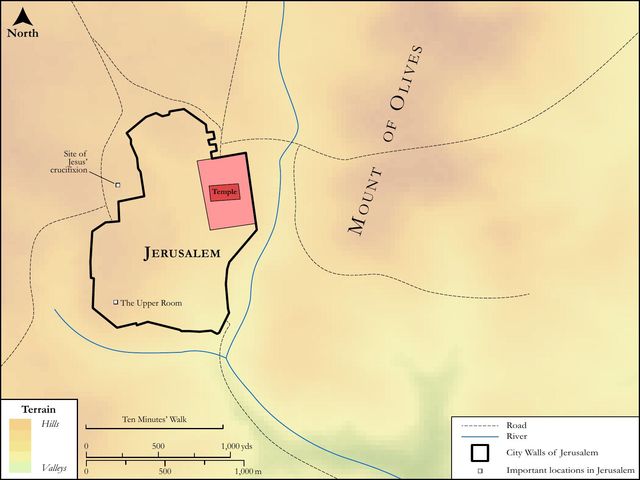
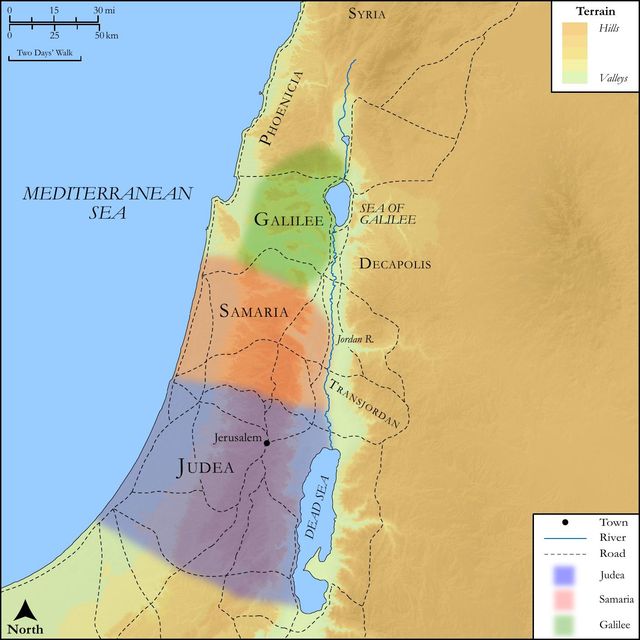
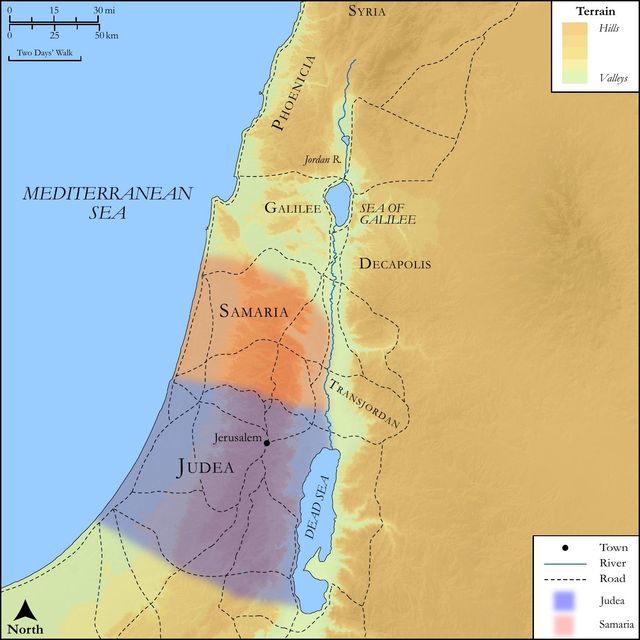
See on the biblical-era maps
Study this verse
Public-domain commentary
Matthew Henry
From his Commentary on the Whole Bible. Henry comments on passages, not single verses — this entry covers Acts 1:6–11. His four-level outline is real structure in the source text, so it is rendered as structure.
In Jerusalem Christ, by his angel, had appointed his disciples to meet him in Galilee; there he appointed them to meet him in Jerusalem again, such a day. Thus he would try their obedience, and it was found ready and cheerful; they came together, as he appointed them, to be the witnesses of his ascension, of which we have here an account. Observe,
I.The question they asked him at this interview.
They came together to him, as those that had consulted one another about it, and concurred in the question nemine contradicente - unanimously; they came in a body, and put it to him as the sense of the house, Lord, wilt thou at this time restore again the kingdom to Israel? Two ways this may be taken: -
1."Surely thou wilt not at all restore it to the present rulers of Israel, the chief priests and the elders, that put thee to death, and, to compass that design, tamely gave up the kingdom to Caesar, and owned themselves his subjects. What! Shall those that hate and persecute thee and us be trusted with power? This be far from thee." Or rather,
2."Surely thou wilt now restore it to the Jewish nation, as far as it will submit to thee as their king." Now two things were amiss in this question: -
(1.)Their expectation of the thing itself. They thought Christ would restore the kingdom to Israel, that is, that he would make the nation of the Jews as great and considerable among the nations as it was in the days of David and Solomon, of Asa and Jehoshaphat; that, as Shiloh, he would restore the sceptre to Judah, and the lawgiver; whereas Christ came to set up his own kingdom, and that a kingdom of heaven, not to restore the kingdom to Israel, an earthly kingdom. See here,
[1.]How apt even good men are to place the happiness of the church too much in external pomp and power; as if Israel could not be glorious unless the kingdom were restored to it, nor Christ's disciples honoured unless they were peers of the realm; whereas we are told to expect the cross in this world, and to wait for the kingdom in the other world.
[2.]How apt we are to retain what we have imbibed, and how hard it is to get over the prejudices of education. The disciples, having sucked in this notion with their milk that the Messiah was to be a temporal prince, were long before they could be brought to have any idea of his kingdom as spiritual.
[3.]How naturally we are biassed in favour of our own people. They thought God would have no kingdom in the world unless it were restored to Israel; whereas the kingdoms of this world were to become his, in whom he would be glorified, whether Israel should sink or swim.
[4.]How apt we are to misunderstand scripture - to understand that literally which is spoken figuratively, and to expound scripture by our schemes, whereas we ought to form our schemes by the scriptures. But, when the Spirit shall be poured out from on high, our mistakes will be rectified, as the apostles' soon after were.
(2.)Their enquiry concerning the time of it: "Lord, wilt thou do it at this time? Now that thou hast called us together is it for this purpose, that proper measures may be concerted for the restoring of the kingdom to Israel? Surely there cannot be a more favourable juncture than this." Now herein they missed their mark,
[1.]That they were inquisitive into that which their Master had never directed nor encouraged them to enquire into.
[2.]That they were impatient for the setting up of that kingdom in which they promised themselves so great a share, and would anticipate the divine counsels. Christ had told them that they should sit on thrones (Luk 22:30), and now nothing will serve them but they must be in the throne immediately, and cannot stay the time; whereas he that believeth doth not make haste, but is satisfied that God's time is the best time.
II.The check which Christ gave to this question, like that which he had a little before given to Peter's enquiry concerning John, What is that to thee? Act 1:7, It is not for you to know the times and seasons. He does not contradict their expectation that the kingdom would be restored to Israel, because that mistake would soon be rectified by the pouring out of the Spirit, after which they never had any more thoughts of the temporal kingdom; and also because there is a sense of the expectation which is true, the setting up of the gospel kingdom in the world; and their mistake of the promise shall not make it of no effect; but he checks their enquiry after the time.
1.The knowledge of this is not allowed to them: It is not for you to know, and therefore it is not for you to ask.
(1.)Christ is now parting from them, and parts in love; and yet he gives them this rebuke, which is intended for a caution to his church in all ages, to take heed of splitting upon the rock which was fatal to our first parents - an inordinate desire of forbidden knowledge, and intruding into things which we have not seen because God has not shown them. Nescire velle quae magister maximus docere non vult, erudita inscitia est - It is folly to covet to be wise above what is written, and wisdom to be content to be no wiser.
(2.)Christ had given his disciples a great deal of knowledge above others (to you it is given to know the mysteries of the kingdom of God), and had promised them his Spirit, to teach them more; now, lest they should be puffed up with the abundance of the revelations, he here lets them understand that there were some things which it was not for them to know. We shall see how little reason we have to be proud of our knowledge when we consider how many things we are ignorant of.
(3.)Christ had given his disciples instructions sufficient for the discharge of their duty, both before his death and since his resurrection, and in this knowledge he will have them to be satisfied; for it is enough for a Christian, in whom vain curiosity is a corrupt humour, to be mortified, and not gratified.
(4.)Christ had himself told his disciples the things pertaining to the kingdom of God, and had promised that the Spirit should show them things to come concerning it, Joh 16:13. He had likewise given them signs of the times, which it was their duty to observe, and a sin to overlook, Mat 24:33; Mat 16:3. But they must not expect nor desire to know either all the particulars of future events or the exact times of them. It is good for us to be kept in the dark, and left at uncertainty concerning the times and moments (as Dr. Hammond reads it) of future events concerning the church, as well as concerning ourselves, - concerning all the periods of time and the final period of it, as well as concerning the period of our own time.
Prudens futuri temporis exitum
Caliginosa nocte premit Deus -
But Jove, in goodness ever wise,
Hath hid, in clouds of thickest night,
All that in future prospect lies
Beyond the ken of mortal sight.
- Hor.
As to the times and seasons of the year, we know, in general, there will be summer and winter counterchanged, but we know not particularly which day will be fair or which foul, either in summer or in winter; so, as to our affairs in this world, when it is a summer-time of prosperity, that we may not be secure, we are told there will come a wintertime of trouble; and in that winter, that we may not despond and despair, we are assured that summer will return; but what this or that particular day will bring forth we cannot tell, but must accommodate ourselves to it, whatever it is, and make the best of it.
2.The knowledge of it is reserved to God as his prerogative; it is what the Father hath put in his own power; it is hid with him. None besides can reveal the times and seasons to come. Known unto God are all his works, but not to us, Act 15:18. It is in his power, and in his only, to declare the end from the beginning; and by this he proves himself to be God, Isa 46:10. "And though he did think fit sometimes to let the Old Testament prophets know the times and the seasons (as of the Israelites' bondage in Egypt four hundred years, and in Babylon seventy years), yet he has not fit to let you know the times and seasons, no not just how long it shall be before Jerusalem be destroyed, though you be so well assured of the thing itself. He hath not said that he will not give you to know something more than you do of the times and seasons;" he did so afterwards to his servant John; "but he has put it in his own power to do it or not, as he thinks fit;" and what is in that New Testament prophecy discovered concerning the times and the seasons is so dark, and hard to be understood, that, when we come to apply it, it concerns us to remember this work, that it is not for us to be positive in determining the times and the seasons. Buxtorf mentions a saying of the rabbin concerning the coming of the Messiah: Rumpatur spiritus eorum qui supputant tempora - Perish the men who calculate the time.
III.He appoints them their work, and with authority assures them of an ability to go on with it, and of success in it.
"It is not for you to know the times and the seasons - this would do you no good; but know this (Act 1:8) that you shall receive a spiritual power, by the descent of the Holy Ghost upon you, and shall not receive it in vain, for you shall be witnesses unto me and my glory; and your testimony shall not be in vain, for it shall be received here in Jerusalem, in the country about, and all the world over," Act 1:8. If Christ make us serviceable to his honour in our own day and generation, let this be enough for us, and let not us perplex ourselves about times and seasons to come. Christ here tells them,
1.That their work should be honourable and glorious: You shall be witnesses unto me.
(1.)They shall proclaim him king, and publish those truths to the world by which his kingdom should be set up, and he would rule. They must openly and solemnly preach his gospel to the world.
(2.)They shall prove this, shall confirm their testimony, not as witnesses do, with an oath, but with the divine seal of miracles and supernatural gifts: You shall be martyrs to me, or my martyrs, as some copies read it; for they attested the truth of the gospel with their sufferings, even unto death.
2.That their power for this work should be sufficient. They had not strength of their own for it, nor wisdom nor courage enough; they were naturally of the weak and foolish things of the world; they durst not appear as witnesses for Christ upon his trial, neither as yet were they able. "But you shall receive the power of the Holy Ghost coming upon you" (so it may be read), "shall be animated and actuated by a better spirit than your own; you shall have power to preach the gospel, and to prove it out of the scriptures of the Old Testament" (which, when they were filled with the Holy Ghost, they did to admiration, Act 18:28), "and to confirm it both by miracles and by sufferings." Note, Christ's witnesses shall receive power for that work to which he calls them; those whom he employs in his service he will qualify for it, and will bear them out in it.
3.That their influence should be great and very extensive: "You shall be witnesses for Christ, and shall carry his cause," (1.) "In Jerusalem; there you must begin, and many there will receive your testimony; and those that do not will be left inexcusable." (2.) "Your light shall thence shine throughout all Judea, where before you have laboured in vain." (3.) "Thence you shall proceed to Samaria, though at your first mission you were forbidden to preach in any of the cities of the Samaritans." (4.) "Your usefulness shall reach to the uttermost part of the earth, and you shall be blessings to the whole world."
IV.Having left these instructions with them, he leaves them (Act 1:9):
When he had spoken these things, and had said all that he had to say, he blessed them (so we were told, Luk 24:50); and while they beheld him, and had their eye fixed upon him, receiving his blessing, he was gradually taken up, and a cloud received him out of their sight. We have here Christ's ascending on high; not fetched away, as Elijah was, with a chariot of fire and horses of fire, but rising to heaven, as he rose from the grave, purely by his own power, his body being now, as the bodies of the saints will be at the resurrection, a spiritual body, and raised in power and incorruption. Observe,
1.He began his ascension in the sight of his disciples, even while they beheld. They did not see him come up out of the grave, because they might see him after he had risen, which would be satisfaction enough; but they saw him go up towards heaven, and had actually their eye upon him with so much care and earnestness of mind that they could not be deceived. It is probable that he did not fly swiftly up, but moved upwards gently, for the further satisfaction of his disciples.
2.He vanished out of their sight, in a cloud, either a thick cloud, for God said that he would dwell in the thick darkness; or a bright cloud, to signify the splendour of his glorious body. It was a bright cloud that overshadowed him in his transfiguration, and most probably this was so, Mat 17:5. This cloud received him, it is probable, when he had gone about as far from the earth as the clouds generally are; yet it was not such a spreading cloud as we commonly see, but such as just served to enclose him. Now he made the clouds his chariot, Psa 104:3. God had often come down in a cloud; now he went up in one. Dr. Hammond thinks that the clouds receiving him here were the angels receiving him; for the appearance of angels is ordinarily described by a cloud, comparing Exo 25:22 with Lev 16:2. By the clouds there is a sort of communication kept up between the upper and lower world; in them the vapours are sent up from the earth, and the dews sent down from heaven. Fitly therefore does he ascend in a cloud who is the Mediator between God and man, by whom God's mercies come down upon us and our prayers come up to him. This was the last that was seen of him. The eyes of a great many witnesses followed him into the cloud; and, if we would know what became of him then, we may find (Dan 7:13), That one like the Son of man came with the clouds of heaven, and came to the Ancient of days, and they brought him in the clouds as he came near before him.
V.The disciples, when he had gone out of their sight, yet still continued looking up stedfastly to heaven (Act 1:10), and this longer than it was fit they should; and why so?
1.Perhaps they hoped that Christ would presently come back to them again, to restore the kingdom to Israel, and were loth to believe they should now part with him for good and all; so much did they still dote upon his bodily presence, though he had told them that it was expedient for them that he should go away. or, they looked after him, as doubting whether he might not be dropped, as the sons of the prophets thought concerning Elijah (Kg2 2:16), and so they might have him again.
2.Perhaps they expected to see some change in the visible heavens now upon Christ's ascension, that either the sun should be ashamed or the moon confounded (Isa 24:23), as being out-shone by his lustre; or, rather, that they should show some sign of joy and triumph; or perhaps they promised themselves a sight of the glory of the invisible heavens, upon their opening to receive him. Christ had told them that hereafter they should see heaven opened (Joh 1:51), and why should not they expect it now?
VI.Two angels appeared to them, and delivered them a seasonable message from God.
There was a world of angels ready to receive our Redeemer, now that he made his public entry into the Jerusalem above: we may suppose these two loth to be absent then; yet, to show how much Christ had at heart the concerns of his church on earth, he sent back to his disciples two of those that came to meet him, who appear as two men in white apparel, bright and glittering; for they know, according to the duty of their place, that they are really serving Christ when they are ministering to his servants on earth. Now we are told what the angels said to them,
1.To check their curiosity: You men of Galilee, why stand you gazing up into heaven? He calls them men of Galilee, to put them in mind of the rock out of which they were hewn. Christ had put a great honour upon them, in making them his ambassadors; but they must remember that they are men, earthen vessels, and men of Galilee, illiterate men, looked upon with disdain. Now, say they, "Why stand you here, like Galileans, rude and unpolished men, gazing up into heaven? What would you see? You have seen all that you were called together to see, and why do you look any further? Why stand you gazing, as men frightened and perplexed, as men astonished and at their wits' end?" Christ's disciples should never stand at a gaze, because they have a sure rule to go by, and a sure foundation to build upon.
2.To confirm their faith concerning Christ's second coming. Their Master had often told them of this, and the angels are sent at this time seasonably to put them in mind of it: "This same Jesus, who is taken up from you into heaven, and whom you are looking thus long after, wishing you had him with you again, is not gone for ever; for there is a day appointed in which he will come in like manner thence, as you have seen him go thither, and you must not expect him back till that appointed day." (1.) "This same Jesus shall come again in his own person, clothed with a glorious body; this same Jesus, who came once to put away sin by the sacrifice of himself, will appear a second time without sin (Heb 9:26, Heb 9:28), who came once in disgrace to be judged, will come again in glory to judge. The same Jesus who has given you your charge will come again to call you to an account how you have performed your trust; he, and not another," Job 19:27. (2.) "He shall come in like manner. He is gone away in a cloud, and attended with angels; and, behold, he comes in the clouds, and with him an innumerable company of angels! He is gone up with a shout and with the sound of a trumpet (Psa 47:5), and he will descend from heaven with a shout and with the trump of God, Th1 4:16. You have now lost the sight of him in the clouds and in the air; and whither he is gone you cannot follow him now, but shall then, when you shall be caught up in the clouds, to meet the Lord in the air." When we stand gazing and trifling, the consideration of our Master's second coming should quicken and awaken us; and, when we stand gazing and trembling, the consideration of it should comfort and encourage us.
Historical interpretation
Thirteen Centuries of Reception
18 surviving comments on this verse. Each one is dated, so this reads as a timeline rather than a list.
Select a marker to jump to its quote. Markers stagger vertically where authors wrote within a few decades of each other.
The Passover affords a more than usually solemn day for baptism; when, withal, the Lord's passion, in which we are baptized, was completed. Nor will it be incongruous to interpret figuratively the fact that, when the Lord was about to celebrate the last Passover, He said to the disciples who were sent to make preparation, "You will meet a man bearing water." He points out the place for celebrating the Passover by the sign of water. After that, Pentecost is a most joyous space for conferring baptisms; wherein, too, the resurrection of the Lord was repeatedly proved among the disciples [Acts 1:3], and the hope of the advent of the Lord indirectly pointed to, in that, at that time, when He had been received back into the heavens [Acts 1:9], the angels told the apostles that "He would so come, as He had withal ascended into the heavens;" [Acts 1:11] at Pentecost, of course. But, moreover, when Jeremiah says, "And I will gather them together from the extremities of the land in the feast-day," he signifies the day of the Passover and of Pentecost, which is properly a "feast-day." However, every day is the Lord's; every hour, every time, is apt for baptism: if there is a difference in the solemnity, distinction there is none in the grace.
The apostle says: "The day of the Lord shall so come as a thief in the night. When they shall say, Peace and security, then on them shall come sudden destruction." [1 Thessalonians 5:2-3] Also in the Acts of the Apostles: "No one can know the times or the seasons which the Father has placed in His own power." [Acts 1:7]
The Son is not lacking in the knowledge of anything that the Father knows, and the Son is not ignorant, because the Father alone knows, since the Father and the Son remain in the unity of the nature. What the Son, in whom all the treasures of wisdom and knowledge are hidden, does not know is in harmony with the divine plan for maintaining silence. The Lord bore testimony to this when he replied to the apostles who had questioned him about the times, “It is not for you to know the times or dates which the Father has fixed by his own authority.”The knowledge is denied them. Not only is it denied, but they are forbidden to be anxious about the knowledge, since it is not for them to know these times. Naturally, after the resurrection, they now interrogate him about the times, since they had been informed previously when they broached the question, that not even the Son knows, and they could not believe that the Son did not know in the literal meaning of the term, because they again question him as one who does not know. Since they are aware that the mystery of not knowing is according to the divine plan for maintaining silence, they conclude that now, after the resurrection, the time for speaking has at length arrived, and they bring forth their questions.
And the Son does not tell them that he does not know but that it is not for them to know, because the Father has settled this matter by his own authority. Consequently, if the apostles realize that this statement, that the Son does not know, is in keeping with the plan of salvation and is not a weakness, shall we assert that the Son, therefore, does not know the day because he is not God? God the Father has determined it by his own authority, therefore, in order that it may not come to the knowledge of our human comprehension, and the Son, when previously interrogated, had said that he did not know and now he does not make the same reply that he does not know, but that it is not for them to know, and that the Father, however, has decided upon these times not in his knowledge but in his authority. Since the day and moment are included in the idea of time, it is impossible to believe that the day and moment for restoring the kingdom of Israel is unknown to him who is to restore it. But, to lead us to the knowledge of his birth through the Father’s unique power, he answered that it was known to him and, while revealing that the right to acquire this knowledge had not been conferred on them, he declared that this knowledge itself is dependent upon the mystery of the Father’s authority.
“It is not for you to know times or seasons.” He has hidden that from us so that we might keep watch and that each of us might think that this coming would take place during our life. For, if the time of his coming were to be revealed, his coming would be in vain, and it would not have been desired by the nations and the ages in which it was to take place. He has indeed said that he will come, but he did not define when, and thus all generations and ages thirst for him.
That is to say, the knowledge of such a kingdom is not for them that are bound in flesh and blood. This contemplation the Father has put away in his own power, meaning by “power” those that are authorized, and by “his own” those who are not held down by the ignorance of things below.
But neither is the Father deceived nor does the Son deceive. It is the custom of the holy Scriptures to speak thus, as the examples I have already given, and many others testify, so that God feigns not to know what he does know. In this then a unity of Godhead and a unity of character is proved to exist in the Father and in the Son; seeing that, as God the Father hides what is known to him, so also the Son, who is the image of God in this respect, hides what is known to him.
"Which the Father hath put in His own power." And yet He declared the Father's power and His to be one: as in the saying, "For as the Father raiseth up the dead and quickeneth them, even so the Son quickeneth whom He will." (John v. 21.) If where need is to work, Thou actest with the same power as the Father; where it behooves to know, dost Thou not know with the same power? Yet certainly to raise up the dead is much greater than to learn the day. If the greater be with power, much more the other.
"Wilt Thou at this time," say they, "restore the kingdom to Israel?" They so well knew his mildness, that after His Passion also they ask Him, "Wilt thou restore?" And yet He had before said to them, "Ye shall hear of wars and rumors of wars, but the end is not yet," nor shall Jerusalem be taken. But now they ask Him about the kingdom, not about the end. And besides, He does not speak at great length with them after the Resurrection. They address then this question, as thinking that they themselves would be in high honor, if this should come to pass. But He (for as touching this restoration, that it was not to be, He did not openly declare; for what needed they to learn this? hence they do not again ask, "What is the sign of Thy coming, and of the end of the world?" for they are afraid to say that: but, "Wilt Thou restore the kingdom to Israel?" for they thought there was such a kingdom), but He, I say, both in parables had shown that the time was not near, and here where they asked, and He answered thereto.
Since then their minds are elevated, He also speaks to them in a higher strain. For He no longer tells them, "Of that day not even the Son of Man knoweth" (Mark xiii. 32); but He says, It is not for you to know the times or the seasons which the Father hath put in His own power. Ye ask things greater than your capacity, He would say. And yet even now they learned things that were much greater than this. And that you may see that this is strictly the case, look how many things I shall enumerate. What, I pray you, was greater than their having learned what they did learn? Thus, they learned that there is a Son of God, and that God has a Son equal with Himself in dignity; they learned that there will be a resurrection; that when He ascended He sat on the right hand of God; and what is still more stupendous, that Flesh is seated in heaven, and adored by Angels, and that He will come again; they learned what is to take place in the judgment; learned that they shall then sit and judge the twelve tribes of Israel; learned that the Jews would be cast out, and in their stead the Gentiles should come in. For, tell me, which is greater? to learn that a person will reign, or to learn the time when? If the greater be with power, much more the other.
But just as when we see a child crying, and pertinaciously wishing to get something from us that is not expedient for him, we hide the thing, and show him our empty hands, and say, "See, we have it not:" the like has Christ here done with the Apostles. The disciples asked to have something, and He said He had it not. And on the first occasion he frightened them. Then again they asked to have it now: He said He had it not; and He did not frighten them now, but after having shown the empty hands, He has done this, and gives them a plausible reason: "Which the Father," He says, "hath put in his own power." What? Thou not know the things of the Father! Thou knowest Him, and not what belongs to Him! And yet Thou hast said, "None knoweth the Father but the Son" (Luke x. 25); and, "The Spirit searcheth all things, yea, the deep things of God" (1 Cor. ii. 10); and Thou not know this! But they feared to ask Him again, lest they should hear Him say, "Are ye also without understanding?" (Matt. xv. 26.) For they feared Him now much more than before.
And this he says, because he was very careful to honor them and to conceal nothing from them. Therefore he refers it to his Father, both to make the matter awesome and to dispel further inquiry on what was said. If this were not the reason, but he is ignorant, when will he know? Will he only know at the same time we do? Who would say this? He knows the Father clearly, just as the Father knows the Son. Is he then ignorant of the day? Furthermore, “the Spirit searches everything, even the depth of God.” But are we to say that he does not even know the time of the judgment? But he knows how he must judge, and he understands the secrets of each. Was he to be ignorant of this, which is much more general? And, if “all things came into being through him, and without him not one thing came into being,” how was he ignorant of the day? For he who made the ages clearly made the times also, and if the times, then also the day. How, then, is he ignorant of what he made?
But when His disciples (who are our apostles) put this question to the all-knowing Christ, they were told: "It is not yours to know the times or the seasons which the Father hath put in His own power." [Acts 1:7] What if Christ, who knows what is expedient for us, knows this knowledge not to be expedient? Through Him I know that it is not ours to know the times which God has placed in His own power; but concerning the origin of souls, I am ignorant whether it is or is not ours to know. If I could be sure that such knowledge is not for us, I should cease not only to dogmatize, but even to inquire. As it is, though the subject is so deep and dark that my fear of becoming a rash teacher is almost greater than my eagerness to learn the truth, I still wish to know it if I can do so. It may be that the knowledge for which the psalmist prays: "Lord, make me to know mine end," [Ps. 39:4] is much more necessary; yet I would that my beginning also might be revealed to me.
People did not realize what they should not know, and the Son of God was not in any sense unaware of this through weakness of the flesh. But if we were to suspect that the divine Majesty cloaked ignorance (a thing it would be irreverent to say), then that ignorance would be found stronger than the divine nature, and could—to speak foolishness—bring down the providence by which all things were created. But since we are taught that this is quite ridiculous, we must believe that the whole Trinity, whose nature is one and all-powerful, has always an unfailing knowledge of all things.
As it is not for us to know the times or the seasons which the Father hath put in His own power,
It is not for you to know times or seasons which the Father has placed in His own authority. He said this, indicating that the time of that (kingdom) is so secret that it lies within the knowledge of the Father alone. And when He says: It is not for you to know, He shows that He Himself knows, whose are all the things that are the Father's, but it is not expedient for mortals to know, so that always uncertain about the coming of the judge, they may live every day as though they were to be judged on another day.
He assures us that nothing which takes place is the effect of accident or chance or destiny, since all things the Father has put in His own power.
Now the Holy Spirit taught the apostles all truth in respect of matters necessary for salvation; those things, to wit, that we are bound to believe and to do. But He did not teach them about all future events.
And yet, even in the meantime a spiritual kingdom will thrust itself forth. In vindicating and protecting this kingdom, God demands their service, as for the rewards, let them be his concern. So they are to give up their desiree to know what they should not know; prepare themselves for events that lie at hand.
Continue studying Acts 1:7 across the web’s major study libraries — every link below opens this exact verse, chapter, or book on the destination site.
Read & Compare
 BibleGatewayThis verse in more than 200 translations and 70 languages.
 Bible.comThe YouVersion reader — hundreds of translations, reading plans, and highlights.
 ESV.orgCrossway's official English Standard Version reader.
 NET BibleThe NET translation with 60,000+ translators' notes on every rendering decision.
 STEP BibleTyndale House's free study tool — original text, vocabulary, and scholarly resources.
 BibliaLogos Bible Software's free web reader.
 USCCBThe New American Bible (Revised Edition) with the U.S. bishops' study notes.
Commentaries
 BibleHub CommentariesDozens of classic commentaries on this verse, gathered on one page.
 StudyLightMore than 100 commentary sets — the largest collection on the web.
 BibleRefPlain-English commentary on what this verse means, verse by verse.
 Enduring WordDavid Guzik's free commentary on this chapter, widely used by Bible teachers.
 Bible Study ToolsVerse commentary alongside Greek and Hebrew study aids.
Original Language & Research
- BibleHub InterlinearThe verse word by word — original language, transliteration, and English.
- BibleHub LexiconEvery word's original-language definition and Strong's entry.
 Blue Letter BibleDeep-study tools — Strong's numbers, concordance, and word studies.
 CNTR CollationThe earliest Greek manuscripts of this verse, collated letter by letter.
Sermons, Hymns & Audio


TrulyRandomVerse is not affiliated with these sites and doesn’t control their content. They’re linked because they’re genuinely useful.
Summary
In Acts 1:7, Jesus directly addresses His disciples' persistent curiosity regarding the timing of the restoration of the Kingdom of Israel, just prior to His ascension. He firmly asserts that the precise "times or seasons" of prophetic fulfillment are exclusively within the sovereign authority of God the Father, redirecting their focus from speculative eschatology to their impending mission as His witnesses empowered by the Holy Spirit. This declaration underscores divine prerogative over future events and sets the stage for the church's primary mandate.
Context
ShowHideLiterary Context
This verse is Jesus' immediate and pivotal response to the disciples' question in Acts 1:6: "Lord, wilt thou at this time restore again the kingdom to Israel?" This question reveals their lingering misunderstanding of the nature of the Messiah's kingdom, despite having spent forty days with Jesus post-resurrection, during which He spoke "of the things pertaining to the kingdom of God" (Acts 1:3). Jesus' reply in Acts 1:7 is not a direct answer to when the kingdom would be restored, but a crucial reorientation of their priorities and understanding. It serves as a preamble to the Great Commission given in Acts 1:8, shifting their attention from chronological speculation to the urgent task of global witness empowered by the Holy Spirit.
Historical & Cultural Context
The disciples, like many Jews of their time, held deeply ingrained expectations of a political, earthly kingdom that would liberate Israel from Roman occupation and restore its national sovereignty, fulfilling Old Testament prophecies of a glorious Davidic reign (e.g., Isaiah 9:6-7, Daniel 7:13-14). They had witnessed Jesus' miracles and resurrection, confirming His messianic identity, but still struggled to reconcile their nationalistic hopes with the spiritual nature of His kingdom. This historical backdrop explains their persistent question about the "restoration of the kingdom to Israel," highlighting the need for Jesus to correct their temporal and earthly focus, preparing them for a spiritual mission that transcended national boundaries.
Key Themes
ShowHideActs 1:7 contributes significantly to several key themes within the book of Acts and broader New Testament theology. Firstly, it powerfully asserts Divine Sovereignty over all of history and prophetic fulfillment. God the Father retains exclusive authority over the timing of eschatological events, emphasizing His omnipotence and wisdom. Secondly, the verse introduces the theme of Eschatological Prudence, teaching that while God reveals certain truths, some knowledge, particularly precise timelines, is purposefully withheld from humanity. This discourages speculative curiosity and promotes humility. Finally, and most importantly, it establishes the theme of Mission over Speculation. By stating that the timing is "not for you to know," Jesus implicitly directs His disciples' attention away from "when" the kingdom would be fully established and towards "what" they were to do in the interim: be His witnesses to the ends of the earth, a theme immediately developed in Acts 1:8.
Exposition and Analysis
ShowHideKey Word Analysis
ShowHideThis verb signifies a deep, experiential knowledge, not merely intellectual acquaintance. In this context, Jesus is not saying they are incapable of understanding, but that they are not permitted or authorized to possess this specific knowledge. It implies a divine withholding, a boundary set by God.
Refers to general chronological time, duration, or a period. It denotes the quantitative aspect of time, the sequence of moments. By using this term, Jesus indicates that even the broad period or duration of future events is not for them to discern.
This word denotes a specific, opportune, or appointed time; a fixed, decisive moment or season for an event. It refers to the qualitative aspect of time, the right moment for something to happen. The combination of chrónos and kairós emphasizes that neither the general span nor the precise moment of these future events is within the disciples' purview.
This term signifies inherent authority, privilege, capacity, or delegated influence. When applied to the Father, it highlights His absolute, sovereign right and control. The Father has "put" (Greek, títhēmi', meaning to place, set, or ordain) these times and seasons "in His own power," underscoring His exclusive and undisputed prerogative over the unfolding of His divine plan.
Verse Breakdown
ShowHide"And he said unto them,"
This phrase introduces Jesus' direct and authoritative response, highlighting the significance of His words as a definitive teaching moment for His disciples. It follows their question, indicating a clear, intentional redirection.
"It is not for you to know"
This is a firm, yet pastoral, declaration of divine limitation on human knowledge. Jesus explicitly states that certain information, specifically the precise timing of future events, is not within the scope of what humans are intended or permitted to comprehend. This sets a boundary for their curiosity.
"the times or the seasons,"
As explored in the key word analysis, the use of both chrónos (general time) and kairós (appointed time) emphasizes the comprehensive nature of this divine withholding. Neither the broad historical epoch nor the specific, opportune moment of the kingdom's full restoration is to be known by them. This underscores the mystery surrounding God's prophetic timetable.
"which the Father hath put in his own power."
This final clause provides the theological rationale for the previous statement. The ultimate authority and control over these matters reside solely with God the Father. The phrase "in his own power" (Greek, _en idía _exousía'__) stresses the Father's exclusive, inherent, and sovereign prerogative, reinforcing that this is a divine secret, not a human one.
Literary Devices
ShowHideActs 1:7 employs several literary devices to convey its profound message. Redirection is central, as Jesus masterfully shifts the disciples' focus from their earthly, temporal concerns about the kingdom's restoration to the spiritual realities of God's sovereignty and their immediate mission. This is an example of Corrective Teaching, where Jesus gently but firmly rectifies a misunderstanding. The use of Contrast is also evident: human curiosity and speculation are contrasted with divine prerogative and hidden wisdom. The phrase "It is not for you to know" serves as a powerful Understatement of the divine mystery, implying a depth of knowledge that is unfathomable to humanity. Furthermore, the emphasis on "the Father hath put in his own power" functions as a form of Divine Prerogative, asserting God's absolute and unquestionable authority over all matters of time and destiny, especially those pertaining to His kingdom.
Theological and Thematic Connections
ShowHideActs 1:7 stands as a foundational text for understanding divine sovereignty and the appropriate human response to eschatological mysteries. It teaches that God, in His infinite wisdom, reserves certain knowledge for Himself, particularly the precise timing of future events related to His kingdom's full establishment. This principle guards against speculative excesses and encourages a posture of humble trust in God's perfect plan and timing. It underscores that while God reveals what is necessary for salvation and faithful living, He does not satisfy every human curiosity, especially when such curiosity might distract from the primary call to obedience and mission. This divine withholding serves to maintain God's ultimate authority and to keep humanity reliant on His revealed will, rather than on prophetic timetables.
Reflection and Application
ShowHideActs 1:7 remains profoundly relevant for believers today, serving as a timeless reminder of where our focus should truly lie. In an age often preoccupied with predicting future events and deciphering complex prophetic charts, Jesus' words call us back to a posture of humility and trust. We are invited to release our need for comprehensive understanding of God's timetable and instead embrace the divine wisdom that chooses to keep certain things hidden. This frees us from the anxiety of speculation and redirects our energy towards the tangible, immediate call of Christ: to be His witnesses. Our primary task is not to know when He will return or how all prophecies will unfold, but to faithfully live out His teachings, share the Gospel, and serve His kingdom now. This verse encourages us to trust God's perfect timing, to focus on the mission He has given us, and to find peace in the knowledge that the Father holds all things securely in His sovereign power.
Questions for Reflection
ShowHideFAQ
ShowHideWhy did the disciples ask this question about the restoration of the kingdom?
ShowHideThe disciples' question in Acts 1:6 stemmed from a deeply ingrained Jewish expectation of a political Messiah who would liberate Israel from Roman rule and restore its national glory, fulfilling Old Testament prophecies of a Davidic kingdom (e.g., Isaiah 9:6-7). Even after Jesus' resurrection and forty days of teaching about the "kingdom of God" (Acts 1:3), their minds were still fixed on an earthly, temporal restoration. They were eager to know if this was the moment for their nationalistic hopes to be realized.
Does Acts 1:7 mean Christians should not study prophecy or future events?
ShowHideNo, Acts 1:7 does not forbid the study of prophecy. Instead, it places a crucial emphasis on the timing of prophetic fulfillment being solely within God the Father's power. Scripture contains numerous prophecies that are meant to be studied, understood, and believed (e.g., the book of Revelation). The warning is against obsessive speculation about precise dates or sequences of events, especially when it distracts from the clear command to be Christ's witnesses (Acts 1:8). The focus should be on what God has revealed, not what He has purposefully kept hidden.
What is the difference between "times" (chronos) and "seasons" (kairos) in this verse?
ShowHideThe Greek word chrónos refers to general chronological time, duration, or a period (e.g., a long time, a short time). It's quantitative. The Greek word kairós refers to a specific, appointed, or opportune time; a fixed, decisive moment or season for an event. It's qualitative. By using both terms, Jesus emphasizes that neither the general period nor the specific, precise moment of these future events is for the disciples to know. Both aspects of time are exclusively within the Father's sovereign power.
Christ-Centered Fulfillment
ShowHideActs 1:7, while seemingly a statement of divine limitation, profoundly points to Christ as the very center of God's sovereign plan, even concerning the "times and seasons" that remain hidden. Jesus, as the incarnate Son, perfectly embodies the Father's will and purpose. Though the precise timing of the kingdom's full restoration is reserved for the Father, it is through Christ that the kingdom has already powerfully broken into history, and it is through Him that it will ultimately be consummated. All of creation and all of history find their ultimate purpose and coherence in Him, for "all things were created by him, and for him" (Colossians 1:16). The Father's "own power" is the power that raised Christ from the dead, seated Him at His right hand, and will send Him again to judge the living and the dead (Revelation 1:7). Thus, while the "when" is hidden, the "who" and the "what" of God's grand redemptive narrative are fully revealed in Jesus. The Father's sovereign plan, though mysterious in its timing, is entirely "a plan for the fullness of time, to unite all things in Christ, things in heaven and things on earth" (Ephesians 1:9-10). Therefore, our focus on Christ, and our obedience to His commission, is the appropriate response to the Father's hidden timetable, knowing that He is the Alpha and the Omega, the beginning and the end of all divine purpose.