


1 Thessalonians 5:1
- ΠερὶPeriConcerningG4012PREPPreposition
- δὲdenowG1161CONJConjunction
- τῶνtōntheG3588T-GPMDefinite article Genitive Plural Masculine
- χρόνωνchronōntimesG5550N-GPMNoun Genitive Plural Masculine
- καὶkaiandG2532CONJConjunction
- τῶνtōntheG3588T-GPMDefinite article Genitive Plural Masculine
- καιρῶνkairōnseasonsG2540N-GPMNoun Genitive Plural Masculine
- ἀδελφοίadelphoibrothersG80N-VPMNoun Vocative Plural Masculine
- οὐounoG3756PRT-NNegative Particle Negative
- χρείανchreianneedG5532N-ASFNoun Accusative Singular Feminine
- ἔχετεecheteyou haveG2192V-PAI-2PVerb Present Active Indicative 2nd Plural
- ὑμῖνhuminto youG4771P-2DPPersonal pronoun Dative 2nd Plural
- γράφεσθαι·graphesthaito be writtenG1125V-PPNVerb Present Passive Infinitive
English is a literal word-by-word gloss of the Greek, not the KJV's wording. Why?
This is the original text the KJV's translators worked from — each Greek word with its own literal English meaning in this verse, prepared by scholars at Tyndale House, Cambridge. The KJV translates whole sentences, not word by word, so its wording differs: one Greek word can become several English words, and the KJV may choose “charity” where the gloss reads “love”. Both are faithful — they answer different questions. For the KJV's own rendering, switch to the KJV text.
Details
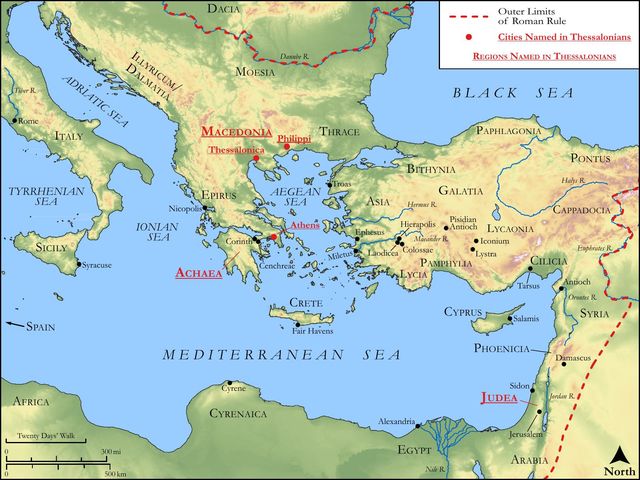
See on the biblical-era map

Study this verse
Public-domain commentary
Matthew Henry
From his Commentary on the Whole Bible. Henry comments on passages, not single verses — this entry covers 1 Thessalonians 5:1–5. His two-level outline is real structure in the source text, so it is rendered as structure.
In these words observe,
I.The apostle tells the Thessalonians it was needless or useless to enquire about the particular time of Christ's coming:
Of the times and seasons you need not that I write unto you, Th1 5:1. The thing is certain that Christ will come, and there is a certain time appointed for his coming; but there was no need that the apostle should write about this, and therefore he had no revelation given him; nor should they or we enquire into this secret, which the Father has reserved in his own power. Of that day and hour knoweth no man. Christ himself did not reveal this while upon earth; it was not in his commission as the great prophet of the church: nor did he reveal this to his apostles; there was no need of this. There are times and seasons for us to do our work in: these it is our duty and interest to know and observe; but the time and season when we must give up our account we know not, nor is it needful that we should know them. Note, There are many things which our vain curiosity desires to know which there is no necessity at all of our knowing, nor would our knowledge of them do us good.
II.He tells them that the coming of Christ would be sudden, and a great surprise to most men, Th1 5:2.
And this is what they knew perfectly, or might know, because our Lord himself had so said: In such an hour as you think not, the Son of man cometh, Mat 24:44. So Mar 13:35, Mar 13:36, Watch you therefore, for you know not when the master of the house cometh; lest, coming suddenly, he find you sleeping. And no doubt the apostle had told them, as of the coming of Christ, so also of his coming suddenly, which is the meaning of his coming as a thief in the night, Rev 16:15. As the thief usually cometh in the dead time of the night, when he is least expected, such a surprise will the day of the Lord be; so sudden and surprising will be his appearance. The knowledge of this will be more useful than to know the exact time, because this should awaken us to stand upon our watch, that we may be ready whenever he cometh.
III.He tells them how terrible Christ's coming would be to the ungodly, Th1 5:3.
It will be to their destruction in that day of the Lord. The righteous God will bring ruin upon his and his people's enemies; and this their destruction, as it will be total and final, so,
1.It will be sudden. It will overtake them, and fall upon them, in the midst of their carnal security and jollity, when they say in their hearts, Peace and safety, when they dream of felicity and please themselves with vain amusements of their fancies or their senses, and think not of it, - as travail cometh upon a woman with child, at the set time indeed, but not perhaps just then expected, nor greatly feared.
2.It will be unavoidable destruction too: They shall not escape; they shall in no wise escape. There will be no means possible for them to avoid the terror nor the punishment of that day. There will be no place where the workers of iniquity shall be able to hide themselves, no shelter from the storm, nor shadow from the burning heat that shall consume the wicked.
IV.He tells them how comfortable this day will be to the righteous, Th1 5:4, Th1 5:5. Here observe,
1.Their character and privilege. They are not in darkness; they are the children of the light, etc. This was the happy condition of the Thessalonians as it is of all true Christians. They were not in a state of sin and ignorance as the heathen world. They were some time darkness, but were made light in the Lord. They were favoured with the divine revelation of things that are unseen and eternal, particularly concerning the coming of Christ, and the consequences thereof. They were the children of the day, for the day-star had risen upon them; yea, the Sun of righteousness had arisen on them with healing under his wings. They were no longer under the darkness of heathenism, nor under the shadows of the law, but under the gospel, which brings life and immortality to light. Ti2 1:10.
2.Their great advantage on this account: that that day should not overtake them as a thief, Th1 5:4. It was at least their own fault if they were surprised by that day. They had fair warning, and sufficient helps to provide against that day, and might hope to stand with comfort and confidence before the Son of man. This would be a time of refreshing to them from the presence of the Lord, who to those that look for him will appear without sin unto their salvation, and will come to them as a friend in the day, not as a thief in the night.
Historical interpretation
Two Centuries of Reception
2 surviving comments on this verse. Each one is dated, so this reads as a timeline rather than a list.
Select a marker to jump to its quote. Markers stagger vertically where authors wrote within a few decades of each other.
For when they shall say, `Peace, 'and `All things are safe, 'then sudden destruction shall come upon them." Again, in the second epistle he addresses them with even greater earnestness: "Now I beseech you, brethren, by the coming of our Lord Jesus Christ, and by our gathering together unto Him, that ye be not soon shaken in mind, nor be troubled, either by spirit, or by word," that is, the word of false prophets, "or by letter," that is, the letter of false apostles, "as if from us, as that the day of the Lord is at hand.
"But concerning the times and the seasons, brethren, ye have no need that aught be written unto you. For yourselves know perfectly that the day of the Lord so cometh as a thief in the night."
Nothing, as it seems, is so curious, and so fondly prone to pry into things obscure and concealed, as the nature of men. And this is wont to happen to it, when the mind is unsettled and in an imperfect state. Why has he not said that no one knows? why has he not said, that it is not revealed, instead of saying, "Ye have no need that aught be written unto you"? Because in that case he would have grieved them more, but by speaking thus he comforted them. For by the expression, "Ye have no need," as if it were both superfluous, and inexpedient, he suffers them not to enquire.
For tell me, what would be the advantage? Let us suppose that the end would be after twenty or thirty or a hundred years, what is this to us? Is not the end of his own life the consummation to every individual? Why art thou curious, and travailest about the general end? But the case is the same with us in this, as in other things. For this reason Christ did not tell it, because it was not expedient.
Hear Paul saying, "For yourselves know perfectly that the day of the Lord so cometh as a thief in the night." Not the general day only, but that of every individual. For the one resembles the other, is also akin to it. For what the one does collectively, that the other does partially. For the period of consummation took its beginning from Adam, and then is the end of the consummation; since even now one would not err in calling it a consummation.
Continue studying 1 Thessalonians 5:1 across the web’s major study libraries — every link below opens this exact verse, chapter, or book on the destination site.
Read & Compare
 BibleGatewayThis verse in more than 200 translations and 70 languages.
 Bible.comThe YouVersion reader — hundreds of translations, reading plans, and highlights.
 ESV.orgCrossway's official English Standard Version reader.
 NET BibleThe NET translation with 60,000+ translators' notes on every rendering decision.
 STEP BibleTyndale House's free study tool — original text, vocabulary, and scholarly resources.
 BibliaLogos Bible Software's free web reader.
 USCCBThe New American Bible (Revised Edition) with the U.S. bishops' study notes.
Commentaries
 BibleHub CommentariesDozens of classic commentaries on this verse, gathered on one page.
 StudyLightMore than 100 commentary sets — the largest collection on the web.
 BibleRefPlain-English commentary on what this verse means, verse by verse.
 Enduring WordDavid Guzik's free commentary on this chapter, widely used by Bible teachers.
 Bible Study ToolsVerse commentary alongside Greek and Hebrew study aids.
Original Language & Research
- BibleHub InterlinearThe verse word by word — original language, transliteration, and English.
- BibleHub LexiconEvery word's original-language definition and Strong's entry.
 Blue Letter BibleDeep-study tools — Strong's numbers, concordance, and word studies.
 CNTR CollationThe earliest Greek manuscripts of this verse, collated letter by letter.
Sermons, Hymns & Audio


TrulyRandomVerse is not affiliated with these sites and doesn’t control their content. They’re linked because they’re genuinely useful.
Summary
First Thessalonians 5:1 marks a pivotal transition in Paul's letter, shifting from a detailed exposition on the certainty of Christ's return and the resurrection of believers in chapter 4 to the practical implications of its timing for daily Christian living. Paul reassures the Thessalonian believers that they are already sufficiently informed about the "times and the seasons" of these eschatological events, indicating that further written instruction on this specific matter is unnecessary. This verse sets the stage for the subsequent exhortations to spiritual vigilance, sobriety, and faithful conduct, emphasizing readiness over speculative knowledge concerning the Lord's coming.
Context
ShowHideLiterary Context
This verse serves as a crucial bridge between Paul's comforting words regarding the resurrection of believers and the Lord's return in 1 Thessalonians 4:13-18 and the practical ethical imperatives that follow in 1 Thessalonians 5:2-11. Having addressed their anxieties about deceased believers missing Christ's return, Paul now tackles their probable curiosity or concern about when these events would occur. By stating they have "no need" for him to write about the timing, he subtly redirects their focus from chronological speculation to the imperative of living prepared for an unknown, yet certain, future event. This prepares the ground for the subsequent call to wakefulness and sobriety.
Historical & Cultural Context
The early Christian community lived with an intense expectation of Christ's imminent return, a belief often referred to as the Parousia. This expectation was fueled by Jesus' own teachings (e.g., Matthew 24:36), the apostles' preaching, and the challenging circumstances of early believers, who often faced persecution and hardship. The Thessalonians, having recently converted from paganism, were particularly eager for clarity on eschatological matters, perhaps even to the point of neglecting daily responsibilities due to a misunderstanding of the timing of the Lord's coming (as hinted at in 2 Thessalonians 3:10-12). Paul's statement here implies that he had already provided thorough oral instruction on this topic during his initial, brief ministry among them, making further written detail redundant.
Key Themes
ShowHideThe verse introduces several key themes that permeate both this chapter and broader New Testament eschatology. Firstly, it highlights the divine sovereignty over timing, emphasizing that the precise "times and seasons" of God's redemptive plan are not for humanity to know, echoing Jesus' words in Acts 1:7. Secondly, it underscores the theme of pastoral reassurance and informed faith, as Paul affirms the Thessalonians' existing knowledge, thereby alleviating any anxiety that they were somehow "behind" on crucial eschatological information. Finally, and most importantly, this verse serves as a foundational premise for the overarching theme of eschatological readiness and ethical living. Since the exact timing is unknown, the emphasis shifts entirely from speculative curiosity to the practical necessity of living a life characterized by watchfulness, sobriety, and holiness, as detailed in the subsequent verses of 1 Thessalonians 5.
Exposition and Analysis
ShowHideKey Word Analysis
ShowHideThis particle, G1161, serves as an adversative or continuative connector. Here, it functions adversatively, signaling a shift in subject from the fact of Christ's return and the resurrection (discussed in 1 Thessalonians 4) to the timing of these events. It indicates a natural progression of thought, addressing a related but distinct aspect of their eschatological concerns.
G5550 refers to chronological time, a duration, or a specific point in time. It denotes the general, quantitative aspect of time—the length or sequence of a period. In this context, it refers to the broad sweep of chronological periods associated with the Lord's return.
G2540 signifies an appointed time, an opportune moment, or a significant epoch. Unlike chronos, kairos emphasizes the qualitative aspect of time—the divinely appointed, significant, or critical moment. Together, "times and seasons" comprehensively covers all aspects of timing, from general duration to specific, divinely ordained moments, reinforcing that both are outside human knowledge.
G5532 denotes employment, an affair, occasion, demand, requirement, or destitution. In this verse, "ye have no need" (οὐ χρείαν ἔχετε) means they have no requirement or necessity for Paul to write further on the subject of the timing of the Lord's coming, implying their prior instruction was sufficient.
Verse Breakdown
ShowHide"¶ But of the times and the seasons, brethren,"
Paul initiates a new topic with the transitional particle "But" (δὲ), indicating a shift from the what of Christ's return (resurrection, rapture) to the when. The phrase "of the times and the seasons" (περὶ δὲ τῶν χρόνων καὶ τῶν καιρῶν) uses two distinct Greek words for time, chronos (general, chronological time) and kairos (specific, opportune, or appointed time), to comprehensively cover all aspects of the timing of the Lord's coming. By addressing them as "brethren" (ἀδελφοί), Paul maintains a tone of affectionate pastoral care and shared spiritual identity, even as he corrects or clarifies their understanding.
"ye have no need that I write unto you."
This declarative statement (οὐ χρείαν ἔχετε γράφειν ὑμῖν) is central to the verse's meaning. It signifies that Paul had already provided sufficient oral instruction on the timing of the Lord's return during his initial ministry in Thessalonica. The phrase "no need" (οὐ χρείαν) implies that their existing knowledge, likely derived from his preaching and perhaps Jesus' own teachings, was adequate. This assertion serves to redirect their focus from speculative curiosity about dates to the practical implications of living in light of the Lord's certain, yet unrevealed, return. It effectively closes the door on further discussion about precise timing, preparing the way for the call to readiness.
Literary Devices
ShowHidePaul employs several literary devices in this concise verse. The opening "But" (δὲ) functions as a Transition, signaling a shift in the letter's focus from doctrinal explanation to practical exhortation, specifically regarding the timing of the Parousia. The direct address "brethren" (ἀδελφοί) is an example of Apostrophe, a rhetorical device where the speaker directly addresses an absent or present person or group, fostering a sense of intimacy and shared community. This affectionate address softens the potentially abrupt shift in topic. Furthermore, Paul's statement "ye have no need that I write unto you" can be seen as a form of Understatement or Litotes, where an affirmative is expressed by the negation of its contrary. By stating they have "no need" for him to write, he implies that they are already well-informed, which is a gentle way of affirming their prior instruction while subtly discouraging further speculative inquiry into the precise timing of events.
Theological and Thematic Connections
ShowHideThis verse profoundly shapes our understanding of eschatology, redirecting focus from speculative curiosity to practical living. It underscores the divine prerogative over the timing of future events, asserting that the precise "times and seasons" of God's redemptive plan are not revealed to humanity. This theological truth serves as a pastoral comfort, freeing believers from the burden of date-setting or obsessive calculation, and instead compels them to live in constant readiness. The emphasis shifts from knowing when to living as if, fostering a lifestyle of vigilance, sobriety, and faithful service, rooted in the certainty of Christ's return rather than the uncertainty of its exact moment. This principle encourages a robust, active faith that anticipates the future by faithfully engaging with the present.
Reflection and Application
ShowHideFirst Thessalonians 5:1 offers a timeless and crucial directive for believers in every age: our focus should not be on predicting or discerning the precise timing of Christ's return, but rather on living in constant readiness for it. In an age often preoccupied with end-times speculation, this verse serves as a powerful corrective, reminding us that such knowledge is reserved for God alone. Instead of expending energy on futile calculations, we are called to channel our spiritual fervor into lives of active faith, holiness, and service. This means cultivating an attitude of watchfulness, not anxiety; of sobriety, not sensationalism; and of faithful stewardship of the time and resources God has given us. Our readiness is demonstrated not by knowing when the Lord will come, but by how we live until He comes, ensuring our lamps are trimmed and burning, and our hearts are aligned with His will.
Questions for Reflection
ShowHideFAQ
ShowHideWhy does Paul say the Thessalonians have "no need" for him to write about the times and seasons?
ShowHidePaul's statement indicates that he had already provided sufficient oral instruction on the timing of the Lord's return during his initial ministry among them. Given the early church's intense anticipation of Christ's Parousia and the Thessalonians' specific questions (implied by the preceding chapter), it's highly probable that Paul had taught them extensively on this topic. His assertion here is not a dismissal but a pastoral reassurance that they already possess the necessary foundational knowledge, thereby redirecting their focus from speculative curiosity to the practical implications of living in light of this truth, which he elaborates on in the subsequent verses of 1 Thessalonians 5.
Christ-Centered Fulfillment
ShowHideWhile 1 Thessalonians 5:1 does not directly prophesy Christ, it profoundly shapes the Christ-centered expectation of His return, setting the stage for how believers are to live in light of His Lordship over all time. The "times and seasons" are ultimately under the sovereign control of the Father, as Jesus Himself declared in Acts 1:7, yet it is the return of Christ that is the focal point of these appointed times. Paul's redirection from chronological speculation to spiritual readiness implicitly highlights the person of Christ as the central figure of eschatological hope. Our anticipation is not merely for an event, but for the glorious appearing of our Lord and Savior Jesus Christ. The very uncertainty of the timing, as taught by Jesus in Matthew 24:42, compels believers to live in a state of constant readiness, reflecting the character and mission of Christ in their daily lives. Thus, this verse, by curbing speculative curiosity, channels the believer's gaze not towards a calendar, but towards the Lamb of God who takes away the sin of the world, whose return is certain, and whose coming demands a life of Christ-like watchfulness and holiness.