


Romans 13:14
Bible text: King James Version (1769 Blayney text) · Public domain
Bible text: Berean Standard Bible · Public domain
Bible text: American Standard Version (1901) · Public domain
Bible text: World English Bible, Messianic edition · Public domain
Bible text: Geneva Bible (1599) · Public domain
Bible text: Young's Literal Translation · Public domain
- ἀλλ᾽all᾽ButG235CONJConjunction
- ἐνδύσασθεendusasthedo put onG1746V-AMM-2PVerb Aorist Middle Imperative 2nd Plural
- τὸνtontheG3588T-ASMDefinite article Accusative Singular Masculine
- κύριονkurionLordG2962N-ASM-TNoun Accusative Singular Masculine Title
- ἸησοῦνIēsounJesusG2424N-ASM-PNoun Accusative Singular Masculine Individual
- ΧριστὸνChristonChristG5547N-ASM-TNoun Accusative Singular Masculine Title
- καὶkaiandG2532CONJConjunction
- τῆςtēsof theG3588T-GSFDefinite article Genitive Singular Feminine
- σαρκὸςsarkosfleshG4561N-GSFNoun Genitive Singular Feminine
- πρόνοιανpronoianprovisionG4307N-ASFNoun Accusative Singular Feminine
- μὴmēnotG3361PRT-NNegative Particle Negative
- ποιεῖσθεpoieisthedo makeG4160V-PMM-2PVerb Present Middle Imperative 2nd Plural
- εἰςeisforG1519PREPPreposition
- ἐπιθυμίαςepithumiasdesiresG1939N-APFNoun Accusative Plural Feminine
English is a literal word-by-word gloss of the Greek, not the KJV's wording. Why?
This is the original text the KJV's translators worked from — each Greek word with its own literal English meaning in this verse, prepared by scholars at Tyndale House, Cambridge. The KJV translates whole sentences, not word by word, so its wording differs: one Greek word can become several English words, and the KJV may choose “charity” where the gloss reads “love”. Both are faithful — they answer different questions. For the KJV's own rendering, switch to the KJV text.
Details
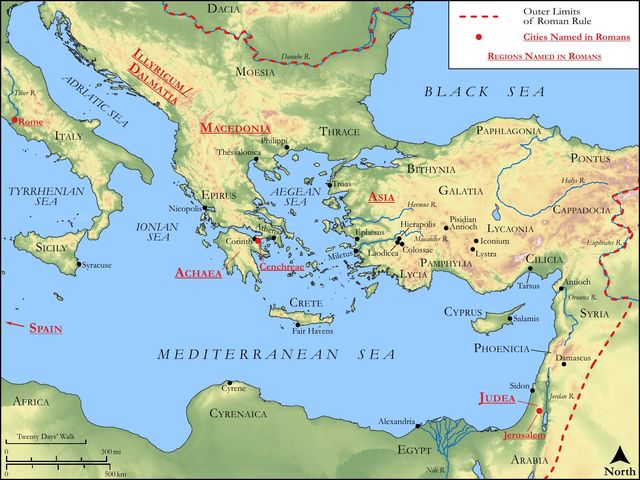
See on the biblical-era maps

Study this verse
Public-domain commentary
Matthew Henry
From his Commentary on the Whole Bible. Henry comments on passages, not single verses — this entry covers Romans 13:11–14. His three-level outline is real structure in the source text, so it is rendered as structure.
We are here taught a lesson of sobriety and godliness in ourselves. Our main care must be to look to ourselves. Four things we are here taught, as a Christian's directory for his day's work: when to awake, how to dress ourselves, how to walk, and what provision to make.
I.When to awake:
Now it is high time to awake (Rom 13:11), to awake out of the sleep of sin (for a sinful condition is a sleeping condition), out of the sleep of carnal security, sloth and negligence, out of the sleep of spiritual death, and out of the sleep of spiritual deadness; both the wise and foolish virgins slumbered and slept, Mat 25:5. We have need to be often excited and stirred up to awake. The word of command to all Christ's disciples is, Watch. "Awake - be concerned about your souls and your eternal interest; take heed of sin, be ready to, and serious in, that which is good, and live in a constant expectation of the coming of our Lord. Considering," 1. "The time we are cast into: Knowing the time. Consider what time of day it is with us, and you will see it is high time to awake. It is gospel time, it is the accepted time, it is working time; it is a time when more is expected than was in the times of that ignorance which God winked at, when people sat in darkness. It is high time to awake; for the sun has been up a great while, and shines in our faces. Have we this light to sleep in? See Th1 5:5, Th1 5:6. It is high time to awake; for others are awake and up about us. Know the time to be a busy time; we have a great deal of work to do, and our Master is calling us to it again and again. Know the time to be a perilous time. We are in the midst of enemies and snares. It is high time to awake, for the Philistines are upon us; our neighbour's house is on fire, and our own in danger. It is time to awake, for we have slept enough (Pe1 4:3), high time indeed, for behold the bridegroom cometh." 2. "The salvation we are upon the brink of: Now is our salvation nearer than when we believed - than when we first believed, and so took upon us the profession of Christianity. The eternal happiness we chose for our portion is now nearer to us than it was when we became Christians. Let us mind our way and mend our pace, for we are now nearer our journey's end than we were when we had our first love. The nearer we are to our centre the quicker should our motion be. Is there but a step between us and heaven, and shall we be so very slow and dull in our Christian course, and move so heavily? The more the days are shortened, and the more grace is increased, the nearer is our salvation, and the more quick and vigorous we should be in our spiritual motions."
II.How to dress ourselves.
This is the next care, when we are awake and up: "The night is far spent, the day is at hand; therefore it is time to dress ourselves. Clearer discoveries will be quickly made of gospel grace than have been yet made, as light gets ground. The night of Jewish rage and cruelty is just at an end; their persecuting power is near a period; the day of our deliverance from them is at hand, that day of redemption which Christ promised, Luk 21:28. And the day of our complete salvation, in the heavenly glory, is at hand. Observe then,"
1."What we must put off; put off our night-clothes, which it is a shame to appear abroad in: Cast off the works of darkness." Sinful works are works of darkness; they come from the darkness of ignorance and mistake, they covet the darkness of privacy and concealment, and they end in the darkness of hell and destruction. "Let us therefore, who are of the day, cast them off; not only cease from the practice of them, but detest and abhor them, and have no more to do with them. Because eternity is just at the door, let us take heed lest we be found doing that which will then make against us," Pe2 3:11, Pe2 3:14.
2."What we must put on." Our care must be wherewithal we shall be clothed, how shall we dress our souls?
(1.)Put on the armour of light. Christians are soldiers in the midst of enemies, and their life a warfare, therefore their array must be armour, that they may stand upon their defence - the armour of God, to which we are directed, Eph 6:13, etc. A Christian may reckon himself undressed if he be unarmed. The graces of the Spirit are this armour, to secure the soul from Satan's temptations and the assaults of this present evil world. This is called the armour of light, some think alluding to the bright glittering armour which the Roman soldiers used to wear; or such armour as it becomes us to wear in the day-light. The graces of the Spirit are suitable splendid ornaments, are in the sight of God of great price.
(2.)Put on the Lord Jesus Christ, Rom 13:14. This stands in opposition to a great many base lusts, mentioned Rom 13:13. Rioting and drunkenness must be cast off: one would think it should follows, but, "Put on sobriety, temperance, chastity," the opposite virtues: no, "Put on Christ, this includes all. Put on the righteousness of Christ for justification; be found in him (Phi 3:9) as a man is found in his clothes; put on the priestly garments of the elder brother, that in them you may obtain the blessing. Put on the spirit and grace of Christ for sanctification; put on the new man (Eph 4:24); get the habit of grace confirmed, the acts of it quickened." Jesus Christ is the best clothing for Christians to adorn themselves with, to arm themselves with; it is decent, distinguishing, dignifying, and defending. Without Christ, we are naked, deformed; all other things are filthy rages, fig-leaves, a sorry shelter. God has provided us coats of skins - large, strong, warm, and durable. By baptism we have in profession put on Christ, Gal 3:27. Let us do it in truth and sincerity. The Lord Jesus Christ. "Put him on as Lord to rule you, as Jesus to save you, and in both as Christ, anointed and appointed by the Father to this ruling saving work."
III.How to walk.
When we are up and dressed, we are not to sit still in an affected closeness and privacy, as monks and hermits. What have we good clothes for, but to appear abroad in them? - Let us walk. Christianity teaches us how to walk so as to please God, whose eye is upon us: Th1 4:1, Walk honestly as in the day. Compare Eph 5:8, Walk as children of light. Our conversation must be as becomes the gospel. Walk honestly; euschēmonōs - decently and becomingly, so as to credit your profession, and to adorn the doctrine of God our Saviour, and recommend religion in its beauty to others. Christians should be in a special manner careful to conduct themselves well in those things wherein men have an eye upon them, and to study that which is lovely and of good report. Particularly, here are three pairs of sins we are cautioned against: - 1. We must not walk in rioting and drunkenness; we must abstain from all excess in eating and drinking. We must not give the least countenance to revelling, nor indulge our sensual appetite in any private excesses. Christians must not overcharge their hearts with surfeiting and drunkenness, Luk 21:34. This is not walking as in the day; for those that are drunk are drunk in the night, Th1 5:7. 2. Not in chambering and wantonness; not in any of those lusts of the flesh, those works of darkness, which are forbidden in the seventh commandment. Downright adultery and fornication are the chambering forbidden. Lascivious thoughts and affections, lascivious looks, words, books, sons, gestures, dances, dalliances, which lead to, and are degrees of, that uncleanness, are the wantonness here forbidden - whatsoever transgresseth the pure and sacred law of chastity and modesty. 3. Not in strife and envying. These are also works of darkness; for, though the acts and instances of strife and envy are very common, yet none are willing to own the principles, or to acknowledge themselves envious and contentious. it may be the lot of the best saints to be envied and striven with; but to strive and to envy ill becomes the disciples and followers of the peaceable and humble Jesus. Where there are riot and drunkenness, there usually are chambering and wantonness, and strife and envy. Solomon puts them all together, Pro 23:29, etc. Those that tarry long at the wine (Pro 23:30) have contentions and wounds without cause (Pro 23:29) and their eyes behold strange women, Pro 23:33.
IV.What provision to make (Pro 23:14):
"Make not provision for the flesh. Be not careful about the body." Our great care must be to provide for our souls; but must we take no care about our bodies? Must we not provide for them, when they need it? Yes, but two things are here forbidden: - 1. Perplexing ourselves with an inordinate care, intimated in these words, pronoian mē poieisthe. "Be not solicitous in forecasting for the body; do not stretch your wits, nor set your thoughts upon the tenter-hooks, in making this provision; be not careful and cumbered about it; do not take thought," Mat 6:31. It forbids an anxious encumbering care. 2. Indulging ourselves in an irregular desire. We are not forbidden barely to provide for the body (it is a lamp that must be supplied with oil), but we are forbidden to fulfil the lusts thereof. The necessities of the body must be considered, but the lusts of it must not be gratified. Natural desires must be answered, but wanton appetites must be checked and denied. To ask meat for our necessities is duty: we are taught to pray for daily bread; but to ask meat for our lusts is provoking, Psa 78:18. Those who profess to walk in the spirit must not fulfil the lusts of the flesh, Gal 5:16.
Historical interpretation
Three Centuries of Reception
12 surviving comments on this verse. Each one is dated, so this reads as a timeline rather than a list.
Select a marker to jump to its quote. Markers stagger vertically where authors wrote within a few decades of each other.
May I have joy of you in the Lord! Be ye sober. Lay aside, every one of you, all malice and beast-like fury, evil-speaking, calumny, filthy speaking, ribaldry, whispering, arrogance, drunkenness, lust, avarice, vainglory, envy, and everything akin to these. "But put ye on the Lord Jesus Christ, and make no provision for the flesh, to fulfil the lusts thereof." Ye presbyters, be subject to the bishop; ye deacons, to the presbyters; and ye, the people, to the presbyters and the deacons. Let my soul be for theirs who preserve this good order; and may the Lord be with them continually!
Let the women wear a plain and becoming dress, but softer than what is suitable for a man, yet not quite immodest or entirely gone in luxury. And let the garments be suited to age, person, figure, nature, pursuits. For the divine apostle most beautifully counsels us "to put on Jesus Christ, and make no provision for the lusts of the flesh."
On the ground of continence the priests likewise of the famous Egyptian bull will judge the "infirmity" of Christians. Blush, O flesh, who hast "put on" Christ! Suffice it thee once for all to marry, whereto "from the beginning" thou wast created, whereto by "the end" thou art being recalled! Return at least to the former Adam, if to the last thou canst not! Once for all did he taste of the tree; once for all felt concupiscence; once for all veiled his shame; once for all blushed in the presence of God; once for all concealed his guilty hue; once for all was exiled from the paradise of holiness; once for all thenceforward married.
The Lord Jesus Christ himself … is said to be the clothing of the saints.
We have often said that Christ is wisdom, righteousness, holiness, truth and all the other virtues. Therefore anyone who has acquired these has put on Christ. For if all these are Christ, then the person who has them must of necessity have Christ as well. Whoever has them will not bother about the flesh. The apostle speaks here with some care, because he knows that we must take some thought for the needs of the flesh. It is the excesses and lusts of the flesh, not its basic needs, which must be avoided.
Paul wants everything the law forbids not to be desired, or if it is desired, to be overcome.… To put on Christ means to cut oneself off from every sin and wickedness, so that at the wedding banquet one will not be found without a new garment and be shamefully thrown out into the darkness.
This means that we should imitate Christ in what we do and show him to others in the way we behave.
Those, therefore, who imitate Christ, imitate Him earnestly. For those who have "put on Christ" [Romans 13:14] in truth, express His likeness in their thoughts, and in their whole life, and in all their behaviour: in word, and in deeds, and in patience, and in fortitude, and in knowledge, and in chastity, and in long-suffering, and in a pure heart, and in faith, and in hope, and in full and perfect love towards God. No virgin, therefore, unless they be in everything as Christ, and as those "who are Christs," [Galatians 5:24] can be saved.
"But put ye on the Lord Jesus Christ."
He no longer speaks of works, but he rouses them to greater things. For when he was speaking of vice, he mentioned the works of it: but when of virtue, he speaks not of works, but of arms, to show that virtue putteth him that is possessed of it into complete safety, and complete brightness. And even here he does not pause, but leading his discourse on to what was greater, a thing far more awestriking; he gives us the Lord Himself for a garment, the King Himself: for he that is clad with Him, hath absolutely all virtue. But in saying, "Put ye on," he bids us be girt about with Him upon every side. As in another place he says, "But if Christ be in you." (Rom. viii. 10.) And again, "That Christ may dwell in the inner man." (Eph. iii. 16, 17.) For He would have our soul to be a dwelling for Himself, and Himself to be laid round about us as a garment, that He may be unto us all things both from within and from without. For He is our fulness; for He is "the fulness of Him that filleth all in all" (Eph. i. 23): and the Way, and the Husband, and the Bridegroom;-for "I have espoused you as a chaste virgin to one husband," (2 Cor. xi. 2): and a root, and drink, and meat, and life;-for he says, "I live, yet not I, but Christ liveth in me;" (Gal. ii. 20) and Apostle, and High-Priest, and Teacher, and Father, and Brother, and Joint-heir, and sharer of the tomb and Cross;-for it says, "We were buried together with Him," and "planted together in the likeness of His Death" (Rom. vi. 4, 5): and a Suppliant;-"For we are ambassadors in Christ's stead" (2 Cor. v. 20): and an "Advocate to the Father;"-for "He also maketh," it says, "intercession for us:" (Rom. viii. 34) and house and inhabitant;-for He says, "He that abideth in Me and I in him" (John xv. 5): and a Friend; for, "Ye are My friends" (John xv. 14): and a Foundation, and Corner-stone. And we are His members and His heritage, and building, and branches, and fellow-workers. For what is there that He is not minded to be to us, when He makes us cleave and fit on to Him in every way? And this is a sign of one loving exceedingly. Be persuaded then, and rousing thee from sleep, put Him on, and when thou hast done so, give thy flesh up to His bridle. For this is what he intimates in saying,
"And make not provision for the flesh, to fulfil the lusts thereof." For as he does not forbid drinking, but drinking to excess, not marrying, but doing wantonness; so too he does not forbid making provision for the flesh either, but doing so with a view "to fulfil the lusts thereof," as, for instance, by going beyond necessaries. For that he does bid make provision for it, hear from what he says to Timothy, "Use a little wine for thy stomach's sake, and thine often infirmities." (1 Tim. v. 23.) So here too he is for taking care of it, but for health, and not wantonness. For this would cease to be making provision for it, when you were lighting up the flame, when you were making the furnace powerful. But that you may form a clearer notion what "making provision" for it "to fulfil the lusts thereof" is, and may shun such a provision, just call to mind the drunken, the gluttonous, those that pride themselves in dress, those that are effeminate, them that live a soft and relaxed life, and you will see what is meant. For they do everything not that they may be healthy, but that they may be wanton and kindle desire. But do thou, who hast put on Christ, prune away all those things, and seek for one thing only, to have thy flesh in health. And to this degree do make provision for it, and not any further, but spend all thy industry on the care of spiritual things. For then you will be able to rouse yourself out of this sleep, without being weighed down with these manifold desires. For the present life is a sleep, and the things in it are no way different from dreams. And as they that are asleep often speak and see things other than healthful, so do we also, or rather we see much worse even.
Christ alone should be seen in us, not the old self, for “one who says he abides in Christ should walk as he walked.”
Paul wants to say that by the regeneration of baptism we have been conformed to Christ and become members of the one body of the church, of which he is the head, and so we must put him on in the understanding of what we are expecting, in that we hope to share in his resurrection.
Provision for the flesh is not to be condemned if it has to do with the needs of bodily health. But if it is a question of unnecessary delights or luxuries, a person who enjoys the delights of the flesh is rightly chastised. For in that case he makes provision for the desires of the flesh, and “he who sows in the flesh will reap corruption in the flesh.”
Continue studying Romans 13:14 across the web’s major study libraries — every link below opens this exact verse, chapter, or book on the destination site.
Read & Compare
 BibleGatewayThis verse in more than 200 translations and 70 languages.
 Bible.comThe YouVersion reader — hundreds of translations, reading plans, and highlights.
 ESV.orgCrossway's official English Standard Version reader.
 NET BibleThe NET translation with 60,000+ translators' notes on every rendering decision.
 STEP BibleTyndale House's free study tool — original text, vocabulary, and scholarly resources.
 BibliaLogos Bible Software's free web reader.
 USCCBThe New American Bible (Revised Edition) with the U.S. bishops' study notes.
Commentaries
 BibleHub CommentariesDozens of classic commentaries on this verse, gathered on one page.
 StudyLightMore than 100 commentary sets — the largest collection on the web.
 BibleRefPlain-English commentary on what this verse means, verse by verse.
 Enduring WordDavid Guzik's free commentary on this chapter, widely used by Bible teachers.
 Bible Study ToolsVerse commentary alongside Greek and Hebrew study aids.
Original Language & Research
- BibleHub InterlinearThe verse word by word — original language, transliteration, and English.
- BibleHub LexiconEvery word's original-language definition and Strong's entry.
 Blue Letter BibleDeep-study tools — Strong's numbers, concordance, and word studies.
 CNTR CollationThe earliest Greek manuscripts of this verse, collated letter by letter.
Sermons, Hymns & Audio


TrulyRandomVerse is not affiliated with these sites and doesn’t control their content. They’re linked because they’re genuinely useful.
Summary
Romans 13:14 serves as a powerful concluding exhortation in Paul's discussion of Christian conduct, urging believers to fully embrace their new identity in Christ. It calls for a deliberate and active spiritual transformation, metaphorically described as "putting on" the character and righteousness of Jesus, while simultaneously renouncing and actively avoiding any indulgence or planning that would cater to the sinful desires of the fallen human nature. This verse encapsulates the essence of practical holiness, emphasizing that true Christian living involves both a positive identification with Christ and a negative renunciation of sin.
Context
ShowHideLiterary Context
Romans 13 begins with Paul's instructions on submission to governing authorities, followed by the overarching command to love one's neighbor as oneself, thereby fulfilling the law (Romans 13:8-10). The immediate preceding verses (Romans 13:11-13) introduce a sense of eschatological urgency, urging believers to "wake up" because their salvation is nearer than when they first believed. Paul contrasts "works of darkness" with "armor of light," setting the stage for the climactic call in Romans 13:14. This verse functions as the practical application and summation of the ethical demands laid out in the chapter, providing the means by which believers can truly "walk properly, as in the daytime" (Romans 13:13).
Historical & Cultural Context
Paul wrote his letter to the church in Rome, a diverse community of Jewish and Gentile believers living in the heart of the Roman Empire. The culture of Rome was characterized by various pagan practices, moral laxity, and often, a pursuit of sensual pleasures. Christians in this environment faced constant temptation to conform to the prevailing societal norms. Paul's exhortation to "put on the Lord Jesus Christ" and "make not provision for the flesh" was a radical call to counter-cultural living, demanding a distinct ethical identity that stood apart from the surrounding paganism and its associated vices. The concept of "putting on" a new identity was also familiar in that day, when new garments could signify a change in status or role.
Key Themes
ShowHideThis verse powerfully contributes to several key themes in Romans and Paul's broader theology. It underscores the theme of spiritual transformation, highlighting the radical change that occurs when one is united with Christ. It also emphasizes practical holiness, moving beyond mere theological assent to lived righteousness, where the believer's conduct reflects their new identity. Furthermore, it addresses the ongoing struggle against sin (the "flesh"), acknowledging its persistent pull while providing the divine solution—identification with Christ. The eschatological urgency mentioned in Romans 13:11-12 also frames this call to ethical living, as believers are to live in light of Christ's imminent return and the full realization of their salvation.
Exposition and Analysis
ShowHideKey Word Analysis
ShowHideProperly "other things," but adverbially "contrariwise." Here, it marks a strong contrast or transition from the previous negative commands (casting off works of darkness) to a positive, active command. It introduces a vital, alternative course of action.
From en (in) and dyno (to sink into a garment), meaning "to invest with clothing." This is a vivid metaphor for a complete and pervasive identification with Christ, suggesting that His character and righteousness should fully envelop the believer, influencing every aspect of their being and conduct.
While literally referring to the physical body, in this theological context, sarx signifies human nature in its fallen, unredeemed state—the sinful disposition that is inherently hostile to God and prone to rebellion. It represents the old self with its inherent desires and tendencies toward sin, as opposed to the Spirit.
From pronoeō, meaning "forethought, provident care or supply." To "make not provision" means to intentionally avoid planning, preparing, or creating opportunities that would cater to or nourish the sinful desires of the flesh. It implies a proactive abstinence from anything that would facilitate sin.
A longing, often specifically for what is forbidden. In this context, it refers to strong, often illicit or sinful cravings and passions that arise from the fallen nature (sarx), leading to immoral thoughts and actions.
Verse Breakdown
ShowHide"But put ye on the Lord Jesus Christ"
This is the primary positive command, urging believers to clothe themselves entirely with the character, attitudes, and righteousness of Jesus Christ. It signifies a radical identity shift, where Christ's life becomes the pattern and power for the believer's daily existence, transforming their thoughts, words, and actions. It's an active, daily appropriation of Christ's nature.
"and make not provision for the flesh"
This is the negative command, directly countering the previous positive one. It instructs believers to intentionally refrain from planning, preparing, or creating any circumstances that would enable or nourish the sinful human nature (sarx). It's a call to proactive vigilance against temptation and a refusal to cater to its desires.
"to fulfil the lusts thereof"
This clause explains the purpose or consequence of "making provision for the flesh." The objective of such "provision" is to satisfy or indulge the sinful cravings and passions (epithymía) that emanate from the fallen nature. Paul's command is to break this cycle by cutting off the "provision" that leads to the fulfillment of these destructive desires.
Literary Devices
ShowHidePaul employs several powerful literary devices in this concise verse. The central device is Metaphor, specifically the imagery of "putting on" (clothing) the Lord Jesus Christ. This vivid metaphor conveys a complete and pervasive identification, suggesting that Christ's character should envelop the believer entirely, much like a garment. It implies a deep identity shift rather than a superficial change. The contrast between "putting on Christ" and "making provision for the flesh" creates a strong Antithesis, highlighting the two opposing ways of life available to the believer: one empowered by Christ and the other driven by sinful desires. The phrase "make not provision for the flesh" also functions as a Metonymy, where "flesh" stands for the sinful human nature, and "making provision" represents the actions and choices that enable its desires. This combination of devices makes the exhortation memorable, urgent, and deeply practical.
Theological and Thematic Connections
ShowHideRomans 13:14 is a profound theological statement on the nature of Christian sanctification and identity. It encapsulates the Pauline tension between the "already" and the "not yet" of salvation, asserting that while believers are new creations in Christ, they must actively, daily choose to live out that new reality. The command to "put on the Lord Jesus Christ" speaks to the believer's union with Christ, where His righteousness becomes their covering and His life their pattern. This active appropriation of Christ's character is inextricably linked to the mortification of the old self, the "flesh," which remains a source of temptation. The verse thus underscores that true spiritual growth is not passive but requires intentional, Spirit-empowered resistance to sin and a proactive pursuit of Christ-likeness, reflecting the ongoing process of being conformed to His image.
Reflection and Application
ShowHideRomans 13:14 offers a timeless and deeply practical challenge for every believer. It compels us to examine the intentionality of our daily choices: Are we actively cultivating habits, thoughts, and relationships that "put on" the character of Christ, or are we inadvertently creating environments that "make provision" for the desires of our fallen nature? This verse calls for a radical reorientation of our priorities, urging us to be vigilant against subtle temptations and to proactively dismantle any structures or patterns in our lives that feed sinful inclinations. Living out this command requires not only self-awareness but also a profound reliance on the Holy Spirit, who empowers us to live in alignment with our new identity in Christ, transforming our desires and enabling us to walk in practical holiness. It reminds us that our spiritual journey is a dynamic process of daily surrender and appropriation, where Christ is increasingly evident in every facet of our lives.
Questions for Reflection
ShowHideFAQ
ShowHideWhat does it mean to "put on the Lord Jesus Christ"?
ShowHideTo "put on the Lord Jesus Christ" is a powerful metaphor signifying a complete and pervasive identification with Him. Just as one puts on a garment to cover themselves, believers are called to be clothed in Christ's character, righteousness, and way of life. It means adopting His attitudes, emulating His actions, and allowing His Spirit to transform one's inner being and outward conduct. This concept is foundational to Christian discipleship and is echoed in passages like Galatians 3:27, which states, "For as many of you as have been baptized into Christ have put on Christ." It implies a daily, active choice to live in conformity with who Christ is.
What is meant by "the flesh" in this verse?
ShowHideIn Pauline theology, "the flesh" (Greek: sarx) does not primarily refer to the physical body itself, but to the sinful human nature, the unredeemed aspect of humanity that is inherently prone to rebellion against God and His will. It represents the old self with its desires, passions, and tendencies toward sin, which stands in opposition to the Spirit of God. To "make not provision for the flesh" means to intentionally avoid creating opportunities, planning, or feeding these sinful desires, recognizing that they hinder spiritual growth and dishonor God. This struggle is further elaborated in Galatians 5:16-17, where Paul contrasts walking by the Spirit with fulfilling the desires of the flesh.
How does this verse relate to self-control and spiritual discipline?
ShowHideThis verse directly calls for both self-control and spiritual discipline. The command to "make not provision for the flesh" requires intentional self-restraint and a proactive stance against indulging sinful cravings. This involves disciplined choices about what we consume (media, entertainment), how we use our time, and the company we keep. Simultaneously, "putting on the Lord Jesus Christ" implies actively pursuing spiritual disciplines like prayer, Bible study, worship, and fellowship, which cultivate Christ-like character and strengthen one's resistance to temptation. It's a synergistic process: denying the flesh creates space for Christ to be more fully "put on," and the active pursuit of Christ-likeness weakens the power of the flesh. The Holy Spirit is essential in empowering believers in this ongoing battle, as seen in Galatians 5:22-23, where self-control is listed as a fruit of the Spirit.
Christ-Centered Fulfillment
ShowHideRomans 13:14 finds its ultimate fulfillment and power in the person and work of Jesus Christ. The command to "put on the Lord Jesus Christ" is not merely an ethical injunction but a spiritual reality made possible by His atoning sacrifice and resurrection. Through His death, Christ broke the power of the "flesh" and its dominion over believers (Romans 6:6), and through His resurrection, He offers new life empowered by the Spirit. When believers are united with Christ by faith, they are clothed in His righteousness (2 Corinthians 5:21) and receive the Holy Spirit, who enables them to walk "not according to the flesh but according to the Spirit" (Romans 8:4). Jesus Himself perfectly exemplified living without making "provision for the flesh," resisting every temptation and living in complete obedience to the Father (Hebrews 4:15). Therefore, "putting on Christ" is not an act of human striving but a Spirit-empowered appropriation of the new identity and power already secured by Christ's finished work, allowing believers to progressively reflect His character and defeat the desires that once enslaved them.