


Galatians 5:17
- ἡhēTheG3588T-NSFDefinite article Nominative Singular Feminine
- γὰρgarforG1063CONJConjunction
- σὰρξsarxfleshG4561N-NSFNoun Nominative Singular Feminine
- ἐπιθυμεῖepithumeidesiresG1937V-PAI-3SVerb Present Active Indicative 3rd Singular
- κατὰkataagainstG2596PREPPreposition
- τοῦtoutheG3588T-GSNDefinite article Genitive Singular Neuter
- πνεύματοςpneumatosSpiritG4151N-GSNNoun Genitive Singular Neuter
- τὸto<the>G3588T-NSNDefinite article Nominative Singular Neuter
- δὲdeandG1161CONJConjunction
- πνεῦμαpneumathe SpiritG4151N-NSNNoun Nominative Singular Neuter
- κατὰkataagainstG2596PREPPreposition
- τῆςtēstheG3588T-GSFDefinite article Genitive Singular Feminine
- σαρκός·sarkosfleshG4561N-GSFNoun Genitive Singular Feminine
- ταῦταtautatheseG3778D-NPNDemonstrative pronoun Nominative Plural Neuter
- γὰρgarforG1063CONJConjunction
- ἀλλήλοιςallēloisto one anotherG240C-DPNReciprocal pronoun Dative Plural Neuter
- ἀντίκειταιantikeitaiare opposedG480V-PNI-3SVerb Present Middle Or Passive Deponent Indicative 3rd Singular
- ἵναinain orderG2443CONJConjunction
- μὴmēnotG3361PRT-NNegative Particle Negative
- ἃhathatG3739R-APNRelative pronoun Accusative Plural Neuter
- ἐὰνeanmaybeG1437CONDConjunction
- θέλητεthelēteyou shall wishG2309V-PAS-2PVerb Present Active Subjunctive 2nd Plural
- ταῦταtautathose thingsG3778D-APNDemonstrative pronoun Accusative Plural Neuter
- ποιῆτεpoiēteyou shall doG4160V-PAS-2PVerb Present Active Subjunctive 2nd Plural
English is a literal word-by-word gloss of the Greek, not the KJV's wording. Why?
This is the original text the KJV's translators worked from — each Greek word with its own literal English meaning in this verse, prepared by scholars at Tyndale House, Cambridge. The KJV translates whole sentences, not word by word, so its wording differs: one Greek word can become several English words, and the KJV may choose “charity” where the gloss reads “love”. Both are faithful — they answer different questions. For the KJV's own rendering, switch to the KJV text.
Details
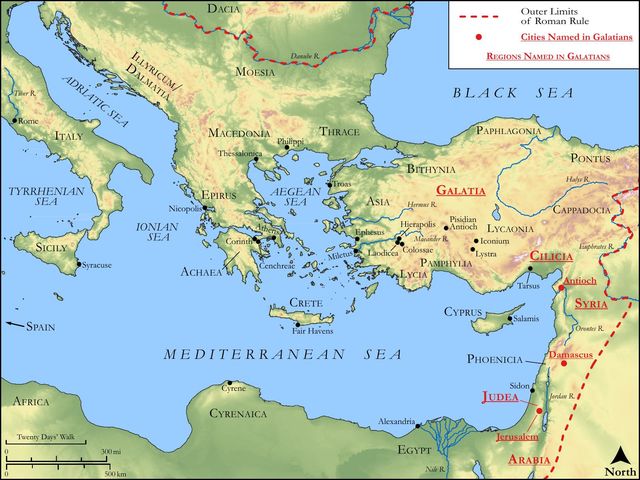
See on the biblical-era map

Study this verse
Public-domain commentary
Matthew Henry
From his Commentary on the Whole Bible. Henry comments on passages, not single verses — this entry covers Galatians 5:13–26. His three-level outline is real structure in the source text, so it is rendered as structure.
In the latter part of this chapter the apostle comes to exhort these Christians to serious practical godliness, as the best antidote against the snares of the false teachers. Two things especially he presses upon them: -
I.That they should not strive with one another, but love one another.
He tells them (Gal 5:13) that they had been called unto liberty, and he would have them to stand fast in the liberty wherewith Christ had made them free; but yet he would have them be very careful that they did not use this liberty as an occasion to the flesh - that they did not thence take occasion to indulge themselves in any corrupt affections and practices, and particularly such as might create distance and disaffection, and be the ground of quarrels and contentions among them: but, on the contrary, he would have them by love to serve one another, to maintain that mutual love and affection which, notwithstanding any minor differences there might be among them, would dispose them to all those offices of respect and kindness to each other which the Christian religion obliged them to. Note,
1.The liberty we enjoy as Christians is not a licentious liberty: though Christ has redeemed us from the curse of the law, yet he has not freed us from the obligation of it; the gospel is a doctrine according to godliness (Ti1 6:3), and is so far from giving the least countenance to sin that it lays us under the strongest obligations to avoid and subdue it.
2.Though we ought to stand fast in our Christian liberty, yet we should not insist upon it to the breach of Christian charity; we should not use it as an occasion of strife and contention with our fellow Christians, who may be differently minded from us, but should always maintain such a temper towards each other as may dispose us by love to serve one another. To this the apostle endeavours to persuade these Christians, and there are two considerations which he sets before them for this purpose: - (1.) That all the law is fulfilled in one word, even in this, Thou shalt love thy neighbour as thyself, Gal 5:14. Love is the sum of the whole law; as love to God comprises the duties of the first table, so love to our neighbour those of the second. The apostle takes notice of the latter here, because he is speaking of their behaviour towards one another; and, when he makes use of this as an argument to persuade them to mutual love, he intimates both that this would be a good evidence of their sincerity in religion and also the most likely means of rooting out those dissensions and divisions that were among them. It will appear that we are the disciples of Christ indeed when we have love one to another (Joh 13:35); and, where this temper is kept up, if it do not wholly extinguish those unhappy discords that are among Christians, yet at least it will so far accommodate them that the fatal consequences of them will be prevented. (2.) The sad and dangerous tendency of a contrary behaviour (Gal 5:15): But, says he, if instead of serving one another in love, and therein fulfilling the law of God, you bite and devour one another, take heed that you be not consumed one of another. If, instead of acting like men and Christians, they would behave themselves more like brute beasts, in tearing and rending one another, they could expect nothing as the consequence of it, but that they would be consumed one of another; and therefore they had the greatest reason not to indulge themselves in such quarrels and animosities. Note, Mutual strifes among brethren, if persisted in, are likely to prove a common ruin; those that devour one another are in a fair way to be consumed one of another. Christian churches cannot be ruined but by their own hands; but if Christians, who should be helps to one another and a joy one to another, be as brute beasts, biting and devouring each other, what can be expected but that the God of love should deny his grace to them, and the Spirit of love should depart from them, and that the evil spirit, who seeks the destruction of them all, should prevail?
II.That they should all strive against sin; and happy would it be for the church if Christians would let all their quarrels be swallowed up of this, even a quarrel against sin-if, instead of biting and devouring one another on account of their different opinions, they would all set themselves against sin in themselves and the places where they live. This is what we are chiefly concerned to fight against, and that which above every thing else we should make it our business to oppose and suppress. To excite Christians hereunto, and to assist them herein, the apostle shows,
1.That there is in every one a struggle between the flesh and the spirit (Gal 5:17): The flesh (the corrupt and carnal part of us) lusts (strives and struggles with strength and vigour) against the spirit: it opposes all the motions of the Spirit, and resists every thing that is spiritual. On the other hand, the spirit (the renewed part of us) strives against the flesh, and opposes the will and desire of it: and hence it comes to pass that we cannot do the things that we would. As the principle of grace in us will not suffer us to do all the evil which our corrupt nature would prompt us to, so neither can we do all the good that we would, by reason of the oppositions we meet with from that corrupt and carnal principle. Even as in a natural man there is something of this struggle (the convictions of his conscience and the corruption of his own heart strive with one another; his convictions would suppress his corruptions, and his corruptions silence his convictions), so in a renewed man, where there is something of a good principle, there is a struggle between the old nature and the new nature, the remainders of sin and the beginnings of grace; and this Christians must expect will be their exercise as long as they continue in this world.
2.That it is our duty and interest in this struggle to side with the better part, to side with our convictions against our corruptions and with our graces against our lusts. This the apostle represents as our duty, and directs us to the most effectual means of success in it. If it should be asked, What course must we take that the better interest may get the better? he gives us this one general rule, which, if duly observed, would be the most sovereign remedy against the prevalence of corruption; and that is to walk in the Spirit (Gal 5:16): This I say, then, Walk in the Spirit, and you shall not fulfil the lust of the flesh. By the Spirit here may be meant either the Holy Spirit himself, who condescends to dwell in the hearts of those whom he has renewed and sanctified, to guide and assist them in the way of their duty, or that gracious principle which he implants in the souls of his people and which lusts against the flesh, as that corrupt principle which still remains in them does against it. Accordingly the duty here recommended to us is that we set ourselves to act under the guidance and influence of the blessed Spirit, and agreeably to the motions and tendency of the new nature in us; and, if this be our care in the ordinary course and tenour of our lives, we may depend upon it that, though we may not be freed from the stirrings and oppositions of our corrupt nature, we shall be kept from fulfilling it in the lusts thereof; so that though it remain in us, yet it shall not obtain a dominion over us. Note, The best antidote against the poison of sin is to walk in the Spirit, to be much in conversing with spiritual things, to mind the things of the soul, which is the spiritual part of man, more than those of the body, which is his carnal part, to commit ourselves to the guidance of the word, wherein the Holy Spirit makes known the will of God concerning us, and in the way of our duty to act in a dependence on his aids and influences. And, as this would be the best means of preserving them from fulfilling the lusts of the flesh, so it would be a good evidence that they were Christians indeed; for, says the apostle (Gal 5:18), If you be led by the Spirit, you are not under the law. As if he had said, "You must expect a struggle between flesh and spirit as long as you are in the world, that the flesh will be lusting against the spirit as well as the spirit against the flesh; but if, in the prevailing bent and tenour of your lives, you be led by the Spirit, - if you act under the guidance and government of the Holy Spirit and of that spiritual nature and disposition he has wrought in you, - if you make the word of God your rule and the grace of God your principle, - it will hence appear that you are not under the law, not under the condemning, though you are still under the commanding, power of it; for there is now no condemnation to those that are in Christ Jesus, who walk not after the flesh, but after the Spirit; and as many as are led by the Spirit of God, they are the sons of God," Rom 8:1-14.
3.The apostle specifies the works of the flesh, which must be watched against and mortified, and the fruits of the Spirit, which must be cherished and brought forth (Gal 5:19, etc.); and by specifying particulars he further illustrates what he is here upon.
(1.)He begins with the works of the flesh, which, as they are many, so they are manifest. It is past dispute that the things he here speaks of are the works of the flesh, or the product of corrupt and depraved nature; most of them are condemned by the light of nature itself, and all of them by the light of scripture. The particulars he specifies are of various sorts; some are sins against the seventh commandment, such as adultery, fornication, uncleanness, lasciviousness, by which are meant not only the gross acts of these sins, but all such thoughts, and words, and actions, as have a tendency towards the great transgression. Some are sins against the first and second commandments, as idolatry and witchcraft. Others are sins against our neighbour, and contrary to the royal law of brotherly love, such as hatred, variance, emulations, wrath, strife, which too often occasion seditions, heresies, envyings, and sometimes break out into murders, not only of the names and reputation, but even of the very lives, of our fellow-creatures. Others are sins against ourselves, such as drunkenness and revellings; and he concludes the catalogue with an et cetera, and gives fair warning to all to take care of them, as they hope to see the face of God with comfort. Of these and such like, says he, I tell you before, as I have also told you in times past, that those who do such things, how much soever they may flatter themselves with vain hopes, shall not inherit the kingdom of God. These are sins which will undoubtedly shut men out of heaven. The world of spirits can never be comfortable to those who plunge themselves in the filth of the flesh; nor will the righteous and holy God ever admit such into his favour and presence, unless they be first washed and sanctified, and justified in the name of our Lord Jesus, and by the Spirit of our God, Co1 6:11.
(2.)He specifies the fruits of the Spirit, or the renewed nature, which as Christians we are concerned to bring forth, Gal 5:22, Gal 5:23. And here we may observe that as sin is called the work of the flesh, because the flesh, or corrupt nature, is the principle that moves and excites men to it, so grace is said to be the fruit of the Spirit, because it wholly proceeds from the Spirit, as the fruit does from the root: and whereas before the apostle had chiefly specified those works of the flesh which were not only hurtful to men themselves but tended to make them so to one another, so here he chiefly takes notice of those fruits of the Spirit which had a tendency to make Christians agreeable one to another, as well as easy to themselves; and this was very suitable to the caution or exhortation he had before given (Gal 5:13), that they should not use their liberty as an occasion to the flesh, but by love serve one another. He particularly recommends to us, love, to God especially, and to one another for his sake, - joy, by which may be understood cheerfulness in conversation with our friends, or rather a constant delight in God, - peace, with God and conscience, or a peaceableness of temper and behaviour towards others, - long-suffering, patience to defer anger, and a contentedness to bear injuries, - gentleness, such a sweetness of temper, and especially towards our inferiors, as disposes us to be affable and courteous, and easy to be entreated when any have wronged us, - goodness (kindness, beneficence), which shows itself in a readiness to do good to all as we have opportunity, - faith, fidelity, justice, and honesty, in what we profess and promise to others, - meekness, wherewith to govern our passions and resentments, so as not to be easily provoked, and, when we are so, to be soon pacified, - and temperance, in meat and drink, and other enjoyments of life, so as not to be excessive and immoderate in the use of them. Concerning these things, or those in whom these fruits of the Spirit are found, the apostle says, There is no law against them, to condemn and punish them. Yea, hence it appears that they are not under the law, but under grace; for these fruits of the Spirit, in whomsoever they are found, plainly show that such are led by the Spirit, and consequently that they are not under the law, as Gal 5:18. And as, by specifying these works of the flesh and fruits of the Spirit, the apostle directs us both what we are to avoid and oppose and what we are to cherish and cultivate, so (Gal 5:24) he informs us that this is the sincere care and endeavour of all real Christians: And those that are Christ's, says he (those who are Christians indeed, not only in show and profession, but in sincerity and truth), have crucified the flesh with the affections and lusts. As in their baptism they were obliged hereunto (for, being baptized into Christ, they were baptized into his death, Rom 6:3), so they are now sincerely employing themselves herein, and, in conformity to their Lord and head, are endeavouring to die unto sin, as he had died for it. They have not yet obtained a complete victory over it; they have still flesh as well as Spirit in them, and that has its affections and lusts, which continue to give them no little disturbance, but as it does not now reign in their mortal bodies, so as that they obey it in the lusts thereof (Rom 6:12), so they are seeking the utter ruin and destruction of it, and to put it to the same shameful and ignominious, though lingering death, which our Lord Jesus underwent for our sakes. Note, If we should approve ourselves to be Christ's, such as are united to him and interested in him, we must make it our constant care and business to crucify the flesh with its corrupt affections and lusts. Christ will never own those as his who yield themselves the servants of sin. But though the apostle here only mentions the crucifying of the flesh with the affections and lusts, as the care and character of real Christians, yet, no doubt, it is also implied that, on the other hand, we should show forth those fruits of the Spirit which he had just before been specifying; this is no less our duty than that, nor is it less necessary to evidence our sincerity in religion. It is not enough that we cease to do evil, but we must learn to do well. Our Christianity obliges us not only to die unto sin, but to live unto righteousness; not only to oppose the works of the flesh, but to bring forth the fruits of the Spirit too. If therefore we would make it appear that we do indeed belong to Christ, this must be our sincere care and endeavour as well as the other; and that it was the design of the apostle to represent both the one and the other of these as our duty, and as necessary to support our character as Christians, may be gathered from what follows (Gal 5:25), where he adds, If we live in the Spirit, let us also walk in the Spirit; that is, "If we profess to have received the Spirit of Christ, or that we are renewed in the Spirit of Christ, or that we are renewed in the spirit of our minds, and endued with a principle of spiritual life, let us make it appear by the proper fruits of the Spirit in our lives." He had before told us that the Spirit of Christ is a privilege bestowed on all the children of God, Gal 4:6. "Now," says he, "if we profess to be of this number, and as such to have obtained this privilege, let us show it by a temper and behaviour agreeable hereunto; let us evidence our good principles by good practices." Our conversation will always be answerable to the principle which we are under the guidance and government of: as those that are after the flesh do mind the things of the flesh, so those that are after the Spirit do mind the things of the Spirit, Rom 8:5. If therefore we would have it appear that we are Christ's, and that we are partakers of his Spirit, it must be by our walking not after the flesh, but after the spirit. We must set ourselves in good earnest both to mortify the deeds of the body, and to walk in newness of life.
4.The apostle concludes this chapter with a caution against pride and envy, Gal 5:26. He had before been exhorting these Christians by love to serve one another (Gal 5:13), and had put them in mind of what would be the consequence if, instead of that, they did bite and devour one another, Gal 5:15. Now, as a means of engaging them to the one and preserving them from the other of these, he here cautions them against being desirous of vain-glory, or giving way to an undue affectation of the esteem and applause of men, because this, if it were indulged, would certainly lead them to provoke one another and to envy one another. As far as this temper prevails among Christians, they will be ready to slight and despise those whom they look upon as inferior to them, and to be put out of humour if they are denied that respect which they think is their due from them, and they will also be apt to envy those by whom their reputation is in any danger of being lessened: and thus a foundation is laid for those quarrels and contentions which, as they are inconsistent with that love which Christians ought to maintain towards each other, so they are greatly prejudicial to the honour and interest of religion itself. This therefore the apostle would have us by all means to watch against. Note,
(1.)The glory which comes from men is vain-glory, which, instead of being desirous of, we should be dead to.
(2.)An undue regard to the approbation and applause of men is one great ground of the unhappy strifes and contentions that exist among Christians.
Historical interpretation
Three Centuries of Reception
18 surviving comments on this verse. Each one is dated, so this reads as a timeline rather than a list.
Select a marker to jump to its quote. Markers stagger vertically where authors wrote within a few decades of each other.
The commandments are written, then, doubly, as appears, for twofold spirits, the ruling and the subject. "For the flesh lusteth against the Spirit, and the Spirit against the flesh.".
The commandment, then, "Thou shalt not lust "says, thou shalt not serve the carnal spirit, but shall rule over it; "For the flesh lusteth against the Spirit".
Soul, putting a bridle-bit on the restive irrational spirit: "For the flesh lusteth against the Spirit."
Thus, so long as the things which are the Spirit's please them not, the things which are of the flesh will please, as being the contraries of the Spirit. "The flesh," saith (the apostle), "lusteth against the Spirit, and the Spirit against the flesh." But what will the flesh "lust" after, except what is more of the flesh? For which reason withal, in.
For although he says that "in his flesh dwelleth no good thing; " although he affirms that "they who are in the flesh cannot please God," because "the flesh lusteth against the Spirit; " yet in these and similar assertions which he makes, it is not the substance of the flesh, but its actions, which are censured.
But the third angel (Naas), by the soul which came from Edem upon Moses, as also upon all men, obscured the precepts of Baruch, and caused his own peculiar injunctions to be hearkened unto. For this reason the soul is arrayed against the spirit, and the spirit against the soul.
What are those carnal things which beget death, and what are the spiritual things which lead to life. Paul to the Galatians: "The flesh lusteth against the Spirit, and the Spirit against the flesh: for these are contrary the one to the other, that ye cannot do even those things which ye wish. But the deeds of the flesh are manifest, which are: adulteries, fornications, impurities, filthiness, idolatries, sorceries, murders, hatreds, strifes, emulations, animosities, provocations, hatreds, dissensions, heresies, envyings, drunkenness, revellings, and such like: with respect to which I declare, that they who do such things shall not possess the kingdom of God. But the fruit of the Spirit is charity, joy, peace, magnanimity, goodness, faith, gentleness, continency, chastity. For they who are Christ's have crucified their flesh, with its vices and lusts."
Moreover, we ask that the will of God may be done both in heaven and in earth, each of which things pertains to the fulfilment of our safety and salvation. For since we possess the body from the earth and the spirit from heaven, we ourselves are earth and heaven; and in both-that is, both in body and spirit-we pray that God's will may be done. For between the flesh and spirit there is a struggle; and there is a daily strife as they disagree one with the other, so that we cannot do those very things that we would, in that the spirit seeks heavenly and divine things, while the flesh lusts after earthly and temporal things; and therefore we ask that, by the help and assistance of God, agreement may be made between these two natures, so that while the will of God is done both in the spirit and in the flesh, the soul which is new-born by Him may be preserved. This is what the Apostle Paul openly and manifestly declares by his words: "The flesh," says he, "lusteth against the spirit, and the spirit against the flesh: for these are contrary the one to the other; so that ye cannot do the things that ye would. Now the works of the flesh are manifest, which are these; adulteries, fornications, uncleanness, lasciviousness, idolatry, witchcraft, murders, hatred, variance, emulations, wraths, strife, seditions, dissensions, heresies, envyings, drunkenness, revellings, and such like: of the which I tell you before, as I have also told you in times past, that they which do such things shall not inherit the kingdom of God. But the fruit of the spirit is love, joy, peace, magnanimity, goodness, faith, gentleness, continence, chastity." And therefore we make it our prayer in daily, yea, in continual supplications, that the will of God concerning us should be done both in heaven and in earth; because this is the will of God, that earthly things should give place to heavenly, and that spiritual and divine things should prevail.
For there are two motions in us, the lust of the flesh and that of the soul, differing from each other,
Here some make the charge that the Apostle has divided man into two parts, and that he states the essence of which he is compounded to be conflicting with itself, and that the body has a contest with the soul. But this is not so, most certainly; for by "the flesh," he does not mean the body; if he did, what would be the sense of the clause immediately following, "for it lusteth," he says, "against the Spirit?" yet the body moves not, but is moved, is not an agent, but is acted upon. How then does it lust, for lust belongs to the soul not to the body, for in another place it is said, "My soul longeth," (Ps. lxxxiv: 2.) and, "Whatsoever thy soul desireth, I will even do it for thee," (1 Sam. xx: 4.) and, "Walk not according to the desires of thy heart," and, "So panteth my soul." (Ps. xlii: 1.) Wherefore then does Paul say, "the flesh lusteth against the Spirit?" he is wont to call the flesh, not the natural body but the depraved will, as where he says, "But ye are not in the flesh, but in the Spirit," (Rom. viii: 8, 9.) and again, "They that are in the flesh cannot please God." What then? Is the flesh to be destroyed? was not he who thus spoke clothed with flesh? such doctrines are not of the flesh, but from the Devil, for "he was a murderer from the beginning." (John viii: 44.) What then is his meaning? it is the earthly mind, slothful and careless, that he here calls the flesh, and this is not an accusation of the body, but a charge against the slothful soul. The flesh is an instrument, and no one feels aversion and hatred to an instrument, but to him who abuses it. For it is not the iron instrument but the murderer, whom we hate and punish. But it may be said that the very calling of the faults of the soul by the name of the flesh is in itself an accusation of the body. And I admit that the flesh is inferior to the soul, yet it too is good, for that which is inferior to what is good may itself be good, but evil is not inferior to good, but opposed to it. Now if you are able to prove to me that evil originates from the body, you are at liberty to accuse it; but if your endeavor is to turn its name into a charge against it, you ought to accuse the soul likewise. For he that is deprived of the truth is called "the natural man." (1 Cor. ii: 14.) and the race of demons "the spirits of wickedness." (Eph. vi: 12.)
Again, the Scripture is wont to give the name of the Flesh to the Mysteries of the Eucharist, and to the whole Church, calling them the Body of Christ. (Col. i: 24.) Nay, to induce you to give the name of blessings to the things of which the flesh is the medium, you have only to imagine the extinction of the senses, and you will find the soul deprived of all discernment, and ignorant of what it before knew. For if the power of God is since "the creation of the world clearly seen, being perceived through the things that are made," (Rom. i: 20.) how could we see them without eyes? and if "faith cometh of hearing," (Rom. x: 17.) how shall we hear without ears? and preaching depends on making circuits wherein the tongue and feet are employed. "For how shall they preach, except they be sent?" (Rom. x: 15.) In the same way writing is performed by means of the hands. Do you not see that the ministry of the flesh produces for us a thousand benefits? In his expression, "the flesh lusteth against the Spirit," he means two mental states. For these are opposed to each other, namely virtue and vice, not the soul and the body. Were the two latter so opposed they would be destructive of one another, as fire of water, and darkness of light. But if the soul cares for the body, and takes great forethought on its account, and suffers a thousand things in order not to leave it, and resists being separated from it, and if the body too ministers to the soul, and conveys to it much knowledge, and is adapted to its operations, how can they be contrary, and conflicting with each other? For my part, I perceive by their acts that they are not only not contrary but closely accordant and attached one to another. It is not therefore of these that he speaks as opposed to each other, but he refers to the contest of bad and good principles. (Compare Rom. vii: 23.) To will and not to will belongs to the soul; wherefore he says, "these are contrary the one to the other," that you may not suffer the soul to proceed in its evil desires. For he speaks this like a Master and Teacher in a threatening way.
(Verse 17.) For the flesh desires against the spirit, and the spirit against the flesh. These indeed are opposed to one another, so that you may not do the things that you wish. The flesh takes pleasure in present and short-lived things, while the spirit is concerned with eternal and future things. In the midst of this conflict, the soul stands, having in its power both good and evil, to will and not to will, but not having the very will and not will itself as perpetual: because it is possible that, when it has consented to the flesh and has done its works, it may, by repentance, unite itself to the spirit and perform its works. This is therefore what he says: These things oppose each other, that is, flesh and spirit, so that you do not do whatever you want. Not because we have our own judgment, by which we agree either with the flesh or with the spirit, but because what we do is not properly ours, but the work itself is attributed to either the flesh or the spirit. It is a great labor and dispute to find some middle ground, having shown the works of the flesh and the spirit, which seem to pertain to neither the flesh nor the spirit. We are called carnal when we give ourselves entirely to pleasure. We are called spiritual when we follow the Holy Spirit, that is, when we are instructed and taught by Him. I consider philosophers to be animalistic, as they believe that their own thoughts are wisdom, about which it is rightly said: But the natural man does not receive what belongs to the Spirit. For it is foolishness to him. To make this clearer, let us consider some examples: Flesh, earth, soul, gold, spirit, fire. As long as gold is in the earth, it loses its name, and is called by the earth with which it is mixed. But when separated from the soil, it takes on both the appearance and the name of gold, yet it is not yet proven. However, if it is heated by fire and purified, then it receives the splendor of gold and the dignity of its adornment. In the same way, the soul, existing between earth and fire, that is, between flesh and spirit, when it surrenders to the flesh, is called flesh; when it belongs to the spirit, it is called spirit. But if he believes in his own thought and thinks that he can find truth without the grace of the Holy Spirit, he is marked as a base metal, by the animal nature of man. This place can be better explained as a single series and body, connecting and not disagreeing with itself. Brothers, you have been called from the servitude of the Law to the freedom of the Gospel. But I beg you, do not abuse your freedom as a license, and do not think that everything that is allowed is beneficial to you, and do not provide opportunity for the flesh and for indulgence. Rather, learn that this liberty is greater than servitude, so that what before the Law forced from the unwilling, now you may serve one another through charity. For indeed, all that burden of the Law and its many precepts have not been so much abolished by the grace of the Gospel as they have been condensed into one short command of charity, that we may love our neighbor as ourselves. For whoever loves their neighbor fulfills the whole law (Matthew 22), giving them good and not causing harm. But if love ceases, and there is no charity, through which the whole law is fulfilled, there will be a kind of public robbery among men, as they rage against each other, devouring and devouring themselves. But you, brothers, according to the spiritual law, must live, so that you do not fulfill the desires of the flesh. For the flesh fears cold, rejects hunger, weakens through sleeplessness, flames with lust, and desires soft and pleasant things. On the other hand, the spirit desires the things that are contrary to the flesh and that can weaken it. And so it happens that, not because you have ceased to be under the slavery of the Law, you think you are free: but know rather that you are retained by the law of nature, because even if the law does not command, and nature has ceased, your will, namely your actions, are not immediately followed, but you are often compelled to do them, the flesh resisting against the spirit, which you do not want to do. From which, brothers, I beseech you, not to give your freedom as an opportunity for the flesh, but rather to serve the Spirit, so that you may begin to do those things which you desire, and owe nothing to the law, that is, not to be under the flesh. For you will be able to truly have the freedom of the law abolished in the Gospel, when the flesh no longer compels you to do what you do not desire, but serving the Spirit, you have taught yourselves not to be under the Law. And because we have begun to explain this passage with a twofold understanding above, what we have omitted must be addressed. The flesh desires against the spirit, that is, a carnal understanding of the stories and scriptures, which resists allegory and spiritual teaching. But the spirit desires against the flesh, that is, it opposes higher things to lower things, the eternal to the fleeting, and truth to shadows. And the carnal understanding of scripture, which cannot be fulfilled (for we are not able to do everything that is written), shows us that we are not in control of fulfilling the law, even if we want to follow the letter, impossibility does not permit it.
The “flesh struggles against the Spirit: ” that is, the literal and flat understanding of Scripture fights against allegory and spiritual doctrine.… And the carnal sense of Scripture, which cannot be fulfilled (since we cannot do all that is written), shows that we do not have it in our power to fulfill the law when even if we wish to follow the letter we are prevented by its impossibility.
The fact is that both are good: the spirit is good and the flesh too is good. And the whole person who consists of both, one ruling and one obeying, is indeed good but a changeable good. Yet these changing goods could not arise were it not for the immutable good, which is the source of every created good, whether small or great. But however small might be one particular good, it is nonetheless made by the one incomparably good. Yet however great, it is in no way comparable to the greatness of its Maker. But in this human nature, good as it is in origin and constitution, there is now war, because there is not yet salvation.
People think that the apostle here denies that we possess free will. They do not perceive what he is saying to them: If they refuse to hold fast to the grace they have received, through which alone they are able to walk in the Spirit and avoid fulfilling the desires of the flesh, they will not be able to do as they wish.… It is love that “fulfills the law.” But “the wisdom of the flesh” by following temporal goods opposes spiritual love. How can it be made subject to the law of God (that is, freely and obediently fulfill righteousness and not be opposed to it) when even as it tries it must be vanquished? The flesh imagines that it can procure a greater temporal good by iniquity than by maintaining righteousness. The first stage, the natural life of a human being, precedes the law, when no wrongdoing or malice is prohibited. The natural being makes no resistance at all to base desires, since there is no one to prohibit them. The second stage is under law before grace, when he is indeed prohibited and tries to abstain from sin but is overcome because he does not yet love righteousness for God’s sake and its own but wishes to observe it in the hope of earthly acquisitions. And therefore, when he sees righteousness on one side and temporal good on another, he is dragged by the weight of his temporal desire and thus forsakes righteousness, which he was trying to maintain only in order to have that which he now sees that he is going to lose by maintaining it. The third stage of life is the one under grace, when no temporal good is preferred to righteousness. This cannot happen except by spiritual love, which the Lord has taught by his example and bestowed by grace. For in this life, even if there remain desires of the flesh from the mortality of the body, yet they do not subdue the mind to consent to sin.
Now this, I think, he writes to the Galatians, to whom he says, “Who gave you the Spirit.” … From this it is apparent that he is speaking to Christians, people to whom God had given the Spirit, and therefore to the baptized. See, the sinful nature is an adversary even within the baptized, and there is not in them that possibility [of sinlessness] which [Pelagius25] says is so implanted in our nature that it cannot be annulled.
The “flesh struggles against the spirit” yet does not subdue it, since the spirit also “struggles against the flesh.” Although that same law of sin holds something of the flesh as its prisoner and thereby resists the law of the mind it does not, however, reign in our body, mortal though it is, if our body does not voluntarily obey its desires.
An inward war is being waged every day within us. The desires of the flesh and of the spirit are within one and the same person. The lust of the flesh rushes headlong into vice, delights in the worldly enjoyments that seem to satisfy. By contrast the opposed desire of the spirit is so eager to cleave entirely to spiritual pursuits that it in an exaggerated way chooses even to exclude the necessary uses of the flesh. By wishing to be so inseparably attached to spiritual things it refuses to take care of its own bodily fragility.
He also said, ‘Fasting is the monk’s control over sin. The man who stops fasting is like a stallion who lusts the moment he sees a mare.’
Abraham, who was a disciple of Agatho, once asked Poemen, ‘Why do the demons attack me?’ Poemen said to him, ‘Is it the demons who attack you? It is not the demons who attack me. When we follow our self-will then our wills seem like demons and it is they who urge us to obey them. If you want to know the kind of people with whom the demons fight, it is Moses and those like him.’
A brother asked a hermit, ‘What shall I do, for I am troubled by many temptations, and I do not know how to resist them?’ He said, ‘Do not fight against them all at once, but against one of them. All the temptations of monks have a single source. You must consider what kind of root of temptation you have, and fight against that and in this way all the other temptations will also be defeated.’
Continue studying Galatians 5:17 across the web’s major study libraries — every link below opens this exact verse, chapter, or book on the destination site.
Read & Compare
 BibleGatewayThis verse in more than 200 translations and 70 languages.
 Bible.comThe YouVersion reader — hundreds of translations, reading plans, and highlights.
 ESV.orgCrossway's official English Standard Version reader.
 NET BibleThe NET translation with 60,000+ translators' notes on every rendering decision.
 STEP BibleTyndale House's free study tool — original text, vocabulary, and scholarly resources.
 BibliaLogos Bible Software's free web reader.
 USCCBThe New American Bible (Revised Edition) with the U.S. bishops' study notes.
Commentaries
 BibleHub CommentariesDozens of classic commentaries on this verse, gathered on one page.
 StudyLightMore than 100 commentary sets — the largest collection on the web.
 BibleRefPlain-English commentary on what this verse means, verse by verse.
 Enduring WordDavid Guzik's free commentary on this chapter, widely used by Bible teachers.
 Bible Study ToolsVerse commentary alongside Greek and Hebrew study aids.
Original Language & Research
- BibleHub InterlinearThe verse word by word — original language, transliteration, and English.
- BibleHub LexiconEvery word's original-language definition and Strong's entry.
 Blue Letter BibleDeep-study tools — Strong's numbers, concordance, and word studies.
 CNTR CollationThe earliest Greek manuscripts of this verse, collated letter by letter.
Sermons, Hymns & Audio


TrulyRandomVerse is not affiliated with these sites and doesn’t control their content. They’re linked because they’re genuinely useful.
Summary
Galatians 5:17 unveils the profound and ceaseless internal conflict within every believer: the sinful nature, or "flesh," wages war against the indwelling Holy Spirit, and vice versa. This inherent opposition between two fundamentally contrary forces creates a tension that prevents believers from perfectly accomplishing their righteous desires, highlighting the ongoing struggle for sanctification and the necessity of dependence on divine grace.
Context
ShowHideLiterary Context
Galatians 5:17 is a pivotal verse situated within Paul's impassioned defense of Christian liberty and life in the Spirit, following his robust theological arguments for justification by faith alone in the earlier chapters of his letter to the churches in Galatia. Having established that believers are freed from the bondage of the Mosaic Law (Galatians 5:1), Paul then transitions to the practical implications of this freedom. He warns against using liberty as an excuse for licentiousness (Galatians 5:13) and immediately precedes verse 17 with the crucial command to "walk by the Spirit, and you will not gratify the desires of the flesh" (Galatians 5:16). Verse 17 then provides the theological rationale for this command, explaining why walking in the Spirit is essential: because the flesh and the Spirit are in direct, constant opposition, making it impossible to live righteously without the Spirit's empowering presence. The verses that follow (Galatians 5:18-26) further elaborate on the manifestations of this conflict, contrasting the "works of the flesh" with the "fruit of the Spirit."
Historical & Cultural Context
The Galatian churches were facing a significant challenge from "Judaizers," Jewish Christians who insisted that Gentile converts must adhere to aspects of the Mosaic Law, particularly circumcision, in addition to faith in Christ for salvation and sanctification. This legalistic teaching threatened to undermine the core message of the gospel—salvation by grace through faith—and to enslave believers once again to a system from which Christ had liberated them. Paul's letter vigorously counters this error, emphasizing that true righteousness and spiritual growth come not from human effort or adherence to external rules, but from the indwelling Holy Spirit. In the broader Greco-Roman world, there were various philosophical schools that posited a dualism between the material body and the immaterial soul, often viewing the body as inherently evil or a prison for the soul. While Paul acknowledges a conflict, his concept of "flesh" (sárx) is not merely the physical body but the fallen human nature, prone to sin, which is distinct from a philosophical body-soul dualism. His teaching provides a uniquely Christian understanding of the internal struggle, rooted in the reality of sin and the power of the Holy Spirit, rather than a Gnostic-like disdain for the physical.
Key Themes
ShowHideGalatians 5:17 encapsulates several key themes central to Paul's theology and the Christian life. Foremost is the Inherent Spiritual Conflict within the believer, a battle between the old, fallen nature (the flesh) and the new, Spirit-empowered nature. This verse vividly portrays the Opposing Desires of these two forces, highlighting that the Christian life is not a passive state but an active, ongoing engagement against internal sin. This tension underscores the theme of Sanctification, the process by which believers are progressively conformed to the image of Christ, which is a work of the Holy Spirit, not human effort or legalistic adherence. It reinforces the theme of Christian Liberty, emphasizing that true freedom is not license to sin but freedom from sin's dominion, enabled by the Spirit. The verse also implicitly highlights the Necessity of the Holy Spirit for Christian living, as it is only through yielding to and walking in the Spirit that believers can overcome the desires of the flesh and bear the fruit of righteousness, as outlined in Galatians 5:22-23. This internal struggle is a universal experience for believers, echoing the personal wrestling described by Paul in Romans 7:14-25.
Exposition and Analysis
ShowHideKey Word Analysis
ShowHideFrom the base of σαρόω; flesh (as stripped of the skin), i.e. (strictly) the meat of an animal (as food), or (by extension) the body (as opposed to the soul (or spirit), or as the symbol of what is external, or as the means of kindred), or (by implication) human nature (with its frailties (physically or morally) and passions), or (specially), a human being (as such):--carnal(-ly, + -ly minded), flesh(-ly). In this context, "flesh" does not merely refer to the physical body, but rather to the unredeemed, fallen human nature, the sinful disposition that remains even in the regenerated believer. It is the seat of desires and impulses that are contrary to God's will and the Spirit's leading.
From ἐπί and θυμός; to set the heart upon, i.e. long for (rightfully or otherwise):--covet, desire, would fain, lust (after). This word denotes a strong desire or craving. While it can be used positively (e.g., to desire good things), in this context, when applied to the flesh, it carries the negative connotation of sinful craving or longing, emphasizing the intense, aggressive nature of the flesh's opposition to the Spirit.
From πνέω; a current of air, i.e. breath (blast) or a breeze; by analogy or figuratively, a spirit, i.e. (human) the rational soul, (by implication) vital principle, mental disposition, etc., or (superhuman) an angel, demon, or (divine) God, Christ's spirit, the Holy Spirit:--ghost, life, spirit(-ual, -ually), mind. Here, "Spirit" unequivocally refers to the Holy Spirit, the third person of the Trinity, who indwells every believer upon conversion. He is the divine power and presence that enables believers to live righteously and overcome the power of sin.
From ἀντί and κεῖμαι; to lie opposite, i.e. be adverse (figuratively, repugnant) to:--adversary, be contrary, oppose. This term highlights the absolute and irreconcilable opposition between the flesh and the Spirit. They are not merely different; they are fundamentally at odds, constantly in conflict, seeking to thwart each other's aims.
Verse Breakdown
ShowHide"For the flesh lusteth against the Spirit,"
This clause introduces the primary antagonist in the believer's internal life. The "flesh," representing the fallen, unredeemed human nature, actively and intensely desires things that are opposed to God's will. This "lusting" is not passive but an aggressive craving, indicating a persistent inclination toward sin.
"and the Spirit against the flesh:"
This parallel clause clarifies that the opposition is reciprocal. The Holy Spirit, indwelling the believer, also has desires and aims, and these are directly contrary to the sinful desires of the flesh. This signifies that the Spirit is not passive in this conflict but actively works within the believer to counter the influence of sin and to promote righteousness.
"and these are contrary the one to the other:"
This statement explicitly defines the nature of the relationship between the flesh and the Spirit. They are fundamentally antithetical, incapable of coexistence in harmony. Their desires and objectives are diametrically opposed, leading to an inevitable and continuous struggle within the believer. This highlights the profound theological reality that a believer's life is a battlefield.
"so that ye cannot do the things that ye would."
This concluding phrase describes the practical consequence of this internal warfare. Because of the constant tension and opposition between the flesh and the Spirit, believers find themselves unable to consistently and perfectly fulfill their righteous desires or the will of God, even when they genuinely want to. This does not imply an inability to choose good or obey God at all, but rather the difficulty in achieving perfect, unhindered obedience due to the persistent pull of the sinful nature. It explains the struggle Paul himself describes in Romans 7:19.
Literary Devices
ShowHidePaul employs several powerful literary devices in Galatians 5:17 to vividly portray the internal struggle. Personification is evident as "the flesh" and "the Spirit" are depicted as active agents, each with desires ("lusteth") and engaging in a direct adversarial relationship ("against," "contrary"). This gives abstract concepts a dynamic, almost living quality, making the conflict tangible. The verse also heavily relies on Antithesis, presenting a stark and absolute opposition between two forces—flesh and Spirit—whose desires are mutually exclusive. This creates a dramatic tension that underscores the gravity of the internal battle. Furthermore, the concept of "lusting against" can be seen as a Metaphor for a spiritual battle or warfare, where two opposing armies (or principles) are locked in a struggle for dominance within the believer's soul. These devices collectively serve to emphasize the intensity, pervasiveness, and irreconcilable nature of the conflict, impressing upon the reader the reality of this spiritual dynamic.
Theological and Thematic Connections
ShowHideGalatians 5:17 is a foundational text for understanding the dynamics of sanctification in the Christian life. It reveals that the believer's journey is not one of immediate perfection or effortless righteousness, but an ongoing process marked by an internal, spiritual conflict. The "flesh" represents the lingering power of sin, the old nature inherited from Adam, which continues to exert its influence even after conversion. The "Spirit," however, is the divine power of the indwelling Holy Spirit, who empowers the believer to resist sin and pursue righteousness. This verse teaches that this struggle is normal and expected for every Christian, not a sign of spiritual failure, but a testament to the presence of both the old and new natures. Victory in this conflict is not achieved through self-effort, legalistic rules, or suppression of the body, but by consciously choosing to yield to the Holy Spirit's leading and power, allowing Him to produce His fruit in one's life. This ongoing battle highlights the continuous need for God's grace and the Spirit's enablement in the believer's walk.
Reflection and Application
ShowHideGalatians 5:17 offers profound comfort and practical guidance for every believer navigating the complexities of the Christian life. It normalizes the internal struggle with sin, assuring us that the persistent pull of the flesh is a universal experience, not an indication of a deficient faith. This understanding liberates us from the condemnation of feeling like we are "failing" when we encounter inner conflict, instead reframing it as an expected part of the spiritual journey. The verse powerfully reminds us that victory over the flesh is not achieved through sheer willpower, self-discipline, or adherence to external rules, but through dependence on the empowering presence of the Holy Spirit. Our daily walk becomes a conscious choice to "walk in the Spirit" (Galatians 5:16), yielding to His promptings, immersing ourselves in God's Word, engaging in prayer, and cultivating spiritual disciplines that strengthen our connection to Him. It encourages us to embrace humility, recognizing our continued need for grace, and to press forward in sanctification, knowing that the Spirit within us is greater than the sinful desires that assail us. This verse calls us to a life of active reliance on God, fostering a deeper intimacy with the Spirit as our source of strength and guidance.
Questions for Reflection
ShowHideFAQ
ShowHideDoes this verse mean believers are incapable of doing good or obeying God?
ShowHideNo, Galatians 5:17 does not imply a complete inability to do good or obey God. Rather, it describes the tension and difficulty in consistently and perfectly fulfilling one's righteous desires due to the persistent opposition of the flesh. The phrase "so that ye cannot do the things that ye would" highlights the internal friction that prevents unhindered, perfect obedience. It means that the flesh's desires are so strong and contrary to the Spirit's that a believer cannot flawlessly or effortlessly live out their regenerated will. This struggle underscores the need to actively "walk by the Spirit" (Galatians 5:16), which is the means by which believers can overcome the flesh and bear spiritual fruit.
What is the "flesh" in this context? Is it just the physical body?
ShowHideIn Galatians 5:17 and much of Paul's writings, "flesh" (Greek: sárx) is far more than just the physical body. It refers to the fallen, unregenerate human nature, the sinful disposition that remains even in a believer after conversion. It represents humanity's inherent inclination towards sin and rebellion against God, apart from the empowering influence of the Holy Spirit. While the body can be an instrument of the flesh's desires, the "flesh" itself is a comprehensive term for the sinful principle that operates within us, encompassing our sinful thoughts, desires, and actions, as opposed to the Spirit-led life.
How does this verse relate to "walking in the Spirit" from the previous verse?
ShowHideGalatians 5:17 provides the crucial explanation for the command given in Galatians 5:16: "But I say, walk by the Spirit, and you will not gratify the desires of the flesh." Verse 17 explains why this command is necessary and why it is a constant challenge. Because the flesh and the Spirit are in direct opposition, there is an ongoing war within the believer. Therefore, to avoid gratifying the desires of the flesh, one must actively and intentionally choose to "walk by the Spirit"—to yield to His guidance, power, and desires. Verse 17 clarifies the nature of the battle that necessitates the Spirit-filled walk.
Christ-Centered Fulfillment
ShowHideGalatians 5:17, while describing an ongoing internal conflict, finds its ultimate resolution and hope in the person and work of Jesus Christ. The very reason this struggle exists is because Christ, through His atoning death, broke the dominion of sin and the flesh, and through His resurrection, inaugurated a new life in the Spirit. Before Christ, humanity was wholly enslaved to the flesh, unable to "do the things that they would" because there was no Spirit to empower them against their fallen nature. But Christ's sacrifice on the cross condemned sin in the flesh (Romans 8:3), providing the means for believers to be set free from its power. Moreover, Christ, having ascended, sent the Holy Spirit to indwell believers (John 16:7), making the conflict described in Galatians 5:17 possible. The Spirit's presence signifies that the believer is no longer merely "in the flesh" but "in the Spirit" (Romans 8:9). The ongoing battle, therefore, is not a sign of defeat but a testament to the Spirit's active work of sanctification, progressively conforming believers to the image of Christ (Romans 8:29). While the tension remains in this life, the believer's victory is assured in Christ, who empowers them through His Spirit to "put to death the deeds of the body" (Romans 8:13) and live a life where "it is no longer I who live, but Christ who lives in me" (Galatians 2:20). The ultimate fulfillment of this struggle awaits the believer's glorification, when the flesh will be fully vanquished, and they will be perfectly conformed to Christ's likeness.