


Nehemiah 4:18
Bible text: King James Version (1769 Blayney text) · Public domain
Bible text: Berean Standard Bible · Public domain
Bible text: American Standard Version (1901) · Public domain
Bible text: World English Bible, Messianic edition · Public domain
Bible text: Geneva Bible (1599) · Public domain
Bible text: Young's Literal Translation · Public domain
- וְהַבּוֹנִיםve·Ha·bo·Nimand the buildersH1129Conj-w ¦ Art ¦ V-Qal-Prtcpl-mpVerb Qal Participle Plural Masculine Absoluteוְandהַtheבּוֹנִיםbuilders
- אִישׁ'isheach oneH376N-msNoun Singular Masculine Absolute
- חַרְבּוֹchar·Bohis swordH2719N-fsc ¦ 3msNoun Singular Feminine Constructחַרְבּswordוֹhis
- אֲסוּרִים'a·su·Rim[were] girdedH631V-Qal-PassPrtcpl-mpVerb Qal Participle Passive Plural Masculine Absolute
- עַל'alonH5921PrepPreposition
- מָתְנָיוma·te·Navhis hipsH4975N-mdc ¦ 3msNoun Dual Masculine Constructמָתְנָיhipsוhis
- וּבוֹנִיםu·vo·Nimand [were] buildingH1129Conj-w ¦ V-Qal-Prtcpl-mpVerb Qal Participle Plural Masculine Absoluteוּandבוֹנִים[were] building
- וְהַתּוֹקֵעַve·ha·to·Ke·a'and the [one who] gave a blastH8628Conj-w ¦ Art ¦ V-Qal-Prtcpl-msVerb Qal Participle Singular Masculine Absoluteוְandהַtheתּוֹקֵעַ[one who] gave a blast
- בַּשּׁוֹפָרba·sho·Faron the ram's hornH7782Prep-b ¦ N-msNoun Singular Masculine Absoluteבַּon theשּׁוֹפָרram's horn
- אֶצְלִי'etz·Li[was] beside meH681N-csc ¦ 1csNoun Singular common gender Constructאֶצְלִ[was] besideיme
English is a literal word-by-word gloss of the Hebrew, not the KJV's wording. Why?
This is the original text the KJV's translators worked from — each Hebrew word with its own literal English meaning in this verse, prepared by scholars at Tyndale House, Cambridge. The KJV translates whole sentences, not word by word, so its wording differs: one Hebrew word can become several English words, and the KJV may choose “the LORD” where the gloss reads “Yahweh”. Both are faithful — they answer different questions. For the KJV's own rendering, switch to the KJV text.
Details
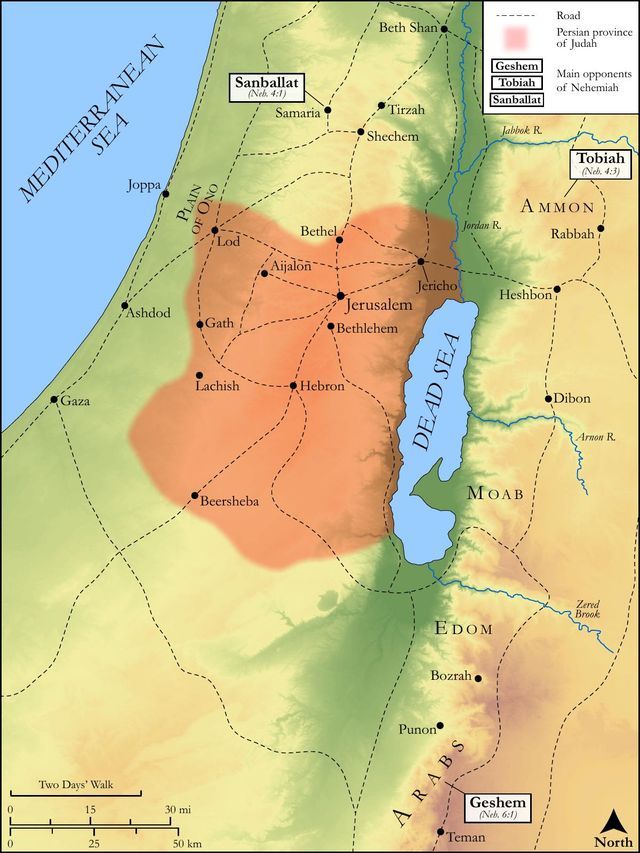
See on the biblical-era map
Study this verse
Public-domain commentary
Matthew Henry
From his Commentary on the Whole Bible. Henry comments on passages, not single verses — this entry covers Nehemiah 4:16–23.
When the builders had so far reason to think the design of the enemies broken as to return to their work, yet they were not so secure as to lay down their arms, knowing how restless and unwearied they were in their attempts, and that, if one design failed, they would be hatching another. Thus must we watch always against our spiritual enemies, and not expect that our warfare will be accomplished till our work is. See what course Nehemiah took, that the people might hold themselves in a readiness, in case there should be an attack. 1. While one half were at work, the other half were under their arms, holding spears, and shields, and bows, not only for themselves but for the labourers too, who would immediately quit their work, and betake themselves to their weapons, upon the first alarm, Neh 4:16. It is probable that they changed services at stated hours, which would relieve the fatigue of both, and particularly would be an ease to the bearers of burdens, whose strength had decayed (Neh 4:10); while they held the weapons, they were eased and yet not idle. Thus dividing their time between the trowels and the spears, they are said to work with one hand and hold their weapons with the other (Neh 4:17), which cannot be understood literally, for the work would require both hands; but it intimates that they were equally employed in both. Thus must we work out our salvation with the weapons of our warfare in our hand; for in every duty we must expect to meet with opposition from our spiritual enemies, against whom we must still be fighting the good fight of faith. 2. Every builder had a sword by his side (Neh 4:18), which he could carry without hindering his labour. The word of God is the sword of the Spirit, which we ought to have always at hand and never to seek, both in our labours and in our conflicts as Christians. 3. Care was taken both to get and give early notice of the approach of the enemy, in case they should endeavour to surprise them. Nehemiah kept a trumpeter always by him to sound an alarm, upon the first intimation of danger. The work was large, and the builders were dispersed; for in all parts of the wall they were labouring at the same time. Nehemiah continually walked round to oversee the work and encourage the workmen, and so would have speedy intelligence if the enemy made an attack, of which, by sound of trumpet, he would soon give notice to all, and they must immediately repair to him with a full assurance that their God would fight for them, Neh 4:18-20. When they acted as workmen, it was requisite they should be dispersed wherever there was work to do; but when as soldiers it was requisite they should come into close order, and be found in a body. Thus should the labourers in Christ's building be ready to unite against a common foe. 4. The inhabitants of the villages were ordered to lodge within Jerusalem, with their servants, not only that they might be the nearer to their work in the morning, but that they might be ready to help in case of an attack in the night, Neh 4:22. The strength of a city lies more in its hands than in its walls; secure them, and God's blessing upon them, and be secure. 5. Nehemiah himself, and all his men, kept closely to their business. The spears were held up, with the sight of them to terrify the enemy, not only from sun to sun, but from twilight to twilight every day, Neh 4:21. Thus ought we to be always upon our guard against our spiritual enemies, not only (as here) while it is light, but when it is dark, for they are the rulers of the darkness of this world. Nay, so very intent was Nehemiah upon his work, and so fast did he hold his servants to it, that while the heat of the business lasted neither he himself nor his attendants went into bed, but every night lay and slept in their clothes (Neh 4:23), except that they shifted them now and then, either for cleanliness or in a case of ceremonial pollution. It was a sign that their heart was upon their work when they could not find time to dress and undress, but resolved they would be at all times ready for service. Good work is likely to go on successfully when those that labour in it thus make a business of it.
Historical interpretation
Historical reception
1 surviving comment on this verse from the historical church.
And it happened from that day on, that half of the young men did the work, etc. It is to be noted that not only half of the young men did the work and the other half were prepared for war, but even those who did the work, the youths, were girded with swords. For so great is the cunning of the ancient enemy, so great is the fury of his militia fighting against the Church, that not only the preachers of truth, but also the people of God themselves must always be vigilant against his schemes and stand as if in battle array. Indeed, those who build gird their loins with swords when those who devote themselves to good works, who take care to arrange those entrusted to them in an orderly manner (that is, to place living stones in the building of the holy city fittingly), strive to restrain the flows of luxury in themselves by the keenness of the word of God. Nor should it be overlooked that when David or Solomon built that same city, nothing is reported about armed builders or adversaries attacking; but when the city was destroyed due to their sins, it was rebuilt with greater labor and industry, because such is the spiritual building that pertains to the salvation of souls, that in baptism, reborn through faith and the confession of the Holy Trinity, we become his city and house by the grace of God without any of our labor. And if after the washing of the sacred font, we relapse into sins, seduced by the devil, and the enemy, victorious, destroys the walls of our virtues with the fire of vices, we must repair the buildings of good works we have lost with greater efforts of prayer, affliction, vigils, alms, and a stricter way of life. For it is more difficult for those who have experienced the allurements of vice to abstain from them than for those who are ignorant of them; and it is less laborious to beware of the unknown pleasure of the flesh than to reject the known one.
Continue studying Nehemiah 4:18 across the web’s major study libraries — every link below opens this exact verse, chapter, or book on the destination site.
Read & Compare
 BibleGatewayThis verse in more than 200 translations and 70 languages.
 Bible.comThe YouVersion reader — hundreds of translations, reading plans, and highlights.
 ESV.orgCrossway's official English Standard Version reader.
 NET BibleThe NET translation with 60,000+ translators' notes on every rendering decision.
 STEP BibleTyndale House's free study tool — original text, vocabulary, and scholarly resources.
 BibliaLogos Bible Software's free web reader.
 USCCBThe New American Bible (Revised Edition) with the U.S. bishops' study notes.
Commentaries
 BibleHub CommentariesDozens of classic commentaries on this verse, gathered on one page.
 StudyLightMore than 100 commentary sets — the largest collection on the web.
 BibleRefPlain-English commentary on what this verse means, verse by verse.
 Enduring WordDavid Guzik's free commentary on this chapter, widely used by Bible teachers.
 Bible Study ToolsVerse commentary alongside Greek and Hebrew study aids.
Original Language & Research
- BibleHub InterlinearThe verse word by word — original language, transliteration, and English.
- BibleHub LexiconEvery word's original-language definition and Strong's entry.
 Blue Letter BibleDeep-study tools — Strong's numbers, concordance, and word studies.
 SefariaThe Hebrew text with Rashi and centuries of Jewish commentary.
Sermons, Hymns & Audio


TrulyRandomVerse is not affiliated with these sites and doesn’t control their content. They’re linked because they’re genuinely useful.
Summary
Nehemiah 4:18 vividly portrays the demanding reality faced by the Jewish exiles diligently rebuilding Jerusalem's walls: a constant intertwining of laborious construction and vigilant defense against relentless opposition. This verse underscores the strategic foresight and unwavering resolve under Nehemiah's leadership, where every builder was personally armed and prepared for immediate combat, while a designated trumpeter stood ready to issue critical signals for coordinated action. It powerfully illustrates the profound commitment required to advance God's work amidst significant spiritual and physical threats, embodying a crucial balance between trust in divine protection and responsible human preparedness.
Context
ShowHideLiterary Context
Nehemiah 4 meticulously chronicles the escalating opposition to the monumental wall-building project. Following initial scorn and mockery from adversaries like Sanballat and Tobiah (as detailed in Nehemiah 4:1-3), their threats intensify into a sinister conspiracy to launch a direct attack on Jerusalem (revealed in Nehemiah 4:7-8). Nehemiah responds with fervent prayer and strategic defensive measures, posting guards day and night (mentioned in Nehemiah 4:9). As the arduous work progresses, the people become increasingly weary and fearful due to the incessant danger (expressed in Nehemiah 4:10-12). Nehemiah then reorganizes the workforce, arming them and strategically positioning them by families (described in Nehemiah 4:13). He exhorts them to remember the Lord and courageously fight for their families and homes (as recorded in Nehemiah 4:14). Verse 17 depicts the extraordinary measure of builders working with one hand while holding a weapon in the other. Nehemiah 4:18 elaborates on this, emphasizing the universal armament of every builder and the critical role of the trumpeter stationed near Nehemiah for rapid communication, setting the stage for the continuous vigilance highlighted in Nehemiah 4:21-23.
Historical & Cultural Context
The events recounted in Nehemiah 4 unfold in the post-exilic period, approximately 445 BC, during the reign of Artaxerxes I of Persia. The returning Jewish exiles faced not only the monumental challenge of reconstructing a devastated city but also intense animosity from surrounding peoples who perceived a fortified, independent Jerusalem as a direct threat to their regional influence. Key adversaries included Sanballat the Horonite (governor of Samaria), Tobiah the Ammonite, and Geshem the Arabian. For the Jewish people, the walls of Jerusalem transcended mere fortifications; they were potent symbols of national identity, security, and the restoration of God's covenant promises. The cultural practice of "girding a sword" was common, signifying readiness for travel, labor, or battle, as it secured loose garments and prepared an individual for strenuous activity. The shofar (trumpet), typically a ram's horn, was an indispensable instrument in ancient Israel, employed for religious festivals, public proclamations, and, crucially, as a military signal for assembly, alarm, or battle. Its strategic placement near Nehemiah in this context unequivocally signaled centralized command and control, essential for coordinated defense.
Key Themes
ShowHideNehemiah 4:18 encapsulates several profound themes central to the book of Nehemiah and broader biblical theology. It powerfully illustrates Vigilance and Preparedness, demonstrating that advancing God's kingdom often necessitates constant readiness for both spiritual and physical opposition, exemplified by the armed builders who steadfastly continued their work. This verse highlights the Integration of Work and Warfare, showing that fulfilling a divine calling is not solely about diligent labor but also about actively defending that labor against hostile forces. The builders' dual role of holding a tool in one hand and a weapon in the other (as implied from Nehemiah 4:17) serves as a vivid metaphor for the Christian life, where spiritual disciplines equip believers for ongoing spiritual battles. Furthermore, Nehemiah's strategic positioning of the trumpeter near him underscores Strategic Leadership and Unified Action, emphasizing the critical importance of wise organization and clear communication in the face of adversity. This practical wisdom, combined with an unwavering trust in God, enabled the people to Persevere Amidst Adversity, refusing to be deterred by threats and ultimately completing the work God had set before them, echoing the divine assurance found in Nehemiah 4:20.
Exposition and Analysis
ShowHideKey Word Analysis
ShowHideThis common Hebrew word refers to a cutting instrument, typically a short sword, dagger, or other sharp implement. In this context, it signifies not merely a tool but an instrument of defense and readiness for combat. Its presence "girded by his side" indicates immediate accessibility and a constant state of preparedness, rather than being stored away. It speaks to the existential threat the builders faced and their active, physical response to it.
This verb means "to yoke or hitch," and by analogy, "to fasten in any sense, to join battle." It implies an active preparation for strenuous activity, often associated with battle or service. When one "girds up their loins," they are preparing for action by tightening their garments. Here, it specifically means the sword was secured in a ready position, not just carried loosely, emphasizing a posture of immediate readiness for engagement.
The shofar was typically a ram's horn, used for various purposes in ancient Israel. While often associated with religious festivals and divine pronouncements, it also served a critical military function as a signal for alarm, assembly, or battle. Its sound could carry over long distances, making it an effective communication tool. Its placement "by me" (Nehemiah) highlights its role as a central command signal, indicating a coordinated defensive strategy.
Verse Breakdown
ShowHide"For the builders, every one had his sword girded by his side,"
This clause emphasizes the universal nature of the defense strategy. It wasn't just a select few, but "every one" of the builders was personally armed. This speaks to the pervasive threat and the individual responsibility taken by each person. The sword being "girded by his side" signifies a constant state of readiness, integrated into their daily work. They were not merely laborers but also vigilant guards, prepared to shift from construction to combat at a moment's notice.
"and so builded."
This short, powerful phrase highlights the extraordinary dedication and resilience of the people. Despite the ever-present danger and the need for a constant defensive posture, the work of rebuilding did not cease. It underscores their unwavering commitment to their divine task, demonstrating that their preparedness was not a distraction from building but an essential condition for its continuation. It portrays a people who refused to be paralyzed by fear, actively pursuing their mission even under duress.
"And he that sounded the trumpet was by me."
This final clause reveals a crucial element of Nehemiah's strategic leadership. The trumpeter, positioned directly "by me" (Nehemiah), served as the central point of communication for the entire dispersed workforce. This ensured that any alarm or command could be swiftly disseminated, enabling a coordinated response across the entire length of the wall. It signifies the importance of clear, centralized leadership and communication in times of crisis, allowing for unified action and effective defense.
Literary Devices
ShowHideNehemiah 4:18 employs several powerful literary devices to convey its profound message. Juxtaposition is central to the verse's impact, as it places the constructive, life-affirming act of "building" directly alongside the "sword girded by his side," an instrument of destruction and defense. This stark contrast highlights the perilous conditions under which the work was accomplished and the dual nature of their calling. Symbolism is also prominent: the "sword" symbolizes not only physical defense but also the vigilance, strength, and readiness required for spiritual warfare. The "trumpet" (shofar) symbolizes centralized communication, alarm, and the unifying call to action, often carrying divine overtones. Nehemiah's position, with the trumpeter "by me," symbolizes Strategic Leadership and the focal point of command, ensuring order and swift response amidst chaos. The entire scene functions as a Metonymy, where the physical act of carrying a sword stands in for the broader concept of constant preparedness and the integration of defense into daily life and work.
Theological and Thematic Connections
ShowHideNehemiah 4:18 offers profound theological insights into the nature of God's work and the life of faith. It teaches that divine calling often involves human responsibility and active engagement in the face of opposition. The builders' commitment to both labor and vigilance underscores that God's sovereignty does not negate the need for human effort and strategic wisdom. While God is ultimately the one who builds and protects, as powerfully stated in Psalm 127:1, His people are called to participate diligently, exercising wisdom and preparedness. This balance reflects a robust theology where faith is active and practical, trusting God for victory while taking every necessary human precaution. The verse also foreshadows the concept of spiritual warfare, where believers are called to "build" the kingdom of God while remaining vigilant against unseen spiritual adversaries.
Reflection and Application
ShowHideFor believers today, Nehemiah 4:18 serves as a powerful and enduring metaphor for the Christian life and ministry. We are unequivocally called to be "builders" of God's kingdom, whether through the direct work of evangelism and discipleship, the faithful acts of service within our communities, or simply by living out our faith with integrity in our daily vocations. Yet, this vital work is rarely accomplished without significant opposition. Just as the physical walls of Jerusalem faced relentless external threats, Christians today contend with spiritual warfare from unseen forces and pervasive cultural pressures that seek to hinder the advancement of God's work. This verse challenges us to adopt a posture of "work and watchfulness"—diligently pursuing our divine callings while remaining spiritually vigilant and alert. Our "sword girded by our side" represents our constant readiness in spiritual disciplines: consistent and fervent prayer, deep and transformative engagement with God's Holy Word, active and encouraging fellowship within the body of Christ, and an unwavering reliance on the empowering presence of the Holy Spirit. The "trumpeter by Nehemiah" reminds us of the profound importance of unified spiritual community and responsive leadership within the Church, where we can encourage one another, share burdens, and respond collectively and strategically to the multifaceted challenges we face. We are called to persevere with unwavering faith, refusing to allow fear or opposition to paralyze us or deter us from building, knowing with absolute certainty that God is with us, He fights for us, and He fully equips us for every good work He has prepared for us.
Questions for Reflection
ShowHideFAQ
ShowHideWhy were the builders required to carry swords while working?
ShowHideThe builders were required to carry swords due to the severe and persistent threat of attack from hostile neighbors like Sanballat, Tobiah, and Geshem, who sought by any means to stop the rebuilding of Jerusalem's walls. This was not merely a precautionary measure but an absolute necessity for their survival and the continuation of the sacred work. As Nehemiah 4:7-8 explicitly indicates, the enemies had conspired to come and fight against Jerusalem, intending to cause confusion and disrupt the project. The sword symbolized their constant readiness for immediate defense, allowing them to transition seamlessly from labor to combat without delay, ensuring the crucial work could proceed despite the imminent danger.
What was the significance of the trumpeter being "by me" (Nehemiah)?
ShowHideThe trumpeter's strategic position "by me" (Nehemiah) was vitally important for centralized command and control across the sprawling construction site. The trumpet (shofar) was a well-known military signal instrument used to gather troops, sound an alarm, or signal the beginning of battle. By having the trumpeter close at hand, Nehemiah ensured that any threat detected along the extensive length of the wall could be immediately communicated to all workers, no matter how dispersed they were. This allowed for a swift, coordinated response, preventing isolated attacks from overwhelming individual sections of the wall. It highlights Nehemiah's wise and practical leadership in establishing clear, efficient communication channels for the safety and overall efficiency of the monumental rebuilding project.
Does Nehemiah 4:18 encourage Christians to use physical violence in their spiritual work?
ShowHideNo, Nehemiah 4:18 does not encourage Christians to use physical violence in their spiritual work. While the historical context involved literal physical threats and defensive measures, the verse serves as a powerful metaphor for the Christian life and the nature of spiritual warfare. The "sword" in the New Testament is often symbolic of the "sword of the Spirit, which is the word of God" (as seen in Ephesians 6:17). Christians are called to engage in spiritual warfare, not physical combat, contending against spiritual forces of evil, not flesh and blood (as clearly stated in Ephesians 6:12). The enduring principle from Nehemiah 4:18 for believers is one of vigilance, preparedness, and active defense against spiritual attacks through consistent prayer, diligent study of God's Word, and unwavering reliance on God's power, all while diligently pursuing the work of the Kingdom.
Christ-Centered Fulfillment
ShowHideNehemiah 4:18 finds its ultimate Christ-centered fulfillment in the person and redemptive work of Jesus, who is both the supreme Builder of His Church and the triumphant Warrior against all spiritual darkness. Just as Nehemiah led the rebuilding of a physical wall, Jesus himself declared, "I will build my church, and the gates of hell shall not prevail against it" (a foundational promise in Matthew 16:18). He is the ultimate leader who perfectly equips His people for both diligent service and effective spiritual warfare, providing the "full armor of God" for believers to stand firm against the cunning schemes of the devil (as described in Ephesians 6:11). The builders' dual role of working with a tool in one hand and a sword in the other powerfully foreshadows Christ's multifaceted ministry, which involved both the constructive work of salvation and reconciliation and the decisive defeat of sin, death, and the demonic powers on the cross (a victory celebrated in Colossians 2:15). He is the one who sounds the ultimate trumpet call, gathering His elect and leading them to final, glorious victory. In Christ, we discover the perfect balance of diligent, faithful service to God's kingdom and unwavering vigilance against spiritual opposition, knowing with absolute certainty that He has already secured the victory and empowers us by His Spirit to build and stand firm until His glorious return.