


Nehemiah 4:19
Bible text: King James Version (1769 Blayney text) · Public domain
Bible text: King James Version with Strong's numbers · Public domain
Bible text: Berean Standard Bible · Public domain
Bible text: American Standard Version (1901) · Public domain
Bible text: World English Bible, Messianic edition · Public domain
Bible text: Geneva Bible (1599) · Public domain
Bible text: Young's Literal Translation · Public domain
- וָאֹמַרva·'o·Marand I saidH559Conj-w ¦ V-Qal-ConsecImperf-1csVerb Qal Consecutive Imperfect 1st Singular common genderוָandאֹמַרI said
- אֶל'eltoH413PrepPreposition
- הַחֹרִיםha·cho·Rimthe noblesH2715Art ¦ N-mpNoun Plural Masculine Absoluteהַtheחֹרִיםnobles
- וְאֶלve·'eland toH413Conj-w ¦ PrepPrepositionוְandאֶלto
- הַסְּגָנִיםha·se·ga·Nimthe officialsH5461Art ¦ N-mpNoun Plural Masculine Absoluteהַtheסְּגָנִיםofficials
- וְאֶלve·'eland toH413Conj-w ¦ PrepPrepositionוְandאֶלto
- יֶתֶרYe·ter[the] rest ofH3499N-mscNoun Singular Masculine Construct
- הָעָםha·'Amthe peopleH5971Art ¦ N-msNoun Singular Masculine Absoluteהָtheעָםpeople
- הַמְּלָאכָהha·me·la·Khahthe workH4399Art ¦ N-fsNoun Singular Feminine Absoluteהַtheמְּלָאכָהwork
- הַרְבֵּהhar·Beh[is] muchH7235V-Hiphil-InfAbsVerb Hiphil Infinitive Absolute
- וּרְחָבָהu·re·cha·Vahand extensiveH7342Conj-w ¦ Adj-fsAdjective Singular Feminine Absoluteוּandרְחָבָהextensive
- וַאֲנַחְנוּva·'a·Nach·nuand weH587Conj-w ¦ Pro-1cpPronoun Personal 1st Plural common genderוַandאֲנַחְנוּwe
- נִפְרָדִיםnif·ra·Dim[are] separateH6504V-Niphal-Prtcpl-mpVerb Niphal Participle Plural Masculine Absolute
- עַל'alonH5921PrepPreposition
- הַחוֹמָהha·cho·Mahthe wallH2346Art ¦ N-fsNoun Singular Feminine Absoluteהַtheחוֹמָהwall
- רְחוֹקִיםre·cho·KimdistantH7350Adj-mpAdjective Plural Masculine Absolute
- אִישׁ'isheachH376N-msNoun Singular Masculine Absolute
- מֵאָחִיוme·'a·Chivfrom his brotherH251Prep-m ¦ N-msc ¦ 3msNoun Singular Masculine Constructמֵfromאָחִיbrotherוhis
English is a literal word-by-word gloss of the Hebrew, not the KJV's wording. Why?
This is the original text the KJV's translators worked from — each Hebrew word with its own literal English meaning in this verse, prepared by scholars at Tyndale House, Cambridge. The KJV translates whole sentences, not word by word, so its wording differs: one Hebrew word can become several English words, and the KJV may choose “the LORD” where the gloss reads “Yahweh”. Both are faithful — they answer different questions. For the KJV's own rendering, switch to the KJV text.
Details
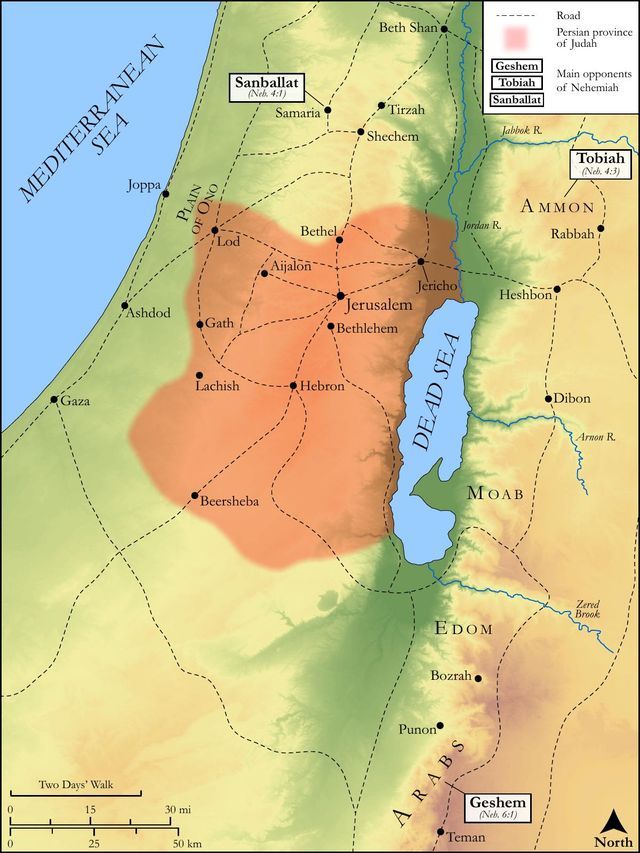
See on the biblical-era map
Study this verse
Public-domain commentary
Matthew Henry
From his Commentary on the Whole Bible. Henry comments on passages, not single verses — this entry covers Nehemiah 4:16–23.
When the builders had so far reason to think the design of the enemies broken as to return to their work, yet they were not so secure as to lay down their arms, knowing how restless and unwearied they were in their attempts, and that, if one design failed, they would be hatching another. Thus must we watch always against our spiritual enemies, and not expect that our warfare will be accomplished till our work is. See what course Nehemiah took, that the people might hold themselves in a readiness, in case there should be an attack. 1. While one half were at work, the other half were under their arms, holding spears, and shields, and bows, not only for themselves but for the labourers too, who would immediately quit their work, and betake themselves to their weapons, upon the first alarm, Neh 4:16. It is probable that they changed services at stated hours, which would relieve the fatigue of both, and particularly would be an ease to the bearers of burdens, whose strength had decayed (Neh 4:10); while they held the weapons, they were eased and yet not idle. Thus dividing their time between the trowels and the spears, they are said to work with one hand and hold their weapons with the other (Neh 4:17), which cannot be understood literally, for the work would require both hands; but it intimates that they were equally employed in both. Thus must we work out our salvation with the weapons of our warfare in our hand; for in every duty we must expect to meet with opposition from our spiritual enemies, against whom we must still be fighting the good fight of faith. 2. Every builder had a sword by his side (Neh 4:18), which he could carry without hindering his labour. The word of God is the sword of the Spirit, which we ought to have always at hand and never to seek, both in our labours and in our conflicts as Christians. 3. Care was taken both to get and give early notice of the approach of the enemy, in case they should endeavour to surprise them. Nehemiah kept a trumpeter always by him to sound an alarm, upon the first intimation of danger. The work was large, and the builders were dispersed; for in all parts of the wall they were labouring at the same time. Nehemiah continually walked round to oversee the work and encourage the workmen, and so would have speedy intelligence if the enemy made an attack, of which, by sound of trumpet, he would soon give notice to all, and they must immediately repair to him with a full assurance that their God would fight for them, Neh 4:18-20. When they acted as workmen, it was requisite they should be dispersed wherever there was work to do; but when as soldiers it was requisite they should come into close order, and be found in a body. Thus should the labourers in Christ's building be ready to unite against a common foe. 4. The inhabitants of the villages were ordered to lodge within Jerusalem, with their servants, not only that they might be the nearer to their work in the morning, but that they might be ready to help in case of an attack in the night, Neh 4:22. The strength of a city lies more in its hands than in its walls; secure them, and God's blessing upon them, and be secure. 5. Nehemiah himself, and all his men, kept closely to their business. The spears were held up, with the sight of them to terrify the enemy, not only from sun to sun, but from twilight to twilight every day, Neh 4:21. Thus ought we to be always upon our guard against our spiritual enemies, not only (as here) while it is light, but when it is dark, for they are the rulers of the darkness of this world. Nay, so very intent was Nehemiah upon his work, and so fast did he hold his servants to it, that while the heat of the business lasted neither he himself nor his attendants went into bed, but every night lay and slept in their clothes (Neh 4:23), except that they shifted them now and then, either for cleanliness or in a case of ceremonial pollution. It was a sign that their heart was upon their work when they could not find time to dress and undress, but resolved they would be at all times ready for service. Good work is likely to go on successfully when those that labour in it thus make a business of it.
Continue studying Nehemiah 4:19 across the web’s major study libraries — every link below opens this exact verse, chapter, or book on the destination site.
Read & Compare
 BibleGatewayThis verse in more than 200 translations and 70 languages.
 Bible.comThe YouVersion reader — hundreds of translations, reading plans, and highlights.
 ESV.orgCrossway's official English Standard Version reader.
 NET BibleThe NET translation with 60,000+ translators' notes on every rendering decision.
 STEP BibleTyndale House's free study tool — original text, vocabulary, and scholarly resources.
 BibliaLogos Bible Software's free web reader.
 USCCBThe New American Bible (Revised Edition) with the U.S. bishops' study notes.
Commentaries
 BibleHub CommentariesDozens of classic commentaries on this verse, gathered on one page.
 StudyLightMore than 100 commentary sets — the largest collection on the web.
 BibleRefPlain-English commentary on what this verse means, verse by verse.
 Enduring WordDavid Guzik's free commentary on this chapter, widely used by Bible teachers.
 Bible Study ToolsVerse commentary alongside Greek and Hebrew study aids.
Original Language & Research
- BibleHub InterlinearThe verse word by word — original language, transliteration, and English.
- BibleHub LexiconEvery word's original-language definition and Strong's entry.
 Blue Letter BibleDeep-study tools — Strong's numbers, concordance, and word studies.
 SefariaThe Hebrew text with Rashi and centuries of Jewish commentary.
Sermons, Hymns & Audio


TrulyRandomVerse is not affiliated with these sites and doesn’t control their content. They’re linked because they’re genuinely useful.
Summary
Nehemiah 4:19 captures a pivotal moment in the rebuilding of Jerusalem's walls, where Nehemiah, the appointed governor, transparently addresses the Jewish exiles. He articulates two critical challenges: the monumental scale of the construction project and the inherent vulnerability arising from the workers being physically dispersed along the extensive wall. This declaration underscores Nehemiah's practical leadership, revealing his acute awareness of both the practical logistics and the strategic dangers faced by his people amidst persistent external threats.
Context
ShowHideLiterary Context
This verse is situated within a narrative of intense opposition to the rebuilding efforts. Prior to Nehemiah's statement, the adversaries—Sanballat, Tobiah, and Geshem—had escalated their mockery and conspiracies into a direct threat of armed attack against Jerusalem, as detailed in Nehemiah 4:7-8. In response, Nehemiah had already implemented a dual strategy: half of the men worked on the wall while the other half stood guard with weapons, and even the builders worked with a weapon at their side, as described in Nehemiah 4:16-18. Verse 19 serves as Nehemiah's candid assessment of the continuing logistical and defensive challenges, specifically the vastness of the project and the resulting dispersion of the workforce. This acknowledgment sets the immediate stage for his strategic solution in Nehemiah 4:20, where he institutes a warning system to consolidate forces rapidly.
Historical & Cultural Context
The events of Nehemiah chapter 4 unfold around 445 BC, during the post-exilic period when Jewish returnees, led by Nehemiah, were striving to reconstruct the protective walls of Jerusalem. These walls had lain in ruins since the Babylonian destruction in 586 BC. This period was marked by significant vulnerability for the nascent Jewish community, surrounded by hostile neighbors who viewed the re-establishment of a fortified Jerusalem as a threat to their regional influence. The act of rebuilding itself was not merely an architectural feat but a profound statement of national and religious identity, symbolizing the restoration of God's people and their covenant city. The cultural context emphasizes communal labor and collective defense, where the entire community was expected to participate in such vital projects, and leaders like Nehemiah were responsible for both organization and protection.
Key Themes
ShowHideNehemiah's declaration in Nehemiah 4:19 highlights several enduring themes. Firstly, it underscores the Immense Task and Potential for Overwhelm that often accompanies God's work. The "great and large" nature of the wall-building mirrors the daunting scale of many spiritual or communal endeavors, which can easily lead to discouragement if not approached with faith and strategic organization. Secondly, the phrase "separated upon the wall, one far from another" emphasizes Vulnerability and Isolation. This physical dispersion made individual workers susceptible to attack and hindered effective collective defense, illustrating the critical need for unity and robust communication in any significant undertaking. Thirdly, Nehemiah's willingness to openly state these difficulties to all levels of his community demonstrates Transparent and Strategic Leadership. He doesn't conceal challenges but rather prepares his people for them, a hallmark of effective leadership in times of crisis. This transparency fosters trust and empowers the community to participate in problem-solving, leading directly to the strategic communication solution detailed in Nehemiah 4:20.
Exposition and Analysis
ShowHideKey Word Analysis
ShowHideFrom the same root as "messenger" or "angel," this term properly signifies "deputyship" or "ministry," and more generally refers to "employment" or "work" (abstractly or concretely). In this context, it signifies the entire enterprise of rebuilding the wall, encompassing not just the physical construction but also the immense logistical, organizational, and defensive efforts required. It conveys the magnitude and complexity of the task Nehemiah and the people faced, highlighting its significance as a divine assignment.
This primitive root means "to increase" or "to be great" in various respects. Here, it denotes magnitude, importance, or difficulty, emphasizing the sheer scale of the project in terms of effort, resources, and the daunting nature of the undertaking. It conveys that the task was not merely large, but also weighty and significant.
This word describes something as "roomy" or "wide" in any direction. It specifically highlights the extensive physical expanse of the wall, emphasizing the vast distances over which the workers were spread. Together with "great," it paints a vivid picture of both the monumental nature of the undertaking and the wide distribution of the workforce, creating a sense of overwhelming challenge and strategic vulnerability.
A primitive root meaning "to break through," "spread," or "separate oneself." This term vividly depicts the physical distance and isolation between the workers along the wall. It implies a lack of immediate proximity and mutual support, highlighting the vulnerability that arises from being spread thin and unable to quickly consolidate in the face of threat. This word underscores the critical strategic problem Nehemiah is addressing, emphasizing the danger posed by their dispersion.
Verse Breakdown
ShowHide"And I said unto the nobles, and to the rulers, and to the rest of the people"
This opening clause shows Nehemiah speaking plainly to nobles, rulers, and people alike. He does not keep the challenges to himself or only inform a select few, but communicates directly and openly with all segments of the community—from the highest-ranking officials ("nobles" and "rulers") to the general populace ("the rest of the people"). This demonstrates his commitment to shared understanding, collective responsibility, and unity in the face of adversity. It underscores a leadership principle of full disclosure to foster buy-in and collective resolve.
"The work [is] great and large"
Nehemiah begins by acknowledging the objective reality of their situation. The rebuilding project was indeed of immense scale, both in terms of the physical dimensions of the wall and the sheer effort required. This statement is not a complaint but a realistic, sober assessment, serving to validate the people's potential feelings of being overwhelmed and to set the stage for the practical implications of such a monumental task. It underscores the daunting nature of their God-given mission, emphasizing its scope and difficulty.
"and we are separated upon the wall, one far from another"
This clause identifies the critical strategic vulnerability. Due to the vast length of the wall and the distribution of the workforce, individual groups or workers were isolated from one another. This physical separation meant that rapid communication, mutual support, and coordinated defense would be severely hampered in the event of an attack. Nehemiah articulates this danger clearly, recognizing that their dispersed state made them susceptible to targeted assaults and undermined their collective strength. It highlights the practical challenge of maintaining cohesion over a wide area.
Literary Devices
ShowHideNehemiah 4:19 employs several effective literary devices to convey its message with impact. Direct Address is prominently featured, as Nehemiah speaks plainly and openly to all segments of the community, fostering a sense of shared understanding and responsibility. The pairing of "great and large" functions as a form of Merism, using two contrasting or complementary terms to express a totality or emphasize an extreme. In this case, it emphasizes the overwhelming scale and extensive breadth of the task, impressing upon the people the gravity of their situation and the need for a unified response. The "work" itself can be seen as Metonymy, where the physical act of building the wall represents the entire complex and dangerous undertaking of restoring Jerusalem's defenses and, by extension, the nation's identity and security. Furthermore, Nehemiah's clear articulation of the problem of being "separated upon the wall" serves as Foreshadowing, setting the stage for the strategic solution he will propose in the very next verse—the establishment of a trumpet signal for rapid assembly and defense. This careful setup builds narrative tension and highlights Nehemiah's proactive and insightful leadership.
Theological and Thematic Connections
ShowHideNehemiah's candid assessment of the "great and large" work and the vulnerability of the "separated" workers offers profound theological and thematic insights. It reminds us that God's calling often involves tasks that seem overwhelming, requiring immense faith, perseverance, and collective effort. The challenge of isolation among the builders mirrors the spiritual danger of individual believers or small groups feeling disconnected, making them vulnerable to spiritual attack or discouragement. Just as Nehemiah recognized the need for unity and a clear communication strategy, the Church is called to function as a unified body, where each member supports the others, and communication is vital for collective strength and mission. This passage underscores the divine principle that while God initiates and empowers His work, He also expects His people to engage in wise planning, transparent leadership, and committed collaboration.
Reflection and Application
ShowHideNehemiah 4:19 provides a timeless blueprint for navigating daunting challenges, whether in personal life, ministry, or community endeavors. It teaches us the importance of acknowledging the true scale of our tasks, rather than minimizing or ignoring difficulties. When we face overwhelming projects, or when we feel isolated and vulnerable in our efforts, Nehemiah's example calls us to transparently articulate these realities, not to despair, but to invite collective wisdom and strategic action. Just as the scattered builders needed a unified signal, we too need clear channels of communication and a commitment to unity within our spiritual communities to overcome obstacles and resist opposition. This verse encourages leaders to be honest about challenges, fostering trust and empowering their teams, and it reminds every individual that their contribution, though seemingly small when "separated," is vital to the collective success of God's greater work. It prompts us to consider how our current challenges might be better addressed through shared understanding and collaborative solutions, rather than isolated efforts.
Questions for Reflection
ShowHideFAQ
ShowHideWhy did Nehemiah state what seemed obvious to everyone working on the wall?
ShowHideNehemiah's statement was not merely to state the obvious but served several crucial purposes, demonstrating profound leadership. Firstly, it exemplified transparent and empathetic leadership. By openly acknowledging the difficulties—the "great and large" nature of the work and the vulnerability of being "separated"—Nehemiah validated the experiences and potential anxieties of the workers. This fostered trust and showed that he was attuned to their struggles, building morale and solidarity. Secondly, it was a strategic assessment delivered to the entire community. Articulating the problem clearly to all stakeholders, from nobles to the common people, ensured everyone understood the gravity of the situation and the rationale behind the upcoming strategic adjustments (like the trumpet signal in Nehemiah 4:20). This shared understanding was vital for collective action and discipline in the face of ongoing threats from adversaries like Sanballat and Tobiah, as documented in Nehemiah 4:7-8). It transformed a perceived problem into a shared challenge requiring a unified solution.
Christ-Centered Fulfillment
ShowHideNehemiah's leadership in acknowledging the "great and large" work and the vulnerability of scattered workers finds its ultimate fulfillment in Christ. The rebuilding of Jerusalem's physical walls foreshadows the infinitely greater work of building God's spiritual temple, the Church, which Jesus initiated and continues through His Spirit (Ephesians 2:19-22). Just as Nehemiah gathered and organized a scattered people for a monumental task, Christ gathers those who were "separated" by sin and alienation from God (Ephesians 2:12-13) and unites them into one body, His Church, under His headship (Colossians 1:18). The "great and large" work of the Great Commission—making disciples of all nations (Matthew 28:19-20)—is a task far surpassing the rebuilding of any physical wall. Yet, unlike the vulnerable builders on Nehemiah's wall, believers are not left "one far from another" without defense. Christ, our ultimate Leader, has not only equipped us with the Holy Spirit, our Helper and Advocate (John 14:26), but also prayed for our unity (John 17:20-23) and promised His abiding presence until the very end of the age (Matthew 28:20). In Christ, the work is indeed great, but we are never truly separated or without His divine protection and unifying power, for He is our ever-present Lord and Commander.