


Numbers 10:9
Bible text: King James Version (1769 Blayney text) · Public domain
Bible text: King James Version with Strong's numbers · Public domain
Bible text: Berean Standard Bible · Public domain
Bible text: American Standard Version (1901) · Public domain
Bible text: World English Bible, Messianic edition · Public domain
Bible text: Geneva Bible (1599) · Public domain
Bible text: Young's Literal Translation · Public domain
- וְכִיve·khiand ifH3588Conj-w ¦ PrtParticle Conditionalוְandכִיif
- תָבֹאוּta·Vo·'uyou will goH935V-Qal-Imperf-2mpVerb Qal Imperfect 2nd Plural Masculine
- מִלְחָמָהmil·cha·MahwarH4421N-fsNoun Singular Feminine Absolute
- בְּאַרְצְכֶםbe·'ar·tze·Khemin your landH776Prep-b ¦ N-fsc ¦ 2mpNoun Singular Feminine Constructבְּinאַרְצְlandכֶםyour
- עַל'alonH5921PrepPreposition
- הַצַּרha·Tzarthe foeH6862Art ¦ N-msNoun Singular Masculine Absoluteהַtheצַּרfoe
- הַצֹּרֵרha·tzo·Rerwho opposesH6887Art ¦ V-Qal-Prtcpl-msVerb Qal Participle Singular Masculine Absoluteהַwhoצֹּרֵרopposes
- אֶתְכֶם'et·Khem<obj.> youH853DirObjM ¦ 2mpParticle Object Indicatorאֶתְ<obj.>כֶםyou
- וַהֲרֵעֹתֶםva·ha·re·'o·Temand you will give an alarmH7321Conj-w ¦ V-Hiphil-ConsecPerf-2mpVerb Hiphil Consecutive Perfect 2nd Plural Masculineוַandהֲרֵעֹתֶםyou will give an alarm
- בַּחֲצֹצְרוֹתba·cha·tzo·tze·Roton trumpetsH2689Prep-b ¦ N-fpNoun Plural Feminine Absoluteבַּonחֲצֹצְרוֹתtrumpets
- וֲנִזְכַּרְתֶּםva·niz·kar·Temand you will be rememberedH2142Conj-w ¦ V-Niphal-ConsecPerf-2mpVerb Niphal Consecutive Perfect 2nd Plural Masculineוֲandנִזְכַּרְתֶּםyou will be remembered
- לִפְנֵיlif·Nei<to> beforeH6440Prep-l ¦ N-mpcNoun Plural Masculine Constructלִ<to>פְנֵיbefore
- יְהוָהYah·wehYahwehH3068N-properNoun Proper Title
- אֱלֹהֵיכֶם'e·lo·hei·Khemyour GodH430N-mpc ¦ 2mpNoun Plural Masculine ConstructאֱלֹהֵיGodכֶםyour
- וְנוֹשַׁעְתֶּםve·no·sha'·Temand you will be deliveredH3467Conj-w ¦ V-Niphal-ConsecPerf-2mpVerb Niphal Consecutive Perfect 2nd Plural Masculineוְandנוֹשַׁעְתֶּםyou will be delivered
- מֵאֹיְבֵיכֶםme·'o·ye·vei·Khemfrom your enemiesH341Prep-m ¦ V-Qal-Prtcpl-mp ¦ 2mpVerb Qal Participle Plural Masculine Constructמֵfromאֹיְבֵיenemiesכֶםyour
English is a literal word-by-word gloss of the Hebrew, not the KJV's wording. Why?
This is the original text the KJV's translators worked from — each Hebrew word with its own literal English meaning in this verse, prepared by scholars at Tyndale House, Cambridge. The KJV translates whole sentences, not word by word, so its wording differs: one Hebrew word can become several English words, and the KJV may choose “the LORD” where the gloss reads “Yahweh”. Both are faithful — they answer different questions. For the KJV's own rendering, switch to the KJV text.
Details
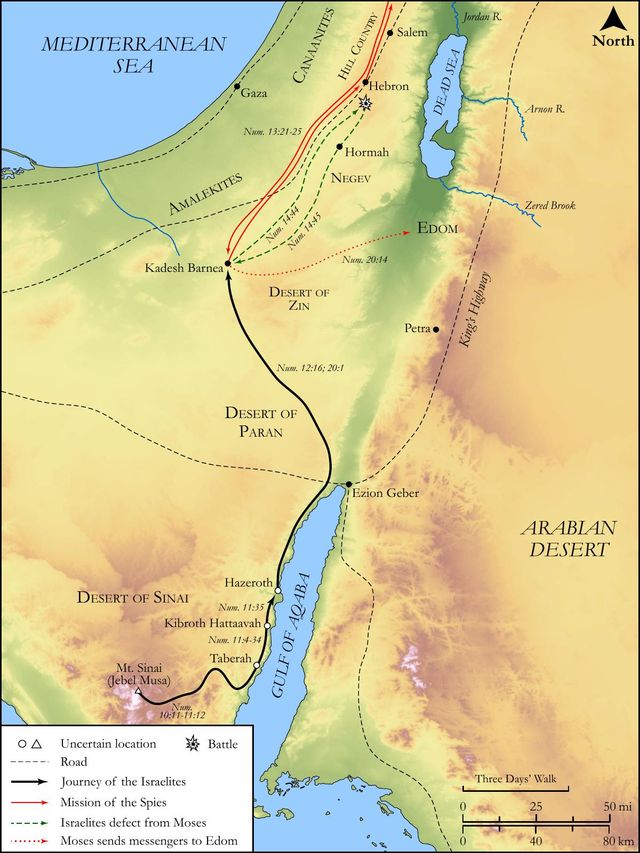
See on the biblical-era map
Study this verse
Public-domain commentary
Matthew Henry
From his Commentary on the Whole Bible. Henry comments on passages, not single verses — this entry covers Numbers 10:1–10.
We have here directions concerning the public notices that were to be given to the people upon several occasions by sound of trumpet. In a thing of this nature, one would think, Moses needed not to have been taught of God: his own reason might teach him the conveniency of trumpets; but the constitution of Israel was to be in every thing divine, and therefore even in this matter, small as it seems. Moses is here directed, 1. About the making of them. They must be made of silver; not cast but of beaten work (as some read it), the matter and shape, no doubt, very fit for the purpose. He was now ordered to make but two, because there were but two priests to use them. But in Solomon's time we read of 120 priests sounding with trumpets, Ch2 5:12. The form of these trumpets is supposed to have been much like ours at this day. 2. Who were to make use of them; not any inferior person, but the priests themselves, the sons of Aaron, Num 10:8. As great as they were, they must not think it a disparagement to them to be trumpeters in the house of God; the meanest office there was honourable. This signified that the Lord's ministers should lift up their voice like a trumpet, to show people their sins (Isa 58:1), to call them to Christ, Isa 27:13. 3. Upon what occasions the trumpets were to be sounded. (1.) For the calling of assemblies, Num 10:2. Thus they are told to blow the trumpet in Zion for the calling of a solemn assembly together, to sanctify a fast, Joe 2:15. Public notice ought to be given of the time and place of religious assemblies; for the invitation to the benefit or ordinances is general: whoever will, let him come. wisdom cries in the chief places of concourse. But, that the trumpet might not give an uncertain sound, they are directed, if only the princes and elders were to meet, to blow but one of the trumpets; less should serve to call them together, who ought to be examples of forwardness in any thing that is good: but, if the body of the people were to be called together, both the trumpets must be sounded, that they might be heard at the greater distance. In allusion to this, they are said to be blessed that hear the joyful sound (Psa 89:15), that is, that are invited and called upon to wait upon God in public ordinances, Psa 122:1. And the general assembly at the great day will be summoned by the sound of the archangel's trumpet, Mat 24:31. (2.) For the journeying of the camps, to give notice when each squadron must move; for no man's voice could reach to give the word of command: soldiers with us that are well disciplined may be exercised by beat of drums. When the trumpets were blown for this purpose, they mustsound an alarm (Num 10:5), a broken, quavering, interrupted sound, which was proper to excite and encourage the minds of people in their marches against their enemies; whereas a continued equal sound was more proper for the calling of the assembly together (Num 10:7): yet when the people were called together to deprecate God's judgments we find an alarm sounded, Joe 2:1. At the first sounding, Judah's squadron marched, at the second Reuben's, at the third Ephraim's, at the fourth Dan's, Num 10:5, Num 10:6. And some think that this was intended to sanctify their marches, for thus were proclaimed by the priests, who were God's mouth to the people, not only the divine orders given them to move, but the divine blessing upon them in all their motions. He that hath ears, let him hear that God is with them of a truth. King Abijah valued himself and his army very much upon this (Ch2 13:12), God himself is with us for our captain and his priests with sounding trumpets. (3.) For the animating and encouraging of their armies, when they went out in battle (Num 10:9): "If you go to war, blow with the trumpets, signifying thereby your appeal to heaven for the decision of the controversy, and your prayer to God to give you victory; and God will own this his own institution, and you shall be remembered before the Lord your God." God will take notice of this sound of the trumpet, and be engaged to fight their battles, and let all the people take notice of it, and be encouraged to fight his, as David, when he heard a sound of a going upon the tops of the mulberry trees. Not that God needed to be awaked by sound of trumpet any more than Christ needed to be awaked by his disciples in the storm, Mat 8:25. But where he intends mercy it is his will that we should solicit it; ministers must stir up the good soldiers of Jesus Christ to fight manfully against sin, the world, and the devil, by assuring them that Christ is the captain of their salvation, and will tread Satan under their feet. (4.) For the solemnizing of their sacred feasts, Mat 8:10. One of their feasts was called a memorial of the blowing of trumpets, Lev 23:23, etc. And it should seem they were thus to grace the solemnity of all their feasts (Psa 81:3), and their sacrifices (Ch2 29:27), to intimate with what joy and delight they performed their duty to God, and to raise the minds of those that attended the services to a holy triumph in the God they worshipped. And then their performances were for a memorial before God; for he takes pleasure in our religious exercises when we take pleasure in them. Holy work should be done with holy joy.
Continue studying Numbers 10:9 across the web’s major study libraries — every link below opens this exact verse, chapter, or book on the destination site.
Read & Compare
 BibleGatewayThis verse in more than 200 translations and 70 languages.
 Bible.comThe YouVersion reader — hundreds of translations, reading plans, and highlights.
 ESV.orgCrossway's official English Standard Version reader.
 NET BibleThe NET translation with 60,000+ translators' notes on every rendering decision.
 STEP BibleTyndale House's free study tool — original text, vocabulary, and scholarly resources.
 BibliaLogos Bible Software's free web reader.
 USCCBThe New American Bible (Revised Edition) with the U.S. bishops' study notes.
Commentaries
 BibleHub CommentariesDozens of classic commentaries on this verse, gathered on one page.
 StudyLightMore than 100 commentary sets — the largest collection on the web.
 BibleRefPlain-English commentary on what this verse means, verse by verse.
 Enduring WordDavid Guzik's free commentary on this chapter, widely used by Bible teachers.
 Bible Study ToolsVerse commentary alongside Greek and Hebrew study aids.
Original Language & Research
- BibleHub InterlinearThe verse word by word — original language, transliteration, and English.
- BibleHub LexiconEvery word's original-language definition and Strong's entry.
 Blue Letter BibleDeep-study tools — Strong's numbers, concordance, and word studies.
 SefariaThe Hebrew text with Rashi and centuries of Jewish commentary.
Sermons, Hymns & Audio


TrulyRandomVerse is not affiliated with these sites and doesn’t control their content. They’re linked because they’re genuinely useful.
Summary
Numbers 10:9 serves as a crucial divine directive for the Israelites as they prepare for their journey to the Promised Land, outlining a specific protocol for engaging in warfare. It commands them to sound a piercing alarm with their sacred trumpets when facing an oppressing enemy within their land. This act of obedience and dependence is met with a profound promise: God will actively "remember" them, turning His attention to their plight and ensuring their ultimate deliverance and salvation from their adversaries, thereby affirming His sovereign involvement in their battles and His unwavering covenant faithfulness.
Context
ShowHideLiterary Context
Numbers 10:9 is intricately woven into a broader section (Numbers 10:1-10) that meticulously details the construction and multifaceted uses of two silver trumpets. This instruction follows the comprehensive organization of the Israelite camp, the census of the tribes, and the specific duties assigned to the Levites, all designed to prepare the nation for their impending departure from Mount Sinai and their journey toward the Promised Land. The preceding verses (Numbers 10:1-8) establish the trumpet's role in assembling the congregation, signaling tribal movements, and convening leaders. Verse 9 specifically extends their function to military engagement, while verse 10 broadens their application to joyous occasions, appointed feasts, and new moons, underscoring the pervasive sacred and practical significance of these instruments in Israel's daily and spiritual life. This particular verse, therefore, highlights God's comprehensive oversight, even in the critical realm of warfare, as the nation transitions from a static, organized encampment to an active, mobile pilgrimage.
Historical & Cultural Context
As the Israelites stood poised to leave Mount Sinai, they were moving from a period of intense divine revelation and meticulous organization into a dynamic phase of pilgrimage and eventual conquest. This journey would inevitably lead to confrontations with various indigenous peoples already inhabiting the land promised to their patriarchs, Abraham, Isaac, and Jacob, a promise reiterated in Genesis 15:18-21. The directive in Numbers 10:9 specifically addresses defensive warfare or battles fought to secure their divinely appointed inheritance: "in your land against the enemy that oppresseth you." Among the nations, military engagements were frequently accompanied by various rituals, shouts, and the use of musical instruments. However, for Israel, the blowing of these trumpets held a unique spiritual dimension, directly linking their military actions to the invocation of divine remembrance and intervention. This practice distinctly set their warfare apart as an act of faith and profound dependence on Yahweh, rather than relying solely on human strategy or might, thereby reinforcing their identity as a people under God's direct command and protection, a foundational theme of their covenant relationship, as seen in Deuteronomy 20:1-4.
Key Themes
ShowHideNumbers 10:9 contributes significantly to several overarching themes within the book of Numbers and the Pentateuch. Firstly, it underscores the theme of Divine Sovereignty in Warfare, demonstrating that Israel's success in battle is not dependent on their military strength alone, but on God's active intervention and leadership. Secondly, it highlights the theme of Covenant Faithfulness, as God's promise to "remember" them and grant salvation is a direct outflow of His unwavering commitment to His covenant with Israel, a commitment often expressed through His active remembrance, as seen in Exodus 2:24. Thirdly, the verse emphasizes the vital role of Obedience and Dependence in Israel's relationship with God. The prescribed action of blowing the trumpets is an act of obedience that serves as a tangible expression of their dependence on God for deliverance, a principle echoed throughout the wilderness narrative. Finally, it reinforces the theme of Divine Presence and Guidance, as the trumpets, sacred instruments, serve as a means by which God communicates with and directs His people in all aspects of their national life, from assembly to warfare and worship (Numbers 9:15-23).
Exposition and Analysis
ShowHideKey Word Analysis
ShowHideThis word (H2689) refers to a specific type of trumpet, likely a straight, silver instrument, distinct from the ram's horn (shofar). The term itself suggests a "sundered or quavering note," indicating a sharp, piercing sound. In this context, it refers to the sacred silver trumpets specifically commanded by God in Numbers 10:2. Their use for an "alarm" implies a broken, urgent blast, signifying a call for immediate attention and action, both from the people and, crucially, from God. They are not merely musical instruments but divinely appointed tools for communication and invocation.
The Hebrew verb (H2142) for "remembered" is profound in its theological implications. It does not suggest that God literally forgets and needs a human reminder. Instead, when God "remembered," it signifies an active, purposeful turning of His attention toward His people, leading to a decisive, benevolent, and often redemptive intervention on their behalf. It means He is about to act in accordance with His covenant promises and His character. Here, it denotes His active engagement in their battle and His commitment to their deliverance, moving from a state of apparent inaction to purposeful intervention.
This primitive root (H3467) means "to be open, wide or free," and by implication, "to be safe." Causatively, it means "to free or succor." In the context of warfare, "saved" refers to being delivered, rescued, or granted victory over enemies. It encompasses not just physical preservation but also the broader concept of liberation from oppression. This word emphasizes that the ultimate outcome of God's "remembrance" is the complete and effective deliverance of His people from their adversaries, underscoring that their salvation is a divine act.
Verse Breakdown
ShowHide"And if ye go to war in your land against the enemy that oppresseth you"
This clause establishes the precise conditions and context for the divine instruction. It specifies a scenario of defensive warfare or battles fought within the territory God has given or is in the process of giving them, against an enemy actively causing distress, subjugation, or harassment. This highlights God's particular concern for His people's security, their rightful inheritance, and His protection against those who would seek to deny them their promised land.
"then ye shall blow an alarm with the trumpets"
This is the direct divine command, outlining the prescribed action in the specified circumstances. The blowing of the teru'ah (alarm blast) with the sacred silver trumpets is not merely a military signal but an act of obedient faith and a public declaration of profound dependence on God in a time of dire need. It signifies a collective cry for His intervention, acknowledging that human strength or strategy alone is insufficient.
"and ye shall be remembered before the LORD your God"
This is the immediate and crucial promise directly linked to their obedience. As detailed in the "Key Word Analysis," God's "remembrance" is an active, covenantal response. It means that upon hearing their obedient cry, God will turn His active attention to their plight and initiate a decisive action on their behalf, demonstrating His unwavering faithfulness to His covenant people. It is a guarantee of divine engagement.
"and ye shall be saved from your enemies"
This is the ultimate promised outcome of God's remembrance and intervention. The phrase assures complete deliverance and decisive victory over their oppressors. This underscores that their salvation in battle is not merely a result of human military prowess or strategic advantage, but a direct, guaranteed act of God in response to their obedient and faith-filled invocation.
Literary Devices
ShowHideNumbers 10:9 is rich with significant literary devices. The verse is structured as a clear Conditional Promise, explicitly using the "if... then..." construction. This highlights the covenantal nature of the relationship between God and Israel, where human obedience triggers divine blessing and intervention. Symbolism is profoundly present in the "trumpets" themselves, which are not mere instruments but sacred objects, divinely ordained for specific purposes. Their sound carries immense spiritual weight, representing a direct channel of communication and invocation between Israel and God. The "alarm" blown with the trumpets functions as a powerful Metonymy, standing in for the entire act of calling upon God in distress, embodying a collective prayer, a declaration of faith, and an appeal for divine aid. Furthermore, the phrase "remembered before the LORD your God" employs Anthropomorphism, attributing human-like memory to God. This figure of speech does not imply divine forgetfulness but rather conveys God's active, benevolent attention, His purposeful turning toward His people, and His imminent intervention on their behalf, reinforcing His personal and active involvement in the affairs of His chosen nation.
Theological and Thematic Connections
ShowHideNumbers 10:9 powerfully illustrates God's active and intimate involvement in the life and battles of His people, emphasizing that their deliverance and victory are ultimately His work. It teaches a foundational principle: obedience to divine commands, even in seemingly practical matters like military signals, is intrinsically linked to divine favor and intervention. The concept of God "remembering" is a profound theological truth, signifying His unwavering covenant faithfulness and His readiness to act decisively on behalf of those who call upon Him in faith. This verse establishes a pattern of divine response to human invocation, a theme consistently echoed throughout Scripture where God's people cry out to Him in distress, and He, in His faithfulness, delivers them. It demonstrates that God is not distant but intimately concerned with the well-being and security of His people.
Reflection and Application
ShowHideNumbers 10:9, though rooted in the ancient military context of Israel, offers profound and timeless spiritual principles for believers today. It serves as a powerful reminder that in our own "wars" – whether against indwelling sin, spiritual oppression, overwhelming temptations, or the myriad challenges and adversities of life – our primary and most effective strategy is to call upon the Lord. Just as the trumpet blast was a divinely commanded signal of distress and dependence for ancient Israel, so too is prayer for us. When we cry out to God with sincere hearts, confessing our need, acknowledging our helplessness, and trusting in His sovereign power, He "remembered" us. This does not imply that He was ever oblivious to our plight, but rather that He actively turns His divine attention to our specific situation, ready to intervene according to His perfect will, His boundless wisdom, and His unfailing covenant promises. This verse powerfully encourages us to cultivate a habit of immediate, faith-filled, and persistent prayer in every moment of need, knowing with certainty that our ultimate salvation, deliverance, and victory come solely from Him.
Questions for Reflection
ShowHideFAQ
ShowHideWhat was the primary purpose of the trumpets in Numbers 10 beyond this verse?
ShowHideThe two silver trumpets described in Numbers 10:1-10 served multiple vital and distinct functions for the Israelite community, integrating both practical organization and sacred worship into their daily life. They were primarily used to assemble the congregation, either the entire assembly or just the leaders, depending on the number and type of blasts. They also served as crucial signals for the breaking of camp and the orderly movement of the different tribal divisions during their wilderness journey. Furthermore, Numbers 10:10 specifies their use during times of rejoicing, on their appointed feasts, and at the beginning of their months, accompanying their burnt offerings and peace offerings. Thus, the trumpets were instruments that wove God's presence and direction into every aspect of Israel's national and spiritual existence.
Does God literally "forget" and need to be "remembered" by human actions?
ShowHideNo, the biblical concept of God "remembering" (Hebrew: zakar) does not imply that God suffers from literal forgetfulness or requires human actions to jog His memory. Instead, when the Bible states that God "remembered" His people or His covenant, it signifies His active, intentional turning of attention towards them, leading to a decisive act of intervention or the fulfillment of His promises. It means He is about to act on their behalf, often in response to their cry, their obedience, or in accordance with His sovereign plan. For example, when God "remembered" Noah (Genesis 8:1), it meant He caused the floodwaters to recede and brought Noah safely out of the ark. When He "remembered" His covenant with Abraham, Isaac, and Jacob (Exodus 2:24), it meant He initiated the miraculous deliverance of Israel from Egyptian bondage. In Numbers 10:9, Israel's blowing of the trumpets is the obedient act that prompts God's active, saving remembrance, demonstrating His faithfulness to His covenant.
Christ-Centered Fulfillment
ShowHideNumbers 10:9, with its promise of divine remembrance and salvation in battle through an obedient cry, finds its ultimate and most profound fulfillment in the person and work of Jesus Christ. While the Old Testament trumpet blast was a temporal signal for physical deliverance from earthly enemies, Christ is the eternal "alarm" and the ultimate Deliverer. He is the one through whom God truly "remembers" His people, not just from physical adversaries, but from the far more oppressive and eternal enemies of sin, death, and the devil. Just as the Israelites were to cry out to God for salvation, so too are we called to cry out to Christ, who serves as our Great High Priest, perpetually interceding for us before the Father's throne (Hebrews 7:25). His sacrificial death on the cross is the definitive act of God's remembrance of His covenant of grace, securing our salvation once and for all (Romans 5:8). Furthermore, the broader biblical motif of the trumpet often points to Christ's future return, when the "trumpet of God" will sound, signaling the ultimate and final deliverance of His people, the resurrection of the dead, and the establishment of His eternal kingdom (1 Thessalonians 4:16). Thus, Numbers 10:9 serves as a powerful foreshadowing of the greater reality that our true and lasting salvation comes not from human signals or strength, but from the sovereign, saving work of God accomplished perfectly and eternally in Jesus Christ.