


Nehemiah 4:16
- וַיְהִיvay·Hiand it wasH1961Conj-w ¦ V-Qal-ConsecImperf-3msVerb Qal Consecutive Imperfect 3rd Singular Masculineוַandיְהִיit was
- מִןminfromH4480PrepPreposition
- הַיּוֹםhai·Yomthe dayH3117Art ¦ N-msNoun Singular Masculine Absoluteהַtheיּוֹםday
- הַהוּאha·Hu'<the> thatH1931Art ¦ Pro-3msPronoun Personal 3rd Singular Masculineהַ<the>הוּאthat
- חֲצִיcha·Tzi<the> half ofH2677N-mscNoun Singular Masculine Construct
- נְעָרַיne·'a·Raimy young menH5288N-mpc ¦ 1csNoun Plural Masculine Constructנְעָרַyoung menיmy
- עֹשִׂים'o·Sim[were] doingH6213V-Qal-Prtcpl-mpVerb Qal Participle Plural Masculine Absolute
- בַּמְּלָאכָהba·me·la·Khah<in> the workH4399Prep-b ¦ N-fsNoun Singular Feminine Absoluteבַּ<in> theמְּלָאכָהwork
- וְחֶצְיָםve·chetz·Yamand half of themH2677Conj-w ¦ N-msc ¦ 3mpNoun Singular Masculine Constructוְandחֶצְיָhalf ofםthem
- מַחֲזִיקִיםma·cha·zi·Kim[were] holdingH2388V-Hiphil-Prtcpl-mpVerb Hiphil Participle Plural Masculine Absolute
- וְהָרְמָחִיםve·ha·re·ma·Chimand the spearsH7420Conj-w ¦ Art ¦ N-mpNoun Plural Masculine Absoluteוְandהָtheרְמָחִיםspears
- הַמָּגִנִּיםha·ma·gi·Nimthe shieldsH4043Art ¦ N-mpNoun Plural Masculine Absoluteהַtheמָּגִנִּיםshields
- וְהַקְּשָׁתוֹתve·ha·ke·sha·Totand the bowsH7198Conj-w ¦ Art ¦ N-fpNoun Plural Feminine Absoluteוְandהַtheקְּשָׁתוֹתbows
- וְהַשִּׁרְיֹנִיםve·ha·shir·yo·Nimand the body armor<s>H8302Conj-w ¦ Art ¦ N-mpNoun Plural Masculine Absoluteוְandהַtheשִּׁרְיֹנִיםbody armor<s>
- וְהַשָּׂרִיםve·Ha·sa·Rimand the commandersH8269Conj-w ¦ Art ¦ N-mpNoun Plural Masculine Absoluteוְandהַtheשָּׂרִיםcommanders
- אַחֲרֵי'a·cha·Rei[were] behindH310Adj-mpcAdjective Numerical Plural Masculine Construct
- כָּלkolallH3605N-mscNoun Singular Masculine Construct
- בֵּיתbeit[the] house ofH1004N-mscNoun Singular Masculine Construct
- יְהוּדָהye·hu·DahJudahH3063N-properNoun Proper Location
English is a literal word-by-word gloss of the Hebrew, not the KJV's wording. Why?
This is the original text the KJV's translators worked from — each Hebrew word with its own literal English meaning in this verse, prepared by scholars at Tyndale House, Cambridge. The KJV translates whole sentences, not word by word, so its wording differs: one Hebrew word can become several English words, and the KJV may choose “the LORD” where the gloss reads “Yahweh”. Both are faithful — they answer different questions. For the KJV's own rendering, switch to the KJV text.
Details
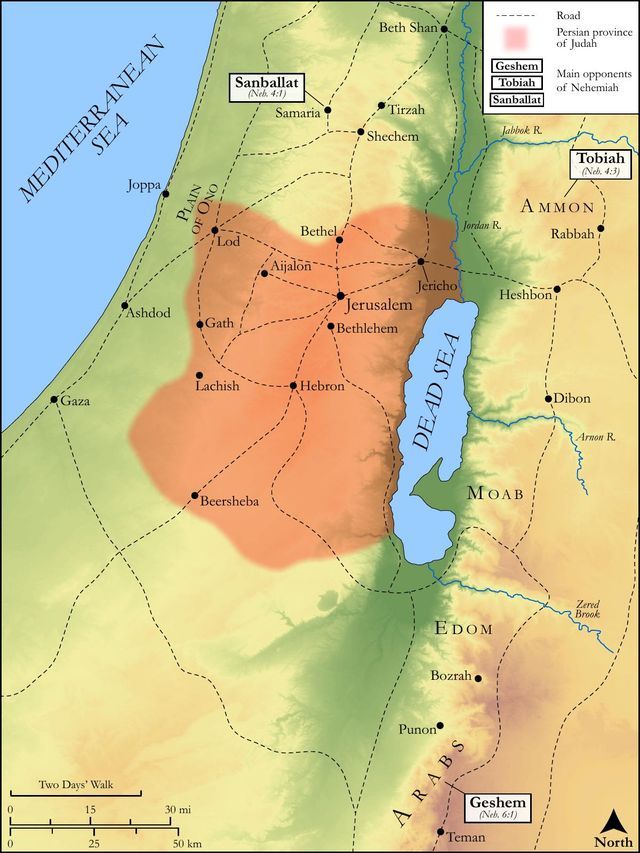
See on the biblical-era map
Study this verse
Public-domain commentary
Matthew Henry
From his Commentary on the Whole Bible. Henry comments on passages, not single verses — this entry covers Nehemiah 4:16–23.
When the builders had so far reason to think the design of the enemies broken as to return to their work, yet they were not so secure as to lay down their arms, knowing how restless and unwearied they were in their attempts, and that, if one design failed, they would be hatching another. Thus must we watch always against our spiritual enemies, and not expect that our warfare will be accomplished till our work is. See what course Nehemiah took, that the people might hold themselves in a readiness, in case there should be an attack. 1. While one half were at work, the other half were under their arms, holding spears, and shields, and bows, not only for themselves but for the labourers too, who would immediately quit their work, and betake themselves to their weapons, upon the first alarm, Neh 4:16. It is probable that they changed services at stated hours, which would relieve the fatigue of both, and particularly would be an ease to the bearers of burdens, whose strength had decayed (Neh 4:10); while they held the weapons, they were eased and yet not idle. Thus dividing their time between the trowels and the spears, they are said to work with one hand and hold their weapons with the other (Neh 4:17), which cannot be understood literally, for the work would require both hands; but it intimates that they were equally employed in both. Thus must we work out our salvation with the weapons of our warfare in our hand; for in every duty we must expect to meet with opposition from our spiritual enemies, against whom we must still be fighting the good fight of faith. 2. Every builder had a sword by his side (Neh 4:18), which he could carry without hindering his labour. The word of God is the sword of the Spirit, which we ought to have always at hand and never to seek, both in our labours and in our conflicts as Christians. 3. Care was taken both to get and give early notice of the approach of the enemy, in case they should endeavour to surprise them. Nehemiah kept a trumpeter always by him to sound an alarm, upon the first intimation of danger. The work was large, and the builders were dispersed; for in all parts of the wall they were labouring at the same time. Nehemiah continually walked round to oversee the work and encourage the workmen, and so would have speedy intelligence if the enemy made an attack, of which, by sound of trumpet, he would soon give notice to all, and they must immediately repair to him with a full assurance that their God would fight for them, Neh 4:18-20. When they acted as workmen, it was requisite they should be dispersed wherever there was work to do; but when as soldiers it was requisite they should come into close order, and be found in a body. Thus should the labourers in Christ's building be ready to unite against a common foe. 4. The inhabitants of the villages were ordered to lodge within Jerusalem, with their servants, not only that they might be the nearer to their work in the morning, but that they might be ready to help in case of an attack in the night, Neh 4:22. The strength of a city lies more in its hands than in its walls; secure them, and God's blessing upon them, and be secure. 5. Nehemiah himself, and all his men, kept closely to their business. The spears were held up, with the sight of them to terrify the enemy, not only from sun to sun, but from twilight to twilight every day, Neh 4:21. Thus ought we to be always upon our guard against our spiritual enemies, not only (as here) while it is light, but when it is dark, for they are the rulers of the darkness of this world. Nay, so very intent was Nehemiah upon his work, and so fast did he hold his servants to it, that while the heat of the business lasted neither he himself nor his attendants went into bed, but every night lay and slept in their clothes (Neh 4:23), except that they shifted them now and then, either for cleanliness or in a case of ceremonial pollution. It was a sign that their heart was upon their work when they could not find time to dress and undress, but resolved they would be at all times ready for service. Good work is likely to go on successfully when those that labour in it thus make a business of it.
Continue studying Nehemiah 4:16 across the web’s major study libraries — every link below opens this exact verse, chapter, or book on the destination site.
Read & Compare
 BibleGatewayThis verse in more than 200 translations and 70 languages.
 Bible.comThe YouVersion reader — hundreds of translations, reading plans, and highlights.
 ESV.orgCrossway's official English Standard Version reader.
 NET BibleThe NET translation with 60,000+ translators' notes on every rendering decision.
 STEP BibleTyndale House's free study tool — original text, vocabulary, and scholarly resources.
 BibliaLogos Bible Software's free web reader.
 USCCBThe New American Bible (Revised Edition) with the U.S. bishops' study notes.
Commentaries
 BibleHub CommentariesDozens of classic commentaries on this verse, gathered on one page.
 StudyLightMore than 100 commentary sets — the largest collection on the web.
 BibleRefPlain-English commentary on what this verse means, verse by verse.
 Enduring WordDavid Guzik's free commentary on this chapter, widely used by Bible teachers.
 Bible Study ToolsVerse commentary alongside Greek and Hebrew study aids.
Original Language & Research
- BibleHub InterlinearThe verse word by word — original language, transliteration, and English.
- BibleHub LexiconEvery word's original-language definition and Strong's entry.
 Blue Letter BibleDeep-study tools — Strong's numbers, concordance, and word studies.
 SefariaThe Hebrew text with Rashi and centuries of Jewish commentary.
Sermons, Hymns & Audio


TrulyRandomVerse is not affiliated with these sites and doesn’t control their content. They’re linked because they’re genuinely useful.
Summary
Nehemiah 4:16 powerfully illustrates the strategic genius and unwavering resolve of Nehemiah and the Jewish people as they undertook the monumental task of rebuilding Jerusalem's walls amidst relentless opposition. This pivotal verse describes Nehemiah's implementation of a dual strategy: half of the workforce diligently continued the construction, while the other half stood guard, fully armed and vigilant. This highly organized division of labor, overseen by watchful rulers, ensured both the advancement of the sacred work and a robust defense against their adversaries, embodying a profound blend of faith, prudence, and perseverance essential for kingdom work under duress.
Context
ShowHideLiterary Context
Nehemiah 4:16 is situated within a narrative arc that meticulously details the challenges and triumphs of rebuilding Jerusalem's walls. Following the initial assessment and commencement of the work in Nehemiah 2-3, chapter 4 opens with the escalating hostility from Sanballat, Tobiah, and Geshem. Their initial mockery (Nehemiah 4:1-3) quickly morphed into a more sinister conspiracy to attack Jerusalem and halt the construction (Nehemiah 4:7-8). Nehemiah's immediate response was a combination of fervent prayer and practical vigilance, setting a guard (Nehemiah 4:9). When their enemies' plans were providentially frustrated and exposed (as recorded in Nehemiah 4:15), Nehemiah, far from relaxing, solidified his defensive posture. Verse 16 marks a critical transition from reactive defense to a proactive, integrated security strategy, ensuring the work could continue without interruption while simultaneously maintaining a constant readiness for any assault. This verse, therefore, represents the institutionalization of a sustainable defense mechanism.
Historical & Cultural Context
The events of Nehemiah are set in the post-exilic period, specifically around 445 BC, during the reign of Artaxerxes I. The Jewish exiles had returned to a desolate Jerusalem, its protective walls in ruins, leaving the city and its inhabitants vulnerable to external threats and internal demoralization. Rebuilding these walls was far more than a mere construction project; it was a profound act of national and spiritual restoration, symbolizing the re-establishment of Israel's identity, security, and covenant relationship with God. The adversaries—Sanballat the Horonite (governor of Samaria), Tobiah the Ammonite, and Geshem the Arab—were regional powers who perceived a strong, independent Jerusalem as a direct threat to their influence and control. The mention of "habergeons" (coats of mail) underscores the serious nature of the military threat and the need for comprehensive defensive gear in the ancient Near Eastern context. This period necessitated a citizen-army, where every able-bodied man was expected to contribute to both the labor and the defense of his community and family, reflecting the harsh realities of survival and sovereignty.
Key Themes
ShowHideNehemiah 4:16 powerfully encapsulates several enduring themes vital for understanding God's work and the life of faith. Firstly, it highlights Vigilance and Preparedness in the face of adversity, demonstrating that spiritual and physical work often demands constant alertness to opposition. Secondly, it exemplifies Balancing Work and Warfare, a crucial lesson that diligent labor for God's kingdom must often be accompanied by a readiness to contend against spiritual and practical obstacles. The people were builders with one hand and warriors with the other, a concept vividly elaborated in Nehemiah 4:17-18. Thirdly, the verse underscores the indispensable role of Strategic Leadership, as Nehemiah's organizational genius and foresight were instrumental in devising and implementing this effective defense. His leadership ensured unity, efficiency, and sustained progress under immense pressure. Finally, it powerfully illustrates the principle of Faith and Action, showing that while Nehemiah consistently turned to God in prayer (Nehemiah 4:9), he also understood the divine mandate for responsible human effort and strategic planning. This is not a contradiction but a harmonious integration, where trust in God is expressed through diligent and wise practical steps, much like the principle articulated in James 2:17.
Exposition and Analysis
ShowHideKey Word Analysis
ShowHideDerived from a root meaning "to divide," this term precisely indicates a division into two equal parts. In this context, it highlights Nehemiah's deliberate and equitable distribution of manpower. This was not a haphazard arrangement but a calculated strategy to optimize both productivity ("wrought in the work") and security ("held both the spears..."). The exact division underscores the meticulous planning required to sustain the project under threat.
This verb, a primitive root, carries a rich semantic range including "to fasten upon," "to seize," "to be strong," "to strengthen," "to hold fast," and "to maintain." Here, it signifies not merely passive possession but an active, firm grip on their weapons, implying readiness, strength, and an unwavering commitment to defense. It speaks to the resolute posture of the armed contingent, prepared to engage at a moment's notice.
This term refers to a "head person" of any rank or class, often translated as "prince," "chief," or "captain." In Nehemiah 4:16, these are the officials or nobles who were positioned "behind all the house of Judah." Their role was crucial: they were not just supervisors of the work but strategic commanders, providing oversight, maintaining order, and serving as a vital layer of leadership and support, ensuring the cohesion and security of the entire community.
Verse Breakdown
ShowHide"¶ And it came to pass from that time forth,"
This introductory phrase signals a decisive and permanent shift in operational strategy. It indicates that the dual approach of building and guarding was not a temporary reaction but a sustained policy implemented from that moment onward, reflecting a necessary and ongoing adaptation to the persistent and credible threat from their adversaries.
"that the half of my servants wrought in the work, and the other half of them held both the spears, the shields, and the bows, and the habergeons;"
This clause meticulously details the pragmatic division of labor and the specific armaments of the defensive contingent. It illustrates Nehemiah's efficient allocation of limited human resources: one half dedicated to the primary task of construction, actively "wrought in the work," while the other half was fully equipped for immediate combat, "held both the spears, the shields, and the bows, and the habergeons." This highlights the dual necessity of maintaining progress while ensuring robust protection.
"and the rulers were behind all the house of Judah."
This concluding clause describes the strategic positioning and vital role of the leadership. The "rulers" were not merely remote overseers but were actively positioned "behind" the entire community, implying they provided comprehensive oversight, encouragement, and a crucial line of command and defense. This positioning suggests they were either protecting the rear flank, serving as a strategic reserve, or acting as a central command and control unit, ensuring the people remained organized, motivated, and secure.
Literary Devices
ShowHideNehemiah 4:16 is rich with literary devices that amplify its powerful message. The most prominent is Juxtaposition, evident in the stark contrast between "wrought in the work" (the act of building) and "held both the spears, the shields, and the bows, and the habergeons" (the act of defending/fighting). This pairing emphasizes the dual nature of their task: constructive labor performed under constant threat, necessitating simultaneous readiness for combat. This creates a vivid and memorable image of a people dedicated to their sacred task while remaining fiercely vigilant. The verse also employs Synecdoche (or more broadly, Metonymy) through the listing of specific armaments ("spears, shields, bows, and habergeons"). These individual weapons stand in for the full panoply of military readiness and the overall defensive posture of the armed half of the workforce, effectively conveying the seriousness of their preparation. Furthermore, there is an inherent Parallelism in the "half...and the other half" structure, which highlights the balanced, organized, and intentional approach Nehemiah implemented, showcasing his strategic brilliance in maintaining both productivity and security.
Theological and Thematic Connections
ShowHideNehemiah 4:16 offers profound theological insights into the nature of God's work and the life of His people. It demonstrates that divine providence does not negate human responsibility; rather, it often works through diligent human effort and strategic wisdom. Nehemiah's actions show that faith in God's protection (as seen in Nehemiah 4:9) is not passive but actively expressed through prudent planning and preparedness. The people were not merely waiting for God to act; they were actively participating in their own defense while trusting in His ultimate sovereignty. This verse underscores the reality that those engaged in God's kingdom work will inevitably face opposition, requiring a "two-handed" approach: building with one hand and defending with the other. This principle applies to spiritual warfare, ministry, and personal sanctification, where progress requires both active engagement and vigilant defense against the schemes of the enemy.
Reflection and Application
ShowHideNehemiah 4:16 serves as a timeless blueprint for believers navigating the complexities of life and ministry in a fallen world. It reminds us that our spiritual journey and our participation in God's kingdom work are rarely free from opposition. Just as Nehemiah's people built with a trowel in one hand and a sword in the other, we are called to be diligent in our faith and service while remaining acutely aware of the spiritual battles around us. This means actively pursuing spiritual growth, engaging in ministry, and living out our calling, but simultaneously being vigilant against temptation, deception, and the schemes of the enemy. It calls for a proactive rather than reactive faith—one that trusts God implicitly but also exercises wisdom, discernment, and preparedness. We must "work out our salvation with fear and trembling" (Philippians 2:12), understanding that while God grants the increase, our faithful labor and spiritual vigilance are indispensable. This verse also highlights the importance of wise leadership and community support in sustaining efforts against opposition, reminding us that we are part of a larger body, called to encourage and protect one another, ensuring that the work of God continues to advance securely.
Questions for Reflection
ShowHideFAQ
ShowHideWhy did Nehemiah divide his workforce this way?
ShowHideNehemiah divided his workforce in this strategic manner in direct response to the escalating and credible threats from his adversaries, primarily Sanballat, Tobiah, and Geshem. These enemies had moved beyond mere mockery to actively conspiring to attack Jerusalem and stop the rebuilding of the walls, as explicitly detailed in Nehemiah 4:7-8. Nehemiah's strategy was a pragmatic and absolutely necessary measure to ensure that the vital work of reconstruction could continue unimpeded while simultaneously providing a robust and immediate defense against any surprise attack. It was a brilliant organizational solution to a critical security challenge, demonstrating his foresight and leadership in protecting both the people and the project.
What are "habergeons" and why are they significant?
ShowHide"Habergeons" (Hebrew: shiryônôt) refer to a type of body armor, specifically a coat of mail, designed to protect the torso. Its significance in Nehemiah 4:16 lies in the fact that it represents a serious level of defensive military equipment, going beyond basic offensive weapons like spears or bows. The inclusion of habergeons indicates that Nehemiah's guards were not merely armed for a skirmish but were fully equipped for sustained combat and comprehensive protection. This detail underscores the severity of the perceived threat and the thoroughness of Nehemiah's preparations to safeguard the workers and the city, demonstrating a commitment to full defensive readiness.
Does this verse suggest that faith isn't enough without human effort?
ShowHideThis verse does not suggest that faith is insufficient in itself, but rather illustrates that genuine faith often expresses itself through diligent human effort and wise planning. Nehemiah consistently demonstrated profound faith, turning to God in fervent prayer at every turn (Nehemiah 4:4-5 and Nehemiah 4:9). However, his faith was active, not passive. He understood that God works through human instrumentality and that divine protection does not negate human responsibility. The division of the workforce, the arming of the guards, and the strategic positioning of the rulers were all acts of prudence and responsibility, flowing from a faith that trusted God for ultimate victory while taking every practical step to prepare for battle. It's a powerful example of combining divine reliance with human responsibility, a principle echoed throughout Scripture (e.g., Proverbs 21:31).
Christ-Centered Fulfillment
ShowHideNehemiah 4:16, with its vivid depiction of building and defending, finds its ultimate fulfillment and deeper meaning in the person and work of Jesus Christ. While Nehemiah was a builder of physical walls and a protector of a physical city, Christ is the ultimate Builder of His Church, against which the "gates of hell shall not prevail" (Matthew 16:18). He is the one who establishes the spiritual walls of salvation and righteousness for His people, a "city that has foundations, whose architect and builder is God" (Hebrews 11:10). Furthermore, Christ is the supreme Warrior who has decisively defeated the spiritual enemies that threaten God's people. He disarmed the principalities and powers on the cross (Colossians 2:15), and He will return as the righteous Judge and victorious King, leading the armies of heaven (Revelation 19:11-16). For believers, this means we are called to participate in the ongoing work of building the Kingdom through sharing the Gospel and living righteously, while simultaneously "contending for the faith that was once for all delivered to the saints" (Jude 1:3). Our spiritual armor, described in Ephesians 6:10-18, is not for an offensive war against flesh and blood, but for standing firm against the schemes of the devil. Ultimately, the security and peace that Nehemiah sought for Jerusalem are found perfectly in Christ, who has overcome the world (John 16:33) and provides eternal salvation and protection for all who trust in Him.