


Nehemiah 5:16
- וְגַםVe·gamand alsoH1571Conj-w ¦ AdvAdverbוְandגַםalso
- בִּמְלֶאכֶתbim·Le·kheton [the] work ofH4399Prep-b ¦ N-fscNoun Singular Feminine Constructבִּonמְלֶאכֶת[the] work of
- הַחוֹמָהha·cho·Mahthe wallH2346Art ¦ N-fsNoun Singular Feminine Absoluteהַtheחוֹמָהwall
- הַזֹּאתha·zoT<the> thisH2063Art ¦ PrtParticle Demonstrativeהַ<the>זֹּאתthis
- הֶחֱזַקְתִּיhe·che·Zak·tiI kept holdH2388V-Hiphil-Perf-1csVerb Hiphil Perfect 1st Singular common gender
- וְשָׂדֶהve·sa·Dehand a fieldH7704Conj-w ¦ N-msNoun Singular Masculine Absoluteוְandשָׂדֶהa field
- לֹאlo'notH3808NegParticle Negative
- קָנִינוּka·Ni·nuwe acquiredH7069V-Qal-Perf-1cpVerb Qal Perfect 1st Plural common gender
- וְכָלve·kholand allH3605Conj-w ¦ N-mscNoun Singular Masculine Constructוְandכָלall
- נְעָרַיne·'a·Raimy servantsH5288N-mpc ¦ 1csNoun Plural Masculine Constructנְעָרַservantsיmy
- קְבוּצִיםke·vu·Tzim[were] assembledH6908V-Qal-PassPrtcpl-mpVerb Qal Participle Passive Plural Masculine Absolute
- שָׁםshamthereH8033AdvAdverb
- עַל'alonH5921PrepPreposition
- הַמְּלָאכָהha·me·la·Khahthe workH4399Art ¦ N-fsNoun Singular Feminine Absoluteהַtheמְּלָאכָהwork
English is a literal word-by-word gloss of the Hebrew, not the KJV's wording. Why?
This is the original text the KJV's translators worked from — each Hebrew word with its own literal English meaning in this verse, prepared by scholars at Tyndale House, Cambridge. The KJV translates whole sentences, not word by word, so its wording differs: one Hebrew word can become several English words, and the KJV may choose “the LORD” where the gloss reads “Yahweh”. Both are faithful — they answer different questions. For the KJV's own rendering, switch to the KJV text.
Details
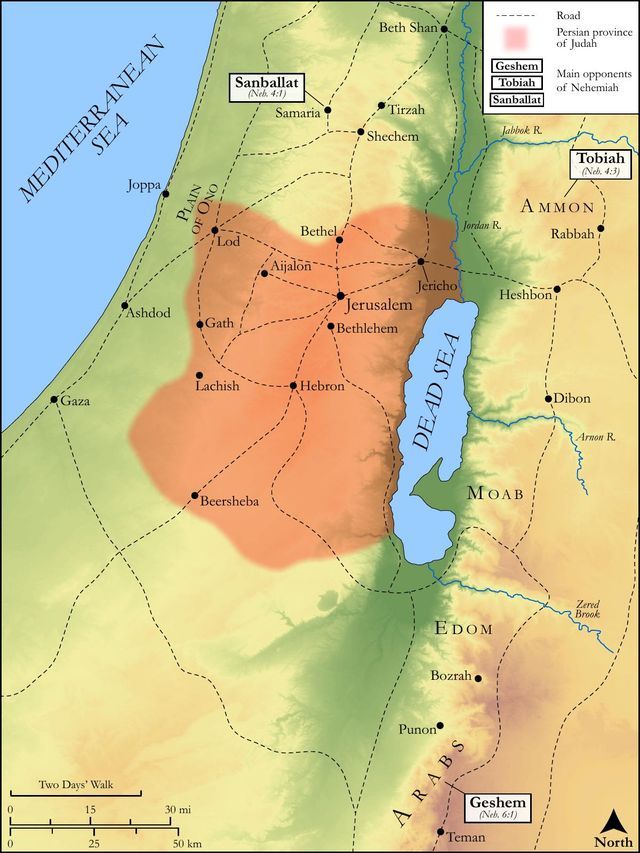
See on the biblical-era map
Study this verse
Public-domain commentary
Matthew Henry
From his Commentary on the Whole Bible. Henry comments on passages, not single verses — this entry covers Nehemiah 5:14–19. His four-level outline is real structure in the source text, so it is rendered as structure.
Nehemiah had mentioned his own practice, as an inducement to the nobles not to burden the poor, no, not with just demands; here he relates more particularly what his practice was, not inn pride or vain-glory, nor to pass a compliment upon himself, but as an inducement both to his successors and to the inferior magistrates to be as tender as might be of the people's ease.
I.He intimates what had been the way of his predecessors, Neh 5:15.
He does not name them, because what he had to say of them was not to their honour, and in such a case it is good to spare names; but the people knew how chargeable they had been, and how dearly the country paid for all the benefit of their government. The government allowed them forty shekels of silver, which was nearly five pounds (so much a day, it is probable); but, besides that, they obliged the people to furnish them with bread and wine, which they claimed as perquisites of their office; and not only so, but they suffered their servants to squeeze the people, and to get all they could out of them. Note,
1.It is no new thing for those who are in public places to seek themselves more than the public welfare, any, and to serve themselves by the public loss.
2.Masters must be accountable for all the acts of fraud and injustice, violence and oppression, which they connive at in their servants.
II.He tells us what had been his own way.
1.In general, he had not done as the former governors did; he would not, he durst not, because of the fear of God. He had an awe of God's majesty and a dread of his wrath. And,
(1.)The fear of God restrained him from oppressing the people. Those that truly fear God will not dare to do any thing cruel or unjust.
(2.)It was purely that which restrained him. He was thus generous, not that he might have praise of men, or serve a turn by his interest in the people, but purely for conscience' sake, because of the fear of God. This will not only be a powerful, but an acceptable principle both of justice and charity. What a good hand his predecessors made of their place appeared by the estates they raised; but Nehemiah, for his part, got nothing, except the satisfaction of doing good: Neither bought we any land, Neh 5:16. Say not then that he was a bad husband, but that he was a good governor, who aimed not to feather his own nest. Let us remember the words of the Lord, how he said, It is more blessed to give than to receive, Act 20:35.
2.More particularly, observe here,
(1.)How little Nehemiah received of what he might have required. He did the work of the governor, but he did not eat the bread of the governor (Neh 5:14), did not require it, Neh 5:18. So far was he from extorting more than his due that he never demanded that, but lived upon what he had got in the king of Persia's court and his own estate in Judea: the reason he gives for this piece of self-denial is, Because the bondage was heavy upon the people. He might have used the common excuse for rigour in such cases, that it would be a wrong to his successors not to demand his dues; but let them look to themselves: he considered the afflicted state of the Jews, and, while they groaned under so much hardship, he could not find it in his heart to add to their burden, but would rather lessen his own estate than ruin them. note, In our demands we must consider not only the justice of them, but the ability of those on whom we make them; where there is nothing to be had we know who loses his right.
(2.)How much he gave which he might have withheld.
[1.]His servants' work, Neh 5:16. The servants of princes think themselves excused from labour; but Nehemiah's servants, by his order no doubt, were all gathered to the work. Those that have many servants should contrive how they may do good with them and keep them well employed.
[2.]His own meat, Neh 5:17, Neh 5:18. He kept a very good table, not on certain days, but constantly; he had many honourable guests, at least 150 of his own countrymen, persons of the first rank, besides strangers that came to him upon business; and he had plentiful provisions for his guests, beef, and mutton, and fowl, and all sorts of wine. Let those in public places remember that they were preferred to do good, not to enrich themselves; and let people in humbler stations learn to use hospitality one to another without grudging, Pe1 4:9.
III.He concludes with a prayer (Neh 5:19): Think upon me, my God, for good.
1.Nehemiah here mentions what he had done for this people, not in pride, as boasting of himself, nor in passion, as upbraiding them, nor does it appear that he had occasion to do it in his own vindication, as Paul had to relate his like self-denying tenderness towards the Corinthians, but to shame the rulers out of their oppressions; let them learn of him to be neither greedy in their demands nor paltry in their expenses, and then they would have the credit and comfort of their liberality, as he had.
2.He mentions it to God in prayer, not as if he thought he had hereby merited any favour from God, as a debt, but to show that he looked not for any recompence of his generosity from men, but depended upon God only to make up to him what he had lost and laid out for his honour; and he reckoned the favour of God reward enough. "If God do but think upon me for good, I have enough." His thoughts to us-ward are our happiness, Psa 40:5. He refers it to God to recompense him in such a manner as he pleased. "If men forget me, let my God think on me, and I desire no more."
Continue studying Nehemiah 5:16 across the web’s major study libraries — every link below opens this exact verse, chapter, or book on the destination site.
Read & Compare
 BibleGatewayThis verse in more than 200 translations and 70 languages.
 Bible.comThe YouVersion reader — hundreds of translations, reading plans, and highlights.
 ESV.orgCrossway's official English Standard Version reader.
 NET BibleThe NET translation with 60,000+ translators' notes on every rendering decision.
 STEP BibleTyndale House's free study tool — original text, vocabulary, and scholarly resources.
 BibliaLogos Bible Software's free web reader.
 USCCBThe New American Bible (Revised Edition) with the U.S. bishops' study notes.
Commentaries
 BibleHub CommentariesDozens of classic commentaries on this verse, gathered on one page.
 StudyLightMore than 100 commentary sets — the largest collection on the web.
 BibleRefPlain-English commentary on what this verse means, verse by verse.
 Enduring WordDavid Guzik's free commentary on this chapter, widely used by Bible teachers.
 Bible Study ToolsVerse commentary alongside Greek and Hebrew study aids.
Original Language & Research
- BibleHub InterlinearThe verse word by word — original language, transliteration, and English.
- BibleHub LexiconEvery word's original-language definition and Strong's entry.
 Blue Letter BibleDeep-study tools — Strong's numbers, concordance, and word studies.
 SefariaThe Hebrew text with Rashi and centuries of Jewish commentary.
Sermons, Hymns & Audio


TrulyRandomVerse is not affiliated with these sites and doesn’t control their content. They’re linked because they’re genuinely useful.
Summary
Nehemiah 5:16 powerfully encapsulates Nehemiah's exemplary leadership, marked by unwavering integrity, profound personal sacrifice, and active dedication to the monumental task of rebuilding Jerusalem's walls. In stark contrast to the economic exploitation practiced by other officials, Nehemiah's resolute refusal to profit from the people's distress and his steadfast commitment to the common good set a compelling standard, demonstrating a holistic devotion that extended to his entire household and staff, all united in the vital work of restoration.
Context
ShowHideLiterary Context
This verse serves as Nehemiah's personal testimony and direct application of the principles he passionately articulated in the preceding verses. Immediately prior, Nehemiah had confronted the Jewish nobles and officials (from Nehemiah 5:1 to Nehemiah 5:13) regarding their egregious economic exploitation of their own people. The populace, burdened by heavy taxes, famine, and usurious loans from their wealthier brethren, had been forced to mortgage their fields, vineyards, and even sell their children into slavery. Nehemiah, upon hearing their desperate cry, was deeply indignant and convened a great assembly. There, he not only rebuked the nobles but also demanded an end to usury and the full restitution of all lands, vineyards, olive groves, and money taken. He even set his own example, stating that he, his brothers, and his servants had lent money and grain without interest. Verse 16 then solidifies his moral authority by demonstrating that his actions were fully aligned with his words, providing a powerful counterpoint to the self-serving behavior of others and reinforcing his commitment to justice and selflessness.
Historical & Cultural Context
The period of Jerusalem's rebuilding under Nehemiah (circa 445 BC) was characterized by immense internal and external pressures. While facing constant threats and mockery from surrounding adversaries like Sanballat, Tobiah, and Geshem, the community also grappled with severe internal social and economic strife. The Mosaic Law explicitly forbade the charging of interest (usury) among fellow Israelites, particularly to the poor, as stipulated in passages like Exodus 22:25, Leviticus 25:36-37, and Deuteronomy 23:19-20. Land ownership was profoundly significant, tied to tribal inheritance, covenant promises, and a family's identity and future. The loss of ancestral land due to debt was thus a devastating blow. Nehemiah, as the Persian-appointed governor, held immense power and could have easily enriched himself, a common practice for officials in the ancient Near East. However, his actions in Nehemiah 5:16, particularly his refusal to "buy any land," directly defied the prevailing corrupt practices and aligned him with the vulnerable, demonstrating an adherence to the spirit of the Law that was exceptionally rare among those in power.
Key Themes
ShowHideNehemiah 5:16 is pivotal in illustrating several key themes woven throughout the book of Nehemiah and the broader biblical narrative. Firstly, it profoundly exemplifies Godly Leadership and Integrity, showcasing a leader who prioritizes the welfare of his people and the divine mission over personal gain, directly contrasting with the self-serving actions of the nobles (as seen in Nehemiah 5:7-11). Secondly, the verse highlights the theme of Self-Sacrifice for the Common Good, as Nehemiah not only abstains from profiting but also dedicates his personal resources and household to the communal work, mirroring the collective effort needed to rebuild Jerusalem (e.g., Nehemiah 4:6). Thirdly, it underscores Justice and Fairness, as Nehemiah's refusal to acquire land directly confronts the pervasive economic injustice prevalent among the elite, pleading the cause of the vulnerable and upholding the principles of the Mosaic Law concerning land and debt (see Leviticus 25). Finally, it speaks to Divine Providence and Human Responsibility, demonstrating how God uses a dedicated and righteous leader to bring about His purposes, even when faced with significant internal and external obstacles, emphasizing that faithful human action is integral to God's redemptive plan for His people and city.
Exposition and Analysis
ShowHideKey Word Analysis
ShowHideThis verb, derived from H2388, means "to fasten upon; hence, to seize, be strong (figuratively, courageous, causatively strengthen, cure, help, repair, fortify), obstinate; to bind, restrain, conquer." In the context of Nehemiah 5:16, it conveys Nehemiah's unwavering steadfastness and resolute commitment to the arduous task of rebuilding the wall. It implies not merely physical presence but also a deep-seated mental and spiritual resolve, a persistent effort maintained despite immense difficulties, external opposition, and internal temptations to deviate from the mission. This word highlights his endurance and unwavering focus on the communal goal, emphasizing his active and continuous engagement.
This verb, derived from H7069, means "to erect, i.e. create; by extension, to procure, especially by purchase (causatively, sell); by implication to own." Nehemiah's explicit statement "neither bought we any land" carries profound ethical weight. It directly addresses the very economic exploitation he had just condemned, where nobles were acquiring land from the impoverished through usurious loans. By explicitly stating his and his household's abstinence from such transactions, Nehemiah demonstrates absolute integrity, a complete avoidance of any appearance of impropriety, and a clear commitment to not profiting from the distress of his people. This action reinforces his moral authority and purity of motive, setting a standard for ethical conduct.
This noun, derived from H4399, means "properly, deputyship, i.e. ministry; generally, employment (never servile) or work (abstractly or concretely); also property (as the result of labor)." Used twice in this verse, it refers to the monumental task of rebuilding the wall. Its inclusion underscores the tangible nature of the project and the collective effort required. Nehemiah's "continuation in the work" and his servants being "gathered thither unto the work" highlight the unified and dedicated labor force, emphasizing that the rebuilding was a shared, purposeful endeavor, not merely a personal ambition.
Verse Breakdown
ShowHide"Yea, also I continued in the work of this wall"
This clause emphasizes Nehemiah's personal, active, and sustained involvement in the monumental undertaking of rebuilding Jerusalem's defenses. It highlights his leadership by example, indicating that he was not merely an administrative overseer but a committed participant, consistently present, engaged, and personally invested in the arduous and dangerous labor. This hands-on, persistent approach would have inspired confidence and dedication among the workers, fostering a spirit of shared purpose.
"neither bought we any land"
This is a powerful declaration of integrity, self-denial, and ethical leadership. In a cultural context where others were exploiting the poor by seizing their land through unjust financial practices, Nehemiah explicitly states that he and his household abstained from any land acquisition. This demonstrates his unwavering commitment to justice, his refusal to personally profit from the people's distress, and his solidarity with the vulnerable, thereby solidifying his moral authority and setting a standard for righteous conduct that directly countered the prevalent corruption.
"and all my servants [were] gathered thither unto the work"
This final clause illustrates the comprehensive extent of Nehemiah's dedication and influence. Not only was he personally involved, but his entire staff and household were also enlisted in the communal effort. This signifies a unified commitment, where personal resources, time, and manpower were directed towards the collective good of the community and the divine mission, reinforcing the idea of selfless service and shared purpose in the monumental task of reconstruction. It shows that his commitment permeated his entire sphere of influence.
Literary Devices
ShowHideNehemiah 5:16 employs several potent literary devices to underscore its message of exemplary leadership and integrity. The most prominent is Contrast, where Nehemiah's actions are set in stark opposition to the corrupt and exploitative practices of the nobles described immediately prior in the chapter. His explicit refusal to "buy any land" directly contrasts with those who were seizing land from the impoverished, thereby amplifying his unique righteousness and selflessness. There is also an element of Understatement in "I continued in the work of this wall," as it subtly conveys the immense, continuous effort and personal sacrifice involved in leading such a monumental project amidst constant threats and internal strife, without overtly boasting of the immense challenges overcome. The phrase "all my servants [were] gathered thither unto the work" uses Synecdoche, where "servants" represents the entirety of Nehemiah's personal resources, influence, and household being dedicated to the communal task, signifying total commitment. Finally, the verse functions as a powerful Exemplum, presenting Nehemiah's conduct as a model of godly leadership and ethical behavior, serving as an enduring example for all who hold positions of authority, demonstrating how integrity and self-sacrifice are foundational to effective and righteous governance.
Theological and Thematic Connections
ShowHideNehemiah 5:16 serves as a powerful biblical illustration of righteous leadership, deeply rooted in covenant faithfulness and a profound commitment to justice. Nehemiah's actions reflect the very heart of God's law, which consistently calls for care for the poor, prohibition of usury among brethren, and the establishment of a just society. His willingness to forgo personal gain and even enlist his household in the communal work demonstrates a practical outworking of the principle that true leadership is selfless service, prioritizing the well-being of the community over individual enrichment. This echoes the broader biblical theme that those entrusted with authority are stewards, accountable to God for how they treat His people, and are called to model integrity and compassion, especially towards the vulnerable. His conduct embodies the divine expectation for leaders to uphold righteousness and protect the lowly, acting as a bulwark against oppression and a catalyst for communal flourishing.
Reflection and Application
ShowHideNehemiah 5:16 offers a timeless and challenging blueprint for leadership and personal conduct in any sphere of life, from the church to the workplace to the home. It calls us to examine our motivations and practices, particularly when we hold positions of influence or are involved in collective endeavors. Nehemiah's integrity, demonstrated by his refusal to exploit others or profit from their hardship, stands as a stark contrast to the pervasive temptation to prioritize personal gain over the common good. His active participation and dedication, even enlisting his own household, highlight that true leadership is not merely about delegation but about personal investment, sacrifice, and leading by example. This verse compels us to consider how our actions align with our words, whether we are willing to forgo personal advantage for the sake of a greater mission, and if our lives truly reflect a commitment to justice and selfless service, especially towards those who are vulnerable or in need. It reminds us that genuine impact often stems from humble, consistent, and integrity-driven engagement in the work God has called us to, fostering trust and inspiring others to contribute wholeheartedly.
Questions for Reflection
ShowHideFAQ
ShowHideWhy was it significant that Nehemiah "neither bought we any land"?
ShowHideThis statement is profoundly significant because it directly addresses the central economic injustice that Nehemiah had just confronted among the Jewish nobles and officials (see Nehemiah 5:1-13). These officials were exploiting their impoverished brethren by charging exorbitant interest rates, forcing them to mortgage and ultimately lose their fields, vineyards, and even their children into slavery. By explicitly stating that he and his household did not acquire any land, Nehemiah demonstrated absolute integrity and a complete lack of personal financial gain from the people's distress. He practiced what he preached, upholding the Mosaic Law's prohibition against usury among Israelites and showing solidarity with the vulnerable. This action solidified his moral authority and distinguished him as a selfless leader committed to justice and the common good, rather than personal enrichment.
How does Nehemiah's leadership in this verse compare to typical ancient Near Eastern rulers?
ShowHideNehemiah's leadership, as depicted in Nehemiah 5:16, stands in stark contrast to the typical practices of ancient Near Eastern rulers. While many rulers in that era were known for accumulating vast personal wealth, exploiting their subjects through heavy taxation, forced labor, and land acquisition, Nehemiah actively chose self-denial. He refused to profit from his position, abstaining from land purchases even when others were doing so. Furthermore, instead of merely commanding, he personally "continued in the work of this wall" and enlisted his own servants in the communal labor, demonstrating a hands-on, servant-hearted approach. This model of leadership, prioritizing the welfare of the people and the divine mission over personal gain, aligns more with the biblical ideal of a righteous king or leader (e.g., Deuteronomy 17:14-20) rather than the self-aggrandizing rulers common in the surrounding pagan nations.
Christ-Centered Fulfillment
ShowHideNehemiah 5:16, with its depiction of a leader who embodies integrity, self-sacrifice, and active participation for the common good, powerfully foreshadows the ultimate servant-leader, Jesus Christ. Nehemiah's refusal to acquire land or profit from the people's hardship, instead dedicating himself and his resources to the rebuilding of Jerusalem, mirrors Christ's radical self-emptying. Jesus, though rich, for our sakes became poor, that we through His poverty might be rich (2 Corinthians 8:9). He did not come to be served, but to serve, and to give His life as a ransom for many (Mark 10:45). Just as Nehemiah was personally invested in the physical restoration of Jerusalem, Christ was utterly devoted to the spiritual restoration of humanity, building a new spiritual temple, the Church, not with bricks and mortar but with His own body and blood (Ephesians 2:19-22). His entire life was a testament to selfless leadership, culminating in His ultimate sacrifice on the cross, where He "bought" us not with silver or gold, but with His precious blood (1 Peter 1:18-19). Nehemiah's integrity and dedication, while exemplary, find their perfect and complete fulfillment in the sinless life and redemptive work of Jesus, who truly gave His all for the establishment of God's eternal kingdom and the spiritual well-being of His people.