


Nehemiah 5:17
Bible text: King James Version (1769 Blayney text) · Public domain
Bible text: Berean Standard Bible · Public domain
Bible text: American Standard Version (1901) · Public domain
Bible text: World English Bible, Messianic edition · Public domain
Bible text: Geneva Bible (1599) · Public domain
Bible text: Young's Literal Translation · Public domain
- וְהַיְּהוּדִיםve·hai·ye·hu·Dimand the JewsH3064Conj-w ¦ Art ¦ N-mpNoun Gentilic Plural Masculine AbsoluteוְandהַtheיְּהוּדִיםJews
- וְהַסְּגָנִיםve·ha·se·ga·Nimand the officialsH5461Conj-w ¦ Art ¦ N-mpNoun Plural Masculine Absoluteוְandהַtheסְּגָנִיםofficials
- מֵאָהme·'Ahone hundredH3967Adj-fsAdjective Numerical Singular Feminine Absolute
- וַחֲמִשִּׁיםva·cha·mi·Shimand fiftyH2572Conj-w ¦ Adj-mpAdjective Numerical Plural Masculine Absoluteוַandחֲמִשִּׁיםfifty
- אִישׁ'Ishperson[s]H376N-msNoun Singular Masculine Absolute
- וְהַבָּאִיםve·ha·ba·'Imand the [ones who] cameH935Conj-w ¦ Art ¦ V-Qal-Prtcpl-mpVerb Qal Participle Plural Masculine Absoluteוְandהַtheבָּאִים[ones who] came
- אֵלֵינוּ'e·Lei·nuto usH413Prep ¦ 1cpPrepositionאֵלֵיtoנוּus
- מִןminfromH4480PrepPreposition
- הַגּוֹיִםha·go·Yimthe nationsH1471Art ¦ N-mpNoun Plural Masculine Absoluteהַtheגּוֹיִםnations
- אֲשֶׁר'a·SherwhichH834RelParticle Relative
- סְבִיבֹתֵינוּse·vi·vo·Tei·nu[were] around usH5439N-cpc ¦ 1cpNoun Plural common gender Constructסְבִיבֹתֵי[were] aroundנוּus
- עַל'al[were] atH5921PrepPreposition
- שֻׁלְחָנִיshul·cha·Nimy tableH7979N-msc ¦ 1csNoun Singular Masculine Constructשֻׁלְחָנִtableיmy
English is a literal word-by-word gloss of the Hebrew, not the KJV's wording. Why?
This is the original text the KJV's translators worked from — each Hebrew word with its own literal English meaning in this verse, prepared by scholars at Tyndale House, Cambridge. The KJV translates whole sentences, not word by word, so its wording differs: one Hebrew word can become several English words, and the KJV may choose “the LORD” where the gloss reads “Yahweh”. Both are faithful — they answer different questions. For the KJV's own rendering, switch to the KJV text.
Details
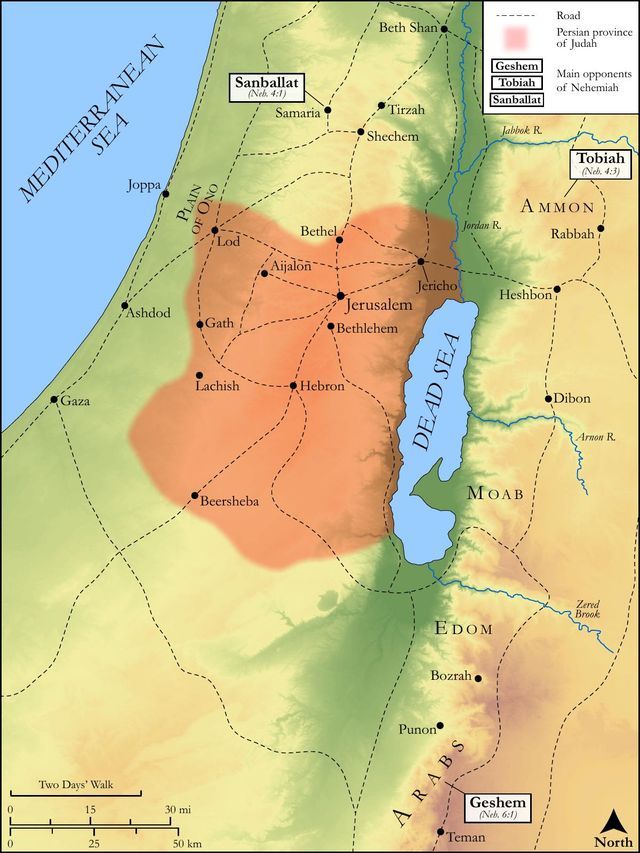
See on the biblical-era map
Study this verse
Public-domain commentary
Matthew Henry
From his Commentary on the Whole Bible. Henry comments on passages, not single verses — this entry covers Nehemiah 5:14–19. His four-level outline is real structure in the source text, so it is rendered as structure.
Nehemiah had mentioned his own practice, as an inducement to the nobles not to burden the poor, no, not with just demands; here he relates more particularly what his practice was, not inn pride or vain-glory, nor to pass a compliment upon himself, but as an inducement both to his successors and to the inferior magistrates to be as tender as might be of the people's ease.
I.He intimates what had been the way of his predecessors, Neh 5:15.
He does not name them, because what he had to say of them was not to their honour, and in such a case it is good to spare names; but the people knew how chargeable they had been, and how dearly the country paid for all the benefit of their government. The government allowed them forty shekels of silver, which was nearly five pounds (so much a day, it is probable); but, besides that, they obliged the people to furnish them with bread and wine, which they claimed as perquisites of their office; and not only so, but they suffered their servants to squeeze the people, and to get all they could out of them. Note,
1.It is no new thing for those who are in public places to seek themselves more than the public welfare, any, and to serve themselves by the public loss.
2.Masters must be accountable for all the acts of fraud and injustice, violence and oppression, which they connive at in their servants.
II.He tells us what had been his own way.
1.In general, he had not done as the former governors did; he would not, he durst not, because of the fear of God. He had an awe of God's majesty and a dread of his wrath. And,
(1.)The fear of God restrained him from oppressing the people. Those that truly fear God will not dare to do any thing cruel or unjust.
(2.)It was purely that which restrained him. He was thus generous, not that he might have praise of men, or serve a turn by his interest in the people, but purely for conscience' sake, because of the fear of God. This will not only be a powerful, but an acceptable principle both of justice and charity. What a good hand his predecessors made of their place appeared by the estates they raised; but Nehemiah, for his part, got nothing, except the satisfaction of doing good: Neither bought we any land, Neh 5:16. Say not then that he was a bad husband, but that he was a good governor, who aimed not to feather his own nest. Let us remember the words of the Lord, how he said, It is more blessed to give than to receive, Act 20:35.
2.More particularly, observe here,
(1.)How little Nehemiah received of what he might have required. He did the work of the governor, but he did not eat the bread of the governor (Neh 5:14), did not require it, Neh 5:18. So far was he from extorting more than his due that he never demanded that, but lived upon what he had got in the king of Persia's court and his own estate in Judea: the reason he gives for this piece of self-denial is, Because the bondage was heavy upon the people. He might have used the common excuse for rigour in such cases, that it would be a wrong to his successors not to demand his dues; but let them look to themselves: he considered the afflicted state of the Jews, and, while they groaned under so much hardship, he could not find it in his heart to add to their burden, but would rather lessen his own estate than ruin them. note, In our demands we must consider not only the justice of them, but the ability of those on whom we make them; where there is nothing to be had we know who loses his right.
(2.)How much he gave which he might have withheld.
[1.]His servants' work, Neh 5:16. The servants of princes think themselves excused from labour; but Nehemiah's servants, by his order no doubt, were all gathered to the work. Those that have many servants should contrive how they may do good with them and keep them well employed.
[2.]His own meat, Neh 5:17, Neh 5:18. He kept a very good table, not on certain days, but constantly; he had many honourable guests, at least 150 of his own countrymen, persons of the first rank, besides strangers that came to him upon business; and he had plentiful provisions for his guests, beef, and mutton, and fowl, and all sorts of wine. Let those in public places remember that they were preferred to do good, not to enrich themselves; and let people in humbler stations learn to use hospitality one to another without grudging, Pe1 4:9.
III.He concludes with a prayer (Neh 5:19): Think upon me, my God, for good.
1.Nehemiah here mentions what he had done for this people, not in pride, as boasting of himself, nor in passion, as upbraiding them, nor does it appear that he had occasion to do it in his own vindication, as Paul had to relate his like self-denying tenderness towards the Corinthians, but to shame the rulers out of their oppressions; let them learn of him to be neither greedy in their demands nor paltry in their expenses, and then they would have the credit and comfort of their liberality, as he had.
2.He mentions it to God in prayer, not as if he thought he had hereby merited any favour from God, as a debt, but to show that he looked not for any recompence of his generosity from men, but depended upon God only to make up to him what he had lost and laid out for his honour; and he reckoned the favour of God reward enough. "If God do but think upon me for good, I have enough." His thoughts to us-ward are our happiness, Psa 40:5. He refers it to God to recompense him in such a manner as he pleased. "If men forget me, let my God think on me, and I desire no more."
Continue studying Nehemiah 5:17 across the web’s major study libraries — every link below opens this exact verse, chapter, or book on the destination site.
Read & Compare
 BibleGatewayThis verse in more than 200 translations and 70 languages.
 Bible.comThe YouVersion reader — hundreds of translations, reading plans, and highlights.
 ESV.orgCrossway's official English Standard Version reader.
 NET BibleThe NET translation with 60,000+ translators' notes on every rendering decision.
 STEP BibleTyndale House's free study tool — original text, vocabulary, and scholarly resources.
 BibliaLogos Bible Software's free web reader.
 USCCBThe New American Bible (Revised Edition) with the U.S. bishops' study notes.
Commentaries
 BibleHub CommentariesDozens of classic commentaries on this verse, gathered on one page.
 StudyLightMore than 100 commentary sets — the largest collection on the web.
 BibleRefPlain-English commentary on what this verse means, verse by verse.
 Enduring WordDavid Guzik's free commentary on this chapter, widely used by Bible teachers.
 Bible Study ToolsVerse commentary alongside Greek and Hebrew study aids.
Original Language & Research
- BibleHub InterlinearThe verse word by word — original language, transliteration, and English.
- BibleHub LexiconEvery word's original-language definition and Strong's entry.
 Blue Letter BibleDeep-study tools — Strong's numbers, concordance, and word studies.
 SefariaThe Hebrew text with Rashi and centuries of Jewish commentary.
Sermons, Hymns & Audio


TrulyRandomVerse is not affiliated with these sites and doesn’t control their content. They’re linked because they’re genuinely useful.
Summary
Nehemiah 5:17 powerfully illustrates Nehemiah's unparalleled integrity, profound generosity, and self-sacrificial leadership amidst the challenging task of rebuilding Jerusalem's walls. This verse highlights his personal commitment to daily providing for a vast number of people, including Jewish citizens, their leaders, and even foreign visitors, setting a profound example of selfless service. This stands in stark contrast to the exploitative practices he had just confronted among some of the Jewish elite, underscoring his unwavering dedication to the welfare of his community and the divine mission entrusted to him.
Context
ShowHideLiterary Context
Nehemiah 5:17 serves as the powerful culmination of Nehemiah's personal testimony regarding his righteous leadership. It immediately follows his detailed account of refusing the customary governor's allowance and bearing the immense financial burden of his administration from his own resources for twelve years, as described in Nehemiah 5:14-16. This section, in turn, is presented as a direct contrast to the severe economic injustice and exploitation of the poor by wealthy Jewish nobles and rulers, which Nehemiah had just vehemently rebuked and corrected in Nehemiah 5:1-13. Thus, verse 17 is not merely a statement of fact but a vivid demonstration of the very principles of justice, generosity, and integrity that Nehemiah demanded from others, solidifying his moral authority and leadership by example.
Historical & Cultural Context
The events of Nehemiah chapter 5 unfold during the Persian period, specifically around 445 BC, when Nehemiah served as governor of the province of Judah. Jerusalem was a vulnerable, partially rebuilt city, and its inhabitants faced not only external threats but also severe internal economic hardship. The custom for governors in the Persian Empire was to receive provisions and taxes from the people to sustain their household and administration. However, Nehemiah chose to forgo this allowance, recognizing the dire poverty of the people. The practice of usury, where loans were given with exorbitant interest, was a particular problem, leading to debt-slavery among the Jewish population, a direct violation of Mosaic Law, as seen in Deuteronomy 23:19-20. In Israel, hospitality was a deeply ingrained cultural value, signifying honor, protection, and fellowship. Nehemiah's large table, including "heathen" (Gentiles), would have been a significant public display of his personal wealth, generosity, and diplomatic acumen, fostering good relations in a potentially hostile environment.
Key Themes
ShowHideNehemiah 5:17 powerfully illustrates several core themes. Generous and Servant Leadership is paramount, as Nehemiah's actions embody a leader who prioritizes the welfare of his people over personal gain, providing for them at his own expense. This contrasts sharply with the self-serving leadership he condemned, echoing the biblical call for leaders to care for their flock, as exhorted in 1 Peter 5:2-3. The theme of Integrity and Justice is also prominent; Nehemiah's personal conduct validates his demand for honest dealing, demonstrating that true leadership lives out the values it espouses. His refusal to exploit the people and his consistent provision for them reflect a deep commitment to God's covenantal justice. Finally, the verse highlights Universal reach and Hospitality, extending beyond the Jewish community to "heathen" visitors. This broad hospitality speaks to a vision of community that, while focused on rebuilding Jerusalem, did not isolate itself, potentially fostering diplomatic ties and reflecting a universal aspect of God's concern for all peoples, even amidst the specific task of restoring Israel.
Exposition and Analysis
ShowHideKey Word Analysis
ShowHideMeaning "a table (as spread out); by implication, a meal." More than just a piece of furniture, "my table" here signifies a place of regular provision, sustenance, and fellowship. In Scripture, sharing a meal at one's table was a profound act of hospitality, indicating inclusion, honor, and a commitment to care for those present. Nehemiah's table was a constant source of nourishment for a large community, symbolizing his personal responsibility for their well-being and his open, generous spirit.
Meaning "a foreign nation; hence, a Gentile." This term refers to non-Israelite nations or Gentiles. The inclusion of "those that came unto us from among the heathen that are about us" at Nehemiah's table is highly significant. It demonstrates that Nehemiah's hospitality and influence extended beyond the Jewish community, encompassing foreign visitors who might have been diplomats, traders, or simply those seeking audience. This open table stands out, especially given the intense focus on Jewish identity and separation during the post-exilic period, suggesting a broader, perhaps strategic, vision for good relations with surrounding peoples.
Meaning "a prefect of a province; prince, ruler." This term refers to officials or deputies, often those in positions of authority within the Jewish community. Nehemiah's provision for "Jews and rulers" signifies that his generosity was not limited to the common people but also extended to those in leadership. This might have been a deliberate act to foster unity, demonstrate impartiality, and ensure that even the officials, some of whom had been complicit in the exploitation, were sustained by his personal example of generosity rather than relying on oppressive practices.
Verse Breakdown
ShowHide"Moreover [there were] at my table"
This phrase emphasizes the continuous and personal nature of Nehemiah's provision. The KJV's bracketed "there were" correctly conveys the ongoing reality of a bustling, well-supplied table. "My table" underscores Nehemiah's personal financial commitment and direct involvement in feeding these individuals, distinguishing his conduct from that of previous governors who extracted their provisions from the people.
"an hundred and fifty of the Jews and rulers"
This specifies the large number and primary beneficiaries of Nehemiah's daily hospitality. The inclusion of both "Jews" (likely common citizens) and "rulers" (officials, perhaps even those he had just rebuked) highlights the breadth of his care and his impartiality. It demonstrates his commitment to sustaining the entire community, from the lowest to the highest ranks, through his personal resources, rather than burdening the impoverished populace.
"beside those that came unto us from among the heathen that [are] about us"
This clause reveals the remarkable extent of Nehemiah's hospitality beyond the immediate Jewish community. "Heathen" refers to non-Jewish people from surrounding nations. Their presence at his table indicates an open-door policy, possibly for diplomatic reasons, trade relations, or simply an expression of broad human kindness. This universal reach fostered goodwill and potentially eased tensions with neighboring peoples, even as the walls of Jerusalem were being rebuilt, often in defiance of these very neighbors.
Literary Devices
ShowHideNehemiah 5:17 employs several potent literary devices to convey its message. The most prominent is Contrast, as Nehemiah's selfless provision stands in stark opposition to the exploitative and oppressive practices of the Jewish nobles described earlier in the chapter. This juxtaposition highlights Nehemiah's moral superiority and the integrity of his leadership. The sheer number of people fed ("an hundred and fifty... beside those from among the heathen") functions as a form of Hyperbole or Exaggeration (or at least a very large, impressive number), emphasizing the extraordinary scale of Nehemiah's generosity and personal sacrifice. This large figure underscores the immense financial burden he willingly bore. Furthermore, Nehemiah himself serves as an Exemplum, a living example of the righteous and just leadership he advocates. His actions are presented as a model for others to emulate, reinforcing his authority not just through his position, but through his character. Finally, the phrase "at my table" can be seen as a Synecdoche, where the part (the table) represents the whole (Nehemiah's entire system of provision, care, and hospitality).
Theological and Thematic Connections
ShowHideNehemiah 5:17 profoundly illustrates the biblical principles of righteous leadership, sacrificial giving, and hospitality to strangers. Nehemiah's actions reflect God's own character as a benevolent Provider and a God of justice who cares for the poor and vulnerable. His refusal to exploit his position and his willingness to bear personal cost for the good of the community align with the divine expectation for leaders to be shepherds, not wolves, prioritizing the welfare of the flock over personal gain. This verse serves as a powerful reminder that true spiritual authority is often demonstrated through humble service and tangible acts of generosity, echoing the very heart of God's covenantal relationship with His people, which calls for care for the lowly and a commitment to equity.
Reflection and Application
ShowHideNehemiah 5:17 offers a timeless blueprint for leadership and personal conduct in any era. It challenges us to examine our own spheres of influence, whether in family, community, church, or workplace, and ask if our actions truly embody the principles of integrity, generosity, and selfless service. In a world often driven by self-interest and accumulation, Nehemiah's example calls us to a counter-cultural posture: to use our resources, whether financial, relational, or positional, not for personal enrichment, but for the flourishing of others, especially those in need. It reminds us that authentic leadership is not about what we can gain, but what we can give, and that true authority is earned through consistent, costly acts of care and compassion. Furthermore, Nehemiah's hospitality to the "heathen" challenges us to extend our generosity and welcome beyond our immediate circles, embracing those who are different, overlooked, or even perceived as "outsiders," reflecting a broader, more expansive vision of God's love for all humanity.
Questions for Reflection
ShowHideFAQ
ShowHideWhat was the significance of Nehemiah feeding "heathen" (Gentiles) at his table?
ShowHideThe inclusion of "heathen" (non-Jewish people) at Nehemiah's table was highly significant. Beyond basic hospitality, it set a governor's table for "those that came unto us from among the heathen that are about us" (Nehemiah 5:17). This act likely served several purposes: fostering good diplomatic relations with surrounding nations, showcasing the generosity and integrity of the Jewish leadership, and perhaps even serving as a quiet testimony to the God of Israel. In a period marked by intense rebuilding and potential external opposition, such hospitality could have eased tensions and prevented unnecessary conflict, reflecting a broader vision for God's people that extended beyond their immediate ethnic boundaries.
How could Nehemiah afford to feed so many people for so long, especially without taking the governor's allowance?
ShowHideNehemiah explicitly states in Nehemiah 5:14-15 that he did not take the customary governor's allowance, nor did his servants "lord it over the people." He further clarifies that he personally bore the cost of the daily provisions for his large household and guests. This implies that Nehemiah used his personal wealth, likely accumulated from his previous high-ranking and influential position as cupbearer to King Artaxerxes in Persia, as mentioned in Nehemiah 1:11. His ability to sustain such a large number of people for twelve years underscores his immense personal sacrifice and deep commitment to the welfare of his people and the work of rebuilding Jerusalem, demonstrating a rare level of integrity and selflessness among ancient governors.
Christ-Centered Fulfillment
ShowHideNehemiah's exemplary leadership, marked by sacrificial provision and hospitality to strangers, profoundly foreshadows the ultimate Servant Leader, Jesus Christ. Just as Nehemiah willingly bore the cost of sustaining his people, so too did Jesus, the Lamb of God who takes away the sin of the world, bear the ultimate cost of humanity's redemption, providing spiritual and eternal sustenance at His own expense. Nehemiah's open table, feeding both Jews and Gentiles, anticipates the universal scope of Christ's ministry, who welcomed all—sinners, outcasts, and foreigners—to His table and into His kingdom, as seen in Matthew 9:10-13. The miraculous feeding of the five thousand and the institution of the Lord's Supper symbolize Christ's boundless provision for His people, both physically and spiritually. Nehemiah's refusal to seek personal gain and his unwavering commitment to justice and service find their perfect embodiment in Jesus, who taught that true greatness lies in humble service (Mark 10:42-45) and who ultimately gave His life as a ransom for many, inviting all to partake of the bread of life and the living water at His eternal table.