


Nehemiah 5:13
- גַּםgamalsoH1571AdvAdverb
- חָצְנִיcha·tze·Nimy bosomH2684N-msc ¦ 1csNoun Singular Masculine Constructחָצְנִbosomיmy
- נָעַרְתִּיna·'Ar·tiI shook outH5287V-Qal-Perf-1csVerb Qal Perfect 1st Singular common gender
- וָאֹמְרָהva·'o·me·Rahand I said !H559Conj-w ¦ V-Qal-ConsecImperf-1cs ¦ SfxVerb Qal Consecutive Imperfect 1st Singular common genderוָandאֹמְרָI saidה!
- כָּכָהKa·khahthusH3602AdvAdverb
- יְנַעֵרye·na·'Ermay he shake outH5287V-Piel-Imperf-3msVerb Piel Imperfect 3rd Singular Masculine
- הָאֱלֹהִיםha·'E·lo·Him<the> GodH430Art ¦ N-mpNoun Plural Masculine Absoluteהָ<the>אֱלֹהִיםGod
- אֶת'et<obj.>H853DirObjMParticle Object Indicator
- כָּלkoleveryH3605N-mscNoun Singular Masculine Construct
- הָאִישׁha·'Ish<the> personH376Art ¦ N-msNoun Singular Masculine Absoluteהָ<the>אִישׁperson
- אֲשֶׁר'a·SherwhoH834RelParticle Relative
- לֹאlo'notH3808NegParticle Negative
- יָקִיםya·Kimhe will carry outH6965V-Hiphil-Imperf-3msVerb Hiphil Imperfect 3rd Singular Masculine
- אֶת'et<obj.>H853DirObjMParticle Object Indicator
- הַדָּבָרha·da·Varthe wordH1697Art ¦ N-msNoun Singular Masculine Absoluteהַtheדָּבָרword
- הַזֶּהha·Zeh<the> thisH2088Art ¦ PrtParticle Demonstrativeהַ<the>זֶּהthis
- מִבֵּיתוֹmi·bei·Tofrom his houseH1004Prep-m ¦ N-msc ¦ 3msNoun Singular Masculine Constructמִfromבֵּיתhouseוֹhis
- וּמִיגִיעוֹu·Mi·gi·'Oand from his propertyH3018Conj-w ¦ Prep-m ¦ N-msc ¦ 3msNoun Singular Masculine Constructוּandמִfromיגִיעpropertyוֹhis
- וְכָכָהve·Kha·khahand thusH3602Conj-w ¦ AdvAdverbוְandכָכָהthus
- יִהְיֶהyih·Yehmay he beH1961V-Qal-Imperf-3msVerb Qal Imperfect 3rd Singular Masculine
- נָעוּרna·'Urshaken outH5287V-Qal-PassPrtcpl-msVerb Qal Participle Passive Singular Masculine Absolute
- וָרֵקva·Rekand emptyH7386Conj-w ¦ Adj-msAdjective Singular Masculine Absoluteוָandרֵקempty
- וַיֹּאמְרוּvai·yo·me·Ruand they saidH559Conj-w ¦ V-Qal-ConsecImperf-3mpVerb Qal Consecutive Imperfect 3rd Plural Masculineוַandיֹּאמְרוּthey said
- כָלkholallH3605N-mscNoun Singular Masculine Construct
- הַקָּהָלha·ka·Halthe assemblyH6951Art ¦ N-msNoun Singular Masculine Absoluteהַtheקָּהָלassembly
- אָמֵן'a·MenamenH543PrtParticle Interjection
- וַיְהַלְלוּvay·ha·Luand they praisedH1984Conj-w ¦ V-Piel-ConsecImperf-3mpVerb Piel Consecutive Imperfect 3rd Plural Masculineוַandיְהַלְלוּthey praised
- אֶת'et<obj.>H853DirObjMParticle Object Indicator
- יְהוָהYah·wehYahwehH3068N-properNoun Proper Title
- וַיַּעַשׂvai·Ya·'asand it didH6213Conj-w ¦ V-Qal-ConsecImperf-3msVerb Qal Consecutive Imperfect 3rd Singular Masculineוַandיַּעַשׂit did
- הָעָםha·'Amthe peopleH5971Art ¦ N-msNoun Singular Masculine Absoluteהָtheעָםpeople
- כַּדָּבָרka·da·Varaccording to the mannerH1697Prep-k ¦ N-msNoun Singular Masculine Absoluteכַּaccording to theדָּבָרmanner
- הַזֶּהha·Zeh<the> thisH2088Art ¦ PrtParticle Demonstrativeהַ<the>זֶּהthis
English is a literal word-by-word gloss of the Hebrew, not the KJV's wording. Why?
This is the original text the KJV's translators worked from — each Hebrew word with its own literal English meaning in this verse, prepared by scholars at Tyndale House, Cambridge. The KJV translates whole sentences, not word by word, so its wording differs: one Hebrew word can become several English words, and the KJV may choose “the LORD” where the gloss reads “Yahweh”. Both are faithful — they answer different questions. For the KJV's own rendering, switch to the KJV text.
Details
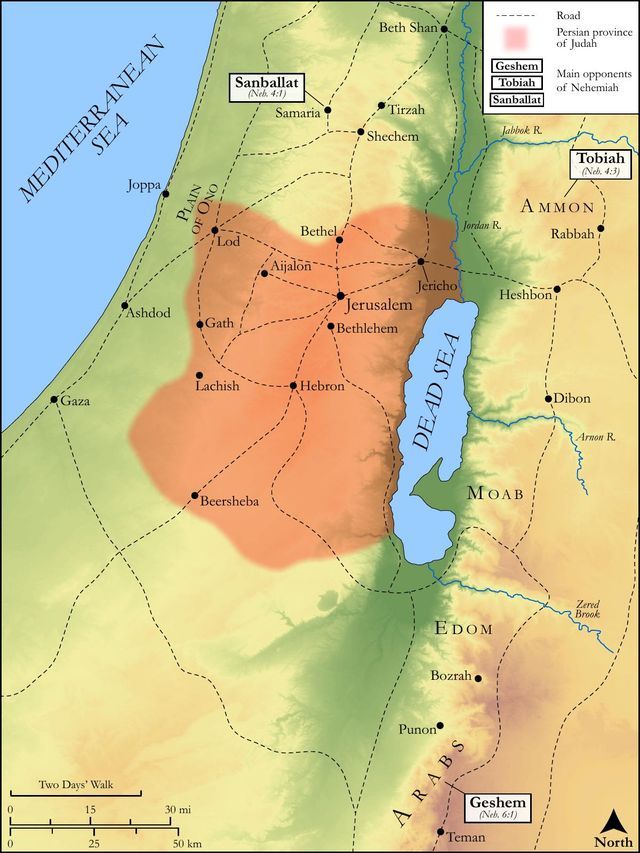
See on the biblical-era map
Study this verse
Public-domain commentary
Matthew Henry
From his Commentary on the Whole Bible. Henry comments on passages, not single verses — this entry covers Nehemiah 5:6–13. His three-level outline is real structure in the source text, so it is rendered as structure.
It should seem the foregoing complaint was made to Nehemiah at the time when he had his head and hands as full as possible of the public business about building the wall; yet, perceiving it to be just, he did not reject it because it was unseasonable; he did not chide the petitioners, nor fall into a passion with them, for disturbing him when they saw how much he had to do, a fault which men of business are too often guilty of; nor did he so much as adjourn the hearing of the cause or proceedings upon it till he had more leisure. The case called for speedy interposition, and therefore he applied himself immediately to the consideration of it, knowing that, let him build Jerusalem's walls ever so high, so thick, so strong, the city could not be safe while such abuses as these were tolerated. Now observe, What method he took for the redress of this grievance which was so threatening to the public.
I.He was very angry (Neh 5:6); he expressed a great displeasure at it, as a very bad thing.
Note, It well becomes rulers to show themselves angry at sin, that by the anger itself they may be excited to their duty, and by the expressions of it others may be deterred from evil.
II.He consulted with himself, Neh 5:7.
By this it appears that his anger was not excessive, but kept within bounds, that, though his spirit was provoked, he did not say or do any thing unadvisedly. Before he rebuked the nobles, he consulted with himself what to say, and when, and how. Note, Reproofs must be given with great consideration, that what is well meant may not come short of its end for want of being well managed. It is the reproof of instruction that giveth life. Even wise men lose the benefit of their wisdom sometimes for want of consulting with themselves and taking time to deliberate.
III.He rebuked the nobles and rulers, who were the monied men, and whose power perhaps made them the more bold to oppress.
Note, Even nobles and rulers, if they do that which is evil, ought to be told of it by proper persons. Let no man imagine that his dignity sets him above reproof.
IV.He set a great assembly against them.
He called the people together to be witnesses of what he said, and to bear their testimony (which the people will generally be forward to do) against the oppressions and extortions their rulers were guilty of, Neh 5:12. Ezra and Nehemiah were both of them very wise, good, useful men, yet, in cases not unlike, there was a great deal of difference between their management: when Ezra was told of the sin of the rulers in marrying strange wives he rent his clothes, and wept, and prayed, and was hardly persuaded to attempt a reformation, fearing it to be impracticable, for he was a man of a mild tender spirit; when Nehemiah was told of as bad a thing he kindled immediately, reproached the delinquents, incensed the people against them, and never rested till, by all the rough methods he could use, he forced them to reform; for he was a man of a hot and eager spirit. Note,
1.Very holy men may differ much from each other in their natural temper and in other things that result from it.
2.God's work may be done, well done, and successfully, and yet different methods taken in the doing of it, which is a good reason why we should neither arraign the management of others nor make our own a standard. There are diversities of operation, but the same Spirit.
V.He fairly reasoned the case with them, and showed them the evil of what they did.
The regular way of reforming men's lives is to endeavour, in the first place, to convince their consciences. Several things he offered to their consideration, which are so pertinent and just that it appeared he had consulted with himself. He lays it before them,
1.That those whom they oppressed were their brethren: You exact every one of his brother. It was bad enough to oppress strangers, but much worse to oppress their poor brethren, from whom the divine law did not allow them to take any usury, Deu 23:19, Deu 23:20.
2.That they were but lately redeemed out of the hand of the heathen. The body of the people were so by the wonderful providence of God; some particular persons among them were so, who, besides their share in the general captivity, were in servitude to heathen masters, and ransomed at the charge of Nehemiah and other pious and well-disposed persons. "Now," says he, "have we taken all this pains to get their liberty out of the hands of the heathen, and shall their own rulers enslave them? What an absurd thing is this! Must we be at the same trouble and expense to redeem them from you as we were to redeem them from Babylon?" Neh 5:8. Those whom God by his grace has made free ought not to be again brought under a yoke of bondage, Gal 5:1; Co1 7:23.
3.That it was a great sin thus to oppress the poor (Neh 5:9): "It is not good that you do; though you get money by it, you contract guilt by it, and ought you not to walk in the fear of God? Certainly you ought, for you profess religion, and relation to him; and, if you do walk in the fear of God, you will not be either covetous of worldly gain or cruel towards your brethren." Those that walk in the fear of God will not dare to do a wicked thing, Job 31:13, Job 31:14, Job 31:23.
4.That it was a great scandal, and a reproach to their profession. "Consider the reproach of the heathen our enemies, enemies to us, to our God, and to our holy religion. They will be glad of any occasion to speak against us, and this will give them great occasion; they will say, These Jews, that profess so much devotion to God, see how barbarous they are one to another." Note,
(1.)All that profess religion should be very careful that they do nothing to expose themselves to the reproach of those that are without, lest religion be wounded through their sides.
(2.)Nothing exposes religion more to the reproach of its enemies than the worldliness and hard-heartedness of the professors of it.
5.That he himself had set them a better example (Neh 5:10), which he enlarges upon afterwards, Neh 5:14, etc. Those that rigorously insist upon their right themselves will with a very ill grace persuade others to recede from theirs.
VI.He earnestly pressed them not only not to make their poor neighbours any more such hard bargains, but to restore that which they had got into their hands, Neh 5:11. See how familiarly he speaks to them: Let us leave off this usury, putting himself in, as becomes reprovers, though far from being any way guilty of the crime. See how earnestly, and yet humbly, he persuades them: I pray you leave off; and I pray you restore. Though he had authority to command, yet, for love's sake, he rather beseeches. See how particularly he presses them to be kind to the poor, to give them up their mortgages, put them again in possession of their estates, remit the interest, and give them time to pay in the principal. He urged them to their loss, yet, urging them to their duty, it would be, at length, to their advantage. What we charitably forgive will be remembered and recompensed, as well as what we charitably give.
VII.He laid them under all the obligations possible to do what he pressed them to.
1.He got a promise from them (Neh 5:12): We will restore them.
2.He sent for the priests to give them their oath that they would perform this promise; now that their convictions were strong, and they seemed resolved, he would keep them to it.
3.He bound them by a solemn curse or execration, hoping that would strike some awe upon them: So let God shake out every man that performeth not this promise, Neh 5:13. This was a threatening that he would certainly do so, to which the people said Amen, as to those curses at Mount Ebal (Deu. 27), that their throats might be cut with their own tongues if they should falsify their engagement, and that by the dread of that they might be kept to their promise. With this Amen the people praised the Lord; so far were they from promising with regret that they promised with all possible expressions of joy and thankfulness. Thus David, when he took God's vows upon him, sang and gave praise, Psa 56:12. This cheerfulness in promising was well, but that which follows was better: They did according to this promise, and adhered to what they had done, not as their ancestors in a like case, who re-enslaved those whom a little before they had released, Jer 34:10, Jer 34:11. Good promises are good things, but good performances are all in all.
Historical interpretation
Historical reception
2 surviving comments on this verse. Each one is dated, so this reads as a timeline rather than a list.
Moreover, I shook out the fold of my garment, and said, etc. For whoever either refuses to give mercy to the poor, or does not blush to demand back what they do not have, as if justly, this person is shaken out of his house, namely, from the assembly of the holy Church, in which he believed he would remain forever, thrown out. He is also shaken out of his labors, that is, deprived of the fruit of the good works in which he thought he had laudably labored. For labors without pity cannot become fruitful before the Lord. How greatly this rebuke or imprecation of Nehemiah moved the hearts of all is clearly declared, when it is immediately added:
And all the multitude said, Amen, etc. For when, having heard his testimony, all responded Amen, and praising God, they did what was commanded; it is evident, indeed, that they received his words not compelled by fear, but with the deep affection of their heart.
Continue studying Nehemiah 5:13 across the web’s major study libraries — every link below opens this exact verse, chapter, or book on the destination site.
Read & Compare
 BibleGatewayThis verse in more than 200 translations and 70 languages.
 Bible.comThe YouVersion reader — hundreds of translations, reading plans, and highlights.
 ESV.orgCrossway's official English Standard Version reader.
 NET BibleThe NET translation with 60,000+ translators' notes on every rendering decision.
 STEP BibleTyndale House's free study tool — original text, vocabulary, and scholarly resources.
 BibliaLogos Bible Software's free web reader.
 USCCBThe New American Bible (Revised Edition) with the U.S. bishops' study notes.
Commentaries
 BibleHub CommentariesDozens of classic commentaries on this verse, gathered on one page.
 StudyLightMore than 100 commentary sets — the largest collection on the web.
 BibleRefPlain-English commentary on what this verse means, verse by verse.
 Enduring WordDavid Guzik's free commentary on this chapter, widely used by Bible teachers.
 Bible Study ToolsVerse commentary alongside Greek and Hebrew study aids.
Original Language & Research
- BibleHub InterlinearThe verse word by word — original language, transliteration, and English.
- BibleHub LexiconEvery word's original-language definition and Strong's entry.
 Blue Letter BibleDeep-study tools — Strong's numbers, concordance, and word studies.
 SefariaThe Hebrew text with Rashi and centuries of Jewish commentary.
Sermons, Hymns & Audio


TrulyRandomVerse is not affiliated with these sites and doesn’t control their content. They’re linked because they’re genuinely useful.
Summary
Nehemiah 5:13 powerfully culminates Nehemiah's confrontation with the wealthy Jewish nobles who were exploiting their impoverished brethren through usury and debt. This pivotal verse records Nehemiah's dramatic symbolic act of shaking out his garment, accompanied by a solemn imprecation invoking divine judgment to "shake out" and "empty" anyone who would fail to uphold the promise of restitution. The verse concludes with the unanimous "Amen" of the entire congregation, signifying their collective agreement and commitment to the oath, immediately followed by their tangible obedience, thereby underscoring the profound gravity of the covenant and the community's renewed dedication to justice and righteousness.
Context
ShowHideLiterary Context
Nehemiah 5:13 serves as the climactic resolution to the internal social and economic crisis detailed in Nehemiah 5:1-13. This chapter interrupts the narrative flow of rebuilding the walls, shifting focus from external opposition (as seen in Nehemiah 4) to a severe internal threat: economic exploitation within the Jewish community itself. The preceding verses vividly describe the desperate plight of the poor, who, burdened by Persian taxes and famine, were forced to mortgage their lands, vineyards, and even sell their children into slavery to their wealthier Jewish kin due to exorbitant interest rates (Nehemiah 5:1-5). Nehemiah's righteous indignation led him to convene a great assembly, where he rebuked the nobles and officials for their blatant violation of Mosaic Law and demanded immediate restitution of all seized properties and interest (Nehemiah 5:6-11). The nobles, confronted by Nehemiah's authority and the weight of their sin, agreed to restore what they had taken (Nehemiah 5:12). Thus, Nehemiah 5:13 acts as the sealing of this covenant, ensuring its solemnity and commitment, before the narrative transitions to Nehemiah's personal example of selflessness in leadership (Nehemiah 5:14-19).
Historical & Cultural Context
The events of Nehemiah 5 unfolded during the post-exilic period, specifically around 444 BC, under the Persian Empire's dominion. The Jewish community, having returned from Babylonian exile, faced immense challenges, including the arduous task of rebuilding Jerusalem and sustaining themselves under the burden of Persian taxation. This economic vulnerability created fertile ground for exploitation, particularly by those with resources. The Mosaic Law explicitly prohibited charging interest on loans to fellow Israelites in need (Exodus 22:25; Leviticus 25:35-37; Deuteronomy 23:19-20). This was not merely a financial regulation but a foundational aspect of Israel's covenantal identity, emphasizing communal solidarity, compassion, and the understanding that all wealth and land ultimately belonged to God. Nehemiah's symbolic act of shaking out his garment was a culturally recognized form of a performative curse, invoking divine judgment and signifying utter destitution upon those who would violate a solemn oath. The public assembly and the communal "Amen" further underscored the gravity and binding nature of the promise within their societal framework.
Key Themes
ShowHideNehemiah 5:13 profoundly encapsulates several core themes central to the book of Nehemiah and the broader biblical narrative. Firstly, Justice and Social Righteousness are paramount. Nehemiah's impassioned response and decisive action against economic oppression highlight that genuine spiritual restoration and community rebuilding must be rooted in ethical conduct and an unwavering commitment to justice for the poor and vulnerable. This reflects God's own character and His consistent demand for righteousness, as seen throughout the prophets (e.g., Amos 5:24). Secondly, the theme of Covenant Faithfulness and Obedience is powerfully demonstrated. The solemn oath, the public affirmation ("Amen"), and the subsequent immediate obedience of the congregation underscore the vital importance of communal accountability and integrity in upholding God's laws. This commitment to the covenant is not merely ritualistic but demands transformative action in daily life. Thirdly, Exemplary Leadership is vividly portrayed through Nehemiah. He not only courageously confronts deep-seated injustice but also leads by personal example, inspiring the community to repentance and righteous action, setting a high standard for all those in positions of authority to champion the cause of the oppressed and ensure the flourishing of God's people (Proverbs 31:8-9).
Exposition and Analysis
ShowHideKey Word Analysis
ShowHideThis term refers to the fold of a garment, typically the outer robe, which was commonly used as a receptacle or pocket for carrying items. Nehemiah's action of "shaking his lap" was a powerful, visually striking symbolic gesture. It represented the complete emptying out of one's possessions, a total disinheritance or dispossession. In this context, it functions as a performative curse, signifying that just as Nehemiah empties his garment, so too would God utterly empty the houses and livelihoods of those who broke their solemn promise.
This verb signifies to shake, to shake off, or to shake out with force. Its repeated use in the verse ("shake out," "shaken out") intensifies the meaning, emphasizing a forceful, violent expulsion or removal. The word conveys the certainty and severity of the invoked divine judgment, implying a complete and devastating stripping away of all that one possesses, leaving them utterly destitute and without recourse.
This word, used as an adjective or adverb, means "empty," "empty-handed," or "without anything." It powerfully reinforces the imagery of destitution and utter loss conveyed by "shake out." To be "emptied" in this context means to lose everything—one's house, one's labor, one's possessions, and one's security—as a direct and inescapable consequence of failing to keep a sacred oath made before God and the community.
Verse Breakdown
ShowHide"Also I shook my lap, and said, So God shake out every man from his house, and from his labour, that performeth not this promise, even thus be he shaken out, and emptied."
Nehemiah performs a dramatic, symbolic act by shaking out the fold of his garment. This physical gesture is a vivid visual representation of the curse he invokes. His accompanying words are a solemn imprecation, a prayerful declaration calling upon God to "shake out" and "empty" any individual who fails to uphold the promise just made—to restore lands and cease usury. This curse targets their very foundation: their "house" (representing their dwelling, family, security, and lineage) and their "labour" (their livelihood, possessions, and the fruit of their work), signifying a complete and utter loss of all they hold dear, a divine judgment mirroring their own exploitative actions against their brethren.
"And all the congregation said, Amen, and praised the LORD."
The entire assembly, having witnessed Nehemiah's powerful act and heard his imprecation, collectively responds with "Amen." This Hebrew word signifies "so be it," "it is true," or "let it be established." It is a profound act of affirmation, indicating their full agreement with the curse and, more importantly, their solemn commitment to the promise of restitution and justice. Their subsequent act of "praising the LORD" demonstrates their recognition of God's justice, His sovereignty over their economic and social lives, and their renewed dedication to His covenantal ways, acknowledging His intervention in their midst.
"And the people did according to this promise."
This concluding phrase is crucial for understanding the immediate impact and transformative power of the event. It confirms that the solemn oath and the communal "Amen" were not mere words or empty gestures but led to immediate and tangible action. The people, especially those who had been exploiting others, followed through on their commitment to restore what they had taken and to cease their usurious practices. This swift obedience highlights the effectiveness of Nehemiah's leadership and the community's willingness to repent and align themselves with God's righteous standards, bringing about genuine reform.
Literary Devices
ShowHideNehemiah 5:13 employs several potent literary devices to convey its message with maximum impact and solemnity. The most prominent is Symbolism, particularly in Nehemiah's act of "shaking my lap." This physical gesture is not merely descriptive but performative, embodying the very curse it pronounces. It functions as a powerful visual Metaphor for the divine judgment of stripping away possessions and security, making the abstract concept of divine retribution tangible. The repeated phrase "shake out... shaken out, and emptied" functions as Repetition for emphasis, powerfully underscoring the severity, certainty, and completeness of the invoked curse. The entire scene constitutes a Solemn Oath or Covenant Ceremony, where a public declaration, a symbolic act, and a communal affirmation ("Amen") are combined to bind the participants to a sacred promise before God. The collective "Amen" serves as an act of Collective Affirmation, demonstrating unity, shared responsibility, and communal accountability to the covenant. The swift resolution, moving from promise to immediate action, also highlights the Narrative Efficiency of the text, emphasizing the profound impact of Nehemiah's leadership and the community's responsiveness to God's call for justice.
Theological and Thematic Connections
ShowHideNehemiah 5:13 is a powerful testament to the biblical emphasis on justice as an integral component of true faith and worship. It demonstrates that spiritual revival is incomplete without a corresponding commitment to ethical conduct and compassionate care for the vulnerable within the community. The confrontation of economic exploitation and the demand for restitution reflect God's unwavering concern for the poor and oppressed, a theme woven throughout the Mosaic Law and the prophetic tradition. The solemn oath and the communal "Amen" underscore the gravity of covenant faithfulness and the importance of integrity in keeping one's word, not just to fellow humans but ultimately before God. This passage serves as a reminder that God's people are called to live out His righteousness in all spheres of life, including economic interactions, ensuring that justice rolls down like waters and righteousness like an ever-flowing stream, changing society from within.
Reflection and Application
ShowHideNehemiah 5:13 offers profound and enduring lessons for contemporary believers and communities. It challenges us to critically examine our own economic practices, financial relationships, and societal structures, ensuring they align with God's immutable principles of justice, equity, and compassion rather than exploitation or self-interest. The passage calls us to be vigilant against any form of oppression that preys on the vulnerable, whether through excessive interest, unfair wages, predatory lending, or pervasive injustices. It powerfully reminds us that our "Amen" to God's Word must always be followed by tangible obedience and decisive action, demonstrating unwavering integrity in our promises and commitments, both personal and communal. Furthermore, it highlights the critical role of righteous leadership in championing justice, confronting sin, and inspiring a community to collective repentance and ethical living. Just as the congregation in Nehemiah's day praised the Lord and acted, so too are we called to embody God's justice, not merely in word but in deed, fostering communities where all are treated with dignity, fairness, and Christ-like love.
Questions for Reflection
ShowHideFAQ
ShowHideWhat is the significance of Nehemiah shaking his lap?
ShowHideNehemiah shaking his lap (or robe) was a powerful, culturally understood symbolic gesture. In ancient times, the fold of one's outer garment often served as a makeshift pouch for carrying goods or money. By shaking it out, Nehemiah was performing a visual curse, signifying the complete emptying out or stripping away of possessions and security. He was invoking divine judgment, praying that just as he emptied his garment, God would "shake out" and "empty" anyone who failed to uphold the solemn promise made by the nobles to cease usury and restore what they had taken. This dramatic act underscored the gravity of the oath and the severe, divinely ordained consequences for breaking it, making the curse tangible and deeply memorable to the entire assembly.
Why was usury (charging interest) such a grave offense in ancient Israel?
ShowHideUsury, specifically charging interest on loans to fellow Israelites, was strictly forbidden by Mosaic Law, as detailed in passages like Exodus 22:25, Leviticus 25:35-37, and Deuteronomy 23:19-20. This prohibition was deeply rooted in God's covenantal relationship with Israel, which emphasized communal solidarity, compassion for the poor, and the theological understanding that all land and wealth ultimately belonged to God. Lending to a fellow Israelite in need was to be an act of charity and brotherly care, not an opportunity for personal profit or exploitation. Charging interest on such loans was seen as exploiting a brother or sister's vulnerability, violating the spirit of the Law, and undermining the social and economic fabric of the community. It was a direct failure to love one's neighbor as oneself and a profound affront to God's justice and covenantal demands.
Christ-Centered Fulfillment
ShowHideWhile Nehemiah 5:13 highlights a powerful moment of justice and covenant renewal in the Old Testament, its ultimate fulfillment and deepest meaning are found in Christ. Nehemiah's righteous anger against oppression and his selfless leadership in demanding justice foreshadow the perfect justice and boundless compassion embodied by Jesus. Just as Nehemiah called the people to repent and uphold the Law, Jesus called His followers to a radical righteousness that surpasses mere external observance, reaching into the heart's deepest motivations and demanding love for neighbor (Matthew 5:20; Matthew 22:39). The "shaking out" and "emptying" invoked as a curse for covenant-breakers in Nehemiah find their ultimate, redemptive resolution in Christ's work on the cross. He, the sinless Lamb of God, was "emptied" of His divine glory in His incarnation (Philippians 2:7) and was "shaken out" of life, bearing the full curse of sin for humanity (Galatians 3:13). Through His sacrificial death, those who believe are not "shaken out" and "emptied" by divine judgment but are instead filled with His Spirit and receive an inheritance that cannot be shaken, a kingdom of enduring righteousness (Hebrews 12:28). The collective "Amen" of the congregation, signifying their agreement and commitment, prefigures the universal "Amen" to God's promises that is found in Christ (2 Corinthians 1:20), where all of God's promises find their "Yes" in Him, inaugurating a new covenant of grace that enables true obedience and justice, empowered by the indwelling Holy Spirit (Jeremiah 31:33).