


Nehemiah 4:22
Bible text: King James Version (1769 Blayney text) · Public domain
Bible text: King James Version with Strong's numbers · Public domain
Bible text: Berean Standard Bible · Public domain
Bible text: American Standard Version (1901) · Public domain
Bible text: World English Bible, Messianic edition · Public domain
Bible text: Geneva Bible (1599) · Public domain
Bible text: Young's Literal Translation · Public domain
- גַּםgamalsoH1571AdvAdverb
- בָּעֵתba·'Etat the timeH6256Prep-b ¦ N-csNoun Singular common gender Absoluteבָּat theעֵתtime
- הַהִיאha·Hi'<the> thatH1931Art ¦ Pro-3fsPronoun Personal 3rd Singular Feminineהַ<the>הִיאthat
- אָמַרְתִּי'a·Mar·tiI saidH559V-Qal-Perf-1csVerb Qal Perfect 1st Singular common gender
- לָעָםla·'Amto the peopleH5971Prep-l ¦ N-msNoun Singular Masculine Absoluteלָto theעָםpeople
- אִישׁ'isheach oneH376N-msNoun Singular Masculine Absolute
- וְנַעֲרוֹve·na·'a·Roand his servantH5288Conj-w ¦ N-msc ¦ 3msNoun Singular Masculine Constructוְandנַעֲרservantוֹhis
- יָלִינוּya·Li·nulet them spend [the] nightH3885V-Qal-Imperf-3mpVerb Qal Imperfect 3rd Plural Masculine
- בְּתוֹךְbe·Tokhin [the] midst ofH8432Prep-b ¦ N-mscNoun Singular Masculine Constructבְּinתוֹךְ[the] midst of
- יְרוּשָׁלִָםye·ru·sha·LimJerusalemH3389N-properNoun Proper Location
- וְהָיוּve·ha·yuand they will beH1961Conj-w ¦ V-Qal-ConsecPerf-3cpVerb Qal Consecutive Perfect 3rd Plural common genderוְandהָיוּthey will be
- לָנוּLa·nufor usPrep-l ¦ 1cpSuffix Personal 1st Plural common genderלָforנוּus
- הַלַּיְלָהha·Lay·lahthe nightH3915Art ¦ N-msNoun Singular Masculine Absoluteהַtheלַּיְלָהnight
- מִשְׁמָרmish·Mara guardH4929N-msNoun Singular Masculine Absolute
- וְהַיּוֹםve·hai·Yomand the dayH3117Conj-w ¦ Art ¦ N-msNoun Singular Masculine Absoluteוְandהַtheיּוֹםday
- מְלָאכָהme·la·KhahworkH4399N-fsNoun Singular Feminine Absolute
English is a literal word-by-word gloss of the Hebrew, not the KJV's wording. Why?
This is the original text the KJV's translators worked from — each Hebrew word with its own literal English meaning in this verse, prepared by scholars at Tyndale House, Cambridge. The KJV translates whole sentences, not word by word, so its wording differs: one Hebrew word can become several English words, and the KJV may choose “the LORD” where the gloss reads “Yahweh”. Both are faithful — they answer different questions. For the KJV's own rendering, switch to the KJV text.
Details
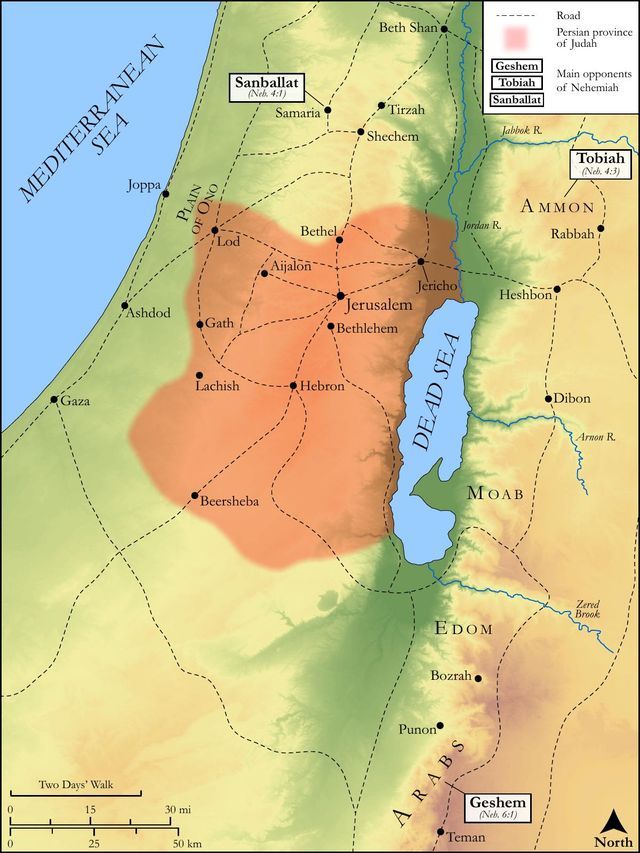
See on the biblical-era map
Study this verse
Public-domain commentary
Matthew Henry
From his Commentary on the Whole Bible. Henry comments on passages, not single verses — this entry covers Nehemiah 4:16–23.
When the builders had so far reason to think the design of the enemies broken as to return to their work, yet they were not so secure as to lay down their arms, knowing how restless and unwearied they were in their attempts, and that, if one design failed, they would be hatching another. Thus must we watch always against our spiritual enemies, and not expect that our warfare will be accomplished till our work is. See what course Nehemiah took, that the people might hold themselves in a readiness, in case there should be an attack. 1. While one half were at work, the other half were under their arms, holding spears, and shields, and bows, not only for themselves but for the labourers too, who would immediately quit their work, and betake themselves to their weapons, upon the first alarm, Neh 4:16. It is probable that they changed services at stated hours, which would relieve the fatigue of both, and particularly would be an ease to the bearers of burdens, whose strength had decayed (Neh 4:10); while they held the weapons, they were eased and yet not idle. Thus dividing their time between the trowels and the spears, they are said to work with one hand and hold their weapons with the other (Neh 4:17), which cannot be understood literally, for the work would require both hands; but it intimates that they were equally employed in both. Thus must we work out our salvation with the weapons of our warfare in our hand; for in every duty we must expect to meet with opposition from our spiritual enemies, against whom we must still be fighting the good fight of faith. 2. Every builder had a sword by his side (Neh 4:18), which he could carry without hindering his labour. The word of God is the sword of the Spirit, which we ought to have always at hand and never to seek, both in our labours and in our conflicts as Christians. 3. Care was taken both to get and give early notice of the approach of the enemy, in case they should endeavour to surprise them. Nehemiah kept a trumpeter always by him to sound an alarm, upon the first intimation of danger. The work was large, and the builders were dispersed; for in all parts of the wall they were labouring at the same time. Nehemiah continually walked round to oversee the work and encourage the workmen, and so would have speedy intelligence if the enemy made an attack, of which, by sound of trumpet, he would soon give notice to all, and they must immediately repair to him with a full assurance that their God would fight for them, Neh 4:18-20. When they acted as workmen, it was requisite they should be dispersed wherever there was work to do; but when as soldiers it was requisite they should come into close order, and be found in a body. Thus should the labourers in Christ's building be ready to unite against a common foe. 4. The inhabitants of the villages were ordered to lodge within Jerusalem, with their servants, not only that they might be the nearer to their work in the morning, but that they might be ready to help in case of an attack in the night, Neh 4:22. The strength of a city lies more in its hands than in its walls; secure them, and God's blessing upon them, and be secure. 5. Nehemiah himself, and all his men, kept closely to their business. The spears were held up, with the sight of them to terrify the enemy, not only from sun to sun, but from twilight to twilight every day, Neh 4:21. Thus ought we to be always upon our guard against our spiritual enemies, not only (as here) while it is light, but when it is dark, for they are the rulers of the darkness of this world. Nay, so very intent was Nehemiah upon his work, and so fast did he hold his servants to it, that while the heat of the business lasted neither he himself nor his attendants went into bed, but every night lay and slept in their clothes (Neh 4:23), except that they shifted them now and then, either for cleanliness or in a case of ceremonial pollution. It was a sign that their heart was upon their work when they could not find time to dress and undress, but resolved they would be at all times ready for service. Good work is likely to go on successfully when those that labour in it thus make a business of it.
Continue studying Nehemiah 4:22 across the web’s major study libraries — every link below opens this exact verse, chapter, or book on the destination site.
Read & Compare
 BibleGatewayThis verse in more than 200 translations and 70 languages.
 Bible.comThe YouVersion reader — hundreds of translations, reading plans, and highlights.
 ESV.orgCrossway's official English Standard Version reader.
 NET BibleThe NET translation with 60,000+ translators' notes on every rendering decision.
 STEP BibleTyndale House's free study tool — original text, vocabulary, and scholarly resources.
 BibliaLogos Bible Software's free web reader.
 USCCBThe New American Bible (Revised Edition) with the U.S. bishops' study notes.
Commentaries
 BibleHub CommentariesDozens of classic commentaries on this verse, gathered on one page.
 StudyLightMore than 100 commentary sets — the largest collection on the web.
 BibleRefPlain-English commentary on what this verse means, verse by verse.
 Enduring WordDavid Guzik's free commentary on this chapter, widely used by Bible teachers.
 Bible Study ToolsVerse commentary alongside Greek and Hebrew study aids.
Original Language & Research
- BibleHub InterlinearThe verse word by word — original language, transliteration, and English.
- BibleHub LexiconEvery word's original-language definition and Strong's entry.
 Blue Letter BibleDeep-study tools — Strong's numbers, concordance, and word studies.
 SefariaThe Hebrew text with Rashi and centuries of Jewish commentary.
Sermons, Hymns & Audio


TrulyRandomVerse is not affiliated with these sites and doesn’t control their content. They’re linked because they’re genuinely useful.
Summary
Nehemiah 4:22 captures a crucial directive from Nehemiah, showcasing his astute leadership and the unwavering commitment demanded from the Jewish community during the arduous rebuilding of Jerusalem's walls. This verse outlines a pragmatic and comprehensive strategy: requiring all workers and their servants to lodge within the city, thereby ensuring continuous vigilance against external threats by night while maximizing labor efficiency for construction by day. It underscores the critical balance between defensive preparedness and diligent work in the face of persistent and escalating opposition.
Context
ShowHideLiterary Context
Nehemiah 4:22 is situated within a narrative of intense opposition to the rebuilding efforts in Jerusalem. Earlier in the chapter, Nehemiah details the mockery, anger, and conspiracy of Sanballat, Tobiah, and Geshem, who sought to hinder the work and even attack the builders (Nehemiah 4:7-8). In response to these escalating threats, Nehemiah had already implemented a partial defensive measure, arming half the workers while the other half labored, with some even working with a weapon in one hand (Nehemiah 4:16-18). Verse 22 represents a further, more comprehensive refinement of this security strategy, moving from a rotational or partial guard system to a full-time, integrated vigilance by requiring everyone to reside within the city walls. This decision reflects Nehemiah's adaptive and proactive leadership, constantly adjusting to the evolving dangers to ensure the project's completion and the people's safety.
Historical & Cultural Context
The post-exilic period was a precarious time for the returning Jewish community, as they sought to re-establish their identity, worship, and secure their homeland after decades of Babylonian captivity. Jerusalem's walls were not merely defensive structures; they were vital symbols of national and religious identity, providing essential security, defining the city's boundaries, and protecting its inhabitants and the newly rebuilt temple. The surrounding peoples, particularly the Samaritans (led by Sanballat), Ammonites (Tobiah), and Arabs (Geshem), viewed the re-fortification of Jerusalem as a direct threat to their regional influence and actively sought to undermine it through intimidation, sabotage, and potential armed conflict. Living outside the city walls, even in nearby villages or temporary shelters, would leave workers and their families highly vulnerable to surprise attacks, especially under the cover of darkness. Nehemiah's command to lodge within Jerusalem was a direct and necessary response to this palpable and constant threat, ensuring a concentrated defense force and fostering a crucial sense of collective security and unity in a hostile environment.
Key Themes
ShowHideThis verse powerfully illustrates several key themes prevalent throughout the book of Nehemiah. Firstly, Vigilance and Preparedness are paramount; Nehemiah understood that the threat was constant and multifaceted, demanding continuous watchfulness both day and night, emphasizing proactive defense over reactive measures. Secondly, Community and Unity are profoundly highlighted as the command for "every one with his servant" to lodge within Jerusalem fostered a deep sense of collective responsibility and mutual dependence in the face of external threats. This reinforced the idea that their safety and success were intertwined, requiring shared burdens and mutual support, echoing the broader call for unity in rebuilding the nation and its spiritual life, as seen in the communal prayer and fasting in Nehemiah 9. Thirdly, the verse perfectly captures the Balancing of Work and Defense, illustrating the practical necessity of integrating diligent labor ("labour on the day") with constant vigilance ("be a guard to us in the night"). This dual demand underscores the pragmatic and spiritual approach necessary for advancing God's work amidst adversity. Finally, it showcases Strategic and Adaptive Leadership, as Nehemiah's instruction demonstrates wise, decisive, and flexible decision-making, adjusting tactics to best protect his people and ensure the project's completion, even under duress, reflecting a reliance on divine wisdom in practical matters, as seen in his initial prayer and planning in Nehemiah 2.
Exposition and Analysis
ShowHideKey Word Analysis
ShowHideThis verb (H3885) means "to stop (usually over night)," "to stay permanently," or "to abide." In this context, it signifies a mandatory, extended stay within the city walls, not merely a temporary visit. It implies a commitment to being present and available for duty around the clock, emphasizing the total dedication required from the community. This word underscores the concept of dwelling together for mutual protection and shared responsibility, fostering a collective defensive posture.
This noun (H4929) refers to a "guard (the man, the post or the prison)," "a watch," "charge," or "duty." It denotes an organized and disciplined act of keeping watch, rather than a casual lookout. The term implies a structured system of vigilance, often with assigned responsibilities, highlighting the military-like precision Nehemiah instilled in his defense strategy. It emphasizes active, protective oversight, ensuring the safety of the workers and the integrity of the ongoing construction.
This noun (H4399) signifies "employment (never servile) or work (abstractly or concretely)," "business," or "occupation." It refers to the diligent and purposeful effort involved in the construction and restoration of Jerusalem's walls. The term emphasizes the practical, physical exertion required for the building project, underscoring the commitment to productivity and the fulfillment of their primary task of rebuilding, which was a sacred duty.
Verse Breakdown
ShowHide"Likewise at the same time said I unto the people,"
This opening clause highlights Nehemiah's direct, personal, and authoritative leadership. The phrase "Likewise at the same time" connects this specific instruction to the immediate context of heightened threats and Nehemiah's ongoing strategic responses, indicating it was a timely and necessary adaptation to the evolving situation. It underscores his active role in guiding and commanding the community, demonstrating his hands-on involvement in the well-being and security of the people.
"Let every one with his servant lodge within Jerusalem,"
This is the core command. "Every one" indicates a universal requirement, encompassing all individuals involved in the rebuilding, from the master to his servant, emphasizing a collective responsibility. This mandate to "lodge within Jerusalem" means they were to reside inside the city walls, ensuring that the entire workforce was concentrated and available for immediate defensive action or labor. This move consolidated their strength, minimized travel time, and drastically reduced vulnerability from living in scattered, unprotected settlements outside the city.
"that in the night they may be a guard to us,"
This clause states the primary purpose of lodging within the city during the night. By having everyone inside, a larger, more readily available force could act as a "guard," providing continuous vigilance and defense against potential nocturnal attacks or infiltrations from their adversaries. This transformed the entire community into a unified defensive perimeter, ensuring constant security and peace of mind for those working.
"and labour on the day."
This clause outlines the complementary purpose for the daytime. By residing within the city, the workers minimized travel time and maximized their efficiency during daylight hours, dedicating their full energy to the construction of the wall. This dual purpose—guarding by night and working by day—demonstrates Nehemiah's practical wisdom in optimizing both security and productivity for the monumental task at hand, ensuring that no time or effort was wasted.
Literary Devices
ShowHideNehemiah 4:22 effectively employs several literary devices to convey its urgent and pragmatic message. The most prominent is Direct Speech, as Nehemiah explicitly states his command, "said I unto the people," which immediately lends authority, immediacy, and urgency to his words. This directness immerses the reader in the critical situation and Nehemiah's decisive leadership. Another significant device is Juxtaposition or Antithesis, seen in the contrasting demands of "in the night they may be a guard to us, and labour on the day." This highlights the dual, continuous nature of their commitment: defensive vigilance is required when active work is paused, and diligent labor occupies the hours of light. This stark contrast underscores the relentless pressure and the comprehensive dedication demanded from the people. Finally, the verse utilizes Imperative Mood through the command "Let every one... lodge," which functions as a direct instruction, emphasizing the non-negotiable nature of Nehemiah's directive and the necessity of immediate obedience for the community's safety and the project's success.
Theological and Thematic Connections
ShowHideNehemiah 4:22 offers profound theological insights into the nature of God's work and the commitment required from His people. It illustrates that divine purposes often unfold amidst intense opposition, necessitating both spiritual vigilance and diligent effort. Nehemiah's leadership, guided by prayer and a deep reliance on God, demonstrates that practical wisdom and strategic planning are not antithetical to faith but are often instruments of God's providence. The command for everyone to lodge within Jerusalem underscores the theological principle of corporate responsibility and unity in the face of adversity. Just as the physical walls provided security for the returning exiles, God's people are called to build His spiritual kingdom with both unwavering dedication and watchful discernment, recognizing that the work is both human effort and divine enablement. The security of the community was paramount, reflecting God's desire for His people's well-being and their ability to fulfill His purposes.
Reflection and Application
ShowHideNehemiah 4:22 provides a powerful blueprint for navigating the challenges of faith and service in contemporary life. Just as the Israelites faced tangible threats to their physical rebuilding, believers today encounter spiritual opposition when seeking to advance God's kingdom, whether in personal discipleship, family life, or broader ministry. This verse calls us to embrace a similar dual commitment: to be both diligent in our work for the Lord and vigilant against the schemes of the adversary. We are reminded that spiritual growth and effective ministry are not passive endeavors but require active participation and strategic foresight. Furthermore, the emphasis on communal lodging highlights the indispensable role of Christian community. In a world often characterized by isolation and spiritual attack, this verse challenges us to draw closer to fellow believers, finding mutual support, encouragement, and shared strength in our collective walk of faith. Our spiritual security and effectiveness are greatly enhanced when we stand together, bearing one another's burdens and collaborating in the work God has called us to do, recognizing that our individual efforts contribute to the collective strength of the body of Christ.
Questions for Reflection
ShowHideFAQ
ShowHideWhy was it necessary for everyone, including servants, to lodge within Jerusalem?
ShowHideIt was necessary for several critical reasons, all rooted in the security and efficiency of the rebuilding project. Firstly, it consolidated the entire workforce and defensive capability within the city walls, making it easier to mount a unified and immediate response to any nocturnal attacks or infiltrations from adversaries like Sanballat, Tobiah, and Geshem, who were actively conspiring against the Jews and even attempting to attack them (Nehemiah 4:7-8). Secondly, by eliminating travel time from outlying villages or temporary camps, it maximized the daylight hours available for "labour on the day," ensuring that the maximum amount of work could be accomplished on the wall without interruption. Thirdly, it fostered a deep sense of unity and shared responsibility among all participants, from the leaders to the servants, reinforcing the idea that their collective safety and success depended on mutual vigilance and cooperation. Nehemiah's pragmatic leadership understood that the project's completion depended on both diligent work and constant, organized defense against external threats.
Christ-Centered Fulfillment
ShowHideNehemiah 4:22, with its emphasis on diligent labor and constant vigilance in building and defending the physical city of Jerusalem, finds its ultimate and spiritual fulfillment in the person and work of Jesus Christ and the building of His church. Just as Nehemiah was the faithful leader overseeing the construction of the old Jerusalem's walls, Jesus is the divine architect and builder of the new, spiritual Jerusalem—His church. He declared, "I will build my church, and the gates of hell shall not prevail against it" (Matthew 16:18). Christ's work involves both active "labor" in establishing His kingdom through His life, death, and resurrection, and continuous "guarding" of His people against spiritual adversaries. He is the Good Shepherd who lays down His life for the sheep and ensures that "no one will snatch them out of my hand" (John 10:28). Believers, as citizens of this heavenly Jerusalem (Hebrews 12:22), are called to participate in this dual reality: to "labor" diligently in advancing the gospel and living out their faith, and to be "vigilant" against the schemes of the devil, putting on the full armor of God (Ephesians 6:11). In Christ, we find the ultimate security and the empowerment to both build and stand guard, knowing that our labor is not in vain and our protection is assured by the One who is forever watchful over His flock, bringing His eternal kingdom to completion.