


2 Kings 10:28
- וַיַּשְׁמֵדvai·yash·Medand he destroyedH8045Conj-w ¦ V-Hiphil-ConsecImperf-3msVerb Hiphil Consecutive Imperfect 3rd Singular Masculineוַandיַּשְׁמֵדhe destroyed
- יֵהוּאye·Hu'JehuH3058N-proper-mNoun Proper Masculine
- אֶת'et<obj.>H853DirObjMParticle Object Indicator
- הַבַּעַלha·Ba·'al<the> BaalH1168Art ¦ N-msNoun Title Singular Masculine Absoluteהַ<the>בַּעַלBaal
- מִיִּשְׂרָאֵלmi·Yis·ra·'Elfrom IsraelH3478Prep-m ¦ N-properNoun Proper LocationמִfromיִּשְׂרָאֵלIsrael
English is a literal word-by-word gloss of the Hebrew, not the KJV's wording. Why?
This is the original text the KJV's translators worked from — each Hebrew word with its own literal English meaning in this verse, prepared by scholars at Tyndale House, Cambridge. The KJV translates whole sentences, not word by word, so its wording differs: one Hebrew word can become several English words, and the KJV may choose “the LORD” where the gloss reads “Yahweh”. Both are faithful — they answer different questions. For the KJV's own rendering, switch to the KJV text.
Details
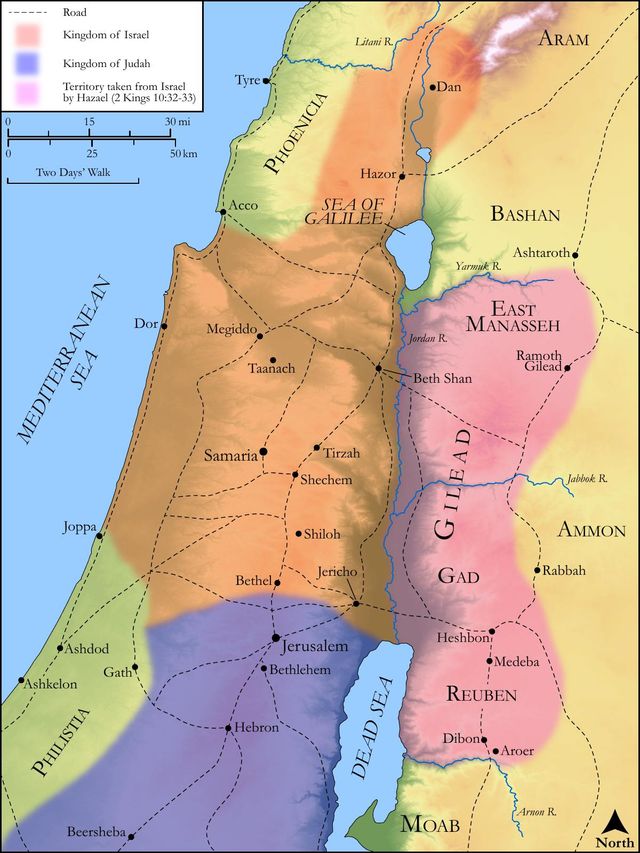
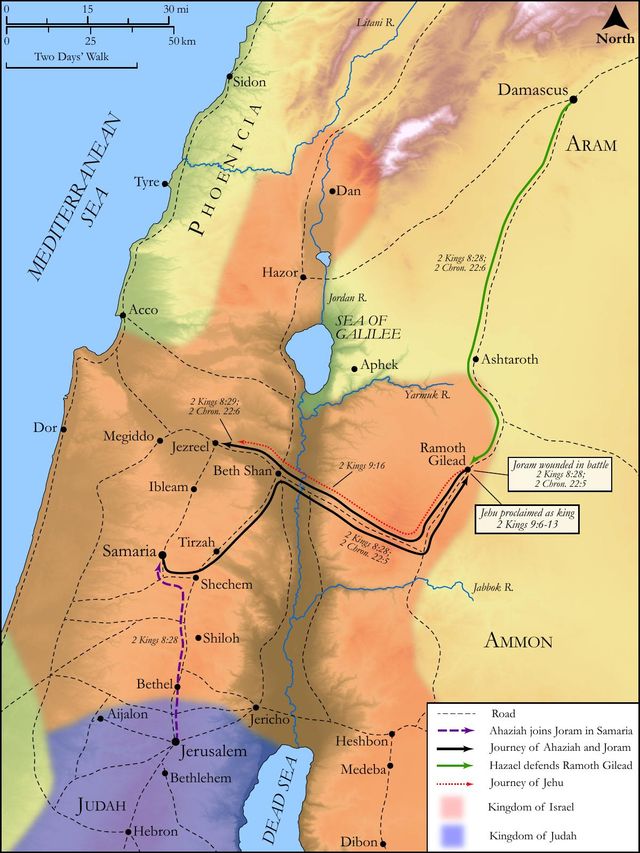
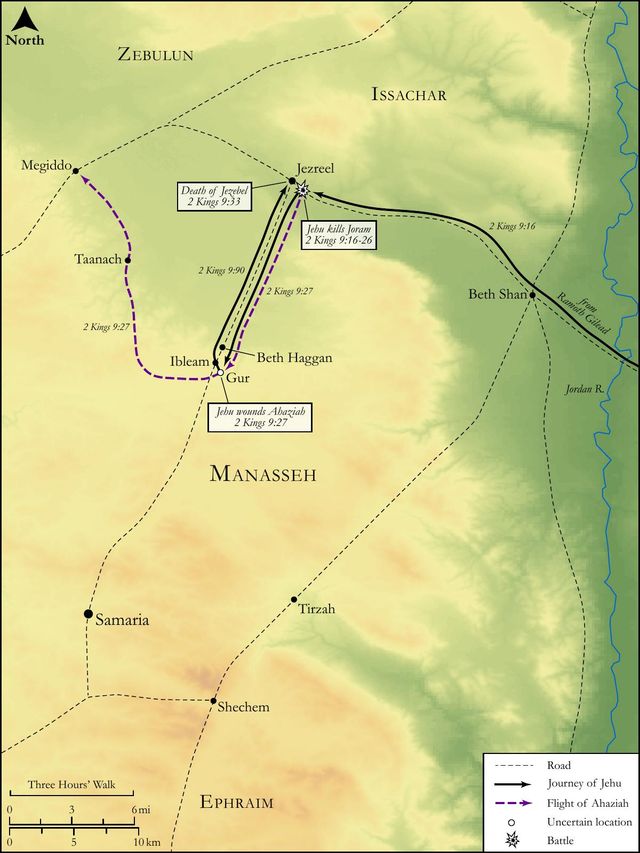
See on the biblical-era map
Study this verse
Public-domain commentary
Matthew Henry
From his Commentary on the Whole Bible. Henry comments on passages, not single verses — this entry covers 2 Kings 10:15–28. His three-level outline is real structure in the source text, so it is rendered as structure.
Jehu, pushing on his work, is here,
I.Courting the friendship of a good man, Jehonadab the son of Rechab, Kg2 10:15, Kg2 10:16.
This Jehonadab, though mortified to the world and meddling little with the business of it (as appears by his charge to his posterity, which they religiously observed 300 years after, not to drink wine nor dwell in cities, Jer 35:6, etc.), yet, upon this occasion, went to meet Jehu, that he might encourage him in the work to which God had called him. The countenance of good men is a thing which great men, if they be wise, will value, and value themselves by. David prayed, Let those that fear thee turn to me, Psa 119:79. This Jehonadab, though no prophet, priest, or Levite, no prince or ruler, was, we may suppose, very eminent for prudence and piety, and generally respected for that life of self-denial and devotion which he lived: Jehu, though a soldier, knew him and honoured him. He did not indeed think of sending for him, but when he met him (though it is likely he drove now as furiously as ever) he stopped to speak to him; and we are here told what passed between them.
1.Jehu saluted him; he blessed him (so the word is), paid him the respect and showed him the good-will that were due to so great an example of serious godliness.
2.Jehonadab assured him that he was sincerely in his interest and a hearty well-wisher to his cause. Jehu professed that his heart was right with him, that he had a true affection for his person and a veneration for the crown of his Nazariteship, and desired to know whether he had the same affection for him and satisfaction in that crown of royal dignity which God had put upon his head: Is thy heart right? a question we should often put to ourselves. "I make a plausible profession, have gained a reputation among men, but is my heart right? Am I sincere and inward with God?" Jehonadab gave him his word (It is), and gave him his hand as a pledge of his heart, yielded to him (so giving the hand is rendered, Ch2 30:8), concurred and covenanted with him, and owned him in the work both of revenge and of reformation he was now about.
3.Jehu took him up into his chariot and took him along with him to Samaria. He put some honour upon him, by taking him into the chariot with him (Jehonadab was not accustomed to ride in a chariot, much less with a king); but he received more honour from him, and from the countenance he gave to his present work. All sober people would think the better of Jehu when they saw Jehonadab in the chariot with him. This was not the only time in which the piety of some has been made to serve the policy of others, and designing men have strengthened themselves by drawing good men into their interests. Jehonadab is a stranger to the arts of fleshly wisdom, and has his conversation in simplicity and godly sincerity; and therefore, if Jehu be a servant of God and an enemy to Ball, he will be his faithful friend. "Come then" (says Jehu), "come with me, and see my zeal for the Lord; and then thou wilt see reason to espouse my cause." This is commonly taken as not well said by Jehu, and as giving cause to suspect that his heart was not right with God in what he did, and that the zeal he pretended for the Lord was really zeal for himself and his own advancement. For,
(1.)He boasted of it, and spoke as if God and man were mightily indebted to him for it.
(2.)He desired it might be seen and taken notice of, like the Pharisees, who did all to be seen of men. An upright heart approves itself to God and covets no more than his acceptance. If we aim at the applause of men, and make their praise our highest end, we are upon a false bottom. Whether Jehu looked any further we cannot judge; however Jehonadab went with him, and, it is likely, animated and assisted him in the further execution of his commission (Kg2 10:17), destroying all Ahab's friends in Samaria. A man may hate cruelty and yet love justice, may be far from thirsting after blood and yet may wash his feet in the blood of the wicked, Psa 58:10.
II.Contriving the destruction of all the worshippers of Baal.
The service of Baal was the crying sin of the house of Ahab: that root of this idolatry was plucked up, but multitudes yet remained that were infected with it, and would be in danger of infecting others. The law of God was express, that they were to be put to death; but they were so numerous, and so dispersed throughout all parts of the kingdom, and perhaps so alarmed with Jehu's beginnings, that it would be a hard matter to find them all out and an endless task to prosecute and execute them one by one. Jehu's project therefore is to cut them all off together.
1.By a wile, by a fraud, he brought them together to the temple of Baal. He pretended he would worship Baal more than ever Ahab had done, Kg2 10:18. Perhaps he spoke this ironically, or to try the body of the people whether they would oppose such a resolution as this, and would resent his threatening to increase his predecessor's exactions, and say, "If it be so, we have no part in Jehu, nor inheritance in the son of Nimshi." But it rather seems to have been spoken purposely to deceive the worshippers of Baal, and then it cannot be justified. The truth of God needs not any man's lie. He issued a proclamation, requiring the attendance of all the worshippers of Baal to join with him in a sacrifice to Baal (Kg2 10:19, Kg2 10:20), not only the prophets and priests, but all, throughout the kingdom, who worshipped Baal, who were not nearly so many as they had been in Elijah's time. Jehu's friends, we may suppose, were aware of what he designed, and were not offended at it; but the bigoted besotted Baalites began to think themselves very happy, and that now they should see golden days again. Joram had put away the image of Baal, Kg2 3:2. If Jehu will restore it, they have what they would have, and come up to Samaria with joy from all parts to celebrate the solemnity; and they are pleased to see the house of Baal crowded (Kg2 10:21), to see his priests in their vestments (Kg2 10:22), and themselves perhaps with some badges or other to notify their relation to Baal, for there were vestments for all his worshippers.
2.He took care that none of the servants of the Lord should be among them, Kg2 10:23. This they took as a provision to preserve the worship of Baal from being profaned by strangers; but it was a wonder that they did not, by this, see themselves brought into a snare and discern a design upon them. No marvel if those that suffer themselves to be deceived by Baal (as all idolaters were by their idols), are deceived by Jehu to their destruction.
3.He gave order for the cutting of them all off, and Jehonadab joined with him therein, Kg2 10:23. When a strict search was made lest any of the servants of God should, either for company or curiosity, have got among them - lest any wheat should be mixed with those tares, and when eighty men were set to stand guard at all the avenues to Baal's temple, that none might escape (Kg2 10:24), then the guards were sent in to put them all to the sword and to mingle their blood with their sacrifices, in a way of just revenge, as they themselves had sometimes done, when, in their blind devotion, they cut themselves with knives and lancets till the blood gushed out, Kg1 18:28. This was accordingly done, and the doing of it, though seemingly barbarous, was, considering the nature of their crime, really righteous. The Lord, whose name is jealous, is a jealous God.
4.The idolaters being thus destroyed, the idolatry itself was utterly abolished. The buildings about the house of Baal (which were so many and so stately that they are here called a city), where Baal's priests and their families lived, were destroyed; all the little images, statues, pictures, or shrines, which beautified Baal's temple, with the great image of Baal himself, were brought out and burnt (Kg2 10:26, Kg2 10:27), and the temple of Baal was broken down, and made a dunghill, the common sink, or sewer, of the city, that the remembrance of it might be blotted out or made infamous. Thus was the worship of Baal quite destroyed, at least for the present, out of Israel, though it had once prevailed so far that there were but 7000 of all the thousands of Israel that had not bowed the knee to Baal, and those concealed. Thus will God destroy all the gods of the heathen, and, sooner or later, triumph over them all.
Continue studying 2 Kings 10:28 across the web’s major study libraries — every link below opens this exact verse, chapter, or book on the destination site.
Read & Compare
 BibleGatewayThis verse in more than 200 translations and 70 languages.
 Bible.comThe YouVersion reader — hundreds of translations, reading plans, and highlights.
 ESV.orgCrossway's official English Standard Version reader.
 NET BibleThe NET translation with 60,000+ translators' notes on every rendering decision.
 STEP BibleTyndale House's free study tool — original text, vocabulary, and scholarly resources.
 BibliaLogos Bible Software's free web reader.
 USCCBThe New American Bible (Revised Edition) with the U.S. bishops' study notes.
Commentaries
 BibleHub CommentariesDozens of classic commentaries on this verse, gathered on one page.
 StudyLightMore than 100 commentary sets — the largest collection on the web.
 BibleRefPlain-English commentary on what this verse means, verse by verse.
 Enduring WordDavid Guzik's free commentary on this chapter, widely used by Bible teachers.
 Bible Study ToolsVerse commentary alongside Greek and Hebrew study aids.
Original Language & Research
- BibleHub InterlinearThe verse word by word — original language, transliteration, and English.
- BibleHub LexiconEvery word's original-language definition and Strong's entry.
 Blue Letter BibleDeep-study tools — Strong's numbers, concordance, and word studies.
 SefariaThe Hebrew text with Rashi and centuries of Jewish commentary.
Sermons, Hymns & Audio


TrulyRandomVerse is not affiliated with these sites and doesn’t control their content. They’re linked because they’re genuinely useful.
Summary
Second Kings 10:28 serves as a concise yet profound summary statement, marking the successful culmination of King Jehu's divinely ordained purge of Baal worship from the Northern Kingdom of Israel. This verse signifies a critical, albeit ultimately incomplete, religious reformation, powerfully illustrating God's uncompromising judgment against idolatry and the zealous, though often flawed, execution of His sovereign will through human instruments. It stands as a testament to the radical measures necessary to confront pervasive spiritual apostasy and reassert the exclusive sovereignty of Yahweh over His covenant people.
Context
ShowHideLiterary Context
This verse provides the climactic summary of Jehu's extensive and violent purge, which commenced with his anointing by a prophet from Elisha's company, specifically commissioned to overthrow the house of Ahab and execute divine judgment (2 Kings 9:6-7). Jehu's campaign systematically eliminated King Joram of Israel, King Ahaziah of Judah, the notorious Queen Jezebel, and all seventy sons of Ahab, thereby decisively ending the Omride dynasty that had aggressively promoted Baal worship throughout Israel. The destruction of Baal worship itself, meticulously detailed in the preceding verses (2 Kings 10:18-27), represents the final and most comprehensive act of this purge, showcasing Jehu's cunning strategy to gather all Baal worshippers into a single temple for a decisive slaughter. Verse 28 thus functions as the definitive concluding statement of this monumental religious cleansing, immediately preceding the narrative's pivot to Jehu's own spiritual shortcomings and the limitations of his obedience in 2 Kings 10:29-31.
Historical & Cultural Context
The worship of Baal, a prominent Canaanite storm and fertility god, had deeply permeated Israelite society, particularly during the reigns of King Ahab and his Phoenician wife, Jezebel. Jezebel actively imported and aggressively promoted Baal worship, establishing temples and supporting prophets for this deity, most notably in Samaria (1 Kings 16:31-33). This pervasive syncretism posed an existential threat to the unique covenant relationship between Yahweh and Israel, as Baal was perceived by many as a rival "lord" who controlled essential elements like rain and agricultural prosperity, directly challenging Yahweh's exclusive claim as the true provider and sovereign God of Israel. Jehu's actions, therefore, were not merely political maneuvers but a divinely orchestrated counter-reformation against a deeply entrenched religious system that had led the nation into profound apostasy, a spiritual battle previously highlighted by the dramatic confrontation between Elijah and the prophets of Baal on Mount Carmel (1 Kings 18).
Key Themes
ShowHideThe destruction of Baal worship, as summarized in 2 Kings 10:28, powerfully underscores several critical themes within the broader narrative of 2 Kings 10. First, it vividly demonstrates Divine Judgment on Idolatry, illustrating God's uncompromising opposition to any rival deity that usurps His rightful place. The eradication of Baal was a direct consequence of Israel's covenant infidelity, a severe violation of the First Commandment to have no other gods before Yahweh (Exodus 20:3). Second, it highlights Zeal for God, as Jehu executed his commission with remarkable fervor and thoroughness, acting as God's chosen instrument of judgment against a corrupt religious system. Third, the event signifies a profound, albeit temporary, Religious Reformation, removing the most overt and state-sponsored form of pagan worship that had plagued the Northern Kingdom for decades. However, the subsequent verses immediately introduce the crucial theme of Incomplete Obedience, as Jehu failed to remove the golden calves at Bethel and Dan, thereby perpetuating the sins of Jeroboam and demonstrating that his zeal against Baal did not translate into a complete and wholehearted turning of his own heart to the Lord (2 Kings 10:29).
Exposition and Analysis
ShowHideKey Word Analysis
ShowHideFrom the root meaning "Jehovah (is) He." This name itself carries theological weight, proclaiming Yahweh's existence and sovereignty. In the context of 2 Kings 10:28, Jehu is presented as the divinely appointed agent through whom God's judgment against Baal is executed. His name underscores that his actions, though violent, were ultimately a fulfillment of God's will and a declaration of Yahweh's ultimate authority.
A primitive root meaning "to desolate; destroy(-uction), bring to nought, overthrow, perish, pluck down, [idiom] utterly." This verb signifies a thorough, complete, and decisive eradication, implying a violent and permanent removal. In this verse, it emphasizes that Jehu's actions were not merely a suppression or temporary setback for Baal worship, but a comprehensive and final dismantling of its organized presence, including its physical structures, priesthood, and public practice. The word conveys the finality and totality of the divine judgment enacted through Jehu.
The same as בַּעַל; Baal, a Phoenician deity. This term literally means "lord" or "master" and refers to the chief Canaanite deity, often associated with storm, rain, and fertility. The destruction of "Baal" in this verse signifies the decisive overthrow of the entire system of Baal worship, including its idols, temples, priests, and the pervasive influence it held over Israelite society. It represents the rejection of a powerful rival claim to divine sovereignty and provision, reasserting Yahweh's exclusive status as the true Lord and God of Israel.
Verse Breakdown
ShowHide"Thus Jehu"
This introductory phrase serves as a summarizing conjunction, linking the preceding detailed account of Jehu's strategic and violent actions against Baal worship (gathering the worshippers, slaughtering them, tearing down the temple and its images) to this concluding statement. It emphasizes that the outcome described in the verse is a direct consequence and culmination of Jehu's specific, deliberate, and divinely commissioned campaign. Jehu is presented as the active and instrumental agent, fulfilling his role as God's instrument of judgment.
"destroyed Baal"
This is the core action and object of the verse, highlighting the decisive nature of the purge. "Destroyed" (as analyzed above) signifies a complete and utter eradication, while "Baal" refers not merely to the idol or the deity itself, but to the entire organized system of worship, its priests, prophets, and physical infrastructure. This clause underscores the radical and thorough nature of the cleansing, targeting the very root of the apostasy that had deeply afflicted the Northern Kingdom.
"out of Israel"
This concluding phrase defines the scope and extent of the destruction. It indicates that the organized, state-sponsored, and public practice of Baal worship was removed from the geographical and national landscape of the Northern Kingdom. While individual pockets of idolatry or private syncretism might have persisted, the official and pervasive presence of Baal worship, which had been aggressively promoted by the Omride dynasty, was decisively dismantled from the national life of Israel.
Literary Devices
ShowHideThe verse "Thus Jehu destroyed Baal out of Israel" employs several significant literary devices. The statement functions as a powerful summary, providing Conciseness to a lengthy and violent narrative of purge, distilling its essence into a single, impactful declaration. There is also an element of Irony present when viewed in the broader context of Jehu's reign; while the verse declares a complete destruction of Baal, the subsequent verses immediately reveal Jehu's failure to remove the golden calves, highlighting the superficiality of the purge and the deeper, persistent idolatry within Israel. This creates a subtle Foreshadowing of Israel's continued spiritual decline despite this significant outward reform. Furthermore, the entire narrative of Jehu's purge, culminating in this verse, functions as a powerful Symbolism of God's uncompromising demand for exclusive worship and His active judgment against spiritual infidelity. Jehu's zeal, though imperfect, symbolizes the necessary radicality in confronting entrenched evil.
Theological and Thematic Connections
ShowHideThe destruction of Baal worship in 2 Kings 10:28 delivers a profound theological statement about God's absolute sovereignty, His divine jealousy for exclusive worship, and His unwavering judgment against all forms of idolatry. It unequivocally declares that Yahweh is not merely one deity among many, but the one true and living God who tolerates no rivals for the allegiance of His people. This event serves as a stark and severe reminder of the covenant stipulations that demanded singular devotion to the Lord and the dire consequences of spiritual apostasy. While Jehu's methods were undeniably violent, they were presented as a direct execution of divine judgment, demonstrating God's active and decisive involvement in the history of His people to purge evil and call them back to covenant faithfulness. The narrative, however, subtly introduces the critical theme of partial obedience, hinting that outward conformity without inward transformation and a complete turning of the heart to God is ultimately insufficient for true spiritual health and lasting national righteousness.
Reflection and Application
ShowHideThe account of Jehu's purge of Baal worship, culminating in 2 Kings 10:28, offers profound and enduring lessons for contemporary believers. While we are not called to physically destroy temples or execute idolaters, the spiritual principle of identifying and ruthlessly eliminating idolatry remains paramount in the life of faith. We are challenged to discern and decisively remove "Baals" in our own lives—anything that subtly or overtly competes for God's rightful place in our hearts, affections, and priorities. This spiritual idolatry can manifest as an inordinate pursuit of wealth, comfort, status, technology, self-reliance, or even the approval of others. The zeal Jehu displayed, though imperfect and mixed with personal ambition, reminds us of the urgency and decisiveness required in confronting spiritual compromise and anything that detracts from God's supreme authority. Moreover, Jehu's partial obedience, as revealed in subsequent verses, serves as a crucial cautionary tale: true spiritual cleansing requires not just the removal of overt evils but a wholehearted, consistent, and uncompromising devotion to God in all areas of life, ensuring that no alternative "lords" or "golden calves" remain unchallenged in our inner sanctuaries. Our call is to a complete and unreserved turning to the Lord, not merely a selective or convenient obedience.
Questions for Reflection
ShowHideFAQ
ShowHideWas Jehu considered a good king by God?
ShowHideJehu's reign presents a complex and nuanced assessment in the biblical narrative. While 2 Kings 10:28 and the preceding verses clearly show him fulfilling God's specific commission to destroy the house of Ahab and eradicate Baal worship, an act which God explicitly commended and rewarded with a dynastic promise (2 Kings 10:30), his obedience was ultimately incomplete. The very next verse, 2 Kings 10:29, states that he "did not turn aside from the sins of Jeroboam the son of Nebat, which he made Israel to sin—the golden calves that were in Bethel and Dan." This indicates that while he purged the foreign Baal cult, he maintained the established Israelite idolatry of the golden calves, which was a political rather than a religious innovation designed to prevent people from going to Jerusalem to worship. Thus, God used Jehu as an instrument for a specific purpose of judgment and reform, but Jehu's heart was not fully devoted to the Lord, demonstrating a zeal for God's commands only when they aligned with his own agenda or political expediency.
What was Baal worship and why was it so prevalent in Israel?
ShowHideBaal was a prominent Canaanite deity, widely worshipped as the god of storms, rain, and fertility. Worshippers believed Baal controlled the productivity of the land, making his cult particularly appealing in an agrarian society like ancient Israel, which was heavily dependent on rainfall for successful crops. The prevalence of Baal worship in Israel was due to a confluence of factors: the Israelites' settlement among Canaanite peoples and their subsequent adoption of local religious practices; the powerful influence of foreign queens like Jezebel, who actively imported and promoted the cult on a state level; and the perceived practical benefits (e.g., ensuring rain and abundant harvests) that seemed to be tied to Baal. This represented a dangerous syncretistic blending of Yahweh worship with pagan practices, often involving cult prostitution, child sacrifice, and ecstatic rituals, all of which were considered an abomination to Yahweh and a direct violation of His covenant with Israel (Deuteronomy 12:31).
Christ-Centered Fulfillment
ShowHideThe historical act of Jehu destroying Baal out of Israel, as recorded in 2 Kings 10:28, finds its ultimate and perfect fulfillment in the person and redemptive work of Jesus Christ. Jehu was an earthly king, an instrument of divine judgment against a physical manifestation of idolatry, but his work was incomplete and his own heart flawed, as evidenced by his failure to remove the golden calves (2 Kings 10:29). Jesus, however, as the true and perfect King and High Priest, does not merely destroy physical idols but utterly vanquishes the spiritual powers of darkness and the very root of all idolatry—sin itself. Through His sacrificial death on the cross, Christ disarmed the principalities and powers, triumphing over them decisively (Colossians 2:15). He is the ultimate Lamb of God who takes away the sin of the world (John 1:29), freeing humanity from the bondage of worshipping created things rather than the Creator (Romans 1:25). Unlike Jehu's outward purge, Christ's work is an inward transformation, enabling believers to worship God in spirit and truth (John 4:24) and empowering them by His Spirit to put to death the "idolatry" of earthly desires and covetousness that still reside within (Colossians 3:5). He is the one who truly cleanses the "Israel" of God, His church, from all forms of spiritual apostasy, establishing an eternal kingdom where He alone is Lord and worthy of all worship, to the glory of God the Father (Philippians 2:9-11).