


2 Chronicles 34:12
- וְהָאֲנָשִׁיםve·ha·'a·na·Shimand the menH582Conj-w ¦ Art ¦ N-mpNoun Plural Masculine Absoluteוְandהָtheאֲנָשִׁיםmen
- עֹשִׂים'o·Sim[were] workingH6213V-Qal-Prtcpl-mpVerb Qal Participle Plural Masculine Absolute
- בֶּאֱמוּנָהbe·'e·mu·Nahin faithfulnessH530Prep-b ¦ N-fsNoun Singular Feminine Absoluteבֶּinאֱמוּנָהfaithfulness
- בַּמְּלָאכָהba·me·la·Khahin the workH4399Prep-b ¦ N-fsNoun Singular Feminine Absoluteבַּin theמְּלָאכָהwork
- וַעֲלֵיהֶםva·'a·lei·Hemand over themH5921Conj-w ¦ Prep ¦ 3mpPrepositionוַandעֲלֵיoverהֶםthem
- מֻפְקָדִיםMuf·ka·dim[were] appointedH6485V-Hophal-PassPrtcpl-mpVerb Hophal Participle Passive Plural Masculine Absolute
- יַחַתYa·chatJahathH3189N-proper-mNoun Proper Masculine
- וְעֹבַדְיָהוּve·'oad·Ya·huand ObadiahH5662Conj-w ¦ N-proper-mNoun Proper MasculineוְandעֹבַדְיָהוּObadiah
- הַלְוִיִּםhal·vi·Yimthe LevitesH3881Art ¦ N-mpNoun Gentilic Plural Masculine AbsoluteהַtheלְוִיִּםLevites
- מִןminofH4480PrepPreposition
- בְּנֵיbe·Nei[the] descendants ofH1121N-mpcNoun Plural Masculine Construct
- מְרָרִיme·ra·RiMerariH4847N-proper-mNoun Proper Masculine
- וּזְכַרְיָהu·ze·khar·Yahand ZechariahH2148Conj-w ¦ N-proper-mNoun Proper MasculineוּandזְכַרְיָהZechariah
- וּמְשֻׁלָּםu·me·shu·Lamand MeshullamH4918Conj-w ¦ N-proper-mNoun Proper MasculineוּandמְשֻׁלָּםMeshullam
- מִןminofH4480PrepPreposition
- בְּנֵיbe·Nei[the] descendants ofH1121N-mpcNoun Plural Masculine Construct
- הַקְּהָתִיםha·ke·ha·Timthe KohathitesH6956Art ¦ N-mpNoun Gentilic Plural Masculine AbsoluteהַtheקְּהָתִיםKohathites
- לְנַצֵּחַle·na·Tze·achto act as overseersH5329Prep-l ¦ V-Piel-InfVerb Piel Infinitive Constructלְtoנַצֵּחַact as overseers
- וְהַלְוִיִּםve·Hal·vi·Yimand the LevitesH3881Conj-w ¦ Art ¦ N-mpNoun Gentilic Plural Masculine AbsoluteוְandהַtheלְוִיִּםLevites
- כָּלkoleveryH3605N-mscNoun Singular Masculine Construct
- מֵבִיןme·Vin[one who] was skilledH995V-Hiphil-Prtcpl-msVerb Hiphil Participle Singular Masculine Absolute
- בִּכְלֵיbikh·leiin instruments ofH3627Prep-b ¦ N-mpcNoun Plural Masculine Constructבִּinכְלֵיinstruments of
- שִׁירShirsongH7892N-msNoun Singular Masculine Absolute
English is a literal word-by-word gloss of the Hebrew, not the KJV's wording. Why?
This is the original text the KJV's translators worked from — each Hebrew word with its own literal English meaning in this verse, prepared by scholars at Tyndale House, Cambridge. The KJV translates whole sentences, not word by word, so its wording differs: one Hebrew word can become several English words, and the KJV may choose “the LORD” where the gloss reads “Yahweh”. Both are faithful — they answer different questions. For the KJV's own rendering, switch to the KJV text.
Details
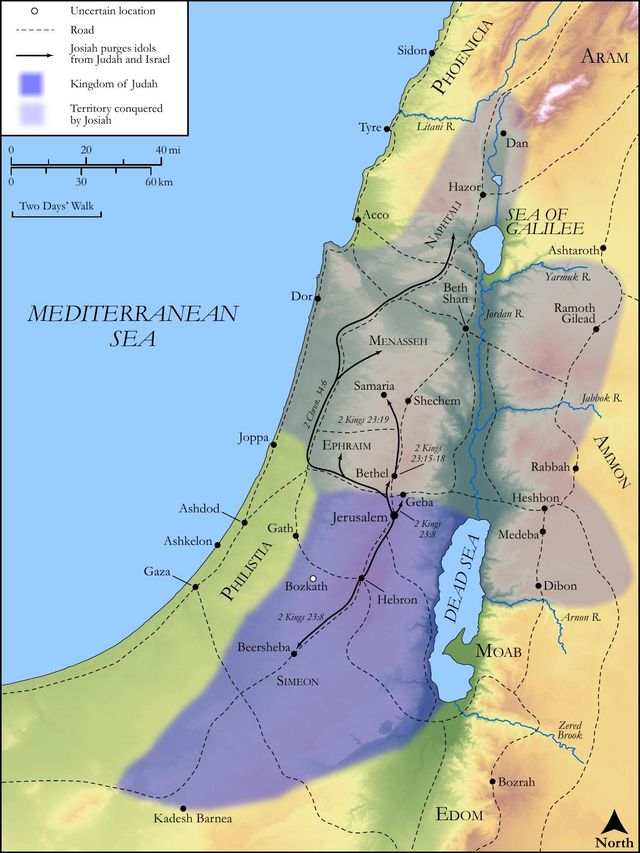
See on the biblical-era map
Study this verse
Public-domain commentary
Matthew Henry
From his Commentary on the Whole Bible. Henry comments on passages, not single verses — this entry covers 2 Chronicles 34:8–13.
Here, 1. Orders are given by the king for the repair of the temple, Ch2 34:8. When he had purged the house of the corruptions of it he began to fit it up for the services that were to be performed in it. Thus we must do by the spiritual temple of the heart, get it cleansed from the pollutions of sin, and then renewed, so as to be transformed into the image of God. Josiah, in this order, calls God the Lord his God. Those that truly love God will love the habitation of his house. 2. Care is taken about it, effectual care. The Levites went about the country and gathered money towards it, which was returned to the three trustees mentioned, Ch2 34:8. They brought it to Hilkiah the high priest (Ch2 34:9), and he and they put it into the hands of workmen, both overseers and labourers, who undertook to do it by the great, as we say, or in the gross, Ch2 34:10, Ch2 34:11. It is observed that the workmen were industrious and honest: They did the work faithfully (Ch2 34:12); and workmen are not completely faithful if they are not both careful and diligent, for a confidence is reposed in them that they will be so. It is also intimated that the overseers were ingenious; for it is said that all those were employed to inspect this work who were skilful in instruments of music; not that their skill in music could be of any use in architecture, but it was an evidence that they were men of sense and ingenuity, and particularly that their genius lay towards the mathematics, which qualified them very much for this trust. Witty men are then wise men when they employ their wit in doing good, in helping their friends, and, as they have opportunity, in serving the public. Observe, in this work, how God dispenses his gifts variously; here were some that were bearers of burdens, cut out for bodily labour and fit to work. Here were others (made meliori luto - of finer materials) that had skill in music, and they were overseers of those that laboured, and scribes and officers. The former were the hands: these were the heads. They had need of one another, and the work needed both. Let not the overseers of the work despise the bearers of burdens, nor let those that work in the service grudge at those whose office it is to direct; but let each esteem and serve the other in love, and let God have the glory and the church the benefit of the different gifts and dispositions of both.
Continue studying 2 Chronicles 34:12 across the web’s major study libraries — every link below opens this exact verse, chapter, or book on the destination site.
Read & Compare
 BibleGatewayThis verse in more than 200 translations and 70 languages.
 Bible.comThe YouVersion reader — hundreds of translations, reading plans, and highlights.
 ESV.orgCrossway's official English Standard Version reader.
 NET BibleThe NET translation with 60,000+ translators' notes on every rendering decision.
 STEP BibleTyndale House's free study tool — original text, vocabulary, and scholarly resources.
 BibliaLogos Bible Software's free web reader.
 USCCBThe New American Bible (Revised Edition) with the U.S. bishops' study notes.
Commentaries
 BibleHub CommentariesDozens of classic commentaries on this verse, gathered on one page.
 StudyLightMore than 100 commentary sets — the largest collection on the web.
 BibleRefPlain-English commentary on what this verse means, verse by verse.
 Enduring WordDavid Guzik's free commentary on this chapter, widely used by Bible teachers.
 Bible Study ToolsVerse commentary alongside Greek and Hebrew study aids.
Original Language & Research
- BibleHub InterlinearThe verse word by word — original language, transliteration, and English.
- BibleHub LexiconEvery word's original-language definition and Strong's entry.
 Blue Letter BibleDeep-study tools — Strong's numbers, concordance, and word studies.
 SefariaThe Hebrew text with Rashi and centuries of Jewish commentary.
Sermons, Hymns & Audio


TrulyRandomVerse is not affiliated with these sites and doesn’t control their content. They’re linked because they’re genuinely useful.
Summary
Second Chronicles 34:12 offers a profound testament to the integrity, diligence, and organizational excellence that characterized the restoration of the Temple under King Josiah. It commends the workers for their unwavering faithfulness and meticulously details the Levites, specifically from the Merarite and Kohathite families, who served as dedicated overseers. Intriguingly, it also highlights the inclusion of Levites skilled in musical instruments, demonstrating how diverse talents were consecrated and strategically applied to ensure the diligent and successful progress of this vital spiritual and physical renewal, thereby underscoring the indispensable role of conscientious labor and effective leadership in God's service.
Context
ShowHideLiterary Context
This verse is strategically placed within the broader narrative of King Josiah's righteous reign, specifically detailing the comprehensive Temple repair initiated in his eighteenth year. The preceding verses, 2 Chronicles 34:8-11, meticulously describe Josiah's command to Hilkiah the high priest to collect money from the people for the repair work and the subsequent, trustworthy distribution of these funds to the workmen. 2 Chronicles 34:10 explicitly states that the money was given "into the hand of them that did the work, that had the oversight of the house of the LORD: and they laid it out to the carpenters and builders, that wrought upon the house." 2 Chronicles 34:11 further notes the purchase of hewn stone and timber. Thus, 2 Chronicles 34:12 acts as a direct continuation and powerful affirmation of the integrity and diligence already established in the handling of the funds, extending that commendation to the actual laborers and their immediate supervisors. The narrative then transitions in 2 Chronicles 34:14 to the momentous discovery of the Book of the Law during this very repair, underscoring the profound spiritual significance that undergirded the physical restoration.
Historical & Cultural Context
King Josiah ascended to the throne of Judah at the tender age of eight (c. 640 BC), inheriting a kingdom deeply entrenched in idolatry due to the wicked reigns of his grandfather Manasseh and father Amon. Unlike his immediate predecessors, Josiah began to seek the God of his father David in his eighth year and initiated a sweeping religious reform in his twelfth year, cleansing Judah and Jerusalem of pagan altars, Asherah poles, and idols. By his eighteenth year, the focus shifted to the restoration of the Temple, which had fallen into severe disrepair and defilement. The Levites, traditionally responsible for the care and service of the Tabernacle and later the Temple, played a crucial and multifaceted role in such projects. Their involvement as overseers, even those "skilled in instruments of musick," highlights the flexibility, dedication, and adaptability required for sacred work. In ancient Near Eastern societies, large-scale construction projects, especially those for religious purposes, often involved communal effort and significant financial contributions. The integrity of both workers and overseers was paramount, as corruption or negligence could undermine the entire endeavor and betray public trust. Josiah's reforms were comprehensive, touching not only religious practices but also the very physical structures dedicated to God's worship.
Key Themes
ShowHideThis verse contributes significantly to several overarching themes within 2 Chronicles and the broader biblical narrative. Firstly, it powerfully illustrates the theme of Faithfulness and Integrity in Service. The declaration "the men did the work faithfully" sets a high standard, emphasizing that God's work demands not just effort, but honest, diligent, and trustworthy execution. This echoes the biblical principle found in 1 Corinthians 4:2 that "it is required in stewards, that a man be found faithful." Secondly, the detailed listing of overseers, specifically Levites from the families of Merari and Kohath, underscores the theme of Organized Leadership and Accountability. Effective spiritual and physical work requires structure, clear roles, and responsible oversight, ensuring that tasks are "set forward" efficiently and correctly. This highlights the importance of divinely appointed order in sacred endeavors, as seen throughout the Levitical system described in Numbers 3. Finally, the inclusion of Levites "all that could skill of instruments of musick" highlights the theme of Diverse Gifts for a Common Purpose. While these individuals were typically associated with Temple worship and music, their skills were repurposed for administrative or supervisory roles in the construction. This demonstrates that all talents, even those seemingly unrelated to a task, can be consecrated and utilized for the advancement of God's kingdom, a concept beautifully articulated in Romans 12:4-8 and 1 Corinthians 12:12-27. The entire Temple repair project under Josiah also serves as a tangible symbol of Restoration and Revival, where physical renewal mirrors a spiritual return to God.
Exposition and Analysis
ShowHideKey Word Analysis
ShowHideDerived from the root aman (אָמַן), this adverb signifies reliability, trustworthiness, firmness, and steadfastness. It implies that the workers performed their duties with integrity, diligence, and commitment, upholding a high standard of honesty and conscientiousness. This is the same root from which concepts like "faith" (אֱמוּנָה, emunah) and "Amen" (אָמֵן) are derived, emphasizing a deep sense of truth, stability, and reliability. Here, it speaks to the workers' character and the quality of their labor, indicating that they were worthy of trust with the sacred task, acting with moral fidelity.
This primitive root carries a broad semantic range, including "to visit (with friendly or hostile intent); by analogy, to oversee, muster, charge, care for, miss, deposit, etc." In this context, it specifically denotes the act of overseeing, appointing, or having charge over the work. It implies active management, ensuring progress, and directing the laborers to achieve the desired outcome. The selection of this word underscores the proactive and responsible nature of the Levites' supervisory role, highlighting their commitment to the successful and timely completion of the Temple restoration.
This noun, derived from kalah (כָּלָה), refers to "something prepared," encompassing any apparatus, implement, utensil, or vessel. In the context of "instruments of musick," it specifically denotes musical instruments. Its inclusion here, alongside the Levites, highlights their primary vocational identity as those dedicated to Temple worship through music. However, the broader meaning of "apparatus" or "tool" subtly hints at the versatility of these individuals, whose skills, though typically applied to music, were now being utilized as "tools" or "instruments" for the physical work of restoration, emphasizing their adaptability and the comprehensive nature of their service.
Verse Breakdown
ShowHide"And the men did the work faithfully:"
This opening clause immediately establishes the commendable character and ethical standard of the laborers involved in the Temple repair. It signifies that their efforts were not merely mechanical or superficial, but imbued with integrity, diligence, and a profound sense of responsibility. Their work was performed with trustworthiness and commitment, setting a foundational moral and ethical tone for the entire sacred project.
"and the overseers of them [were] Jahath and Obadiah, the Levites, of the sons of Merari;"
This segment introduces the first named pair of overseers, explicitly identifying them as Levites from the Merarite family. The Merarites were one of the three major divisions of the Levites, traditionally responsible for the care and transport of the Tabernacle's heavier, structural components (e.g., Numbers 3:36). Their inclusion here as supervisors underscores their established expertise in handling physical structures and their inherent organizational skills, now aptly applied to the Temple's extensive repair.
"and Zechariah and Meshullam, of the sons of the Kohathites, to set [it] forward;"
This clause introduces the second pair of named overseers, from the Kohathite division of the Levites. The Kohathites were entrusted with the most sacred elements of the Tabernacle, such as the Ark of the Covenant and the altar (e.g., Numbers 3:31). Their involvement as overseers, specifically tasked "to set it forward," emphasizes their leadership capacity and their crucial role in ensuring the diligent progress and ultimate completion of the work. The specific mention of these prominent Levitical families highlights the structured and highly organized nature of the project under Josiah.
"and [other of] the Levites, all that could skill of instruments of musick."
This final, intriguing phrase broadens the scope of oversight. It indicates that beyond the named individuals, other Levites, particularly those renowned for their musical abilities, were also involved in the supervision or facilitation of the work. This suggests a flexible and pragmatic approach to utilizing all available talents for the common goal. While their primary role was typically in Temple worship through music, their organizational skills, leadership acumen, or perhaps even their ability to maintain order and rhythm (analogous to musical harmony) were effectively repurposed for the construction effort. It powerfully demonstrates that diverse gifts can be consecrated for God's glory in unexpected and highly effective ways.
Literary Devices
ShowHideThe verse employs several literary devices to convey its message with precision and impact. Enumeration is prominently featured through the specific naming of Jahath, Obadiah, Zechariah, and Meshullam, along with their precise Levitical lineages (Merari and Kohathites). This detailed listing lends credibility, historical specificity, and a sense of accountability to the account, emphasizing the highly organized and trustworthy nature of the work. The phrase "all that could skill of instruments of musick" functions as a form of Synecdoche, where a characteristic skill (musical proficiency) represents the individuals (the Levites who possessed such skill) who were now contributing in a supervisory capacity. This highlights the unexpected but valuable contribution of individuals whose primary vocational identity was different. Furthermore, the entire description functions as a clear Commendation, praising the faithfulness of the workers and the effective, diverse leadership of the Levites, thereby setting a positive example of diligent and consecrated service. The juxtaposition of the Levites' usual musical role with their current supervisory role in construction also introduces a subtle Paradox or Irony, underscoring the versatility and adaptability of God's servants and the comprehensive nature of service to Him.
Theological and Thematic Connections
ShowHide2 Chronicles 34:12 powerfully articulates the enduring biblical principle that all work, especially that undertaken for God's purposes, must be characterized by faithfulness, integrity, and diligent oversight. The commendation of the workers' "faithfulness" (Hebrew ʼĕmûwnâh') connects directly to the core concept of emunah—trustworthiness, steadfastness, and moral fidelity—which is foundational to a right relationship with God and a life lived in accordance with His will. This verse illustrates that spiritual revival (as powerfully seen in Josiah's reign following the discovery of the Book of the Law) is often accompanied by practical, diligent, and organized efforts to restore what is broken, whether physically or spiritually. The strategic utilization of Levites, including those skilled in music, for supervisory roles in construction underscores the profound theological truth that God can and does use diverse gifts and talents in unexpected ways for the advancement of His kingdom, calling all His people to consecrated service wherever they are needed. It speaks to the unity of purpose within the community of faith, where different members contribute their unique abilities for the common good, demonstrating that all skills, when surrendered to God, become instruments for His glory.
Reflection and Application
ShowHideThis verse serves as a profound and practical reminder that our service to God, whether in grand public projects or in the quiet, often unseen duties of daily life, is to be marked by unwavering integrity and diligent faithfulness. The "faithfulness" of the workers was not merely about completing a task, but fundamentally about the spirit and character with which it was done—a reflection of their devotion. This challenges us to deeply consider the quality of our own work, our commitments, and our stewardship of all resources—our time, our talents, and our treasures—as an act of worship offered unto the Lord. Furthermore, the intriguing inclusion of musically skilled Levites as overseers offers a powerful and liberating lesson on the versatility of gifts within the body of Christ. It encourages us to look beyond conventional roles and recognize that every skill, every passion, and every ability can be consecrated and utilized for God's purposes, even in unexpected capacities. Good leadership, accountability, and the humble willingness to serve wherever needed are absolutely essential for any endeavor, especially those aimed at spiritual renewal, the building up of the church, and the advancement of God's kingdom in the world. Our efforts, however humble or seemingly insignificant, contribute to the larger, magnificent narrative of God's redemptive work.
Questions for Reflection
ShowHideFAQ
ShowHideWhat was the significance of the Levites being involved in the Temple repair, especially those skilled in music?
ShowHideThe Levites were divinely appointed for comprehensive service in the Tabernacle and later the Temple, primarily in roles related to worship, teaching the Law, and maintaining the sanctity and functionality of the sanctuary. While some Levites, particularly the Kohathites and Merarites, had long-standing responsibilities related to the physical care and transport of the Tabernacle structure (as seen in Numbers 3:29-37), the specific mention of those "skilled in instruments of musick" is particularly notable. These were typically the Levites assigned to lead Temple worship through song and instrumentation (e.g., 1 Chronicles 25:1-8). Their involvement in the Temple repair, specifically as overseers "to set it forward," signifies a crucial principle: all gifts and talents within God's people can be consecrated and applied to whatever task is necessary for the advancement of His kingdom. It demonstrates remarkable flexibility, dedication, and the understanding that the overall mission (restoring God's house and worship) transcended specific job descriptions. Their inherent leadership, organizational skills, or perhaps even their ability to maintain order and rhythm, honed in their musical roles, were valuable assets in supervising the construction, showcasing God's ability to repurpose and utilize every gift for His glory.
Christ-Centered Fulfillment
ShowHideWhile 2 Chronicles 34:12 describes the faithful work of men and Levites in restoring a physical temple, it profoundly foreshadows the ultimate work of restoration accomplished through Jesus Christ. The diligence, integrity, and unified purpose displayed by Josiah's workers point to the perfect faithfulness of Christ, who came not to restore a building made with human hands, but to rebuild a broken humanity and reconcile it to God. Just as the physical Temple was the dwelling place for God's presence among His people, Jesus declared Himself to be the true Temple, saying, "Destroy this temple, and in three days I will raise it up" (referring to His own body). His death and resurrection established a new and living way to God, making obsolete the need for a physical temple. The diverse gifts of the Levites, including musicians, being repurposed for the Temple's construction, beautifully prefigure the New Testament church, where all believers, endowed with various spiritual gifts by the Holy Spirit (1 Corinthians 12:4-11), are called to serve as living stones in the spiritual temple of God (1 Peter 2:5). Christ, as the Chief Cornerstone (Ephesians 2:20), oversees and builds His church, ensuring its faithful completion and growth. Our faithful work today, whether in physical labor or spiritual ministry, is a participation in His ongoing redemptive work, ultimately pointing to the one who perfectly fulfilled all righteousness and built a dwelling place for God among humanity, not made with hands (Hebrews 9:11).