


2 Chronicles 34:13
- וְעַלve·'Al<and> [were] overH5921Conj-w ¦ PrepPrepositionוְ<and>עַל[were] over
- הַסַּבָּלִיםha·sa·ba·Limthe burden-bearersH5449Art ¦ N-mpNoun Plural Masculine Absoluteהַtheסַּבָּלִיםburden-bearers
- וּמְנַצְּחִיםu·me·na·tze·Chimand [were] acting as overseersH5329Conj-w ¦ V-Piel-Prtcpl-mpVerb Piel Participle Plural Masculine Absoluteוּandמְנַצְּחִים[were] acting as overseers
- לְכֹלle·Kholof everyH3605Prep-l ¦ N-mscNoun Singular Masculine Constructלְofכֹלevery
- עֹשֵׂה'o·Sehdoer ofH6213V-Qal-Prtcpl-msVerb Qal Participle Singular Masculine Construct
- מְלָאכָהme·la·KhahworkH4399N-fsNoun Singular Feminine Absolute
- לַעֲבוֹדָהla·'a·vo·Dahfor laborH5656Prep-l ¦ N-fsNoun Singular Feminine Absoluteלַforעֲבוֹדָהlabor
- וַעֲבוֹדָהva·'a·vo·Dahand laborH5656Conj-w ¦ N-fsNoun Singular Feminine Absoluteוַandעֲבוֹדָהlabor
- וּמֵהַלְוִיִּםu·me·hal·vi·Yimand some of the LevitesH3881Conj-w ¦ Prep-m ¦ Art ¦ N-mpNoun Gentilic Plural Masculine Absoluteוּandמֵsome ofהַtheלְוִיִּםLevites
- סוֹפְרִיםsof·Rim[were] scribesH5608N-mpNoun Plural Masculine Absolute
- וְשֹׁטְרִיםve·sho·te·Rimand officialsH7860Conj-w ¦ V-Qal-Prtcpl-mpVerb Qal Participle Plural Masculine Absoluteוְandשֹׁטְרִיםofficials
- וְשׁוֹעֲרִיםve·sho·'a·Rimand gatekeepersH7778Conj-w ¦ N-mpNoun Plural Masculine Absoluteוְandשׁוֹעֲרִיםgatekeepers
English is a literal word-by-word gloss of the Hebrew, not the KJV's wording. Why?
This is the original text the KJV's translators worked from — each Hebrew word with its own literal English meaning in this verse, prepared by scholars at Tyndale House, Cambridge. The KJV translates whole sentences, not word by word, so its wording differs: one Hebrew word can become several English words, and the KJV may choose “the LORD” where the gloss reads “Yahweh”. Both are faithful — they answer different questions. For the KJV's own rendering, switch to the KJV text.
Details
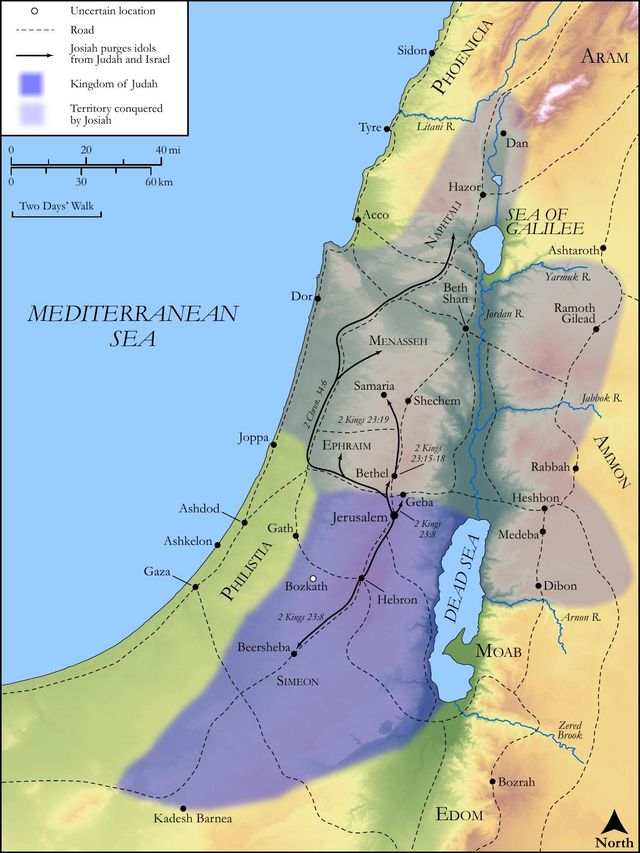
See on the biblical-era map
Study this verse
Public-domain commentary
Matthew Henry
From his Commentary on the Whole Bible. Henry comments on passages, not single verses — this entry covers 2 Chronicles 34:8–13.
Here, 1. Orders are given by the king for the repair of the temple, Ch2 34:8. When he had purged the house of the corruptions of it he began to fit it up for the services that were to be performed in it. Thus we must do by the spiritual temple of the heart, get it cleansed from the pollutions of sin, and then renewed, so as to be transformed into the image of God. Josiah, in this order, calls God the Lord his God. Those that truly love God will love the habitation of his house. 2. Care is taken about it, effectual care. The Levites went about the country and gathered money towards it, which was returned to the three trustees mentioned, Ch2 34:8. They brought it to Hilkiah the high priest (Ch2 34:9), and he and they put it into the hands of workmen, both overseers and labourers, who undertook to do it by the great, as we say, or in the gross, Ch2 34:10, Ch2 34:11. It is observed that the workmen were industrious and honest: They did the work faithfully (Ch2 34:12); and workmen are not completely faithful if they are not both careful and diligent, for a confidence is reposed in them that they will be so. It is also intimated that the overseers were ingenious; for it is said that all those were employed to inspect this work who were skilful in instruments of music; not that their skill in music could be of any use in architecture, but it was an evidence that they were men of sense and ingenuity, and particularly that their genius lay towards the mathematics, which qualified them very much for this trust. Witty men are then wise men when they employ their wit in doing good, in helping their friends, and, as they have opportunity, in serving the public. Observe, in this work, how God dispenses his gifts variously; here were some that were bearers of burdens, cut out for bodily labour and fit to work. Here were others (made meliori luto - of finer materials) that had skill in music, and they were overseers of those that laboured, and scribes and officers. The former were the hands: these were the heads. They had need of one another, and the work needed both. Let not the overseers of the work despise the bearers of burdens, nor let those that work in the service grudge at those whose office it is to direct; but let each esteem and serve the other in love, and let God have the glory and the church the benefit of the different gifts and dispositions of both.
Continue studying 2 Chronicles 34:13 across the web’s major study libraries — every link below opens this exact verse, chapter, or book on the destination site.
Read & Compare
 BibleGatewayThis verse in more than 200 translations and 70 languages.
 Bible.comThe YouVersion reader — hundreds of translations, reading plans, and highlights.
 ESV.orgCrossway's official English Standard Version reader.
 NET BibleThe NET translation with 60,000+ translators' notes on every rendering decision.
 STEP BibleTyndale House's free study tool — original text, vocabulary, and scholarly resources.
 BibliaLogos Bible Software's free web reader.
 USCCBThe New American Bible (Revised Edition) with the U.S. bishops' study notes.
Commentaries
 BibleHub CommentariesDozens of classic commentaries on this verse, gathered on one page.
 StudyLightMore than 100 commentary sets — the largest collection on the web.
 BibleRefPlain-English commentary on what this verse means, verse by verse.
 Enduring WordDavid Guzik's free commentary on this chapter, widely used by Bible teachers.
 Bible Study ToolsVerse commentary alongside Greek and Hebrew study aids.
Original Language & Research
- BibleHub InterlinearThe verse word by word — original language, transliteration, and English.
- BibleHub LexiconEvery word's original-language definition and Strong's entry.
 Blue Letter BibleDeep-study tools — Strong's numbers, concordance, and word studies.
 SefariaThe Hebrew text with Rashi and centuries of Jewish commentary.
Sermons, Hymns & Audio


TrulyRandomVerse is not affiliated with these sites and doesn’t control their content. They’re linked because they’re genuinely useful.
Summary
Second Chronicles 34:13 meticulously details the crucial administrative and supervisory roles undertaken by the Levites during King Josiah's extensive and divinely inspired renovation of the Jerusalem Temple. This verse illuminates the highly organized nature of the project, emphasizing that beyond their traditional priestly and cultic duties, the Levites were integral to the practical execution of the work, serving as managers, record-keepers, and logistical coordinators, thereby ensuring the diligent and orderly progress of this sacred undertaking.
Context
ShowHideLiterary Context
This verse is situated within the broader narrative of King Josiah's righteous reign, as chronicled in 2 Chronicles 34. Following his early commitment to seeking God (vv. 1-3) and his zealous purge of idolatry throughout Judah and Israel (vv. 4-7), Josiah initiates the repair and restoration of the Temple in Jerusalem (v. 8). Verses 9-12 describe the collection of funds and the engagement of skilled craftsmen. Verse 13 then specifically focuses on the management structure put in place for this massive undertaking, highlighting the Levites' pivotal role in overseeing various aspects of the work, from manual labor to administration and record-keeping. This detailed account of organizational diligence sets the stage for the subsequent, momentous discovery of the Book of the Law, which further propels Josiah's comprehensive reforms.
Historical & Cultural Context
King Josiah's reign (640-609 BC) marked a significant period of religious reform after decades of apostasy under his grandfather Manasseh and father Amon. The Temple, neglected and defiled, was in dire need of repair, symbolizing the spiritual decay of the nation. In ancient Israel, the Levites, descendants of Levi, were set apart for service to the Lord. While their primary roles often involved priestly duties, teaching the Law, and judicial functions (as seen in Deuteronomy 33:10 and 1 Chronicles 23:4), this verse underscores their broader administrative and organizational capabilities. Their involvement in overseeing the Temple repair reflects a practical application of their consecrated service, ensuring the integrity and efficiency of a project vital to the nation's spiritual renewal and adherence to the covenant.
Key Themes
ShowHideThe meticulous organization described in 2 Chronicles 34:13 underscores several key themes. Firstly, it highlights the importance of order and administration in carrying out God's work, demonstrating that divine projects require human diligence and structured effort. Secondly, it reveals the multifaceted nature of Levitical service, extending beyond ritual duties to encompass significant administrative, supervisory, and logistical roles, thereby showcasing their comprehensive dedication to God and the community. This holistic approach to service is a recurring theme in the Chronicler's work, emphasizing the Levites' integral role in all aspects of Israelite life. Thirdly, the detailed oversight implies a commitment to diligence and integrity in the service of the Lord, ensuring that the work was executed efficiently and correctly. Finally, this organized effort in Temple repair was a tangible part of Josiah's broader restoration and revival movement, illustrating that practical, administrative work is essential for facilitating spiritual renewal and preparing the ground for God's Word to take root, as it did with the discovery of the Book of the Law.
Exposition and Analysis
ShowHideKey Word Analysis
ShowHideThis term, derived from a root meaning "to glitter from afar" or "to be eminent," signifies a role of superintendence, particularly in the context of Temple services. Here, it denotes the Levites' active managerial responsibility, indicating they were not merely present but were actively engaged in supervising, inspecting, and directing the work. This highlights their authority and accountability in ensuring the quality and progress of the Temple repair project.
From a root meaning "to score with a mark as a tally or record," these Levites were highly literate individuals skilled in writing, enumerating, and managing records. Their role was crucial for financial accountability, tracking materials, documenting progress, and preserving important texts. Their presence underscores the administrative sophistication of the project and foreshadows the critical role of record-keeping in the subsequent discovery of the Book of the Law, which was likely preserved and rediscovered through such meticulous scribal work.
This term refers to an official superintendent or magistrate, implying a role of authority in organizing the workforce, enforcing discipline, and ensuring the smooth execution of tasks. These Levites acted as intermediaries between the higher supervisors and the laborers, coordinating efforts and maintaining order. Their inclusion signifies the hierarchical and structured nature of the Temple repair operation, ensuring efficiency and compliance.
Verse Breakdown
ShowHide"Also [they were] over the bearers of burdens"
This clause indicates that a segment of the Levites held supervisory authority over those engaged in heavy manual labor, such as transporting stones, timber, and other materials necessary for the Temple's reconstruction. This highlights their direct involvement in managing the logistics and physical demands of the project, ensuring the efficient movement of resources.
"and [were] overseers of all that wrought the work in any manner of service"
This expands the scope of the Levites' oversight beyond just the "bearers of burdens" to encompass all types of skilled and unskilled labor involved in the repair. It signifies their comprehensive managerial responsibility for the entire undertaking, ensuring that every aspect of the work, regardless of its specific nature, was properly directed and executed with diligence.
"and of the Levites [there were] scribes, and officers, and porters"
This specifies the particular administrative and support roles that certain Levites filled. "Scribes" managed documentation and finances, ensuring accountability; "officers" provided general administration and coordination, maintaining order; and "porters" (gatekeepers) likely managed access to the Temple complex, secured materials, and oversaw logistical flow. This demonstrates the diverse and specialized functions within the Levitical ranks that contributed to the overall success of the project, showcasing their multifaceted contribution.
Literary Devices
ShowHideThe verse employs Enumeration and Listing to detail the various roles and responsibilities of the Levites, creating a sense of thoroughness and meticulous organization. By itemizing "bearers of burdens," "overseers," "scribes," "officers," and "porters," the text emphasizes the comprehensive nature of the administrative structure. Furthermore, there is an implicit Emphasis on Detail and Order, as the precise description of roles underscores the importance of structure and good management in sacred work, reflecting God's character as a God of order. The verse also uses Synecdoche where "bearers of burdens" stands in for the entire manual labor force, highlighting a specific, demanding aspect of the work being supervised, while implying the broader scope of physical labor involved.
Theological and Thematic Connections
ShowHideThe detailed organization and diverse roles of the Levites in 2 Chronicles 34:13 underscore a profound theological truth: God is a God of order, and He expects His work to be carried out with diligence, integrity, and good stewardship. The Temple repair was not merely a physical renovation but a spiritual act, a tangible expression of national repentance and revival. This verse demonstrates that practical administration and oversight are not secondary but essential components of spiritual service. It highlights that every task, from the most strenuous manual labor to the most intricate record-keeping, when performed in service to God, contributes to His kingdom and glory. The Levites' multifaceted involvement illustrates the principle that diverse gifts and talents are necessary for the effective functioning of God's people, all working together for a common, divine purpose.
Reflection and Application
ShowHideThe meticulous organization and diverse contributions of the Levites in 2 Chronicles 34:13 offer timeless lessons for believers and the church today. This passage challenges us to recognize that all work done in service to God, whether it involves visible leadership, behind-the-scenes administration, or physical labor, is valuable and contributes to the flourishing of His kingdom. It calls us to embrace a holistic view of ministry, where practical management and diligent oversight are just as vital as spiritual teaching and worship. We are reminded that good stewardship of resources, time, and talent is not merely a secular principle but a biblical imperative for those who seek to honor God in their endeavors. Just as the Levites specialized in various roles, the church thrives when individuals identify and utilize their unique gifts—whether administrative, organizational, or practical—to build up the body of Christ and advance His mission, understanding that every contribution, no matter how seemingly small, is significant in God's eyes.
Questions for Reflection
ShowHideFAQ
ShowHideWhy were Levites involved in administrative and supervisory roles, rather than just priestly duties?
ShowHideWhile primarily associated with priestly and cultic functions, the Levites had a much broader scope of responsibilities within ancient Israel. According to the Law, they were also involved in teaching, judging, and maintaining the infrastructure of the tabernacle and later the Temple. Their roles often extended to administrative, logistical, and even judicial duties (e.g., 1 Chronicles 23:4). In the context of Josiah's Temple repair, their involvement in oversight and administration was a natural extension of their consecrated service. They possessed the necessary training, trustworthiness, and understanding of sacred space to manage such a significant undertaking, ensuring that the work was conducted with integrity and according to divine principles. This highlights that service to God encompasses a wide array of practical and organizational tasks, not just ritualistic ones.
What was the significance of the "scribes" among the Levites, especially in this context?
ShowHideThe presence of "scribes" among the Levites was profoundly significant. These individuals were highly literate and skilled in record-keeping, accounting, and the preservation of written texts. In the context of the Temple repair, their role was crucial for managing the incoming funds, tracking expenditures, and documenting the progress of the work, ensuring transparency and accountability. More importantly, it was through the diligent work of these scribes that the "Book of the Law" was discovered by Hilkiah the high priest (as recounted in 2 Chronicles 34:14-15). This discovery was the catalyst for Josiah's deeper reforms and the national covenant renewal. The scribes' meticulous preservation of sacred texts underscores the vital importance of literacy and record-keeping in maintaining spiritual heritage and facilitating revival.
Christ-Centered Fulfillment
ShowHideThe diligent and organized efforts of the Levites in restoring the physical Temple under King Josiah find their ultimate fulfillment and greater purpose in Jesus Christ. The Temple, in its brokenness and subsequent repair, foreshadows the ultimate restoration achieved through Christ. He is not merely an overseer of a physical structure but the divine Builder and Cornerstone of a spiritual house, His Church (Matthew 16:18). Jesus declared Himself to be the true Temple, whose body would be destroyed and raised in three days (John 2:19-21), signifying that access to God would no longer be confined to a physical building but would be through Him. The Levites' diverse service, from managing burdens to meticulous record-keeping, points to Christ's perfect, holistic ministry: He bore the ultimate burden of sin (Isaiah 53:4), perfectly fulfilled every righteous requirement of the Law as the ultimate Scribe and Teacher (Matthew 5:17), and perfectly ordered the work of salvation. We, as believers, are now living stones being built into this spiritual house (1 Peter 2:5), serving under Christ's supreme headship, each with diverse gifts for the building up of His body (Romans 12:4-8). The order and diligence of the Levites anticipate the perfect, complete, and eternally effective work of Christ, who came not to be served but to serve and to give His life as a ransom for many (Mark 10:45), establishing a new covenant where all believers are priests, participating in His ongoing work of building His spiritual kingdom.