


2 Chronicles 8:14
- וַיַּעֲמֵדvai·ya·'a·Medand he appointedH5975Conj-w ¦ V-Hiphil-ConsecImperf-3msVerb Hiphil Consecutive Imperfect 3rd Singular Masculineוַandיַּעֲמֵדhe appointed
- כְּמִשְׁפַּטke·mish·Pataccording to [the] ordinance ofH4941Prep-k ¦ N-mscNoun Singular Masculine Constructכְּaccording toמִשְׁפַּט[the] ordinance of
- דָּוִידda·vidDavidH1732N-proper-mNoun Proper Masculine
- אָבִיו'A·vivhis fatherH1N-msc ¦ 3msNoun Singular Masculine Constructאָבִיfatherוhis
- אֶת'et<obj.>H853DirObjMParticle Object Indicator
- מַחְלְקוֹתmach·le·Kot[the] divisions ofH4256N-fpcNoun Plural Feminine Construct
- הַכֹּהֲנִיםha·ko·ha·Nimthe priestsH3548Art ¦ N-mpNoun Plural Masculine Absoluteהַtheכֹּהֲנִיםpriests
- עַל'alonH5921PrepPreposition
- עֲבֹדָתָם'a·vo·da·Tamtheir serviceH5656N-fsc ¦ 3mpNoun Singular Feminine Constructעֲבֹדָתָserviceםtheir
- וְהַלְוִיִּםve·hal·vi·Yimand the LevitesH3881Conj-w ¦ Art ¦ N-mpNoun Gentilic Plural Masculine AbsoluteוְandהַtheלְוִיִּםLevites
- עַל'alonH5921PrepPreposition
- מִשְׁמְרוֹתָםMish·me·ro·tomtheir dutiesH4931N-fpc ¦ 3mpNoun Plural Feminine Constructמִשְׁמְרוֹתָdutiesםtheir
- לְהַלֵּלle·ha·Lelto praiseH1984Prep-l ¦ V-Piel-InfVerb Piel Infinitive Constructלְtoהַלֵּלpraise
- וּלְשָׁרֵתu·le·sha·Retand to serveH8334Conj-w ¦ Prep-l ¦ V-Piel-InfVerb Piel Infinitive Constructוּandלְtoשָׁרֵתserve
- נֶגֶדNe·gedbeforeH5048Adj-mscAdjective Numerical Singular Masculine Construct
- הַכֹּהֲנִיםha·ko·ha·Nimthe priestsH3548Art ¦ N-mpNoun Plural Masculine Absoluteהַtheכֹּהֲנִיםpriests
- לִדְבַרlid·varto [the] matter ofH1697Prep-l ¦ N-mscNoun Singular Masculine Constructלִtoדְבַר[the] matter of
- יוֹםYoma dayH3117N-msNoun Singular Masculine Absolute
- בְּיוֹמוֹbe·yo·Moin its dayH3117Prep-b ¦ N-msc ¦ 3msNoun Singular Masculine Constructבְּinיוֹמdayוֹits
- וְהַשּׁוֹעֲרִיםve·ha·sho·'a·Rimand the gatekeepersH7778Conj-w ¦ Art ¦ N-mpNoun Plural Masculine Absoluteוְandהַtheשּׁוֹעֲרִיםgatekeepers
- בְּמַחְלְקוֹתָםbe·mach·le·ko·Tamby their divisionsH4256Prep-b ¦ N-fpc ¦ 3mpNoun Plural Feminine Constructבְּbyמַחְלְקוֹתָdivisionsםtheir
- לְשַׁעַרle·Sha·'arfor a gateH8179Prep-l ¦ N-msNoun Singular Masculine Absoluteלְforשַׁעַרa gate
- וָשָׁעַרva·Sha·'arand a gateH8179Conj-w ¦ N-msNoun Singular Masculine Absoluteוָandשָׁעַרa gate
- כִּיkiforH3588PrtParticle Conditional
- כֵןKhen[was] thusH3651AdvAdverb
- מִצְוַתmitz·Vat[the] commandment ofH4687N-fscNoun Singular Feminine Construct
- דָּוִידda·VidDavidH1732N-proper-mNoun Proper Masculine
- אִישׁ'ish[the] man ofH376N-mscNoun Singular Masculine Construct
- הָאֱלֹהִיםha·'E·lo·Him<the> GodH430Art ¦ N-mpNoun Plural Masculine Absoluteהָ<the>אֱלֹהִיםGod
English is a literal word-by-word gloss of the Hebrew, not the KJV's wording. Why?
This is the original text the KJV's translators worked from — each Hebrew word with its own literal English meaning in this verse, prepared by scholars at Tyndale House, Cambridge. The KJV translates whole sentences, not word by word, so its wording differs: one Hebrew word can become several English words, and the KJV may choose “the LORD” where the gloss reads “Yahweh”. Both are faithful — they answer different questions. For the KJV's own rendering, switch to the KJV text.
Details
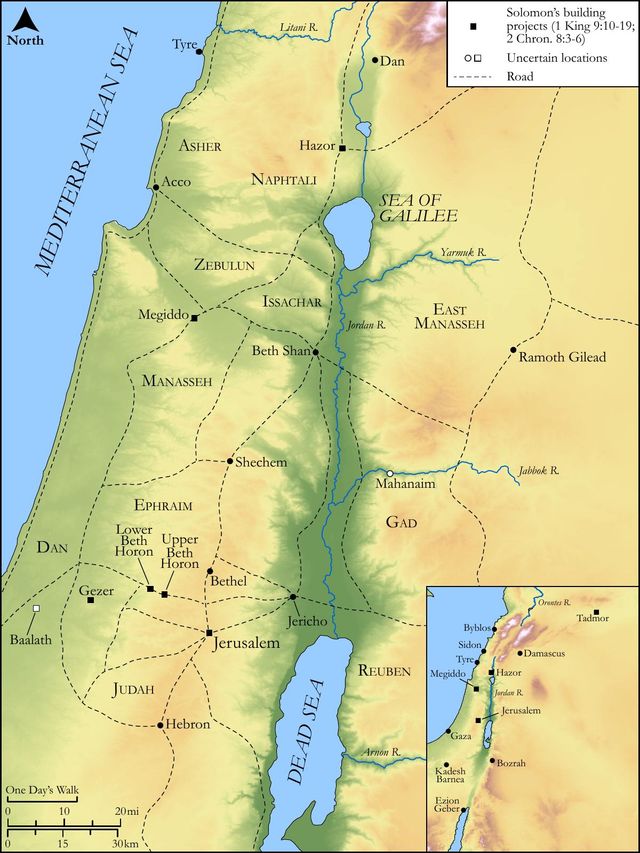
See on the biblical-era map
Study this verse
Public-domain commentary
Matthew Henry
From his Commentary on the Whole Bible. Henry comments on passages, not single verses — this entry covers 2 Chronicles 8:12–18.
Here is, I. Solomon's devotion. The building of the temple was in order to the service of the temple. Whatever cost he was at in rearing the structure, if he had neglected the worship that was to be performed there, it would all have been to no purpose. Assisting the devotion of others will not atone for our own neglects. When Solomon had built the temple, 1. He kept up the holy sacrifices there, according to the law of Moses, Ch2 8:12, Ch2 8:13. In vain had the altar been built, and in vain had fire come down from heaven, if sacrifices had not been constantly brought as the food of the altar and the fuel of that fire. There were daily sacrifices, a certain rate every day, as duly as the day came, weekly sacrifices on the sabbath, double to what was offered on other days, monthly sacrifices on the new moons, and yearly sacrifices at the three solemn feasts. Those are spiritual sacrifices that are now required of us, which we are to bring daily and weekly; and it is good to be in a settled method of devotion. 2. He kept up the holy songs there, according to the law of David, who is here called the man of God, as Moses was, because he was both instructed and authorised of God to make these establishments; and Solomon took care to see them observed as the duty of every day required, Ch2 8:14. Solomon, though a wise and great man and the builder of the temple, did not attempt to amend, alter, or add to what the man of God had, in God's name, commanded, but closely adhered to that, and used his authority to have that duly observed; and then none departed from the commandment of the king concerning any matter, Ch2 8:15. He observed God's laws, and then all obeyed his orders. When the service of the temple was put into this good order, then it is said, The house of the Lord was perfected, Ch2 8:16. The work was the main matter, not the place; the temple was unfinished till all this was done.
II.Solomon's merchandise.
He did himself in person visit the sea-port towns of Eloth and Ezion-geber; for those that deal much in the world will find it their interest, as far as they can, to inspect their affairs themselves and to see with their own eyes, Ch2 8:17. Canaan was a rich country, and yet must send to Ophir for gold; the Israelites were a wise and understanding people, and yet must be beholden to the king of Tyre for men that had knowledge of the seas, Ch2 8:18. Yet Canaan was God's peculiar land, and Israel God's peculiar people. This teaches us that grace, and not gold, is the best riches, and acquaintance with God and his law, not with arts and sciences, the best knowledge.
Continue studying 2 Chronicles 8:14 across the web’s major study libraries — every link below opens this exact verse, chapter, or book on the destination site.
Read & Compare
 BibleGatewayThis verse in more than 200 translations and 70 languages.
 Bible.comThe YouVersion reader — hundreds of translations, reading plans, and highlights.
 ESV.orgCrossway's official English Standard Version reader.
 NET BibleThe NET translation with 60,000+ translators' notes on every rendering decision.
 STEP BibleTyndale House's free study tool — original text, vocabulary, and scholarly resources.
 BibliaLogos Bible Software's free web reader.
 USCCBThe New American Bible (Revised Edition) with the U.S. bishops' study notes.
Commentaries
 BibleHub CommentariesDozens of classic commentaries on this verse, gathered on one page.
 StudyLightMore than 100 commentary sets — the largest collection on the web.
 BibleRefPlain-English commentary on what this verse means, verse by verse.
 Enduring WordDavid Guzik's free commentary on this chapter, widely used by Bible teachers.
 Bible Study ToolsVerse commentary alongside Greek and Hebrew study aids.
Original Language & Research
- BibleHub InterlinearThe verse word by word — original language, transliteration, and English.
- BibleHub LexiconEvery word's original-language definition and Strong's entry.
 Blue Letter BibleDeep-study tools — Strong's numbers, concordance, and word studies.
 SefariaThe Hebrew text with Rashi and centuries of Jewish commentary.
Sermons, Hymns & Audio


TrulyRandomVerse is not affiliated with these sites and doesn’t control their content. They’re linked because they’re genuinely useful.
Summary
2 Chronicles 8:14 meticulously records King Solomon's faithful and comprehensive organization of the Temple's sacred services, precisely aligning with the divinely inspired blueprint and established order laid down by his father, King David. This verse underscores Solomon's unwavering commitment to ensuring that the roles and responsibilities of the priests, Levites, and porters were clearly defined, systematically arranged into "courses," and diligently executed according to a perpetual, daily schedule, thereby maintaining continuous and orderly worship within the newly completed Jerusalem Temple.
Context
ShowHideLiterary Context
This verse appears at a pivotal juncture in 2 Chronicles, marking a transition from the extensive chronicles of Solomon's grand building projects (chapters 2-8) to the operational and spiritual administration of the magnificent Temple. The preceding verses in Chapter 8 detail Solomon's construction of the Temple, his own palace, and various fortified cities, as well as his administrative control over the land and its people. Having completed these monumental physical structures, Solomon now shifts his focus to the spiritual functioning of the Temple, ensuring that its purpose as the central place of worship for Yahweh is fulfilled with precision and reverence. Verse 14 specifically highlights Solomon's adherence to the organizational structure and divine blueprint for worship that David had established, a testament to the Chronicler's emphasis on continuity with the Davidic covenant and the importance of proper worship. This deep respect for David's legacy, particularly his divinely revealed plans for the Temple and its service, is a recurring theme throughout 1 and 2 Chronicles, as seen in passages like 1 Chronicles 28:11-19.
Historical & Cultural Context
The organization of the Temple service was of paramount importance in ancient Israelite society, as the Temple served not only as the spiritual epicenter but also as a significant national and civic institution. Following centuries of a nomadic Tabernacle, the permanent Temple in Jerusalem symbolized God's enduring presence among His people. The detailed division of labor among the priests, Levites, and porters was not an arbitrary administrative decision but was deeply rooted in the Mosaic Law and further refined by Davidic innovation. The "courses" system, meticulously organized by David (as elaborated in 1 Chronicles 23-26), was a sophisticated administrative structure designed to ensure the sanctity, purity, and efficiency of daily sacrifices, praise, and maintenance. This system allowed for continuous, year-round service without overwhelming any single group, reflecting a highly organized and ritualistic approach to worship that, while sharing some structural similarities with other ancient Near Eastern temple cults, was uniquely dedicated to the worship of Yahweh and His revealed commands.
Key Themes
ShowHideThis verse contributes significantly to several key themes within 2 Chronicles and the broader historical books. Firstly, it underscores the theme of Order and Organization in Worship. Solomon's actions reflect the profound biblical principle that God is a God of order, and therefore, His worship should be conducted with precision, regularity, and discipline, not haphazardly. The mention of "courses" signifies fixed schedules and assigned duties, ensuring that sacred responsibilities were performed with reverence and efficiency. Secondly, the verse highlights Continuity and Legacy of Divine Mandate. Solomon's adherence to "the order of David his father" demonstrates his profound respect for his predecessor's wisdom and a commitment to maintaining the established spiritual heritage. David, often referred to as "the man of God," had received divine revelation for the Temple's design and its service, and Solomon faithfully implemented it, ensuring the Lord's presence continued among His people. Thirdly, it emphasizes Diligence and Regularity in Service, as the phrase "as the duty of every day required" points to the ongoing, daily commitment necessary for the proper functioning of the Temple, signifying a constant, unwavering devotion to God. Lastly, the verse illustrates the Specific Roles and Interdependence within the Priesthood, clearly delineating the distinct functions of the priests (offering sacrifices, ministering), the Levites (praising, assisting priests), and the porters (guarding gates, maintaining order), showcasing a well-defined hierarchy and division of labor crucial for the Temple's seamless operation.
Exposition and Analysis
ShowHideKey Word Analysis
ShowHideThis verb (H5975) means "to stand" or "to cause to stand," but in this context, it carries the sense of "to establish," "to ordain," or "to set in place." It signifies Solomon's deliberate and authoritative act of organizing and implementing the established system. This was not a casual arrangement but a firm, lasting establishment of the Temple's operational structure, ensuring its continuity and stability.
This noun (H4256) refers to a "division," "section," or "portion," specifically denoting the organizational units or shifts into which the priests, Levites, and porters were divided. King David meticulously arranged these groups, primarily into 24 courses (as detailed in 1 Chronicles 24:1-19), to ensure continuous, year-round service. This system guaranteed that the vast and complex duties of the Temple were distributed equitably and performed without interruption, reflecting a highly sophisticated and divinely inspired administrative structure for sacred service.
This versatile noun (H1697) means "word," "matter," or "thing." In this context, "duty" refers to the specific requirements, obligations, or matters that needed to be attended to daily. It highlights the practical, ongoing demands of Temple service, emphasizing that the worship and maintenance were not occasional events but a constant, perpetual responsibility that required diligent and consistent attention from all personnel involved.
Verse Breakdown
ShowHide"And he appointed, according to the order of David his father, the courses of the priests to their service"
This opening clause establishes Solomon's deliberate and authoritative action. The phrase "according to the order of David his father" is crucial, emphasizing that Solomon's organization was not an innovation but a faithful implementation of a pre-existing, divinely-ordained system. The "courses" (divisions) of priests were assigned specific "service" (duties) related to sacrifices, offerings, and ministering before the Lord, ensuring an orderly and continuous discharge of their sacred responsibilities in the Temple.
"and the Levites to their charges, to praise and minister before the priests"
This segment focuses on the Levites, who had distinct "charges" or responsibilities. Their primary roles included leading in praise and worship, often with musical instruments and song, and assisting the priests in various capacities, such as preparing sacrifices, maintaining the Temple facilities, and teaching the Law. This highlights the complementary nature of their roles, working in coordination with the priests within the Temple hierarchy.
"as the duty of every day required"
This phrase underscores the continuous, daily nature of the Temple service. It was not an occasional or seasonal undertaking but a constant, diligent commitment to God's worship, necessitating ongoing effort and dedication from all involved personnel. This speaks to the unwavering devotion and meticulousness expected in the service of the Lord, reflecting the perpetual nature of the covenant relationship.
"the porters also by their courses at every gate"
This specifies another crucial group within the Temple administration: the porters, or gatekeepers. They were responsible for guarding the Temple gates, maintaining order, controlling access to the sacred precincts, and ensuring the security and sanctity of the holy space. Like the priests and Levites, they were organized into "courses" to ensure continuous coverage and efficient operation at all entry points, preventing unauthorized entry and preserving the Temple's purity.
"for so had David the man of God commanded"
This concluding phrase serves as a powerful theological justification and authoritative endorsement for Solomon's actions. It reiterates that the entire organizational structure was not Solomon's invention but a direct implementation of David's commands, which are implicitly presented as divinely authoritative due to David's status as "the man of God." This underscores the supreme importance of obedience to divinely revealed patterns for worship and administration, linking Solomon's reign to the foundational spiritual legacy of David.
Literary Devices
ShowHideThe verse effectively employs Emphasis through repetition and specific phrasing to highlight the paramount importance of order and divine authority. The repeated mention of "courses" for priests, Levites, and porters underscores the meticulous Organization and systematic approach to Temple service. The phrases "according to the order of David his father" and the concluding "for so had David the man of God commanded" function as a powerful Framing Device, attributing ultimate authority and wisdom for the Temple's administration to David. The honorific title "Man of God" attributed to David serves as a Symbol of divine endorsement and prophetic authority, lending immense weight to his commands and, by extension, to Solomon's faithful adherence. The verse also utilizes Specification by clearly delineating the distinct roles and responsibilities of priests, Levites, and porters, showcasing a comprehensive and well-structured division of labor essential for the sacred space's proper functioning.
Theological and Thematic Connections
ShowHideThis verse is a profound theological statement on the nature of worship and divine service. It teaches that God is a God of order, and His worship should reflect that order, not chaos or improvisation. The meticulous organization of the Temple service under Solomon, adhering to David's divinely inspired blueprint, underscores the principle that intentionality, discipline, and reverence are essential components of true worship. It also highlights the importance of continuity in spiritual heritage, valuing the wisdom and divine revelations passed down through generations. Every role, from the most prominent priest to the humble porter, is vital and contributes to the overall functioning of God's house and the glory of His name, emphasizing that all service, when done diligently and according to God's revealed will, is honorable and necessary for the flourishing of God's people.
Reflection and Application
ShowHide2 Chronicles 8:14 offers timeless principles for believers today, emphasizing that our service and worship, both individually and corporately, should be characterized by order, diligence, and faithfulness to God's revealed will. Just as the Temple service was meticulously structured, so too should our spiritual disciplines and church ministries be conducted with intentionality, reverence, and a commitment to excellence. This promotes effectiveness, honors God, and fosters a sense of purpose and unity within the body of Christ. The verse encourages us to value every role within the community of faith, recognizing that whether one is a visible leader or serves in a seemingly humble capacity, all contributions are vital for the proper functioning and spiritual health of the church. Furthermore, Solomon's respect for David's legacy reminds us to appreciate and build upon the spiritual foundations laid by faithful predecessors, stewarding the truths and traditions passed down through generations while remaining diligent in our daily commitment to God's commands and purposes.
Questions for Reflection
ShowHideFAQ
ShowHideWhy was David's "order" so important for Solomon to follow?
ShowHideDavid's "order" was crucial because it was not merely a human organizational scheme but a divinely inspired blueprint for the Temple's construction and its service. As "the man of God," David had received specific instructions and visions from the Lord concerning the Temple's design and the meticulous arrangement of the priestly and Levitical courses (see 1 Chronicles 28:11-19). Solomon's faithful adherence to this order ensured continuity with God's revealed will, prevented chaos in worship, and maintained the sanctity and efficacy of the sacred rituals. It demonstrated his obedience and respect for the divine authority vested in his father's commands, thereby securing God's blessing upon the Temple and the nation as a whole.
What were the specific duties of the priests, Levites, and porters mentioned in this verse?
ShowHideEach group had distinct, yet complementary, responsibilities essential for the Temple's comprehensive operation:
Christ-Centered Fulfillment
ShowHideThe meticulous order and sacrificial system established by David and faithfully implemented by Solomon, as described in 2 Chronicles 8:14, find their ultimate fulfillment and perfection in Jesus Christ. The "courses of the priests" and their daily "service" of offering sacrifices pointed forward to the once-for-all, perfect sacrifice of Jesus, who, as our great High Priest, offered Himself as the complete and sufficient atonement for sin, thereby rendering the continuous animal sacrifices obsolete (see Hebrews 9:11-14). The Levites' role "to praise and minister" foreshadows the new worship in spirit and truth inaugurated by Christ, where believers, through Him, become a "royal priesthood" offering spiritual sacrifices of praise and service (see 1 Peter 2:9 and Romans 12:1). Even the porters, guarding the gates and controlling access to the Temple, can be seen as a shadow of Christ who declares, "I am the door; if anyone enters through Me, he will be saved" and who grants believers direct access to the very presence of God through His blood (see Hebrews 10:19-22). Thus, the Old Testament Temple's ordered service, commanded by "David the man of God," serves as a rich type and shadow, pointing to the superior and eternal order established by Christ, the ultimate "Man of God," who perfectly fulfills all priestly, sacrificial, and access-granting roles, ushering in a new covenant of grace and a new, living way of worship.