


2 Chronicles 8:16
- וַתִּכֹּןva·ti·Konand it was arrangedH3559Conj-w ¦ V-Niphal-ConsecImperf-3fsVerb Niphal Consecutive Imperfect 3rd Singular Feminineוַandתִּכֹּןit was arranged
- כָּלkolallH3605N-mscNoun Singular Masculine Construct
- מְלֶאכֶתme·Le·khet[the] work ofH4399N-fscNoun Singular Feminine Construct
- שְׁלֹמֹהshe·lo·MohSolomonH8010N-proper-mNoun Proper Masculine
- עַד'aduntilH5704PrepPreposition
- הַיּוֹםhai·Yomthe day ofH3117Art ¦ N-mscNoun Singular Masculine Constructהַtheיּוֹםday of
- מוּסַדmu·Sad[the] foundation ofH4143N-mscNoun Singular Masculine Construct
- בֵּיתbeit[the] house ofH1004N-mscNoun Singular Masculine Construct
- יְהוָהYah·wehYahwehH3068N-properNoun Proper Title
- וְעַדve·'adand untilH5704Conj-w ¦ PrepPrepositionוְandעַדuntil
- כְּלֹתוֹke·lo·Towas complete itH3615V-Qal-Inf ¦ 3msVerb Qal Infinitive Constructכְּלֹתwas completeוֹit
- שָׁלֵםsha·Lem[was] completeH8003Adj-msAdjective Singular Masculine Absolute
- בֵּיתbeit[the] house ofH1004N-mscNoun Singular Masculine Construct
- יְהוָהYah·wehYahwehH3068N-properNoun Proper Title
English is a literal word-by-word gloss of the Hebrew, not the KJV's wording. Why?
This is the original text the KJV's translators worked from — each Hebrew word with its own literal English meaning in this verse, prepared by scholars at Tyndale House, Cambridge. The KJV translates whole sentences, not word by word, so its wording differs: one Hebrew word can become several English words, and the KJV may choose “the LORD” where the gloss reads “Yahweh”. Both are faithful — they answer different questions. For the KJV's own rendering, switch to the KJV text.
Details
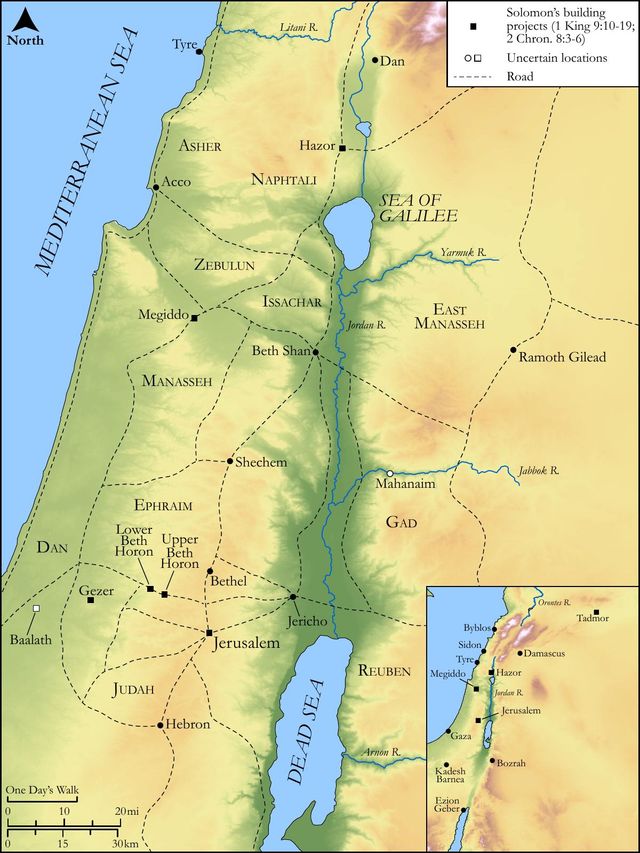
See on the biblical-era map
Study this verse
Public-domain commentary
Matthew Henry
From his Commentary on the Whole Bible. Henry comments on passages, not single verses — this entry covers 2 Chronicles 8:12–18.
Here is, I. Solomon's devotion. The building of the temple was in order to the service of the temple. Whatever cost he was at in rearing the structure, if he had neglected the worship that was to be performed there, it would all have been to no purpose. Assisting the devotion of others will not atone for our own neglects. When Solomon had built the temple, 1. He kept up the holy sacrifices there, according to the law of Moses, Ch2 8:12, Ch2 8:13. In vain had the altar been built, and in vain had fire come down from heaven, if sacrifices had not been constantly brought as the food of the altar and the fuel of that fire. There were daily sacrifices, a certain rate every day, as duly as the day came, weekly sacrifices on the sabbath, double to what was offered on other days, monthly sacrifices on the new moons, and yearly sacrifices at the three solemn feasts. Those are spiritual sacrifices that are now required of us, which we are to bring daily and weekly; and it is good to be in a settled method of devotion. 2. He kept up the holy songs there, according to the law of David, who is here called the man of God, as Moses was, because he was both instructed and authorised of God to make these establishments; and Solomon took care to see them observed as the duty of every day required, Ch2 8:14. Solomon, though a wise and great man and the builder of the temple, did not attempt to amend, alter, or add to what the man of God had, in God's name, commanded, but closely adhered to that, and used his authority to have that duly observed; and then none departed from the commandment of the king concerning any matter, Ch2 8:15. He observed God's laws, and then all obeyed his orders. When the service of the temple was put into this good order, then it is said, The house of the Lord was perfected, Ch2 8:16. The work was the main matter, not the place; the temple was unfinished till all this was done.
II.Solomon's merchandise.
He did himself in person visit the sea-port towns of Eloth and Ezion-geber; for those that deal much in the world will find it their interest, as far as they can, to inspect their affairs themselves and to see with their own eyes, Ch2 8:17. Canaan was a rich country, and yet must send to Ophir for gold; the Israelites were a wise and understanding people, and yet must be beholden to the king of Tyre for men that had knowledge of the seas, Ch2 8:18. Yet Canaan was God's peculiar land, and Israel God's peculiar people. This teaches us that grace, and not gold, is the best riches, and acquaintance with God and his law, not with arts and sciences, the best knowledge.
Continue studying 2 Chronicles 8:16 across the web’s major study libraries — every link below opens this exact verse, chapter, or book on the destination site.
Read & Compare
 BibleGatewayThis verse in more than 200 translations and 70 languages.
 Bible.comThe YouVersion reader — hundreds of translations, reading plans, and highlights.
 ESV.orgCrossway's official English Standard Version reader.
 NET BibleThe NET translation with 60,000+ translators' notes on every rendering decision.
 STEP BibleTyndale House's free study tool — original text, vocabulary, and scholarly resources.
 BibliaLogos Bible Software's free web reader.
 USCCBThe New American Bible (Revised Edition) with the U.S. bishops' study notes.
Commentaries
 BibleHub CommentariesDozens of classic commentaries on this verse, gathered on one page.
 StudyLightMore than 100 commentary sets — the largest collection on the web.
 BibleRefPlain-English commentary on what this verse means, verse by verse.
 Enduring WordDavid Guzik's free commentary on this chapter, widely used by Bible teachers.
 Bible Study ToolsVerse commentary alongside Greek and Hebrew study aids.
Original Language & Research
- BibleHub InterlinearThe verse word by word — original language, transliteration, and English.
- BibleHub LexiconEvery word's original-language definition and Strong's entry.
 Blue Letter BibleDeep-study tools — Strong's numbers, concordance, and word studies.
 SefariaThe Hebrew text with Rashi and centuries of Jewish commentary.
Sermons, Hymns & Audio


TrulyRandomVerse is not affiliated with these sites and doesn’t control their content. They’re linked because they’re genuinely useful.
Summary
2 Chronicles 8:16 serves as a definitive capstone to the account of King Solomon's monumental construction projects, particularly the sacred Temple in Jerusalem. This verse powerfully encapsulates the meticulous planning, comprehensive execution, and ultimate completion of the House of the LORD, affirming that every aspect of the undertaking, from its foundational inception to its final, glorious touches, was brought to a state of divine perfection and readiness for its holy purpose as the consecrated dwelling place of the Almighty.
Context
ShowHideLiterary Context
This verse provides a climactic and summarizing statement, concluding the detailed overview of Solomon's extensive building activities found in 2 Chronicles 8:1-16. Prior to this chapter, the Chronicler meticulously describes the actual construction, dedication, and initial operations of the Temple in chapters 3-7, beginning with Solomon's laying of the foundation in 2 Chronicles 3:1. Following the Temple's completion and its glorious dedication, 2 Chronicles 8 broadens the narrative to encompass Solomon's other significant architectural achievements, including his royal palace, fortified cities, and various administrative centers. It also details his efficient organization of labor, notably distinguishing between the conscription of non-Israelite peoples and the roles of Israelite citizens as officers and soldiers. Therefore, verse 16 acts as a theological pronouncement, emphasizing that amidst all these diverse undertakings, the most crucial and central work—the House of the LORD—was brought to absolute completion and perfection, serving as a profound affirmation of God's blessing and the fulfillment of His covenantal promises to David.
Historical & Cultural Context
Solomon's reign, typically dated from approximately 970-931 BC, is historically characterized as a golden age for Israel, marked by unprecedented peace, immense prosperity, and ambitious architectural endeavors. The construction of a permanent Temple in Jerusalem represented a pivotal shift from the portable Tabernacle, signifying the establishment of a fixed, central dwelling place for God's presence and solidifying Jerusalem's status as the spiritual and political heart of the nation. Culturally, grand-scale building projects were a hallmark of ancient Near Eastern monarchs, often serving as tangible expressions of their power, wealth, and perceived divine favor. Solomon's strategic use of skilled artisans from Tyre, such as Hiram, and the systematic organization of labor, including the corvée (forced labor) of non-Israelite populations, were common practices of the era. The Chronicler, however, takes care to clarify that Israelite citizens were exempt from such forced labor for the Temple itself. The Temple's completion was not merely an architectural marvel; it was a profound national and religious event, symbolizing the enduring covenant relationship between Yahweh and His people, Israel.
Key Themes
ShowHide2 Chronicles 8:16 encapsulates several profound themes central to the Chronicler's theological agenda and the broader biblical narrative. Firstly, it underscores the theme of Diligent Preparation and Meticulous Execution, highlighting that God's work demands not only human effort but also careful planning, foresight, and unwavering commitment to quality. The verse emphasizes that the entire project was "prepared" from its inception. Secondly, it speaks powerfully to the theme of Divine Perfection and Completion, asserting that the Temple was not merely "finished" but "perfected." This signifies a state of absolute wholeness, integrity, and fitness for its sacred purpose, implying God's active hand in bringing His plans to their intended fruition. This resonates deeply with the biblical truth that God is faithful to complete what He starts. Finally, the verse profoundly illustrates the theme of God's Sovereign Oversight in Human Endeavors, where human agency (Solomon's extensive work) is ultimately blessed, guided, and brought to a successful conclusion by divine providence, ensuring that the House of the LORD was constructed precisely according to God's will and for His glory.
Exposition and Analysis
ShowHideKey Word Analysis
ShowHideThis noun (H4399) refers to employment, business, or work, often implying a task that is not servile but rather a skilled occupation or a significant undertaking. In this context, it encompasses the entirety of Solomon's monumental efforts in constructing the Temple, including the planning, craftsmanship, and organization of resources and labor. It emphasizes the comprehensive and purposeful nature of the building project, highlighting the diligent effort invested.
This verb (H3559) signifies to establish, make ready, or make firm. It conveys the idea of careful planning, setting things in order, and ensuring stability from the very beginning. In the context of the Temple, it speaks to the meticulous groundwork, resource gathering, and organizational efforts that went into every stage of construction, from its initial conception to the final day. It implies a deliberate, purposeful, and well-executed process, ensuring a solid foundation and a stable structure.
Derived from the root (H8003), from which "shalom" (peace, wholeness) also comes, shâlêm here means to complete, finish, or make whole. It signifies that the Temple lacked nothing, was sound and intact in every part, and fully accomplished its intended design and purpose. It implies not just the cessation of building activity but the attainment of a state of absolute integrity, wholeness, and fitness, rendering it fully consecrated and ready for divine indwelling and worship.
Verse Breakdown
ShowHide"Now all the work of Solomon was prepared unto the day of the foundation of the house of the LORD,"
This initial clause emphasizes the extensive and comprehensive nature of Solomon's efforts, covering all aspects of the Temple project. The phrase "prepared unto the day of the foundation" highlights that the meticulous planning, organization, and readiness extended backward in time to the very inception of the project. It suggests that the entire undertaking was conceived and organized with remarkable foresight and diligence from its earliest stages, ensuring a solid, well-planned, and divinely sanctioned beginning for the sacred edifice.
"and until it was finished."
This phrase establishes the temporal scope of the preparation and work, indicating that the diligence and thoroughness were maintained consistently throughout the entire construction process. It spans from the foundational stage all the way to the absolute completion of the structure, signifying that no part of the work was left undone or incomplete, and that the initial meticulousness was sustained until the very last detail was addressed.
"[So] the house of the LORD was perfected."
This concluding statement serves as the powerful culmination and theological summary of the preceding clauses. The implied conjunction "So" (present in many translations) indicates the direct result or consequence of the thorough preparation and comprehensive completion. The Temple was not merely "finished" in a functional sense but "perfected," signifying that it reached a state of wholeness, integrity, and divine approval, thereby fully fulfilling its purpose as a sacred dwelling place for God's presence and the center of Israelite worship.
Literary Devices
ShowHideThe verse employs several literary devices to convey its profound message of completion and divine approval. Emphasis is powerfully conveyed through the cumulative language and repetition of ideas related to thoroughness and finality ("all the work," "prepared," "finished," "perfected"). This cumulative effect underscores the magnitude and success of Solomon's monumental undertaking. The use of Hyperbole might be subtly present in "perfected," suggesting an ultimate and ideal state of completion that goes beyond mere functionality, implying divine quality. Furthermore, the Temple itself functions as a profound Symbolism, representing God's covenanted presence among His people, His faithfulness, and the central locus of Israelite worship and national identity. The clear progression within the verse, moving from the "foundation" to the "finished" state and culminating in the declaration that it was "perfected," illustrates a precise Chronological Progression that builds towards a state of ultimate achievement and divine satisfaction.
Theological and Thematic Connections
ShowHideThis verse powerfully articulates the intersection of human diligence and divine enablement within God's overarching redemptive plan. The "perfection" of the Temple is not merely an architectural boast but a profound theological statement about God's faithfulness to establish a dwelling place among His people. It signifies that the work was not only physically complete but also spiritually fit and consecrated for the LORD's holy presence, echoing the divine standard of holiness and wholeness that God demands. This divine oversight in human endeavors assures us that when we commit our work to the LORD with diligence, excellence, and integrity, He brings it to a fruitful and purposeful end that aligns with His will. The Temple, as a physical manifestation of God's presence among His people, foreshadows a more profound and enduring reality of God dwelling with humanity, ultimately fulfilled in Christ and His church.
Reflection and Application
ShowHide2 Chronicles 8:16 offers profound and timeless lessons for contemporary believers, calling us to a higher standard in our service to God. The emphasis on thorough preparation and ultimate perfection in the building of God's house reminds us of the divine call to excellence in all our endeavors for the Lord. Whether in our personal spiritual disciplines, our active service within the local church, or our professional vocations, we are encouraged to approach our tasks with diligence, integrity, and an unwavering commitment to quality, knowing that our work is ultimately for God's glory and His kingdom. Just as Solomon's monumental work was meticulously "prepared" and divinely "perfected," we too are called to be intentional, complete, and faithful in our obedience and service, trusting that God will bring our sincere efforts to their intended fruition. This verse also provides immense comfort and assurance, reminding us that God is utterly faithful to complete the good work He begins, both in our individual lives as He sanctifies us and in His broader kingdom purposes, ultimately ensuring that His eternal dwelling place with humanity will be perfectly established.
Questions for Reflection
ShowHideFAQ
ShowHideWhat does "perfected" truly mean in the context of the Temple's completion in 2 Chronicles 8:16?
ShowHideIn 2 Chronicles 8:16, "perfected" (Hebrew: shâlêm) signifies far more than just physical completion. It means the Temple was brought to a state of absolute wholeness, integrity, and fitness for its intended sacred purpose. It implies that the structure lacked nothing, was sound and complete in every part, and fully met the divine standards for God's dwelling place. It was not merely finished, but fully consecrated, consecrated, and ready for the LORD's presence and the worship of His people, reflecting divine approval and the complete fulfillment of its architectural and theological design.
Why does the Chronicler emphasize Solomon's building work so much, even beyond the Temple itself?
ShowHideThe Chronicler's primary theological purpose is to highlight the enduring Davidic covenant and the paramount importance of the Temple as the central locus of Israel's worship and God's dwelling place. By detailing Solomon's extensive building projects, including his royal palace, fortified cities, and administrative centers (as seen in 2 Chronicles 8:1-6), the Chronicler underscores Solomon's immense wealth, profound wisdom, and the unprecedented peace of his reign—all of which are presented as direct blessings from God. This widespread prosperity and national stability enabled the grandest and most significant project of all: the construction and perfection of the House of the LORD. The broader building efforts thus serve as a comprehensive testament to the multifaceted nature of God's blessing upon Solomon and Israel, culminating in the ultimate success of the Temple project, which was absolutely central to the Chronicler's theological message of God's faithfulness and the importance of proper worship.
Christ-Centered Fulfillment
ShowHideThe perfection of Solomon's Temple, as meticulously described in 2 Chronicles 8:16, finds its ultimate and most profound fulfillment in the person and work of Jesus Christ. While the physical Temple was a magnificent structure, it was ultimately a temporary and symbolic shadow of the true dwelling place of God. Jesus himself boldly declared, "Destroy this temple, and in three days I will raise it up," speaking not of the stone edifice but of the temple of his body. Christ is the ultimate and perfect Temple, the very embodiment of God dwelling among humanity, the Word made flesh who "tabernacled among us" (as seen in John 1:14). His sinless life, sacrificial death, and glorious resurrection represent the definitive "perfecting" work of God, not merely in a physical structure but in the spiritual redemption and reconciliation of humanity. Through His single, perfect offering on the cross, Christ has "perfected for ever them that are sanctified" (Hebrews 10:14), accomplishing what the Old Testament sacrifices and the physical Temple could only foreshadow and point towards. Moreover, through Christ's redemptive work, believers are now spiritually built together into a "holy temple in the Lord," becoming a dwelling place for God by the Spirit, living stones in a spiritual house, perpetually perfected by His grace and indwelling presence. Thus, the completed Temple of Solomon foreshadows the completed work of Christ and the glorious new spiritual reality of God's intimate indwelling in His redeemed people.