


2 Chronicles 8:12
- אָז'azthenH227AdvAdverb
- הֶעֱלָהhe·'e·Lahhe offered upH5927V-Hiphil-Perf-3msVerb Hiphil Perfect 3rd Singular Masculine
- שְׁלֹמֹהshe·lo·MohSolomonH8010N-proper-mNoun Proper Masculine
- עֹלוֹתo·Lotburnt offeringsH5930N-fpNoun Plural Feminine Absolute
- לַיהוָהla·Yah·wehto YahwehH3068Prep-l ¦ N-properNoun Proper TitleלַtoיהוָהYahweh
- עַל'alonH5921PrepPreposition
- מִזְבַּחmiz·Bach[the] altar ofH4196N-mscNoun Singular Masculine Construct
- יְהוָהYah·wehYahwehH3068N-properNoun Proper Title
- אֲשֶׁר'a·SherwhichH834RelParticle Relative
- בָּנָהba·Nahhe had builtH1129V-Qal-Perf-3msVerb Qal Perfect 3rd Singular Masculine
- לִפְנֵיlif·Nei<to> beforeH6440Prep-l ¦ N-mpcNoun Plural Masculine Constructלִ<to>פְנֵיbefore
- הָאוּלָםha·'u·Lamthe porchH197Art ¦ N-msNoun Singular Masculine Absoluteהָtheאוּלָםporch
English is a literal word-by-word gloss of the Hebrew, not the KJV's wording. Why?
This is the original text the KJV's translators worked from — each Hebrew word with its own literal English meaning in this verse, prepared by scholars at Tyndale House, Cambridge. The KJV translates whole sentences, not word by word, so its wording differs: one Hebrew word can become several English words, and the KJV may choose “the LORD” where the gloss reads “Yahweh”. Both are faithful — they answer different questions. For the KJV's own rendering, switch to the KJV text.
Details
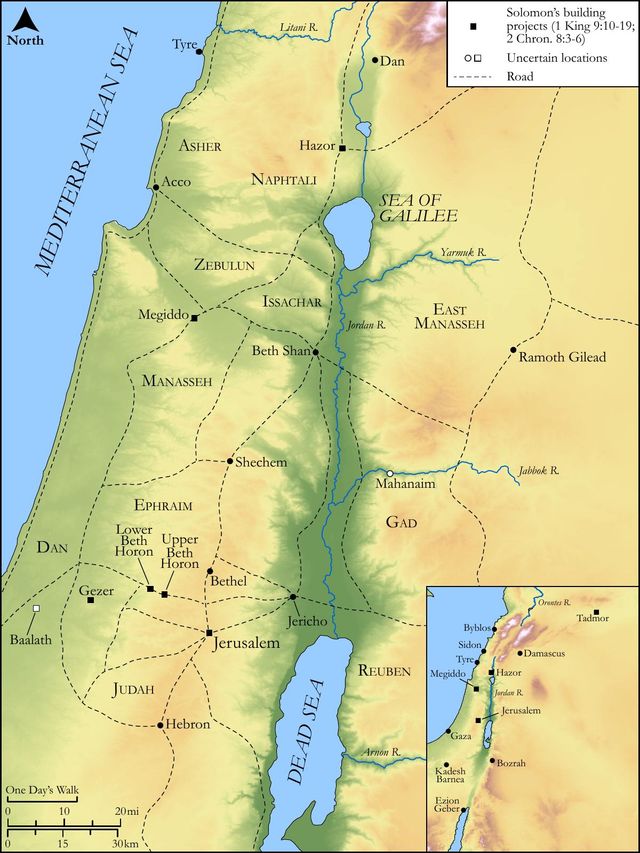
See on the biblical-era map
Study this verse
Public-domain commentary
Matthew Henry
From his Commentary on the Whole Bible. Henry comments on passages, not single verses — this entry covers 2 Chronicles 8:12–18.
Here is, I. Solomon's devotion. The building of the temple was in order to the service of the temple. Whatever cost he was at in rearing the structure, if he had neglected the worship that was to be performed there, it would all have been to no purpose. Assisting the devotion of others will not atone for our own neglects. When Solomon had built the temple, 1. He kept up the holy sacrifices there, according to the law of Moses, Ch2 8:12, Ch2 8:13. In vain had the altar been built, and in vain had fire come down from heaven, if sacrifices had not been constantly brought as the food of the altar and the fuel of that fire. There were daily sacrifices, a certain rate every day, as duly as the day came, weekly sacrifices on the sabbath, double to what was offered on other days, monthly sacrifices on the new moons, and yearly sacrifices at the three solemn feasts. Those are spiritual sacrifices that are now required of us, which we are to bring daily and weekly; and it is good to be in a settled method of devotion. 2. He kept up the holy songs there, according to the law of David, who is here called the man of God, as Moses was, because he was both instructed and authorised of God to make these establishments; and Solomon took care to see them observed as the duty of every day required, Ch2 8:14. Solomon, though a wise and great man and the builder of the temple, did not attempt to amend, alter, or add to what the man of God had, in God's name, commanded, but closely adhered to that, and used his authority to have that duly observed; and then none departed from the commandment of the king concerning any matter, Ch2 8:15. He observed God's laws, and then all obeyed his orders. When the service of the temple was put into this good order, then it is said, The house of the Lord was perfected, Ch2 8:16. The work was the main matter, not the place; the temple was unfinished till all this was done.
II.Solomon's merchandise.
He did himself in person visit the sea-port towns of Eloth and Ezion-geber; for those that deal much in the world will find it their interest, as far as they can, to inspect their affairs themselves and to see with their own eyes, Ch2 8:17. Canaan was a rich country, and yet must send to Ophir for gold; the Israelites were a wise and understanding people, and yet must be beholden to the king of Tyre for men that had knowledge of the seas, Ch2 8:18. Yet Canaan was God's peculiar land, and Israel God's peculiar people. This teaches us that grace, and not gold, is the best riches, and acquaintance with God and his law, not with arts and sciences, the best knowledge.
Continue studying 2 Chronicles 8:12 across the web’s major study libraries — every link below opens this exact verse, chapter, or book on the destination site.
Read & Compare
 BibleGatewayThis verse in more than 200 translations and 70 languages.
 Bible.comThe YouVersion reader — hundreds of translations, reading plans, and highlights.
 ESV.orgCrossway's official English Standard Version reader.
 NET BibleThe NET translation with 60,000+ translators' notes on every rendering decision.
 STEP BibleTyndale House's free study tool — original text, vocabulary, and scholarly resources.
 BibliaLogos Bible Software's free web reader.
 USCCBThe New American Bible (Revised Edition) with the U.S. bishops' study notes.
Commentaries
 BibleHub CommentariesDozens of classic commentaries on this verse, gathered on one page.
 StudyLightMore than 100 commentary sets — the largest collection on the web.
 BibleRefPlain-English commentary on what this verse means, verse by verse.
 Enduring WordDavid Guzik's free commentary on this chapter, widely used by Bible teachers.
 Bible Study ToolsVerse commentary alongside Greek and Hebrew study aids.
Original Language & Research
- BibleHub InterlinearThe verse word by word — original language, transliteration, and English.
- BibleHub LexiconEvery word's original-language definition and Strong's entry.
 Blue Letter BibleDeep-study tools — Strong's numbers, concordance, and word studies.
 SefariaThe Hebrew text with Rashi and centuries of Jewish commentary.
Sermons, Hymns & Audio


TrulyRandomVerse is not affiliated with these sites and doesn’t control their content. They’re linked because they’re genuinely useful.
Summary
Following the successful completion of his monumental building projects, including the magnificent Temple and his royal palace, King Solomon diligently demonstrated his unwavering commitment to the covenant by regularly offering burnt offerings to the LORD. This consistent act of worship, performed on the very altar he had constructed and positioned prominently before the Temple's porch, underscored the spiritual foundation of his reign, affirmed his adherence to the Mosaic Law, and highlighted the centrality of the sacrificial system in ancient Israelite devotion.
Context
ShowHideLiterary Context
This verse immediately follows a detailed account of King Solomon's administrative and architectural achievements, specifically the completion of the Temple and his own royal palace, as outlined in 2 Chronicles 8:1-11. Having firmly established his temporal power and the physical infrastructure of his kingdom, the narrative shifts to highlight his spiritual devotion and adherence to divine ordinances. This transition emphasizes that Solomon's reign was not merely about material splendor but was fundamentally rooted in his relationship with God and the prescribed forms of worship, building upon the grand dedication of the Temple in 2 Chronicles 7. The chronicler consistently portrays Solomon as a faithful king who upheld the religious traditions inherited from his father, David, demonstrating that true kingship in Israel was inextricably linked to covenant faithfulness.
Historical & Cultural Context
Solomon's reign (c. 970-931 BC) marked a period of unprecedented peace, prosperity, and architectural expansion for ancient Israel. The construction of the Temple in Jerusalem was the crowning achievement, solidifying Jerusalem as the religious and political capital. In ancient Israelite culture, the sacrificial system, as meticulously detailed in the Pentateuch (e.g., Leviticus 1-7), was the primary means by which the people approached God, sought atonement for sin, expressed gratitude, and affirmed their covenant relationship. Burnt offerings, in particular, symbolized complete dedication and propitiation. Solomon's regular offerings underscore the importance of maintaining proper worship according to the Law, not just at the Temple's dedication but as an ongoing, foundational practice for the nation. The altar, positioned "before the porch" of the Temple, was the central locus of this sacrificial worship, making it highly visible and accessible for the priests performing the rites on behalf of the people.
Key Themes
ShowHideThe verse contributes to several key themes prevalent in 2 Chronicles. Firstly, it highlights Solomon's Obedience and Piety, demonstrating his commitment to God's commands and the established forms of worship, thereby legitimizing his rule not just by might but by divine favor. This aligns with the chronicler's broader emphasis on the prosperity that accompanies faithfulness to God's covenant, as seen in the blessings promised to David's line in 2 Samuel 7. Secondly, it underscores the Regularity and Centrality of Worship, showing that sacred rites were not one-time events but an ongoing, essential component of national life, reinforcing the continuous need for atonement and communion with God. This aligns with the chronicler's emphasis on faithful adherence to the Mosaic Law, particularly concerning the Temple cult. Thirdly, the focus on the altar emphasizes the Importance of the Sacrificial System as the divinely ordained means of approaching God under the Old Covenant, a system that foreshadowed a greater sacrifice. Finally, Solomon's actions reflect the theme of Divine Provision and Response, as his offerings acknowledge the LORD's sovereignty and seek His continued blessing upon the kingdom, echoing the divine presence that filled the Temple at its dedication in 2 Chronicles 7:1-3.
Exposition and Analysis
ShowHideKey Word Analysis
ShowHideThe Hebrew verb עָלָה (ʻâlâh) literally means "to ascend" or "to go up." In the context of sacrifices, it refers to the act of causing the offering to ascend in smoke to God, implying the burning of the sacrifice. This word choice emphasizes the upward movement and acceptance of the offering by the divine, signifying a complete and dedicated presentation to the LORD.
The Hebrew noun עוֹלָה (ʻôlâh), derived from the verb ʻâlâh, literally means "that which ascends" or "goes up." This term specifically refers to a type of sacrifice where the entire animal (except for the skin) was consumed by fire on the altar, symbolizing complete dedication, surrender, and full atonement for sin. It was a foundational and recurring act of worship, signifying the worshiper's desire for reconciliation and complete devotion to God.
The Hebrew word מִזְבֵּחַ (mizbêach) refers to a place of sacrifice, derived from the root meaning "to slaughter" or "to sacrifice." In the context of the Temple, this was the large bronze altar located in the outer court, directly in front of the Temple building itself. It was the primary site for all animal sacrifices, serving as the focal point of the sacrificial system and the divinely appointed means by which the people could approach God with their offerings.
Verse Breakdown
ShowHide"Then Solomon offered burnt offerings"
This phrase marks a significant transition in the narrative, shifting focus from Solomon's extensive secular achievements to his profound religious duties. The act of "offering" specifically refers to the burning of sacrifices, particularly the ‘olah or burnt offering, which was a regular and central part of Israelite worship. It highlights Solomon's active participation in the prescribed religious rites, demonstrating his personal piety and leadership in the spiritual life of the nation.
"unto the LORD"
This specifies the divine recipient of the offerings. The sacrifices were not for human appeasement or for other deities, but exclusively directed towards Yahweh, the covenant God of Israel. This reinforces the monotheistic nature of Israelite worship and Solomon's adherence to the first commandment, emphasizing that all true worship is directed solely to the sovereign Creator.
"on the altar of the LORD"
This emphasizes the designated and sacred place for these offerings. The altar was not just any structure but "the altar of the LORD," consecrated for divine worship and specifically built according to God's instructions. Its sacred status underscored the holiness of the sacrificial act and the divine acceptance of the offerings made upon it, signifying that God Himself had ordained this means of approach.
"which he had built before the porch"
This detail specifies the precise location of the altar. The "porch" (Hebrew, ʼûlâm) was the entrance hall of the Temple, a prominent and visible part of the sacred structure. Positioning the altar directly "before" or in front of the porch meant it was the first and most central element encountered when approaching the Temple, signifying the foundational role of sacrifice in accessing God's presence and the public nature of these acts of worship. It also reminds the reader that Solomon himself, as the divinely appointed builder of the Temple, was responsible for providing the means for proper and ongoing worship.
Literary Devices
ShowHideThe verse employs several literary devices to convey its meaning and significance. Repetition is evident in the phrase "the LORD" appearing twice, emphasizing the singular focus of Solomon's worship on the covenant God of Israel and reinforcing the divine ownership of both the offerings and the altar. This repetition amplifies the reverence and exclusivity of the worship. Symbolism is central, with the "burnt offerings" symbolizing complete dedication, atonement, and the ascending of worship to God. The "altar" itself is a powerful symbol of divine-human encounter, sacrifice, and reconciliation, serving as the consecrated meeting point. The placement "before the porch" also carries symbolic weight, indicating the accessibility of worship through sacrifice and the foundational role of atonement as the entry point to God's holy presence. This spatial arrangement visually communicates the theological truth that one must first deal with sin through sacrifice before drawing near to God's dwelling.
Theological and Thematic Connections
ShowHideThis verse powerfully connects the Old Covenant sacrificial system to enduring theological principles. Solomon's consistent offering of burnt offerings underscores the biblical truth that access to God and the maintenance of a right relationship with Him have always required a means of atonement and an expression of complete dedication. Under the Mosaic Law, this was achieved through the shedding of animal blood and the complete consumption of the offering, symbolizing the gravity of sin and the need for a perfect, unblemished substitute. While the specific ritual has passed away, the underlying principles of devotion, recognition of sin, and the need for divine provision remain. It highlights that true worship involves both outward actions and inward surrender, pointing to a God who demands holiness and provides a way for His people to draw near. This continuous act of worship also foreshadows the singular, perfect sacrifice that would ultimately fulfill all the requirements of the Law.
Reflection and Application
ShowHideSolomon's diligent practice of offering burnt offerings, even after the grand dedication of the Temple, serves as a profound reminder that true devotion is not merely about monumental achievements or grand gestures, but about consistent, obedient, and heartfelt worship. For believers today, while the physical altar and animal sacrifices are no longer required, the principle of offering our whole selves to God remains paramount. We are called to live lives of continuous worship, not just in church services, but in every aspect of our daily existence—our work, relationships, thoughts, and actions. This means consciously dedicating our time, talents, and resources to God's glory, acknowledging His sovereignty, and seeking His will above our own. Our "altar" is now our heart, where we offer "spiritual sacrifices" of praise, thanksgiving, and obedience, empowered by the finished work of Christ. This consistent spiritual discipline fosters a deeper communion with God and aligns our lives with His purposes, transforming us into living testimonies of His grace and a fragrant aroma to Him.
Questions for Reflection
ShowHideFAQ
ShowHideWhy did Solomon continue to offer burnt offerings regularly after the Temple's dedication?
ShowHideSolomon's continued offering of burnt offerings, as described in 2 Chronicles 8:12, was a fundamental aspect of Israelite worship prescribed by the Mosaic Law. The dedication of the Temple in 2 Chronicles 7 was a unique, grand event, but the sacrificial system was designed for ongoing, daily, weekly, and annual atonement, thanksgiving, and communion with God. The burnt offering (Hebrew, ‘olah) symbolized complete dedication and atonement for unintentional sins, and its regular performance underscored the continuous need for God's grace and the people's perpetual commitment to their covenant relationship. Solomon, as king, was responsible for upholding these divine ordinances and setting an example of piety for the nation, ensuring that the Temple functioned as the center of true and continuous worship.
What is the significance of the altar being "before the porch" of the Temple?
ShowHideThe placement of the bronze altar "before the porch" (or vestibule) of the Temple, as mentioned in 2 Chronicles 8:12, was strategically and symbolically significant. The porch (Hebrew, ʼûlâm) was the main entrance to the Temple building itself, leading into the Holy Place. By placing the altar directly in front of it, it became the first and most prominent feature encountered by anyone approaching the sanctuary. This emphasized that access to God's presence, symbolized by the Temple's interior, was only possible through sacrifice and atonement. It visually reinforced the foundational role of the sacrificial system as the divinely ordained means of reconciliation and communion with God under the Old Covenant. It also highlighted the public and central nature of these acts of worship for the entire community, making it clear that the path to God was through the blood of sacrifice.
Christ-Centered Fulfillment
ShowHideThe burnt offerings made by Solomon on the altar, symbolizing complete dedication and atonement, find their ultimate and perfect fulfillment in the person and work of Jesus Christ. The Old Testament sacrificial system, with its repeated shedding of animal blood, was a shadow pointing to the reality to come. Jesus, as the perfect Lamb of God who takes away the sin of the world, offered Himself as the singular, once-for-all sacrifice for sin, rendering all subsequent animal sacrifices obsolete. His death on the cross was the ultimate "burnt offering," a complete and perfect self-giving that fully propitiated God's wrath against sin and perfectly reconciled humanity to God. As the author of Hebrews declares, "By that will we have been sanctified through the offering of the body of Jesus Christ once for all." Through Christ's finished work, believers now have direct access to God's presence, not through the blood of bulls and goats, but through the precious blood of Jesus, our great High Priest who entered the true heavenly sanctuary (Hebrews 9:11-14). Our worship is now a spiritual offering of ourselves—our lives, praise, and obedience—made acceptable to God through Him (1 Peter 2:5), a living sacrifice that mirrors Christ's perfect self-offering.