


2 Chronicles 8:15
- וְלֹאve·Lo'and notH3808Conj-w ¦ NegParticle Negativeוְandלֹאnot
- סָרוּsa·Ruthey turned asideH5493V-Qal-Perf-3cpVerb Qal Perfect 3rd Plural common gender
- מִצְוַתmitz·Vat[the] command ofH4687N-fscNoun Singular Feminine Construct
- הַמֶּלֶךְha·Me·lekhthe kingH4428Art ¦ N-msNoun Singular Masculine Absoluteהַtheמֶּלֶךְking
- עַל'alonH5921PrepPreposition
- הַכֹּהֲנִיםha·ko·ha·Nimthe priestsH3548Art ¦ N-mpNoun Plural Masculine Absoluteהַtheכֹּהֲנִיםpriests
- וְהַלְוִיִּםve·hal·vi·Yimand the LevitesH3881Conj-w ¦ Art ¦ N-mpNoun Gentilic Plural Masculine AbsoluteוְandהַtheלְוִיִּםLevites
- לְכָלle·kholto anyH3605Prep-l ¦ N-mscNoun Singular Masculine Constructלְtoכָלany
- דָּבָרda·VarmatterH1697N-msNoun Singular Masculine Absolute
- וְלָאֹצָרוֹתve·la·'o·tza·Rotand to the treasuriesH214Conj-w ¦ Prep-l ¦ N-fpNoun Plural Feminine Absoluteוְandלָto theאֹצָרוֹתtreasuries
English is a literal word-by-word gloss of the Hebrew, not the KJV's wording. Why?
This is the original text the KJV's translators worked from — each Hebrew word with its own literal English meaning in this verse, prepared by scholars at Tyndale House, Cambridge. The KJV translates whole sentences, not word by word, so its wording differs: one Hebrew word can become several English words, and the KJV may choose “the LORD” where the gloss reads “Yahweh”. Both are faithful — they answer different questions. For the KJV's own rendering, switch to the KJV text.
Details
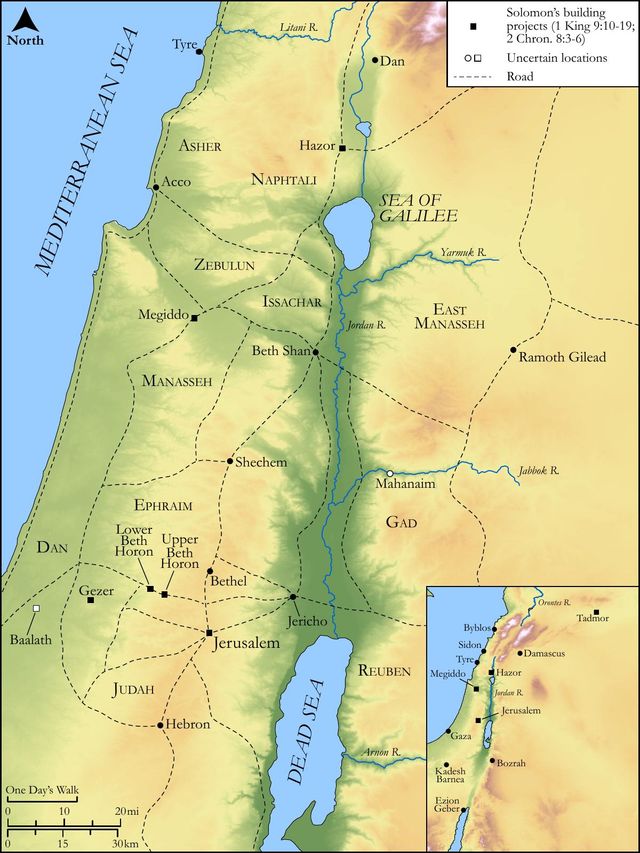
See on the biblical-era map
Study this verse
Public-domain commentary
Matthew Henry
From his Commentary on the Whole Bible. Henry comments on passages, not single verses — this entry covers 2 Chronicles 8:12–18.
Here is, I. Solomon's devotion. The building of the temple was in order to the service of the temple. Whatever cost he was at in rearing the structure, if he had neglected the worship that was to be performed there, it would all have been to no purpose. Assisting the devotion of others will not atone for our own neglects. When Solomon had built the temple, 1. He kept up the holy sacrifices there, according to the law of Moses, Ch2 8:12, Ch2 8:13. In vain had the altar been built, and in vain had fire come down from heaven, if sacrifices had not been constantly brought as the food of the altar and the fuel of that fire. There were daily sacrifices, a certain rate every day, as duly as the day came, weekly sacrifices on the sabbath, double to what was offered on other days, monthly sacrifices on the new moons, and yearly sacrifices at the three solemn feasts. Those are spiritual sacrifices that are now required of us, which we are to bring daily and weekly; and it is good to be in a settled method of devotion. 2. He kept up the holy songs there, according to the law of David, who is here called the man of God, as Moses was, because he was both instructed and authorised of God to make these establishments; and Solomon took care to see them observed as the duty of every day required, Ch2 8:14. Solomon, though a wise and great man and the builder of the temple, did not attempt to amend, alter, or add to what the man of God had, in God's name, commanded, but closely adhered to that, and used his authority to have that duly observed; and then none departed from the commandment of the king concerning any matter, Ch2 8:15. He observed God's laws, and then all obeyed his orders. When the service of the temple was put into this good order, then it is said, The house of the Lord was perfected, Ch2 8:16. The work was the main matter, not the place; the temple was unfinished till all this was done.
II.Solomon's merchandise.
He did himself in person visit the sea-port towns of Eloth and Ezion-geber; for those that deal much in the world will find it their interest, as far as they can, to inspect their affairs themselves and to see with their own eyes, Ch2 8:17. Canaan was a rich country, and yet must send to Ophir for gold; the Israelites were a wise and understanding people, and yet must be beholden to the king of Tyre for men that had knowledge of the seas, Ch2 8:18. Yet Canaan was God's peculiar land, and Israel God's peculiar people. This teaches us that grace, and not gold, is the best riches, and acquaintance with God and his law, not with arts and sciences, the best knowledge.
Continue studying 2 Chronicles 8:15 across the web’s major study libraries — every link below opens this exact verse, chapter, or book on the destination site.
Read & Compare
 BibleGatewayThis verse in more than 200 translations and 70 languages.
 Bible.comThe YouVersion reader — hundreds of translations, reading plans, and highlights.
 ESV.orgCrossway's official English Standard Version reader.
 NET BibleThe NET translation with 60,000+ translators' notes on every rendering decision.
 STEP BibleTyndale House's free study tool — original text, vocabulary, and scholarly resources.
 BibliaLogos Bible Software's free web reader.
 USCCBThe New American Bible (Revised Edition) with the U.S. bishops' study notes.
Commentaries
 BibleHub CommentariesDozens of classic commentaries on this verse, gathered on one page.
 StudyLightMore than 100 commentary sets — the largest collection on the web.
 BibleRefPlain-English commentary on what this verse means, verse by verse.
 Enduring WordDavid Guzik's free commentary on this chapter, widely used by Bible teachers.
 Bible Study ToolsVerse commentary alongside Greek and Hebrew study aids.
Original Language & Research
- BibleHub InterlinearThe verse word by word — original language, transliteration, and English.
- BibleHub LexiconEvery word's original-language definition and Strong's entry.
 Blue Letter BibleDeep-study tools — Strong's numbers, concordance, and word studies.
 SefariaThe Hebrew text with Rashi and centuries of Jewish commentary.
Sermons, Hymns & Audio


TrulyRandomVerse is not affiliated with these sites and doesn’t control their content. They’re linked because they’re genuinely useful.
Summary
Second Chronicles 8:15 serves as a powerful testament to the unwavering obedience and diligent adherence of the priests and Levites to the comprehensive organizational directives issued by King Solomon. This verse encapsulates their faithfulness in upholding every facet of the Temple service, from the intricate ritualistic duties to the meticulous management of sacred treasures, thereby ensuring the orderly, reverent, and divinely sanctioned functioning of God's house as established through Solomon's God-given wisdom and David's foundational plans.
Context
ShowHideLiterary Context
This verse concludes a pivotal section in 2 Chronicles (8:12-16) that meticulously details King Solomon's establishment and organization of the Temple service following its completion and dedication in Jerusalem. Having successfully constructed the magnificent Temple and his own royal palace, Solomon's focus shifts to instituting a permanent and orderly system for worship. The preceding verses delineate his precise arrangements for the priestly courses, the daily burnt offerings, the Sabbath and New Moon sacrifices, and the three annual feasts (Passover, Weeks, and Tabernacles). These arrangements were not arbitrary but were explicitly stated to be in accordance with the Law of Moses and the organizational plans laid out by his father, King David, as extensively documented in 1 Chronicles 23 and 1 Chronicles 24. Verse 15 acts as a concluding affirmation, underscoring the successful implementation and steadfast adherence to these divinely inspired and royally mandated regulations, leading into a summary of the Temple's completion.
Historical & Cultural Context
King Solomon's reign (c. 970-931 BC) represents a zenith of prosperity, peace, and national identity for ancient Israel, largely defined by the construction and establishment of the centralized worship at the Temple in Jerusalem. The Temple was not merely a building; it was the spiritual and cultural epicenter of Israelite life, symbolizing God's dwelling among His people and serving as the primary locus for atonement and communion. The roles of priests and Levites were hereditary, highly structured, and indispensable for maintaining ritual purity, offering sacrifices, and teaching the Mosaic Law. Solomon's administrative prowess, coupled with the divine wisdom bestowed upon him, was crucial in formalizing these roles and ensuring that the complex operations of the Temple, including the handling of vast contributions and sacred items, were managed with integrity and precision. This emphasis on order and meticulous adherence to religious protocol was characteristic of ancient Near Eastern religious practices, but in Israel, it uniquely reflected the holiness and orderliness of Yahweh.
Key Themes
ShowHideThe verse powerfully articulates several core themes central to the Chronicler's theological agenda. First, it profoundly emphasizes Obedience and Faithfulness to divinely appointed authority. The phrase "departed not" underscores an absolute and unwavering commitment to the established order, whether originating directly from God's commands or mediated through the king's decrees, which were understood to align with God's will for His people and His sanctuary. Second, it highlights the paramount importance of Divine Order and Administration in worship and service. Solomon's meticulous organization, rooted in David's prior arrangements and ultimately inspired by God, ensured that the Temple functioned efficiently and reverently. This principle of orderliness in worship is a recurring biblical theme, echoed in later calls for decorum and structure in the New Testament church, such as Paul's instruction for all things to be done "decently and in order" in 1 Corinthians 14:40. Third, the explicit mention of "treasures" brings to the forefront the theme of Stewardship. The priests and Levites were not only responsible for ritual duties but also for the responsible management of the Temple's vast wealth and resources, a principle of faithful management that extends to all believers in their handling of God's gifts, as exhorted in 1 Peter 4:10.
Exposition and Analysis
ShowHideKey Word Analysis
ShowHideFrom the root H5493, meaning "to turn off (literal or figurative); be(-head), bring, call back, decline, depart, eschew, get (you), go (aside), [idiom] grievous, lay away (by), leave undone, be past, pluck away, put (away, down), rebel, remove (to and fro), revolt, [idiom] be sour, take (away, off), turn (aside, away, in), withdraw, be without." The negative construction "departed not" (לֹא סָרוּ, lo' saru) powerfully conveys the absolute and unwavering nature of the priests' and Levites' obedience. It signifies that they did not stray, turn away, or neglect any aspect of the king's instructions, emphasizing their steadfast adherence and faithfulness to the established order.
Meaning "a command, whether human or divine (collectively, the Law); (which was) commanded(-ment), law, ordinance, precept." While often used to refer to God's divine commandments (as in the Mosaic Law), here "mitsvâh" denotes a royal decree or instruction. In this context, Solomon's "commandment" is understood not as an arbitrary human dictate but as an administrative order that aligns with and implements the divine will for the proper functioning of the Temple and its services, reflecting the king's role as God's anointed agent.
Meaning "a depository; armory, cellar, garner, store(-house), treasure(-house) (-y)." This term refers to the stored wealth, sacred offerings, and valuable resources of the Temple. It encompasses not only monetary contributions but also precious vessels, dedicated items, and provisions for the Temple's upkeep and the support of its personnel. The inclusion of "treasures" highlights the comprehensive scope of the priests' and Levites' responsibilities, extending beyond ritual duties to include meticulous financial and material stewardship.
Verse Breakdown
ShowHide"And they departed not from the commandment of the king"
This opening clause establishes the central theme of unwavering obedience. "They" refers to the priests and Levites, the primary religious functionaries of the Temple. Their actions were in direct and full compliance with the directives issued by King Solomon, indicating a disciplined and faithful execution of their duties without deviation or neglect. This highlights a profound respect for both royal and, by extension, divine authority.
"unto the priests and Levites"
This specifies the recipients of the king's comprehensive organizational decrees. It underscores that the established order applied directly and specifically to those entrusted with the sacred duties of Temple worship and administration, highlighting their unique responsibility and accountability before God and the king.
"concerning any matter"
This phrase emphasizes the comprehensive nature of their obedience. It implies that their adherence was not selective but extended to every single detail of their responsibilities, whether procedural, ceremonial, or administrative. This demonstrates a thoroughness that left no room for personal interpretation, laxity, or half-hearted compliance, ensuring the integrity of the entire system.
"or concerning the treasures"
This final clause provides a specific and crucial example of the breadth of their obedience. It highlights their faithfulness in managing the Temple's valuable resources, offerings, and stored wealth. This demonstrates that their integrity and diligence encompassed not only their spiritual duties but also their material stewardship, ensuring the proper, accountable, and reverent use of God's provisions for His house and His people.
Literary Devices
ShowHideThe verse employs Conciseness to deliver a powerful summary statement, distilling a complex reality of diligent administration into a single, impactful sentence. The negative construction "departed not" serves as a form of Emphasis, powerfully highlighting the steadfastness and absolute adherence of the priests and Levites, rather than merely stating that they obeyed. This negative phrasing underscores the complete absence of any deviation, making their obedience particularly noteworthy and exemplary. Furthermore, the phrase "concerning any matter, or concerning the treasures" functions as a form of Merism, where two contrasting or complementary parts ("any matter" representing the general, and "treasures" representing a specific, critical aspect) are used to encompass the totality of their responsibilities. This literary technique effectively conveys the comprehensive scope of their faithfulness, covering all aspects of their duties from the general to the particular.
Theological and Thematic Connections
ShowHideThe unwavering obedience of the priests and Levites in 2 Chronicles 8:15 resonates deeply with broader biblical themes of faithfulness to divine instruction and the importance of order in worship. Their adherence to Solomon's commands, which were themselves an outworking of God's design for the Temple, serves as a model for all who serve God. It underscores that true spiritual service is not merely about outward acts but about a heart posture of submission to God's established ways, whether directly revealed or mediated through godly leadership. This commitment ensures that God's house functions according to His will, glorifying Him through reverent and orderly worship and responsible stewardship of His resources.
Reflection and Application
ShowHideThe steadfast obedience of the priests and Levites in 2 Chronicles 8:15 offers a profound challenge and encouragement for believers today. In a world often characterized by individualism, a questioning of authority, and a tendency towards convenience, this verse calls us to a renewed commitment to faithful adherence—not to blind obedience, but to discerning and submitting to godly order, whether in our churches, communities, or personal lives. It reminds us that diligence in "any matter" and integrity "concerning the treasures" are not peripheral but central to our walk with God. Our service, whether in formal ministry, vocational calling, or the seemingly mundane tasks of daily life, should be marked by the same unwavering commitment to biblical principles and responsible stewardship of all that God has entrusted to us—our time, talents, resources, and spiritual gifts. When we serve with such faithfulness, we contribute to the orderly and effective functioning of God's purposes in the world, bringing Him honor and blessing to those around us, reflecting the very character of God.
Questions for Reflection
ShowHideFAQ
ShowHideWhat was the significance of "the commandment of the king" in this context?
ShowHideIn ancient Israel, the king, especially one like Solomon who was divinely appointed and endowed with wisdom, acted as God's representative on earth. Therefore, "the commandment of the king" concerning the Temple service was not seen as merely a human decree but as an administrative order that aligned with and implemented the divine will and the Mosaic Law regarding worship. Solomon's commands were based on the detailed plans given by his father David, which were themselves inspired by God (see 1 Chronicles 28:11-19). Thus, the priests' and Levites' obedience to the king's commands was tantamount to obedience to God's established order for His house and His people.
Why is the mention of "treasures" specifically highlighted in this verse?
ShowHideThe specific mention of "treasures" underscores the comprehensive nature of the priests' and Levites' responsibilities and their integrity. It highlights that their faithfulness extended beyond ritualistic and ceremonial duties to include the crucial aspect of financial and material stewardship. The Temple accumulated vast wealth through offerings, tithes, and dedications, and the honest and meticulous management of these resources was vital for the Temple's upkeep, the support of its personnel, and the overall integrity of the worship system. This detail emphasizes that faithfulness in God's service involves both spiritual devotion and practical, ethical administration of resources, a principle that remains profoundly relevant for the church today (Matthew 25:21).
Christ-Centered Fulfillment
ShowHideWhile 2 Chronicles 8:15 speaks of the Old Covenant priests' and Levites' obedience to King Solomon's directives concerning the physical Temple, it powerfully foreshadows the perfect obedience of the ultimate King and High Priest, Jesus Christ. Unlike the Levitical priests, who, despite their faithfulness, were imperfect and subject to human limitations, Christ perfectly fulfilled every divine command and perfectly administered the "treasures" of God's kingdom. His entire life was one of unwavering obedience to His Father's will, even to the point of death on the cross, as beautifully articulated in Philippians 2:8. Furthermore, Christ Himself is the new and eternal Temple, the dwelling place of God, and through His sacrifice, He has established a new covenant where believers are made "a chosen race, a royal priesthood" (1 Peter 2:9). We are now called to live in obedience to Him, stewarding the spiritual "treasures" of the Gospel and the gifts of the Spirit, ensuring that our lives and ministries are conducted in the perfect order established by our Lord, who is both our King and our High Priest forever, as profoundly described in Hebrews 7 and Hebrews 9.