


Numbers 18:24
- כִּיkiforH3588PrtParticle Conditional
- אֶת'et<obj.>H853DirObjMParticle Object Indicator
- מַעְשַׂרma'·Sar[the] tithe ofH4643N-mscNoun Singular Masculine Construct
- בְּנֵיbe·nei[the] people ofH1121N-mpcNoun Plural Masculine Construct
- יִשְׂרָאֵלYis·ra·'ElIsraelH3478N-properNoun Proper Location
- אֲשֶׁר'a·SherwhichH834RelParticle Relative
- יָרִימוּya·Ri·muthey will offer upH7311V-Hiphil-Imperf-3mpVerb Hiphil Imperfect 3rd Plural Masculine
- לַיהוָהla·Yah·wehto YahwehH3068Prep-l ¦ N-properNoun Proper TitleלַtoיהוָהYahweh
- תְּרוּמָהte·ru·Maha contributionH8641N-fsNoun Singular Feminine Absolute
- נָתַתִּיna·Ta·tiI giveH5414V-Qal-Perf-1csVerb Qal Perfect 1st Singular common gender
- לַלְוִיִּםlal·vi·Yimto the LevitesH3881Prep-l ¦ N-mpNoun Gentilic Plural Masculine Absoluteלַto theלְוִיִּםLevites
- לְנַחֲלָהle·na·cha·Lahfor an inheritanceH5159Prep-l ¦ N-fsNoun Singular Feminine Absoluteלְforנַחֲלָהan inheritance
- עַל'althere-H5921PrepPreposition
- כֵּןken-foreH3651AdvAdverb
- אָמַרְתִּי'a·Mar·tiI have saidH559V-Qal-Perf-1csVerb Qal Perfect 1st Singular common gender
- לָהֶםla·Hemof <the> themPrep-l ¦ 3mpSuffix Personal 3rd Plural Masculineלָof <the>הֶםthem
- בְּתוֹךְbe·toKhin amongH8432Prep-b ¦ N-mscNoun Singular Masculine Constructבְּinתוֹךְamong
- בְּנֵיbe·Nei[the] people ofH1121N-mpcNoun Plural Masculine Construct
- יִשְׂרָאֵלYis·ra·'ElIsraelH3478N-properNoun Proper Location
- לֹאlo'notH3808NegParticle Negative
- יִנְחֲלוּyin·cha·Luthey will inheritH5157V-Qal-Imperf-3mpVerb Qal Imperfect 3rd Plural Masculine
- נַחֲלָהna·cha·Lahan inheritanceH5159N-fsNoun Singular Feminine Absolute
English is a literal word-by-word gloss of the Hebrew, not the KJV's wording. Why?
This is the original text the KJV's translators worked from — each Hebrew word with its own literal English meaning in this verse, prepared by scholars at Tyndale House, Cambridge. The KJV translates whole sentences, not word by word, so its wording differs: one Hebrew word can become several English words, and the KJV may choose “the LORD” where the gloss reads “Yahweh”. Both are faithful — they answer different questions. For the KJV's own rendering, switch to the KJV text.
Details
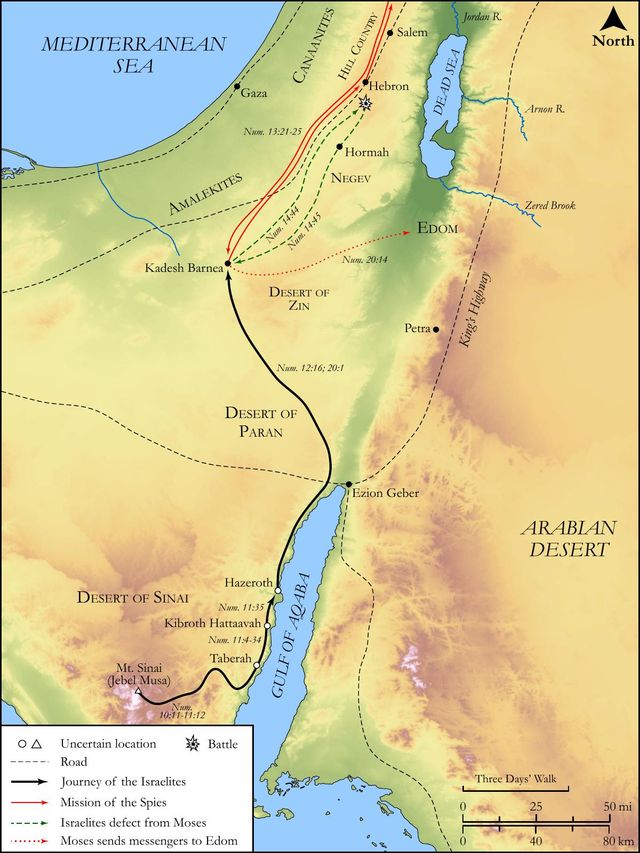
See on the biblical-era map
Study this verse
Public-domain commentary
Matthew Henry
From his Commentary on the Whole Bible. Henry comments on passages, not single verses — this entry covers Numbers 18:20–32. His four-level outline is real structure in the source text, so it is rendered as structure.
Here is a further account of the provision that was made both for the Levites and for the priests, out of the country.
I.They must have no inheritance in the land; only cities to dwell in were afterwards allowed them, but no ground to occupy:
Thou shalt not have any part among them, Num 18:20. It is repeated again Num 18:23, and again Num 18:24, Among the children of Israel they shall have no inheritance, either by purchase or descent. God would have them comfortably provided for, but would not have their families over-rich, lest they should think themselves above that work which their wages supposed and obliged them constantly to attend upon. As Israel was a peculiar people, and not to be numbered among the nations, so Levi was a peculiar tribe, and not to be settled as the rest of the tribes, but in all respects distinguished from them. A good reason is given why they must have no inheritance in the land, for, says God, I am thy part, and thy inheritance. Note, Those that have God for their inheritance and their portion for ever ought to look with a holy contempt and indifference upon the inheritances of this world, and not covet their portion in it. "The Lord is my portion, therefore will I hope in him, and not depend upon any thing I have on this earth," Lam 3:24. The Levites shall have no inheritance, and yet they shall live very comfortably and plentifully - to teach us that Providence has various ways of supporting those that live in a dependence upon it; the fowls reap not, and yet are fed, the lilies spin not, and yet are clothed, the Levites have no inheritance in Israel, and yet live better than any other tribe. The repetition of that caution, that no Israelite should approach the tabernacle, comes in suitable, though somewhat abruptly, Num 18:22. It seems set in opposition to that order concerning the priests and Levites that they should have no inheritance in Israel, to show how God dispenses his favours variously. The Levites have the honour of attending the tabernacle, which is denied the Israelites; but then the Israelites have the honour of inheritances in Canaan, which is denied the Levites; thus each is kept from either envying or despising the other, and both have reason to rejoice in their lot. The Israelites must not come nigh the tabernacle, but then the Levites must have no inheritance in the land; if ministers expect that people should keep in their sphere, and not intermeddle with sacred offices, let them keep in theirs, and not entangle themselves in secular affairs.
II.But they must both have tithes of the land.
Besides the first-fruits which were appropriated to the priests, which, the Jews say, were to be a fiftieth part, or at least a sixtieth, the tithe also was appropriated.
1.The Levites had the tithes of the people's increase (Num 18:21): I have given (whose the whole is) all the tenths in Israel, of all the productions of the land, to the children of Levi, to be divided among them in just proportions, for their service which they serve. The Levites were the smallest tribe of the twelve, and yet, besides all other advantages, they had a tenth part of the yearly profits, without the trouble and expense of ploughing and sowing; such care did God take of those that were devoted to his service; not only that they might be well maintained, but that they might be honoured with a national acknowledgment of the good services they did to the public, and owned as God's agents and receivers; for that which was a heave-offering, or an offering lifted heavenward unto the Lord, was by him consigned to the Levites.
2.The priests had the tenths of the Levites' tithes settled upon them. The order for this Moses is directed to give to the Levites, whom God would have to pay it with cheerfulness, rather than the priests to demand it with authority: Speak to the Levites that it be offered by them, rather than levied upon them. Now observe,
(1.)The Levites were to give God his dues out of their tithes, as well as the Israelites out of their increase. They were God's tenants, and rent was expected from them, nor were they exempted by their office. Thus now, ministers must be charitable out of what they receive; and the more freely they have received the more freely they must give, and be examples of liberality. You shall offer a heave-offering to the Lord, Num 18:26. Those that are employed to assist the devotions of others must be sure to pay their own, as a heave-offering to the Lord. Prayers and praises lifted up to God, or rather the heart lifted up in them, are now our heave-offerings. This (says God) shall be reckoned to you as though it were the corn of the threshing-floor; that is, though it was not the fruit of their ground, nor of their own labour, as the tithes of other Israelites were, yet being of such as they had it should be accepted, to the sanctifying of all the rest.
(2.)This was to be given to Aaron the priest (Num 18:28), and to his successors the high priests, to be divided and disposed of in such proportions as they should think fit among the inferior priests. Most of the profits of the priests' office, which were appointed in the former part of the chapter, arising from the sacrifices, those priests had the benefit of who constantly attended at the altar; but, forasmuch as there were many priests employed in the country to teach and rule, those tithes taken by the Levites, it is probable, were directed by the high priest for their maintenance. It is the probable conjecture of the learned bishop Patrick that the tenth of this last tenth was reserved for the high priest himself, to support his state and dignity; for otherwise we read not of any peculiar provision made for him.
(3.)When the Levites had thus paid the tenth of their income, as a heave-offering to the Lord, they had themselves the comfortable enjoyment of the other nine parts (Num 18:30): "When you have thus heaved the best from it (for still God's part must be the best) then you shall eat the rest, not as a holy thing, but with the same freedom that the other Israelites eat their part with, in every place, you and your households," Num 18:31. See here what is the way to have the comfort of all our worldly possessions so as to bear no sin by reason of them, as it follows, Num 18:32.
[1.]We must be sure that what we have be got honestly and in the service of God. It is your reward for your service; that meat is the best eating that is first earned; but, if any will not work, neither shall he eat, Th2 3:10. And that seems to be spoken of as having a particular comfort and satisfaction in it which is the reward of faithful service done in the tabernacle of the congregation.
[2.]We must be sure that God has his dues out of it. Then we have the comfort of our substance when we have honoured the Lord with it. The you shall bear no sin by reason of it, when you have heaved the best from it. This intimates that we must never feed ourselves without fear, lest our table become a snare, and we bear sin by reason of it; and that therefore we are concerned to give alms of such things as we have, that all may be clean and comfortable to us.
Continue studying Numbers 18:24 across the web’s major study libraries — every link below opens this exact verse, chapter, or book on the destination site.
Read & Compare
 BibleGatewayThis verse in more than 200 translations and 70 languages.
 Bible.comThe YouVersion reader — hundreds of translations, reading plans, and highlights.
 ESV.orgCrossway's official English Standard Version reader.
 NET BibleThe NET translation with 60,000+ translators' notes on every rendering decision.
 STEP BibleTyndale House's free study tool — original text, vocabulary, and scholarly resources.
 BibliaLogos Bible Software's free web reader.
 USCCBThe New American Bible (Revised Edition) with the U.S. bishops' study notes.
Commentaries
 BibleHub CommentariesDozens of classic commentaries on this verse, gathered on one page.
 StudyLightMore than 100 commentary sets — the largest collection on the web.
 BibleRefPlain-English commentary on what this verse means, verse by verse.
 Enduring WordDavid Guzik's free commentary on this chapter, widely used by Bible teachers.
 Bible Study ToolsVerse commentary alongside Greek and Hebrew study aids.
Original Language & Research
- BibleHub InterlinearThe verse word by word — original language, transliteration, and English.
- BibleHub LexiconEvery word's original-language definition and Strong's entry.
 Blue Letter BibleDeep-study tools — Strong's numbers, concordance, and word studies.
 SefariaThe Hebrew text with Rashi and centuries of Jewish commentary.
Sermons, Hymns & Audio


TrulyRandomVerse is not affiliated with these sites and doesn’t control their content. They’re linked because they’re genuinely useful.
Summary
Numbers 18:24 comprehensively outlines the unique provision for the Levitical tribe, establishing their divine inheritance not in territorial land but in the tithes contributed by the other tribes of Israel. This verse underscores God's meticulous care for those consecrated to His service, ensuring their sustenance through the offerings presented by the people. This arrangement freed the Levites to dedicate themselves entirely to their sacred duties within the Tabernacle and later, the Temple, without the distractions of agricultural labor or concerns over material inheritance, thereby facilitating their singular focus on spiritual ministry.
Context
ShowHideLiterary Context
Numbers 18:24 is situated within a crucial section (Numbers 18-19) that meticulously details the duties, privileges, and responsibilities of the Aaronic priesthood and the Levites. This passage immediately follows the severe judgment on Korah, Dathan, and Abiram's rebellion, which profoundly challenged the divinely appointed authority of Aaron and the exclusive role of the Levites in Tabernacle service. In response to this rebellion, God unequivocally reaffirms the sanctity of the priesthood and the distinct, non-transferable nature of Levitical service. Chapter 18, in particular, meticulously outlines the specific offerings and portions designated for the priests and Levites, emphasizing their separation for holy service and their unique mode of sustenance. This verse, therefore, serves as a foundational declaration regarding the Levites' economic model, directly linked to their consecrated status and God's sovereign provision for His chosen servants within the covenant community. The broader context of Numbers 18 emphasizes the sacredness of the Tabernacle and the necessity of proper priestly and Levitical service to avoid divine wrath.
Historical & Cultural Context
In ancient Israel, land inheritance was of paramount importance, signifying not only economic security but also tribal identity, social standing, and continuity within the covenant community. Each of the twelve tribes, descended from Jacob's sons, was allotted a specific territory in the Promised Land, forming the bedrock of their economic and social life. The Levites, however, were deliberately set apart from this conventional system of land ownership. Their divinely ordained role as guardians of the Tabernacle, teachers of the Law, and assistants to the priests meant they could not be tied to agricultural pursuits or specific territorial ownership. Instead, their "inheritance" was explicitly the Lord Himself and the provisions He commanded from the people. This unique arrangement allowed them to be distributed among all the tribes in designated Levitical cities, serving as spiritual guides, judicial authorities, and educators throughout the land, a concept further elaborated in Deuteronomy 10:9 and Joshua 21. This distinct economic model underscored their complete dependence on God and the faithfulness of the people.
Key Themes
ShowHideThis verse contributes significantly to several foundational themes within the book of Numbers and the broader Pentateuch. Firstly, it highlights the theme of Divine Provision and Stewardship, demonstrating God's unwavering faithfulness in providing for those consecrated to His service, while simultaneously establishing the people's sacred responsibility to support the sacred ministry through their tithes. This reciprocal relationship underscores God's meticulous care for His covenant people. Secondly, it reinforces the theme of Separation and Consecration, underscoring the Levites' unique status as a tribe "set apart" for the Lord, distinct from the other tribes in their duties, their means of livelihood, and their ultimate inheritance. This separation is rooted in their dedication to the Lord, as seen in Numbers 3:5-9. Thirdly, the verse clarifies the Sacred Nature of the Tithe, describing it as an "heave offering unto the LORD." This emphasizes that the tithe was not merely a tax for the Levites but an offering to God that He then designated for their support. This elevates tithing to an act of worship, obedience, and an acknowledgment of God's ultimate ownership of all resources, as commanded in Leviticus 27:30.
Exposition and Analysis
ShowHideKey Word Analysis
ShowHideMeaning "a tenth; especially a tithe." In the Mosaic Law, this referred to a divinely mandated portion, typically a tenth of agricultural produce and livestock, which was to be given to the Lord. It signified God's ownership over all things and the people's acknowledgment of His sovereignty and provision. It was a regular, obligatory contribution, distinct from voluntary offerings, forming the primary economic support for the Levites.
Meaning "a present (as offered up), especially in sacrifice or as tribute; gift, heave offering." This term denotes a contribution or offering that was "lifted up" or "set apart" from the general produce or possessions and presented to the Lord. Its application to the tithe signifies that the tithe was not merely a tax or a payment to the Levites, but a sacred contribution directed to God Himself, which He then designated for the support of His consecrated servants.
Meaning "something inherited, i.e. (abstractly) occupancy, or (concretely) an heirloom; generally an estate, patrimony or portion." In the context of Israel, this term primarily referred to the tribal land allotments. For the Levites, however, their "inheritance" was redefined by God to be the tithes and offerings of the people, emphasizing their unique relationship with the Lord as their ultimate portion and provider, rather than a physical territory.
Verse Breakdown
ShowHide"But the tithes of the children of Israel, which they offer [as] an heave offering unto the LORD"
This opening clause establishes both the source and the sacred nature of the Levites' provision. The "tithes" (a tenth of produce and livestock) are explicitly declared to be an "heave offering unto the LORD." This signifies that these contributions are consecrated to God first, underscoring their sacred character and the divine authority behind their collection. It highlights that the people's act of giving is fundamentally an act of worship and obedience directed to God Himself, not merely a practical tax for the Levites. This designation elevates the tithe from a mundane transaction to a holy act.
"I have given to the Levites to inherit"
Here, God directly declares His sovereign act of allocating these tithes to the Levites. The phrase "I have given" emphasizes divine initiative and authority. The term "to inherit" is crucial, as it redefines the concept of inheritance for this specific tribe. While other tribes inherited land, the Levites inherited a divine provision, ensuring their sustenance directly from God's hand through the people's obedience. This unique form of inheritance underscores their distinct relationship with the Lord, who Himself becomes their ultimate portion and provider.
"therefore I have said unto them, Among the children of Israel they shall have no inheritance"
This final clause reiterates and reinforces the Levites' distinct status and the theological rationale behind it. Their lack of territorial inheritance among the other tribes is a direct consequence of their divine designation and their unique inheritance in the Lord. This separation allowed them to be wholly devoted to the service of God and the spiritual well-being of the entire nation, without the economic ties or responsibilities of land ownership and agricultural labor. Their lack of earthly inheritance paradoxically signified a richer, spiritual inheritance in God's direct provision and presence.
Literary Devices
ShowHideNumbers 18:24 employs several potent literary devices to convey its profound message and underscore the divine decree. Divine Fiat is powerfully evident in the direct, authoritative declarations "I have given" and "I have said," emphasizing God's absolute sovereignty and unchallengeable authority in establishing this unique arrangement for the Levites. There is a clear Contrast established between the Levites and the other "children of Israel" regarding their inheritance; one receives land, the other receives the Lord's provision through the tithes. This stark contrast highlights the Levites' consecrated status and their distinct calling. The Repetition of the concept of "inheritance" (what they do inherit – the tithes, and what they do not inherit – land) serves to underscore the theological significance of their unique calling and provision, reinforcing the idea that their portion is spiritual, not material in the conventional sense. Furthermore, the phrase "heave offering unto the LORD" functions as powerful Symbolism, transforming a material contribution into a sacred act of worship and dedication to God, reinforcing the spiritual nature and divine destination of the tithe.
Theological and Thematic Connections
ShowHideNumbers 18:24 is foundational for understanding the enduring biblical principle of divine provision for those in ministry and the sacred nature of giving. It establishes that those set apart for God's service are to be supported by the community, allowing them to focus entirely on their spiritual duties without the burden of secular labor for sustenance. This arrangement reflects God's meticulous care for His servants and His expectation that His people will participate in sustaining His work on earth. The verse also reinforces the profound concept that true inheritance for God's people is ultimately found in Him, rather than in earthly possessions or temporal security. This principle transcends the Old Covenant, pointing to a spiritual reality where God Himself is the ultimate portion and reward for His faithful servants.
Reflection and Application
ShowHideNumbers 18:24, while rooted in the Old Covenant economy and specific to the Levitical priesthood, offers timeless principles for believers today, illuminating God's faithfulness and the community's responsibility. It reminds us that God is faithful to provide for those whom He calls into service, and that His people have a sacred responsibility to participate in that provision. Just as the Levites were freed from worldly concerns to fully embrace their spiritual duties, those who dedicate their lives to ministry today should be supported by the body of Christ, enabling them to devote themselves wholeheartedly to teaching, preaching, and shepherding the flock. This verse calls us to recognize God's ultimate ownership of all resources and to engage in generous giving as an act of worship and obedience, trusting that our contributions enable the advancement of His kingdom and the flourishing of His church. It fosters a spirit of interdependence within the community of faith, where each part contributes to the health and vitality of the whole, reflecting a divine design for mutual support and shared mission. Our giving, like the tithe, should be seen as an "heave offering unto the LORD," a sacred act of devotion.
Questions for Reflection
ShowHideFAQ
ShowHideWas the tithe to the Levites a tax or a voluntary offering?
ShowHideNumbers 18:24 explicitly describes the tithes as an "heave offering unto the LORD," which signifies a divinely mandated and consecrated contribution, rather than a mere tax or a purely voluntary donation. While it served the practical purpose of supporting the Levites, its theological significance was paramount: it was an act of worship and obedience, acknowledging God's ownership of all things and His right to a portion. The Lord commanded the tithe, making it an obligatory part of Israelite worship and their covenant relationship with God, as seen in Leviticus 27:30. This divine command underscores its sacred and obligatory nature within the Old Covenant.
Christ-Centered Fulfillment
ShowHideNumbers 18:24, with its depiction of the Levites' unique inheritance and their role as mediators and servants in the Tabernacle, finds its ultimate fulfillment in Jesus Christ. The Levites, set apart from the other tribes and sustained by the tithes, foreshadowed Christ's own singular dedication to the Father's will and His being "set apart" as our great High Priest. Unlike the Levitical priests, whose inheritance was earthly provision, Jesus' inheritance is eternal glory and all authority in heaven and on earth, achieved through His perfect obedience and sacrificial death. The very system of tithes and offerings, which supported the Levitical priesthood, pointed to the need for a perfect sacrifice and a perfect priest. The New Covenant, inaugurated by Christ, renders the Levitical system obsolete, as Hebrews 7:12 explains, "for when there is a change in the priesthood, there must also be a change in the law." Jesus, as our eternal High Priest after the order of Melchizedek, does not require tithes for His sustenance, for He is the one who provides all things. His "inheritance" is not a portion of Israel's produce, but the redemption of all who believe, purchased by His own blood. He is the ultimate "heave offering," lifted up on the cross, who takes away the sin of the world, fulfilling every shadow and type of the Old Testament sacrificial and priestly system. Now, under the New Covenant, all believers are part of a "royal priesthood" (1 Peter 2:9), called to offer spiritual sacrifices—our very lives—in service to Him who is our ultimate inheritance and the source of all provision.