


Deuteronomy 10:9
- עַל'althere-H5921PrepPreposition
- כֵּןken-foreH3651AdvAdverb
- לֹאlo'notH3808NegParticle Negative
- הָיָהha·Yahit belongsH1961V-Qal-Perf-3msVerb Qal Perfect 3rd Singular Masculine
- לְלֵוִיle·le·Vito LeviH3881Prep-l ¦ N-proper-mNoun Proper MasculineלְtoלֵוִיLevi
- חֵלֶקChe·leka portionH2506N-msNoun Singular Masculine Absolute
- וְנַחֲלָהve·na·cha·Lahand an inheritanceH5159Conj-w ¦ N-fsNoun Singular Feminine Absoluteוְandנַחֲלָהan inheritance
- עִם'imwithH5973PrepPreposition
- אֶחָיו'e·Chavhis brothersH251N-mpc ¦ 3msNoun Plural Masculine Constructאֶחָיbrothersוhis
- יְהוָהYah·wehYahwehH3068N-properNoun Proper Title
- הוּאhu'heH1931Pro-3msPronoun Personal 3rd Singular Masculine
- נַחֲלָתוֹna·cha·la·To[is] his inheritanceH5159N-fsc ¦ 3msNoun Singular Feminine Constructנַחֲלָת[is] inheritanceוֹhis
- כַּאֲשֶׁרka·'a·Sherjust asH834Prep-k ¦ RelParticle Relativeכַּjustאֲשֶׁרas
- דִּבֶּרdi·Berhe spokeH1696V-Piel-Perf-3msVerb Piel Perfect 3rd Singular Masculine
- יְהוָהYah·wehYahwehH3068N-properNoun Proper Title
- אֱלֹהֶיךָ'e·lo·Hei·khayour GodH430N-mpc ¦ 2msNoun Plural Masculine ConstructאֱלֹהֶיGodךָyour
- לוֹloto <the> himPrep-l ¦ 3msSuffix Personal 3rd Singular Masculineלto <the>וֹhim
English is a literal word-by-word gloss of the Hebrew, not the KJV's wording. Why?
This is the original text the KJV's translators worked from — each Hebrew word with its own literal English meaning in this verse, prepared by scholars at Tyndale House, Cambridge. The KJV translates whole sentences, not word by word, so its wording differs: one Hebrew word can become several English words, and the KJV may choose “the LORD” where the gloss reads “Yahweh”. Both are faithful — they answer different questions. For the KJV's own rendering, switch to the KJV text.
Details
See on the biblical-era map
Study this verse
Public-domain commentary
Matthew Henry
From his Commentary on the Whole Bible. Henry comments on passages, not single verses — this entry covers Deuteronomy 10:1–11. His two-level outline is real structure in the source text, so it is rendered as structure.
There were four things in and by which God showed himself reconciled to Israel and made them truly great and happy, and in which God's goodness took occasion from their badness to make him the more illustrious: -
I.He gave them his law, gave it to them in writing, as a standing pledge of his favour.
Though the tables that were first written were broken, because Israel had broken the commandments, and God might justly break the covenant, yet when his anger was turned away the tables were renewed, Deu 10:1, Deu 10:2. Note, God's putting his law in our reconciliation to God and the best earnest of our happiness in him. Moses is told to hew the tables; for the law prepares the heart by conviction and humiliation for the grace of God, but it is only that grace that then writes the law in it. Moses made an ark of shittim-wood (Deu 10:3), a plain chest, the same, I suppose, in which the tables were afterwards preserved: but Bezaleel is said to make it (Exo 37:1), because he afterwards finished it up and overlaid it with gold. Or Moses is said to make it because, when he went up the second time into the mount, he ordered it to be made by Bezaleel against he came down. And it is observable that for this reason the ark was the first thing that God gave orders about, Exo 25:10. And this left an earnest to the congregation that the tables should not miscarry this second time, as they had done the first. God will send his law and gospel to those whose hearts are prepared as arks to receive them. Christ is the ark in which now our salvation is kept safely, that it may not be lost as it was in the first Adam, when he had it in his own hand. Observe,
1.What it was that God wrote on the two tables, the ten commandments (Deu 10:4), or ten words, intimating in how little a compass they were contained: they were not ten volumes, but ten words: it was the same with the first writing, and both the same that he spoke in the mount. The second edition needed no correction nor amendment, nor did what he wrote differ form what he spoke. The written word is as truly the word of God as that which he spoke to his servants the prophets.
2.What care was taken of it. These two tables, thus engraven, were faithfully laid up in the ark. And there they be, said Moses, pointing it is probable towards the sanctuary, Deu 10:5. That good thing which was committed to him he transmitted to them, and left it pure and entire in their hands; now let them look to it at their peril. Thus we may say to the rising generation, "God has entrusted us with Bibles, sabbaths, sacraments, etc., as tokens of his presence and favour, and there they be; we lodge them with you," Ti2 1:13, Ti2 1:14.
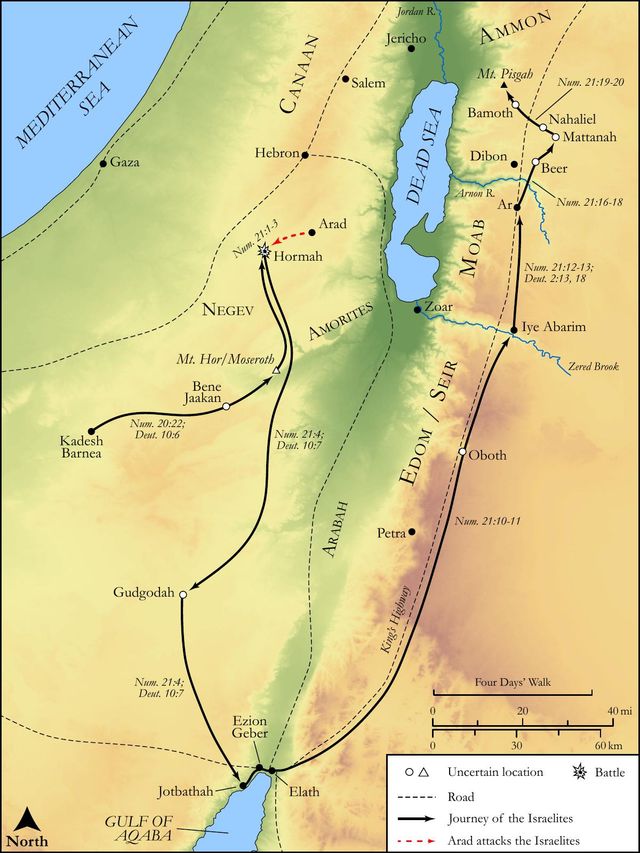
II.He led them forward towards Canaan, though they in their hearts turned back towards Egypt, and he might justly have chosen their delusions, Deu 10:6, Deu 10:7. He brought them to a land of rivers of waters, out of a dry and barren wilderness. Sometimes God supplied their wants by the ordinary course of nature: when that failed, then by miracles; and yet after this, when they were brought into a little distress, we find them distrusting God and murmuring, Num 20:3, Num 20:4.
III.He appointed a standing ministry among them, to deal for them in holy things.
At that time when Moses went up a second time to the mount, or soon after, he had orders to separate the tribe of Levi to God, and to his immediate service, they having distinguished themselves by their zeal against the worshippers of the golden calf, Deu 10:8, Deu 10:9. The Kohathites carried the ark; they and the other Levites stood before the Lord, to minister to him in all the offices of the tabernacle; and the priests, who were of that tribe, were to bless the people. This was a standing ordinance, which had now continued almost forty years, even unto this day; and provision was made for the perpetuating of it by the settled maintenance of that tribe, which was such as gave them great encouragement in their work, and no diversion from it. The Lord is his inheritance. Note, A settled ministry is a great blessing to a people, and a special token of God's favour. And, since the particular priests could not continue by reason of death, God showed his care of the people in securing a succession, which Moses takes notice of here, Deu 10:6. When Aaron died, the priesthood did not die with him, but Eleazar his son ministered in his stead, and took care of the ark, in which the tables of stone, those precious stones, were deposited, that they should suffer no damage; there they be, and he has the custody of them. Under the law, a succession in the ministry was kept up, by an entail of the office on a certain tribe and family. But now, under the gospel, when the effusion of the Spirit is more plentiful and powerful, the succession is kept up by the Spirit's operation on men's hearts, qualifying men for, and inclining men to, that work, some in every age, that the name of Israel may not be blotted out.
IV.He accepted Moses as an advocate or intercessor for them, and therefore constituted him their prince and leader (Deu 10:10, Deu 10:11):
The Lord hearkened to me and said, Arise, go before the people. It was a mercy to them that they had such a friend, so faithful both to him that appointed him and to those for whom he was appointed. It was fit that he who had saved them from ruin, by his intercession with heaven, should have the conduct and command of them. And herein he was a type of Christ, who, as he ever lives making intercession for us, so he has all power both in heaven and in earth.
Continue studying Deuteronomy 10:9 across the web’s major study libraries — every link below opens this exact verse, chapter, or book on the destination site.
Read & Compare
 BibleGatewayThis verse in more than 200 translations and 70 languages.
 Bible.comThe YouVersion reader — hundreds of translations, reading plans, and highlights.
 ESV.orgCrossway's official English Standard Version reader.
 NET BibleThe NET translation with 60,000+ translators' notes on every rendering decision.
 STEP BibleTyndale House's free study tool — original text, vocabulary, and scholarly resources.
 BibliaLogos Bible Software's free web reader.
 USCCBThe New American Bible (Revised Edition) with the U.S. bishops' study notes.
Commentaries
 BibleHub CommentariesDozens of classic commentaries on this verse, gathered on one page.
 StudyLightMore than 100 commentary sets — the largest collection on the web.
 BibleRefPlain-English commentary on what this verse means, verse by verse.
 Enduring WordDavid Guzik's free commentary on this chapter, widely used by Bible teachers.
 Bible Study ToolsVerse commentary alongside Greek and Hebrew study aids.
Original Language & Research
- BibleHub InterlinearThe verse word by word — original language, transliteration, and English.
- BibleHub LexiconEvery word's original-language definition and Strong's entry.
 Blue Letter BibleDeep-study tools — Strong's numbers, concordance, and word studies.
 SefariaThe Hebrew text with Rashi and centuries of Jewish commentary.
Sermons, Hymns & Audio


TrulyRandomVerse is not affiliated with these sites and doesn’t control their content. They’re linked because they’re genuinely useful.
Summary
Deuteronomy 10:9 articulates the unique and consecrated status of the tribe of Levi within ancient Israel, distinguishing their portion from that of their brethren. While the other tribes were allotted a territorial inheritance in the Promised Land, the Levites were set apart for exclusive service to Yahweh and the community. Consequently, their inheritance was not a physical land but the LORD Himself, a profound declaration that underscored their divine calling, their spiritual provision, and God's unwavering faithfulness to those dedicated to His sacred purposes, fulfilling a promise made to them.
Context
ShowHideLiterary Context
This verse is strategically placed within Moses' second major discourse to the Israelites, delivered on the plains of Moab as they stood poised to enter Canaan. Chapters 9 and 10 form a crucial section, serving as a powerful reminder of God's covenant faithfulness despite Israel's repeated rebellion, most notably the egregious sin of the golden calf. Moses recounts his fervent intercession for the people and for Aaron, culminating in God's renewal of the covenant and the command to prepare a second set of tablets. Immediately following this renewed covenant, Deuteronomy 10:8 details the specific setting apart of the tribe of Levi for sacred service, with verse 9 providing the economic and existential consequence of this divine appointment, sharply contrasting their portion with the earthly inheritance designated for the other tribes. This sequence underscores that the Levites' unique role was a direct, divinely ordained outcome of the covenant relationship.
Historical & Cultural Context
The historical setting for the Levites' unique status traces back to their zealous response to Moses' call for faithfulness after the golden calf idolatry, as recounted in Exodus 32:26-29. This act of loyalty solidified their distinct consecration, setting them apart from the other tribes. Their divinely appointed duties were comprehensive, encompassing the carrying of the Ark of the Covenant, ministering before the Lord, blessing the people in His name, and diligently teaching His statutes and judgments to Israel, as later affirmed in Deuteronomy 33:10. Due to their full-time occupation in sacred service, they were exempted from the agricultural and land-management responsibilities that defined the other tribes. Their sustenance was therefore derived from the tithes, offerings, and firstfruits brought by the other tribes, ensuring their provision while maintaining their spiritual focus. Additionally, they were provided with specific Levitical cities scattered throughout Israel, allowing them to remain integrated within the broader community while fulfilling their distinct priestly and teaching functions.
Key Themes
ShowHideDeuteronomy 10:9 profoundly contributes to several overarching themes within Deuteronomy and the Pentateuch. It powerfully illustrates the theme of Divine Provision, demonstrating God's unwavering commitment to sustaining those dedicated to His service. The Levites' livelihood was inextricably linked to their spiritual duties, signifying that God Himself was their ultimate source of security and blessing, a principle emphatically reiterated in Numbers 18:20. The verse also highlights the Unique Calling and Consecration of the Levites, underscoring that their lack of material inheritance was not a deficit but an emphasis on their separation for spiritual devotion and their role as mediators between God and His people, rather than for worldly gain. Most profoundly, Deuteronomy 10:9 articulates the concept of Spiritual Inheritance, elevating the intimate relationship with God above any earthly possession. While other tribes received tangible land, the Levites received God Himself, suggesting that true wealth, security, and ultimate belonging are found in Him alone, a concept beautifully echoed in Psalm 16:5.
Exposition and Analysis
ShowHideKey Word Analysis
ShowHideThis term, derived from a root meaning "to divide" or "to allot," properly refers to a smoothness or portion. In this context, it signifies an allotted portion or share, particularly in terms of land or property. Its use here emphasizes that Levi was not to receive a territorial "share" alongside his brethren, highlighting their distinct economic and social status within the tribal distribution.
From a root meaning "to inherit," this word describes something inherited, an heirloom, or generally an estate or patrimony. It denotes a permanent, often ancestral, possession. The striking application of this term to the LORD ("the LORD is his inheritance") is a profound theological statement, asserting that Yahweh Himself functions as Levi's ultimate and enduring possession, providing all the security, provision, and identity typically associated with a material inheritance.
This primitive root primarily means "to speak" or "to arrange." In a figurative sense, it conveys the act of speaking with authority, often implying a command, declaration, or promise. Here, it underscores that the unique arrangement for Levi's sustenance and status was not arbitrary but was a direct, authoritative declaration and promise from the LORD, emphasizing divine intentionality and faithfulness in their calling.
Verse Breakdown
ShowHide"Wherefore Levi hath no part nor inheritance with his brethren;"
This initial clause establishes the distinct economic and social reality for the tribe of Levi. Unlike the other eleven tribes of Israel, who were to receive specific territorial allotments in Canaan as their ancestral "part" (chêleq) and "inheritance" (nachălâh), the Levites were explicitly excluded from this land distribution. This exclusion was not a punitive measure but a foundational aspect of their divine calling, setting them apart from the typical land-based economy and tribal structure of ancient Israel.
"the LORD [is] his inheritance,"
This is the central, profound declaration of the verse, revealing the divine compensation for the Levites' lack of material inheritance. Instead of land, the Levites received God Himself as their portion. This signifies that their security, provision, identity, and ultimate blessing were found directly and exclusively in their relationship with Yahweh and their dedicated service to Him. It elevates their spiritual vocation above any earthly possession, making God their ultimate and all-sufficient source of sustenance and significance.
"according as the LORD thy God promised him."
This concluding phrase grounds the Levites' unique status and provision in divine promise and covenant faithfulness. It indicates that this extraordinary arrangement was not a spontaneous decision but was part of God's pre-ordained plan for their tribe, a promise that began to be articulated after their faithfulness at Sinai and further detailed in the wilderness wanderings (e.g., Numbers 3:12 and Numbers 18:20-24). This highlights God's sovereignty in establishing their distinct role and His unwavering commitment to fulfilling His word to them.
Literary Devices
ShowHideDeuteronomy 10:9 masterfully employs several literary techniques to convey its profound message. Central to the verse is Contrast, which sharply juxtaposes Levi's lack of earthly "part nor inheritance" with the sublime reality that "the LORD is his inheritance." This creates a powerful Paradox, where what appears to be a deprivation (no land) is, in fact, an elevation to a higher, more secure, and infinitely more valuable form of provision (God Himself). The use of Metaphor is foundational, as "the LORD is his inheritance" takes the familiar concept of a tangible, material inheritance and applies it to an intangible, spiritual reality. This metaphorical language imbues the relationship with God with all the tangible benefits of security, provision, and belonging, emphasizing that God fully embodies and surpasses all that a physical inheritance could offer. Furthermore, the verse employs Repetition of "the LORD" (YHWH) to underscore the divine source and nature of this unique arrangement, reinforcing God's active role as both the giver of the promise and the substance of the inheritance.
Theological and Thematic Connections
ShowHideDeuteronomy 10:9 presents a profound theological truth that transcends the specific context of the Levites: God Himself is the ultimate inheritance for His people, particularly for those consecrated to His service. This principle illustrates that true wealth, security, and fulfillment are found not in material possessions, earthly status, or worldly achievements, but in an intimate, covenantal relationship with the Creator. It underscores the idea that divine provision is guaranteed for those who prioritize God's kingdom and purposes, and that such a spiritual inheritance is infinitely more valuable, enduring, and satisfying than any temporal estate. This verse serves as a foundational statement about the nature of God's relationship with those who serve Him, establishing a precedent for radical spiritual dedication over worldly gain and reminding all believers that their ultimate source of life and blessing is the Lord Himself.
Reflection and Application
ShowHideWhile the specific context of the Levites' land inheritance is unique to ancient Israel's tribal structure, the profound principle that "the LORD is his inheritance" holds enduring relevance for believers across all generations. This verse challenges us to critically re-evaluate our deepest priorities and sources of security, prompting us to ask where we truly seek our "inheritance." It serves as a powerful reminder that our greatest treasure, most reliable security, and ultimate fulfillment should be found not in material wealth, career success, social status, or any earthly possession, but exclusively in our intimate relationship with God. For those who dedicate their lives to serving God in various capacities—whether in full-time vocational ministry, through faithful obedience in their daily vocations, or in their family and community roles—this verse calls for a radical trust in divine provision. It encourages us to embrace a spiritual perspective on life, recognizing that our ultimate inheritance is eternal and found in Christ, far surpassing the fleeting things of this world. Our true fulfillment, identity, and sustenance flow from Him, and He promises to be our ultimate provider and sustainer when we seek His kingdom and righteousness first.
Questions for Reflection
ShowHideFAQ
ShowHideWhat does it mean for "the LORD" to be someone's "inheritance," and how was this practically fulfilled for the Levites?
ShowHideFor "the LORD" to be someone's "inheritance" means that God Himself becomes their ultimate source of provision, security, identity, and blessing, rather than a physical plot of land or material wealth. In the context of Deuteronomy 10:9, it signifies that the Levites, unlike the other tribes who received territorial allotments in Canaan, received God as their portion. Practically, this meant their sustenance, livelihood, and purpose were directly tied to their dedicated service in the Tabernacle and later the Temple. They lived off the offerings, tithes, and firstfruits brought by the other tribes, as detailed in passages like Numbers 18:21-24. This arrangement ensured their provision while emphasizing their spiritual focus and their unique role as mediators between God and His people. Theologically, it elevates the spiritual relationship with God above any earthly possession, asserting that true wealth and security are found in Him. This concept is beautifully echoed in Psalm 16:5, where the psalmist declares, "The LORD is the portion of mine inheritance and of my cup: thou maintainest my lot."
Christ-Centered Fulfillment
ShowHideDeuteronomy 10:9, by declaring "the LORD is his inheritance," profoundly foreshadows the ultimate spiritual inheritance found in Christ for all believers. While the Levites received God as their portion through their dedicated, Old Covenant service, believers in the New Covenant receive God Himself through union with Jesus Christ, the Great High Priest. Christ is the ultimate fulfillment of this divine inheritance, for in Him "we have obtained an inheritance" (Ephesians 1:11), not through our works, but through His perfect sacrifice. Through His atoning work, Jesus has made us "heirs of God, and joint-heirs with Christ" (Romans 8:17), granting us intimate access to the very presence, provision, and eternal life of God. Our "inheritance" is not a physical land or a temporary blessing, but an "inheritance incorruptible, and undefiled, and that fadeth not away, reserved in heaven for you" (1 Peter 1:4), secured by the resurrection of Jesus Christ. Just as the Levites' lack of earthly portion underscored their unique consecration to God, so too does the believer's spiritual inheritance in Christ call for a life set apart from worldly pursuits, prioritizing the eternal over the temporal, trusting that our ultimate security, provision, and joy reside in the "unsearchable riches of Christ" (Ephesians 3:8) and the indwelling Holy Spirit, who is the "earnest of our inheritance" (Ephesians 1:14).