


2 Corinthians 8:5
Bible text: King James Version (1769 Blayney text) · Public domain
Bible text: Berean Standard Bible · Public domain
Bible text: American Standard Version (1901) · Public domain
Bible text: World English Bible, Messianic edition · Public domain
Bible text: Geneva Bible (1599) · Public domain
Bible text: Young's Literal Translation · Public domain
- καὶkaiAndG2532CONJConjunction
- οὐounot [only]G3756PRT-NNegative Particle Negative
- καθὼςkathōseven asG2531CONJConjunction
- ἠλπίσαμενēlpisamenwe had hopedG1679V-AAI-1PVerb Aorist Active Indicative 1st Plural
- ἀλλ᾽all᾽butG235CONJConjunction
- ἑαυτοὺςhe'autousthemselvesG1438F-3APMReflexive pronoun Accusative 3rd Plural Masculine
- ἔδωκανedōkanthey gaveG1325V-AAI-3PVerb Aorist Active Indicative 3rd Plural
- πρῶτονprōtonfirstG4413A-ASNAdjective Accusative Singular Neuter
- τῷtōto theG3588T-DSMDefinite article Dative Singular Masculine
- κυρίῳkuriōLordG2962N-DSM-TNoun Dative Singular Masculine Title
- καὶkaiand thenG2532CONJConjunction
- ἡμῖνhēminto usG3165P-1DPPersonal pronoun Dative 1st Plural
- διὰdiathroughG1223PREPPreposition
- θελήματοςthelēmatos[the] willG2307N-GSNNoun Genitive Singular Neuter
- θεοῦtheouof GodG2316N-GSM-TNoun Genitive Singular Masculine Title
English is a literal word-by-word gloss of the Greek, not the KJV's wording. Why?
This is the original text the KJV's translators worked from — each Greek word with its own literal English meaning in this verse, prepared by scholars at Tyndale House, Cambridge. The KJV translates whole sentences, not word by word, so its wording differs: one Greek word can become several English words, and the KJV may choose “charity” where the gloss reads “love”. Both are faithful — they answer different questions. For the KJV's own rendering, switch to the KJV text.
Details
See on the biblical-era maps

Study this verse
Public-domain commentary
Matthew Henry
From his Commentary on the Whole Bible. Henry comments on passages, not single verses — this entry covers 2 Corinthians 8:1–6. His four-level outline is real structure in the source text, so it is rendered as structure.
Observe here,
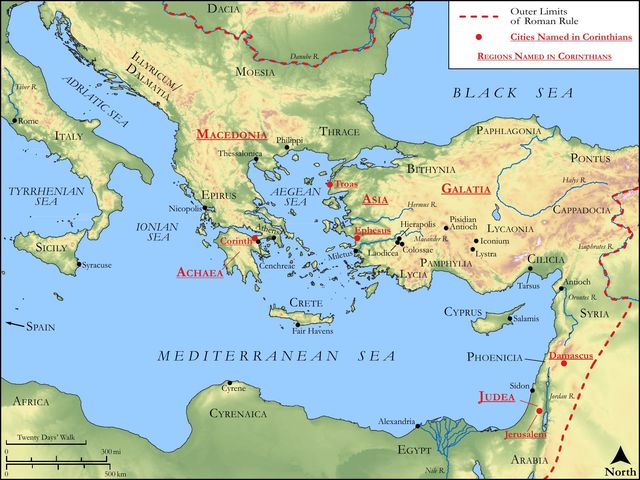
I.The apostle takes occasion from the good example of the churches of Macedonia, that is, of Philippi, Thessalonica, Berea, and others in the region of Macedonia, to exhort the Corinthians and the Christians in Achaia to the good work of charity. And,
1.He acquaints them with their great liberality, which he calls the grace of God bestowed on the churches, Co2 8:1. Some think the words should be rendered, the gift of God given in or by the churches. He certainly means the charitable gifts of these churches, which are called the grace or gifts of God, either because they were very large, or rather because their charity to the poor saints did proceed from God as the author, and was accompanied with true love to God, which also was manifested this way. The grace of God must be owned as the root and fountain of all the good that is in us, or done by us, at any time; and it is great grace and favour from God, and bestowed on us, if we are made useful to others, and are forward to any good work.
2.He commends the charity of the Macedonians, and sets it forth with good advantage. He tells them,
(1.)They were but in a low condition, and themselves in distress, yet they contributed to the relief of others. They were in great tribulation and deep poverty, Co2 8:2. It was a time of great affliction with them, as may be seen, Act 18:17. The Christians in these parts met with ill treatment, which had reduced them to deep poverty; yet, as they had abundance of joy in the midst of tribulation, they abounded in their liberality; they gave out of a little, trusting in God to provide for them, and make it up to them.
(2.)They gave very largely, with the riches of liberality (Co2 8:2), that is, as liberally as if they had been rich. It was a large contribution they made, all things considered; it was according to, yea beyond, their power (Co2 8:3), as much as could well be expected from them, if not more. Note, Though men may condemn the indiscretion, yet God will accept the pious zeal, of those who in real works of piety and charity do rather beyond their power.
(3.)They were very ready and forward to this good work. They were willing of themselves (Co2 8:3), and were so far from needing that Paul should urge and press them with many arguments that they prayed him with much entreaty to receive the gift, Co2 8:4. It seems Paul was backward to undertake this trust, for he would give himself to the word and prayer; or, it may be, he was apprehensive how ready his enemies would be to reproach and blacken him upon all occasions, and might take a handle against him upon account of so large a sum deposited in his hands, to suspect or accuse him of indiscretion and partiality in the distribution, if not of some injustice. Note, How cautious ministers should be, especially in money-matters, not to give occasion to those who seek occasion to speak reproachfully!
(4.)Their charity was founded in true piety, and this was the great commendation of it. They performed this good work in a right method: First they gave themselves to the Lord, and then they gave unto us their contributions, by the will of God (Co2 8:5), that is, according as it was the will of God they should do, or to be disposed of as the will of God should be, and for his glory. This, it seems, exceeded the expectation of the apostle; it was more than he hoped for, to see such warm and pious affections shining in these Macedonians, and this good work performed with so much devotion and solemnity. They solemnly, jointly, and unanimously, made a fresh surrender of themselves, and all they had, unto the Lord Jesus Christ. They had done this before, and now they do it again upon this occasion; sanctifying their contributions to God's honour, by first giving themselves to the Lord. Note,
[1.]We should give ourselves to God; we cannot bestow ourselves better.
[2.]When we give ourselves to the Lord, we then give him all we have, to be called for and disposed of according to his will.
[3.]Whatever we use or lay out for God, it is only giving to him what is his own.
[4.]What we give or bestow for charitable uses will not be accepted of God, nor turn to our advantage, unless we first give ourselves to the Lord.
II.The apostle tells them that Titus was desired to go and make a collection among them (Co2 8:6), and Titus, he knew, would be an acceptable person to them. He had met with a kind reception among them formerly. They had shown good affection to him, and he had a great love for them. Besides, Titus had already begun this work among them, therefore he was desired to finish it. So that he was, on all accounts, a proper person to be employed; and, when so good a work had already prospered in so good a hand, it would be a pity if it should not proceed and be finished. Note, It is an instance of wisdom to use proper instruments in a work we desire to do well; and the work of charity will often succeed the best when the most proper persons are employed to solicit contributions and dispose of them.
Historical interpretation
Historical reception
3 surviving comments on this verse. Each one is dated, so this reads as a timeline rather than a list.
Select a marker to jump to its quote. Markers stagger vertically where authors wrote within a few decades of each other.
By giving themselves to God first and then to their fellow believers, the Macedonians demonstrated their sincere desire to be made perfect. Paul quoted their example in the hope of persuading the Corinthians to do likewise.
"And" this, "not as we hoped." This he says with reference both to the amount and to their afflictions. 'For we could never have hoped,' he says, 'that whilst in so great affliction and poverty, they would even have urged us and so greatly intreated us.' He showed also their carefulness of life in other respects, by saying, "But first they gave their own selves to the Lord, and to us by the will of God." 'For in everything their obedience was beyond our expectations; nor because they showed mercy did they neglect the other virtues,' "but first gave themselves to the Lord." What is, "gave themselves to the Lord?" 'They offered up [themselves]; they showed themselves approved in faith; they displayed much fortitude in their trials, order, goodness, love, in all things both readiness and zeal.' What means, "and to us?" 'They were tractable to the rein, loved, obeyed us; both fulfilling the laws of God and bound unto us by love.' And observe how here also he again shows their earnestness saying, "gave themselves to the Lord." They did not in some things obey God, and in some the world; but in all things Him; and gave themselves wholly unto God. For neither because they showed mercy were they filled up with senseless pride, but displaying much lowlymindedness, much obedience, much reverence, much heavenly wisdom, they so wrought their almsdeeds also. But what is, "by the will of God?" Since he had said, they "gave themselves to us," yet was it not "to us," after the manner of men, but they did this also according to the mind of God.
The words “not as we expected” refer not to the Macedonians’ willingness to give but to the amount which they gave.
Continue studying 2 Corinthians 8:5 across the web’s major study libraries — every link below opens this exact verse, chapter, or book on the destination site.
Read & Compare
 BibleGatewayThis verse in more than 200 translations and 70 languages.
 Bible.comThe YouVersion reader — hundreds of translations, reading plans, and highlights.
 ESV.orgCrossway's official English Standard Version reader.
 NET BibleThe NET translation with 60,000+ translators' notes on every rendering decision.
 STEP BibleTyndale House's free study tool — original text, vocabulary, and scholarly resources.
 BibliaLogos Bible Software's free web reader.
 USCCBThe New American Bible (Revised Edition) with the U.S. bishops' study notes.
Commentaries
 BibleHub CommentariesDozens of classic commentaries on this verse, gathered on one page.
 StudyLightMore than 100 commentary sets — the largest collection on the web.
 BibleRefPlain-English commentary on what this verse means, verse by verse.
 Enduring WordDavid Guzik's free commentary on this chapter, widely used by Bible teachers.
 Bible Study ToolsVerse commentary alongside Greek and Hebrew study aids.
Original Language & Research
- BibleHub InterlinearThe verse word by word — original language, transliteration, and English.
- BibleHub LexiconEvery word's original-language definition and Strong's entry.
 Blue Letter BibleDeep-study tools — Strong's numbers, concordance, and word studies.
 CNTR CollationThe earliest Greek manuscripts of this verse, collated letter by letter.
Sermons, Hymns & Audio


TrulyRandomVerse is not affiliated with these sites and doesn’t control their content. They’re linked because they’re genuinely useful.
Summary
Second Corinthians 8:5 reveals the profound spiritual foundation of the Macedonian churches' extraordinary generosity. Far exceeding the Apostle Paul's expectations, these believers first surrendered themselves completely to the Lord, and subsequently, by God's divine will, committed themselves to Paul and his ministry. This verse underscores that genuine Christian giving and service flow from a prior, wholehearted dedication of one's entire being to God.
Context
ShowHideLiterary Context
This verse is situated at the beginning of Paul's extended appeal to the Corinthian church concerning the collection for the impoverished saints in Jerusalem (2 Corinthians 8-9). Paul introduces the Macedonian churches as a compelling example of sacrificial giving. Immediately preceding this verse, in 2 Corinthians 8:1-4, Paul describes their deep poverty and severe affliction, yet highlights their overflowing joy and extreme generosity, noting that they gave "beyond their ability" and "implored us with much urgency for the favor of participation in the support of the saints." Verse 5 then explains the spiritual root of this remarkable financial liberality, showing that their material giving was a direct outflow of their prior spiritual commitment. The subsequent verses in 2 Corinthians 8 continue to elaborate on the principles of Christian giving, using the Macedonians as a model and Christ as the ultimate example.
Historical & Cultural Context
The collection for the poor saints in Jerusalem was a significant initiative for Paul, serving multiple purposes: providing material relief to the suffering Jewish Christians, demonstrating the unity between Jewish and Gentile believers, and validating Paul's apostolic ministry. Jerusalem, the birthplace of the church, had faced severe famine and economic hardship, making the support from Gentile churches crucial. The Macedonian churches, located in cities like Philippi, Thessalonica, and Berea, were generally not wealthy. Philippi, for instance, was a Roman colony with a strong military presence, but the churches there, like others in the region, often comprised economically modest believers. Their "deep poverty" (as mentioned in 2 Corinthians 8:2) makes their exceptional generosity even more striking, highlighting that their giving was not from abundance but from a Spirit-empowered willingness to sacrifice.
Key Themes
ShowHide2 Corinthians 8:5 contributes to several key themes within 2 Corinthians and Paul's broader theology. Firstly, it emphasizes the priority of spiritual surrender over material contribution. True Christian giving is not merely financial but stems from a heart fully devoted to God. Secondly, it illustrates the power of divine grace at work in believers, enabling them to act beyond human capacity or expectation, as seen in the Macedonians' "overflowing joy" despite their "deep poverty" (2 Corinthians 8:2). Thirdly, the verse highlights partnership in ministry, showing that self-giving to the Lord naturally extends to supporting God's appointed servants and their work. Finally, it underscores the sovereignty of God's will in inspiring and directing the actions of believers, ensuring that their generosity is not merely human effort but a divinely ordained expression of faith.
Exposition and Analysis
ShowHideKey Word Analysis
ShowHideThis verb signifies a decisive act of giving, bestowing, or delivering. In this context, it emphasizes the voluntary and complete surrender of the Macedonians. It is not merely a passive state but an active, intentional offering of themselves. The wide application of this word in the Greek suggests a comprehensive and unreserved act of commitment.
This reflexive pronoun underscores the personal, radical, and total nature of their giving. It highlights that the offering was not external possessions or mere actions, but their very being, their identity, their will, and their future. This was a self-donation, indicating a deep, internal commitment rather than an external obligation.
This term denotes a determination, purpose, or decree, as well as an active choice or abstract volition. When applied to God, it refers to His sovereign plan and active intention. Here, it confirms that the Macedonians' extraordinary actions were not random or purely human-initiated but were aligned with and empowered by God's specific desire and design.
Verse Breakdown
ShowHide"And [this they did], not as we hoped,"
This clause immediately establishes the surprising nature of the Macedonians' actions. Paul admits that their response exceeded his expectations, implying that their generosity and commitment were far greater than he had anticipated, even from devoted believers. The parenthetical "[this they did]" clarifies that the preceding description of their grace-filled giving is what is being referred to.
"but first gave their own selves to the Lord,"
This is the pivotal statement, revealing the foundational principle behind their remarkable generosity. Before any material giving, the Macedonians made a primary, complete, and personal surrender of their very being to Christ. This spiritual devotion was the wellspring from which all subsequent actions flowed, establishing a hierarchy of commitment: self to God first.
"and unto us by the will of God."
Following their dedication to the Lord, the Macedonians then committed themselves to Paul and his apostolic team. This was not a secondary, human-initiated act, but a direct consequence and extension of their primary surrender to God, explicitly stated as being "by the will of God." This phrase highlights divine orchestration, indicating that their partnership in ministry was part of God's sovereign plan for them and for the advancement of the Gospel.
Literary Devices
ShowHideThe verse employs Contrast to highlight the exceptional nature of the Macedonians' actions ("not as we hoped, but first..."). This rhetorical device immediately draws the reader's attention to the surprising and profound depth of their commitment. There is also strong Emphasis on "their own selves," using the reflexive pronoun to underscore the personal and total nature of their dedication. This highlights that their giving was not superficial but originated from the core of their being. Furthermore, the phrase "by the will of God" serves as a theological Affirmation, attributing the extraordinary grace and generosity witnessed in the Macedonians directly to divine inspiration and guidance, rather than mere human effort.
Theological and Thematic Connections
ShowHideThe profound truth of 2 Corinthians 8:5 is that all genuine Christian service and generosity must flow from a prior, complete surrender of one's self to the Lord. This verse establishes a fundamental theological principle: our external actions, particularly in giving and ministry partnership, are merely the overflow of an internal, spiritual dedication. The Macedonians understood that their lives, resources, and very being belonged to God, and thus, their material contributions were a natural, joyful expression of that foundational relationship. This principle challenges believers to examine the root of their service, ensuring it is grounded in personal devotion to Christ rather than obligation or human expectation.
Reflection and Application
ShowHide2 Corinthians 8:5 offers a powerful and enduring challenge for every believer: before we consider what we can give to God's work, we must first give ourselves entirely to Him. The Macedonians' example teaches us that true generosity is not measured by the amount of money or effort, but by the depth of personal surrender that precedes it. When our lives are fully yielded to the Lord, our giving—whether of time, talent, or treasure—becomes a joyful, natural, and Spirit-empowered expression of our devotion, rather than a grudging duty. This principle calls us to a radical reorientation of priorities, where our identity and resources are seen as belonging to God, to be used according to His will. It encourages us to cultivate a heart that seeks God's pleasure and purpose above all else, knowing that from such a heart flows genuine and impactful service for His kingdom.
Questions for Reflection
ShowHideFAQ
ShowHideWhat does it mean to "give their own selves to the Lord"?
ShowHideTo "give their own selves to the Lord" means to make a complete and unreserved surrender of one's entire being—including one's will, desires, possessions, time, talents, and future—to the lordship of Jesus Christ. It signifies a primary commitment where one acknowledges God's ultimate ownership and authority over every aspect of life. This is not merely a one-time decision but an ongoing posture of submission and devotion, akin to presenting one's body as a "living sacrifice" as exhorted in Romans 12:1. It implies that all subsequent actions, particularly in service and generosity, flow from this foundational spiritual dedication.
Christ-Centered Fulfillment
ShowHideThe Macedonian believers' act of first giving "their own selves to the Lord" profoundly foreshadows and reflects the ultimate act of Christ's self-giving. Jesus, though rich in divine glory and equality with God, "made himself nothing, taking the very nature of a servant" (Philippians 2:7), ultimately giving His life as a ransom for many (Mark 10:45). His entire earthly ministry, culminating in His death on the cross, was an unparalleled act of self-surrender to the Father's will, even to the point of death (Philippians 2:8). The Macedonians' generosity, therefore, is a beautiful outworking of the grace of God modeled by Christ Himself, who "for your sakes became poor, that you through His poverty might become rich" (2 Corinthians 8:9). Believers are called to emulate this pattern of Christ-like self-sacrifice, recognizing that our lives are no longer our own, but have been "bought with a price" (1 Corinthians 6:20), compelling us to live for Him who died and rose again (2 Corinthians 5:15).