


John 13:31
- ὍτεHoteWhenG3753CONJConjunction
- οὖνounthereforeG3767CONJConjunction
- ἐξῆλθενexēlthenhe had gone outG1831V-2AAI-3SVerb 2nd Aorist Active Indicative 3rd Singular
- λέγειlegeisaysG3004V-PAI-3SVerb Present Active Indicative 3rd Singular
- ὁho<the>G3588T-NSMDefinite article Nominative Singular Masculine
- Ἰησοῦς·IēsousJesusG2424N-NSM-PNoun Nominative Singular Masculine Individual
- νῦνnunNowG3568ADVAdverb
- ἐδοξάσθηedoxasthēhas been glorifiedG1392V-API-3SVerb Aorist Passive Indicative 3rd Singular
- ὁhotheG3588T-NSMDefinite article Nominative Singular Masculine
- υἱὸςhuiosSonG5207N-NSM-TNoun Nominative Singular Masculine Title
- τοῦtou<the>G3588T-GSMDefinite article Genitive Singular Masculine
- ἀνθρώπουanthrōpouof ManG444N-GSM-TNoun Genitive Singular Masculine Title
- καὶkaiandG2532CONJConjunction
- ὁho<the>G3588T-NSMDefinite article Nominative Singular Masculine
- θεὸςtheosGodG2316N-NSM-TNoun Nominative Singular Masculine Title
- ἐδοξάσθηedoxasthēhas been glorifiedG1392V-API-3SVerb Aorist Passive Indicative 3rd Singular
- ἐνeninG1722PREPPreposition
- αὐτῷautōHimG846P-DSMPersonal pronoun Dative Singular Masculine
English is a literal word-by-word gloss of the Greek, not the KJV's wording. Why?
This is the original text the KJV's translators worked from — each Greek word with its own literal English meaning in this verse, prepared by scholars at Tyndale House, Cambridge. The KJV translates whole sentences, not word by word, so its wording differs: one Greek word can become several English words, and the KJV may choose “charity” where the gloss reads “love”. Both are faithful — they answer different questions. For the KJV's own rendering, switch to the KJV text.
Details
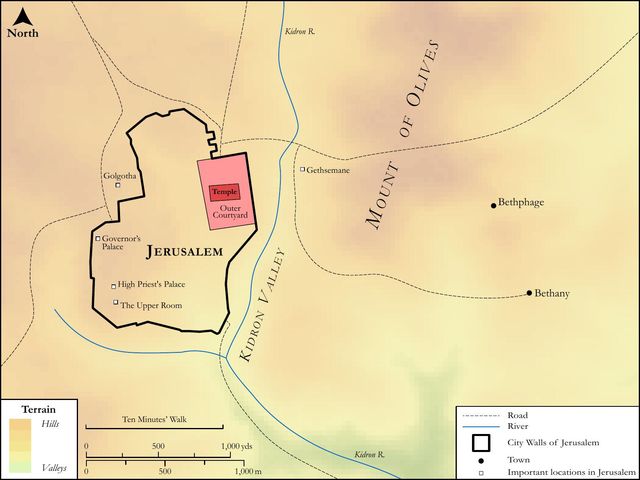
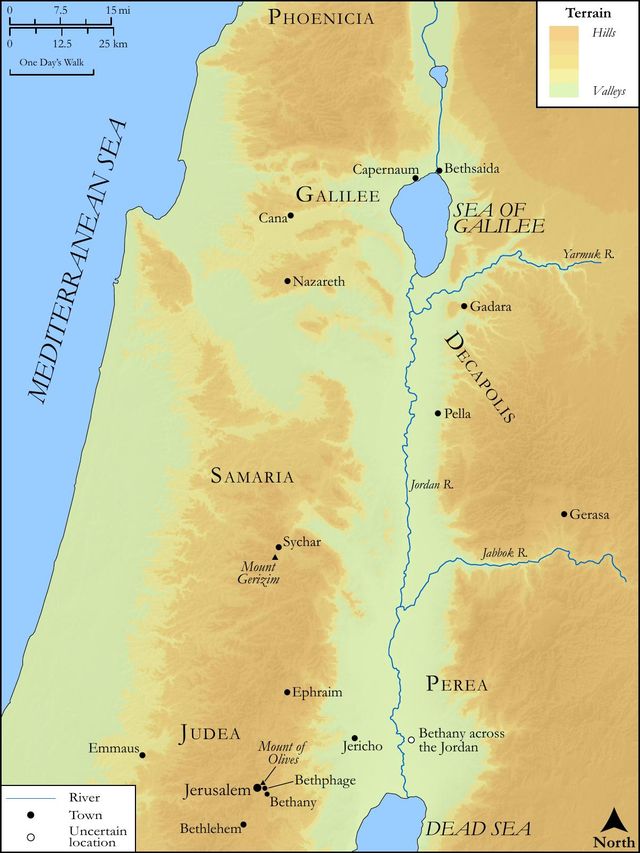
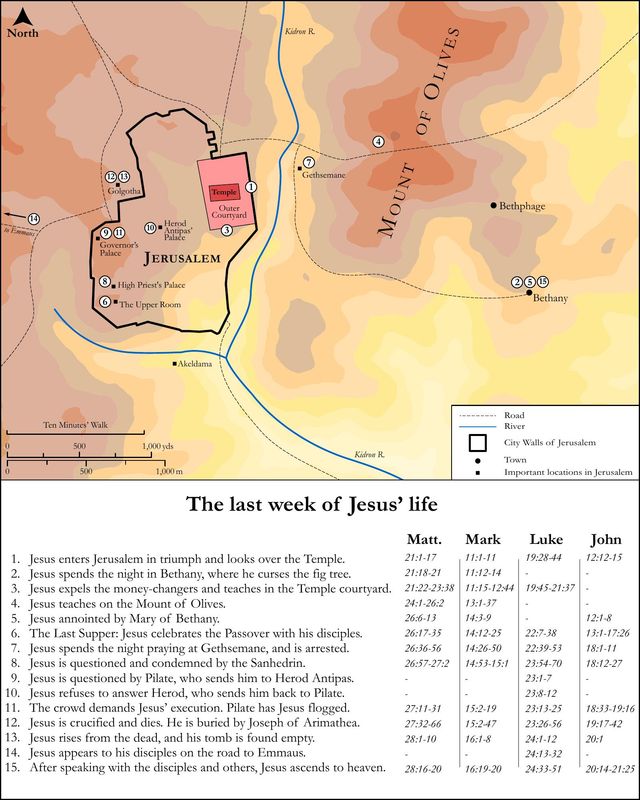
See on the biblical-era map
Study this verse
Public-domain commentary
Matthew Henry
From his Commentary on the Whole Bible. Henry comments on passages, not single verses — this entry covers John 13:31–35. His four-level outline is real structure in the source text, so it is rendered as structure.
This and what follows, to the end of ch. 14, was Christ's table-talk with his disciples. When supper was done, Judas went out; but what did the Master and his disciples do, whom he left sitting at table? They applied themselves to profitable discourse, to teach us as much as we can to make conversation with our friends at table serviceable to religion. Christ begins this discourse. The more forward we are humbly to promote that communication which is good, and to the use of edifying, the more like we are to Jesus Christ. Those especially that by their place, reputation, and gifts, command the company, to whom men give ear, ought to use the interest they have in other respects as an opportunity of doing them good. Now our Lord Jesus discourses with them (and probably discourses much more largely than is here recorded),
I.Concerning the great mystery of his own death and sufferings, about which they were as yet so much in the dark that they could not persuade themselves to expect the thing itself, much less did they understand the meaning of it; and therefore Christ gives them such instructions concerning it as made the offence of the cross to cease. Christ did not begin this discourse till Judas was gone out, for he was a false brother. The presence of wicked people is often a hindrance to good discourse. When Judas was gone out, Christ said, now is the Son of man glorified; now that Judas is discovered and discarded, who was a spot in their love-feast and a scandal to their family, now is the Son of man glorified. Note, Christ is glorified by the purifying of Christian societies: corruptions in his church are a reproach to him; the purging out of those corruptions rolls away the reproach. Or, rather, now Judas was gone to set the wheels a-going, in order to his being put to death, and the thing was likely to be effected shortly: Now is the Son of man glorified, meaning, Now he is crucified.
1.Here is something which Christ instructs them in, concerning his sufferings, that was very comforting.
(1.)That he should himself be glorified in them. Now the Son of man is to be exposed to the greatest ignominy and disgrace, to be despitefully used to the last degree, and dishonoured both by the cowardice of his friends and the insolence of his enemies; yet now he is glorified; For,
[1.]Now he is to obtain a glorious victory over Satan and all the powers of darkness, to spoil them, and triumph over them. He is now girding on the harness, to take the field against these adversaries of God and man, with as great an assurance as if he had put it off.
[2.]Now he is to work out a glorious deliverance for his people, by his death to reconcile them to God, and bring in an everlasting righteousness and happiness for them; to shed that blood which is to be an inexhaustible fountain of joys and blessings to all believers.
[3.]Now he is to give a glorious example of self-denial and patience under the cross, courage and contempt of the world, zeal for the glory of God, and love to the souls of men, such as will make him to be for ever admired and had in honour. Christ had been glorified in many miracles he had wrought, and yet he speaks of his being glorified now in his sufferings, as if that were more than all his other glories in his humble state.
(2.)That God the Father should be glorified in them. The sufferings of Christ were,
[1.]The satisfaction of God's justice, and so God was glorified in them. Reparation was thereby made with great advantage for the wrong done him in his honour by the sin of man. The ends of the law were abundantly answered, and the glory of his government effectually asserted and maintained.
[2.]They were the manifestation of his holiness and mercy. The attributes of God shine brightly in creation and providence, but much more in the work of redemption; see Co1 1:24; Co2 4:6. God is love, and herein he hath commended his love.
(3.)That he should himself be greatly glorified after them, in consideration of God's being greatly glorified by them, Joh 13:32. Observe how he enlarges upon it.
[1.]He is sure that God will glorify him; and those whom God glorifies are glorious indeed. Hell and earth set themselves to vilify Christ, but God resolved to glorify him, and he did it. He glorified him in his sufferings by the amazing signs and wonders, both in heaven and earth, which attended them, and extorted even from his crucifiers an acknowledgment that he was the Son of God. But especially after his sufferings he glorified him, when he set him at his own right hand, gave him a name above every name.
[2.]That he will glorify him in himself - en heautō. Either, First, In Christ himself. He will glorify him in his own person, and not only in his kingdom among men. This supposes his speedy resurrection. A common person may be honoured after his death, in his memory or posterity, but Christ was honoured in himself. Or, secondly, in God himself. God will glorify him with himself, as it is explained, Joh 17:5. He shall sit down with the Father upon his throne, Rev 3:21. This is true glory.
[3.]That he will glorify him straightway. He looked upon the joy and glory set before him, not only as great, but as near; and his sorrows and sufferings short and soon over. Good services done to earthly princes often remain long unrewarded; but Christ had his preferments presently. It was but forty hours (or not so much) from his death to his resurrection, and forty days thence to his ascension, so that it might well be said that he was straightway glorified, Psa 16:10.
[4.]All this in consideration of God's being glorified in and by his sufferings: Seeing God is glorified in him, and receives honour from his sufferings, God shall in like manner glorify him in himself, and give honour to him. Note, first, In the exaltation of Christ there was a regard had to his humiliation, and a reward given for it. Because he humbled himself, therefore God highly exalted him. If the Father be so great a gainer in his glory by the death of Christ, we may be sure that the Son shall be no loser in his. See the covenant between them, Isa 53:12. Secondly, Those who mind the business of glorifying God no doubt shall have the happiness of being glorified with him.
2.Here is something that Christ instructs them in, concerning his sufferings, which was awakening, for as yet they were slow of heart to understand it (Joh 13:33): Little children, yet a little while I am with you, etc. Two things Christ here suggests, to quicken his disciples to improve their present opportunities; two serious words: -
(1.)That his stay in this world, to be with them here, they would find to be very short. Little children. This compellation does not bespeak so much their weakness as his tenderness and compassion; he speaks to them with the affection of a father, now that he is about to leaven them, and to leave blessings with them. Know this, then, that yet a little while I am with you. Whether we understand this as referring to his death or his ascension it comes much to one; he had but a little time to spend with them, and therefore,
[1.]Let them improve the advantage they now had. If they had any good question to ask, if they would have any advice, instruction, or comfort, let them speak quickly; for yet a little while I am with you. We must make the best of the helps we have for our souls while we have them, because we shall not have them long; they will be taken from us, or we from them.
[2.]Let them not doat upon his bodily presence, as if their happiness and comfort were bound up in that; no, they must think of living without it; not be always little children, but go alone, without their nurses. Ways and means are appointed but for a little while, and are not to be rested in, but pressed through to our rest, to which they have a reference.
(2.)That their following him to the other world, to be with him there, they would find to be very difficult. What he had said to the Jews (Joh 7:34) he saith to his disciples; for they have need to be quickened by the same considerations that are propounded for the convincing and awakening of sinners. Christ tells them here,
[1.]That when he was gone they would feel the want of him; You shall seek me, that is "you shall wish you had me again with you." We are often taught the worth of mercies by the want of them. Though the presence of the Comforter yielded them real and effectual relief in straits and difficulties, yet it was not such a sensible satisfaction as his bodily presence would have been to those who had been used to it. But observe, Christ said to the Jews, You shall seek me and not find me; but to the disciples he only saith, You shall seek me, intimating that though they should not find his bodily presence any more than the Jews, yet they should find that which was tantamount, and should not seek in vain. When they sought his body in the sepulchre, though they did not find it, yet they sought to good purpose.
[2.]That whither he went they could not come, which suggests to them high thoughts of him, who was going to an invisible inaccessible world, to dwell in that light which none can approach unto; and also low thoughts of themselves, and serious thoughts of their future state. Christ tells them that they could not follow him (as Joshua told the people that they could not serve the Lord) only to quicken them to so much the more diligence and care. They could not follow him to his cross, for they had not courage and resolution; it appeared that they could not when they all forsook him and fled. Nor could they follow him to his crown, for they had not a sufficiency of their own, nor were their work and warfare yet finished.
II.He discourses with them concerning the great duty of brotherly love (Joh 13:34, Joh 13:35):
You shall love one another. Judas was now gone out, and had proved himself a false brother; but they must not therefore harbour such jealousies and suspicions one of another as would be the bane of love: though there was one Judas among them, yet they were not all Judases. Now that the enmity of the Jews against Christ and his followers was swelling to the height, and they must expect such treatment as their Master had, it concerned them by brotherly love to strengthen one another's hands. Three arguments for mutual love are here urged: -
1.The command of their Master (Joh 13:34): A new commandment I give unto you. He not only commends it as amiable and pleasant, not only counsels it as excellent and profitable, but commands it, and makes it one of the fundamental laws of his kingdom; it goes a-breast with the command of believing in Christ, Jo1 3:23; Pe1 1:22. It is the command of our ruler, who has a right to give law to us; it is the command of our Redeemer, who gives us this law in order to the curing of our spiritual diseases and the preparing of us for our eternal bliss. It is a new commandment; that is,
(1.)It is a renewed commandment; it was a commandment from the beginning (Jo1 2:7), as old as the law of nature, it was the second great commandment of the law of Moses; yet, because it is also one of the great commandments of the New Testament, of Christ the new Lawgiver, it is called a new commandment; it is like an old book in a new edition corrected and enlarged. This commandment has been so corrupted by the traditions of the Jewish church that when Christ revived it, and set it in a true light, it might well be called a new commandment. Laws of revenge and retaliation were so much in vogue, and self-love had so much the ascendant, that the law of brotherly love was forgotten as obsolete and out of date; so that as it came from Christ new, it was new to the people.
(2.)It is an excellent command, as a new song is an excellent song, that has an uncommon gratefulness in it.
(3.)It is an everlasting command; so strangely new as to be always so; as the new covenant, which shall never decay (Heb 8:13); it shall be new to eternity, when faith and hope are antiquated.
(4.)As Christ gives it, it is new. Before it was, Thou shalt love thy neighbour; now it is, You shall love one another; it is pressed in a more winning way when it is thus pressed as mutual duty owing to one another.
2.The example of their Saviour is another argument for brotherly love: As I have loved you. It is this that makes it a new commandment - that this rule and reason of love (as I have loved you) is perfectly new, and such as had been hidden from ages and generations. Understand this,
(1.)Of all the instances of Christ's love to his disciples, which they had already experienced during the time he went in and out among them. He spoke kindly to them, concerned himself heartily for them, and for their welfare, instructed, counselled, and comforted them, prayed with them and for them, vindicated them when they were accused, took their part when they were run down, and publicly owned them to be dearer to him that his mother, or sister, or brother. He reproved them for what was amiss, and yet compassionately bore with their failings, excused them, made the best of them, and passed by many an oversight. Thus he had loved them, and just now washed their feet; and thus they must love one another, and love to the end. Or,
(2.)It may be understood of the special instance of love to all his disciples which he was now about to give, in laying down his life for them. Greater love hath no man than this, Joh 15:13. Has he thus loved us all? Justly may he expect that we should be loving to one another. Not that we are capable of doing any thing of the same nature for each other (Psa 49:7), but we must love one another in some respects after the same manner; we must set this before us as our copy, and take directions from it. Our love to one another must be free and ready, laborious and expensive, constant and persevering; it must be love to the souls one of another. We must also love one another from this motive, and upon this consideration - because Christ has loved us. See Rom 15:1, Rom 15:3; Eph 5:2, Eph 5:25; Phi 2:1-5.
3.The reputation of their profession (Joh 13:35): By this shall all men know that you are my disciples, if you have love one to another. Observe, We must have love, not only show love, but have it in the root and habit of it, and have it when there is not any present occasion to show it; have it ready. "Hereby it will appear that you are indeed my followers by following me in this." Note, Brotherly love is the badge of Christ's disciples. By this he knows them, by this they may know themselves (Jo1 2:14), and by this others may know them. This is the livery of his family, the distinguishing character of his disciples; this he would have them noted for, as that wherein they excelled all others - their loving one another. This was what their Master was famous for; all that ever heard of him have heard of his love, his great love; and therefore, if you see any people more affectionate one to another than what is common, say, "Certainly these are the followers of Christ, they have been with Jesus." Now by this it appears,
(1.)That the heart of Christ was very much upon it, that his disciples should love one another. In this they must be singular; whereas the way of the world is to be every one for himself, they should be hearty for one another. He does not say, By this shall men know that you are my disciples - if you work miracles, for a worker of miracles is but a cypher without charity (Co1 13:1, Co1 13:2); but if you love one another from a principle of self-denial and gratitude to Christ. This Christ would have to be the proprium of his religion, the principal note of the true church.
(2.)That it is the true honour of Christ's disciples to excel in brotherly love. Nothing will be more effectual than this to recommend them to the esteem and respect of others. See what a powerful attractive it was, Act 2:46, Act 2:47. Tertullian speaks of it as the glory of the primitive church that the Christians were known by their affection to one another. Their adversaries took notice of it, and said, See how these Christians love one another, Apol. cap. 39.
(3.)That, if the followers of Christ do not love one another, they not only cast an unjust reproach upon their profession, but give just cause to suspect their own sincerity. O Jesus! are these thy Christians, these passionate, malicious, spiteful, ill-natured people? Is this thy son's coat? When our brethren stand in need of help from us, and we have an opportunity of being serviceable to them, when they differ in opinion and practice from us, or are any ways rivals with or provoking to us, and so we have an occasion to condescend and forgive, in such cases as this it will be known whether we have this badge of Christ's disciples.
Historical interpretation
Two Centuries of Reception
10 surviving comments on this verse. Each one is dated, so this reads as a timeline rather than a list.
Select a marker to jump to its quote. Markers stagger vertically where authors wrote within a few decades of each other.
It was the Son of God who was in the Son of man that was betrayed, as the Scripture says afterward, “Now the Son of man has been glorified, and God has been glorified in him.” Who is here meant by God? Certainly not the Father, but the Word of the Father who was in the Son of man—that is, in the flesh in which Jesus had been already glorified by the divine power and word. “And God,” he says, “will also glorify him in himself.” In other words, the Father shall glorify the Son because [the Father] has [the Son] within himself. And even though the Son is prostrated to the earth and put to death, [the Father] would soon glorify [the Son] by his resurrection and make him conqueror over death.
But the matters in this passage might be understood even more clearly as follows. Just as the name of God is blasphemed among the Gentiles because of some, so, because of the saints whose good works are seen very distinctly before people, the name of the Father who is in heaven is glorified. In whom, then, was it glorified more than in Jesus, since he committed no sin, nor was deceit found in his mouth, nor did he know sin? And since he is such as this, therefore, the Son is glorified, and God is glorified in him. But if God is glorified in him, the Father presents something to him in return that is greater than what the Son of man has done. For the glory of the Son of man, when the Father glorifies him, far exceeds the Father’s glory when he [the Father] is glorified in the Son, since it is only fitting that the greater should return the greater glory.
After the glory of his miracles and his transfiguration, the next glorifying of the Son of man began when Judas went out with Satan, who had entered into him.… Because it is not possible that the Christ is glorified if the Father is not glorified in him, the statement “and God is glorified in him” is added to the words “now is the Son of man glorified.” But the glory that resulted from Jesus’ death for the human race did not belong to the only-begotten Word, which by nature does not die, nor to wisdom and truth, nor to any of the other titles that are said to belong to the divine aspects in Jesus. They belonged to the man who was also the Son of man born of the seed of David according to the flesh. … Now I think God highly exalted this [Son of] man when he became obedient “unto death, even the death of a cross.” For the Word in the beginning with God, God the Word, was not capable of being highly exalted. But the high exaltation of the Son of man that occurred when he glorified God in his own death consisted in the fact that he was no longer different from the Word but was the same with him … so that the humanity of Jesus became one with the Word when he who “did not consider equality with God as something to be grasped” was highly exalted. The Word, however, remained in his own grandeur or was even restored to it when he was again with God, God the Word being man. But Jesus glorified God in death, and “when he had despoiled the principalities and powers, he exposed them confidently, having triumphed in the cross.” “He also “made peace through the blood of his cross, whether they are things in earth or things in heaven.” … For in all these the Son of man was glorified, and God was glorified in him. Now since he who is glorified is glorified by someone, you will ask who this is.
But there is no comparison between the excellent glory of Christ and the knowledge of Moses whereby the face of his soul was glorified.… For the whole of the Father’s glory shines on the Son, who is the brightness of his glory and the express image of his person. Yes, and from the light of this whole glory there go forth particular glories throughout the whole rational creation, though none can take in the whole of the divine glory except the Son.…But only insofar as the Son was known to the world, so far was he glorified. And as yet he was not fully known. But afterward the Father spread the knowledge of him over the whole world, and then the Son of man was glorified in those who knew him. And of this glory he has made all who know him partakers, as the apostle said, “We all, with open face beholding as in a glass the glory of the Lord, are changed into the same image, from glory to glory,” that is, from his glory we receive glory. When he was approaching then that dispensation by which he was to become known to the world and to be glorified in the glory of those who glorified him, he says, “Now is the Son of man glorified.” And because “no one knows the Father but the Son, and he to whomever the Son will reveal him,” and the Son by the dispensation was about to reveal the Father, this is why he said, “And God is glorified in him.”
The noun glory is not used with reference to an indifferent entity in the way some of the Greeks take it, where they define glory to be approval by the multitude. It is clear that the noun is used of something over and above this from the following words in Exodus. “And the tabernacle was filled with the glory of the Lord.” … “And when [Moses] descended from the mountain [he] also did not know that the appearance of his facial skin had been glorified while he spoke with him.” …So far as the literal sense is concerned, there was a divine epiphany in the tabernacle and in the temple, which were destroyed, and in the face of Moses when he had conversed with the divine nature. But in a higher and more spiritual sense we are glorified, when with the eye of the understanding we penetrate into the things of God. For the mind, when it ascends above material things and spiritually sees God, is deified. The visible glory on the face of Moses is a figure of this spiritual glory. For it was his mind that was deified by its contemplation of God.
In the words, "Now is the Son of Man honoured, and God is honoured in Him," we have first the glory of the Son of Man, then the glory of God in the Son of Man. So there is first signified the glory of the body, which it borrows from its association with the divine nature: and then follows the promotion to a fuller glory derived from an addition to the glory of the body. "If God hath been honoured in Him, God hath honoured Him in Himself, and straightway hath God honoured Him." God has glorified Him in Himself, because He has already been glorified in Him. "God was glorified in Him:" this refers to the glory of the body, for by this glory is expressed in a human body the glory of God, in the glory of the Son of Man is seen the divine glory. "God was glorified in Him, and therefore hath God glorified Him in Himself:" that is, by His promotion to the Godhead, whose glory was increased in Him, God has glorified Him in Himself. Already before this He was reigning in the glory which springs from the divine glory: from henceforth, however, He is Himself to pass into the divine glory. "God hath glorified Him in Himself:" that is, in that nature by which God is what He is. "That God may be all in all:" that His whole being, leaving behind the Dispensation by which He is man, may be eternally transformed into divinity. Nor is the time of this hidden from us: "And God hath glorified Him in Himself, and straightway hath He glorified Him." At the moment when Judas arose to betray Him, He signified as present the glory which He would obtain after His Passion through the Resurrection, but assigned to the future the glory with which God would glorify Him with Himself. The glory of God is seen in Him in the power of the Resurrection, but He Himself, out of the Dispensation of subjection, will be taken eternally into the glory of God, that is, into God, the all in all.
(xi. de. Trin. c. 42) That God is glorified in Him, refers to the glory of the body, which glory is the glory of God, in that the body borrows its glory from its association with the Divine nature. Because God is glorified in Him, therefore He will glorify Him in Himself, in that He who reigns in the glory arising from the glory of God, He forthwith passes over into God's glorya, leaving the dispensation of His manhood, wholly to abide in God. Nor is He silent as to the time: And shall straightway glorify Him. This referring to the glory of His resurrection which was immediately to follow His passion, which He mentions as present, because Judas had now gone out to betray Him; whereas that God would glorify Him in Himself, He reserves for the future. The glory of God was shown in Him by the miracle of the resurrection; but He will abide in the glory of God when He has left the dispensation of subjection. The sense of these first words, Now is the Son of man glorified, is not doubtful: it is the glory of the flesh which is meant, not that of the Word. But what means the next, And God is glorified in Him? The Son of man is not another Person from the Son of God, for, the Word was made flesh. (John 1:14) How is God glorified in this Son of man, who is the Son of God? The next clause helps us; If God is glorified in Him, God also will glorify Him in Himself. A man is not glorified in himself, nor, on the other hand, does God who is glorified in man, because He receives glory, cease to be God. So the words, God is glorified in Him, either mean that Christ is glorified in the flesh, or that God is glorified in Christ. If God means Christ, it is Christ who is glorified in the flesh; if the Father, then it is the Sacrament of unity, the Father glorified in the Son. Again, God glorifies in Himself God glorified in the Son of man. This overthrows the impious doctrine that Christ is not very God, in verity of nature. For how can that which God glorifies in Himself be out of Himself? He whom the Father glorifies must be confessed to be in His glory, and He who is glorified in the glory of the Father, must be understood to be in the same case with the Father.
(Hom. lxxii. 2.) i. e. by Himself, not by any other. And shall straightway glorify Him, i. e. not at any distant time, but immediately, while He is yet on the very cross shall His glory appear. For the sun was darkened, rocks were rent, and many bodies of those that slept arose. In this way He restores the drooping spirits of His disciples, and persuades them, instead of sorrowing, to rejoice.
Let us give our mind's best attention, and, with the Lord's help, seek after God. The language of the divine hymn is: "Seek God and your soul shall live." Let us search for that which needs to be discovered, and into that which has been discovered. He whom we need to discover is concealed, in order to be sought after; and when found, is infinite, in order still to be the object of our search. Hence it is elsewhere said, "Seek His face evermore." For He satisfies the seeker to the utmost of his capacity; and makes the finder still more capable, that he may seek to be filled anew, according to the growth of his ability to receive. Therefore it was not said, "Seek His face evermore," in the same sense as of certain others, who are "always learning, and never coming to a knowledge of the truth;" but rather as the preacher saith, "When a man hath finished, then he beginneth;" till we reach that life where we shall be so filled, that our natures shall attain their utmost capacity, because we shall have arrived at perfection, and no longer be aiming at more.
What is it, then, that the Lord says, after that Judas went out, to do quickly what he purposed doing, namely, betraying the Lord? What says the day when the night had gone out? What says the Redeemer when the seller had departed? "Now," He says, "is the Son of man glorified." Why "now"? It was not, was it, merely that His betrayer was gone out, and that those were at hand who were to seize and slay Him? Is it thus that He "is now glorified," to wit, that His deeper humiliation is approaching; that over Him are impending both bonds, and judgment, and condemnation, and mocking, and crucifixion, and death? Is this glorification, or rather humiliation? Even when He was working miracles, does not this very John say of Him, "The Spirit was not yet given, because that Jesus was not yet glorified"? Even then, therefore, when He was raising the dead, He was not yet glorified; and is He glorified now, when drawing near in His own person unto death? He was not yet glorified when acting as God, and is He glorified in going to suffer as man? It would be strange if it were this that God, the great Master, signified and taught in such words.
I get here a sight of something that prefigures a great reality. Judas went out, and Jesus is glorified; the son of perdition went out, and the Son of man is glorified. He it was that had gone out, on whose account it had been said to them all, "And ye are clean, but not all." When, therefore, the unclean one departed, all that remained were clean, and continued with their Cleanser. Something like this will it be when this world shall have been conquered by Christ, and shall have passed away, and there shall be no one that is unclean remaining among His people; when, the tares having been separated from the wheat, the righteous shall shine forth as the sun in the kingdom of their Father. The Lord, foreseeing such a future as this, and in testimony that such was signified now in the separation of the tares, as it were, by the departure of Judas, and the remaining behind of the wheat in the persons of the holy apostles, said, "Now is the Son of man glorified:" as if He had said, See, so will it be in that day of my glorification yet to come, when none of the wicked shall be present, and none of the good shall be wanting.
(Tr. lxiii. 2) Or thus: The unclean went out: the clean remained with their cleanser. Thus will it be when the tares are separated from the wheat; The righteous shall shine forth as the sun in the kingdom of their Father. (Matt. 13:43) Our Lord, foreseeing this, said, when Judas went out, as if the tares were now separated, and He left alone with the wheat, the holy Apostles, Now is the Son of man glorified; as if to say, Behold what will take place at My glorifying, at winch none of the wicked shall be present, none of the righteous shall perish. He does not say, Now is the glorifying of the Son of man signified; but, Now is the Son of man glorified; as it is not that rock signified Christ, but, That Rock was Christ. (1 Cor. 10:4) Scripture often speaks of the things signifying, as if they were the things signified.
Continue studying John 13:31 across the web’s major study libraries — every link below opens this exact verse, chapter, or book on the destination site.
Read & Compare
 BibleGatewayThis verse in more than 200 translations and 70 languages.
 Bible.comThe YouVersion reader — hundreds of translations, reading plans, and highlights.
 ESV.orgCrossway's official English Standard Version reader.
 NET BibleThe NET translation with 60,000+ translators' notes on every rendering decision.
 STEP BibleTyndale House's free study tool — original text, vocabulary, and scholarly resources.
 BibliaLogos Bible Software's free web reader.
 USCCBThe New American Bible (Revised Edition) with the U.S. bishops' study notes.
Commentaries
 BibleHub CommentariesDozens of classic commentaries on this verse, gathered on one page.
 StudyLightMore than 100 commentary sets — the largest collection on the web.
 BibleRefPlain-English commentary on what this verse means, verse by verse.
 Enduring WordDavid Guzik's free commentary on this chapter, widely used by Bible teachers.
 Bible Study ToolsVerse commentary alongside Greek and Hebrew study aids.
Original Language & Research
- BibleHub InterlinearThe verse word by word — original language, transliteration, and English.
- BibleHub LexiconEvery word's original-language definition and Strong's entry.
 Blue Letter BibleDeep-study tools — Strong's numbers, concordance, and word studies.
 CNTR CollationThe earliest Greek manuscripts of this verse, collated letter by letter.
Sermons, Hymns & Audio


TrulyRandomVerse is not affiliated with these sites and doesn’t control their content. They’re linked because they’re genuinely useful.
Summary
John 13:31 marks a pivotal moment in Jesus' ministry, immediately following Judas's departure from the Last Supper. Jesus declares that "Now is the Son of man glorified, and God is glorified in him," signaling the immediate commencement of the Passion narrative. This statement paradoxically frames the impending suffering, crucifixion, resurrection, and ascension not as defeat, but as the ultimate revelation of Jesus' divine glory and, through Him, the supreme glory of God the Father.
Context
ShowHideLiterary Context
This verse serves as a dramatic turning point, a theological pivot from the private discourse of the Upper Room (which began with the foot-washing in John 13:1-11) and the identification of the betrayer (John 13:21-30), to Jesus' final, extensive discourses with His disciples before His arrest. Judas's exit is the catalyst, marking the moment when the divine plan for Jesus' "hour" (John 12:23) is set in irreversible motion. The atmosphere shifts from the intimate fellowship of the meal to the solemn anticipation of the cross, which John consistently portrays as Jesus' exaltation and glorification.
Historical & Cultural Context
The setting is Jerusalem during the Passover feast, a time of intense religious fervor and nationalistic expectation. Jewish messianic hopes often centered on a conquering king who would liberate Israel from Roman rule, not a suffering servant. Jesus' declaration of "glorification" in the face of imminent betrayal and death would have been profoundly counter-cultural and perplexing to His disciples, who still struggled to grasp the nature of His kingdom. The concept of "glory" (Hebrew: kavod, Greek: doxa) in the Old Testament often referred to God's visible manifestation of His presence, power, and majesty. Jesus redefines this glory, revealing it not through earthly triumph but through self-sacrificial love and obedience, culminating in the cross.
Key Themes
ShowHideThe central theme is Glory (doxa), understood paradoxically as revealed through suffering and death. John's Gospel repeatedly emphasizes Jesus' "hour" (John 2:4, John 7:30, John 8:20, John 12:23), which culminates in His crucifixion and resurrection. This "hour" is not merely a chronological marker but a divinely appointed moment of destiny and revelation. The title "Son of Man" is also significant, often used by Jesus to refer to His dual identity—both human and divine—and His eschatological role as judge and savior (John 5:27). The mutual glorification of the Son and the Father underscores the unity and co-equality within the Godhead, a profound theological truth woven throughout John's narrative (John 10:30, John 14:9-11).
Exposition and Analysis
ShowHideKey Word Analysis
ShowHideFrom ἐκ and ἔρχομαι, meaning "to issue (literally or figuratively)," "come (forth, out), depart (out of), escape, get out, go (abroad, away, forth, out, thence), proceed (forth), spread abroad." In this context, it specifically refers to Judas's physical departure from the Upper Room, which Jesus recognizes as the precise trigger for the events leading to His glorification. His exit is not merely a physical movement but the symbolic initiation of the Passion.
A primary particle of present time, meaning "now" (as adverb of date, a transition or emphasis); also as noun or adjective present or immediate. The use of "Now" (νῦν) is emphatic and crucial. It signifies that the long-anticipated "hour" of Jesus' glorification, which has been alluded to throughout John's Gospel, has finally arrived. Judas's departure marks the definitive moment when the divine plan shifts from preparation to execution.
From δόξα, meaning "to render (or esteem) glorious (in a wide application):--(make) glorify(-ious), full of (have) glory, honour, magnify." This word is repeated twice in the verse, highlighting its central importance. In John's theology, Jesus' glorification is not merely a future event (like His ascension) but begins with His crucifixion. The cross, seemingly a place of shame and defeat, is paradoxically the ultimate display of God's love and Jesus' divine majesty.
Verse Breakdown
ShowHide"Therefore, when he was gone out"
The connective "Therefore" (οὖν) links Jesus' declaration directly to the departure of Judas. This is not a casual observation but a profound statement recognizing that Judas's act of betrayal, though evil in itself, serves as the divinely ordained catalyst for the "hour" of Jesus' glorification. The moment Judas leaves the fellowship and enters the darkness, the stage is set for the culmination of God's redemptive plan.
"Jesus said"
This phrase emphasizes the deliberate and authoritative nature of Jesus' words. He is not reacting in despair or surprise but speaking with full knowledge and intentionality, revealing a divine perspective on the unfolding events. His statement is a prophetic utterance, declaring the spiritual reality behind the physical departure.
"Now is the Son of man glorified"
The emphatic "Now" signals the immediate commencement of Jesus' glorification. "The Son of man" refers to Jesus' identity as both fully human and the divine, messianic figure from Daniel's vision (Daniel 7:13-14). His "glorification" encompasses His suffering, death, resurrection, and ascension. For John, the cross is not a sign of weakness but the ultimate revelation of Jesus' divine power, love, and obedience, through which His true nature is magnified and honored.
"and God is glorified in him"
This second clause reveals the profound theological reciprocity. Jesus' glorification is inextricably linked to the glorification of God the Father. Through Jesus' perfect obedience, His sacrificial death, and His ultimate triumph over sin and death, the character, power, and redemptive plan of God are fully revealed and magnified. Jesus' entire mission, culminating in the Passion, serves to bring ultimate honor and praise to the Father.
Literary Devices
ShowHideThe verse powerfully employs Paradox, presenting the seemingly contradictory idea that Jesus' imminent suffering and death—typically associated with shame and defeat—are, in fact, the means of His and God's ultimate Glory. This redefinition of glory is central to John's theology. There is also strong Foreshadowing, as Jesus' words point directly to the unfolding events of the Passion, resurrection, and ascension, which will fully manifest this glorification. The repetition of "glorified" (doxázō) functions as Thematic Repetition, emphasizing the central concept and its dual application to both the Son and the Father. Finally, the scene is imbued with Dramatic Irony, as Judas departs, believing he is carrying out his own will, while Jesus declares that his departure is, in fact, the very catalyst for the divine plan of glorification to unfold.
Theological and Thematic Connections
ShowHideJohn 13:31 encapsulates a profound Johannine theological truth: the cross is not merely an instrument of suffering but the very throne of Christ's glory. Unlike synoptic accounts that emphasize the shame and humiliation of the cross, John consistently portrays it as Jesus' exaltation, the moment when His divine nature is most fully revealed. This is the ultimate expression of God's love for humanity, demonstrating that true glory is found not in worldly power or triumph, but in self-sacrificial obedience and redemptive suffering. The mutual glorification of the Son and the Father underscores the unity and shared purpose within the Godhead, revealing that Jesus' mission is entirely aligned with and brings honor to the Father's will.
Reflection and Application
ShowHideJohn 13:31 challenges our conventional understanding of glory, inviting us to see strength in vulnerability, triumph in sacrifice, and divine revelation in suffering. In a world that often equates glory with power, success, and outward display, Jesus reveals a radically different path. His glorification through the cross teaches us that true honor and purpose are found in obedient submission to God's will, even when that path involves hardship or apparent defeat. For believers, this verse encourages us to embrace our own "hours" of difficulty not as moments of despair, but as potential opportunities for God's glory to be revealed in and through us. It calls us to find our identity and purpose not in worldly accolades, but in reflecting Christ's self-giving love and allowing His character to be magnified in our lives, even through our weaknesses.
Questions for Reflection
ShowHideFAQ
ShowHideWhy does Jesus say "Now is the Son of man glorified" when the crucifixion had not yet occurred?
ShowHideThe "Now" (Greek: nŷn) in John 13:31 signifies the immediate and decisive commencement of Jesus' "hour," a concept woven throughout John's Gospel. While the physical act of crucifixion had not yet taken place, Judas's departure was the final, divinely appointed trigger that set in motion the events leading directly to the cross. From Jesus' divine perspective, the process of glorification had already begun with this act of betrayal, as it was the necessary step toward His ultimate exaltation, resurrection, and return to the Father. John's theology often views the cross itself as the moment of Jesus' glorification, not merely a prelude to it, because it is there that God's love and Jesus' divine identity are most fully and powerfully revealed.
Christ-Centered Fulfillment
ShowHideJohn 13:31 finds its profound Christ-centered fulfillment in the entirety of Jesus' Passion, resurrection, and ascension. The "glorification" Jesus speaks of is not a worldly triumph but the ultimate revelation of God's redemptive plan through the self-sacrifice of the Son. As the Lamb of God who takes away the sin of the world, Jesus' death on the cross, seemingly a defeat, becomes the pinnacle of His obedience and the most profound display of divine love and power. This act of glorification culminates in His resurrection, demonstrating His victory over death and sin (Romans 6:9-10), and His ascension, where He is exalted to the right hand of the Father (Acts 2:33). Thus, the "Son of Man" is glorified by fulfilling His messianic mission as the suffering servant, and in so doing, He perfectly reveals and glorifies the Father, establishing the new covenant through His blood and paving the way for the outpouring of the Holy Spirit, which further glorifies Him (John 16:14).