


2 Peter 3:8
- ἛνHen[This] oneG1520A-NSNAdjective Nominative Singular Neuter
- δὲdehoweverG1161CONJConjunction
- τοῦτοtoutothingG3778D-NSNDemonstrative pronoun Nominative Singular Neuter
- μὴmēnotG3361PRT-NNegative Particle Negative
- λανθανέτωlanthanetōshould be hidden fromG2990V-PAM-3SVerb Present Active Imperative 3rd Singular
- ὑμᾶςhumasyouG4771P-2APPersonal pronoun Accusative 2nd Plural
- ἀγαπητοίagapētoibelovedG27A-VPMAdjective Vocative Plural Masculine
- ὅτιhotithatG3754CONJConjunction
- μίαmiaoneG1520A-NSFAdjective Nominative Singular Feminine
- ἡμέραhēmeradayG2250N-NSFNoun Nominative Singular Feminine
- παρὰparawith [the]G3844PREPPreposition
- κυρίῳkuriōLord [is]G2962N-DSM-TNoun Dative Singular Masculine Title
- ὡςhōslikeG5613PRTParticle or Disjunctive
- χίλιαchiliaa thousandG5507A-NPNAdjective Nominative Plural Neuter
- ἔτηetēyearsG2094N-NPNNoun Nominative Plural Neuter
- καὶkaiandG2532CONJConjunction
- χίλιαchiliaa thousandG5507A-NPNAdjective Nominative Plural Neuter
- ἔτηetēyearsG2094N-NPNNoun Nominative Plural Neuter
- ὡςhōslikeG5613PRTParticle or Disjunctive
- ἡμέραhēmeradayG2250N-NSFNoun Nominative Singular Feminine
- μίαmiaoneG1520A-NSFAdjective Nominative Singular Feminine
English is a literal word-by-word gloss of the Greek, not the KJV's wording. Why?
This is the original text the KJV's translators worked from — each Greek word with its own literal English meaning in this verse, prepared by scholars at Tyndale House, Cambridge. The KJV translates whole sentences, not word by word, so its wording differs: one Greek word can become several English words, and the KJV may choose “charity” where the gloss reads “love”. Both are faithful — they answer different questions. For the KJV's own rendering, switch to the KJV text.
Details
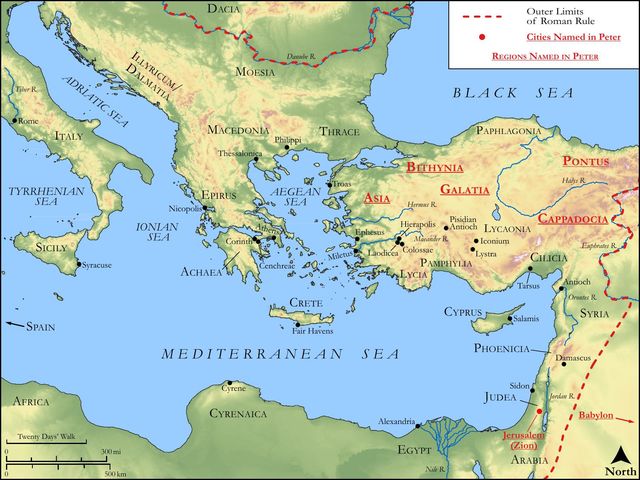
See on the biblical-era maps

Study this verse
Public-domain commentary
Matthew Henry
From his Commentary on the Whole Bible. Henry comments on passages, not single verses — this entry covers 2 Peter 3:8.
The apostle comes in these words to instruct and establish Christians in the truth of the coming of the Lord, where we may clearly discern the tenderness and affection wherewith he speaks to them, calling them beloved; he had a compassionate concern and a love of good-will for the ungodly wretches who refused to believe divine revelation, but he has a peculiar respect for the true believers, and the remaining ignorance and weakness that the apprehends to be in them make him jealous, and put him on giving them a caution. Here we may observe,
I.The truth which the apostle asserts - that with the Lord one day is as a thousand years, and a thousand years are as one day.
Though, in the account of men, there is a great deal of difference between a day and a year, and a vast deal more between one day and a thousand years, yet in the account of God, who inhabits eternity, in which there is no succession, there is no difference; for all things past, present, and future, are ever before him, and the delay of a thousand years cannot be so much to him as the deferring of any thing for a day or an hour is to us.
II.The importance of this truth:
This is the one thing the apostle would not have us ignorant of; a holy awe and reverential fear of God are necessary in order to our worshiping and glorifying him, and a belief of the inconceivable distance between him and us is very proper to beget and maintain that religious fear of the Lord which is the beginning of wisdom. This is a truth that belongs to our peace, and therefore he endeavours that it may not be hidden from our eyes; as it is in the original, Let not this one thing be hidden from you. If men have no knowledge or belief of the eternal God, they will be very apt to think him such a one as themselves. Yet how hard is it to conceive of eternity! It is therefore not very easy to attain such a knowledge of God as is absolutely necessary.
Historical interpretation
Eight Centuries of Reception
10 surviving comments on this verse. Each one is dated, so this reads as a timeline rather than a list.
Select a marker to jump to its quote. Markers stagger vertically where authors wrote within a few decades of each other.
Now we have understood that the expression used among these words, 'According to the days of the tree [of life] shall be the days of my people; the works of their toil shall abound' obscurely predicts a thousand years. For as Adam was told that in the day he ate of the tree he would die, we know that he did not complete a thousand years. We have perceived, moreover, that the expression, 'The day of the Lord is as a thousand years,' is connected with this subject.
And there are some, again, who relegate the death of Adam to the thousandth year; for since "a day of the Lord is as a thousand years".
This is an account of the things formerly created, as also it is a prophecy of what is to come. For the day of the Lord is as a thousand years;
Therefore let the philosophers, who enumerate thousands of ages from the beginning of the world, know that the six thousandth year is not yet completed, and that when this number is completed the consummation must take place, and the condition of human affairs be remodelled for the better, the proof of which must first be related, that the matter itself may be plain. God completed the world and this admirable work of nature in the space of six days, as is contained in the secrets of Holy Scripture, and consecrated the seventh day, on which He had rested from His works. But this is the Sabbath-day, which in the language of the Hebrews received its name from the number, whence the seventh is the legitimate and complete number. For there are seven days, by the revolutions of which in order the circles of years are made up; and there are seven stars which do not set, and seven luminaries which are called planets, whose differing and unequal movements are believed to cause the varieties of circumstances and times.
Therefore, since all the works of God were completed in six days, the world must continue in its present state through six ages, that is, six thousand years. For the great day of God is limited by a circle of a thousand years, as the prophet shows, who says "In Thy sight, O Lord, a thousand years are as one day." And as God laboured during those six days in creating such great works, so His religion and truth must labour during these six thousand years, while wickedness prevails and bears rule. And again, since God, having finished His works, rested the seventh day and blessed it, at the end of the six thousandth year all wickedness must be abolished from the earth, and righteousness reign for a thousand years; and there must be tranquillity and rest from the labours which the world now has long endured.
Scripture says that human life is short and full of trouble, but you belong to the unseen and eternal one. And a thousand years are like a single day, or even like a watch of the night. It is during the fourth watch that those who are entrusted to guard it are divided, and it was during that watch that the Lord came to the holy apostles. If he has spoken this way about a thousand years, it is clear that the lifespan of a man is extremely short. The day of the Lord is like a thousand years, and yet it is undivided. No one lives for a thousand years, but no one has known a full day of the Lord either.
A thousand years is the time that the temple worship lasted. For from the completion of the temple by Solomon, who built the Lord’s house until it became redundant when Christ died on the cross is a thousand years. This thousand years is compared to a day, or to a watch in the night, because everything appeared to be night before the coming of the Savior. For until the sun of righteousness arose, everyone dwelt in ignorance and confusion.
If we take the millennium and think of the end of that time as being the end of the world, we could say that it was the end of time in general, for a thousand years in God’s sight are like a single day. Because of this, anything that was done during the millennium could be spoken of as done at the end of time or on the last day.
Just as a man works for a day and afterwards remembers what he has done, so God does not forget even after a thousand years. It may be a long time before he gets round to punishing sinners, but when he does so he uses his power in a single instant.
Since it is written concerning the day of judgment that a thousand years will be like one day, who can tell whether we shall spend days, months or even years in that fire?
But this one thing, beloved, do not let it escape your notice, that one day with the Lord, etc. Some think this statement should be understood as though the day of judgment has such a length as a span of a thousand years, not considering that he does not simply say there will be one day like a thousand years, but: One, he says, day with the Lord is like a thousand years. Because in the knowledge of divine power, the past, the future, and the present equally abide. And the courses of time which seem long to us and those which seem short are of equal measure to the Creator of time, according to the Psalmist: For a thousand years in your sight are like a day that has just gone by, or like a watch in the night (Psalm 89), which are as nothing, their years will be. For just as it is understood that the Psalmist equates a thousand years not with the future day of judgment, but with the past day that has passed in the sight of the Creator, indeed he likens all our years, that is the whole time of this age, to a watch in the night, which is a fourth part of the night, so blessed Peter equates each day of the present age as a thousand years and a thousand years to each day with the Lord, that is, he asserts they are of the same measure. Because evidently he sees all things, both small and great, equally. And indeed, if Peter wanted this to be understood only about the day of judgment, that it truly would be of such length as a thousand of our years, he could certainly have indicated his opinion more openly, nor would there be any need to add, with the Lord, because if that last day were of such length, it would appear to all men when it arrived. But the Apostle remembers these things to convince those whom he had mentioned earlier saying: Where is the promise of his coming? showing that the Lord is by no means forgetful of his promise or coming, to judge the living and the dead. But as he thus embraces each day of our age with His eternal memory, like a circuit of a thousand years, so he surveys a thousand years as the span of one day without effort, it is manifestly to be understood that He surely knows the end of all these days and years, and without any doubt He has also foreseen this, when the glory of His coming is to be revealed, when the promises are to be returned to the saints. Therefore it is rightly added:
But, beloved, be not ignorant of this one thing, that one day is with the Lord as a thousand years, and a thousand years as one day. The Lord is not slack concerning his promise, as some men count slackness; but is longsuffering toward us, not willing that any should perish, but that all should come to repentance.
"The Lord is not slack." Having completed the discourse on the End, which will necessarily be through fire, all of which we have explained more fully, it transitions to the production or extension of the time until the world is ended, and says: The Lord is not slack concerning his promise, as some understand slowness. Instead, he is patient, waiting for our salvation, not willing that any should perish, but that all should come to repentance: for certainly to him who is infinite and the sea of essence unconstrained, nothing is extended, but a thousand years are just like a single day with him. Or rather, according to David, there is no multiplication of days: for he says in this way: "A thousand years in your sight, O Lord, are like a day that has just gone by and like a watch in the night" (Ps. 89:4): by watch signifying the briefest span of the night. For the night is divided into four watches: since the Lord came to the holy apostles in the fourth watch. (Matt. 14:25)
Continue studying 2 Peter 3:8 across the web’s major study libraries — every link below opens this exact verse, chapter, or book on the destination site.
Read & Compare
 BibleGatewayThis verse in more than 200 translations and 70 languages.
 Bible.comThe YouVersion reader — hundreds of translations, reading plans, and highlights.
 ESV.orgCrossway's official English Standard Version reader.
 NET BibleThe NET translation with 60,000+ translators' notes on every rendering decision.
 STEP BibleTyndale House's free study tool — original text, vocabulary, and scholarly resources.
 BibliaLogos Bible Software's free web reader.
 USCCBThe New American Bible (Revised Edition) with the U.S. bishops' study notes.
Commentaries
 BibleHub CommentariesDozens of classic commentaries on this verse, gathered on one page.
 StudyLightMore than 100 commentary sets — the largest collection on the web.
 BibleRefPlain-English commentary on what this verse means, verse by verse.
 Enduring WordDavid Guzik's free commentary on this chapter, widely used by Bible teachers.
 Bible Study ToolsVerse commentary alongside Greek and Hebrew study aids.
Original Language & Research
- BibleHub InterlinearThe verse word by word — original language, transliteration, and English.
- BibleHub LexiconEvery word's original-language definition and Strong's entry.
 Blue Letter BibleDeep-study tools — Strong's numbers, concordance, and word studies.
 CNTR CollationThe earliest Greek manuscripts of this verse, collated letter by letter.
Sermons, Hymns & Audio


TrulyRandomVerse is not affiliated with these sites and doesn’t control their content. They’re linked because they’re genuinely useful.
Summary
In 2 Peter 3:8, the Apostle Peter addresses the profound difference between divine and human perceptions of time, particularly in the context of the anticipated return of Jesus Christ. This verse serves as a foundational theological statement, reminding believers that God's eternal nature transcends human chronology, thereby reframing the perceived "delay" of Christ's second coming not as unfaithfulness or inability, but as an expression of divine patience and purpose.
Context
ShowHideLiterary Context
This verse is strategically placed within Peter's final epistle, specifically in chapter 3, where he confronts the skepticism of "scoffers" who mock the promise of Christ's return. Peter has just reminded his readers of God's past intervention in history through the Flood (2 Peter 3:5-6), and warns of a future judgment by fire (2 Peter 3:7). The scoffers' argument, articulated in 2 Peter 3:4, questions the Lord's coming based on their limited human timeline. Peter's response in 2 Peter 3:8 directly counters this temporal skepticism, asserting God's timeless nature and boundless patience, which is then further elaborated upon in 2 Peter 3:9 as a delay for the sake of repentance.
Historical & Cultural Context
The early Christian community, having received the promise of Christ's imminent return, faced increasing questions and doubts as time passed. This was particularly acute in a Greco-Roman world where philosophical ideas, such as Epicureanism, might have fostered a worldview that dismissed divine intervention or a personal God. Scoffers, whether from outside or within the church, would have challenged the credibility of Christian eschatology based on the perceived "delay." Peter's words provided a crucial theological framework, drawing on Old Testament wisdom, to address these concerns and reinforce faith in God's ultimate sovereignty over time and history, rather than allowing human impatience to dictate understanding of divine promises.
Key Themes
ShowHideThe central message of 2 Peter 3:8 is God's Timelessness and Patience. It asserts that the Creator is not bound by human chronology; what appears as a long delay to humanity is instantaneous to God, and vice versa. This concept underscores God's immense patience, especially in allowing time for repentance before the final judgment, as explicitly stated in 2 Peter 3:9. Furthermore, the verse encourages believers to adopt a Divine Perspective on time, shifting from a finite, human viewpoint to an eternal one. This divine vantage point ensures that God's promises, including the Second Coming of Christ, will be fulfilled in His perfect timing, demonstrating His Sovereignty Over Prophecy and history.
Exposition and Analysis
ShowHideKey Word Analysis
ShowHideThis term, derived from the Greek verb for divine love (agapao), signifies Peter's deep affection and pastoral care for his readers. It sets a tone of endearment and trust, underscoring that the subsequent warning is given out of love, not condemnation. It implies a shared spiritual bond and a desire for their spiritual well-being amidst the challenges of skepticism.
The phrase "be not ignorant" (formed by the negative particle mḗ and lanthánō) is a strong admonition against being unaware or overlooking a crucial truth. Lanthánō means "to lie hid" or "to be unawares." Peter is urging his audience not to let this fundamental truth about God's relationship with time escape their notice or understanding, as such ignorance could lead to doubt and spiritual complacency.
While literally referring to a 24-hour period, the Greek word hēméra (day) in biblical contexts can also denote a more indefinite period, an "age," or a "time." In this verse, its figurative use is paramount, highlighting that God's "days" are not constrained by human temporal measurements. It emphasizes the qualitative difference between divine and human experience of time, rather than a mere quantitative conversion.
Verse Breakdown
ShowHide"But, beloved, be not ignorant of this one thing,"
Peter opens with an affectionate address, "beloved," immediately followed by a pastoral warning. The phrase "be not ignorant" is a strong imperative, urging his readers to pay close attention to a singular, vital truth that will counteract the scoffers' arguments and strengthen their faith. This "one thing" is the foundational principle of God's timelessness.
"that one day [is] with the Lord as a thousand years,"
This clause introduces the core concept: God's perception of time is radically different from humanity's. The numerical comparison is not a literal mathematical conversion but a poetic and hyperbolic expression emphasizing the vastness of divine time. "With the Lord" (παρὰ Κυρίῳ, para Kyriō) signifies that from God's eternal vantage point, temporal distinctions as humans understand them are fluid or non-existent. A short human period can encompass immense divine activity.
"and a thousand years as one day."
This parallel clause reinforces the first, creating a chiasm (ABBA structure) that solidifies the message. It underscores the complete transcendence of God over human chronology. Whether a period is short or long by human standards, it is equally accessible and manageable within God's eternal plan. This fluidity highlights God's patience and sovereignty, assuring believers that perceived delays are part of His perfect timing.
Literary Devices
ShowHidePeter employs several powerful literary devices in this verse to convey his profound theological message. The most prominent is Hyperbole, where the numerical comparison of "one day" to "a thousand years" is not meant to be a literal equation but a vivid, exaggerated illustration of the vast disparity between human and divine time. This serves to emphasize God's transcendence and eternality. Closely related is Figurative Language, as the verse does not offer a scientific formula for time conversion but rather a theological truth about God's relationship to time. Furthermore, Peter uses Contrast or Antithesis by juxtaposing "one day" and "a thousand years," highlighting the immense difference between human temporal experience and God's eternal perspective. Finally, there is a clear Allusion to Psalm 90:4, where Moses similarly declares God's timelessness, grounding Peter's argument in established Old Testament wisdom and demonstrating a consistent biblical truth across millennia.
Theological and Thematic Connections
ShowHideThe profound truth of 2 Peter 3:8 reverberates throughout biblical theology, affirming God's absolute transcendence over creation, including the dimension of time. It underscores His eternality, omniscience, and omnipotence, revealing that His plans and promises are not subject to human limitations or impatience. The "delay" of Christ's return is thus reframed not as a sign of weakness or forgetfulness, but as an expression of divine patience and a gracious extension of opportunity for repentance, demonstrating God's steadfast love and desire for all to come to salvation. This verse provides a robust theological anchor for believers navigating perceived delays in God's promises, reminding them that His timing is always perfect and purposeful, driven by His unchanging character and ultimate redemptive plan.
Reflection and Application
ShowHideFor believers today, 2 Peter 3:8 offers immense comfort and a vital call to spiritual maturity. In a world characterized by instant gratification and anxiety over the future, this verse reminds us that God operates on an eternal timeline, not constrained by our human calendars or expectations. It encourages us to cultivate patient endurance, trusting that God's promises, no matter how long they seem to take, are absolutely certain and will be fulfilled in His perfect timing. This divine perspective should alleviate our anxieties about perceived delays in answered prayers, the unfolding of prophecies, or the realization of God's justice. Instead of succumbing to skepticism or complacency, we are called to live with a hopeful anticipation, understanding that God's "slowness" is actually His immense patience, providing more opportunities for people to turn to Him in repentance. This truth should motivate us to live holy and godly lives, prepared for Christ's certain return, and to actively participate in His mission of reconciliation, knowing that every "day" is a gift of grace from the Lord.
Questions for Reflection
ShowHideFAQ
ShowHideIs 2 Peter 3:8 a literal mathematical equation for converting human time to divine time?
ShowHideNo, 2 Peter 3:8 is not intended to be a literal mathematical equation for converting human time to divine time. Instead, it employs hyperbole and figurative language to emphasize the vast difference between God's eternal perspective and humanity's finite understanding of time. The verse highlights God's transcendence over temporal limitations, asserting that He is not bound by the chronological constraints that govern human existence. It's a theological statement about God's nature, not a scientific formula.
Why does God seem to delay the Second Coming of Christ?
ShowHidePeter directly addresses the perceived "delay" in the very next verse, 2 Peter 3:9. He explains that "The Lord is not slow to fulfill his promise as some count slowness, but is patient toward you, not wishing that any should perish, but that all should reach repentance." Therefore, what humans perceive as a delay is, from God's perspective, an act of immense patience and grace, providing more time for people to turn to Him in repentance and salvation before the final judgment.
Does this verse mean that a "day" in the Genesis creation account is actually a thousand years?
ShowHideWhile 2 Peter 3:8 speaks to God's perception of time, it does not directly define the length of the "days" in the Genesis creation account. This verse is about God's timelessness and patience in the context of the Second Coming, not a hermeneutical key for interpreting the duration of creation days. The meaning of "day" (yom) in Genesis 1 is a separate theological and exegetical discussion, but this verse should not be used to definitively state that each creation "day" was literally a thousand years.
Christ-Centered Fulfillment
ShowHideThe truth articulated in 2 Peter 3:8 finds its ultimate fulfillment and deepest meaning in the person and work of Jesus Christ. He is the eternal Word, who was "in the beginning with God" (John 1:1-3), existing outside of time, yet willingly entered into human history at the "fullness of time" (Galatians 4:4) to accomplish redemption. Christ Himself embodies the divine patience described by Peter; His first coming was precisely when God ordained it, and His second coming will also occur at the Father's appointed time, known only to Him (Acts 1:7). As the Alpha and Omega, the beginning and the end (Revelation 1:8), Jesus is the unchanging Lord (Hebrews 13:8) who transcends all temporal limitations. His return, though seemingly delayed from a human perspective, is absolutely certain and will usher in the new heavens and new earth, fulfilling all of God's eternal purposes. Therefore, our hope is anchored not in a human calendar, but in the eternal, faithful, and returning Christ, who promises, "Surely I am coming soon" (Revelation 22:20).