


Genesis 45:25
Bible text: King James Version (1769 Blayney text) · Public domain
Bible text: Berean Standard Bible · Public domain
Bible text: American Standard Version (1901) · Public domain
Bible text: World English Bible, Messianic edition · Public domain
Bible text: Geneva Bible (1599) · Public domain
Bible text: Young's Literal Translation · Public domain
- וַיַּעֲלוּvai·ya·'a·Luand they went upH5927Conj-w ¦ V-Qal-ConsecImperf-3mpVerb Qal Consecutive Imperfect 3rd Plural Masculineוַandיַּעֲלוּthey went up
- מִמִּצְרָיִםmi·mitz·Ra·yimfrom EgyptH4714Prep-m ¦ N-properNoun Proper LocationמִfromמִּצְרָיִםEgypt
- וַיָּבֹאוּvai·ya·Vo·'uand they cameH935Conj-w ¦ V-Qal-ConsecImperf-3mpVerb Qal Consecutive Imperfect 3rd Plural Masculineוַandיָּבֹאוּthey came
- אֶרֶץ'E·retz[the] land ofH776N-fscNoun Singular Feminine Construct
- כְּנַעַןke·Na·'anCanaanH3667N-properNoun Proper Location
- אֶל'eltoH413PrepPreposition
- יַעֲקֹבya·'a·KoJacobH3290N-proper-mNoun Proper Masculine
- אֲבִיהֶם'a·vi·Hemtheir fatherH1N-msc ¦ 3mpNoun Singular Masculine Constructאֲבִיfatherהֶםtheir
English is a literal word-by-word gloss of the Hebrew, not the KJV's wording. Why?
This is the original text the KJV's translators worked from — each Hebrew word with its own literal English meaning in this verse, prepared by scholars at Tyndale House, Cambridge. The KJV translates whole sentences, not word by word, so its wording differs: one Hebrew word can become several English words, and the KJV may choose “the LORD” where the gloss reads “Yahweh”. Both are faithful — they answer different questions. For the KJV's own rendering, switch to the KJV text.
Details
See on the biblical-era maps


Study this verse
Public-domain commentary
Matthew Henry
From his Commentary on the Whole Bible. Henry comments on passages, not single verses — this entry covers Genesis 45:25–28.
We have here the good news brought to Jacob. 1. The relation of it, at first, sunk his spirits. When, without any preamble, his sons came in, crying, Joseph is yet alive, each striving which should first proclaim it, perhaps he thought they bantered him, and the affront grieved him; or the very mention of Joseph's name revived his sorrow, so that his heart fainted, Gen 45:26. It was a good while before he came to himself. He was in such care and fear about the rest of them that at this time it would have been joy enough to him to hear that Simeon was released, and that Benjamin had come safely home (for he had been ready to despair concerning both these); but to hear that Joseph is alive is too good news to be true; he faints, for he believes it not. Note, We faint, because we do not believe; David himself had fainted if he had not believed, Psa 27:13. 2. The confirmation of it, by degrees, revived his spirit. Jacob had easily believed his sons formerly when they told him, Joseph is dead; but he can hardly believe them now that they tell him, Joseph is alive. Weak and tender spirits are influenced more by fear than hope, and are more apt to receive impressions that are discouraging than those that are encouraging. But at length Jacob is convinced of the truth of the story, especially when he sees the wagons which were sent to carry him (for seeing is believing), then his spirit revived. Death is as the wagons which are sent to fetch us to Christ: the very sight of it approaching should revive us. Now Jacob is called Israel (Gen 45:28), for he begins to recover his wonted vigour. (1.) It pleases him to think that Joseph is alive. He says nothing of Joseph's glory, of which they told him; it was enough to him that Joseph was alive. Note, Those that would be content with less degrees of comfort are best prepared for greater. (2.) It pleases him to think of going to see him. Though he was old, and the journey long, yet he would go to see Joseph, because Joseph's business would not permit him to come to see him. Observe, He says, "I will go and see him," not, "I will go and live with him;" Jacob was old, and did not expect to live long; "But I will go and see him before I die, and then let me depart in peace; let my eyes be refreshed with this sight before they are closed, and then it is enough, I need no more to make me happy in this world." Note, It is good for us all to make death familiar to us, and to speak of it as near, that we may think how little we have to do before we die, that we may do it with all our might, and may enjoy our comforts as those that must quickly die, and leave them.
Historical interpretation
Historical reception
2 surviving comments on this verse. Each one is dated, so this reads as a timeline rather than a list.
Select a marker to jump to its quote. Markers stagger vertically where authors wrote within a few decades of each other.
We should observe in reading the holy Scriptures how “to go up” and “to go down” are employed in each individual passage. For if we were to give diligent consideration, we would discover that almost never is anyone said to have gone down to a holy place, nor is anyone related to have gone up to a blameworthy place. These observations show that the divine Scripture was not composed, as it seems to most, in illiterate and uncultivated language but was adapted in accordance with the discipline of divine instruction. Nor is Scripture devoted so much to historical narratives as to things and ideas that are mystical.You will find it written, therefore, that those who are born of the seed of Abraham have gone down into Egypt and again that the sons of Israel have gone up out of Egypt. Indeed Scripture speaks thus also of Abraham himself: “But Abraham went up out of Egypt into the desert, he and his wife and all that was his, and Lot with him.”
What is the land of Canaan? A land that was faltering. Is it not clear that the time of the apostles is being described? They entered the faltering synagogues of the Jews and preached the power of the Lord Jesus, as we find in the Acts of the Apostles, when Peter says, “This Jesus God has raised up, and we are all witnesses of it. Therefore, exalted by the right hand of God and receiving from the Father the promise of the Holy Spirit, he has poured forth this gift which you see.”
Continue studying Genesis 45:25 across the web’s major study libraries — every link below opens this exact verse, chapter, or book on the destination site.
Read & Compare
 BibleGatewayThis verse in more than 200 translations and 70 languages.
 Bible.comThe YouVersion reader — hundreds of translations, reading plans, and highlights.
 ESV.orgCrossway's official English Standard Version reader.
 NET BibleThe NET translation with 60,000+ translators' notes on every rendering decision.
 STEP BibleTyndale House's free study tool — original text, vocabulary, and scholarly resources.
 BibliaLogos Bible Software's free web reader.
 USCCBThe New American Bible (Revised Edition) with the U.S. bishops' study notes.
Commentaries
 BibleHub CommentariesDozens of classic commentaries on this verse, gathered on one page.
 StudyLightMore than 100 commentary sets — the largest collection on the web.
 BibleRefPlain-English commentary on what this verse means, verse by verse.
 Enduring WordDavid Guzik's free commentary on this chapter, widely used by Bible teachers.
 Bible Study ToolsVerse commentary alongside Greek and Hebrew study aids.
Original Language & Research
- BibleHub InterlinearThe verse word by word — original language, transliteration, and English.
- BibleHub LexiconEvery word's original-language definition and Strong's entry.
 Blue Letter BibleDeep-study tools — Strong's numbers, concordance, and word studies.
 SefariaThe Hebrew text with Rashi and centuries of Jewish commentary.
Sermons, Hymns & Audio


TrulyRandomVerse is not affiliated with these sites and doesn’t control their content. They’re linked because they’re genuinely useful.
Summary
Genesis 45:25 marks a pivotal moment in the Joseph narrative, describing the departure of Joseph's brothers from Egypt, laden with provisions and the extraordinary news that their long-lost brother is not only alive but the powerful ruler of all Egypt. This journey back to the land of Canaan signifies the beginning of the long-awaited reunion of Jacob and his beloved son, setting the stage for the entire family's relocation and the preservation of the covenant line.
Context
ShowHideLiterary Context
This verse immediately follows Joseph's dramatic and emotional revelation of his true identity to his brothers, a moment of profound reconciliation that brought years of separation and guilt to an end. After weeping with his brothers and assuring them of God's sovereign hand in their ordeal (Genesis 45:5-8), Joseph instructs them to return to their father Jacob with the astonishing news and to bring him and all their households to Egypt, where they would be settled in the fertile land of Goshen. Pharaoh himself, upon hearing the news, enthusiastically endorsed Joseph's plan, providing wagons for their journey and ample provisions for their families (Genesis 45:16-20). The brothers were thus sent off with lavish gifts and a clear mission, underscoring the magnitude of Joseph's position and the divine orchestration of events. Genesis 45:25 captures the very first steps of this momentous return journey, filled with anticipation and the weighty responsibility of delivering such life-altering news to their aged father.
Historical & Cultural Context
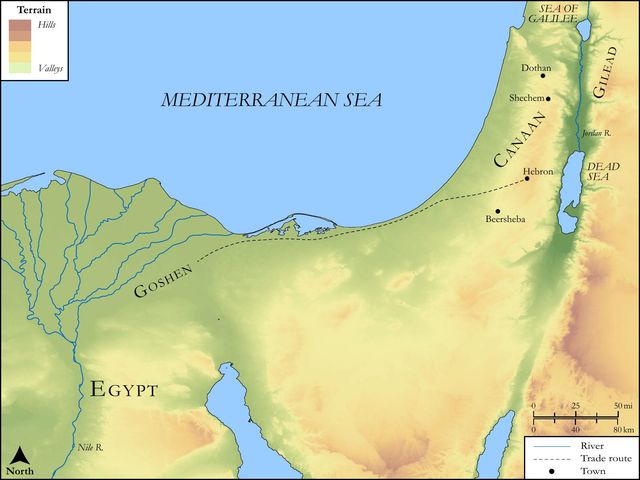
Travel in the days of the patriarchs was arduous and time-consuming, especially for a large group with provisions. The journey from the Nile Delta (Egypt) to the hill country of Canaan would have taken several days, if not weeks, depending on the pace and the size of the caravan. The mention of "going up" from Egypt is geographically accurate, as Canaan generally sits at a higher elevation than the low-lying Nile Delta. Culturally, the patriarchal family structure, with Jacob as the revered head, meant that his well-being and blessing were paramount. The news of Joseph's survival and exaltation would have been an unimaginable joy, reversing years of mourning and despair for Jacob, who believed his favorite son was dead (Genesis 37:35). The provision of wagons by Pharaoh was a significant royal gesture, indicating the importance of Joseph's family and facilitating their relocation, a testament to the power and generosity of both Joseph and the Egyptian monarch.
Key Themes
ShowHideThis verse contributes significantly to several overarching themes within the book of Genesis. Foremost is the theme of Divine Providence, demonstrating God's meticulous orchestration of events, even through human sin and suffering, to fulfill His purposes. Joseph's journey from pit to palace, culminating in his ability to sustain his family, is a powerful testament to God's unseen hand (Genesis 50:20). The verse also highlights Reconciliation and Restoration, as the fractured family unit, torn apart by jealousy and deceit (Genesis 37), begins its journey toward healing and reunion. The brothers' return to Canaan with good news signifies the Preservation of the Covenant Line, as Jacob's descendants, through whom God's promises would be fulfilled, are saved from famine and brought into a place of sustenance. This narrative arc underscores God's faithfulness to His covenant with Abraham, Isaac, and Jacob (Genesis 12:1-3), ensuring the survival and future prosperity of the chosen family.
Exposition and Analysis
ShowHideThe verse reads: "And they went up out of Egypt, and came into the land of Canaan unto Jacob their father,"
Key Word Analysis
ShowHideA primitive root meaning "to ascend, intransitively (be high) or actively (mount)." This word literally describes the geographical ascent from the lower elevation of Egypt to the higher terrain of Canaan. Symbolically, it can also suggest a lifting or elevation in status and hope, as the brothers' journey is one from despair to joy, carrying news of their brother's exaltation.
A primitive root meaning "to go or come (in a wide variety of applications)." This verb emphasizes the successful arrival and culmination of their journey. It signifies the completion of a significant phase in their mission—the physical return to their homeland, bringing them to the threshold of delivering their monumental message.
A primitive word meaning "father, in a literal and immediate, or figurative and remote application; chief." This term highlights the central figure of Jacob, to whom the brothers are returning. It underscores the patriarchal structure of the family and the deep familial bond, emphasizing that the ultimate purpose of this journey is to bring comfort and joy to their grieving patriarch.
Verse Breakdown
ShowHide"And they went up out of Egypt"
This clause describes the commencement of the brothers' journey. The use of "went up" (Hebrew 'alah) is not merely a geographical descriptor but carries a sense of purpose and elevation, signifying a departure from a foreign land and a return towards their ancestral home. It marks a physical and spiritual transition from a place of testing and revelation to the path of reunion.
"and came into the land of Canaan unto Jacob their father"
This second clause specifies the destination and the ultimate purpose of their arduous journey. Their arrival in Canaan is not an end in itself, but a means to an end: to reach Jacob. The phrase "unto Jacob their father" emphasizes the familial bond and the profound significance of the news they carry, highlighting the emotional weight and anticipation surrounding their reunion with the patriarch.
Literary Devices
ShowHideThe verse employs Symbolism and Antithesis. The act of "going up out of Egypt" is symbolic of a reversal of fortunes and a return to the covenant land. Egypt, a place of foreignness and future bondage for Israel, is temporarily a place of refuge and provision through Joseph. The ascent to Canaan symbolizes a movement towards restoration and the fulfillment of God's promise to the patriarchs regarding their land. Furthermore, there is an inherent Antithesis in the narrative's progression: the brothers' previous descent into Egypt with Joseph, whom they sold into slavery, is now contrasted by their "going up" out of Egypt, bringing news of Joseph's life and power. This reversal underscores the divine hand at work, turning evil intentions into good outcomes.
Theological and Thematic Connections
ShowHideGenesis 45:25 serves as a crucial bridge in the Joseph narrative, moving from the intense personal reconciliation between Joseph and his brothers to the broader family reunion. It powerfully illustrates God's intricate weaving of human actions, both good and ill, into His overarching plan of redemption. The journey itself, from the land of temporary sustenance back to the promised land, then ultimately back to Egypt, highlights the transient nature of their dwelling and God's sovereign control over their movements. This verse underscores that God's covenant promises to Abraham, Isaac, and Jacob are steadfast, even when the path to their fulfillment is marked by unforeseen detours and trials. The brothers, once agents of betrayal, are now messengers of life and hope, demonstrating the transformative power of divine grace and forgiveness.
Reflection and Application
ShowHideGenesis 45:25 invites us to reflect on the profound truth that God is always at work, even in the most broken and seemingly hopeless situations. Just as Jacob had mourned Joseph for years, believing him lost forever, we too can experience periods of deep despair and loss. Yet, this verse reminds us that God can orchestrate incredible reversals, bringing life from apparent death, and reunion from painful separation. It encourages us to cultivate a spirit of anticipation and hope, trusting that God's providence extends to every detail of our lives. Furthermore, the brothers' mission to deliver good news to their father serves as a powerful call for us to be bearers of hope and reconciliation in our own spheres, sharing the good news of God's faithfulness and the possibility of restoration in relationships. It challenges us to consider how we might be instruments of God's healing and joy to those who are grieving or estranged.
Questions for Reflection
ShowHideFAQ
ShowHideWhy is the journey from Egypt to Canaan described as "going up"?
ShowHideThe Hebrew verb 'alah (עָלָה), meaning "to go up" or "ascend," is used here. This is geographically accurate, as the land of Canaan, particularly the hill country where Jacob resided, is generally at a higher elevation than the low-lying Nile Delta region of Egypt. Symbolically, it also represents a transition from a foreign land (Egypt) to the promised homeland (Canaan), a return to a place of spiritual significance and ancestral heritage for Jacob's family.
What was the primary purpose of the brothers' return to Canaan?
ShowHideTheir primary and most urgent purpose was to inform their father Jacob that Joseph was alive and had become the powerful ruler of all Egypt. Beyond this astonishing news, they were also tasked with bringing Jacob and his entire household back to Egypt to settle in the fertile land of Goshen, as instructed by Joseph and generously endorsed by Pharaoh (Genesis 45:9-11).
What challenges might the brothers have faced in convincing Jacob of Joseph's survival?
ShowHideJacob had grieved Joseph for over two decades, firmly believing he was dead (Genesis 37:35). The news would have been incredibly difficult for him to believe, potentially overwhelming him with shock and disbelief. The brothers would have needed to present compelling evidence, such as the wagons provided by Pharaoh and Joseph's specific instructions, to overcome Jacob's long-held sorrow and convince him of the miraculous truth (Genesis 45:26-28).
Christ-Centered Fulfillment
ShowHideThe journey of Joseph's brothers, carrying the life-altering news of their brother's survival and exaltation back to their grieving father Jacob, serves as a profound prefigurement of the Gospel message and the work of Christ. Just as Joseph, once thought dead and lost, was revealed to be alive and exalted as a savior for his family and the nations, so too is Christ, who truly died for the sins of the world, now gloriously risen from the dead and seated at the right hand of God, reigning in power and authority (Romans 8:34). The brothers' mission to bring their father to Joseph in Egypt, where there was provision and life, foreshadows the Holy Spirit's work in drawing humanity to Christ, the true sustainer and Savior, for reconciliation and eternal life (John 6:44). The restoration of Jacob's family through Joseph's provision and the subsequent journey to Egypt for sustenance points to the ultimate reconciliation and spiritual preservation offered to all who come to Christ, the one who brings good out of evil (1 Peter 3:18) and unites a scattered people into one family of God, the Church (Ephesians 2:19-20). This narrative beautifully illustrates that the "good news" of Christ's triumph over death is the ultimate message of hope and life, transforming despair into overwhelming joy for all who believe.