


1 Samuel 30:12
Bible text: King James Version (1769 Blayney text) · Public domain
Bible text: King James Version with Strong's numbers · Public domain
Bible text: Berean Standard Bible · Public domain
Bible text: American Standard Version (1901) · Public domain
Bible text: World English Bible, Messianic edition · Public domain
Bible text: Geneva Bible (1599) · Public domain
Bible text: Young's Literal Translation · Public domain
- וַיִּתְּנוּvai·yi·te·nuand they gaveH5414Conj-w ¦ V-Qal-ConsecImperf-3mpVerb Qal Consecutive Imperfect 3rd Plural Masculineוַandיִּתְּנוּthey gave
- לוֹloto <the> himPrep-l ¦ 3msSuffix Personal 3rd Singular Masculineלto <the>וֹhim
- פֶלַחFe·lacha slice ofH6400N-fscNoun Singular Feminine Construct
- דְּבֵלָהde·ve·Lahfig cakeH1690N-fsNoun Singular Feminine Absolute
- וּשְׁנֵיu·she·Neiand twoH8147Conj-w ¦ N-cdcNoun Dual common gender Constructוּandשְׁנֵיtwo
- צִמֻּקִיםtzi·mu·Kimbunches of raisinsH6778N-mpNoun Plural Masculine Absolute
- וַיֹּאכַלvai·Yo·khaland he ateH398Conj-w ¦ V-Qal-ConsecImperf-3msVerb Qal Consecutive Imperfect 3rd Singular Masculineוַandיֹּאכַלhe ate
- וַתָּשָׁבva·Ta·shovand it returnedH7725Conj-w ¦ V-Qal-ConsecImperf-3fsVerb Qal Consecutive Imperfect 3rd Singular Feminineוַandתָּשָׁבit returned
- רוּחוֹru·Chohis spiritH7307N-fsc ¦ 3msNoun Singular Feminine Constructרוּחspiritוֹhis
- אֵלָיו'e·Lavto himH413Prep ¦ 3msPreposition Definiteאֵלָיtoוhim
- כִּיkiforH3588PrtParticle Conditional
- לֹאlo'notH3808NegParticle Negative
- אָכַל'A·khalhe had eatenH398V-Qal-Perf-3msVerb Qal Perfect 3rd Singular Masculine
- לֶחֶםle·chemfoodH3899N-msNoun Singular Masculine Absolute
- וְלֹאve·lo'and notH3808Conj-w ¦ NegParticle Negativeוְandלֹאnot
- שָׁתָהSha·tahhe had drunkH8354V-Qal-Perf-3msVerb Qal Perfect 3rd Singular Masculine
- מַיִםMa·yimwaterH4325N-mpNoun Plural Masculine Absolute
- שְׁלֹשָׁהshe·lo·ShahthreeH7969N-csNoun Singular common gender Absolute
- יָמִיםya·MimdaysH3117N-mpNoun Plural Masculine Absolute
- וּשְׁלֹשָׁהu·she·lo·Shahand threeH7969Conj-w ¦ N-csNoun Singular common gender Absoluteוּandשְׁלֹשָׁהthree
- לֵילוֹתlei·LotnightsH3915N-fpNoun Plural Feminine Absolute
English is a literal word-by-word gloss of the Hebrew, not the KJV's wording. Why?
This is the original text the KJV's translators worked from — each Hebrew word with its own literal English meaning in this verse, prepared by scholars at Tyndale House, Cambridge. The KJV translates whole sentences, not word by word, so its wording differs: one Hebrew word can become several English words, and the KJV may choose “the LORD” where the gloss reads “Yahweh”. Both are faithful — they answer different questions. For the KJV's own rendering, switch to the KJV text.
Details
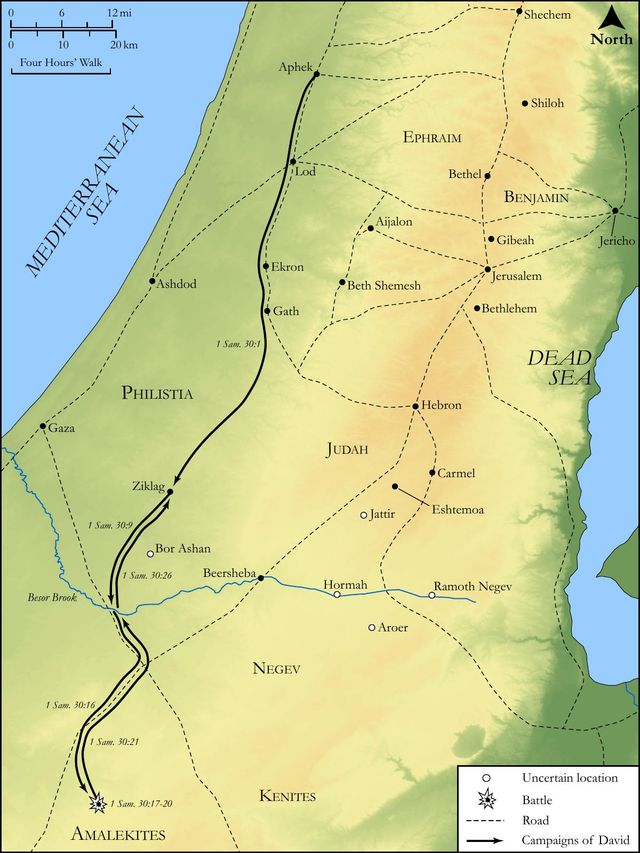
See on the biblical-era map
Study this verse
Public-domain commentary
Matthew Henry
From his Commentary on the Whole Bible. Henry comments on passages, not single verses — this entry covers 1 Samuel 30:7–20. His three-level outline is real structure in the source text, so it is rendered as structure.
Solomon observes that the righteous is delivered out of trouble and the wicked cometh in his stead, that the just falleth seven times a-day and riseth again; so it was with David. Many were his troubles, but the Lord delivered him out of them all, and particularly out of this of which we have here an account.
I.He enquired of the Lord both concerning his duty - Shall I pursue after this troop? and concerning the event - Shall I overtake them? Sa1 30:8. It was a great advantage to David that he had the high priest with him and the breast-plate of judgment, which, as a public person, he might consult in all his affairs, Num 27:21. We cannot think that he left Abiathar and the ephod at Ziklag, for then he and it would have been carried away by the Amalekites, unless we may suppose them hidden by a special providence, that they might be ready for David to consult at his return. If we conclude that David had his priest and ephod with him in the camp of the Philistines, it was certainly a great neglect in him that he did not enquire of the Lord by them concerning his engagement to Achish. Perhaps he was ashamed to own his religion so far among the uncircumcised; but now he begins to apprehend that this trouble is brought upon him to correct him for that oversight, and therefore the first thing he does is to call for the ephod. It is well if we get this good by our afflictions, to be reminded by them of neglected duties, and particularly to be quickened by them to enquire of the Lord. See Ch1 15:13. David had no room to doubt but that his war against these Amalekites was just, and he had an inclination strong enough to set upon them when it was for the recovery of that which was dearest to him in this world; and yet he would not go about it without asking counsel of God, thereby owning his dependence upon God and submission to him. If we thus, in all our ways, acknowledge God, we may expect that he will direct our steps, as he did David's here, answering him above what he asked, with an assurance that he should recover all.
II.He went himself in person, and took with him all the force he had, in pursuit of the Amalekites, Sa1 30:9, Sa1 30:10.
See how quickly, how easily, how effectually the mutiny among the soldiers was quelled by his patience and faith. When they spoke of stoning him (Sa1 30:6), if he had spoken of hanging them, or had ordered that the ringleaders of the faction should immediately have their heads struck off, though it would have been just, yet it might have been of pernicious consequence to his interest in this critical juncture; and, while he and his men were contending, the Amalekites would have clearly carried off their spoil. But when he, as a deaf man, heard not, smothered his resentments, and encouraged himself in the Lord his God, the tumult of the people was stilled by his gentleness and the power of God on their hearts; and, being thus mildly treated, they are now as ready to follow his foot as they were but a little before to fly in his face. Meekness is the security of any government. All his men were willing to go along with him in pursuit of the Amalekites, and he needed them all; but he was forced to drop a third part of them by the way; 200 out of 600 were so fatigued with their long march, and so sunk under the load of their grief, that they could not pass the brook Besor, but staid behind there. This was,
1.A great trial of David's faith, whether he could go on, in a dependence upon the word of God, when so many of his men failed him. When we are disappointed and discouraged in our expectations from second causes, then to go on with cheerfulness, confiding in the divine power, this is giving glory to God, by believing against hope, in hope.
2.A great instance of David's tenderness to his men, that he would by no means urge them beyond their strength, though the case itself was so very urgent. The Son of David thus considers the frame of his followers, who are not all alike strong and vigorous in their spiritual pursuits and conflicts; but, where we are weak, there he is kind; nay, more there he is strong, Co2 12:9, Co2 12:10.
III.Providence threw one in their way that gave them intelligence of the enemy's motions, and guided theirs; a poor Egyptian lad, scarcely alive, is made instrumental of a great deal of good to David. God chooses the foolish things of the world, with them to confound the wise. Observe,
1.His master's cruelty to him. He had got out of him all the service he could, and when the lad fell sick, probably being over-toiled with his work, he barbarously left him to perish in the field, when he was in no such haste but he might have put him into some of the carriages, and brought him home, or, at least, have left him wherewithal to support himself. That master has the spirit of an Amalekite, not of an Israelite, that can thus use a servant worse than one would use a beast. The tender mercies of the wicked are cruel. This Amalekite thought he should now have servants enough of the Israelite-captives, and therefore cared not what became of his Egyptian slave, but could willingly let him die in a ditch for want of necessaries, while he himself was eating and drinking, Sa1 30:16. Justly did Providence make this poor servant, that was thus basely abused, instrumental towards the destruction of a whole army of Amalekites and his master among the rest; for God hears the cry of oppressed servants.
2.David's compassion to him. Though he had reason to think he was one of those that had helped to destroy Ziklag, yet, finding him in distress, he generously relieved him, not only with bread and water (Sa1 30:11), but with figs and raisins, Sa1 30:12. Though the Israelites were in haste, and had no great plenty for themselves, yet they would not forbear to deliver one that was drawn unto death, nor say, Behold, we knew it not, Pro 24:11, Pro 24:12. Those are unworthy the name of Israelites who shut up the bowels of their compassion from persons in distress. It was also prudently done to relieve this Egyptian; for, though despicable, he was capable of doing them service: so it proved, though they were not certain of this when they relieved him. It is a good reason why we should neither do an injury nor deny a kindness to any man that we know not but, some time or other, it may be in his power to return either a kindness or an injury.
3.The intelligence David received from this poor Egyptian when he had come to himself. He gave him an account concerning his party.
(1.)What they had done (Sa1 30:14): We made an invasion, etc. The countries which David had pretended to Achish to have made an incursion upon (Sa1 27:10) they really had invaded and laid waste. What was then false now proved too true.
(2.)Whither they had gone, Sa1 30:15. This he promised David to inform him of upon condition he would spare his life and protect him from his master, who, if he could hear of him again (he thought), would add cruelty to cruelty. Such an opinion this poor Egyptian had of the obligation of an oath that he desired no greater security for his life than this: Swear unto me by God, not by the gods of Egypt or Amalek, but by the one supreme God.
IV.David, being directed to the place where they lay, securely celebrating their triumphs, fell upon them, and, as he used to pray, saw his desire upon his enemies.
1.The spoilers were cut off. The Amalekites, finding the booty was rich, and having got with it (as they thought) out of the reach of danger, were making themselves very merry with it, Sa1 30:16. All thoughts of war were laid aside, nor were they in any haste to house their prey, but spread themselves abroad on the earth in the most careless manner that could be, and there they were found eating, and drinking, and dancing, probably in honour of their idol-gods, to whom they gave the praise of their success. In this posture David surprised them, which made the conquest of them, and the blow he gave them, the more easy to him and the more dismal to them. Then are sinners nearest to ruin when they cry, Peace and safety, and put the evil day far from them. Nor does any thing give our spiritual enemies more advantage against us than sensuality and the indulgence of the flesh. Eating, and drinking, and dancing, have been the soft and pleasant way in which many have gone down to the congregation of the dead. Finding them thus off their guard, and from their arms (many of them, it may be, drunk, and unable to make any resistance), he put them all to the sword, and only 400 escaped, Sa1 30:17. Thus is the triumphing of the wicked short, and wrath comes on them, as on Belshazzar, when they are in the midst of their jollity.
2.The spoil was recovered and brought off, and nothing was lost, but a great deal gotten.
(1.)They retrieved all their own (Sa1 30:18, Sa1 30:19): David rescued his two wives; this is mentioned particularly, because this pleased David more than all the rest of his achievements. Providence had so ordered it that the Amalekites carefully preserved all that they had taken, concluding that they kept it for themselves, though really they preserved it for the right owners, so that there was nothing lacking to them; so it proved, when they concluded all was gone: so much better is God oftentimes to us than our own fears. Our Lord Jesus was indeed the Son of David and the Son of Abraham, in this resembling them both (Abraham, Gen 14:16, and David here), that he took the prey from the mighty, and led captivity captive. But this was not all.
(2.)They took all that belonged to the Amalekites besides (Sa1 30:20): Flocks and herds, either such as were taken from the Philistines and others, which David had the disposal of by the law of war; or perhaps he made a sally into the enemy's country, and fetched off these flocks and herds thence, as interest for his own. This drove was put in the van of the triumph, with this proclamation, "This is David's spoil. This we may thank him for." Those who lately spoke of stoning him now caressed him and cried him up, because they got by him more than they had then lost. Thus are the world and its sentiments governed by interest.
Historical interpretation
Historical reception
2 surviving comments on this verse. Each one is dated, so this reads as a timeline rather than a list.
Select a marker to jump to its quote. Markers stagger vertically where authors wrote within a few decades of each other.
The poor and the feeble, the blind and the lame, are called and come because the weak and the despised in this world are often quicker to hear the voice of God, as in this world they have nothing to delight them.The Egyptian servant of the Amalekites is a good example of this. When the Amalekites were plundering and moving about, he was left behind on the road sick and fainting from hunger and thirst. When David found him, he provided him with food and drink, and as soon as he revived he became David’s guide, found the celebrating Amalekites, and with great bravery overthrew the people who had left him behind sick.
Amalekite means “a people that laps.” What does “a people that laps” signify but the hearts of the worldly? Going about after the things of earth, it is as if they are lapping them up when they take delight in temporal things alone. A lapping people takes plunder, so to speak, when out of its love for earthly things it heaps up profit from others’ losses. The Egyptian servant is left behind on the road sick, because all sinners, once they begin to grow weak from the situation of this world, soon come to be despised by worldly minds. David found him and provided him with food and drink, because the Lord, who is “brave in hand” (if we attribute to him the meaning of David’s name), does not despise what the world has cast aside. Often he directs to the grace of his love those who are not strong enough to follow the world, and who are, so to speak, left behind on the road, holding out to them the food and drink of his word. It is as if he chooses them as guides for himself on the road when he makes them his preachers. When they bring Christ to the hearts of sinners, it is as if they are leading David upon the enemy, and, like David, they strike the celebrating Amalekites with the sword, because by the Lord’s power they overthrow all the proud who had despised them in the world.
Who, when he had eaten, etc. When he had received the nourishment of the true faith, he also received the confidence of mind by which he would hope to obtain the grace of mercy.
Continue studying 1 Samuel 30:12 across the web’s major study libraries — every link below opens this exact verse, chapter, or book on the destination site.
Read & Compare
 BibleGatewayThis verse in more than 200 translations and 70 languages.
 Bible.comThe YouVersion reader — hundreds of translations, reading plans, and highlights.
 ESV.orgCrossway's official English Standard Version reader.
 NET BibleThe NET translation with 60,000+ translators' notes on every rendering decision.
 STEP BibleTyndale House's free study tool — original text, vocabulary, and scholarly resources.
 BibliaLogos Bible Software's free web reader.
 USCCBThe New American Bible (Revised Edition) with the U.S. bishops' study notes.
Commentaries
 BibleHub CommentariesDozens of classic commentaries on this verse, gathered on one page.
 StudyLightMore than 100 commentary sets — the largest collection on the web.
 BibleRefPlain-English commentary on what this verse means, verse by verse.
 Enduring WordDavid Guzik's free commentary on this chapter, widely used by Bible teachers.
 Bible Study ToolsVerse commentary alongside Greek and Hebrew study aids.
Original Language & Research
- BibleHub InterlinearThe verse word by word — original language, transliteration, and English.
- BibleHub LexiconEvery word's original-language definition and Strong's entry.
 Blue Letter BibleDeep-study tools — Strong's numbers, concordance, and word studies.
 SefariaThe Hebrew text with Rashi and centuries of Jewish commentary.
Sermons, Hymns & Audio


TrulyRandomVerse is not affiliated with these sites and doesn’t control their content. They’re linked because they’re genuinely useful.
Summary
1 Samuel 30:12 narrates the pivotal moment when David's pursuing army encounters a dying Egyptian slave, abandoned by his Amalekite master. Despite their own profound distress and urgent mission to recover their families and possessions, David's men demonstrate remarkable compassion by providing the man with food and water. This act of mercy leads to his rapid physical restoration after three days of severe deprivation, enabling him to provide crucial intelligence that ultimately guides David to the Amalekite raiders and the successful recovery of all that was lost.
Context
ShowHideLiterary Context
This verse is situated within a critical juncture in David's life, immediately following the devastating Amalekite raid on Ziklag, which left the city burned and its inhabitants, including David's two wives and children, taken captive. Overwhelmed with grief and facing the potential revolt of his own men, David "strengthened himself in the Lord his God" and sought divine guidance through the ephod, receiving assurance that he would pursue, overtake, and recover all (1 Samuel 30:6-8). As David and his 600 men pursued the raiders, they encountered a sick and abandoned Egyptian slave in the field (1 Samuel 30:11). Verse 12 details the compassionate act of sustenance that revives him, setting the stage for his crucial role as an informant, leading David directly to the Amalekite camp and the subsequent victory described in 1 Samuel 30:17-20.
Historical & Cultural Context
The narrative unfolds in the arid Negev region, where water and food were scarce and vital for survival, especially during military campaigns. The Amalekites were a nomadic, predatory people, known for their cruelty and historical enmity with Israel, having attacked them during the Exodus (Exodus 17:8-16). Their practice of abandoning a sick slave, rather than caring for him, reflects a common harshness of ancient servitude and contrasts sharply with the compassionate act of David's men. The "cake of figs" and "clusters of raisins" were common, energy-dense provisions, easily transportable and capable of providing quick sustenance, making them ideal for travelers and soldiers. The mention of "three days and three nights" underscores the extreme and life-threatening deprivation the Egyptian had endured, highlighting the miraculous nature of his recovery and the urgency of the intervention.
Key Themes
ShowHideThis verse powerfully illustrates several key themes. First, Compassion and Humanity are central, as David's men, despite their own profound grief and urgent mission, extend life-saving mercy to a dying stranger, an enemy's slave, contrasting sharply with the Amalekites' callous abandonment. This act of kindness underscores the moral character fostered by faith in God, even in dire circumstances. Second, the theme of Divine Providence and Provision is evident; what appears to be a simple act of charity is divinely orchestrated to provide David with the critical intelligence needed for his mission. The recovery of the Egyptian is not merely a humanitarian gesture but a pivotal moment in God's plan to ensure David's success and the recovery of all that was lost, demonstrating God's ability to use unexpected means and individuals to accomplish His purposes, as seen in the broader narrative of 1 Samuel 30. Finally, Physical Restoration and Life-Giving Sustenance are vividly portrayed, emphasizing the immediate and profound impact of basic nourishment on a body severely weakened by hunger and dehydration, signifying a return of strength and consciousness.
Exposition and Analysis
ShowHideKey Word Analysis
ShowHideThe phrase "his spirit came again to him" uses the Hebrew word rûwach, which in this context refers to the person's breath, vital force, or consciousness. It signifies a dramatic return of physical vitality and mental awareness, indicating that the Egyptian was on the brink of death due to severe deprivation. This usage emphasizes the immediate and profound physical resuscitation brought about by the food and water, restoring his life-force.
A "cake of figs" (Hebrew dᵉbêlâh) was a common, energy-dense food item in ancient Israel, made by pressing dried figs into a compact block. Figs are rich in natural sugars, fiber, and minerals, providing a quick and sustained energy boost. This specific detail highlights the practical and effective nature of the provision, offering immediate and vital nourishment to a severely weakened individual.
Similar to fig cakes, "clusters of raisins" (Hebrew tsammûwq, dried grapes) were also a staple, known for their high sugar content and ease of transport. Together with the fig cake, they represent a concentrated source of carbohydrates, essential for rapidly restoring blood sugar levels and energy in someone suffering from extreme malnutrition and dehydration.
Verse Breakdown
ShowHide"And they gave him a piece of a cake of figs, and two clusters of raisins:"
This clause details the specific act of compassion and the nature of the provisions offered. David's men, despite their own exhaustion and distress, actively chose to care for a stranger, providing him with readily available, energy-rich foods that were critical for his immediate survival. This highlights their humanity and practical benevolence.
"and when he had eaten, his spirit came again to him:"
This clause describes the immediate and profound effect of the nourishment. The phrase "his spirit came again to him" (as discussed in Key Word Analysis) signifies a dramatic revival of his physical and mental faculties, moving him from a state of near-death unconsciousness to a state of renewed strength and awareness. It underscores the life-giving power of basic sustenance.
"for he had eaten no bread, nor drunk [any] water, three days and three nights."
This final clause provides the crucial context for the Egyptian's condition and the necessity of the intervention. The "three days and three nights" emphasizes the extreme duration and severity of his deprivation, explaining why he was on the verge of death. This detail amplifies the impact of the compassionate act and the dramatic nature of his recovery.
Literary Devices
ShowHideThe verse employs several literary devices to enhance its impact. Contrast is prominent, highlighting the stark difference between the Amalekites' cruelty in abandoning their sick slave and David's men's compassion in tending to him, even amidst their own personal crisis. The detailing of "a piece of a cake of figs, and two clusters of raisins" adds realism and specificity to the act of provision, emphasizing the practical and immediate nature of the care given. The phrase "his spirit came again to him" functions as an idiom or metonymy, where "spirit" represents his life force or consciousness, vividly portraying his physical revival. Furthermore, the explicit mention of "three days and three nights" serves as an emphasis or even a form of hyperbole to underscore the extreme severity of his starvation and dehydration, making his recovery all the more remarkable and highlighting the urgency of the intervention.
Theological and Thematic Connections
ShowHideThe compassionate act of David's men in 1 Samuel 30:12 resonates deeply with biblical principles of mercy, hospitality, and divine providence. It illustrates that even in moments of profound personal crisis and urgent mission, the people of God are called to extend kindness to the vulnerable and suffering, regardless of their background or perceived status. This act of selfless care, seemingly small, becomes a critical link in God's larger plan, demonstrating His sovereignty over circumstances and His ability to use unexpected means—even a dying, abandoned slave—to accomplish His purposes. It underscores that God often works through human acts of compassion, turning them into instruments of His redemptive will. This narrative reminds us that true faith is often expressed through tangible acts of love and care for those in need, reflecting the very heart of God.
Reflection and Application
ShowHideThe account of David's men ministering to the abandoned Egyptian slave in 1 Samuel 30:12 offers profound lessons for contemporary believers. It challenges us to consider our priorities in times of personal distress or urgent tasks. Are we so consumed by our own needs and goals that we overlook the suffering of others, even those who might seem insignificant or unrelated to our immediate concerns? This narrative calls us to cultivate a radical compassion that mirrors God's own heart, extending practical care to those who are vulnerable, hungry, or in despair, regardless of their background or our perceived inconvenience. It reminds us that acts of basic human kindness—providing food, water, or shelter—can have far-reaching, divinely orchestrated consequences, becoming the very means through which God unfolds His purposes. We are encouraged to trust that God can use the most unexpected encounters and individuals to bring about His will, transforming what appears to be a detour into a divine appointment.
Questions for Reflection
ShowHideFAQ
ShowHideWhy were David's men so compassionate to a stranger, especially in their own distress?
ShowHideDavid's men, though deeply distressed by the loss of their families and possessions, were operating under David's leadership, who himself had just "strengthened himself in the Lord" (1 Samuel 30:6). Their act of compassion reflects several factors: the general humanitarian ethics present in ancient Israel, which often included care for the sojourner and the vulnerable, contrasting with the cruelty of their enemies; the influence of David's own character, which, despite his flaws, often demonstrated a heart after God; and, most importantly, divine providence. This seemingly spontaneous act of mercy was, in fact, God's way of providing the crucial intelligence David needed. Their compassion was not merely a good deed but a divinely guided step towards victory.
What is the significance of "three days and three nights" without food or water?
ShowHideThe detail of "three days and three nights" highlights the extreme and life-threatening condition of the Egyptian slave. In ancient times, this duration without sustenance, especially water in an arid region, would typically lead to severe dehydration, organ failure, and death. It emphasizes that the man was literally at death's door. This detail magnifies the impact of the simple act of providing food and water, making his rapid recovery appear truly miraculous and underscoring the immediate, life-saving power of basic nourishment. It also serves to stress the Amalekites' profound lack of humanity in abandoning someone in such a desperate state.
Christ-Centered Fulfillment
ShowHideThe life-giving sustenance offered to the dying Egyptian slave in 1 Samuel 30:12 beautifully foreshadows the ultimate provision and restoration found in Jesus Christ. Just as the cake of figs and clusters of raisins brought physical life back to a man on the brink of death, so Jesus offers spiritual life and sustenance to humanity, which is spiritually dead and dying due to sin. He declares Himself to be the "Bread of Life" (John 6:35), stating that whoever comes to Him will never hunger, and whoever believes in Him will never thirst. Furthermore, He promises "living water" (John 4:10) that springs up to eternal life, contrasting with the temporary physical relief given to the Egyptian. The compassion shown by David's men reflects Christ's own ministry, as He consistently reached out to the lowly, the sick, and the abandoned, demonstrating radical love and providing for both physical and spiritual needs (Matthew 9:35-36). The unexpected role of the revived slave in leading David to victory also points to Christ, who, though appearing in humble form, became the ultimate "key" to humanity's victory over sin and death, leading us to the full recovery of our lost inheritance and relationship with God through His sacrifice and resurrection (Colossians 2:15).