


Matthew 27:63
Bible text: King James Version (1769 Blayney text) · Public domain
Bible text: Berean Standard Bible · Public domain
Bible text: American Standard Version (1901) · Public domain
Bible text: World English Bible, Messianic edition · Public domain
Bible text: Geneva Bible (1599) · Public domain
Bible text: Young's Literal Translation · Public domain
- λέγοντες·legontessayingG3004V-PAP-NPMVerb Present Active Participle Nominative Plural Masculine
- κύριεkurieSirG2962N-VSMNoun Vocative Singular Masculine
- ἐμνήσθημενemnēsthēmenwe have rememberedG3403V-API-1PVerb Aorist Passive Indicative 1st Plural
- ὅτιhotihowG3754CONJConjunction
- ἐκεῖνοςekeinosthat [on,e]G1565D-NSMDemonstrative pronoun Nominative Singular Masculine
- ὁhotheG3588T-NSMDefinite article Nominative Singular Masculine
- πλάνοςplanosdeceiverG4108A-NSMAdjective Nominative Singular Masculine
- εἶπενeipensaidG2036V-2AAI-3SVerb 2nd Aorist Active Indicative 3rd Singular
- ἔτιetiwhileG2089ADVAdverb
- ζῶν·zōnlivingG2198V-PAP-NSMVerb Present Active Participle Nominative Singular Masculine
- μετὰmetaAfterG3326PREPPreposition
- τρεῖςtreisthreeG5140A-APFAdjective Accusative Plural Feminine
- ἡμέραςhēmerasdaysG2250N-APFNoun Accusative Plural Feminine
- ἐγείρομαιegeiromaiI ariseG1453V-PPI-1SVerb Present Passive Indicative 1st Singular
English is a literal word-by-word gloss of the Greek, not the KJV's wording. Why?
This is the original text the KJV's translators worked from — each Greek word with its own literal English meaning in this verse, prepared by scholars at Tyndale House, Cambridge. The KJV translates whole sentences, not word by word, so its wording differs: one Greek word can become several English words, and the KJV may choose “charity” where the gloss reads “love”. Both are faithful — they answer different questions. For the KJV's own rendering, switch to the KJV text.
Details
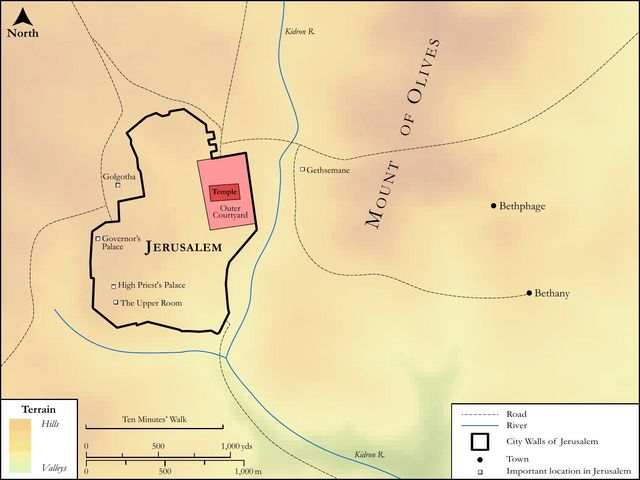
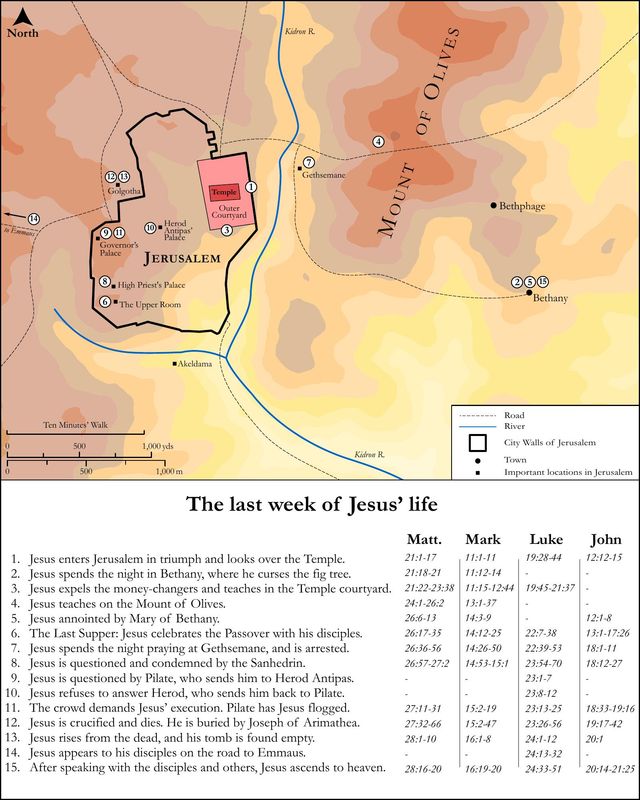
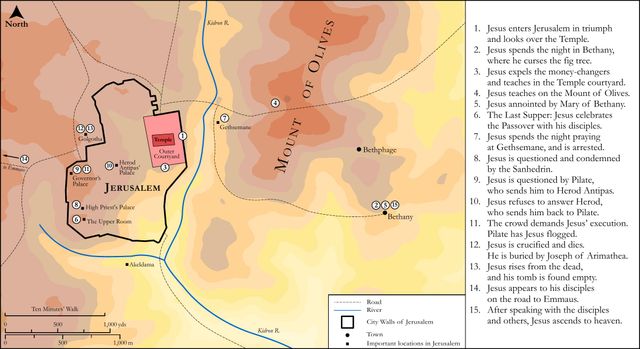
See on the biblical-era maps
Study this verse
Historical interpretation
Six Centuries of Reception
10 surviving comments on this verse. Each one is dated, so this reads as a timeline rather than a list.
Select a marker to jump to its quote. Markers stagger vertically where authors wrote within a few decades of each other.
What do you say, chief priest? Do you really think that Christ said to his men "after three days I will rise again" and then secretly commanded them to steal his body during the night and to tell everyone that he had risen from the dead after three days? Yet it is manifestly incredible that after giving such great moral instruction to all peoples and after demonstrating such great power throughout all of Judea, he would then turn and deceive his disciples. Even they would find fault with their commander and therefore refuse to do his bidding, most especially in view of the danger which would have threatened them from the people if they had confessed the man just crucified to be both their teacher and the Messiah. But if it is hardly believable for him to have said such a thing to his disciples, see if it is not more logical to believe that just as he performed great miracles and predicted that his gospel would be preached "to the ends of the earth," that his disciples "would stand before rulers and kings" and that "Jerusalem would be destroyed by an army," so also did he predict his resurrection when he said "destroy this temple and in three days I will raise it up." Indeed, it was for that reason that the chief priests and Pharisees said to Pilate, "That imposter said, while he was still alive, 'after three days I will rise again.' "
It is reasonable to ask the chief priests who approached Pilate the following line of questions. Tell us, for what purpose do you think Jesus said, "Destroy this temple and in three days I will raise it up"? Was he speaking about the death and resurrection "of his body" or about the destruction and reconstruction of the temple? If you thought that he was speaking of his resurrection, why did you testify against him because he had said, "I am able to destroy this temple and in three days to rebuild it"? If, however, you thought that he was speaking of the temple, as you have testified, then how do you know that he meant "after three days" he would be raised from the dead? See then how Christ exposes their impiety with their own words. Through their words, the chief priests condemn their own testimony, for understanding truly that Christ was speaking of his resurrection, they deliberately twisted his meaning to make it seem like he was speaking of the destruction and reconstruction of that inanimate temple.
Their fear lest the body should be stolen, the setting a watch on the tomb, and sealing it, are marks of folly and unbelief, that they should have sought to seal up the tomb of One at whose bidding they had seen a dead man raised from the tomb.
(Hom. lxxxix.) Observe how against their will they concert to demonstrate the truth, for by their precautions irrefragable demonstration of the resurrection was attained. The sepulchre was watched, and so no fraud could have been practised; and if there was no collusion, it is certain that the Lord rose again.
Pilate will not suffer that the soldiers alone should seal. But as though he had learnt the truth concerning Christ, he was no longer willing to be partner in their acts, and says, Seal it as ye will yourselves, that ye may not be able to accuse others. For had the soldiers alone sealed, they might have said that the soldiers had suffered the disciples to steal the body, and so given the disciples a handle to forge a tale concerning the resurrection; but this could they not say now, when they themselves had sealed the sepulchre.
Everywhere deceit recoils upon itself, and against its will supports the truth. And observe. It was necessary for it to be believed that He died, and that He rose again, and that He was buried, and all these things are brought to pass by His enemies. See, at any rate, these words bearing witness to every one of these facts. "We remember," these are the words, "that that deceiver said, when He was yet alive," (He was therefore now dead), "After three days I rise again. Command therefore that the sepulchre be sealed," (He was therefore buried), "lest His disciples come and steal Him away." So that if the sepulchre be sealed, there will be no unfair dealing. For there could not be. So then the proof of His resurrection has become incontrovertible by what ye have put forward. For because it was sealed, there was no unfair dealing. But if there was no unfair dealing, and the sepulchre was found empty, it is manifest that He is risen, plainly and incontrovertibly. Seest thou, how even against their will they contend for the proof of the truth?
But mark thou, I pray thee, the disciples' love of truth, how they conceal from us none of the things that are said by His enemies, though they use opprobrious language. Behold, at any rate, they even call Him a deceiver, and these men are not silent about that.
But these things show also their savageness (that not even at His death did they let go their anger), and these men's simple and truthful disposition.
But it were worth while to inquire concerning that point also, where He said, "After three days I rise again?" For one would not find this thus distinctly stated, but rather the example of Jonah. So that they understood His saying, and of their own will dealt unfairly.
What then saith Pilate? "Ye have a watch; make it as sure as ye can. And they made it sure, sealing the sepulchre, and setting the watch." He suffers not the soldiers alone to seal, for as having learnt the things concerning Christ, he was no longer willing to co-operate with them. But in order to be rid of them, he endures this also, and saith, "Do ye seal it as ye will, that ye may not have it in your power to blame others." For if the soldiers only had sealed, they might have said (although the saying would have been improbable and false, yet nevertheless as in the rest they cast aside shame, so in this too they might have been able to say), that the soldiers, having given up the body to be stolen, gave His disciples opportunity to feign the history concerning His resurrection, but now having themselves made it sure, they are not able to say so much as this.
Seest thou how they labor for the truth against their will? For they themselves came to Pilate, themselves asked, themselves sealed, setting the watch, so as to be accusers, and refuters one of another. And indeed when should they have stolen Him? on the Sabbath? And how? for it was not lawful so much as to go out. And even if they transgressed the law, how should they have dared, who were so timid, to come forth? And how could they also have been able to persuade the multitude? By saying what? By doing what? And from what sort of zeal could they have stood in behalf of the dead? expecting what recompense? what requital? Seeing Him yet alive and merely seized, they had fled; and after His death were they likely to speak boldly in His behalf, unless He had risen again? And how should these things be reasonable? For that they were neither willing nor able to feign a resurrection, that did not take place, is plain from hence. He discoursed to them much of a resurrection, and continually said, as indeed these very men have stated, "After three days I rise again." If therefore He rose not again, it is quite clear that these men (having been deceived and made enemies to an entire nation for His sake, and come to be without home and without city) would have abhorred Him, and would not have been willing to invest Him with such glory; as having been deceived, and having fallen into the utmost dangers on His account. For that they would not even have been able, unless the resurrection had been true, to feign it, this does not so much as need reasoning.
For in what were they confident? In the shrewdness of their reasonings? Nay of all men they were the most unlearned. But in the abundance of their possessions? Nay, they had neither staff nor shoes. But in the distinction of their race? Nay, they were mean, and of mean ancestors. But in the greatness of their country? Nay, they were of obscure places. But in their own numbers? Nay, they were not more than eleven, and they were scattered abroad. But in their Master's promises? What kind of promises? For if He were not risen again, neither would those be likely to be trusted by them. And how should they endure a frantic people. For if the chief of them endured not the speech of a woman, keeping the door, and if all the rest too, on seeing Him bound, were scattered abroad, how should they have thought to run to the ends of the earth, and plant a feigned tale of a resurrection? For if he stood not a woman's threat, and they not so much as the sight of bonds, how were they able to stand against kings, and rulers, and nations, where were swords, and gridirons, and furnaces, and ten thousand deaths day by day, unless they had the benefit of the power and grace of Him who rose again? Such miracles and so many were done, and none of these things did the Jews regard, but crucified Him, who had done them, and were they likely to believe these men at their mere word about a resurrection? These things are not, they are not so, but the might of Him, who rose again, brought them to pass.
But mark, I pray thee, their craft, how ridiculous it is. "We remember," these are their words, "that that deceiver said, while He was yet alive, After three days I rise again." Yet if He were a deceiver, and boastfully uttered falsehood, why are ye afraid and run to and fro, and use so much diligence? We are afraid, it is replied, lest perchance the disciples steal Him away, and deceive the multitude. And yet this has been proved to have no probability at all. Malice, however, is a thing contentious and shameless, and attempts what is unreasonable.
And they command it to be made sure for three days, as contending for doctrines, and being minded to prove that before that time also He was a deceiver, and they extend their malice even to His tomb. For this reason then He rose sooner, that they might not say that He spake falsely, and was stolen. For this, His rising sooner, was open to no charge, but to be later would have been full of suspicion. For indeed if He had not risen then, when they were sitting there, and watching, but when they had withdrawn after the three days, they would have had something to say, and to speak against it, although foolishly. For this reason then He anticipated the time. For it was meet the resurrection should take place, while they were sitting by and watching. Therefore also it was fit it should take place within the three days, since if it had been when they were passed, and the men had withdrawn, the matter would have been regarded with suspicion. Wherefore also He allowed them to seal it, as they were minded, and soldiers sat around it.
And they cared not about doing these things, and working on a Sabbath day, but they looked to one object only, their own wicked purpose, as though by that they were to succeed; which was a mark of extreme folly, and of fear now greatly dismaying them. For they who seized Him, when living, are afraid of Him when dead. And yet if He had been a mere man, they had reason to have taken courage. But that they might learn, that when living also He endured of His own will, what He did endure; behold, both a seal, a stone, and a watch, and they were not able to hold Him. But there was one result only, that the burial was published, and the resurrection thereby proved. For indeed soldiers sat by it, and Jews are on the watch.
(V. 61 seqq.) Now there was there Mary Magdalene and the other Mary, sitting opposite the sepulchre. And on the next day, which followed the day of preparation, the chief priests and the Pharisees gathered together to Pilate, saying: Lord, we remember that that seducer said, while he was yet alive: After three days I will rise again. But the rest having left the Lord, the women persevered in their duty, expecting what Jesus had promised; and therefore they were the first to see the risen Lord, for he who perseveres to the end shall be saved (Matthew 10:22; 24:13).
It was not enough for the Chief Priests to have crucified the Lord the Saviour, if they did not guard the sepulchre, and do their utmost to lay hands on Him as He rose from the dead.
('Aug. in Serm.' non occ.) He rose again after three days, to signify the consent of the whole Trinity in the passion of the Son; the three days' space is read figuratively, because the Trinity which in the beginning made man, the same in the end restores man by the passion of Christ.
And to this day the holy women, that is, the lowly souls of the saints, do the like in this present world, and with pious assiduity wait while Christ's passion is being completed.
They say that He had declared, After three days I will rise again, in consequence of that He said above, As Jonas was three days and, three nights in the whale's belly, &c. (Matt. 12:40.) But let us see in what way He can be said to have risen again after three days. Some would have the three hours of darkness understood as one night, and the light succeeding the darkness as a day, but these do not know the force of figurative language. The sixth day of the week on which He suffered comprehended the foregoing night; then follows the night of the Sabbath with its own day, and the night of the Lord's day includes also its own day; and hence it is true that He rose again after three days.
By the Parasceve is meant 'preparation;' and they gave this name to the sixth day of the week, on which they made ready the things needed for the Sabbath, as was commanded respecting the manna, On the sixth day they gathered twice as much. (Exod. 16:22.) Because on the sixth day man was made, and on the seventh God rested; therefore on the sixth day Jesus died for man, and rested the Sabbath day in the tomb. The Chief Priests although in putting the Lord to death they had committed a heinous crime, yet were they not satisfied unless even after His death they carried on the venom of their malice once begun, traducing His character, and calling one, whom they knew to be guileless, a deceiver. (John 11:49.) But as Caiaphas prophesied without knowing it, that it is expedient that one man should die for the people, so now, Christ was a deceiver,1 not from truth into error, but leading men from error to truth, from vices to virtue, from death to life.
Command therefore that the sepulchre be made sure until the third day. For Christ's disciples were spiritually thieves; stealing from the unthankful Jews the writings of the New and Old Testament, they bestowed them to be used by the Church; and while they slept, that is, while the Jews were sunk in the lethargy of unbelief, they carried off the promised Saviour, and gave Him to be believed on by the Gentiles.
When they say, And the last error will be worse than the first, they utter a truth unwittingly, for their contempt of penitence was worse for the Jews than was their error of ignorance.
Pilate's answer to their request is as much as to say, Be it enough for you that ye have conspired the death of an innocent man, henceforth let your error remain with you.
Continue studying Matthew 27:63 across the web’s major study libraries — every link below opens this exact verse, chapter, or book on the destination site.
Read & Compare
 BibleGatewayThis verse in more than 200 translations and 70 languages.
 Bible.comThe YouVersion reader — hundreds of translations, reading plans, and highlights.
 ESV.orgCrossway's official English Standard Version reader.
 NET BibleThe NET translation with 60,000+ translators' notes on every rendering decision.
 STEP BibleTyndale House's free study tool — original text, vocabulary, and scholarly resources.
 BibliaLogos Bible Software's free web reader.
 USCCBThe New American Bible (Revised Edition) with the U.S. bishops' study notes.
Commentaries
 BibleHub CommentariesDozens of classic commentaries on this verse, gathered on one page.
 StudyLightMore than 100 commentary sets — the largest collection on the web.
 BibleRefPlain-English commentary on what this verse means, verse by verse.
 Enduring WordDavid Guzik's free commentary on this chapter, widely used by Bible teachers.
 Bible Study ToolsVerse commentary alongside Greek and Hebrew study aids.
Original Language & Research
- BibleHub InterlinearThe verse word by word — original language, transliteration, and English.
- BibleHub LexiconEvery word's original-language definition and Strong's entry.
 Blue Letter BibleDeep-study tools — Strong's numbers, concordance, and word studies.
 CNTR CollationThe earliest Greek manuscripts of this verse, collated letter by letter.
Sermons, Hymns & Audio


TrulyRandomVerse is not affiliated with these sites and doesn’t control their content. They’re linked because they’re genuinely useful.
Summary
Matthew 27:63 captures the profound anxiety and deep-seated hostility of the chief priests and Pharisees following Jesus' crucifixion. Confronting Pontius Pilate, they recall Jesus' explicit prophecy of His resurrection, a claim they dismiss as the deceit of an impostor. Their urgent request for a guarded tomb, intended to prevent any fabricated resurrection, ironically sets the stage for undeniable proof of God's sovereign power and the truthfulness of Jesus' words.
Context
ShowHideLiterary Context
This verse immediately follows the burial of Jesus in Joseph of Arimathea's tomb, as recounted in Matthew 27:57-61. The chief priests and Pharisees, having successfully orchestrated Jesus' execution, now turn their attention to preventing any post-mortem claims of His divine authority. Their concern is not that Jesus might actually rise, but that His disciples might steal the body and then falsely proclaim His resurrection, thereby validating His "deception" and potentially inciting further unrest among the populace. This passage directly precedes the sealing and guarding of the tomb in Matthew 27:64-66, which ironically provides external, hostile witnesses to the empty tomb on Easter morning.
Historical & Cultural Context
The chief priests and Pharisees represented the religious and political establishment of Judaism under Roman occupation. Their fear stemmed from a combination of theological rejection of Jesus as Messiah and pragmatic concern for maintaining their authority and the precarious peace with Rome. Prophecies of resurrection, while present in Jewish thought (e.g., Daniel 12:2, Isaiah 26:19), were not widely expected to occur for an individual before the general resurrection at the end of days. Jesus' claims, therefore, were seen as blasphemous and dangerously disruptive. Pilate, as the Roman governor, was responsible for maintaining order. The Jewish leaders' appeal to him underscores their reliance on Roman power to suppress what they perceived as a threat to their religious and social order, even after Jesus' death.
Key Themes
ShowHideThis verse powerfully contributes to several overarching themes in Matthew's Gospel. It highlights the persistent unbelief and opposition of the religious leaders, who, despite overwhelming evidence and Jesus' own clear prophecies, remained hardened in their rejection of Him. Their derogatory label "that deceiver" (G4108, plános) underscores their spiritual blindness and malice. Furthermore, the passage reinforces the theme of divine sovereignty triumphing over human opposition; the very measures taken to prevent the resurrection inadvertently serve to confirm its reality. Finally, it emphasizes the significance of Jesus' resurrection prophecies, demonstrating that His enemies were well aware of His claims, which were central to His identity and mission, as seen in passages like Matthew 16:21, Matthew 17:23, and Matthew 20:19.
Exposition and Analysis
ShowHideKey Word Analysis
ShowHideThis term (G4108) carries the sense of a wanderer, one who leads others astray, or an impostor. The chief priests and Pharisees use this word to completely discredit Jesus, framing Him as a fraud who misled the people. It reveals their profound spiritual opposition and their deliberate rejection of Jesus' identity as the Messiah, reducing His divine claims to mere trickery.
The verb (G2198) means "to live" in both a literal and figurative sense. The phrase "while he was yet alive" emphasizes that Jesus' claims about His resurrection were made publicly and repeatedly before His death. This detail is crucial because it confirms that His enemies were fully aware of His prophecies, making their subsequent actions to guard the tomb a direct response to His pre-mortem declarations.
This verb (G1453) means to waken or rouse, whether literally from sleep, from lying, from disease, or, most significantly here, from death. It implies a raising up or an awakening from a state of non-existence or inactivity. The religious leaders' remembrance of Jesus' use of this term highlights the specificity and clarity of His resurrection prophecies, which they now desperately seek to nullify.
Verse Breakdown
ShowHide"Saying, Sir,"
This opening indicates the formal address by the chief priests and Pharisees to Pontius Pilate. The term "Sir" (Greek, kýrios' - G2962) is a respectful, albeit pragmatic, address to the Roman governor, acknowledging his authority in their request. It underscores the gravity of their appeal and their reliance on secular power to counter what they perceived as a religious threat.
"we remember that that deceiver said,"
This clause reveals the core of their concern and their profound contempt for Jesus. Their "remembrance" (Greek, mnáomai' - G3415) is not one of reverence but of apprehension. By labeling Jesus "that deceiver" (Greek, plános' - G4108), they publicly denounce Him as a charlatan, attempting to delegitimize His entire ministry and prophetic claims. This accusation highlights their hardened hearts and spiritual blindness, refusing to acknowledge any truth in His words.
"while he was yet alive,"
This phrase emphasizes the pre-crucifixion nature of Jesus' prophecy. It confirms that Jesus had openly and repeatedly spoken of His resurrection before His death. This fact is significant because it means the religious leaders were not reacting to a new, post-mortem claim by His disciples, but to a well-known, public declaration made by Jesus Himself.
"After three days I will rise again."
This is the precise prophecy that haunts the religious leaders. It demonstrates Jesus' clear and consistent foreknowledge of His resurrection on the third day. Their accurate recollection of this specific timeframe underscores the widespread knowledge of Jesus' claims and sets the precise condition they fear will be "fulfilled" by His disciples. This prophecy, though spoken by Jesus, is here recounted by His enemies, adding an ironic layer of validation to its truthfulness.
Literary Devices
ShowHideMatthew 27:63 employs several powerful literary devices. Irony is prominent, as the very efforts of Jesus' enemies to prevent His resurrection inadvertently provide undeniable proof of it. Their fear of a fabricated resurrection leads them to secure the tomb, which then makes the actual resurrection even more miraculous and verifiable. Characterization is also key, as the chief priests and Pharisees are depicted as deeply hostile and spiritually blind, referring to Jesus as "that deceiver." This derogatory label not only reveals their contempt but also their complete rejection of His divine identity and mission. Finally, the verse contains an element of foreshadowing, as the religious leaders' recollection of Jesus' prophecy ("After three days I will rise again") directly anticipates the miraculous event of the resurrection detailed in Matthew 28.
Theological and Thematic Connections
ShowHideMatthew 27:63 serves as a pivotal moment, highlighting the clash between human opposition and divine sovereignty. The religious leaders, driven by fear and unbelief, attempt to control the narrative surrounding Jesus' death, yet their actions unwittingly contribute to the irrefutable evidence of His resurrection. This verse underscores the certainty of Jesus' victory over death, a truth that even His enemies could not ignore, though they misinterpreted its source. It powerfully demonstrates that God's plan of salvation, centered on the resurrection of His Son, cannot be thwarted by human machinations or hostility. The very attempts to suppress the truth ultimately serve to illuminate it more brightly.
Reflection and Application
ShowHideMatthew 27:63 offers profound insights for contemporary believers. It reminds us that God's purposes are immutable and will ultimately prevail, regardless of human opposition or skepticism. The fears of Jesus' enemies, leading them to guard the tomb, inadvertently strengthened the evidence for His resurrection, demonstrating God's ability to use even the resistance of His adversaries to accomplish His will. For us, this reinforces the absolute reliability of Jesus' promises and the foundational truth of His victory over death. It challenges us to examine our own hearts: are we quick to dismiss truths that challenge our preconceived notions, or are we open to God's revelation, even when it seems impossible? The resurrection of Jesus is the cornerstone of Christian faith, offering not only historical certainty but also the living hope of new life, forgiveness, and eternal communion with God. This passage encourages us to stand firm in our faith, knowing that the God who raised Jesus from the dead is sovereign over all circumstances.
Questions for Reflection
ShowHideFAQ
ShowHideWho are "we" in Matthew 27:63, and why are they speaking to Pilate?
ShowHideThe "we" refers to the chief priests and Pharisees, the leading religious and political authorities among the Jewish people at that time. They are speaking to Pontius Pilate, the Roman governor of Judea, because he holds the ultimate civil and military authority in the region. Having successfully orchestrated Jesus' crucifixion, they now seek Pilate's permission and resources (Roman guards) to secure Jesus' tomb. Their motivation is to prevent Jesus' disciples from stealing the body and then claiming He had risen, which they feared would validate Jesus' "deception" and cause further unrest, potentially jeopardizing their own standing with Rome.
Why do the chief priests and Pharisees call Jesus "that deceiver"?
ShowHideThe term "deceiver" (Greek, plános) reflects their profound contempt and outright rejection of Jesus' identity and teachings. They viewed Jesus' claims, particularly His messianic claims and His prophecies of resurrection, as fraudulent and dangerous lies designed to mislead the people. By labeling Him a "deceiver," they sought to discredit Him completely and justify their actions in having Him crucified. This label also reveals their spiritual blindness, as they refused to acknowledge the divine power and truth evident in Jesus' miracles and words.
What prophecies did Jesus make about His resurrection that they remembered?
ShowHideJesus repeatedly and explicitly prophesied His death and resurrection to His disciples throughout His ministry. While the Gospels record these predictions primarily to His inner circle, it's clear from this verse that the knowledge of these prophecies extended to His enemies. Key instances where Jesus foretold His resurrection include Matthew 16:21, where He first tells His disciples He must suffer, be killed, and be raised on the third day; Matthew 17:23, where He states He will be betrayed and killed, and on the third day be raised; and Matthew 20:19, where He speaks of being delivered to the Gentiles, mocked, scourged, crucified, and raised on the third day. These consistent prophecies confirm Jesus' unique foreknowledge and divine authority.
Christ-Centered Fulfillment
ShowHideMatthew 27:63, though spoken by Jesus' enemies, powerfully underscores the centrality of His resurrection to God's redemptive plan. The very prophecy that the chief priests and Pharisees sought to nullify—"After three days I will rise again"—is the ultimate testament to Jesus' identity as the Christ. His resurrection is not merely a historical event; it is the divine affirmation of His claims, the vindication of His suffering, and the cornerstone of Christian faith. As the apostle Paul declared, Jesus was "declared to be the Son of God with power according to the Spirit of holiness by His resurrection from the dead." His rising from the grave signifies His triumph over sin and death, fulfilling Old Testament prophecies (e.g., Psalm 16:10) and demonstrating His authority as the Lord of life. For believers, Jesus' resurrection guarantees our own future resurrection and provides the living hope of new life in Him, as 1 Corinthians 15 so eloquently articulates. The "deceiver" they sought to contain proved to be the conqueror of death, ushering in an everlasting kingdom.