


1 Samuel 30:15
Bible text: King James Version (1769 Blayney text) · Public domain
Bible text: King James Version with Strong's numbers · Public domain
Bible text: Berean Standard Bible · Public domain
Bible text: American Standard Version (1901) · Public domain
Bible text: World English Bible, Messianic edition · Public domain
Bible text: Geneva Bible (1599) · Public domain
Bible text: Young's Literal Translation · Public domain
- וַיֹּאמֶרvai·Yo·merand he saidH559Conj-w ¦ V-Qal-ConsecImperf-3msVerb Qal Consecutive Imperfect 3rd Singular Masculineוַandיֹּאמֶרhe said
- אֵלָיו'e·Lavto himH413Prep ¦ 3msPreposition Definiteאֵלָיtoוhim
- דָּוִדda·VidDavidH1732N-proper-mNoun Proper Masculine
- הֲתוֹרִדֵנִיha·to·ri·De·ni¿ will you take down meH3381Interrog ¦ V-Hiphil-Imperf-2ms ¦ 1csVerb Hiphil Imperfect 2nd Singular Masculineהֲ¿תוֹרִדֵwill you take downנִיme
- אֶל'eltoH413PrepPreposition
- הַגְּדוּדha·ge·Dudthe marauding bandH1416Art ¦ N-msNoun Singular Masculine Absoluteהַtheגְּדוּדmarauding band
- הַזֶּהha·Zeh<the> thisH2088Art ¦ PrtParticle Demonstrativeהַ<the>זֶּהthis
- וַיֹּאמֶרvai·Yo·merand he saidH559Conj-w ¦ V-Qal-ConsecImperf-3msVerb Qal Consecutive Imperfect 3rd Singular Masculineוַandיֹּאמֶרhe said
- הִשָּׁבְעָהhi·sha·ve·'Ahswear !H7650V-Niphal-Imp-2ms ¦ SfxVerb Niphal Imperative 2nd Singular Masculineהִשָּׁבְעָswearה!
- לִּיlito <the> mePrep-l ¦ 1csSuffix Personal 1st Singular common genderלִּto <the>יme
- בֵאלֹהִיםve·lo·Himby GodH430Prep-b ¦ N-mpNoun Plural Masculine AbsoluteבֵbyאלֹהִיםGod
- אִם'imifH518PrtParticle Conditional
- תְּמִיתֵנִיte·mi·Te·niyou will kill meH4191V-Hiphil-Imperf-2ms ¦ 1csVerb Hiphil Imperfect 2nd Singular Masculineתְּמִיתֵyou will killנִיme
- וְאִםve·'imand ifH518Conj-w ¦ PrtParticle Conditionalוְandאִםif
- תַּסְגִּרֵנִיtas·gi·Re·niyou will deliver up meH5462V-Hiphil-Imperf-2ms ¦ 1csVerb Hiphil Imperfect 2nd Singular Masculineתַּסְגִּרֵyou will deliver upנִיme
- בְּיַדbe·yadin [the] hand ofH3027Prep-b ¦ N-cscNoun Singular common gender Constructבְּinיַד[the] hand of
- אֲדֹנִי'a·do·Nimy masterH113N-msc ¦ 1csNoun Singular Masculine Constructאֲדֹנִmasterיmy
- וְאוֹרִדְךָve·'o·rid·Khaand I will take down youH3381Conj-w ¦ V-Hiphil-ConjImperf-1cs ¦ 2msVerb Hiphil Conjunction+Imperfect 1st Singular common genderוְandאוֹרִדְI will take downךָyou
- אֶל'eltoH413PrepPreposition
- הַגְּדוּדha·ge·Dudthe marauding bandH1416Art ¦ N-msNoun Singular Masculine Absoluteהַtheגְּדוּדmarauding band
- הַזֶּהha·Zeh<the> thisH2088Art ¦ PrtParticle Demonstrativeהַ<the>זֶּהthis
English is a literal word-by-word gloss of the Hebrew, not the KJV's wording. Why?
This is the original text the KJV's translators worked from — each Hebrew word with its own literal English meaning in this verse, prepared by scholars at Tyndale House, Cambridge. The KJV translates whole sentences, not word by word, so its wording differs: one Hebrew word can become several English words, and the KJV may choose “the LORD” where the gloss reads “Yahweh”. Both are faithful — they answer different questions. For the KJV's own rendering, switch to the KJV text.
Details
See on the biblical-era map
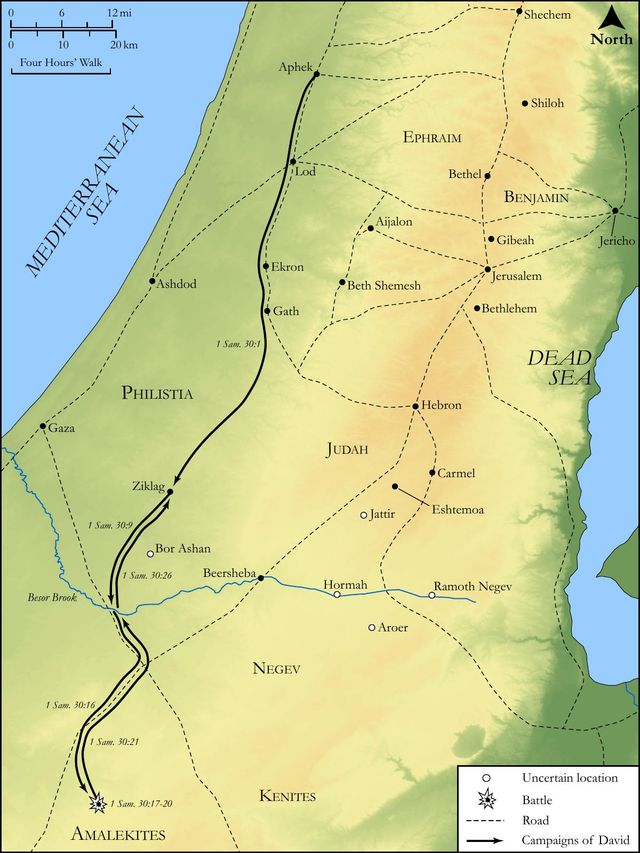
Study this verse
Public-domain commentary
Matthew Henry
From his Commentary on the Whole Bible. Henry comments on passages, not single verses — this entry covers 1 Samuel 30:7–20. His three-level outline is real structure in the source text, so it is rendered as structure.
Solomon observes that the righteous is delivered out of trouble and the wicked cometh in his stead, that the just falleth seven times a-day and riseth again; so it was with David. Many were his troubles, but the Lord delivered him out of them all, and particularly out of this of which we have here an account.
I.He enquired of the Lord both concerning his duty - Shall I pursue after this troop? and concerning the event - Shall I overtake them? Sa1 30:8. It was a great advantage to David that he had the high priest with him and the breast-plate of judgment, which, as a public person, he might consult in all his affairs, Num 27:21. We cannot think that he left Abiathar and the ephod at Ziklag, for then he and it would have been carried away by the Amalekites, unless we may suppose them hidden by a special providence, that they might be ready for David to consult at his return. If we conclude that David had his priest and ephod with him in the camp of the Philistines, it was certainly a great neglect in him that he did not enquire of the Lord by them concerning his engagement to Achish. Perhaps he was ashamed to own his religion so far among the uncircumcised; but now he begins to apprehend that this trouble is brought upon him to correct him for that oversight, and therefore the first thing he does is to call for the ephod. It is well if we get this good by our afflictions, to be reminded by them of neglected duties, and particularly to be quickened by them to enquire of the Lord. See Ch1 15:13. David had no room to doubt but that his war against these Amalekites was just, and he had an inclination strong enough to set upon them when it was for the recovery of that which was dearest to him in this world; and yet he would not go about it without asking counsel of God, thereby owning his dependence upon God and submission to him. If we thus, in all our ways, acknowledge God, we may expect that he will direct our steps, as he did David's here, answering him above what he asked, with an assurance that he should recover all.
II.He went himself in person, and took with him all the force he had, in pursuit of the Amalekites, Sa1 30:9, Sa1 30:10.
See how quickly, how easily, how effectually the mutiny among the soldiers was quelled by his patience and faith. When they spoke of stoning him (Sa1 30:6), if he had spoken of hanging them, or had ordered that the ringleaders of the faction should immediately have their heads struck off, though it would have been just, yet it might have been of pernicious consequence to his interest in this critical juncture; and, while he and his men were contending, the Amalekites would have clearly carried off their spoil. But when he, as a deaf man, heard not, smothered his resentments, and encouraged himself in the Lord his God, the tumult of the people was stilled by his gentleness and the power of God on their hearts; and, being thus mildly treated, they are now as ready to follow his foot as they were but a little before to fly in his face. Meekness is the security of any government. All his men were willing to go along with him in pursuit of the Amalekites, and he needed them all; but he was forced to drop a third part of them by the way; 200 out of 600 were so fatigued with their long march, and so sunk under the load of their grief, that they could not pass the brook Besor, but staid behind there. This was,
1.A great trial of David's faith, whether he could go on, in a dependence upon the word of God, when so many of his men failed him. When we are disappointed and discouraged in our expectations from second causes, then to go on with cheerfulness, confiding in the divine power, this is giving glory to God, by believing against hope, in hope.
2.A great instance of David's tenderness to his men, that he would by no means urge them beyond their strength, though the case itself was so very urgent. The Son of David thus considers the frame of his followers, who are not all alike strong and vigorous in their spiritual pursuits and conflicts; but, where we are weak, there he is kind; nay, more there he is strong, Co2 12:9, Co2 12:10.
III.Providence threw one in their way that gave them intelligence of the enemy's motions, and guided theirs; a poor Egyptian lad, scarcely alive, is made instrumental of a great deal of good to David. God chooses the foolish things of the world, with them to confound the wise. Observe,
1.His master's cruelty to him. He had got out of him all the service he could, and when the lad fell sick, probably being over-toiled with his work, he barbarously left him to perish in the field, when he was in no such haste but he might have put him into some of the carriages, and brought him home, or, at least, have left him wherewithal to support himself. That master has the spirit of an Amalekite, not of an Israelite, that can thus use a servant worse than one would use a beast. The tender mercies of the wicked are cruel. This Amalekite thought he should now have servants enough of the Israelite-captives, and therefore cared not what became of his Egyptian slave, but could willingly let him die in a ditch for want of necessaries, while he himself was eating and drinking, Sa1 30:16. Justly did Providence make this poor servant, that was thus basely abused, instrumental towards the destruction of a whole army of Amalekites and his master among the rest; for God hears the cry of oppressed servants.
2.David's compassion to him. Though he had reason to think he was one of those that had helped to destroy Ziklag, yet, finding him in distress, he generously relieved him, not only with bread and water (Sa1 30:11), but with figs and raisins, Sa1 30:12. Though the Israelites were in haste, and had no great plenty for themselves, yet they would not forbear to deliver one that was drawn unto death, nor say, Behold, we knew it not, Pro 24:11, Pro 24:12. Those are unworthy the name of Israelites who shut up the bowels of their compassion from persons in distress. It was also prudently done to relieve this Egyptian; for, though despicable, he was capable of doing them service: so it proved, though they were not certain of this when they relieved him. It is a good reason why we should neither do an injury nor deny a kindness to any man that we know not but, some time or other, it may be in his power to return either a kindness or an injury.
3.The intelligence David received from this poor Egyptian when he had come to himself. He gave him an account concerning his party.
(1.)What they had done (Sa1 30:14): We made an invasion, etc. The countries which David had pretended to Achish to have made an incursion upon (Sa1 27:10) they really had invaded and laid waste. What was then false now proved too true.
(2.)Whither they had gone, Sa1 30:15. This he promised David to inform him of upon condition he would spare his life and protect him from his master, who, if he could hear of him again (he thought), would add cruelty to cruelty. Such an opinion this poor Egyptian had of the obligation of an oath that he desired no greater security for his life than this: Swear unto me by God, not by the gods of Egypt or Amalek, but by the one supreme God.
IV.David, being directed to the place where they lay, securely celebrating their triumphs, fell upon them, and, as he used to pray, saw his desire upon his enemies.
1.The spoilers were cut off. The Amalekites, finding the booty was rich, and having got with it (as they thought) out of the reach of danger, were making themselves very merry with it, Sa1 30:16. All thoughts of war were laid aside, nor were they in any haste to house their prey, but spread themselves abroad on the earth in the most careless manner that could be, and there they were found eating, and drinking, and dancing, probably in honour of their idol-gods, to whom they gave the praise of their success. In this posture David surprised them, which made the conquest of them, and the blow he gave them, the more easy to him and the more dismal to them. Then are sinners nearest to ruin when they cry, Peace and safety, and put the evil day far from them. Nor does any thing give our spiritual enemies more advantage against us than sensuality and the indulgence of the flesh. Eating, and drinking, and dancing, have been the soft and pleasant way in which many have gone down to the congregation of the dead. Finding them thus off their guard, and from their arms (many of them, it may be, drunk, and unable to make any resistance), he put them all to the sword, and only 400 escaped, Sa1 30:17. Thus is the triumphing of the wicked short, and wrath comes on them, as on Belshazzar, when they are in the midst of their jollity.
2.The spoil was recovered and brought off, and nothing was lost, but a great deal gotten.
(1.)They retrieved all their own (Sa1 30:18, Sa1 30:19): David rescued his two wives; this is mentioned particularly, because this pleased David more than all the rest of his achievements. Providence had so ordered it that the Amalekites carefully preserved all that they had taken, concluding that they kept it for themselves, though really they preserved it for the right owners, so that there was nothing lacking to them; so it proved, when they concluded all was gone: so much better is God oftentimes to us than our own fears. Our Lord Jesus was indeed the Son of David and the Son of Abraham, in this resembling them both (Abraham, Gen 14:16, and David here), that he took the prey from the mighty, and led captivity captive. But this was not all.
(2.)They took all that belonged to the Amalekites besides (Sa1 30:20): Flocks and herds, either such as were taken from the Philistines and others, which David had the disposal of by the law of war; or perhaps he made a sally into the enemy's country, and fetched off these flocks and herds thence, as interest for his own. This drove was put in the van of the triumph, with this proclamation, "This is David's spoil. This we may thank him for." Those who lately spoke of stoning him now caressed him and cried him up, because they got by him more than they had then lost. Thus are the world and its sentiments governed by interest.
Historical interpretation
Historical reception
2 surviving comments on this verse. Each one is dated, so this reads as a timeline rather than a list.
Select a marker to jump to its quote. Markers stagger vertically where authors wrote within a few decades of each other.
The poor and the feeble, the blind and the lame, are called and come because the weak and the despised in this world are often quicker to hear the voice of God, as in this world they have nothing to delight them.The Egyptian servant of the Amalekites is a good example of this. When the Amalekites were plundering and moving about, he was left behind on the road sick and fainting from hunger and thirst. When David found him, he provided him with food and drink, and as soon as he revived he became David’s guide, found the celebrating Amalekites, and with great bravery overthrew the people who had left him behind sick.
Amalekite means “a people that laps.” What does “a people that laps” signify but the hearts of the worldly? Going about after the things of earth, it is as if they are lapping them up when they take delight in temporal things alone. A lapping people takes plunder, so to speak, when out of its love for earthly things it heaps up profit from others’ losses. The Egyptian servant is left behind on the road sick, because all sinners, once they begin to grow weak from the situation of this world, soon come to be despised by worldly minds. David found him and provided him with food and drink, because the Lord, who is “brave in hand” (if we attribute to him the meaning of David’s name), does not despise what the world has cast aside. Often he directs to the grace of his love those who are not strong enough to follow the world, and who are, so to speak, left behind on the road, holding out to them the food and drink of his word. It is as if he chooses them as guides for himself on the road when he makes them his preachers. When they bring Christ to the hearts of sinners, it is as if they are leading David upon the enemy, and, like David, they strike the celebrating Amalekites with the sword, because by the Lord’s power they overthrow all the proud who had despised them in the world.
And David said to him: Can you lead me to this band? etc. David is advised to find and conquer the robbers, who is left sick by the Amalekites; because there are those who, having lived among heretics, by the laziness of their mind, do not have the strength to harm the good, and the same ones, suddenly favored and touched by divine grace, acquire sufficient strength from God to resist the perverse; indeed, it is much more convenient and certain through those who know the secrets of the heretics, being converted to the Catholic, their errant sayings are confounded. But what he asks to be sworn to him, that he will not be killed, and that he will not be handed over to his master, so that he will reveal to them the hostile band of persecutors; this surely he asks from his spiritual teachers, that only on this condition will he disclose to them the secrets of the heretics, if they show him without any doubt the faith by which he may escape perpetual death; nor allow him to be subjected again to vain doctrines.
Continue studying 1 Samuel 30:15 across the web’s major study libraries — every link below opens this exact verse, chapter, or book on the destination site.
Read & Compare
 BibleGatewayThis verse in more than 200 translations and 70 languages.
 Bible.comThe YouVersion reader — hundreds of translations, reading plans, and highlights.
 ESV.orgCrossway's official English Standard Version reader.
 NET BibleThe NET translation with 60,000+ translators' notes on every rendering decision.
 STEP BibleTyndale House's free study tool — original text, vocabulary, and scholarly resources.
 BibliaLogos Bible Software's free web reader.
 USCCBThe New American Bible (Revised Edition) with the U.S. bishops' study notes.
Commentaries
 BibleHub CommentariesDozens of classic commentaries on this verse, gathered on one page.
 StudyLightMore than 100 commentary sets — the largest collection on the web.
 BibleRefPlain-English commentary on what this verse means, verse by verse.
 Enduring WordDavid Guzik's free commentary on this chapter, widely used by Bible teachers.
 Bible Study ToolsVerse commentary alongside Greek and Hebrew study aids.
Original Language & Research
- BibleHub InterlinearThe verse word by word — original language, transliteration, and English.
- BibleHub LexiconEvery word's original-language definition and Strong's entry.
 Blue Letter BibleDeep-study tools — Strong's numbers, concordance, and word studies.
 SefariaThe Hebrew text with Rashi and centuries of Jewish commentary.
Sermons, Hymns & Audio


TrulyRandomVerse is not affiliated with these sites and doesn’t control their content. They’re linked because they’re genuinely useful.
Summary
1 Samuel 30:15 captures a pivotal negotiation between David and an abandoned Egyptian slave, discovered near death in the wilderness, following the devastating Amalekite raid on Ziklag. This crucial exchange highlights David's urgent need for intelligence to pursue the raiders and the Egyptian's profound fear for his life, leading him to demand a solemn, divinely witnessed oath from David. The verse serves as a testament to God's providential orchestration, demonstrating how seemingly insignificant encounters can become instrumental in divine deliverance and the recovery of all that was lost.
Context
ShowHideLiterary Context
This verse is strategically placed at a critical juncture in David's narrative, immediately after the traumatic Amalekite attack on Ziklag. The city was burned, and its inhabitants, including David's two wives and the families of his men, were taken captive. David and his men were plunged into deep distress, with the men even contemplating stoning him in their bitter grief and anguish of soul. In this desperate moment, David found strength in the Lord his God and, after inquiring of the Lord through the ephod, received clear divine affirmation to pursue the raiders, accompanied by the promise of complete recovery of all that was taken. As David and his 600 men embarked on the pursuit, 200 became too exhausted to continue, remaining at the brook Besor. It was during this relentless pursuit, after crossing the brook, that David's company providentially discovered the abandoned Egyptian slave in a field, setting the stage for the crucial dialogue and agreement recorded in this verse. This encounter is the turning point that enables the successful recovery.
Historical & Cultural Context
The historical setting for 1 Samuel 30:15 is the tumultuous period of early Israelite monarchy, a time frequently marked by inter-tribal conflicts and predatory raids. The Amalekites were a notorious nomadic people, consistently hostile to Israel, known for their opportunistic and cruel attacks on vulnerable settlements. The practice of taking captives during raids was a common and devastating aspect of ancient warfare, often leading to enslavement or worse. The Egyptian servant's profound fear of being killed or forcibly returned to a harsh master vividly illustrates the precarious and often brutal reality of servitude among the nations of that day, where masters wielded absolute power over their slaves, and abandonment could mean certain death. Furthermore, the demand for an oath "by God" underscores the immense sanctity and binding nature of such vows in the cultural milieu. Invoking a deity meant calling upon a divine witness and enforcer, making the oath an unbreakable covenant, a concept deeply embedded in the legal, social, and religious fabric of the time.
Key Themes
ShowHideThe immediate context of 1 Samuel 30:15 significantly contributes to several overarching themes within the book of 1 Samuel and the broader narrative of David's life. Firstly, it powerfully illustrates Divine Providence and Guidance, demonstrating how God meticulously orchestrates seemingly coincidental events—like the discovery of an abandoned slave—to fulfill His sovereign purposes and provide deliverance for His chosen leader. This unexpected source of aid underscores God's ability to work through unlikely means. Secondly, the verse highlights the theme of David's Leadership and Compassion, as he demonstrates mercy and strategic wisdom in dealing with the vulnerable Egyptian. This compassionate act stands in stark contrast to the Amalekites' cruelty in abandoning their sick slave. David's kindness secures vital intelligence, foreshadowing his later reign characterized by justice and mercy, as seen in his care for Mephibosheth in 2 Samuel 9. Thirdly, the exchange emphasizes the Significance of Oaths and Covenants, revealing the profound cultural and spiritual weight placed on a solemn promise made in the name of God, which was considered an unbreakable bond. This theme resonates with other instances of covenant-making in David's life, such as his enduring covenant with Jonathan in 1 Samuel 20.
Exposition and Analysis
ShowHideKey Word Analysis
ShowHideThis primitive root properly means "to be complete," but is used as a denominative from the word for "seven." It signifies "to seven oneself," meaning to take an oath or make a solemn promise, as if by repeating a declaration seven times, implying a binding and complete agreement. To "swear by God" meant invoking the divine as a witness and guarantor of the truthfulness and binding nature of the promise. Breaking such an oath was considered a grave offense, inviting divine retribution. In this context, the Egyptian's demand for an oath underscores his profound distrust and fear, seeking the highest possible assurance of safety and commitment from David.
This plural noun refers to "gods in the ordinary sense," but specifically, and especially with the article, it refers to the supreme God of Israel. It can also be applied by way of deference to magistrates or as a superlative. The Egyptian, though not necessarily an Israelite, understood the gravity of invoking a deity in an oath. His choice to use "God" suggests a recognition of the universal power and authority associated with such a vow, or perhaps an understanding that David's God was the one whose name would make the oath truly binding for David, ensuring his protection.
This term refers to "a crowd (especially of soldiers)," an "army," "band (of men)," or "troop (of robbers)." It specifically denotes a military unit, often one engaged in predatory or plundering activities. The Egyptian's use of this term accurately describes the Amalekite group as a mobile, aggressive, and dangerous force, emphasizing the strategic importance of locating precisely this type of marauding party. It is not merely a group of people, but a specific, hostile, armed contingent.
Verse Breakdown
ShowHide"And David said to him, Canst thou bring me down to this company?"
David's direct and urgent question reveals his singular focus: locating the Amalekite raiders who had devastated Ziklag and abducted his family. The phrase "bring me down" implies leading him to their current location, likely a lower or more accessible place where they might be encamped, or simply guiding him to their whereabouts. This question is born out of desperation and the critical need for intelligence, as David's family and the families of his men are still captive, and time is of the essence for their rescue.
"And he said, Swear unto me by God,"
The Egyptian's immediate response is not an affirmation but a conditional demand, prioritizing his personal safety above all else. Given his vulnerable position as an abandoned slave, his request for an oath "by God" signifies the utmost seriousness of his condition. He is not merely asking for a promise but a divinely attested vow, indicating his deep-seated fear and the high stakes involved in trusting David, a leader of men, with his life.
"that thou wilt neither kill me, nor deliver me into the hands of my master,"
This clause articulates the two critical fears of the Egyptian servant. His first fear is of immediate death, either by David's hand if he proved uncooperative or by being left to die in the wilderness. His second, equally potent fear, is of being returned to his former master, who had cruelly abandoned him to die when he fell ill. This highlights the harsh realities of slavery under the Amalekites and the potential for severe punishment, torture, or death at the hands of a cruel master.
"and I will bring thee down to this company."
This final clause is the Egyptian's promise, contingent entirely upon David's solemn oath. It reveals that he possesses the crucial intelligence David needs—the precise location of the Amalekite raiding party. His willingness to guide David is directly tied to the assurance of his own life and freedom, demonstrating the transactional nature of the agreement forged under duress and desperation, yet providentially orchestrated by God.
Literary Devices
ShowHideThe verse effectively employs Dialogue to advance the plot and reveal character. The concise, direct exchange between David and the Egyptian slave immediately establishes the terms of their crucial interaction, conveying urgency and high stakes. There is a strong element of Irony, as the key to David's deliverance and the recovery of all that was lost comes not from a mighty warrior, a trusted ally, or a prophetic vision, but from a discarded, near-dead slave, highlighting God's ability to work through unexpected and seemingly insignificant means. This unexpected source of help underscores the theme of divine providence working through unlikely instruments. Furthermore, the Egyptian's demand for an oath functions as Foreshadowing, signaling that David's word and integrity will be tested, and that the successful outcome of the pursuit hinges on this initial, solemn agreement. The Contrast between the Amalekites' cruelty (abandoning their sick slave to die) and David's willingness to show mercy and make a binding promise highlights David's emerging character as a compassionate, just, and honorable leader, a stark difference from the ruthless practices of his enemies.
Theological and Thematic Connections
ShowHideThis pivotal encounter in 1 Samuel 30:15 serves as a powerful illustration of God's meticulous providence, demonstrating how He orchestrates seemingly random events and uses unexpected individuals to fulfill His divine purposes. David, in his deepest hour of despair, having strengthened himself in the Lord, finds his answer not through a miraculous vision or a direct angelic intervention, but through a human encounter with a discarded, vulnerable individual. This highlights a recurring biblical pattern where God's hand is evident in the ordinary and the overlooked, turning a moment of human desperation into an opportunity for divine intervention and miraculous recovery. The Egyptian's fear and David's compassionate, yet strategic, response underscore the importance of integrity, mercy, and the binding nature of a solemn promise before God, which ultimately paves the way for a miraculous recovery and victory.
Reflection and Application
ShowHide1 Samuel 30:15 offers profound lessons for believers today, reminding us that God's provision often comes through unexpected channels and that our character, particularly our integrity and compassion, plays a vital role in navigating life's challenges. In moments of crisis, when we feel overwhelmed and desperate, this verse encourages us to inquire of the Lord, as David did, and then to remain open to the seemingly insignificant encounters or individuals God might place in our path. Our willingness to extend kindness, even to those we might deem "unimportant" or "other," can unlock crucial insights, assistance, or opportunities for divine intervention. This passage challenges us to look beyond superficial appearances and recognize the inherent dignity and potential for divine use in every person. Furthermore, the emphasis on the oath reminds us of the enduring power of our word. In a world where promises are often broken and trust is eroded, the integrity of our commitments, especially those made before God, remains a powerful testimony to our faith and a foundational element for meaningful relationships and successful endeavors, reflecting the trustworthiness of God Himself.
Questions for Reflection
ShowHideFAQ
ShowHideWhy was the Egyptian servant so insistent on an oath "by God"?
ShowHideThe Egyptian servant's insistence on an oath "by God" (Hebrew: shebha‘-lî bē'lōhîm) was born out of profound fear and a deep understanding of the cultural and spiritual weight of such a vow in that day. As an abandoned slave, he was in an extremely vulnerable position, facing potential death from exposure or a cruel return to his former master. In this context, a mere promise from David would not suffice. An oath "by God" invoked a divine witness and guarantor, meaning that if David broke his promise, he would be accountable to a higher power. This made the oath the strongest possible form of assurance, providing the Egyptian with the confidence that his life and freedom would be protected, allowing him to trust David and lead him to the Amalekites. This practice is seen throughout the Old Testament, where solemn oaths were considered binding covenants, as exemplified in the oath between Abimelech and Isaac in Genesis 26:28 or the deep covenantal oath between Jonathan and David in 1 Samuel 20:42.
Christ-Centered Fulfillment
ShowHide1 Samuel 30:15, while a narrative of David's pursuit and recovery, ultimately points to a greater fulfillment in Jesus Christ. David, as a type of Christ, demonstrates compassion and integrity, securing deliverance for his people through an act of mercy towards an outcast. This foreshadows Christ's ultimate act of compassion and salvation. Just as David sought out the lost and recovered what was stolen, Jesus came to seek and to save the lost, to recover humanity from the bondage of sin and death, declaring His mission in Luke 19:10. The abandoned Egyptian, left for dead and without hope, finds life and purpose through David's mercy, echoing how Christ extends grace to those abandoned by the world, those who are spiritually sick and helpless, bringing them into His company and giving them new life and a place in His kingdom. Jesus Himself stated that He came not for the healthy but for the sick, calling sinners to repentance, as seen in Matthew 9:12-13. The binding oath David makes also finds its ultimate fulfillment in God's unbreakable covenant promises in Christ. God swore an oath by Himself to Abraham, promising blessing and a multitude of descendants, a promise recorded in Genesis 22:16-18. This divine oath is ultimately fulfilled in Jesus, through whom all the promises of God find their "Yes" and "Amen" for the glory of God, as affirmed in 2 Corinthians 1:20. Thus, the desperate pursuit, the unlikely guide, and the solemn oath in 1 Samuel 30:15 all beautifully prefigure the greater rescue accomplished by the Lamb of God, who, through His own self-sacrifice on the cross, secures eternal life and recovery for all who trust in Him, as proclaimed by John the Baptist: "Behold, the Lamb of God, who takes away the sin of the world!"