


1 Samuel 30:20
Bible text: King James Version (1769 Blayney text) · Public domain
Bible text: Berean Standard Bible · Public domain
Bible text: American Standard Version (1901) · Public domain
Bible text: World English Bible, Messianic edition · Public domain
Bible text: Geneva Bible (1599) · Public domain
Bible text: Young's Literal Translation · Public domain
- וַיִּקַּחvai·yi·Kachand he tookH3947Conj-w ¦ V-Qal-ConsecImperf-3msVerb Qal Consecutive Imperfect 3rd Singular Masculineוַandיִּקַּחhe took
- דָּוִדda·VidDavidH1732N-proper-mNoun Proper Masculine
- אֶת'et<obj.>H853DirObjMParticle Object Indicator
- כָּלkolallH3605N-mscNoun Singular Masculine Construct
- הַצֹּאןha·Tzonthe sheepH6629Art ¦ N-csNoun Singular common gender Absoluteהַtheצֹּאןsheep
- וְהַבָּקָרve·ha·ba·Karand the cattleH1241Conj-w ¦ Art ¦ N-csNoun Singular common gender Absoluteוְandהַtheבָּקָרcattle
- נָהֲגוּna·ha·Guthey drove [them]H5090V-Qal-Perf-3cpVerb Qal Perfect 3rd Plural common gender
- לִפְנֵיlif·Nei<to> beforeH6440Prep-l ¦ N-mpcNoun Plural Masculine Constructלִ<to>פְנֵיbefore
- הַמִּקְנֶהha·mik·Nehthe livestockH4735Art ¦ N-msNoun Singular Masculine Absoluteהַtheמִּקְנֶהlivestock
- הַהוּאha·Hu'<the> thatH1931Art ¦ Pro-3msPronoun Personal 3rd Singular Masculineהַ<the>הוּאthat
- וַיֹּאמְרוּvai·Yo·me·Ruand they saidH559Conj-w ¦ V-Qal-ConsecImperf-3mpVerb Qal Consecutive Imperfect 3rd Plural Masculineוַandיֹּאמְרוּthey said
- זֶהzehthisH2088PrtParticle Demonstrative
- שְׁלַלshe·Lal[is] [the] booty ofH7998N-mscNoun Singular Masculine Construct
- דָּוִדda·VidDavidH1732N-proper-mNoun Proper Masculine
English is a literal word-by-word gloss of the Hebrew, not the KJV's wording. Why?
This is the original text the KJV's translators worked from — each Hebrew word with its own literal English meaning in this verse, prepared by scholars at Tyndale House, Cambridge. The KJV translates whole sentences, not word by word, so its wording differs: one Hebrew word can become several English words, and the KJV may choose “the LORD” where the gloss reads “Yahweh”. Both are faithful — they answer different questions. For the KJV's own rendering, switch to the KJV text.
Details
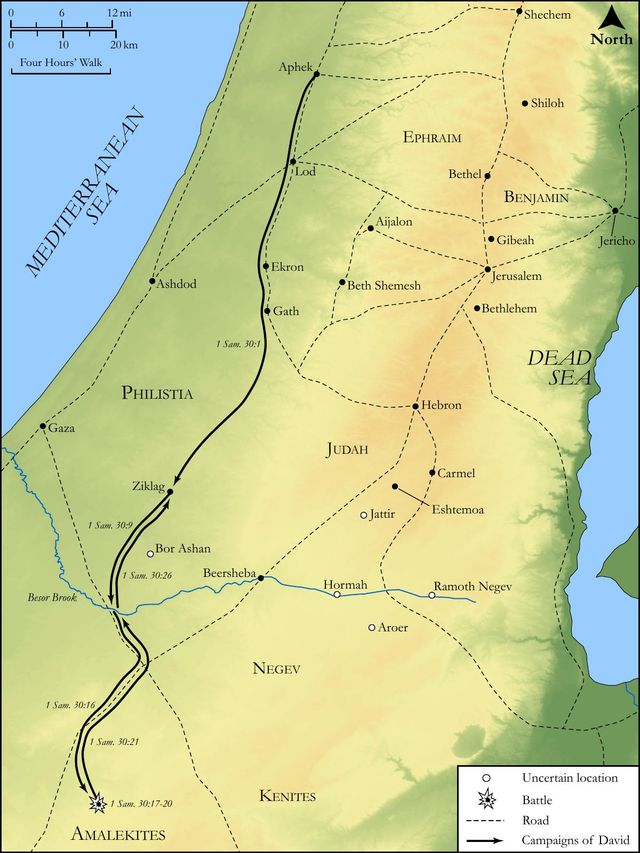
See on the biblical-era map
Study this verse
Public-domain commentary
Matthew Henry
From his Commentary on the Whole Bible. Henry comments on passages, not single verses — this entry covers 1 Samuel 30:7–20. His three-level outline is real structure in the source text, so it is rendered as structure.
Solomon observes that the righteous is delivered out of trouble and the wicked cometh in his stead, that the just falleth seven times a-day and riseth again; so it was with David. Many were his troubles, but the Lord delivered him out of them all, and particularly out of this of which we have here an account.
I.He enquired of the Lord both concerning his duty - Shall I pursue after this troop? and concerning the event - Shall I overtake them? Sa1 30:8. It was a great advantage to David that he had the high priest with him and the breast-plate of judgment, which, as a public person, he might consult in all his affairs, Num 27:21. We cannot think that he left Abiathar and the ephod at Ziklag, for then he and it would have been carried away by the Amalekites, unless we may suppose them hidden by a special providence, that they might be ready for David to consult at his return. If we conclude that David had his priest and ephod with him in the camp of the Philistines, it was certainly a great neglect in him that he did not enquire of the Lord by them concerning his engagement to Achish. Perhaps he was ashamed to own his religion so far among the uncircumcised; but now he begins to apprehend that this trouble is brought upon him to correct him for that oversight, and therefore the first thing he does is to call for the ephod. It is well if we get this good by our afflictions, to be reminded by them of neglected duties, and particularly to be quickened by them to enquire of the Lord. See Ch1 15:13. David had no room to doubt but that his war against these Amalekites was just, and he had an inclination strong enough to set upon them when it was for the recovery of that which was dearest to him in this world; and yet he would not go about it without asking counsel of God, thereby owning his dependence upon God and submission to him. If we thus, in all our ways, acknowledge God, we may expect that he will direct our steps, as he did David's here, answering him above what he asked, with an assurance that he should recover all.
II.He went himself in person, and took with him all the force he had, in pursuit of the Amalekites, Sa1 30:9, Sa1 30:10.
See how quickly, how easily, how effectually the mutiny among the soldiers was quelled by his patience and faith. When they spoke of stoning him (Sa1 30:6), if he had spoken of hanging them, or had ordered that the ringleaders of the faction should immediately have their heads struck off, though it would have been just, yet it might have been of pernicious consequence to his interest in this critical juncture; and, while he and his men were contending, the Amalekites would have clearly carried off their spoil. But when he, as a deaf man, heard not, smothered his resentments, and encouraged himself in the Lord his God, the tumult of the people was stilled by his gentleness and the power of God on their hearts; and, being thus mildly treated, they are now as ready to follow his foot as they were but a little before to fly in his face. Meekness is the security of any government. All his men were willing to go along with him in pursuit of the Amalekites, and he needed them all; but he was forced to drop a third part of them by the way; 200 out of 600 were so fatigued with their long march, and so sunk under the load of their grief, that they could not pass the brook Besor, but staid behind there. This was,
1.A great trial of David's faith, whether he could go on, in a dependence upon the word of God, when so many of his men failed him. When we are disappointed and discouraged in our expectations from second causes, then to go on with cheerfulness, confiding in the divine power, this is giving glory to God, by believing against hope, in hope.
2.A great instance of David's tenderness to his men, that he would by no means urge them beyond their strength, though the case itself was so very urgent. The Son of David thus considers the frame of his followers, who are not all alike strong and vigorous in their spiritual pursuits and conflicts; but, where we are weak, there he is kind; nay, more there he is strong, Co2 12:9, Co2 12:10.
III.Providence threw one in their way that gave them intelligence of the enemy's motions, and guided theirs; a poor Egyptian lad, scarcely alive, is made instrumental of a great deal of good to David. God chooses the foolish things of the world, with them to confound the wise. Observe,
1.His master's cruelty to him. He had got out of him all the service he could, and when the lad fell sick, probably being over-toiled with his work, he barbarously left him to perish in the field, when he was in no such haste but he might have put him into some of the carriages, and brought him home, or, at least, have left him wherewithal to support himself. That master has the spirit of an Amalekite, not of an Israelite, that can thus use a servant worse than one would use a beast. The tender mercies of the wicked are cruel. This Amalekite thought he should now have servants enough of the Israelite-captives, and therefore cared not what became of his Egyptian slave, but could willingly let him die in a ditch for want of necessaries, while he himself was eating and drinking, Sa1 30:16. Justly did Providence make this poor servant, that was thus basely abused, instrumental towards the destruction of a whole army of Amalekites and his master among the rest; for God hears the cry of oppressed servants.
2.David's compassion to him. Though he had reason to think he was one of those that had helped to destroy Ziklag, yet, finding him in distress, he generously relieved him, not only with bread and water (Sa1 30:11), but with figs and raisins, Sa1 30:12. Though the Israelites were in haste, and had no great plenty for themselves, yet they would not forbear to deliver one that was drawn unto death, nor say, Behold, we knew it not, Pro 24:11, Pro 24:12. Those are unworthy the name of Israelites who shut up the bowels of their compassion from persons in distress. It was also prudently done to relieve this Egyptian; for, though despicable, he was capable of doing them service: so it proved, though they were not certain of this when they relieved him. It is a good reason why we should neither do an injury nor deny a kindness to any man that we know not but, some time or other, it may be in his power to return either a kindness or an injury.
3.The intelligence David received from this poor Egyptian when he had come to himself. He gave him an account concerning his party.
(1.)What they had done (Sa1 30:14): We made an invasion, etc. The countries which David had pretended to Achish to have made an incursion upon (Sa1 27:10) they really had invaded and laid waste. What was then false now proved too true.
(2.)Whither they had gone, Sa1 30:15. This he promised David to inform him of upon condition he would spare his life and protect him from his master, who, if he could hear of him again (he thought), would add cruelty to cruelty. Such an opinion this poor Egyptian had of the obligation of an oath that he desired no greater security for his life than this: Swear unto me by God, not by the gods of Egypt or Amalek, but by the one supreme God.
IV.David, being directed to the place where they lay, securely celebrating their triumphs, fell upon them, and, as he used to pray, saw his desire upon his enemies.
1.The spoilers were cut off. The Amalekites, finding the booty was rich, and having got with it (as they thought) out of the reach of danger, were making themselves very merry with it, Sa1 30:16. All thoughts of war were laid aside, nor were they in any haste to house their prey, but spread themselves abroad on the earth in the most careless manner that could be, and there they were found eating, and drinking, and dancing, probably in honour of their idol-gods, to whom they gave the praise of their success. In this posture David surprised them, which made the conquest of them, and the blow he gave them, the more easy to him and the more dismal to them. Then are sinners nearest to ruin when they cry, Peace and safety, and put the evil day far from them. Nor does any thing give our spiritual enemies more advantage against us than sensuality and the indulgence of the flesh. Eating, and drinking, and dancing, have been the soft and pleasant way in which many have gone down to the congregation of the dead. Finding them thus off their guard, and from their arms (many of them, it may be, drunk, and unable to make any resistance), he put them all to the sword, and only 400 escaped, Sa1 30:17. Thus is the triumphing of the wicked short, and wrath comes on them, as on Belshazzar, when they are in the midst of their jollity.
2.The spoil was recovered and brought off, and nothing was lost, but a great deal gotten.
(1.)They retrieved all their own (Sa1 30:18, Sa1 30:19): David rescued his two wives; this is mentioned particularly, because this pleased David more than all the rest of his achievements. Providence had so ordered it that the Amalekites carefully preserved all that they had taken, concluding that they kept it for themselves, though really they preserved it for the right owners, so that there was nothing lacking to them; so it proved, when they concluded all was gone: so much better is God oftentimes to us than our own fears. Our Lord Jesus was indeed the Son of David and the Son of Abraham, in this resembling them both (Abraham, Gen 14:16, and David here), that he took the prey from the mighty, and led captivity captive. But this was not all.
(2.)They took all that belonged to the Amalekites besides (Sa1 30:20): Flocks and herds, either such as were taken from the Philistines and others, which David had the disposal of by the law of war; or perhaps he made a sally into the enemy's country, and fetched off these flocks and herds thence, as interest for his own. This drove was put in the van of the triumph, with this proclamation, "This is David's spoil. This we may thank him for." Those who lately spoke of stoning him now caressed him and cried him up, because they got by him more than they had then lost. Thus are the world and its sentiments governed by interest.
Continue studying 1 Samuel 30:20 across the web’s major study libraries — every link below opens this exact verse, chapter, or book on the destination site.
Read & Compare
 BibleGatewayThis verse in more than 200 translations and 70 languages.
 Bible.comThe YouVersion reader — hundreds of translations, reading plans, and highlights.
 ESV.orgCrossway's official English Standard Version reader.
 NET BibleThe NET translation with 60,000+ translators' notes on every rendering decision.
 STEP BibleTyndale House's free study tool — original text, vocabulary, and scholarly resources.
 BibliaLogos Bible Software's free web reader.
 USCCBThe New American Bible (Revised Edition) with the U.S. bishops' study notes.
Commentaries
 BibleHub CommentariesDozens of classic commentaries on this verse, gathered on one page.
 StudyLightMore than 100 commentary sets — the largest collection on the web.
 BibleRefPlain-English commentary on what this verse means, verse by verse.
 Enduring WordDavid Guzik's free commentary on this chapter, widely used by Bible teachers.
 Bible Study ToolsVerse commentary alongside Greek and Hebrew study aids.
Original Language & Research
- BibleHub InterlinearThe verse word by word — original language, transliteration, and English.
- BibleHub LexiconEvery word's original-language definition and Strong's entry.
 Blue Letter BibleDeep-study tools — Strong's numbers, concordance, and word studies.
 SefariaThe Hebrew text with Rashi and centuries of Jewish commentary.
Sermons, Hymns & Audio


TrulyRandomVerse is not affiliated with these sites and doesn’t control their content. They’re linked because they’re genuinely useful.
Summary
1 Samuel 30:20 marks the triumphant culmination of David's pursuit of the Amalekites, who had raided Ziklag and taken his and his men's families and possessions captive. This verse vividly portrays the overwhelming success of David's divinely sanctioned mission, demonstrating not only the complete recovery of all that was lost but also the acquisition of additional flocks and herds—the Amalekites' own plunder. David's declarative statement, "This is David's spoil," asserts his rightful claim and underscores the magnitude of God's restorative and superabundant provision in the face of utter despair.
Context
ShowHideLiterary Context
This verse is situated at the climax of David's military campaign against the Amalekites, following their devastating raid on Ziklag. The narrative begins with the profound distress of David and his men upon discovering their city burned and their families abducted (1 Samuel 30:1-3). In his despair, David "encouraged himself in the Lord his God" (1 Samuel 30:6) and, crucially, inquired of the Lord whether he should pursue the raiders. God's unambiguous command, "Pursue: for thou shalt surely overtake them, and without fail recover all" (1 Samuel 30:8), sets the stage for the ensuing victory. Verses 1 Samuel 30:18-19 confirm the complete recovery of "all that the Amalekites had carried away," making 1 Samuel 30:20 the tangible evidence and emphatic declaration of this divine promise fulfilled, even exceeding expectations.
Historical & Cultural Context
The Amalekites were a nomadic, predatory people, long-standing enemies of Israel, first encountered in Exodus 17:8-16. Their practice of raiding and plundering settlements was common among the nations of that day, particularly against undefended towns like Ziklag, which David and his men had left vulnerable while serving the Philistines. The concept of "spoil" (booty or plunder) was a significant part of ancient warfare, often distributed among the victorious army and sometimes dedicated to deities. David's actions here reflect the cultural norms of military leadership—leading the pursuit, securing the victory, and managing the distribution of the spoils. His declaration "This is David's spoil" asserts his authority and ownership over the recovered and newly acquired assets, which would subsequently be used to strengthen his position and build alliances with the elders of Judah (1 Samuel 30:26-31).
Key Themes
ShowHideThis verse powerfully illustrates several key themes central to the book of 1 Samuel and the broader biblical narrative. Firstly, it highlights Divine Restoration and Superabundance. God not only fulfills His promise to restore what was lost but goes beyond, providing an abundance that far exceeds the original possessions. The addition of "those [other] cattle" signifies God's capacity to turn devastating loss into overflowing gain, a theme echoed in other accounts of divine recompense, such as Job's double portion after his trials (Job 42:10). Secondly, it underscores God's Faithfulness to His Promises. David's inquiry and God's clear assurance in 1 Samuel 30:8 are directly manifested in the outcome of this battle. This event serves as a powerful testament to God's unwavering commitment to those who seek Him and obey His commands, even when circumstances seem hopeless. Lastly, it showcases David's Maturing Leadership. Despite his initial despair and his men's talk of stoning him (1 Samuel 30:6), David's resolve to seek God, lead the pursuit, secure the victory, and then manage the distribution of the spoil demonstrates his growing capacity as a divinely appointed leader, preparing him for his future kingship.
Exposition and Analysis
ShowHideKey Word Analysis
ShowHideThis verb signifies "to take," "to seize," or "to acquire" in its widest applications. In this context, it denotes David's active and decisive role in securing the spoil. It's not merely a passive reception but an assertive act of taking possession after a victorious campaign, emphasizing his leadership and the tangible, divinely-granted outcome of the battle.
Meaning "to drive forth," "to lead," or "to carry away." This word highlights the dynamic movement of the livestock. The phrase "drave before those [other] cattle" suggests that the recovered flocks and herds, combined with the Amalekites' own plunder, formed an immense, triumphant procession. This imagery conveys not just recovery, but immense quantity and a powerful, visible demonstration of victory.
This term refers to "booty," "plunder," or "prey" taken in war. It encompasses all the material gains from a military victory. David's declaration, "This is David's spoil," is a public assertion of ownership and a recognition of the material blessing derived from God's intervention, distinguishing it as a legitimate acquisition under his authority and a sign of divine favor.
Verse Breakdown
ShowHide"And David took all the flocks and the herds,"
This clause immediately establishes David's direct involvement and the vast quantity of the recovered assets. "Flocks and herds" represent significant wealth in an agrarian society, indicating not just recovery but substantial gain. The emphatic use of "all" underscores the completeness of the recovery, a direct and miraculous fulfillment of God's promise to "recover all" (1 Samuel 30:8).
"[which] they drave before those [other] cattle,"
This phrase is critical for understanding the magnitude of the spoil. The "other cattle" likely refers to the Amalekites' own existing livestock or previous plunder they had gathered from other raids. David's men didn't just recover their own; they seized the Amalekites' accumulated wealth as well, turning the tables on their enemies. This detail signifies a superabundant blessing, where the victory yielded far more than what was initially lost, transforming a devastating defeat into an overwhelming triumph.
"and said, This [is] David's spoil."
This is a powerful, authoritative declaration. David is not merely observing; he is asserting ownership and attributing the success. This statement serves multiple purposes: it publicly claims the victory and its fruits, solidifies his leadership among his men, and implicitly acknowledges divine provision, as this spoil was a direct result of God's command and blessing. It marks the definitive end of the campaign and the beginning of the distribution of the immense wealth.
Literary Devices
ShowHide1 Samuel 30:20 employs several literary devices to convey its profound message. The phrase "drave before those [other] cattle" functions as Hyperbole, emphasizing the extraordinary abundance of the spoil beyond what was merely recovered from Ziklag. It suggests a quantity so vast that it included not only David's original possessions but also the Amalekites' own accumulated wealth, creating an image of overwhelming blessing. The entire event serves as Symbolism for divine restoration and recompense; the physical recovery and surplus of livestock symbolize God's ability to turn loss into gain and despair into hope. David's concluding statement, "This is David's spoil," is an act of Assertion and Declaration, a powerful verbal act that publicly claims ownership and authority over the immense wealth. This declaration also carries an implicit Irony, as the very enemies who sought to impoverish David and his men ultimately became the source of their unprecedented enrichment, highlighting God's sovereign control over even the actions of adversaries.
Theological and Thematic Connections
ShowHide1 Samuel 30:20 stands as a powerful testament to God's character as a God of restoration, abundance, and faithfulness. It illustrates that when His people seek Him in their deepest despair and obey His commands, He is not only capable of recovering what was lost but also of providing a surplus that far exceeds their original possessions. This narrative underscores the principle that God can redeem even the most devastating circumstances, turning moments of profound loss into opportunities for greater blessing and a clearer revelation of His power and provision. It teaches that divine intervention often results in a "more than" outcome, where God's generosity surpasses human expectation and calculation, transforming sorrow into joy and scarcity into overflowing abundance.
Reflection and Application
ShowHideThe narrative of David at Ziklag, culminating in the overflowing spoil of 1 Samuel 30:20, offers profound encouragement and practical lessons for believers today. In a world fraught with loss, disappointment, and unexpected setbacks, this passage reminds us that our God is sovereign over all circumstances, even those that seem utterly hopeless. Like David, we are called to bring our deepest distress and grief before the Lord, to "encourage ourselves in the Lord" when all human strength fails. The promise of restoration and superabundance is not merely a historical anecdote but a timeless truth about God's character. It challenges us to trust that God can not only heal our wounds and return what was taken but also use our trials to bring about a greater blessing, a deeper faith, and a more profound testimony of His faithfulness. It encourages perseverance in prayer and obedience, knowing that our God delights in turning our ashes into beauty and our mourning into dancing.
Questions for Reflection
ShowHideFAQ
ShowHideWhat is the significance of David's declaration, "This is David's spoil"?
ShowHideDavid's declaration, "This is David's spoil," is highly significant for several reasons. Firstly, it asserts his rightful claim and ownership over the recovered and newly acquired plunder, solidifying his authority as a leader who successfully led his men to victory. In Israel, the distribution and claim of spoil, as in the division of the spoil of Midian, were crucial for a leader's legitimacy and the morale of his troops. Secondly, it serves as a public acknowledgment of the immense blessing and provision that came directly from God's hand, fulfilling His promise in 1 Samuel 30:8. It's a statement of triumph and a testament to divine faithfulness. Lastly, it sets the stage for David's subsequent actions of distributing the spoil, not just among his men but also to the elders of Judah, which was a strategic move to build alliances and support for his future kingship (1 Samuel 30:26-31).
How does the phrase "drave before those [other] cattle" enhance the meaning of the verse?
ShowHideThe phrase "drave before those [other] cattle" is crucial because it indicates that David's men recovered not only their own families and possessions but also seized additional flocks and herds that the Amalekites had previously plundered from other places. This detail elevates the victory from a mere recovery to a superabundant gain. It signifies that God's restoration was not just a return to the status quo but an overflowing blessing, where the enemy's accumulated wealth was added to David's own. This emphasizes God's capacity to turn a situation of devastating loss into one of unprecedented prosperity, demonstrating His power to provide "more than" what was lost, transforming a moment of despair into a testimony of divine generosity.
Christ-Centered Fulfillment
ShowHideThe triumphant recovery and superabundant spoil of 1 Samuel 30:20 find their ultimate and most profound fulfillment in the person and work of Jesus Christ. David's victory over the Amalekites, who had plundered and taken captives, foreshadows Christ's decisive victory over sin, death, and the spiritual enemies that hold humanity captive. Just as David recovered "all" and gained a surplus, Christ, through His death and resurrection, has "spoiled principalities and powers" (Colossians 2:15) and led "captivity captive," bestowing gifts on men (Ephesians 4:8). The "spoil" Christ took from His enemies is not material wealth but the redeemed souls of humanity, whom He liberates from spiritual bondage and brings into His kingdom. He is the Good Shepherd who not only restores our souls but also gives us "life, and that more abundantly" (John 10:10). In Christ, we experience a restoration far greater than any earthly possession—the restoration of our relationship with God, eternal life, and an inheritance that is imperishable, undefiled, and unfading (1 Peter 1:4). Through Him, we are more than conquerors (Romans 8:37), receiving not just what was lost to sin, but an immeasurable spiritual richness that far surpasses all our earthly losses.