


Judges 15:19
Bible text: King James Version (1769 Blayney text) · Public domain
Bible text: King James Version with Strong's numbers · Public domain
Bible text: Berean Standard Bible · Public domain
Bible text: American Standard Version (1901) · Public domain
Bible text: World English Bible, Messianic edition · Public domain
Bible text: Geneva Bible (1599) · Public domain
Bible text: Young's Literal Translation · Public domain
- וַיִּבְקַעvai·yiv·Ka'and he split openH1234Conj-w ¦ V-Qal-ConsecImperf-3msVerb Qal Consecutive Imperfect 3rd Singular Masculineוַandיִּבְקַעhe split open
- אֱלֹהִים'E·lo·HimGodH430N-mpNoun Plural Masculine Absolute
- אֶת'et<obj.>H853DirObjMParticle Object Indicator
- הַמַּכְתֵּשׁha·makh·Teshthe deep hollowH4388Art ¦ N-msNoun Singular Masculine Absoluteהַtheמַּכְתֵּשׁdeep hollow
- אֲשֶׁר'a·SherwhichH834RelParticle Relative
- בַּלֶּחִיba·Le·chi[is] at <the> LehiH3895Prep-b ¦ N-properNoun Proper Locationבַּ[is] at <the>לֶּחִיLehi
- וַיֵּצְאוּvai·ye·tze·'Uand they came outH3318Conj-w ¦ V-Qal-ConsecImperf-3mpVerb Qal Consecutive Imperfect 3rd Plural Masculineוַandיֵּצְאוּthey came out
- מִמֶּנּוּmi·Me·nufrom itH4480Prep ¦ 3msPreposition Definiteמִמֶּfromנּוּit
- מַיִםma·yimwatersH4325N-mpNoun Plural Masculine Absolute
- וַיֵּשְׁתְּvai·Ye·shetand he drankH8354Conj-w ¦ V-Qal-ConsecImperf-3msVerb Qal Consecutive Imperfect 3rd Singular Masculineוַandיֵּשְׁתְּhe drank
- וַתָּשָׁבva·Ta·shovand it returnedH7725Conj-w ¦ V-Qal-ConsecImperf-3fsVerb Qal Consecutive Imperfect 3rd Singular Feminineוַandתָּשָׁבit returned
- רוּחוֹru·Chohis spiritH7307N-fsc ¦ 3msNoun Singular Feminine Constructרוּחspiritוֹhis
- וַיֶּחִיvai·Ye·chiand he livedH2421Conj-w ¦ V-Qal-ConsecImperf-3msVerb Qal Consecutive Imperfect 3rd Singular Masculineוַandיֶּחִיhe lived
- עַל'althere-H5921PrepPreposition
- כֵּןken-foreH3651AdvAdverb
- קָרָאka·Ra'he calledH7121V-Qal-Perf-3msVerb Qal Perfect 3rd Singular Masculine
- שְׁמָהּshe·Mahits nameH8034N-msc ¦ 3fsNoun Singular Masculine Constructשְׁמָnameהּits
- עֵין'einEnH5875N-properNoun Proper Location
- הַקּוֹרֵאha·ko·Re'HakkoreH5875N-properNoun Proper Location
- אֲשֶׁר'a·SherwhichH834RelParticle Relative
- בַּלֶּחִיba·Le·chi[is] at <the> LehiH3896Prep-b ¦ N-properNoun Proper Locationבַּ[is] at <the>לֶּחִיLehi
- עַד'aduntilH5704PrepPreposition
- הַיּוֹםhai·Yomthe dayH3117Art ¦ N-msNoun Singular Masculine Absoluteהַtheיּוֹםday
- הַזֶּהha·Zeh<the> thisH2088Art ¦ PrtParticle Demonstrativeהַ<the>זֶּהthis
English is a literal word-by-word gloss of the Hebrew, not the KJV's wording. Why?
This is the original text the KJV's translators worked from — each Hebrew word with its own literal English meaning in this verse, prepared by scholars at Tyndale House, Cambridge. The KJV translates whole sentences, not word by word, so its wording differs: one Hebrew word can become several English words, and the KJV may choose “the LORD” where the gloss reads “Yahweh”. Both are faithful — they answer different questions. For the KJV's own rendering, switch to the KJV text.
Details
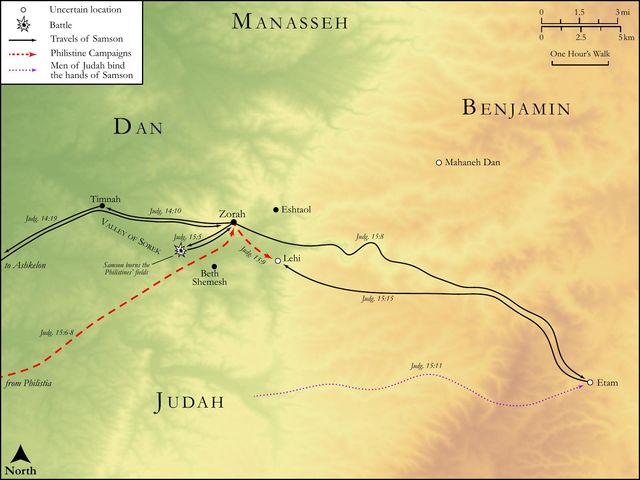
See on the biblical-era maps

Study this verse
Public-domain commentary
Matthew Henry
From his Commentary on the Whole Bible. Henry comments on passages, not single verses — this entry covers Judges 15:18–20. His two-level outline is real structure in the source text, so it is rendered as structure.
Here is, I. The distress which Samson was in after this great performance (Jdg 15:18): He was sore athirst. It was a natural effect of the great heat he had been in, and the great pains he had taken; his zeal consumed him, ate him up, and made him forget himself, till, when he had time to pause a little, he found himself reduced to the last extremity for want of water and ready to faint. Perhaps there was a special hand of God in it, as there was in the whole transaction; and God would hereby keep him from being proud of his great strength and great achievements, and let him know that he was but a man, and liable to the calamities that are common to men. And Josephus says, It was designed to chastise him for not making mention of God and his hand in his memorial of the victory he had obtained, but taking all the praise to himself: I have slain a thousand men; now that he is ready to die for thirst he is under a sensible conviction that his own arm could not have saved him, without God's right hand and arm. Samson had drunk largely of the blood of the Philistines, but blood will never quench any man's thirst. Providence so ordered it that there was no water near him, and he was so fatigued that he could not go far to seek it; the men of Judah, one would think, should have met him, now that he had come off a conqueror, with bread and wine, as Melchizedek did Abram, to atone for the injury they had done him; but so little notice did they take of their deliverer that he was ready to perish for want of a draught of water. Thus are the greatest slights often put upon those that do the greatest services. Christ on the cross, said, I thirst.
II.His prayer to God in this distress.
Those that forget to attend God with their praises may perhaps be compelled to attend him with their prayers. Afflictions are often sent to bring unthankful people to God. Two things he pleads with God in this prayer,
1.His having experienced the power and goodness of God in his late success: Thou hast given this great deliverance into the hand of thy servant. He owns himself God's servant in what he had been doing: "Lord, wilt thou not own a poor servant of thine, that has spent himself in thy service? I am thine, save me." He calls his victory a deliverance, a great deliverance; for, if God had not helped him, he had not only not conquered the Philistines, but had been swallowed up by them. He owns it to come from God, and now corrects his former error in assuming it too much to himself; and this he pleads in his present strait. Note, Past experiences of God's power and goodness are excellent pleas in prayer for further mercy. "Lord, thou hast delivered often, wilt thou not deliver still? Co2 1:10. Thou hast begun, wilt thou not finish? Thou hast done the greater, wilt thou not do the less?" Psa 56:13.
2.His being now exposed to his enemies: "Lest I fall into the hands of the uncircumcised, and then they will triumph, will tell it in Gath, and in the streets of Ashkelon; and will it not redound to God's dishonour of his champion become so easy a prey to the uncircumcised?" The best pleas are those taken from God's glory.
III.The seasonable relief God sent him.
God heard his prayer, and sent him water, either out of the bone or out of the earth through the bone, Jdg 15:19. That bone which he had made an instrument of God's service God, to recompense him, made an instrument of his supply. But I rather incline to our marginal reading: God clave a hollow place that was in Lehi: the place of this action was, from the jaw-bone, called Lehi; even before the action we find it so called, Jdg 15:9, Jdg 15:14. And there, in that field, or hill, or plain, or whatever it was, that was so called, God caused a fountain suddenly and seasonably to open just by him, and water to spring up out of it in abundance, which continued a well ever after. Of this fair water he drank, and his spirits revived. We should be more thankful for the mercy of water did we consider how ill we can spare it. And this instance of Samson's relief should encourage us to trust in God, and seek to him, for, when he pleases, he can open rivers in high places. See Isa 41:17, Isa 41:18.
IV.The memorial of this, in the name Samson gave to this upstart fountain, Enhakkore, the well of him that cried, thereby keeping in remembrance both his own distress, which occasioned him to cry, and God's favour to him, in answer to his cry. Many a spring of comfort God opens to his people, which may fitly be called by this name; it is the well of him that cried. Samson had given a name to the place which denoted him great and triumphant - Ramath-lehi, the lifting up of the jaw-bone; but here he gives it another name, which denotes him needy and dependent.
V.The continuance of Samson's government after these achievements, Jdg 15:20.
At length Israel submitted to him whom they had betrayed. Now it was past dispute that God was with him, so that henceforward they all owned him and were directed by him as their judge. The stone which the builders refused became the head-stone. It intimates the low condition of Israel that the government was dated by the days of the Philistines; yet it was a mercy to Israel that, though they were oppressed by a foreign enemy, yet they had a judge that preserved order and kept them from ruining one another. Twenty years his government continued, according to the usages of the judges' administration; but of the particulars we have no account, save of the beginning of his government in this chapter and the end of it in the next.
Historical interpretation
Four Centuries of Reception
3 surviving comments on this verse. Each one is dated, so this reads as a timeline rather than a list.
Select a marker to jump to its quote. Markers stagger vertically where authors wrote within a few decades of each other.
And now he began to burn with thirst, and there was no water, and yet he had great need of it. Wherefore perceiving that there is nothing so easy for human strength, as not to be rendered difficult by the absence of Divine aid, he besought God not to lay to his charge that he had ascribed ought to himself, giving Him all the glory of the victory, by the words, "Thou hast given this great deliverance into the hand of Thy servant," and now help me, for lo, "I die of thirst", and thirst gives me over into the hand of those over whom Thou hast given me so great a triumph. Wherefore God in His mercy clave a hollow place in the jaw bone which Samson had cast aside, and a stream of water flowed from it, and Samson drank, and his spirit revived, and he called the place 'the invoking of the spring,' because by his suppliant prayers he made amends for his boast of victory, and thus two judgements were opportunely declared, the one that arrogance soon incurs offence, the other that without any offence humility gains reconciliation.
Although we had been dried up because of lack of the dew of God’s grace, we merited to be changed into fountains and rivers. At that time Samson prayed and a fountain issued from the jawbone. This fact is clearly fulfilled in us, for the Lord himself said, “He who believes in me, from within him there shall flow rivers of living water.”
In the relics of the saints the Lord Christ has provided us with saving fountains which in many ways pour out benefactions and gush with fragrant ointment. And let no one disbelieve. For, if by the will of God water poured out of the precipitous living rock in the desert, and for the thirsty Samson from the jawbone of an ass, is it unbelievable that fragrant ointment should flow from the relics of the martyrs? Certainly not, at least for such as know the power of God and the honor which the saints have from him.
Continue studying Judges 15:19 across the web’s major study libraries — every link below opens this exact verse, chapter, or book on the destination site.
Read & Compare
 BibleGatewayThis verse in more than 200 translations and 70 languages.
 Bible.comThe YouVersion reader — hundreds of translations, reading plans, and highlights.
 ESV.orgCrossway's official English Standard Version reader.
 NET BibleThe NET translation with 60,000+ translators' notes on every rendering decision.
 STEP BibleTyndale House's free study tool — original text, vocabulary, and scholarly resources.
 BibliaLogos Bible Software's free web reader.
 USCCBThe New American Bible (Revised Edition) with the U.S. bishops' study notes.
Commentaries
 BibleHub CommentariesDozens of classic commentaries on this verse, gathered on one page.
 StudyLightMore than 100 commentary sets — the largest collection on the web.
 BibleRefPlain-English commentary on what this verse means, verse by verse.
 Enduring WordDavid Guzik's free commentary on this chapter, widely used by Bible teachers.
 Bible Study ToolsVerse commentary alongside Greek and Hebrew study aids.
Original Language & Research
- BibleHub InterlinearThe verse word by word — original language, transliteration, and English.
- BibleHub LexiconEvery word's original-language definition and Strong's entry.
 Blue Letter BibleDeep-study tools — Strong's numbers, concordance, and word studies.
 SefariaThe Hebrew text with Rashi and centuries of Jewish commentary.
Sermons, Hymns & Audio


TrulyRandomVerse is not affiliated with these sites and doesn’t control their content. They’re linked because they’re genuinely useful.
Summary
Judges 15:19 recounts a pivotal moment of divine intervention following Samson's monumental victory over the Philistines. Exhausted and facing imminent death from extreme thirst, Samson cried out to God. In a miraculous display of power and provision, God split open a hollow place within the very jawbone that Samson had used as a weapon, causing life-giving water to gush forth. Samson drank, was immediately revived, and named the spring Enhakkore, "the spring of him who called," establishing a lasting memorial to God's faithful response to his desperate plea.
Context
ShowHideLiterary Context
This verse immediately follows Samson's incredible, divinely empowered slaughter of a thousand Philistines with the jawbone of a donkey in Judges 15:14-17. The preceding verse, Judges 15:18, captures Samson's desperate cry to the Lord, acknowledging his utter dependence despite his recent superhuman feat. The narrative brilliantly juxtaposes Samson's immense physical strength and triumph with his sudden, profound vulnerability to a basic human need: thirst. This highlights that even the most powerful individuals are utterly dependent on God for sustenance and life, shifting the focus from Samson's might to God's ultimate provision. The naming of the place, Enhakkore, serves as an etiological explanation, cementing the memory of this miracle within the ongoing narrative of Israel's judges.
Historical & Cultural Context
The book of Judges describes a tumultuous period in Israel's history, characterized by cycles of apostasy, oppression by foreign powers (like the Philistines), and God raising up deliverers. Samson operated in a time when the Philistines were a dominant force, often raiding Israelite territory. Water was, and remains, a precious commodity in the arid climate of ancient Israel. Springs and wells were vital for survival, and their miraculous appearance was a clear sign of divine favor and intervention. The location, Lehi (meaning "jawbone"), was likely a known landmark, and the miraculous spring would have been a significant local feature, serving as a tangible reminder of God's power and Samson's story for generations. This miracle would have reinforced the belief in Yahweh as the God who provides, even in the most desolate circumstances.
Key Themes
ShowHideJudges 15:19 powerfully encapsulates several recurring themes within the book of Judges and the broader biblical narrative. It is a profound demonstration of Divine Provision and Miraculous Intervention, showcasing God's ability to supply life-sustaining needs in the most unexpected and supernatural ways, turning an instrument of death (the jawbone) into a source of life. This act underscores God's Faithfulness to His Covenant and His Chosen Ones, even when His servants, like Samson, are deeply flawed and often act impulsively. God hears Samson's desperate plea, illustrating the Power of Prayer and God's responsiveness to the cries of His people in their weakness, a truth echoed in Jeremiah 33:3. Furthermore, the immediate physical and spiritual Revival and Restoration Samson experiences highlights God's capacity to renew and invigorate, not just physically but also inwardly, reminding us that God's strength is made perfect in human weakness, as seen in 2 Corinthians 12:9.
Exposition and Analysis
ShowHideKey Word Analysis
ShowHideThis primitive root signifies a forceful rending, breaking, or splitting open. As seen in the parting of the Red Sea (Exodus 14:16) or the splitting of rocks to bring forth water (Psalm 78:15), its use here emphasizes the supernatural and violent nature of God's action. It denotes a direct, powerful intervention to create a source of water where none should naturally exist, particularly from a bone.
This proper noun literally means "fountain of One calling" or "spring of the caller." The name itself serves as a perpetual memorial, directly linking the miraculous spring to Samson's desperate cry to God in Judges 15:18. It highlights the cause-and-effect relationship between Samson's prayer and God's immediate, life-saving response, ensuring that future generations would remember the divine provision.
This primitive root means "to live," whether literally or figuratively, and causatively, "to revive." It encompasses the full restoration of life, strength, vitality, and well-being after extreme exhaustion or near-death. The text implies not just physical rehydration but a renewal of Samson's inner spirit and resolve, signifying a holistic restoration by God's grace, bringing him back from the brink.
Verse Breakdown
ShowHide"But God clave an hollow place that [was] in the jaw, and there came water thereout;"
This clause immediately establishes divine agency ("But God"). The miracle is attributed directly to God, who "clave" (violently split open) a hollow place within the very jawbone that Samson had just used to slay a thousand men. This is an extraordinary act, turning an instrument of death into a source of life, demonstrating God's power to create sustenance from the most unlikely and even grotesque sources. The water's immediate appearance underscores the supernatural nature of the event.
"and when he had drunk, his spirit came again, and he revived:"
This describes the immediate and profound effect of the water. Samson's near-fatal dehydration is instantly reversed. The phrase "his spirit came again" indicates a complete restoration, not just physical rehydration but a renewal of his inner vitality and strength, pulling him back from the brink of death and restoring his full vigor.
"wherefore he called the name thereof Enhakkore, which [is] in Lehi unto this day."
This final clause explains the naming of the spring and its lasting significance. Samson names the place "Enhakkore," meaning "the spring of him who called," directly commemorating his desperate prayer and God's faithful answer. The phrase "unto this day" is a common biblical idiom, indicating that the spring and its name served as a perpetual physical memorial and testimony to this miraculous event for generations, reinforcing the truth of God's intervention.
Literary Devices
ShowHideJudges 15:19 is rich with Irony, perhaps its most striking literary device. The jawbone of a donkey, an instrument of death and destruction in Samson's hands, is miraculously transformed by God into a source of life-giving water. This subversion of expectation powerfully highlights God's sovereign power to use ordinary, even macabre, objects for extraordinary, redemptive purposes. The narrative also employs Etiology, explaining the origin of the place name "Enhakkore" and its connection to Samson's desperate cry and God's response, thereby embedding the miracle within the geographical and historical memory of Israel. Symbolism is evident in the water itself, which universally represents life, purification, and refreshment, here signifying divine provision and spiritual renewal. The entire event is a profound Miracle, a direct divine intervention that defies natural laws, serving to underscore God's active involvement in the lives of His people and His ability to provide in impossible circumstances.
Theological and Thematic Connections
ShowHideThis miraculous provision of water for Samson profoundly illustrates God's sovereign care and responsive nature, even towards His flawed servants. It teaches that God is not limited by human weakness or the scarcity of resources; He can bring forth life and provision from the most unexpected and seemingly impossible sources. The event serves as a powerful reminder that true strength and survival ultimately come from acknowledging one's utter dependence on God and crying out to Him in humility. God's faithfulness to His promises and His willingness to sustain His chosen instruments for His purposes, despite their personal failings, demonstrates that His grace often extends beyond human merit. The naming of the spring ensures that this act of divine provision becomes a permanent testimony, a "stone of help" reminding future generations of God's power to hear and answer.
Reflection and Application
ShowHideJudges 15:19 offers profound encouragement for believers facing their own moments of exhaustion and desperation. Just as Samson, after a mighty victory, found himself utterly depleted and on the verge of death, so too can we, even after significant spiritual or personal triumphs, encounter profound weakness and need. This verse reminds us that our greatest moments of vulnerability are often precisely when God desires to demonstrate His power and provision most clearly. It calls us to emulate Samson's desperate, humble cry to God, recognizing that our ultimate source of strength, refreshment, and revival is not found in our own abilities or resources, but solely in Him. God delights in turning our impossible situations into testimonies of His miraculous intervention, providing "water" from the most unlikely "jawbones" of our lives, transforming despair into renewed hope and vitality. We are invited to trust that when we are parched and depleted, God is able to open up springs of life in our wilderness.
Questions for Reflection
ShowHideFAQ
ShowHideWhy did God choose to provide water from the jawbone specifically, rather than another source?
ShowHideGod's choice to provide water from the very jawbone Samson had just used to defeat the Philistines (Judges 15:15) is a powerful demonstration of divine irony and sovereignty. It emphasizes that God is not bound by conventional means; He can use anything—even an instrument of death—to bring forth life. This act underscores His complete control and His ability to turn the most unlikely circumstances into a display of His power and provision. It also serves as a direct, undeniable sign to Samson that this was indeed God's doing, directly linked to his recent miraculous victory.
What is the significance of the name "Enhakkore" and its lasting presence "unto this day"?
ShowHideThe name "Enhakkore" (meaning "fountain of him that called" or "spring of the caller") is highly significant because it permanently links the miraculous provision of water to Samson's desperate prayer in Judges 15:18. It serves as an etiological marker, explaining the origin of a geographical feature and ensuring that the memory of God's responsive faithfulness would endure. The phrase "unto this day" indicates that the spring was still known by this name when the book of Judges was written, testifying to the historical reality and lasting impact of God's intervention for generations of Israelites. It became a tangible memorial of God hearing and answering the cry of His servant.
Christ-Centered Fulfillment
ShowHideThe miraculous provision of water for Samson in Judges 15:19 offers a profound foreshadowing of Christ, the ultimate source of living water. Samson's physical thirst and desperate cry for life-giving water, provided supernaturally from an unlikely source, mirrors humanity's deeper spiritual thirst for salvation and renewal. Jesus, as the true Rock from which living water flows, declares in John 7:37-38 that "If anyone thirsts, let him come to me and drink." He is the one who offers water that, once drunk, will cause a person "never to thirst again" (John 4:14). Just as Samson's spirit was revived by physical water, believers are spiritually revived and given new life by the Holy Spirit, which Jesus pours out. The jawbone, an instrument of death, becoming a source of life points to Christ's death on the cross, which, though an instrument of suffering, became the ultimate source of eternal life and spiritual refreshment for all who believe. In Christ, our deepest spiritual thirst is quenched, and our spirits are eternally revived.