


Isaiah 40:26
Bible text: King James Version (1769 Blayney text) · Public domain
Bible text: King James Version with Strong's numbers · Public domain
Bible text: Berean Standard Bible · Public domain
Bible text: American Standard Version (1901) · Public domain
Bible text: World English Bible, Messianic edition · Public domain
Bible text: Geneva Bible (1599) · Public domain
Bible text: Young's Literal Translation · Public domain
- שְׂאוּse·'ulift upH5375V-Qal-Imp-2mpVerb Qal Imperative 2nd Plural Masculine
- מָרוֹםma·RomheightH4791N-msNoun Singular Masculine Absolute
- עֵינֵיכֶם'ei·nei·Khemyour eyesH5869N-fdc ¦ 2mpNoun Dual Feminine Constructעֵינֵיeyesכֶםyour
- וּרְאוּu·re·'Uand seeH7200Conj-w ¦ V-Qal-Imp-2mpVerb Qal Imperative 2nd Plural Masculineוּandרְאוּsee
- מִיmiwho?H4310InterrogPronoun Interrogative
- בָרָאva·Ra'did he createH1254V-Qal-Perf-3msVerb Qal Perfect 3rd Singular Masculine
- אֵלֶּה'E·lehtheseH428PrtParticle Demonstrative
- הַמּוֹצִיאha·mo·Tzi'the [one who] brings outH3318Art ¦ V-Hiphil-Prtcpl-msVerb Hiphil Participle Singular Masculine Absoluteהַtheמּוֹצִיא[one who] brings out
- בְמִסְפָּרve·mis·Parby numberH4557Prep-b ¦ N-msNoun Singular Masculine Absoluteבְbyמִסְפָּרnumber
- צְבָאָםtze·va·'Amtheir hostH6635N-msc ¦ 3mpNoun Singular Masculine Constructצְבָאָhostםtheir
- לְכֻלָּםle·khu·Lam<to> all of themH3605Prep-l ¦ N-msc ¦ 3mpNoun Singular Masculine Constructלְ<to>כֻלָּall ofםthem
- בְּשֵׁםbe·Shemby nameH8034Prep-b ¦ N-msNoun Singular Masculine Absoluteבְּbyשֵׁםname
- יִקְרָאyik·Ra'he callsH7121V-Qal-Imperf-3msVerb Qal Imperfect 3rd Singular Masculine
- מֵרֹבme·Rofrom greatness ofH7230Prep-m ¦ N-mscNoun Singular Masculine Constructמֵfromרֹבgreatness of
- אוֹנִים'o·Nimstrength<s>H202N-mpNoun Plural Masculine Absolute
- וְאַמִּיץve·'a·Mitzand a strong [one] ofH533Conj-w ¦ Adj-mscAdjective Singular Masculine Constructוְandאַמִּיץa strong [one] of
- כֹּחַKo·achpowerH3581N-msNoun Singular Masculine Absolute
- אִישׁ'ishanyH376N-msNoun Singular Masculine Absolute
- לֹאlo'notH3808NegParticle Negative
- נֶעְדָּרne'·Darit is missingH5737V-Niphal-Prtcpl-msVerb Niphal Participle Singular Masculine Absolute
English is a literal word-by-word gloss of the Hebrew, not the KJV's wording. Why?
This is the original text the KJV's translators worked from — each Hebrew word with its own literal English meaning in this verse, prepared by scholars at Tyndale House, Cambridge. The KJV translates whole sentences, not word by word, so its wording differs: one Hebrew word can become several English words, and the KJV may choose “the LORD” where the gloss reads “Yahweh”. Both are faithful — they answer different questions. For the KJV's own rendering, switch to the KJV text.
Details
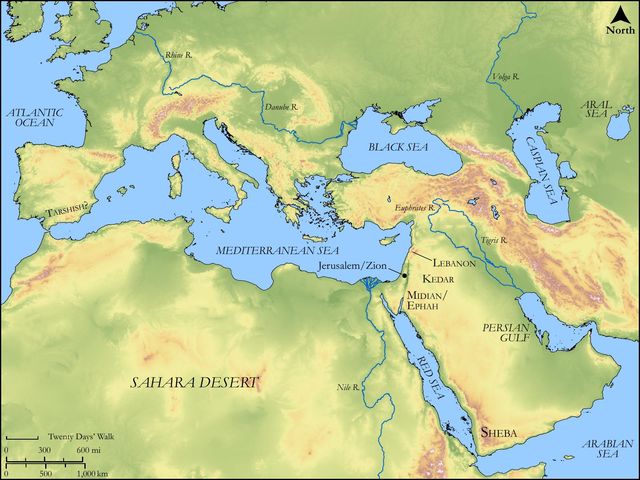
See on the biblical-era map
Study this verse
Public-domain commentary
Matthew Henry
From his Commentary on the Whole Bible. Henry comments on passages, not single verses — this entry covers Isaiah 40:18–26. His four-level outline is real structure in the source text, so it is rendered as structure.
The prophet here reproves those, 1. Who represented God by creatures, and so changed his truth into a lie and his glory into shame, who made images and then said that they resembled God, and paid their homage to them accordingly. 2. Who put creatures in the place of God, who feared them more than God, as if they were a match for him, or loved them more than God, as if they were fit to be rivals with him. Twice the challenge is here made, To whom will you liken God? Isa 40:18, and again Isa 40:25. The Holy One himself says, To whom will you liken me? This shows the folly and absurdity, (1.) Of corporal idolatry, making visible images of him who is invisible, imagining the image to be animated by the deity, and the deity to be presentiated by the image, which, as it was an instance of the corruption of the human nature, so it was an intolerable injury to the honour of the divine nature. (2.) Of spiritual idolatry, making creatures equal with God in our affections. Proud people make themselves equal with God; covetous people make their money equal with God; and whatever we esteem or love, fear or hope in, more than God, that creature we equal with God, which is the highest affront imaginable to him who is God over all. Now, to show the absurdity of this,
I.The prophet describes idols as despicable things and worthy of the greatest contempt (Isa 40:19, Isa 40:20):
"Look upon the better sort of them, which rich people set up, and worship; they are made of some base metal, cast into what shape the founder pleases, and that is gilded, or overlaid with plates of gold, that it may pass for a golden image. It is a creature; for the workman made it; therefore it is not God, Hos 8:6. It depended upon his will whether it should be a god at all, and of what shape it should be. It is a cheat; for it is gold on the outside, but within it is lead or copper, in this indeed representing the deities, that they were not what they seemed to be, and deceived their admirers. How despicable then are the worst sort of them - the poor men's gods! He that is so impoverished that he has scarcely a sacrifice to offer to his god when he has made him will yet not be without an enshrined deity of his own; and, though he cannot procure one of brass or stone, he will have a wooden one rather than none, and for that purpose chooses a tree that will not soon rot, and of that he will have his graven image made. Both agree to have their image well fastened, that they may not be robbed of it. The better sort have silver chains to fix theirs with; and, though it be but a wooden image, care is taken that it shall not be moved." Let us pause a little and see,
1.How these idolaters shame themselves, and what a reproach they put upon their own reason, in dreaming that gods of their own making (Nehushtans, pieces of brass or logs of wood) should be able to do them any kindness. Thus vain were they in their imaginations; and how was their foolish heart darkened!
2.See how these idolaters shame us, who worship the only living and true God. They spared no cost upon their idols; we grudge that as waste which is spent in the service of our God. They took care that their idols should not be moved; we wilfully provoke our God to depart from us.
II.He describes God as infinitely great, and worthy of the highest veneration; so that between him and idols, whatever competition there may be, there is no comparison. To prove the greatness of God he appeals,
1.To what they had heard of him by the hearing of the ear, and the consent of all ages and nations concerning him (Isa 40:21): "Have you not known by the very light of nature? Has it not been told you by your fathers and teachers, according to the constant tradition received from their ancestors and predecessors, even from the beginning?" (Those notices of God are as ancient as the world.) "Have you not understood it as always acknowledged from the foundation of the earth, that God is a great God, and a great King above all gods?" It has been a truth universally admitted that there is an infinite Being who is the fountain of all being. This is understood not only ever since the beginning of the world, but from and by the origin of the universe. It is founded upon the foundation of the earth. The invisible things of God are clearly seen from the creation of the world, Rom 1:20. Thou mayest not only ask thy father, and he shall tell thee this, and thy elders (Deu 32:7); but ask those that go by the way (Job 21:29), ask the first man you meet, and he will say the same. Some read it, Will you not know? Will you not hear it? For those that are ignorant of this are willingly ignorant; the light shines in their faces, but they shut their eyes against it. Now that which is here said of God is,
(1.)That he has the command of all the creatures. The heaven and the earth themselves are under his management: He sits upon the circle, or globe, of the earth, Isa 40:22. He that has the special residence of his glory in the upper world maintains a dominion over this lower world, gives law to it, and directs all the motions of it to his own glory. He sits undisturbed upon the earth, and so establishes it. He is still stretching out the heavens, his power and providence keep them still stretched out, and will do so till the day comes that they shall be rolled together like a scroll. He spreads them out as easily as we draw a curtain to and fro, opening these curtains in the morning and drawing them close again at night. And the heaven is to this earth as a tent to dwell in; it is a canopy drawn over our heads, et quod tegit omnia coelum - and it encircles all. - Ovid. See Psa 104:2.
(2.)That the children of men, even the greatest and mightiest, are as nothing before him. The numerous inhabitants of this earth are in his eye as grasshoppers in ours, so little and inconsiderable, of such small value, of such little use, and so easily crushed. Proud men's lifting up themselves is but like the grasshopper's leap; in an instant they must stoop down to the earth again. If the spies thought themselves grasshoppers before the sons of Anak (Num 13:33), what are we before the great God? Grasshoppers live but awhile, and live carelessly, not like the ant; so do the most of men.
(3.)That those who appear and act against him, how formidable soever they may be to their fellow-creatures, will certainly be humble and brought down by the mighty hand of God, Isa 40:23, Isa 40:24. Princes and judges, who have great authority, and abuse it to the support of oppression and injustice, make nothing of those about them; as for all their enemies they puff at them (Psa 10:5; Psa 12:5); but, when the great God takes them to task, he brings them to nothing; he humbles them, and tames them, and makes them as vanity, little regarded, neither feared nor loved. He makes them utterly unable to stand before his judgments, which shall either,
[1.]Prevent their settlement in their authority: They shall not be planted; they shall not be sown; and those are the two ways of propagating plants, either by seed or slips. Nay, if they should gain a little interest, and so be planted or sown, yet their stock shall not take root in the earth, they shall not continue long in power. Eliphaz saw the foolish taking root, but suddenly cursed their habitation. And then how soon is the fig-tree withered away! Or,
[2.]He will blast them when they think they are settled. He does but blow upon them, and then they shall wither, and come to nothing, and the whirlwind shall take them away as stubble. For God's wrath, though it seem at first to blow slightly upon them, will soon become a mighty whirlwind. When God judges he will overcome. Those that will not bow before him cannot stand before him.
2.He appeals to what their eyes saw of him (Isa 40:26): "Lift up your eyes on high; be not always poring on this earth" (O curvae in terras animae et coelestium inanes! - Degenerate minds, that can bend so towards the earth, having nothing celestial in them!), "but sometimes look up" (Os homini sublime dedit, coelumque tueri jussit - Heaven gave to man an erect countenance, and bade him gaze on the stars); "behold the glorious lights of heaven, consider who has created them. They neither made nor marshalled themselves; doubtless, therefore, there is a God that gave them their being, power, and motion." What we see of the creature should lead us to the Creator. The idolaters, when they lifted up their eyes and beheld the hosts of heaven, being wholly immerged in sense, looked no further, but worshipped them, Deu 4:19; Job 31:26. Therefore the prophet here directs us to make use of our reason as well as our senses, and to consider who created them, and to pay our homage to him. Give him the glory of his sovereignty over them - He brings out their host by number, as a general draws out the squadrons and battalions of his army; of the knowledge he has of them - He calls them all by names, proper names, according as their place and influence are (Psa 147:4); and of the use he makes of them; when he calls them out to any service, so obsequious are they that, by the greatness of his might, not one of them fails, but, as when the stars in their courses fought against Sisera, every one does that to which he is appointed. To make these creatures therefore rivals with God, which are such ready servants to him, is an injury to them as well as an affront to him.
Historical interpretation
Two Centuries of Reception
6 surviving comments on this verse. Each one is dated, so this reads as a timeline rather than a list.
Select a marker to jump to its quote. Markers stagger vertically where authors wrote within a few decades of each other.
"Lift up your eyes" occurs in many places in Scripture when the divine Word admonishes us to exalt and lift up our thoughts, to elevate the insight that lies below in a rather sickly condition, and is stooped and completely incapable of looking up, as it is written, for instance, in Isaiah: "Lift up your eyes on high and see. Who has made all these things known?"
(Vers. 21 seqq.) Do you not know? Do you not hear? Has it not been announced to you from the beginning? Have you not understood the foundations of the earth? He sits above the circle of the earth, and its inhabitants are like locusts. He spreads out the heavens like nothing, and expands them as a tent to dwell in. He makes secret things known as if they were not. He has made the rulers of the earth as nothing. They are not planted, nor are they sown, nor do their roots take hold in the earth. He blows on them and they wither, and the whirlwind carries them away like stubble. And to whom have you compared me and made me equal? says the Lord. Lift up your eyes on high and see who has created these things: he who brings out their host by number, and calls them all by name. Because of his great power and strength, and because his power has no end. LXX: Do you not know? Have you not heard? Has it not been told to you from the beginning? Have you not understood the foundation of the earth? He who sits above the circle of the earth, and its inhabitants are like grasshoppers. He who sets the heavens like a tent and stretches them like a dwelling place. He who makes princes rule for nothing, and reduces the earth to nothing. For they shall not be planted, nor shall they be sown, nor shall their root be established in the earth. He blows upon them, and they wither, and the storm carries them away like straw. So now to whom will you compare me? Or how am I equal? says the Holy One. Lift up your eyes on high and see: who created these? He who leads according to his ordered number, he will call all by name, from much glory and in the strength of fortitude: nothing escapes you. From the beginning, he said, I have taught you by the natural law, and afterwards I have testified through the written law of Moses, what idols are nothing, and that the Creator of the world himself is God, who has founded such a great mass of land upon the seas, and has placed it upon the rivers: so that the heaviest element hangs by the will of God upon the thin waters, who sits as a king upon the circumference of the earth: from which some contend that it is like a dot and a globe, and its inhabitants like locusts. For if we consider the various nations in the whole world, from the Ocean to the Ocean, that is, from the Indian sea to the British, and from the Atlantic to the harshness of the North, where the waters freeze and beautiful amber grows, we see that the entire human race dwells in the middle like locusts. So why does the earth and ash boast? Because the heavens, indeed, as I will use the authority of the Scriptures, are stretched out like a chamber; or, as it is contained in Hebrew, like a tent, of which we have spoken above: for which the LXX interpreted it as saliva there: and one word now translated as spit, now as chamber, that is, a vault; and its width extends above them like a tent and a canopy, so as to cover people like a roof and make them dwell as if in a very large house. Why should we be surprised if the small bodies of humans are considered like locusts and tiny creatures? Again, in this place, they argue that the semicircle is close to the earth (or rather, the heavens), and they claim that the sky is similar to a sphere. They use the term 'arch' because the middle part of the sphere covers the earth: when in Hebrew, we read not 'arch' but 'dust', that is, very fine powder. For the saliva that is thrown onto the ground and mixes with the dust and disappears, shows that the magnitude of all bodies should be regarded as nothing. But he who stretched out the heavens and spread them out, so that either above could dwell the multitude of angels, or below could dwell human beings, and as if he created a great house for reasonable creatures, he himself established princes according to the quality of the times, whether as secret scrutineers, so that they may be as if they are not; and he made judges of the earth as if they were nothing. For this reason, the Seventy translated it, but they translated the earth as if it were nothing; indeed, in the beginning of Genesis where it is written, 'But the earth was invisible and unfinished' (Gen. 1:1), others translated it as, 'But the earth was empty and nothing.' How many kings, both Greek and Barbarian, does Roman history narrate! Where is that countless army of Xerxes? Where is the multitude of Israel in the desert? Where is the incredible power of kings? What about the ancient ones? Let present examples teach us, that princes are considered as nothing, and rulers of the earth as empty. Those princes and rulers of the earth (or, as others suspect, of heaven) are neither satisfied, nor established, nor firmly rooted, and by the sudden command of God they are taken away and perish, as straw is carried away by the whirlwind and storm; according to what is written: 'I passed by, and he was not there; I sought him, and his place was not found' (Ps. XXXVI, 36). So with such great power and majesty of the Creator, how can you compare God to the likeness of a creature? And do you not rather understand the Creator from the magnitude of the creatures? If you do not believe in words, believe at least in your own eyes; and consider the power of the Lord from the service of the heavens and all the elements. He summons their army, that is, the heavens, in number; and he calls them all by name, and it is understood, the stars. Of which it is also sung in the Psalms: He counts the multitude of the stars: and he calls them all by name (Ps. 46:4). Whether we interpret the hosts of heaven as the army of angels and all the heavenly hosts of which Daniel speaks: Thousands of thousands ministered to Him, and ten thousand times ten thousand stood before Him (Dan. VII, 10). Hence the Lord of hosts is called, which in our language is called the Lord of armies and forces, or powers. He brings forth his host according to the number of the heavens: so that the sun, and the moon, and the other stars, which Abraham could not number, are numbered by Him, and serve the assigned function (Gen. XV): while the same course of the heavens is completed by the sun in one year, by the morning star and the evening star in two years, by the moon in each month, and all the stars follow their appointed times, and some of them are called wandering, and we see their movements with our eyes, not with our minds, nor do we understand them as much as we marvel at them. For the magnitude of God's strength makes all things serve in its own order. Whether according to the Seventy, by the multitude of his glory and the power of his virtue, nothing can escape him; but he knows all the ways, plans, and courses of the Creator by his majesty.
Since so great is the power and majesty of the Creator, to which likeness do you compare God, thus failing to understand the founder from the greatness of creation? If you do not believe the words, at least believe your eyes and recognize the power of the Lord from the service all heavens and elements give him, who “leads out their army by number,” that is, the heavens, about which in the psalms it says, “Who numbers the host of stars and calls them all by name.” Or we can call the army of heaven angels and all the companies of heaven.… For the greatness of the strength of God made all to serve him in order … but he knows their way and reasons and course in his majesty as the Creator.
He says, look at the sun, the moon, the movement of the stars, the cycle of the year, the changing of the seasons, the regular succession of night and day. For this is what he has added: “He who brings forth by number the order of the cosmos.” For He calls the setting in order of creation “the cosmos.” “He shall call them all by names.” He is ignorant of nothing, he says, but He knows all things with clarity, since it is He who has given a name equally to each and everything. “By means of the greatness of Your glory and by the power of Your might nothing has escaped You.” He has power above all, He is able to do all, He is ignorant of nothing that exits and He knows the very thoughts of men. (Theodoret of Cyrus) God, whose knowledge is simply manifold, and uniform in its variety, comprehends all incomprehensibles with so incomprehensible a comprehension, that though He willed always to make His later works novel and unlike what went before them, He could not produce them without order and foresight, nor conceive them suddenly, but by His eternal foreknowledge. (St. Augustine City of God)
Do not think that I ignore the designs of your souls, God says through Isaiah, and do not believe that you escape my view when you hold perverse reasonings. This passage lets [us] see clearly that he has also thrown the accusation of polytheism against Israel itself.
[Isaiah] says, look at the sun, the moon, the movement of the stars, the cycle of the year, the changing of the seasons, the regular succession of night and day. For this is what [Isaiah] has added: “He who brings forth by number the order of the cosmos.” For he calls the setting in order of creation “the cosmos.” “He shall call them by names.” He is ignorant of nothing, [Isaiah] says, but he knows all things with clarity, since it is he who has given a name equally to each and every thing. “By means of the greatness of [your] glory and by the power of [your] might nothing has escaped you.” He has power above all, he is able [to do] all, he is ignorant of nothing that exists, and he knows the very thoughts of people.
Continue studying Isaiah 40:26 across the web’s major study libraries — every link below opens this exact verse, chapter, or book on the destination site.
Read & Compare
 BibleGatewayThis verse in more than 200 translations and 70 languages.
 Bible.comThe YouVersion reader — hundreds of translations, reading plans, and highlights.
 ESV.orgCrossway's official English Standard Version reader.
 NET BibleThe NET translation with 60,000+ translators' notes on every rendering decision.
 STEP BibleTyndale House's free study tool — original text, vocabulary, and scholarly resources.
 BibliaLogos Bible Software's free web reader.
 USCCBThe New American Bible (Revised Edition) with the U.S. bishops' study notes.
Commentaries
 BibleHub CommentariesDozens of classic commentaries on this verse, gathered on one page.
 StudyLightMore than 100 commentary sets — the largest collection on the web.
 BibleRefPlain-English commentary on what this verse means, verse by verse.
 Enduring WordDavid Guzik's free commentary on this chapter, widely used by Bible teachers.
 Bible Study ToolsVerse commentary alongside Greek and Hebrew study aids.
Original Language & Research
- BibleHub InterlinearThe verse word by word — original language, transliteration, and English.
- BibleHub LexiconEvery word's original-language definition and Strong's entry.
 Blue Letter BibleDeep-study tools — Strong's numbers, concordance, and word studies.
 SefariaThe Hebrew text with Rashi and centuries of Jewish commentary.
Sermons, Hymns & Audio


TrulyRandomVerse is not affiliated with these sites and doesn’t control their content. They’re linked because they’re genuinely useful.
Summary
Isaiah 40:26 stands as a majestic declaration of God's unparalleled sovereignty, omnipotence, and meticulous care over all creation. As part of a larger message of comfort and restoration for a despondent Israel, the prophet directs their gaze heavenward, inviting them to contemplate the Creator who not only brought the vast celestial host into existence but also meticulously orders, numbers, and names every star. This profound assertion of divine power and unwavering faithfulness provides an irrefutable foundation for trust, assuring God's people that His plans and promises are as unfailing as the order of the heavens He sustains.
Context
ShowHideLiterary Context
Isaiah 40 inaugurates the "Book of Comfort" (chapters 40-66) within the prophecy of Isaiah, marking a dramatic shift from earlier pronouncements of judgment to themes of hope, redemption, and restoration for Israel. The chapter opens with the tender command, "Comfort ye, comfort ye my people, saith your God" Isaiah 40:1, directly addressing a nation grappling with the trauma of exile and questioning God's faithfulness and power. Against this backdrop of national despair and theological doubt, Isaiah systematically contrasts the fleeting nature of humanity and the futility of idols with the eternal, incomparable, and all-sufficient God. Verse 26, therefore, functions as a climactic rhetorical question and assertion, providing irrefutable evidence of God's absolute dominion over creation. It establishes the divine capacity to fulfill promises, directly preceding and laying the groundwork for further declarations of God's strength and His ability to empower the faint, as seen in Isaiah 40:29-31.
Historical & Cultural Context
The primary audience for Isaiah 40 was either experiencing or anticipating the Babylonian exile, a period of profound national humiliation and spiritual crisis for Israel. They were immersed in the polytheism of the nations, particularly Babylon, where astral worship was prevalent. Deities like Marduk and Ishtar were often associated with celestial bodies, and astrological practices heavily influenced daily life. In this environment, Isaiah's declaration that Yahweh alone "bringeth out their host by number" and "calleth them all by names" was a radical and direct challenge to the supremacy of any other god or heavenly power. It asserted Yahweh's unique and exclusive sovereignty over the heavens, dismantling the claims of pagan deities. Furthermore, the people's lament, "My way is hid from the LORD, and my judgment is passed over from my God" Isaiah 40:27, highlights their deep-seated fear that God had forgotten them or was too weak to intervene. Isaiah 40:26 directly refutes this, demonstrating God's infinite power and intimate knowledge of His creation as irrefutable proof of His unwavering attention and capability to act on behalf of His covenant people.
Key Themes
ShowHideThis verse powerfully contributes to several overarching theological themes within Isaiah 40 and the broader book. Firstly, it underscores God's Incomparable Sovereignty and Omnipotence. By depicting God as the sole Creator who not only brings the vast celestial host into existence but also meticulously numbers and names each star, Isaiah emphasizes that God's power is boundless and beyond human comprehension. This theme is foundational to the comfort offered, assuring Israel that the God who effortlessly controls the heavens can certainly control their destiny and bring about their promised restoration. Secondly, the verse highlights God's Meticulous Order and Unwavering Faithfulness. The concluding phrase, "not one faileth," speaks to God's perfect order, reliability, and precision. Just as the celestial bodies obey His command without deviation, so too will His covenant promises to Israel be fulfilled. This provides a strong counterpoint to the people's doubts about God's faithfulness, reinforcing the idea that His word is as sure and dependable as the rising of the stars. This divine reliability is a recurring motif throughout Scripture, echoing sentiments found in passages like Lamentations 3:22-23. Finally, the verse implicitly promotes Awe, Worship, and Trust, inviting humanity to look beyond their earthly troubles and recognize the magnificent Creator. This call to "lift up your eyes on high" is an invitation to shift perspective from human weakness and despair to divine strength and boundless capability, fostering a spirit of profound trust and adoration.
Exposition and Analysis
ShowHideKey Word Analysis
ShowHideA primitive root meaning "to create," often implying creation ex nihilo (out of nothing) or a unique, formative act. This verb is frequently reserved for divine activity, particularly in the context of bringing something entirely new into existence or establishing a new order. Here, it emphasizes God's sole prerogative and absolute power in originating the vast celestial bodies, underscoring His unmatched status as the ultimate source of all existence. Unlike human making or forming from existing materials, bârâʼ denotes a sovereign act of bringing forth that which was not.
Referring to a "mass of persons (or figuratively, things), especially reg. organized for war (an army)." In this context, "host" vividly portrays the stars not as random, scattered objects, but as an immense, disciplined army or multitude, perfectly marshaled and commanded by God. This militaristic imagery conveys God's supreme authority, precision, and the sheer number and orderliness of the stars, all under His direct and unquestioned command. It speaks to the disciplined obedience of the heavens to their Creator.
A primitive root meaning "to arrange as a battle, a vineyard (to hoe); hence, to muster and so to miss (or find wanting); dig, fail, keep (rank), lack." In the negative ("not one faileth"), this word powerfully affirms God's perfect control and the unwavering obedience of His creation. It signifies that not a single star is missing, lost, deviates from its divinely appointed course, or falls short of its purpose. This speaks to God's absolute reliability, His perfect knowledge, and the complete success of His sovereign will, providing an ultimate assurance of His faithfulness and the unwavering stability of His order in the heavens.
Verse Breakdown
ShowHide"Lift up your eyes on high, and behold who hath created these [things]"
This opening imperative serves as a direct command, urging the reader or listener to shift their perspective from their immediate earthly concerns and anxieties to the vastness and majesty of the heavens. The rhetorical question, "who hath created these," implicitly points to Yahweh as the sole and incomparable Creator, inviting contemplation of the divine origin of the heavens and the earth. The "these [things]" primarily refers to the stars and celestial bodies, which, though seemingly countless and chaotic to human observation, are presented as the direct result of God's unique creative power. It is a call to observe the testimony of creation as undeniable evidence of God's existence, power, and glory.
"that bringeth out their host by number"
This clause emphasizes God's active, ongoing, and meticulous control over the celestial bodies. The imagery of "bringing out" suggests a general leading forth, akin to a shepherd leading his flock or a commander deploying an army. The "host" refers to the innumerable stars, depicted as an organized multitude. The phrase "by number" highlights God's meticulous precision and infinite knowledge; He does not merely create them but knows and manages each one individually, demonstrating an order and comprehension that transcends all human capacity. This speaks to divine omniscience and omnipotence.
"he calleth them all by names"
This is a profound statement of God's intimate knowledge, personal authority, and proprietorship over His creation. To call by name, as in "I have called thee by thy name; thou art mine," signified ownership, authority, and a deep personal relationship. Despite the vastness and multitude of the stars, God knows each one intimately, not merely by number but by name. This conveys His personal engagement and sovereign care, asserting His dominion over every minute detail of the universe, and by extension, over the lives and destinies of His people.
"by the greatness of his might, for that [he is] strong in power"
This phrase provides the theological basis and explanation for God's ability to perform such an astonishing feat of creation and sustenance. It attributes His effortless control over the universe to His inherent divine attributes: His "greatness of his might" (Hebrew, rob 'on) and His being "strong in power" (Hebrew, 'ammits koach). These are not merely abstract qualities but active, dynamic forces that enable Him to create, sustain, and command the entire universe with effortless ease. This reiterates His omnipotence as the ultimate source of all order, existence, and reliability.
"not one faileth"
This concluding declaration serves as a powerful and reassuring affirmation of God's absolute reliability and the perfect execution of His will. Because of His immense might and power, not a single star deviates from its appointed course, is lost, or fails to appear when commanded. This speaks to the unwavering consistency of God's character, His perfect governance, and the complete success of His sovereign will, assuring the reader that His promises and plans for His people are as reliable and unfailing as the celestial order He maintains. It is a promise of divine dependability.
Literary Devices
ShowHideIsaiah 40:26 masterfully employs several potent literary devices to convey its message of divine majesty and comfort. The verse opens with a direct Imperative ("Lift up your eyes"), immediately engaging the audience and commanding a shift in perspective from earthly troubles to heavenly grandeur. This is followed by a Rhetorical Question ("who hath created these [things]?"), which implicitly guides the listener to the undeniable conclusion of Yahweh's unique and unparalleled creative power. Personification is richly evident in the portrayal of the stars as a "host" (an army) that God "bringeth out" and "calleth them all by names." This imbues the inanimate celestial bodies with agency and obedience, vividly highlighting God's supreme command over them as if they were His personal legions, responding to His every word. The concept of God knowing and naming every single star, despite their countless number, functions as a powerful Hyperbole, emphasizing an infinite level of detailed knowledge, intimate care, and comprehensive control that transcends all human capacity to grasp. Finally, the entire verse serves as a compelling Argument from Creation, using the undeniable evidence of the vast, ordered, and unfailing host of heaven to demonstrate God's boundless power, unwavering faithfulness, and meticulous governance, thereby building an irrefutable foundation for trust in His ability to deliver His people from their plight.
Theological and Thematic Connections
ShowHideIsaiah 40:26 is a cornerstone passage for understanding God's transcendence and immanence, revealing Him as both the majestic, incomparable Creator and the intimately involved Sustainer of the universe. It asserts God's absolute sovereignty over creation, portraying Him as the meticulous architect and tireless sustainer of the heavens and the earth, whose power is not merely abstract but actively engaged in ordering every detail of the vast heavens. This control provides the ultimate assurance for His covenant people; if God can manage the infinite complexities of the heavens with such precision and unwavering power, He is certainly capable of orchestrating the affairs of humanity, intervening in history, and fulfilling His promises to Israel. The verse directly challenges human doubt, anxiety, and feelings of insignificance by pointing to an infinitely capable God, whose faithfulness is as constant and reliable as the ordered movement of the stars. It invites a profound sense of awe, worship, and humble trust, shifting focus from human limitations and fleeting circumstances to divine omnipotence and unwavering reliability.
Reflection and Application
ShowHideIn a world often consumed by anxieties, uncertainties, and the pervasive feeling of being overwhelmed or overlooked, Isaiah 40:26 offers a profound and steadfast anchor for the soul. It issues a timeless call for us to lift our gaze from our immediate troubles—whether personal struggles, societal chaos, or existential doubts—and fix them upon the God who effortlessly commands the universe. If the Creator of the countless stars knows each one by name, brings them out by number, and ensures that "not one faileth," then how much more intimately does He know, care for, and sustain His beloved children, who are made in His image? This verse serves as a powerful antidote to the feeling of being forgotten or insignificant in the vastness of existence. It reminds us that our God is not a distant, disengaged deity, but an infinitely powerful, meticulously attentive, and deeply personal Father. His demonstrated ability to maintain perfect order in the heavens assures us that He is entirely capable of bringing order to our lives, fulfilling His promises, and guiding us through every season, no matter how turbulent. Trusting in the God who commands the stars empowers us to surrender our fears, rest securely in His unwavering sovereignty, and find profound peace in His unfailing faithfulness. It transforms our perspective from one of human limitation and despair to one of divine omnipotence and enduring hope, fostering a deeper worship and an unwavering reliance on His character.
Questions for Reflection
ShowHideFAQ
ShowHideWhy is it significant that God "calleth them all by names"?
ShowHideThe act of "calling by names" signifies profound intimacy, personal knowledge, and absolute authority. In Hebrew thought, naming something often implied ownership, control, and a deep personal connection. For God to call every star by name, despite their innumerable quantity and vastness, emphasizes His meticulous attention to detail, His personal relationship with His creation, and His complete sovereignty over it. It implies that nothing in the vast universe is random, chaotic, or beyond His direct knowledge and command. This concept profoundly reassures us that if God knows and cares for every star, He certainly knows and cares for every individual human being, as Jesus Himself affirmed that even the hairs on our head are numbered by our Heavenly Father Matthew 10:30.
What does "not one faileth" imply about God's character and our trust in Him?
ShowHideThe declaration "not one faileth" underscores God's perfect reliability, unwavering faithfulness, and absolute competence in His governance of the universe. It means that not a single star deviates from its appointed course, goes missing, or fails to appear at His command. This speaks to the flawless execution of God's will and the perfect, consistent order He maintains throughout His creation. For believers, this truth provides immense comfort and a solid foundation for trust. If God's control over the vast, complex heavens is so absolute that nothing fails, then His promises to His people are equally certain and dependable. It assures us that His plans for us will not fail, His care will not cease, and His power will not diminish, reinforcing the truth that His mercies are new every morning and His faithfulness is great Lamentations 3:22-23.
Christ-Centered Fulfillment
ShowHideIsaiah 40:26, with its majestic portrayal of God as the Creator and Sustainer of all things, finds its ultimate and most profound fulfillment in the person and redemptive work of Jesus Christ. The New Testament consistently identifies Jesus as the divine agent through whom all things were created and are perpetually sustained. John 1:3 declares with absolute clarity that "All things were made by him; and without him was not any thing made that was made." Similarly, Colossians 1:16-17 explicitly states that "by him were all things created, that are in heaven, and that are in earth, visible and invisible... all things were created by him, and for him: And he is before all things, and by him all things consist." The very "greatness of his might" and "strong in power" that brings out the stars by number and calls them by name is perfectly embodied in Christ, who is the "radiance of the glory of God and the exact imprint of his nature," upholding the universe by the word of His power Hebrews 1:3. Therefore, when we "lift up our eyes on high" and behold the ordered heavens, we are beholding the magnificent handiwork of the pre-existent Christ. Furthermore, the promise that "not one faileth" extends beyond the physical creation to the spiritual realm of redemption; just as no star is lost from God's host, so no one whom the Father gives to Christ will be lost, but He will raise them up at the last day John 6:39. Christ's sovereign power over creation assures His absolute power to save, sustain, and perfect His people, ensuring that His redemptive work, like His creative work, will never fail.