


Genesis 45:20
Bible text: King James Version (1769 Blayney text) · Public domain
Bible text: Berean Standard Bible · Public domain
Bible text: American Standard Version (1901) · Public domain
Bible text: World English Bible, Messianic edition · Public domain
Bible text: Geneva Bible (1599) · Public domain
Bible text: Young's Literal Translation · Public domain
- וְעֵינְכֶםve·'Ei·ne·Khemand your eyeH5869Conj-w ¦ N-fsc ¦ 2mpNoun Singular Feminine Constructוְandעֵינְeyeכֶםyour
- אַל'almay notH408NegParticle Negative
- תָּחֹסta·Chosit look with regretH2347V-Qal-Imperf-3fsVerb Qal Imperfect 3rd Singular Feminine
- עַל'alonH5921PrepPreposition
- כְּלֵיכֶםke·lei·Khemyour thingsH3627N-mpc ¦ 2mpNoun Plural Masculine Constructכְּלֵיthingsכֶםyour
- כִּיkiforH3588PrtParticle Conditional
- טוּבtuv[the] good thing[s] ofH2898N-mscNoun Singular Masculine Construct
- כָּלkolallH3605N-mscNoun Singular Masculine Construct
- אֶרֶץ'E·retz[the] land ofH776N-fscNoun Singular Feminine Construct
- מִצְרַיִםmitz·Ra·yimEgyptH4714N-properNoun Proper Location
- לָכֶםla·Khem[will belong] to youPrep-l ¦ 2mpSuffix Personal 2nd Plural Masculineלָ[will belong] toכֶםyou
- הוּאHu'itH1931Pro-3msPronoun Personal 3rd Singular Masculine
English is a literal word-by-word gloss of the Hebrew, not the KJV's wording. Why?
This is the original text the KJV's translators worked from — each Hebrew word with its own literal English meaning in this verse, prepared by scholars at Tyndale House, Cambridge. The KJV translates whole sentences, not word by word, so its wording differs: one Hebrew word can become several English words, and the KJV may choose “the LORD” where the gloss reads “Yahweh”. Both are faithful — they answer different questions. For the KJV's own rendering, switch to the KJV text.
Details
See on the biblical-era maps


Study this verse
Public-domain commentary
Matthew Henry
From his Commentary on the Whole Bible. Henry comments on passages, not single verses — this entry covers Genesis 45:16–24. His three-level outline is real structure in the source text, so it is rendered as structure.
Here is, 1. The kindness of Pharaoh to Joseph, and to his relations for his sake: he bade his brethren welcome (Gen 45:16), though it was a time of scarcity, and they were likely to be a charge to him. Nay, because it pleased Pharaoh, it pleased his servants too, at least they pretended to be pleased because Pharaoh was. He engaged Joseph to send for his father down to Egypt, and promised to furnish them with all conveniences both for his removal thither and his settlement there. If the good of all the land of Egypt (as it was not better stocked than any other land, thanks to Joseph, under God) would suffice him, he was welcome to it all, it was all his own, even the fat of the land (Gen 45:18), so that they need not regard their stuff, Gen 45:20. What they had in Canaan he reckoned but stuff, in comparison with what he had for them in Egypt; and therefore if they should be constrained to leave some of that behind them, let them not be discontented; Egypt would afford them enough to make up the losses of their removal. Thus those for whom Christ intends shares in his heavenly glory ought not to regard the stuff of this world: The best of its enjoyments are but stuff, but lumber; we cannot make sure of it while we are here, much less can we carry it away with us; let us not therefore be solicitous about it, nor set our eyes or hearts upon it. There are better things reserved for us in that blessed land whither our Joseph has gone to prepare a place.
II.The kindness of Joseph to his father and brethren.
Pharaoh was respectful to Joseph, in gratitude, because he had been an instrument of much good to him and his kingdom, not only preserving it from the common calamity, but helping to make it considerable among the nations; for all their neighbours would say, "Surely the Egyptians are a wise and an understanding people, that are so well stocked in a time of scarcity." For this reason Pharaoh never thought any thing too much that he could do for Joseph. Note, There is a gratitude owing even to inferiors; and when any have shown us kindness we should study to requite it, not only to them, but to their relations. And Joseph likewise was respectful to his father and brethren in duty, because they were his near relations, though his brethren had been his enemies, and his father long a stranger.
1.He furnished them for necessity, Gen 45:21. He gave them wagons and provisions for the way, both going and coming; for we never find that Jacob was very rich, and, at this time, when the famine prevailed, we may suppose he was rather poor.
2.He furnished them for ornament and delight. To his brethren he gave two suits a piece of good clothes, to Benjamin five suits, and money besides in his pocket, Gen 45:22. To his father he sent a very handsome present of the varieties of Egypt, Gen 45:23. Note, Those that are wealthy should be generous, and devise liberal things; what is an abundance good for, but to do good with it?
3.He dismissed them with a seasonable caution: See that you fall not out by the way, Gen 45:24. He knew they were but too apt to be quarrelsome; and what had lately passed, which revived the remembrance of what they had done formerly against their brother, might give them occasion to quarrel. Joseph had observed them to contend about it, Gen 42:22. To one they would say, "It was you that first upbraided him with his dreams;" to another, "It was you that stripped him of his fine coat;" to another, "It was you that threw him into the pit," etc. Now Joseph, having forgiven them all, lays this obligation upon them, not to upbraid one another. This charge our Lord Jesus has given to us, that we love one another, that we live in peace, that whatever occurs, or whatever former occurrences are remembered, we fall not out. For,
(1.)We are brethren, we have all one Father.
(2.)We are his brethren, and we shame our relation to him who is our peace, if we fall out.
(3.)We are guilty, verily guilty, and, instead of quarrelling with one another, have a great deal of reason to fall out with ourselves.
(4.)We are, or hope to be, forgiven of God whom we have all offended, and therefore should be ready to forgive one another.
(5.)We are by the way, a way that lies through the land of Egypt, where we have many eyes upon us, that seek occasion and advantage against us, a way that leads to Canaan, where we hope to be for ever in perfect peace.
Continue studying Genesis 45:20 across the web’s major study libraries — every link below opens this exact verse, chapter, or book on the destination site.
Read & Compare
 BibleGatewayThis verse in more than 200 translations and 70 languages.
 Bible.comThe YouVersion reader — hundreds of translations, reading plans, and highlights.
 ESV.orgCrossway's official English Standard Version reader.
 NET BibleThe NET translation with 60,000+ translators' notes on every rendering decision.
 STEP BibleTyndale House's free study tool — original text, vocabulary, and scholarly resources.
 BibliaLogos Bible Software's free web reader.
 USCCBThe New American Bible (Revised Edition) with the U.S. bishops' study notes.
Commentaries
 BibleHub CommentariesDozens of classic commentaries on this verse, gathered on one page.
 StudyLightMore than 100 commentary sets — the largest collection on the web.
 BibleRefPlain-English commentary on what this verse means, verse by verse.
 Enduring WordDavid Guzik's free commentary on this chapter, widely used by Bible teachers.
 Bible Study ToolsVerse commentary alongside Greek and Hebrew study aids.
Original Language & Research
- BibleHub InterlinearThe verse word by word — original language, transliteration, and English.
- BibleHub LexiconEvery word's original-language definition and Strong's entry.
 Blue Letter BibleDeep-study tools — Strong's numbers, concordance, and word studies.
 SefariaThe Hebrew text with Rashi and centuries of Jewish commentary.
Sermons, Hymns & Audio


TrulyRandomVerse is not affiliated with these sites and doesn’t control their content. They’re linked because they’re genuinely useful.
Summary
Genesis 45:20 encapsulates Joseph's profound reassurance and God's overarching providence, as Joseph instructs his brothers to release their attachment to their earthly belongings. Having dramatically revealed his identity, Joseph promises his family the choicest part of Egypt, underscoring a divine provision that far surpasses their current possessions and anxieties, inviting them into a new reality of abundance and security.
Context
ShowHideLiterary Context
This pivotal verse immediately follows Joseph's emotional revelation of his identity to his brothers in Genesis 45:1-4. The preceding verses detail Joseph's explanation that God, not their malicious intent, orchestrated his journey to Egypt to preserve life during a severe famine, a theme powerfully articulated in Genesis 45:5-8. Pharaoh, upon hearing of Joseph's family, enthusiastically endorses Joseph's plan, promising Jacob's entire household the "fat of the land" and instructing them to bring all their possessions to Egypt (Genesis 45:16-18). Verse 20, therefore, serves as Joseph's personal, emphatic reiteration of Pharaoh's promise, specifically addressing any lingering anxieties his brothers might have about leaving their homes and belongings in Canaan. It is a command rooted in the certainty of a superior, divinely-appointed provision.
Historical & Cultural Context
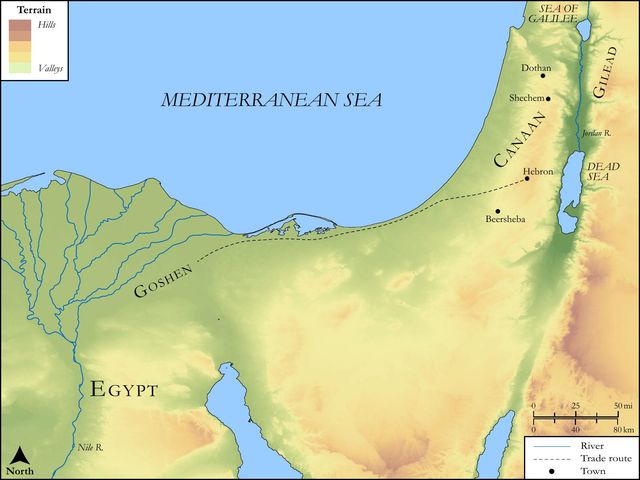
The setting is ancient Egypt during a severe, multi-year famine that gripped the entire region, as foretold by Joseph (Genesis 41:29-31). Jacob's family, dwelling in Canaan, was experiencing the devastating effects of this famine, which would have made their "stuff" (possessions, household goods, tools) meager and difficult to transport. The journey from Canaan to Egypt was long and arduous, making the idea of abandoning non-essential items practical. Furthermore, the concept of a powerful ruler offering land and provision to foreigners was not uncommon among the kings of that day, often as a means of securing loyalty or labor. Joseph's position as vizier, second only to Pharaoh, granted him immense authority to make such a generous offer, backed by the full power of the Egyptian state. The land of Goshen, promised to Jacob's family, was renowned for its fertile pasturelands, ideal for their pastoral lifestyle, further emphasizing the superior nature of the promised provision.
Key Themes
ShowHideThis verse powerfully contributes to several overarching themes within Genesis and the broader biblical narrative. It highlights Divine Providence, demonstrating God's sovereign hand orchestrating seemingly disparate events—from Joseph's betrayal and enslavement to his elevation in Egypt—for the ultimate good of His chosen people, ensuring their survival and growth (Genesis 50:20). The theme of Reconciliation and Forgiveness is prominent, as Joseph, despite past wrongs, extends boundless grace and provision to his brothers. Furthermore, it underscores God's Abundant Provision, moving beyond mere sustenance to offer the "good of all the land," reflecting God's character as a generous giver who provides not just necessities but overflowing blessing. Finally, it introduces the theme of Trust and Detachment from Materialism, urging a release from earthly anxieties in favor of reliance on God's greater promises, a principle echoed throughout scripture, such as in Matthew 6:25-34.
Exposition and Analysis
ShowHideKey Word Analysis
ShowHideThis word denotes "something prepared," encompassing any apparatus, implement, utensil, dress, vessel, or weapon. In this context, it refers broadly to their household goods, tools, and personal belongings. Joseph's instruction implies that these items, which might seem valuable or necessary in their famine-stricken land, are insignificant compared to the abundance awaiting them.
This primitive root means "to cover," and figuratively, "to compassionate," "pity," or "spare." The negative command "regard not" (אַל-תָּחֹסוּ, al-takhosu) thus literally means "do not pity" or "do not spare" your belongings. It's a strong injunction against sentimentality, attachment, or anxiety over their material possessions, urging them to release their grip.
This word signifies "good" in the widest sense, particularly "goodness," "welfare," "beauty," or "the best." When Joseph declares "the good of all the land of Egypt is yours," he is promising not just sustenance, but the choicest, most fertile, and most prosperous parts of the land, ensuring their welfare, comfort, and flourishing.
Verse Breakdown
ShowHide"Also regard not your stuff"
This is a direct, emphatic command from Joseph to his brothers. It calls them to abandon any concern, sentimentality, or attachment to their current possessions in Canaan. The implication is that these items, which they might feel compelled to gather and transport, are of little value compared to the immense provision awaiting them. It's a call to release anxiety and trust in the promise of something far superior.
"for the good of all the land of Egypt is yours"
This clause provides the compelling reason for the preceding command. Joseph assures his family that the very best, the choicest, and most prosperous parts of the entire land of Egypt are now designated for them. This is not merely an offer of survival or basic needs, but a promise of abundant blessing, security, and a life of comfort. It signifies an inheritance of wealth and prosperity far beyond what Jacob's family could have ever imagined or achieved on their own, highlighting the vastness of God's provision through Joseph.
Literary Devices
ShowHideGenesis 45:20 employs several powerful literary devices. Hyperbole is evident in the phrase "the good of all the land of Egypt is yours," which, while literally true in terms of the choicest land, also serves to emphasize the overwhelming generosity and abundance of the provision. This is amplified by the stark Contrast between the "stuff" (meager, famine-stricken possessions) they are instructed to disregard and the immense, fertile "good of all the land of Egypt" that awaits them. This contrast underscores the radical shift in their circumstances, from scarcity to superabundance. Furthermore, the narrative functions as Foreshadowing, as Joseph's act of providing a new, better land for his family prefigures God's greater provision for His people and the ultimate inheritance found in Christ.
Theological and Thematic Connections
ShowHideThis verse powerfully illustrates God's unwavering commitment to His covenant with Abraham, Isaac, and Jacob, preserving their lineage and ensuring their flourishing even amidst famine and family strife. It highlights God's ability to use human actions, even those intended for evil, to accomplish His good and redemptive purposes, providing for His people in ways they could not foresee. The command "regard not your stuff" serves as a timeless theological principle, encouraging believers to prioritize spiritual realities over material attachments, trusting in God's superior provision. The promise of "the good of all the land of Egypt" reflects God's character as a generous provider who offers not just sufficiency, but abundance and blessing to those He calls. Joseph's act of grace towards his brothers, despite their past betrayal, mirrors God's reconciling grace towards humanity, offering restoration and a new inheritance.
Reflection and Application
ShowHideGenesis 45:20 offers profound lessons for contemporary believers, calling us to cultivate a deep trust in God's unfailing provision, particularly when faced with uncertainty or the need to step into the unknown. Just as Joseph's family was urged to release their grip on their old possessions for a greater promise, we are encouraged to detach from materialism, prioritizing God's kingdom and His promises over the accumulation or anxiety of earthly "stuff." This verse reminds us that God's plan often involves not just survival, but abundant blessing, inviting us to gratefully receive the good gifts and opportunities He provides as extensions of His boundless grace. It challenges us to examine what "stuff" we might be clinging to—whether material possessions, old habits, or past grievances—that prevents us from fully embracing the new and greater things God has for us.
Questions for Reflection
ShowHideFAQ
ShowHideWhat is the significance of Joseph telling his brothers to "regard not your stuff"?
ShowHideThe phrase "regard not your stuff" (Hebrew: אַל-תָּחֹסוּ עַל-כְּלֵיכֶם, al-takhosu al-k'leikhem) means "do not pity" or "do not spare" your belongings. It's a powerful command to release sentimentality and attachment to their current possessions. The significance lies in the stark contrast between what they were leaving behind in famine-stricken Canaan and the superior, abundant provision awaiting them in Egypt. Joseph was assuring them that their old belongings were insignificant compared to the "good of all the land of Egypt" that was now theirs. It was a call to trust completely in the new, greater provision and to let go of any anxiety or regret about what they might leave behind, much like Jesus' later teaching not to worry about what we will eat or wear, but to seek first God's kingdom and His righteousness.
Christ-Centered Fulfillment
ShowHideJoseph, as a remarkable type of Christ, provides a powerful foreshadowing of the ultimate provision and eternal inheritance found in Jesus. Just as Joseph called his family to abandon their lesser, temporary possessions for the "good of all the land of Egypt," Christ calls believers to relinquish the fleeting things of this world for an eternal, immeasurable inheritance in His kingdom. Through His atoning sacrifice and resurrection, Jesus provides not merely physical sustenance, but spiritual life, complete reconciliation with God, and an eternal dwelling place far superior to any earthly land or possession. He is the ultimate "good" that is ours, offering an abundance of grace, truth, and eternal life that transcends all earthly concerns, inviting us to trust in His perfect and everlasting provision. Indeed, in Christ, we are given "every spiritual blessing in the heavenly places" (Ephesians 1:3), inheriting "an inheritance that is imperishable, undefiled, and unfading, kept in heaven for you" (1 Peter 1:4). This echoes Joseph's promise, but on an eternal scale, where the "good" is not merely a fertile land, but the very presence and glory of God Himself.