


Acts 20:37
Bible text: King James Version (1769 Blayney text) · Public domain
Bible text: Berean Standard Bible · Public domain
Bible text: American Standard Version (1901) · Public domain
Bible text: World English Bible, Messianic edition · Public domain
Bible text: Geneva Bible (1599) · Public domain
Bible text: Young's Literal Translation · Public domain
- ἱκανὸςhikanosMuchG2425A-NSMAdjective Nominative Singular Masculine
- δὲdethenG1161CONJConjunction
- κλαυθμὸςklauthmosweepingG2805N-NSMNoun Nominative Singular Masculine
- ἐγένετοegenetothere wasG1096V-2ADI-3SVerb 2nd Aorist Middle Deponent Indicative 3rd Singular
- πάντωνpantōnamong allG3956A-GPMAdjective Genitive Plural Masculine
- καὶkaiandG2532CONJConjunction
- ἐπιπεσόντεςepipesonteshaving fallenG1968V-2AAP-NPMVerb 2nd Aorist Active Participle Nominative Plural Masculine
- ἐπὶepiuponG1909PREPPreposition
- τὸνtontheG3588T-ASMDefinite article Accusative Singular Masculine
- τράχηλονtrachēlonneckG5137N-ASMNoun Accusative Singular Masculine
- τοῦtou<the>G3588T-GSMDefinite article Genitive Singular Masculine
- ΠαύλουPaulouof PaulG3972N-GSM-PNoun Genitive Singular Masculine Individual
- κατεφίλουνkatephilounthey were kissingG2705V-IAI-3PVerb Imperfect Active Indicative 3rd Plural
- αὐτόνautonhimG846P-ASMPersonal pronoun Accusative Singular Masculine
English is a literal word-by-word gloss of the Greek, not the KJV's wording. Why?
This is the original text the KJV's translators worked from — each Greek word with its own literal English meaning in this verse, prepared by scholars at Tyndale House, Cambridge. The KJV translates whole sentences, not word by word, so its wording differs: one Greek word can become several English words, and the KJV may choose “charity” where the gloss reads “love”. Both are faithful — they answer different questions. For the KJV's own rendering, switch to the KJV text.
Details
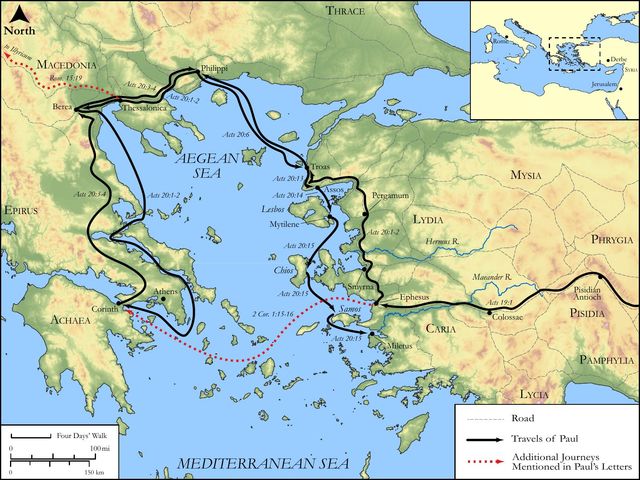
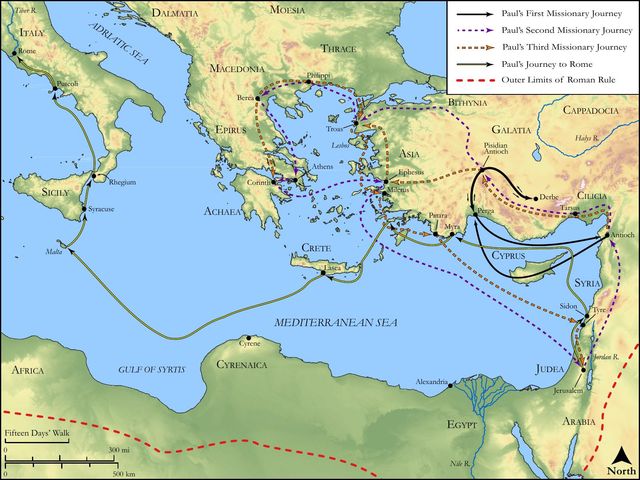
See on the biblical-era maps

Study this verse
Public-domain commentary
Matthew Henry
From his Commentary on the Whole Bible. Henry comments on passages, not single verses — this entry covers Acts 20:36–38. His two-level outline is real structure in the source text, so it is rendered as structure.
After the parting sermon that Paul preached to the elders of Ephesus, which was very affecting, we have here the parting prayer and tears, which were yet more affecting; we can scarcely read the account here given of them, and meditate upon them with dry eyes.
I.They parted with prayer (Act 20:36):
And, when he had thus spoken, he kneeled down, and prayed with them all. And, no doubt, it was a prayer every way suited to the present mournful occasion. He committed them to God in this prayer, prayed that he would not leave them, but continue his presence with them.
1.It was a joint prayer. He not only prayed for them, but prayed with them, prayed with them all; that they might put up the same petitions for themselves and one another that he put up to God for them all, and that they might learn what to ask of God for themselves when he was gone. Public prayers are so far from being intended to supersede our own secret prayers, and make them needless, that they are designed to quicken and encourage them, and to direct us in them. When we are alone we should pray over the prayers that our ministers have put up with us.
2.It was a humble reverent prayer. This was expressed by the posture they used: He kneeled down, and prayed with them, which is the most proper gesture in prayer, and significant both of adoration and of petition, especially petition for the forgiveness of sin. Paul used it much: I bow my knees, Eph 3:14.
3.It was a prayer after sermon; and, we may suppose, he prayed over what he had preached. He had committed the care of the church at Ephesus to those elders, and now he prays that God would enable them faithfully to discharge this great trust reposed in them, and would give them those measures of wisdom and grace which it required; he prayed for the flock, and all that belonged to it, that the great Shepherd of the sheep would take care of them all, and keep them from being a prey to the grievous wolves. Thus he taught these ministers to pray for those they preached to, that they might not labour in vain.
4.It was a parting prayer, which might be likely to leave lasting impressions, as the farewell sermon did. It is good for friends, when they part, to part with prayer, that by praying together just at parting they may be enabled to pray the more feelingly one for another when they are separated, which is one part of our Christian duty, and an improvement of the communion of saints. The Lord watch between us, and watch over us both, when we are absent one from the other, is a good parting prayer (Gen 31:49), as also that our next meeting may be either nearer heaven or in heaven. Paul here followed the example of Christ, who, when he took leave of his disciples, after he had preached to them, prayed with them all, Joh 17:1.
II.They parted with tears, abundance of tears, and most affectionate embraces, Act 20:37, Act 20:38.
1.They all wept sorely. We have reason to think the Paul himself began; though he was determined to go, and saw his call clear to other work, yet he was sorry in his heart to leave them, and many a tear it cost him. He that was so often in tears while he was with them (Act 20:19, Act 20:31), no doubt shed many at parting, so watering what he had sown among them. But the notice is taken of their tears: They all wept sorely; there was not a dry eye among them, and it is probable the affectionate expressions Paul used in prayer set them a-weeping. These were tears of love and mutual endearment, like those of Jonathan and David, when they were forced to part, and wept one with another, until (as if they wept for strife) David exceeded, Sa1 20:41.
2.They fell upon Paul's neck, and kissed him, all, one after another, each bewailing his own loss: "How can I part with this invaluable man, this blessed Paul," says one, "in whom my life is a manner bound up?" - "Farewell, my dear friend," says another, "a thousand thanks to thee, and ten thousand to God for thee, and for all the pains thou hast taken with me for my good." "And must we part?" says another: "must I lose my spiritual father, nurse, and guide?" - "What will become of us now?" says another, "when we shall no more have him to apply to, and receive direction from? What shall I do, if the Lord take away my master from my head? My father, my father, the chariots of Israel, and the horsemen thereof." Note, Those that are most loving are commonly best beloved. Paul, who was a most affectionate friend himself, had friends that were very affectionate to him. These tears at parting with Paul were a grateful return for all the tears he had shed in preaching to them and praying with them. He that watereth shall be watered also himself.
3.That which cut them to the heart thus, and made this place such a Bochim, such a place of weepers, was, that word which Paul spoke, that he was certain they should see his face no more. If he had given them directions to follow him, as he did to those that were his usual companions, or any intimation that he would come hereafter and make them a visit, they could have borne this parting pretty well; but when they are told that they shall see his face no more in this world, that it is a final farewell they are now giving and taking, this makes it a great mourning; it makes farewell just like a funeral, and puts them into this passion of weeping. There were other things for which they sorrowed - that they should lose the benefit of his public performances, and see him no longer presiding in their assemblies, should have none of his personal counsels and comforts; and, we hope, they sorrowed for their own sin, in not profiting more by his labours while they had him among them, and which had provoked God to order his remove. But that which gave the most sensible accent to their grief was that they should see his face no more. When our friends are separated from us by death, this is the consideration with which we raise up our mourning, that we shall see their faces no more; but we complain of this as those that have no hope, for if our friends died in Christ, and we live to him, they are gone to see God's face, to behold his glory, with the reflection of which their faces shine, and we hope to be with them shortly. Though we shall see their faces no more in this world, we hope to see them again in a better world, and to be there together for ever and with the Lord.
III.They accompanied him unto the ship, partly to show their respect for him (they would bring him on his way as far as they could), and partly that they might have a little more of his company and conversation; if it must be the last interview, they will have as much of him as they can, and see the last of him. And we have reason to think that when they came to the water-side, and he was about to go on board, their tears and embraces were repeated; for loth to part bids oft farewell. But this was a comfort to both sides, and soon turned this tide of passion, that the presence of Christ both went with him and staid with them.
Historical interpretation
Historical reception
1 surviving comment on this verse from the historical church.
"And they all wept sore, and fell on Paul's neck and kissed him, sorrowing most of all for the words which he spake, that they should see his face no more." He had said, that "grievous wolves should enter in;" had said, "I am pure from the blood of all men:" and yet the thing that grieved them most of all was this, "that they should see him no more:" since indeed it was this that made the war grievous. "And they fell on his neck," it says, "and wept." He shows their affection also by saying, "Upon his neck," as taking a last and yet a last embrace, such was the love they conceived from his discourse, such the spell of love that bound them. For if we groan when simply parting from each other, although we know that we shall receive one another back again, what a tearing away of themselves it must have been to them!
Continue studying Acts 20:37 across the web’s major study libraries — every link below opens this exact verse, chapter, or book on the destination site.
Read & Compare
 BibleGatewayThis verse in more than 200 translations and 70 languages.
 Bible.comThe YouVersion reader — hundreds of translations, reading plans, and highlights.
 ESV.orgCrossway's official English Standard Version reader.
 NET BibleThe NET translation with 60,000+ translators' notes on every rendering decision.
 STEP BibleTyndale House's free study tool — original text, vocabulary, and scholarly resources.
 BibliaLogos Bible Software's free web reader.
 USCCBThe New American Bible (Revised Edition) with the U.S. bishops' study notes.
Commentaries
 BibleHub CommentariesDozens of classic commentaries on this verse, gathered on one page.
 StudyLightMore than 100 commentary sets — the largest collection on the web.
 BibleRefPlain-English commentary on what this verse means, verse by verse.
 Enduring WordDavid Guzik's free commentary on this chapter, widely used by Bible teachers.
 Bible Study ToolsVerse commentary alongside Greek and Hebrew study aids.
Original Language & Research
- BibleHub InterlinearThe verse word by word — original language, transliteration, and English.
- BibleHub LexiconEvery word's original-language definition and Strong's entry.
 Blue Letter BibleDeep-study tools — Strong's numbers, concordance, and word studies.
 CNTR CollationThe earliest Greek manuscripts of this verse, collated letter by letter.
Sermons, Hymns & Audio


TrulyRandomVerse is not affiliated with these sites and doesn’t control their content. They’re linked because they’re genuinely useful.
Summary
Acts 20:37 vividly portrays the profound emotional bond between the Apostle Paul and the Ephesian elders at their farewell in Miletus. Following Paul's poignant address and prayer, the elders responded with overwhelming grief, weeping intensely as they embraced Paul, falling on his neck and repeatedly kissing him. This deeply moving scene underscores the genuine affection, mutual respect, and shared spiritual journey that characterized their relationship, highlighting the sorrow of their impending separation and Paul's impactful ministry among them.
Context
ShowHideLiterary Context
This verse is the climax of a deeply emotional farewell scene. It immediately follows Paul's final prayer with the Ephesian elders on the beach at Miletus, as recorded in Acts 20:36. Paul had summoned these leaders from Ephesus, delivering a comprehensive and prophetic address that recounted his faithful ministry among them (Acts 20:18-35). A central theme of his speech, and a primary source of the elders' sorrow, was Paul's explicit declaration that they would "see his face no more" (Acts 20:25, Acts 20:38). This verse, therefore, captures the raw, immediate emotional response to the finality of Paul's departure, intensifying the depth of their spiritual and personal bond.
Historical & Cultural Context
In that day, public displays of emotion, including weeping and embracing, were more common and culturally accepted than in many modern Western societies. The act of falling on someone's neck and kissing them was a traditional gesture of deep affection, respect, and often, reunion or poignant farewells. This gesture is seen in other biblical narratives, such as the reunion of Joseph and Benjamin in Genesis 45:14 and the father's embrace of the prodigal son in Luke 15:20. The city of Miletus, a significant port city south of Ephesus, served as a convenient meeting point, allowing Paul to avoid delays in Ephesus while still meeting with the church's leadership. The journey Paul was embarking on to Jerusalem was fraught with danger, a fact he had explicitly stated (Acts 20:22-23), adding to the gravity and sorrow of the farewell.
Key Themes
ShowHideThis passage profoundly contributes to several key themes within the book of Acts and Paul's ministry. Firstly, it highlights the relational nature of Christian ministry and fellowship, demonstrating the deep, personal bonds forged through shared faith and service, extending beyond mere theological agreement to genuine affection. Secondly, it underscores the pain and reality of separation and loss, even within the context of God's sovereign plan. The "wept sore" emphasizes the legitimate human emotion of grief that accompanies significant farewells. Thirdly, the elders' intense reaction serves as a powerful testament to the authenticity and impact of Paul's apostolic ministry. Their sorrow was a direct reflection of his selfless dedication, sacrificial service, and the transformative spiritual guidance he had provided to the Ephesian church, fulfilling his commission to preach the kingdom of God and testify to the gospel of the grace of God.
Exposition and Analysis
ShowHideKey Word Analysis
ShowHideMeaning "lamentation" or "wailing." This term denotes a strong, audible, and often prolonged expression of grief, more intense than mere tears. The addition of "sore" (G2425, hikanós' - meaning "sufficient," "ample," or "greatly") further emphasizes the depth and intensity of their collective sorrow, indicating a profound and unrestrained outpouring of emotion. It was not a quiet shedding of tears but a loud, communal lamentation.
Meaning "to embrace (with affection) or seize (with more or less violence)." This word, combined with the preposition "on" (G1909, epí'), describes the physical action of collapsing or throwing oneself upon someone. In this context, it conveys a spontaneous, passionate, and deeply affectionate embrace, indicative of overwhelming emotion and a desire for close physical contact in a moment of profound farewell.
Meaning "to kiss earnestly." This compound verb is more intense than a simple kiss (phileō). It implies repeated, fervent, or affectionate kissing, conveying a deep sense of devotion, reverence, and profound emotional attachment. It is a gesture of intimate affection and respect, signifying the depth of the bond and the sorrow of parting.
Verse Breakdown
ShowHide"And they all wept sore,"
This clause immediately establishes the collective and profound nature of the elders' grief. The use of "all" (G3956, pâs') indicates a universal emotional response among the gathered leaders, underscoring the widespread impact Paul had on them. Their weeping was not a gentle shedding of tears but an intense, audible lamentation, signaling deep sorrow at the prospect of Paul's permanent departure.
"and fell on Paul's neck,"
This physical action vividly portrays the intensity of their affection and sorrow. It is a gesture of deep embrace, signifying an overwhelming emotional response that compelled them to cling to Paul. This act communicates profound love, respect, and the pain of separation, as if they wished to hold onto him and prevent his departure.
"and kissed him,"
Following the embrace, the act of kissing, specifically using the intensified Greek term kataphiléō, emphasizes the fervent and repeated nature of their expressions of affection. This was a tender, intimate, and heartfelt farewell, sealing their deep bond and conveying their profound devotion to Paul, their spiritual father and mentor.
Literary Devices
ShowHideThe verse is rich in Emotional Imagery, painting a vivid picture of raw human feeling. The description of "wept sore," "fell on Paul's neck," and "kissed him" uses strong verbs and culturally significant gestures to convey an overwhelming sense of grief, affection, and finality. The collective "they all" emphasizes the Universality of this emotional outpouring among the elders, suggesting a shared and deeply felt connection to Paul. The scene employs Pathos to evoke sympathy and understanding for the deep bonds within the early Christian community. The specific actions described are forms of Gesture, which in Israel carried significant symbolic weight, communicating profound respect, love, and sorrow in a way that words alone might not capture. The intensified nature of the weeping ("sore") and kissing (kataphiléō) can also be seen as a form of Hyperbole or Intensification, emphasizing the extreme depth of their emotional response beyond a simple, polite farewell.
Theological and Thematic Connections
ShowHideActs 20:37 powerfully illustrates the profound relational aspect of Christian ministry and community. It transcends mere intellectual agreement, revealing the deep, personal bonds of love, respect, and shared spiritual experience that characterized the early church. The elders' intense sorrow at Paul's departure highlights that true spiritual leadership fosters genuine affection, making farewells painful but also testifying to the authenticity and impact of the ministry. This scene underscores the legitimacy of human emotion, even grief, within the Christian life, demonstrating that faith does not negate feelings but often deepens them in the context of shared spiritual journey and impending loss. Their tears were not a sign of weakness, but a testament to the powerful, life-changing work God had done through Paul in their midst, forging an unbreakable bond in Christ.
Reflection and Application
ShowHideActs 20:37 offers a profound lesson on the nature of Christian relationships and the impact of faithful ministry. It reminds us that the church is not merely an organization, but a family bound by deep spiritual and emotional ties. The genuine affection displayed by the Ephesian elders for Paul challenges us to cultivate authentic, loving relationships within our own Christian communities, moving beyond superficial interactions to truly invest in one another's lives. This passage also serves as a powerful affirmation of the legitimacy of human emotion, particularly grief, in the face of separation. It is natural and healthy to mourn the departure of those we love and respect, especially spiritual mentors who have significantly impacted our faith journey. Furthermore, the elders' deep sorrow is a testament to Paul's impactful and selfless ministry; it prompts us to consider the legacy we are building through our service, aiming to equip others and foster a spiritual bond that endures. Ultimately, this scene calls us to cherish the bonds of Christian fellowship, to honor those who faithfully serve, and to embrace the full spectrum of human emotion as we navigate life's farewells, all within the context of God's overarching plan.
Questions for Reflection
ShowHideFAQ
ShowHideWhy did the Ephesian elders weep "sore" and embrace Paul so intensely?
ShowHideThe elders' intense emotional display was a profound expression of their deep love, respect, and sorrow at Paul's impending departure. Paul had just told them they would "see his face no more" (Acts 20:25, Acts 20:38), signaling a permanent separation. Their weeping "sore" (meaning intensely or greatly) and their actions of falling on his neck and kissing him were culturally appropriate gestures in that day for expressing overwhelming grief and profound affection during a poignant farewell. It reflected the genuine, heartfelt bond forged through years of shared ministry, Paul's tireless spiritual guidance, and the transformative impact he had on their lives and the church in Ephesus.
Is it appropriate for Christians to display such strong emotions like intense weeping and physical embraces?
ShowHideAbsolutely. Acts 20:37, along with other biblical accounts like Jesus weeping at Lazarus's tomb, demonstrates that deep human emotion, including sorrow and physical expressions of affection, are natural and legitimate within the Christian life. Faith does not negate feelings but often deepens them. The scene with Paul and the Ephesian elders highlights the authenticity of their relationships and the profound impact of spiritual bonds. It teaches us that expressing grief, love, and respect in heartfelt ways is a healthy and biblical response to significant life events and relationships.
Christ-Centered Fulfillment
ShowHideWhile Acts 20:37 describes a poignant human farewell, it ultimately points to the greater reality of Christ's perfect love and the eternal bonds forged in Him. The deep affection and sorrow shared between Paul and the elders foreshadow the even deeper, unbreakable union believers have with Christ and with one another through His Spirit. Their temporary separation, though painful, finds its ultimate comfort in the promise of eternal communion with God through Jesus. Christ himself experienced profound human emotions, weeping over Jerusalem (Luke 19:41) and at the tomb of Lazarus (John 11:35), demonstrating that deep feeling is part of our humanity, redeemed and sanctified by His incarnation. The "kissed him" gesture, signifying deep devotion, echoes the ultimate devotion of Christ, who laid down His life for His sheep (John 10:11). Moreover, the pain of this farewell, rooted in the uncertainty of future earthly reunion, is ultimately overcome by the Christian hope in Christ's return, when all believers will be gathered to Him forever, and there will be no more tears or separation (Revelation 21:4). Thus, the emotional depth of Acts 20:37, while humanly moving, serves as a powerful reminder of the eternal, perfect fellowship secured by Christ's sacrifice and the promise of His glorious appearing.