


Acts 20:36
- καὶkaiAndG2532CONJConjunction
- ταῦταtautathese thingsG3778D-APNDemonstrative pronoun Accusative Plural Neuter
- εἰπὼνeipōnhaving saidG2036V-2AAP-NSMVerb 2nd Aorist Active Participle Nominative Singular Masculine
- θεὶςtheishaving bowedG5087V-2AAP-NSMVerb 2nd Aorist Active Participle Nominative Singular Masculine
- τὰtatheG3588T-APNDefinite article Accusative Plural Neuter
- γόναταgonatakneeG1119N-APNNoun Accusative Plural Neuter
- αὐτοῦautouof himG846P-GSMPersonal pronoun Genitive Singular Masculine
- σὺνsunwithG4862PREPPreposition
- πᾶσινpasinallG3956A-DPMAdjective Dative Plural Masculine
- αὐτοῖςautoisthemG846P-DPMPersonal pronoun Dative Plural Masculine
- προσηύξατοprosēuxatohe prayedG4336V-ADI-3SVerb Aorist Middle Deponent Indicative 3rd Singular
English is a literal word-by-word gloss of the Greek, not the KJV's wording. Why?
This is the original text the KJV's translators worked from — each Greek word with its own literal English meaning in this verse, prepared by scholars at Tyndale House, Cambridge. The KJV translates whole sentences, not word by word, so its wording differs: one Greek word can become several English words, and the KJV may choose “charity” where the gloss reads “love”. Both are faithful — they answer different questions. For the KJV's own rendering, switch to the KJV text.
Details
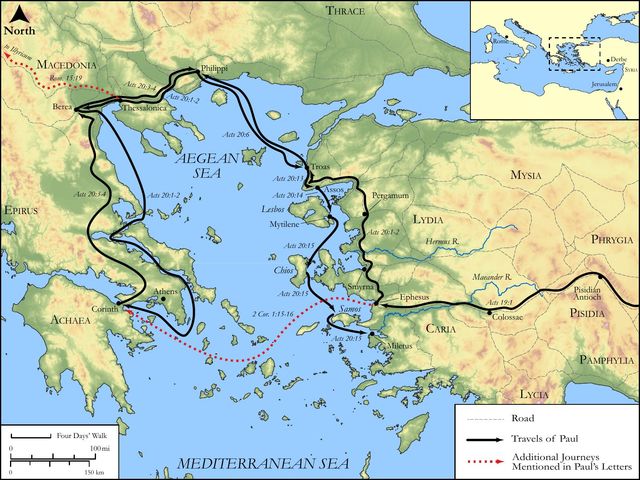
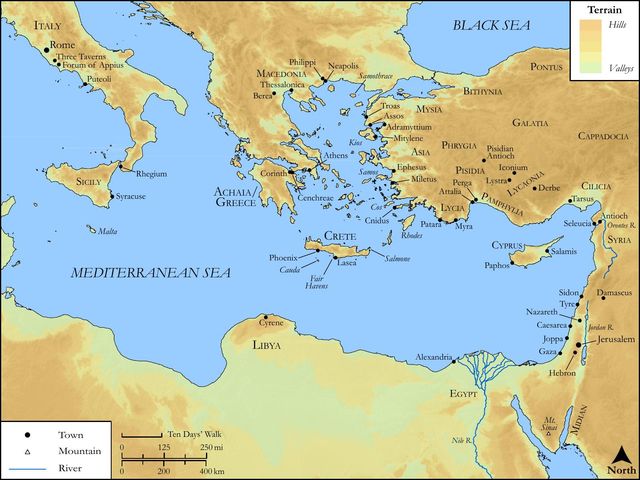
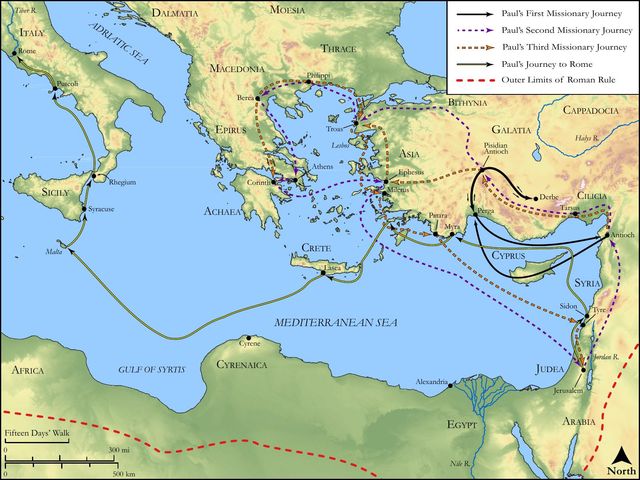
See on the biblical-era map
Study this verse
Public-domain commentary
Matthew Henry
From his Commentary on the Whole Bible. Henry comments on passages, not single verses — this entry covers Acts 20:36–38. His two-level outline is real structure in the source text, so it is rendered as structure.
After the parting sermon that Paul preached to the elders of Ephesus, which was very affecting, we have here the parting prayer and tears, which were yet more affecting; we can scarcely read the account here given of them, and meditate upon them with dry eyes.
I.They parted with prayer (Act 20:36):
And, when he had thus spoken, he kneeled down, and prayed with them all. And, no doubt, it was a prayer every way suited to the present mournful occasion. He committed them to God in this prayer, prayed that he would not leave them, but continue his presence with them.
1.It was a joint prayer. He not only prayed for them, but prayed with them, prayed with them all; that they might put up the same petitions for themselves and one another that he put up to God for them all, and that they might learn what to ask of God for themselves when he was gone. Public prayers are so far from being intended to supersede our own secret prayers, and make them needless, that they are designed to quicken and encourage them, and to direct us in them. When we are alone we should pray over the prayers that our ministers have put up with us.
2.It was a humble reverent prayer. This was expressed by the posture they used: He kneeled down, and prayed with them, which is the most proper gesture in prayer, and significant both of adoration and of petition, especially petition for the forgiveness of sin. Paul used it much: I bow my knees, Eph 3:14.
3.It was a prayer after sermon; and, we may suppose, he prayed over what he had preached. He had committed the care of the church at Ephesus to those elders, and now he prays that God would enable them faithfully to discharge this great trust reposed in them, and would give them those measures of wisdom and grace which it required; he prayed for the flock, and all that belonged to it, that the great Shepherd of the sheep would take care of them all, and keep them from being a prey to the grievous wolves. Thus he taught these ministers to pray for those they preached to, that they might not labour in vain.
4.It was a parting prayer, which might be likely to leave lasting impressions, as the farewell sermon did. It is good for friends, when they part, to part with prayer, that by praying together just at parting they may be enabled to pray the more feelingly one for another when they are separated, which is one part of our Christian duty, and an improvement of the communion of saints. The Lord watch between us, and watch over us both, when we are absent one from the other, is a good parting prayer (Gen 31:49), as also that our next meeting may be either nearer heaven or in heaven. Paul here followed the example of Christ, who, when he took leave of his disciples, after he had preached to them, prayed with them all, Joh 17:1.
II.They parted with tears, abundance of tears, and most affectionate embraces, Act 20:37, Act 20:38.
1.They all wept sorely. We have reason to think the Paul himself began; though he was determined to go, and saw his call clear to other work, yet he was sorry in his heart to leave them, and many a tear it cost him. He that was so often in tears while he was with them (Act 20:19, Act 20:31), no doubt shed many at parting, so watering what he had sown among them. But the notice is taken of their tears: They all wept sorely; there was not a dry eye among them, and it is probable the affectionate expressions Paul used in prayer set them a-weeping. These were tears of love and mutual endearment, like those of Jonathan and David, when they were forced to part, and wept one with another, until (as if they wept for strife) David exceeded, Sa1 20:41.
2.They fell upon Paul's neck, and kissed him, all, one after another, each bewailing his own loss: "How can I part with this invaluable man, this blessed Paul," says one, "in whom my life is a manner bound up?" - "Farewell, my dear friend," says another, "a thousand thanks to thee, and ten thousand to God for thee, and for all the pains thou hast taken with me for my good." "And must we part?" says another: "must I lose my spiritual father, nurse, and guide?" - "What will become of us now?" says another, "when we shall no more have him to apply to, and receive direction from? What shall I do, if the Lord take away my master from my head? My father, my father, the chariots of Israel, and the horsemen thereof." Note, Those that are most loving are commonly best beloved. Paul, who was a most affectionate friend himself, had friends that were very affectionate to him. These tears at parting with Paul were a grateful return for all the tears he had shed in preaching to them and praying with them. He that watereth shall be watered also himself.
3.That which cut them to the heart thus, and made this place such a Bochim, such a place of weepers, was, that word which Paul spoke, that he was certain they should see his face no more. If he had given them directions to follow him, as he did to those that were his usual companions, or any intimation that he would come hereafter and make them a visit, they could have borne this parting pretty well; but when they are told that they shall see his face no more in this world, that it is a final farewell they are now giving and taking, this makes it a great mourning; it makes farewell just like a funeral, and puts them into this passion of weeping. There were other things for which they sorrowed - that they should lose the benefit of his public performances, and see him no longer presiding in their assemblies, should have none of his personal counsels and comforts; and, we hope, they sorrowed for their own sin, in not profiting more by his labours while they had him among them, and which had provoked God to order his remove. But that which gave the most sensible accent to their grief was that they should see his face no more. When our friends are separated from us by death, this is the consideration with which we raise up our mourning, that we shall see their faces no more; but we complain of this as those that have no hope, for if our friends died in Christ, and we live to him, they are gone to see God's face, to behold his glory, with the reflection of which their faces shine, and we hope to be with them shortly. Though we shall see their faces no more in this world, we hope to see them again in a better world, and to be there together for ever and with the Lord.
III.They accompanied him unto the ship, partly to show their respect for him (they would bring him on his way as far as they could), and partly that they might have a little more of his company and conversation; if it must be the last interview, they will have as much of him as they can, and see the last of him. And we have reason to think that when they came to the water-side, and he was about to go on board, their tears and embraces were repeated; for loth to part bids oft farewell. But this was a comfort to both sides, and soon turned this tide of passion, that the presence of Christ both went with him and staid with them.
Historical interpretation
Historical reception
1 surviving comment on this verse from the historical church.
He prayed over them while exhorting them: he shows it both by action - "And when he had thus spoken, he kneeled down, and prayed with them all" - he did not simply pray, but with much feeling: great was the consolation - and by his saying, "I commend you to the Lord."
Continue studying Acts 20:36 across the web’s major study libraries — every link below opens this exact verse, chapter, or book on the destination site.
Read & Compare
 BibleGatewayThis verse in more than 200 translations and 70 languages.
 Bible.comThe YouVersion reader — hundreds of translations, reading plans, and highlights.
 ESV.orgCrossway's official English Standard Version reader.
 NET BibleThe NET translation with 60,000+ translators' notes on every rendering decision.
 STEP BibleTyndale House's free study tool — original text, vocabulary, and scholarly resources.
 BibliaLogos Bible Software's free web reader.
 USCCBThe New American Bible (Revised Edition) with the U.S. bishops' study notes.
Commentaries
 BibleHub CommentariesDozens of classic commentaries on this verse, gathered on one page.
 StudyLightMore than 100 commentary sets — the largest collection on the web.
 BibleRefPlain-English commentary on what this verse means, verse by verse.
 Enduring WordDavid Guzik's free commentary on this chapter, widely used by Bible teachers.
 Bible Study ToolsVerse commentary alongside Greek and Hebrew study aids.
Original Language & Research
- BibleHub InterlinearThe verse word by word — original language, transliteration, and English.
- BibleHub LexiconEvery word's original-language definition and Strong's entry.
 Blue Letter BibleDeep-study tools — Strong's numbers, concordance, and word studies.
 CNTR CollationThe earliest Greek manuscripts of this verse, collated letter by letter.
Sermons, Hymns & Audio


TrulyRandomVerse is not affiliated with these sites and doesn’t control their content. They’re linked because they’re genuinely useful.
Summary
Acts 20:36 marks a profoundly poignant moment in the ministry of the Apostle Paul, capturing his final interaction with the Ephesian elders at Miletus. After delivering a powerful farewell address, Paul demonstrates profound spiritual leadership and humility by kneeling with the entire group to pray, committing them to God's care and embodying his deep affection and reliance on divine strength as he prepares for an uncertain future in Jerusalem. This act underscores the spiritual gravity of their parting and the enduring power of communal prayer.
Context
ShowHideLiterary Context
This verse serves as the emotional climax and conclusion of Paul's farewell address to the Ephesian elders, whom he had summoned to Miletus (Acts 20:17-35). Having recounted his blameless conduct, diligent teaching, and selfless service among them, Paul then warns them of future challenges, including false teachers and internal divisions (Acts 20:29-30). He emphasizes his own example of hard work and generosity, famously quoting Jesus' words, "It is more blessed to give than to receive" (Acts 20:35). The act of kneeling and praying together is the natural, spiritual culmination of this deeply personal and weighty discourse, solidifying their bond and entrusting their future to God as Paul prepares for a journey to Jerusalem where he anticipates suffering (Acts 20:22-23).
Historical & Cultural Context
Paul's third missionary journey was nearing its end, and his decision to meet the Ephesian elders at Miletus, a port city south of Ephesus, was practical, allowing him to avoid delays in Ephesus while still connecting with key leaders. Kneeling was a common posture for prayer in both Jewish and early Christian traditions, signifying reverence, humility, and earnest supplication before God. This gesture by Paul, a revered apostle, with the elders — the spiritual leaders of a significant church — was not merely a formality but a deeply meaningful act of shared dependence and spiritual solidarity, common in moments of significant transition or farewell in the ancient world.
Key Themes
ShowHideActs 20:36 powerfully encapsulates several key themes prevalent throughout Paul's ministry and the book of Acts. It highlights spiritual leadership characterized by humility and service, as Paul, despite his apostolic authority, kneels alongside the elders, modeling dependence on God rather than asserting hierarchical distance. The scene also underscores the power and importance of corporate prayer, demonstrating how communal supplication fosters unity, provides comfort, and serves as a vital means of entrusting individuals and ministries to God's sovereign care, especially in times of uncertainty, as seen in the early church's consistent practice of prayer (e.g., Acts 2:42). Furthermore, the emotional depth of this farewell emphasizes the profound pastoral bond between Paul and the churches he founded, reflecting the apostle's deep affection and commitment to the spiritual well-being of his flock, a theme echoed in his letters (e.g., Philippians 1:3-8).
Exposition and Analysis
ShowHideKey Word Analysis
ShowHideThis verb signifies to "speak or say (by word or writing)." In this context, it refers to the completion of Paul's extensive and emotionally charged farewell address to the Ephesian elders. The use of this verb emphasizes the spoken nature of his final instructions, warnings, and exhortations, which were delivered with authority and deep personal investment.
Derived from the word for "knee," this term, in conjunction with "down," describes the physical posture Paul assumed. It denotes a position of humility, reverence, and earnest supplication. In ancient cultures, kneeling was a common and powerful non-verbal expression of submission, respect, and intense prayer, indicating a profound spiritual posture before God.
This verb means "to place" or "to set," often implying a passive or horizontal posture. When combined with "kneeled" (góny), it forms the phrase "kneeled down," reinforcing the deliberate act of lowering oneself to the ground in a posture of deep reverence and earnest petition. It highlights the intentionality and solemnity of Paul's action.
This verb specifically means "to pray to God," "to supplicate," or "to worship." It indicates a direct and intentional communication with the divine. The use of this term here emphasizes that Paul's act was not merely a general expression of piety but a specific, earnest, and direct appeal to God, made corporately with the elders.
Verse Breakdown
ShowHide"And when he had thus spoken"
This introductory clause sets the scene, indicating that Paul's act of prayer immediately followed the conclusion of his significant and heartfelt farewell discourse to the Ephesian elders. The phrase "thus spoken" refers back to the entirety of his preceding sermon and exhortation in Acts 20:18-35, highlighting the weight and finality of his verbal instructions before turning to spiritual intercession.
"he kneeled down"
This describes Paul's physical posture. His act of kneeling is a powerful visual demonstration of humility, reverence, and earnestness. For an apostle of his stature to kneel among the elders, rather than stand above them, models servant leadership and complete dependence on God, setting a profound example for those he was leaving behind.
"and prayed with them all"
This final clause reveals the communal nature of the prayer. Paul did not pray alone but included "them all"—the entire group of Ephesian elders. This corporate prayer session served to unite them in their shared reliance on God, to commit each other to divine care, and to seek God's blessing and guidance for the future, especially given the impending challenges Paul had just warned them about.
Literary Devices
ShowHideActs 20:36 employs several impactful literary devices. Symbolism is prominent in Paul's act of kneeling; it is not merely a physical posture but a powerful symbol of humility, submission, and profound reverence before God. This gesture underscores Paul's complete dependence on divine power, despite his apostolic authority. The scene is also rich in pathos, evoking deep emotion due to the context of a final, tearful farewell between Paul and the elders. The shared prayer intensifies this emotional connection, providing a sacred space for their grief and their mutual commitment to God. Finally, Paul's actions serve as a powerful example or modeling. He doesn't just teach about prayer or humility; he embodies it in a critical moment, providing a tangible pattern for the elders (and subsequent church leaders) to emulate in their own spiritual leadership and reliance on God.
Theological and Thematic Connections
ShowHideActs 20:36 profoundly illustrates the essential role of prayer in Christian leadership and communal life. Paul, facing an uncertain and perilous future, does not rely on his own strength or past accomplishments but immediately turns to God in humble, corporate prayer. This act underscores the theological truth that effective ministry and spiritual perseverance are rooted in divine dependence. It also highlights the intimate connection between leaders and their flock, demonstrating that true spiritual authority is exercised in shared vulnerability and mutual commitment to God's will. The verse teaches that in moments of transition, challenge, or farewell, the most powerful and unifying act is to collectively seek God's presence and guidance, entrusting all things to His sovereign care and grace.
Reflection and Application
ShowHideActs 20:36 provides a timeless blueprint for spiritual leadership and the practice of faith in community. Paul's example calls believers, especially those in leadership, to cultivate a profound sense of humility and dependence on God, recognizing that true strength comes from surrendering to His will rather than relying on human wisdom or authority. In our own lives, particularly during times of transition, uncertainty, or significant farewells, this verse reminds us to prioritize prayer—not as a last resort, but as our primary and most natural response. Engaging in corporate prayer, whether in families, small groups, or church gatherings, fosters unity, strengthens bonds, and provides a powerful avenue for mutual encouragement and shared reliance on God's grace. It challenges us to entrust our loved ones, our ministries, and our future into God's hands, confident in His faithfulness to sustain and guide.
Questions for Reflection
ShowHideFAQ
ShowHideWhy did Paul kneel to pray with the elders?
ShowHidePaul's act of kneeling was a deeply significant gesture, common in ancient prayer practices, signifying profound humility, reverence, and earnest supplication before God. For Paul, a revered apostle, to kneel alongside the elders, rather than standing above them, powerfully demonstrated his servant leadership and complete dependence on God. It was an act of solidarity, showing that he, too, relied on divine strength and grace, and it underscored the solemnity and sincerity of his final prayer with them, committing them to God's care.
What is the significance of "praying with them all" in this context?
ShowHideThe phrase "prayed with them all" emphasizes the corporate nature of this prayer. It highlights the importance of communal prayer, especially during moments of significant transition or farewell. By praying together, Paul fostered unity among the elders, provided comfort in their shared grief, and collectively entrusted their future, and the future of the Ephesian church, into God's sovereign hands. This act reinforced their spiritual bond and mutual reliance on God's sustaining power as Paul departed for Jerusalem, where he anticipated suffering (see Acts 20:22-23).
Christ-Centered Fulfillment
ShowHideActs 20:36, with Paul's humble posture and earnest prayer with the Ephesian elders, powerfully foreshadows and reflects the ultimate example of Christ-centered leadership and dependence on God. Just as Paul knelt, Jesus Himself often withdrew to pray, demonstrating profound reliance on His Father, most poignantly in the Garden of Gethsemane, where He "fell on His face and prayed" (Matthew 26:39; see also Mark 14:35 and Luke 22:41). Christ, though divine, exemplified perfect humility and submission to the Father's will, even to the point of death on a cross (see Philippians 2:8). Paul's intercessory prayer for the elders also mirrors Christ's ongoing intercession for His disciples and for all believers, as our great High Priest who "always lives to make intercession for them" (Hebrews 7:25; see also Romans 8:34). Thus, Paul's actions in Acts 20:36 are not merely an example of good leadership, but a Christ-like demonstration of self-giving love, humble service, and unwavering dependence on God, all fulfilled perfectly in the person and work of Jesus Christ.