


Acts 21:5
- ὅτεhoteWhenG3753CONJConjunction
- δὲdethenG1161CONJConjunction
- ἐγένετοegenetoit happened thatG1096V-2ADI-3SVerb 2nd Aorist Middle Deponent Indicative 3rd Singular
- ἡμᾶςhēmasweG3165P-1APPersonal pronoun Accusative 1st Plural
- ἐξαρτίσαιexartisai[were] completingG1822V-AANVerb Aorist Active Infinitive
- τὰςtastheG3588T-APFDefinite article Accusative Plural Feminine
- ἡμέραςhēmerasdaysG2250N-APFNoun Accusative Plural Feminine
- ἐξελθόντεςexelthonteshaving set outG1831V-2AAP-NPMVerb 2nd Aorist Active Participle Nominative Plural Masculine
- ἐπορευόμεθαeporeuomethawe were journeyingG4198V-INI-1PVerb Imperfect Middle Or Passive Deponent Indicative 1st Plural
- προπεμπόντωνpropempontōnwhile are accompanyingG4311V-PAP-GPMVerb Present Active Participle Genitive Plural Masculine
- ἡμᾶςhēmasusG3165P-1APPersonal pronoun Accusative 1st Plural
- πάντωνpantōneveryoneG3956A-GPMAdjective Genitive Plural Masculine
- σὺνsunwithG4862PREPPreposition
- γυναιξὶνgunaixinwivesG1135N-DPFNoun Dative Plural Feminine
- καὶkaiandG2532CONJConjunction
- τέκνοιςteknoischildrenG5043N-DPNNoun Dative Plural Neuter
- ἕωςhe'ōsas far asG2193PREPPreposition
- ἔξωexōoutsideG1854PREPPreposition
- τῆςtēstheG3588T-GSFDefinite article Genitive Singular Feminine
- πόλεωςpoleōscityG4172N-GSFNoun Genitive Singular Feminine
- καὶkaiAndG2532CONJConjunction
- θέντεςthenteshaving bowedG5087V-2AAP-NPMVerb 2nd Aorist Active Participle Nominative Plural Masculine
- τὰtatheG3588T-APNDefinite article Accusative Plural Neuter
- γόναταgonatakneesG1119N-APNNoun Accusative Plural Neuter
- ἐπὶepionG1909PREPPreposition
- τὸνtontheG3588T-ASMDefinite article Accusative Singular Masculine
- αἰγιαλὸνaigialonshoreG123N-ASMNoun Accusative Singular Masculine
- προσευξάμενοιproseuxamenoihaving prayedG4336V-ADP-NPMVerb Aorist Middle Deponent Participle Nominative Plural Masculine
English is a literal word-by-word gloss of the Greek, not the KJV's wording. Why?
This is the original text the KJV's translators worked from — each Greek word with its own literal English meaning in this verse, prepared by scholars at Tyndale House, Cambridge. The KJV translates whole sentences, not word by word, so its wording differs: one Greek word can become several English words, and the KJV may choose “charity” where the gloss reads “love”. Both are faithful — they answer different questions. For the KJV's own rendering, switch to the KJV text.
Details
See on the biblical-era map
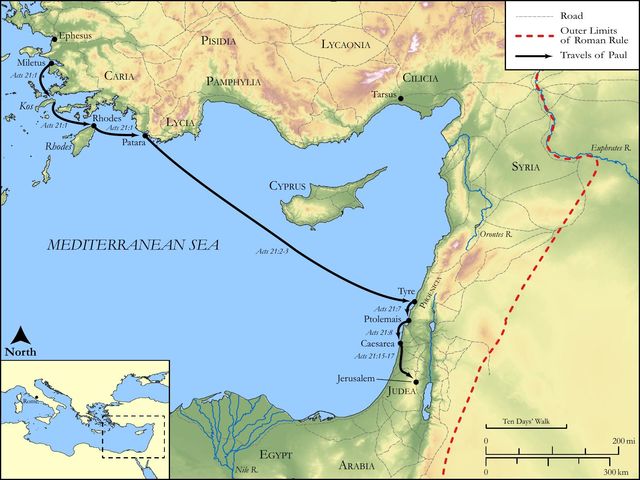
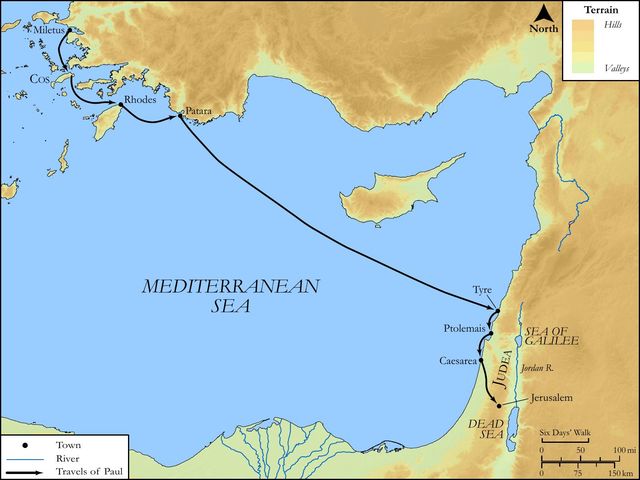
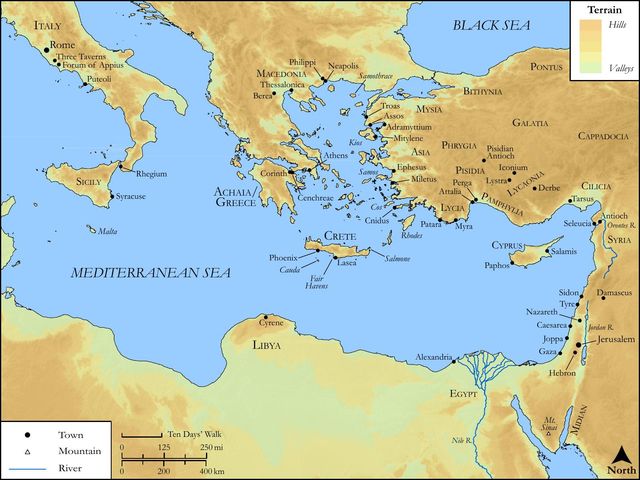
Study this verse
Public-domain commentary
Matthew Henry
From his Commentary on the Whole Bible. Henry comments on passages, not single verses — this entry covers Acts 21:1–7. His three-level outline is real structure in the source text, so it is rendered as structure.
We may observe here,
I.How much ado Paul had to get clear from Ephesus, intimated in the first words of the chapter, after we had gotten from them, that is, were drawn from them as by violence. It was a force put upon both sides; Paul was loth to leave them, and they were loth to part with him, and yet there was no remedy, but so it must be. When good people are taken away by death, they are, as it were, gotten from their friends here below, who struggled hard to have detained them if possible.
II.What a prosperous voyage they had thence.
Without any difficulty, they came with a straight course, by direct sailing, to Coos, a famous Grecian island, - the next day to Rhodes, talked of for the Colossus there, - thence to Patara, a famous port, the metropolis of Lycia (Act 21:1); here they very happily found a ship sailing over into Phenicia, the very course they were steering, Act 21:2. Providence must be acknowledged when things happen thus opportunely, and we are favoured by some little circumstances that contribute to the expediting of our affairs; and we must say, It is God that maketh our way perfect. This ship that was bound for Phenicia (that is, Tyre) they took the convenience of, went on board, and set sail for Tyre. In this voyage they discovered Cyprus, the island that Barnabas was of, and which he took care of, and therefore Paul did not visit it, but we left it on the left hand (Act 21:3), sailed upon the coast of Syria, and at length landed at Tyre, that celebrated mart of the nations, so it had been, but was now reduced; yet something of a trade it had still, for there the ship was to unlade her burden, and did so.
III.The halt that Paul made at Tyre; when he had arrived there, he was upon the coast of the land of Israel, and found now that he could compass the remainder of his journey within the time he had fixed.
1.At Tyre he found disciples, some that had embraced the gospel, and professed the Christian faith. Observe, Wherever Paul came, he enquired what disciples were there, found them out, and associated with them; for we know what is the usage with birds of a feather. When Christ was upon earth, though he went sometimes into the coast of Tyre, yet he never went thither to preach the gospel there; nor did he think fit to afford to Tyre and Sidon the advantages which Chorazin and Bethsaida had, though he knew that if they had had them they would have made a better improvement of them, Luk 10:13, Luk 10:14. But, after the enlarging of the gospel-commission, Christ was preached at Tyre, and had disciples there; and to this, some think, that prophecy concerning Tyre had reference (Isa 23:18), Her merchandise and her hire shall be holiness to the Lord.
2.Paul, finding those disciples at Tyre, tarried there seven days, they urging him to stay with them as long as he could. He staid seven days at Troas (Act 20:6), and here so many days at Tyre, that he might be sure to spend one Lord's day with them, and so might have an opportunity of preaching publicly among them; for it is the desire of good men to do good wherever they come, and where we find disciples we may either benefit them or be benefited by them.
3.The disciples at Tyre were endowed with such gifts that they could by the Spirit foretel the troubles Paul would meet with at Jerusalem; for the Holy Ghost witnessed it in every city, Act 20:23. Being a thing that would be so much talked of when it came to pass, God saw fit to have it much prophesied of before, that people's faith, instead of being offended, might be confirmed. And withal they were endowed with such graces that foreseeing his troubles, out of love to him and concern for the church, especially the churches of the Gentiles, that could ill spare him, they begged of him that he would not go up to Jerusalem, for they hoped the decree was conditional: If he go up, he will come into trouble there; as the prediction to David that the men of Keilah will deliver him up (that is, if he venture himself with them); and therefore they said to him, by the Spirit, that he should not go up, because they concluded it would be most for the glory of God that he should continue at liberty; and it was not at all their fault to think so, and consequently to dissuade him; but it was their mistake, for his trial would be for the glory of God and the furtherance of the gospel, and he knew it; and the importunity that was used with him, to dissuade him from it, renders his pious and truly heroic resolution the more illustrious.
4.The disciples of Tyre, though they were none of Paul's converts, yet showed a very great respect to Paul, whose usefulness in the church they had heard so much of when he departed from Tyre. Though they had had but seven days' acquaintance with him, yet, as if he had been some great man, they all came together, with their wives and children, solemnly to take leave of him, to beg his blessing, and to bring him as far on his way as the sea would permit them. Note,
(1.)We should pay respect, not only to our own ministers, that are over us in the Lord, and admonish us, and, for their work's sake among us, esteem them highly in love, but we must, as there is occasion, testify our love and respect to all the faithful ministers of Christ, both for his sake whose ministers they are, and for their work's sake among others.
(2.)We must, in a particular manner, honour those whom God hath singularly honoured, by making them eminently useful in their generation.
(3.)It is good to train up children in a respect to good people and good ministers. This was particularly remarkable at Tyre, which we have not met with any where else, that they brought their wives and children to attend Paul, to do him the more honour and to receive benefit by his instructions and prayers; and as angry notice was taken of the children of the idolaters of Bethel, that mocked a prophet, so, no doubt, gracious notice was taken of the children of the disciples at Tyre, that honoured an apostle, as Christ accepted the hosannas of the little children.
(4.)We should be good husbands of our opportunities, and make the utmost we can of them for the good of our souls. They brought Paul on his way, that they might have so much the more of his company and his prayers. Some refer us to Psa 45:12, as a prediction of this, The daughter of Tyre shall be there with a gift; for it is probable that they made some presents to Paul at parting, as usual to our friends that are going to sea, Act 28:10.
5.They parted with prayer, as Paul and the Ephesians elders had done, ch. 20:36. Thus Paul has taught us by example, as well as rule, to pray always, to pray without ceasing. We kneeled down on the shore and prayed. Paul prayed for himself, prayed for them, prayed for all the churches; as he was much in prayer so he was mighty in prayer. They prayed upon the shore, that their last farewell might be sanctified and sweetened with prayer. Those that are going to sea should, when they quit the shore, commit themselves to God by prayer, and put themselves under his protection, as those that hope, even when they leave the terra firma, to find firm footing for their faith in the providence and promise of God. They kneeled down on the shore, though we may suppose it either stony or dirty, and there prayed. Paul would that men should pray every where, and so he did himself; and, where he lifted up his prayer, he bowed his knees. Mr. George Herbert says, Kneeling never spoiled silk stockings.
6.They parted at last (Act 21:6): When we had taken our leave one of another, with the most affectionate embraces and expressions of love and grief, we took ship to be gone, and they returned home again, each complaining that this is a parting world. Observe how they disposed of themselves: "We, that had a journey before us, took ship, thankful that we had a ship to carry us; and those, who had no occasions to call them abroad returned home again, thankful that they had a home to go to." Rejoice Zebulun in thy going out, and Issachar in thy tents. Paul left his blessing behind him with those that returned home, and those that staid sent their prayers after those that went to sea.
IV.Their arrival at Ptolemais, which was not far from Tyre (Act 21:27):
We came to Ptolemais, which some think is the same place with Accho, which we find in the tribe of Asher, Jdg 1:31. Paul begged leave to go ashore there, to salute the brethren, to enquire of their state, and to testify his good will to them; though he could not stay long with them, yet he would not pass by them without paying his respects to them, and he abode with them one day, perhaps it was a Lord's day; better a short stay than no visit.
Historical interpretation
Three Centuries of Reception
2 surviving comments on this verse. Each one is dated, so this reads as a timeline rather than a list.
Select a marker to jump to its quote. Markers stagger vertically where authors wrote within a few decades of each other.
And there again they part from each other with prayer. "And when we had accomplished those days, we departed, and went our way; and they all brought us on our way, with wives and children, till we were out of the city: and we kneeled down on the shore, and prayed. And when we had taken our leave one of another, we took ship; and they returned home again." See how great was the entreaty. And again they part with prayer. "But after we had accomplished the days," i.e. had fulfilled the appointed days, "we separated, and went on our way: they all bringing us on our way with wives and children." Also in Ptolemais they stay one day, but in Caesarea many.
We set out, being escorted by wives and children, etc. The prophecy which sings of the Church is fulfilled: The daughters of Tyre will seek your favor with gifts, the rich among the people (Psalm XLIV), and the rest, up to the end of the Psalm. For no city received, held, or dismissed the Apostle with greater sweetness. Indeed, today the place in the sands where they prayed together is shown.
Continue studying Acts 21:5 across the web’s major study libraries — every link below opens this exact verse, chapter, or book on the destination site.
Read & Compare
 BibleGatewayThis verse in more than 200 translations and 70 languages.
 Bible.comThe YouVersion reader — hundreds of translations, reading plans, and highlights.
 ESV.orgCrossway's official English Standard Version reader.
 NET BibleThe NET translation with 60,000+ translators' notes on every rendering decision.
 STEP BibleTyndale House's free study tool — original text, vocabulary, and scholarly resources.
 BibliaLogos Bible Software's free web reader.
 USCCBThe New American Bible (Revised Edition) with the U.S. bishops' study notes.
Commentaries
 BibleHub CommentariesDozens of classic commentaries on this verse, gathered on one page.
 StudyLightMore than 100 commentary sets — the largest collection on the web.
 BibleRefPlain-English commentary on what this verse means, verse by verse.
 Enduring WordDavid Guzik's free commentary on this chapter, widely used by Bible teachers.
 Bible Study ToolsVerse commentary alongside Greek and Hebrew study aids.
Original Language & Research
- BibleHub InterlinearThe verse word by word — original language, transliteration, and English.
- BibleHub LexiconEvery word's original-language definition and Strong's entry.
 Blue Letter BibleDeep-study tools — Strong's numbers, concordance, and word studies.
 CNTR CollationThe earliest Greek manuscripts of this verse, collated letter by letter.
Sermons, Hymns & Audio


TrulyRandomVerse is not affiliated with these sites and doesn’t control their content. They’re linked because they’re genuinely useful.
Summary
Acts 21:5 vividly portrays a poignant moment in Paul's third missionary journey as he departs from Tyre, having completed his stay. This verse captures the deep bond of fellowship between Paul and the local believers, who, along with their families, accompanied him out of the city. The scene culminates in a powerful, communal act of prayer on the seashore, underscoring the early church's reliance on divine guidance and spiritual unity in the face of an uncertain future.
Context
ShowHideLiterary Context
This verse is situated within the latter part of Paul's third missionary journey, specifically detailing his determined return to Jerusalem. The preceding verses (Acts 21:1-4) describe Paul's stop in Tyre, where he stayed for seven days with disciples. Crucially, Acts 21:4 notes that these disciples, "through the Spirit, told Paul not to go on to Jerusalem." Acts 21:5, therefore, marks the moment of departure from Tyre, following this Spirit-inspired warning, highlighting Paul's unwavering resolve to continue his journey despite the prophetic counsel. The subsequent verses (Acts 21:6-16) will detail further stops and warnings, culminating in Paul's arrival in Jerusalem and the trials that await him. The narrative flow emphasizes Paul's steadfast commitment to his mission, even when it leads to hardship.
Historical & Cultural Context
Paul's journey to Jerusalem was not merely a return trip but a significant pilgrimage, likely coinciding with a Jewish feast, possibly Pentecost, as hinted at in Acts 20:16. Tyre, a prominent Phoenician port city, had a diverse population, including a Christian community that had likely grown since the initial spread of the gospel (Acts 11:19). The act of "bringing someone on their way" (propempein) was a common courtesy and expression of honor and support in the ancient world, often involving accompanying travelers for a distance. Kneeling for prayer was a widely recognized posture of humility, reverence, and earnest supplication in both Jewish and early Christian traditions, signifying deep submission to God's will and fervent intercession. The public nature of this farewell and prayer on the shore would have been a visible testimony to their faith and unity.
Key Themes
ShowHideActs 21:5 significantly contributes to several overarching themes within the book of Acts and Paul's ministry. Firstly, it powerfully illustrates the theme of Christian Community and Fellowship. The presence of "all" the disciples, including "wives and children," underscores the holistic and inclusive nature of the early church, where mutual support and deep affection transcended individual roles. This communal solidarity is a recurring motif, as seen in the early Jerusalem church's shared life (Acts 2:42-47) and Paul's farewells to other communities (Acts 20:36-38). Secondly, the verse highlights the Primacy and Power of Prayer. The communal act of kneeling and praying on the shore before a challenging journey emphasizes absolute reliance on God's sovereignty and provision, a pattern consistently demonstrated by Paul (Acts 16:25) and the early church (Acts 4:23-31). Lastly, it subtly reinforces Paul's Unwavering Commitment to His Mission, even in the face of prophetic warnings and emotional farewells. Despite the Spirit's counsel not to go to Jerusalem, Paul's resolve, rooted in obedience to his divine calling, remains steadfast, foreshadowing the trials he is prepared to endure for the sake of the gospel (Acts 20:22-24).
Exposition and Analysis
ShowHideKey Word Analysis
ShowHideThis word (G1822) means "to finish out (time)" or "to equip fully." In this context, it refers to the completion of the "days" Paul and his companions spent in Tyre. It implies a sense of fulfillment or bringing to an end a defined period, suggesting that their stay had served its purpose and was now complete, allowing for the next stage of their journey.
The KJV translates the combination of G5087 (títhēmi, "to place" or "to set") and G1119 (góny, "knee") as "kneeled down." While títhēmi broadly means to place or put, its usage here with "knee" specifically denotes the physical act of bending the knees to the ground. This posture is universally recognized as one of humility, reverence, and intense supplication in prayer, indicating a deep spiritual earnestness and submission to God.
This word (G4336) specifically means "to pray to God," emphasizing an act of supplication or worship directed towards the divine. It signifies a conscious and intentional communication with God, seeking His presence, guidance, or intervention. The use of this term here highlights the spiritual nature of the farewell and the communal reliance on God for the journey ahead.
Verse Breakdown
ShowHide"And when we had accomplished those days,"
This clause establishes the temporal setting, indicating the completion of the seven-day stay in Tyre mentioned in Acts 21:4. The term "accomplished" (exartízō) suggests a purposeful completion of their time there, perhaps implying that all necessary fellowship and spiritual exchange had taken place.
"we departed and went our way;"
This signifies the physical act of leaving Tyre, continuing Paul's journey towards Jerusalem. It marks a decisive transition from their period of rest and fellowship to the resumption of travel, despite the warnings they had received.
"and they all brought us on our way, with wives and children, till [we were] out of the city:"
This is a powerful depiction of communal solidarity and affection. The entire Christian community, including women and children, accompanied Paul and his companions to the city's outskirts. This act of "bringing on their way" (propempein) was a customary gesture of honor, support, and farewell, emphasizing the deep bond and mutual care within the early church. It underscores that the church was not just a gathering of men but a family unit.
"and we kneeled down on the shore, and prayed."
This climactic action highlights the spiritual depth of the farewell. The choice of the shore, a liminal space between land and sea, adds symbolic weight to the moment of transition. The collective act of kneeling signifies humility, reverence, and earnest supplication before God. This communal prayer was a solemn moment of seeking divine protection, guidance, and strength for Paul's challenging journey, demonstrating their profound reliance on God in the face of uncertainty and impending hardship.
Literary Devices
ShowHideActs 21:5 employs several literary devices to convey its profound message. The scene is imbued with Pathos, evoking a strong sense of emotion through the tender farewell and the unified act of prayer. The imagery of "wives and children" accompanying Paul underscores the deep affection and human connection, making the departure particularly poignant. Symbolism is evident in the choice of location: the shore serves as a liminal space, a boundary between the known and the unknown, land and sea, symbolizing transition, departure, and the crossing into a new, potentially perilous phase of Paul's journey. The act of kneeling itself is highly symbolic, representing humility, reverence, and profound submission to God's will, especially in a moment of significant decision and impending trial. The collective nature of the action ("they all brought us... we kneeled down... and prayed") highlights Unity and Solidarity within the Christian community, demonstrating a shared faith and mutual support. Finally, the solemnity and earnestness of this farewell, following the Spirit's warnings in Acts 21:4, subtly employs Foreshadowing, hinting at the difficulties and suffering that await Paul in Jerusalem, lending a somber yet resolute tone to the narrative.
Theological and Thematic Connections
ShowHideActs 21:5 offers a rich theological tapestry, weaving together themes of Christian community, the power of prayer, and unwavering commitment to God's calling. The communal farewell, involving entire families, powerfully illustrates the deep koinonia (fellowship) that characterized the early church, where believers were bound by more than just shared beliefs—they were a spiritual family, supporting one another through life's transitions and trials. This scene underscores that faith is not a solitary journey but a communal endeavor, strengthened by mutual encouragement and shared spiritual disciplines. The act of communal prayer, particularly in a moment of significant departure and prophetic warning, highlights the church's absolute reliance on God's sovereignty and grace. It is a testament to the belief that divine guidance and strength are essential for navigating life's difficult paths. Paul's resolute continuation of his journey, despite the emotional farewell and the Spirit-inspired warnings, further emphasizes the theme of obedience to divine calling, even when it leads to suffering, mirroring the steadfastness required of all who follow Christ.
Reflection and Application
ShowHideActs 21:5 provides a poignant and practical blueprint for contemporary believers navigating life's transitions and challenges. The scene of the Tyrian believers accompanying Paul, including their wives and children, serves as a powerful reminder of the indispensable value of Christian community. In a world that often promotes individualism, this passage calls us to actively cultivate deep, supportive relationships within our spiritual families. We are reminded that we are not meant to walk alone, especially when facing difficult decisions or embarking on new phases of life. Just as the Tyrian church offered their presence and prayers, we too are called to be present for one another, offering tangible support and spiritual encouragement. The communal act of kneeling in prayer on the shore underscores the absolute necessity of prioritizing prayer, particularly in moments of uncertainty or before significant undertakings. It teaches us to collectively and individually bring our plans, fears, and hopes before God, acknowledging His sovereignty and seeking His wisdom and strength. This deep reliance on God through prayer fosters peace and confidence, enabling us to move forward with faith, even when the path ahead is unclear or fraught with warnings. Ultimately, Paul's unwavering commitment, despite the emotional cost and prophetic warnings, challenges us to reflect on our own dedication to God's calling in our lives. It encourages perseverance, reminding us that true faithfulness often requires courage to step into the unknown, trusting that God's plan, though it may involve hardship, is always for our good and His glory.
Questions for Reflection
ShowHideFAQ
ShowHideWhy did the entire community, including women and children, accompany Paul out of the city?
ShowHideThe act of "bringing someone on their way" (propempein in Greek) was a deeply ingrained cultural practice in the ancient world, signifying honor, respect, and heartfelt support for a departing traveler. The inclusion of "wives and children" underscores the holistic nature of the early Christian community in Tyre. It demonstrates that the fellowship extended beyond just the men or leaders; it encompassed entire families, highlighting their unified affection and solidarity with Paul. This communal farewell was a powerful visual testimony to their deep bond and their shared commitment to the gospel, emphasizing that the church functioned as a spiritual family, united in purpose and love.
What is the significance of kneeling on the shore to pray?
ShowHideKneeling is a universal posture of humility, reverence, and earnest supplication in prayer, signifying deep submission to God's will and fervent intercession. The choice of the "shore" (aigialós) adds symbolic depth to the moment. As a liminal space between land and sea, it represents a point of transition and departure, a boundary between the known and the unknown. Praying at such a threshold underscores the believers' and Paul's reliance on God as they moved into an uncertain future. It was a solemn, public act of seeking divine guidance, protection, and strength before embarking on a challenging and potentially dangerous leg of Paul's journey to Jerusalem, as foreshadowed by the warnings in Acts 21:4. This collective prayer also emphasizes the communal aspect of their faith and their shared dependence on God.
Christ-Centered Fulfillment
ShowHideActs 21:5, while detailing a poignant human farewell, finds its deepest resonance in the person and work of Jesus Christ. The communal support and fervent prayer witnessed here mirror the ultimate example set by Christ Himself. Just as the Tyrian believers accompanied Paul, Christ continually walks with His disciples, offering an abiding presence and interceding for them before the Father (Romans 8:34). The act of kneeling in prayer, a posture of humility and submission, profoundly echoes Jesus' own life of prayer, particularly His agonizing prayer in Gethsemane (Luke 22:41-44), where He submitted His will to the Father's, even unto suffering and death. Paul's unwavering commitment to his mission, despite the warnings and emotional goodbyes, reflects the perfect obedience of Christ, who "humbled himself by becoming obedient to the point of death, even death on a cross" (Philippians 2:8). The solidarity of the church in Tyre, gathering as one family, also foreshadows the eschatological reality of the church as the unified body of Christ, bound together by the Spirit, reflecting the love and unity found within the Godhead (Ephesians 4:1-3). Thus, this scene is not merely a historical account but a living testament to the Christ-like qualities of community, prayerful dependence, and steadfast obedience that define the life of faith.