


Acts 15:3
- ΟἱHoiTheyG3588T-NPMDefinite article Nominative Plural Masculine
- μὲνmenindeedG3303PRTParticle or Disjunctive
- οὖνounthereforeG3767CONJConjunction
- προπεμφθέντεςpropemphthenteshaving been sent forwardG4311V-APP-NPMVerb Aorist Passive Participle Nominative Plural Masculine
- ὑπὸhupobyG5259PREPPreposition
- τῆςtēstheG3588T-GSFDefinite article Genitive Singular Feminine
- ἐκκλησίαςekklēsiaschurchG1577N-GSFNoun Genitive Singular Feminine
- διήρχοντοdiērchontowere passing throughG1330V-INI-3PVerb Imperfect Middle Or Passive Deponent Indicative 3rd Plural
- τήνtēn<the>G3588T-ASFDefinite article Accusative Singular Feminine
- ΦοινίκηνPhoinikēnPhoeniciaG5403N-ASF-LNoun Accusative Singular Feminine Location
- καὶkaiandG2532CONJConjunction
- ΣαμάρειανSamareianSamariaG4540N-ASF-LNoun Accusative Singular Feminine Location
- ἐκδιηγούμενοιekdiēgoumenoirelating in detailG1555V-PNP-NPMVerb Present Middle Or Passive Deponent Participle Nominative Plural Masculine
- τὴνtēntheG3588T-ASFDefinite article Accusative Singular Feminine
- ἐπιστροφὴνepistrophēnconversionG1995N-ASFNoun Accusative Singular Feminine
- τῶνtōnof theG3588T-GPNDefinite article Genitive Plural Neuter
- ἐθνῶνethnōnGentilesG1484N-GPNNoun Genitive Plural Neuter
- καὶkaiandG2532CONJConjunction
- ἐποίουνepoiounthey were bringingG4160V-IAI-3PVerb Imperfect Active Indicative 3rd Plural
- χαρὰνcharanjoyG5479N-ASFNoun Accusative Singular Feminine
- μεγάληνmegalēngreatG3173A-ASFAdjective Accusative Singular Feminine
- πᾶσινpasinto allG3956A-DPMAdjective Dative Plural Masculine
- τοῖςtoistheG3588T-DPMDefinite article Dative Plural Masculine
- ἀδελφοῖςadelphoisbrothersG80N-DPMNoun Dative Plural Masculine
English is a literal word-by-word gloss of the Greek, not the KJV's wording. Why?
This is the original text the KJV's translators worked from — each Greek word with its own literal English meaning in this verse, prepared by scholars at Tyndale House, Cambridge. The KJV translates whole sentences, not word by word, so its wording differs: one Greek word can become several English words, and the KJV may choose “charity” where the gloss reads “love”. Both are faithful — they answer different questions. For the KJV's own rendering, switch to the KJV text.
Details
See on the biblical-era map
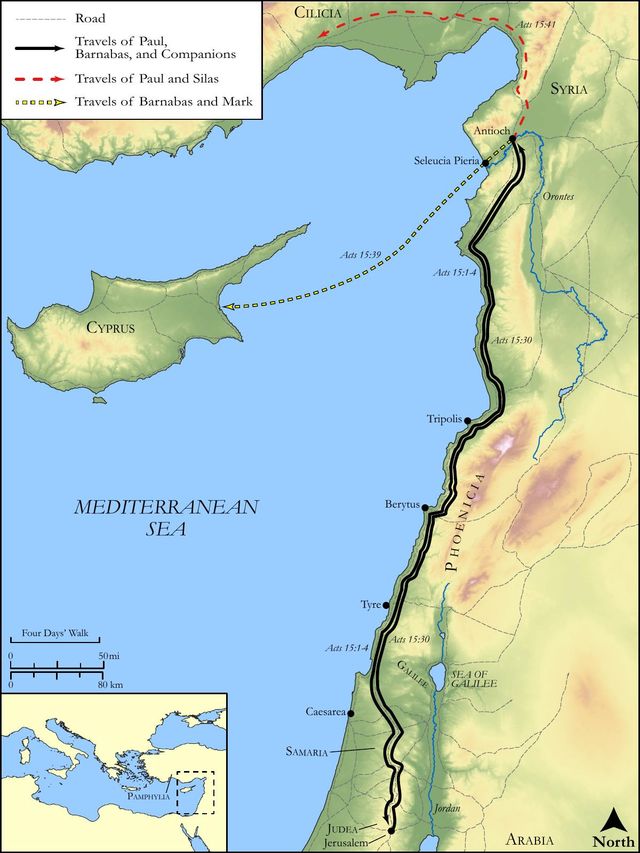
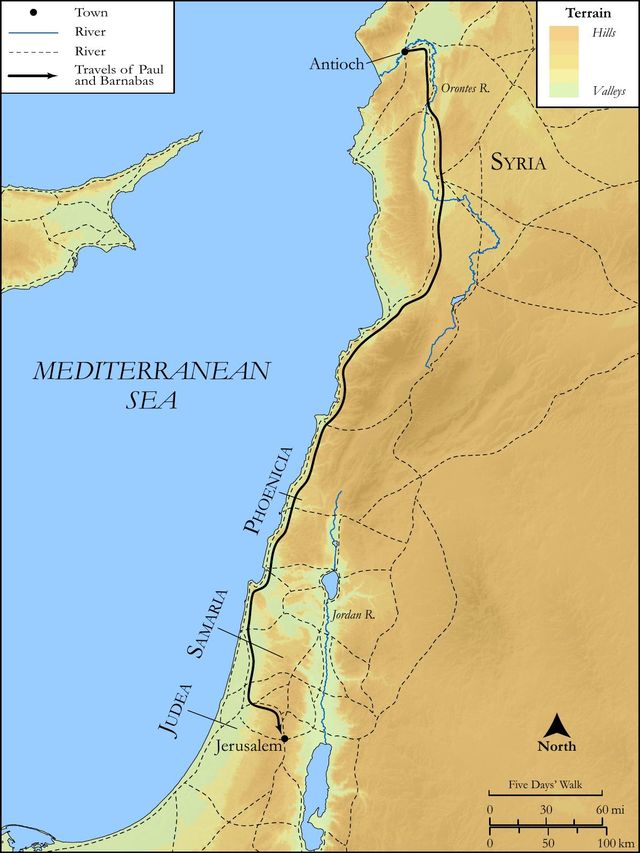
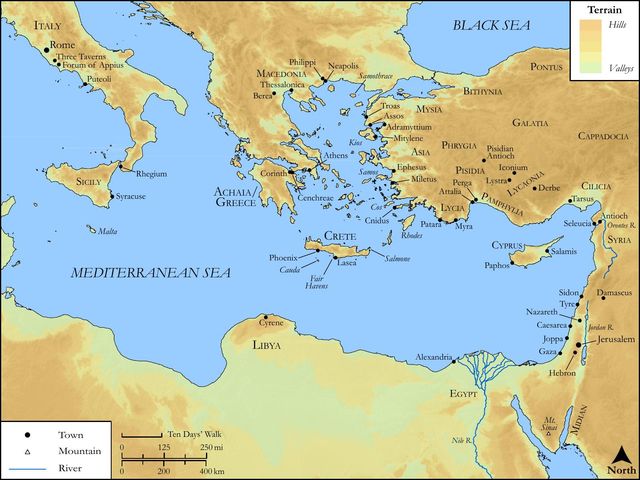
Study this verse
Public-domain commentary
Matthew Henry
From his Commentary on the Whole Bible. Henry comments on passages, not single verses — this entry covers Acts 15:1–5. His three-level outline is real structure in the source text, so it is rendered as structure.
Even when things go on very smoothly and pleasantly in a state or in a church, it is folly to be secure, and to think the mountain stands strong and cannot be moved; some uneasiness or other will arise, which is not foreseen, cannot be prevented, but must be prepared for. If ever there was a heaven upon earth, surely it was in the church at Antioch at this time, when there were so many excellent ministers there, and blessed Paul among them, building up that church in her most holy faith. But here we have their peace disturbed, and differences arising. Here is,
I.A new doctrine started among them, which occasioned this division, obliging the Gentile converts to submit to circumcision and the ceremonial law, Act 15:1. Many that had been proselytes to the Jewish religion became Christians; and they would have such as were proselyted to the Christian religion to become Jews.
1.The persons that urged this were certain men who came down from Judea; some think such as had been of the Pharisees (Act 15:5), or perhaps of those priests who were obedient to the faith, Act 6:7. They came from Judea, pretending perhaps to be sent by the apostles at Jerusalem, at least to be countenanced by them. Having a design to spread their notions, they came to Antioch, because that was the head-quarters of those that preached to the Gentiles, and the rendezvous of the Gentile converts; and, if they could but make an interest there, this leaven would soon be diffused to all the churches of the Gentiles. They insinuated themselves into an acquaintance with the brethren, pretended to be very glad that they had embraced the Christian faith, and congratulated them on their conversion; but tell them that yet one thing they lack, they must be circumcised. Note, Those that are ever so well taught have need to stand upon their guard that they be not untaught again, or ill taught.
2.The position they laid down, the thesis they gave, was this, that except the Gentiles who turned Christians were circumcised after the manner of Moses, and thereby bound themselves to all the observances of the ceremonial law, they could not be saved. As to this,
(1.)Many of the Jews who embraced the faith of Christ, yet continued very zealous for the law, Act 21:20. They knew it was from God and its authority was sacred, valued it for its antiquity, had been bred up in the observance of it, and it is probable had been often devoutly affected in their attendance on these observances; they therefore kept them up after they were by baptism admitted into the Christian church, kept up the distinction of meats, and used the ceremonial purifyings from ceremonial pollutions, attend the temple service, and celebrated the feasts of the Jews. Herein they were connived at, because the prejudices of education are not to be overcome all at once, and in a few years the mistake would be effectually rectified by the destruction of the temple and the total dissolution of the Jewish church, by which the observance of the Mosaic ritual would become utterly impracticable. But it did not suffice them that they were herein indulged themselves, they must have the Gentile converts brought under the same obligations. Note, There is a strange proneness in us to make our opinion and practice a rule and a law to every body else, to judge of all about us by our standard, and to conclude that because we do well all do wrong that do not just as we do.
(2.)Those Jews who believed that Christ was the Messiah, as they could not get clear of their affection to the law, so they could not get clear of the notions they had of the Messiah, that he should set up a temporal kingdom in favour of the Jewish nation, should make this illustrious and victorious; it was a disappointment to them that there was as yet nothing done towards this in the way they expected. But now that they hear the doctrine of Christ is received among the Gentiles, and his kingdom begins to be set up in the midst of them, if they can but persuade those that embrace Christ to embrace the law of Moses too they hope their point will be gained, the Jewish nation will be made as considerable as they can wish, though in another way; and "Therefore by all means let the brethren be pressed to be circumcised and keep the law, and then with our religion our dominion will be extended, and we shall in a little time be able to shake off the Roman yoke; and not only so, but to put it on the necks of our neighbours, and so shall have such a kingdom of the Messiah as we promised ourselves." Note, It is no wonder if those who have wrong notions of the kingdom of Christ take wrong measures for the advancement of it, and such as really tend to the destruction of it, as these do.
(3.)The controversy about the circumcising of the Gentile proselytes had been on foot among the Jews long before this. This is observed by Dr. Whitby out of Josephus - Antiq. 20.38-45: "That when Izates, the son of Helen queen of Adiabene, embraced the Jews' religion, Ananias declared he might do it without circumcision; but Eleazar maintained that it was a great impiety to remain uncircumcised." And when two eminent Gentiles fled to Josephus (as he relates in the history of his own life) "the zealots among the Jews were urgent for their circumcision; but Josephus dissuaded them from insisting upon it." Such has been the difference in all ages between bigotry and moderation.
(4.)It is observable what a mighty stress they laid upon it; they do not only say, "You ought to be circumcised after the manner of Moses, and it will be good service to the kingdom of the Messiah if you be; it will best accommodate matters between you and the Jewish converts, and we shall take it very kindly if you will, and shall converse the more familiarly with you;" but, "Except you be circumcised you cannot be saved. If you be not herein of our mind and way, you will never go to heaven, and therefore of course you must go to hell." Note, it is common for proud impostors to enforce their own inventions under pain of damnation; and to tell people that unless they believe just as they would have them believe, and do just as they would have them do, they cannot be saved, it is impossible they should; not only their case is hazardous, but it is desperate. Thus the Jews tell their brethren that except they be of their church, and come into their communion, and conform to the ceremonies of their worship, though otherwise good men and believers in Christ, yet they cannot be saved; salvation itself cannot save them. None are in Christ but those that are within their pale. We ought to see ourselves well warranted by the word of God before we say, "Except you do so and so, you cannot be saved."
II.The opposition which Paul and Barnabas gave to this schismatical notion, which engrossed salvation to the Jews, now that Christ has opened the door of salvation to the Gentiles (Act 15:2): They had no small dissension and disputation with them. They would by no means yield to this doctrine, but appeared and argued publicly against it.
1.As faithful servants of Christ, they would not see his truths betrayed. They knew that Christ came to free us from the yoke of the ceremonial law, and to take down that wall of partition between Jews and Gentiles and unite them both in himself; and therefore could not bear to hear of circumcising the Gentile converts, when their instructions were only to baptize them. The Jews would unite with the Gentiles, that is, they would have them to conform in every thing to their rites, and then, and not till then they will look upon them as their brethren; and no thanks to them. But, this not being the way in which Christ designed to unite them, it is not to be admitted.
2.As spiritual fathers to the Gentile converts, they would not see their liberties encroached upon. They had told the Gentiles that if they believed in Jesus Christ they should be saved; and now to be told that this was not enough to save them, except they were circumcised and kept the law of Moses, this was such a discouragement to them at setting out, and would be such a stumbling-block in their way, as might almost tempt them to think of returning into Egypt again; and therefore the apostles set themselves against it.
III.The expedient pitched upon for preventing the mischief of this dangerous notion, and silencing those that vented it, as well as quieting the minds of the people with reference to it. They determined that Paul and Barnabas, and some others of their number, should go to Jerusalem to the apostles and elders, concerning this doubt. Not that the church at Antioch had any doubt concerning it: they knew the liberty wherewith Christ had made them free; but they sent the case to Jerusalem,
1.Because those who taught this doctrine came from Jerusalem, and pretended to have directions from the apostles there to urge circumcision upon the Gentile converts; it was therefore very proper to send to Jerusalem about it, to know if they had any such direction from the church there. And it was soon found to be all wrong, which yet pretended to be of apostolical right. It was true that these went out from them (Act 15:24), but they never had any such orders from them.
2.Because those who were taught this doctrine would be the better confirmed in their opposition to it, and in the less danger of being shocked and disturbed by it, if they were sure that the apostles and elders at Jerusalem (which was the Christian church that of all others retained the most affection to the law of Moses) were against it; and, if they could but have this under their hands, it would be the likeliest means to silence and shame these incendiaries, who had pretended to have it from them.
3.Because the apostles at Jerusalem were fittest to be consulted in a point not yet fully settled; and being most eminent for an infallible spirit, peculiar to them as apostles, their decision would be likely to end the controversy. It was owing to the subtlety and malice of the great enemy of the church's peace (as it appears by Paul's frequent complaints of these judaizing teachers, these false apostles, these deceitful workers, these enemies of the cross of Christ), that it had not this effect.
IV.Their journey to Jerusalem upon this errand, Act 15:3. Where we find,
1.That they were honoured at parting: They were brought on their way by the church, which was then much used as a token of respect to useful men, and is directed to be done after a godly sort, Jo3 1:6. Thus the church showed their favour to those who witnessed against these encroachments on the liberties of the Gentile converts, and stood up for them.
2.That they did good as they went along. They were men that would not lose time, and therefore visited the churches by the way; they passed through Phenice and Samaria, and as they went declared the conversion of the Gentiles, and what wonderful success the gospel had had among them, which caused great joy to all the brethren. Note, The progress of the gospel is and ought to be a matter of great joy. All the brethren, the faithful brethren in Christ's family, rejoice when more are born into the family; for the family will be never the poorer for the multitude of its children. In Christ and heaven there is portion enough, and inheritance enough for them all.
V.Their hearty welcome at Jerusalem, Act 15:4.
1.The good entertainment their friends gave them: They were received of the church, and of the apostles and elders, were embraced as brethren, and had audience as messengers of the church at Antioch; they received them with all possible expressions of love and friendship.
2.The good entertainment they gave their friends: They declared all things that God had done with them, gave them an account of the success of their ministry among the Gentiles, not what they had done, but what God had done with them, what he had by his grace in them enabled them to do, and what he had by his grace in their hearers enabled them to receive. As they went they had planted, as they came back they had watered; but in both they were ready to own it was God that gave the increase. Note, It is a great honour to be employed for God, to be workers for him; for those that are so have him a worker with them, and he must have all the glory.
VI.The opposition they met with from the same party at Jerusalem, Act 15:5.
When Barnabas and Paul gave an account of the multitude of the Gentiles, and of the great harvest of souls gathered in to Christ there, and all about them congratulated them upon it, there rose up certain of the sect of the Pharisees, who received the tidings very coldly, and, though they believed in Christ, yet were not satisfied in the admission of these converts, but thought it was needful to circumcise them. Observe here,
1.That those who have been most prejudiced against the gospel yet have been captivated by it; so mighty has it been through God to the pulling down of strong-holds. When Christ was here upon earth, few or none of the rulers and of the Pharisees believed on him; but now there are those of the sect of the Pharisees who believed, and many of them, we hope, in sincerity.
2.That it is very hard for men suddenly to get clear of their prejudices: those that had been Pharisees, even after they became Christians, retained some of the old leaven. All did not so, witness Paul, but some did; and they had such a jealousy for the ceremonial law, and such a dislike of the Gentiles, that they could not admit the Gentiles into communion with them, unless they would be circumcised, and thereby engage themselves to keep the law of Moses. This was, in their opinion, needful; and for their parts they would not converse with them unless they submitted to it.
Historical interpretation
Historical reception
1 surviving comment on this verse from the historical church.
And observe, the consequence is that all the Samaritans also, learn what has come to the Gentiles: and they rejoiced. Do you mark, as many as are not enamoured of rule, rejoiced in their believing? It was no ambitious feeling that prompted their recitals, neither was it for display, but in justification of the preaching to the Gentiles.
Continue studying Acts 15:3 across the web’s major study libraries — every link below opens this exact verse, chapter, or book on the destination site.
Read & Compare
 BibleGatewayThis verse in more than 200 translations and 70 languages.
 Bible.comThe YouVersion reader — hundreds of translations, reading plans, and highlights.
 ESV.orgCrossway's official English Standard Version reader.
 NET BibleThe NET translation with 60,000+ translators' notes on every rendering decision.
 STEP BibleTyndale House's free study tool — original text, vocabulary, and scholarly resources.
 BibliaLogos Bible Software's free web reader.
 USCCBThe New American Bible (Revised Edition) with the U.S. bishops' study notes.
Commentaries
 BibleHub CommentariesDozens of classic commentaries on this verse, gathered on one page.
 StudyLightMore than 100 commentary sets — the largest collection on the web.
 BibleRefPlain-English commentary on what this verse means, verse by verse.
 Enduring WordDavid Guzik's free commentary on this chapter, widely used by Bible teachers.
 Bible Study ToolsVerse commentary alongside Greek and Hebrew study aids.
Original Language & Research
- BibleHub InterlinearThe verse word by word — original language, transliteration, and English.
- BibleHub LexiconEvery word's original-language definition and Strong's entry.
 Blue Letter BibleDeep-study tools — Strong's numbers, concordance, and word studies.
 CNTR CollationThe earliest Greek manuscripts of this verse, collated letter by letter.
Sermons, Hymns & Audio


TrulyRandomVerse is not affiliated with these sites and doesn’t control their content. They’re linked because they’re genuinely useful.
Summary
Acts 15:3 chronicles the pivotal journey of Paul and Barnabas from Antioch to Jerusalem, undertaken with the full support of the Antiochian church. As they traversed the regions of Phoenicia and Samaria, they shared compelling testimonies of the Holy Spirit's work among the Gentiles, detailing their conversions to faith in Christ. This groundbreaking news resonated deeply with the Christian communities they encountered, eliciting profound joy among all the believers, underscoring the expanding scope of God's redemptive plan beyond traditional ethnic boundaries.
Context
ShowHideLiterary Context
This verse serves as the immediate narrative bridge between the theological dispute in Antioch and the momentous Jerusalem Council. Having completed their first missionary journey, Paul and Barnabas returned to Antioch, where they were confronted by certain Jewish believers insisting that Gentile converts must be circumcised and adhere to the Mosaic Law for salvation (Acts 15:1). This profound theological disagreement, threatening the very nature of the gospel, necessitated an authoritative resolution. The church in Antioch, recognizing the gravity of the matter, commissioned Paul, Barnabas, and others to travel to Jerusalem to consult with the apostles and elders (Acts 15:2). Thus, Acts 15:3 describes their journey and the significant impact of their message along the way, setting the stage for the crucial deliberations that would define the early church's stance on Gentile inclusion, culminating in the council's decision recorded in Acts 15:6-29.
Historical & Cultural Context
The early Christian movement, originating within Judaism, faced immense internal tension regarding the inclusion of non-Jews. For centuries, Jewish identity was inextricably linked to the covenant of circumcision and adherence to the Torah. The conversion of Gentiles, particularly without full adoption of Jewish customs, challenged deeply ingrained cultural and religious paradigms. The regions of Phoenicia (modern-day Lebanon) and Samaria were historically complex. Phoenicia, with its coastal cities like Tyre and Sidon, had long been a center of diverse trade and culture, often interacting with Jewish communities. Samaria, populated by descendants of Israelites who intermarried with Assyrians, had a long-standing antagonistic relationship with Judea, though Jesus himself had initiated ministry there (John 4). The fact that Paul and Barnabas found receptive "brethren" in these areas, and that the news of Gentile conversions brought them joy, highlights the transformative power of the gospel to transcend historical animosities and cultural barriers, fostering a new, inclusive community of faith.
Key Themes
ShowHideActs 15:3 powerfully contributes to several overarching themes in the book of Acts. Firstly, it underscores the universal scope of the gospel, demonstrating God's redemptive plan extending beyond ethnic and cultural boundaries to include the Gentiles. This aligns with the Great Commission given by Christ to make disciples of all nations (Matthew 28:19). Secondly, the verse highlights the unity and fellowship within the early church, as believers in various regions shared in the joy of God's work, transcending geographical distance and potential theological differences. The act of the church "bringing them on their way" symbolizes communal support and shared mission, echoing the church's role in sending out Paul and Barnabas on their initial journey (Acts 13:1-3). Finally, the "great joy" signifies the affirmation of the Holy Spirit's work, as the conversions of Gentiles were not merely human initiatives but divine acts, confirming God's approval of this inclusive movement, reminiscent of the Spirit's outpouring on Cornelius's household (Acts 10:44-48).
Exposition and Analysis
ShowHideKey Word Analysis
ShowHideFrom the Greek propémpō (G4311), meaning "to send forward, i.e., escort or aid in travel." This term signifies more than a mere farewell; it implies active support, provision, and endorsement by the Antiochian church. It suggests that the church not only approved of their mission to Jerusalem but also provided for their needs and perhaps even accompanied them for a portion of their journey, demonstrating their solidarity and shared conviction regarding the importance of this delegation.
From the Greek ekdiēgéomai (G1555), meaning "to narrate through wholly" or "to declare." This word implies a detailed, comprehensive, and continuous recounting of events. Paul and Barnabas were not merely giving a brief report but were sharing extensive testimonies, likely including specific stories of conversions, miraculous interventions, and the evident work of the Holy Spirit among the Gentiles. This thorough narration was crucial for conveying the full impact and divine validation of the Gentile mission.
From the Greek epistrophḗ (G1995), meaning "reversion, i.e., morally, revolution." This term denotes a turning around, a radical change of direction, specifically a moral or spiritual transformation. It signifies the decisive act of turning from idolatry and sin to God, embracing faith in Christ. The "conversion of the Gentiles" therefore refers to their complete spiritual reorientation and their entrance into a new relationship with God through faith, apart from the Mosaic Law.
Verse Breakdown
ShowHide"And being brought on their way by the church,"
This opening clause establishes the official nature of Paul and Barnabas's journey. They were not traveling on their own initiative but were formally commissioned and supported by the church in Antioch. This communal backing underscores the unity and shared purpose of the early Christian community, emphasizing that the mission to Jerusalem was a collective endeavor to resolve a pressing theological issue.
"they passed through Phenice and Samaria,"
This specifies the geographical route taken by Paul and Barnabas. Traveling from Antioch (in Syria) to Jerusalem (in Judea), they would naturally pass through the coastal region of Phoenicia and then the inland territory of Samaria. The mention of these regions highlights the expanding reach of the gospel beyond its initial Jewish strongholds and into areas with diverse populations, including those historically at odds with Judea.
"declaring the conversion of the Gentiles:"
This is the core message Paul and Barnabas shared. As they traveled, they recounted the powerful stories of how God was bringing non-Jews to faith in Christ. This "declaring" was likely a detailed and enthusiastic testimony of the Holy Spirit's work, including specific examples of individuals and communities turning from paganism to follow Jesus, demonstrating the undeniable evidence of God's grace among the Gentiles.
"and they caused great joy unto all the brethren."
The immediate and widespread response to their message was profound joy. This indicates that the news of Gentile conversions was not met with universal skepticism or opposition, but with genuine gladness among many believers in these regions. This joy stemmed from witnessing God's salvation extending to all peoples, fulfilling Old Testament prophecies and confirming the inclusive nature of the new covenant community. It suggests a prevailing spirit of welcome and affirmation for Gentile believers within these Christian communities.
Literary Devices
ShowHideThe verse employs several significant literary devices. Narrative Progression is evident as Luke meticulously details the journey from Antioch to Jerusalem, providing a geographical and chronological bridge to the Jerusalem Council. This movement underscores the urgency and importance of the delegation. The repeated emphasis on "declaring the conversion of the Gentiles" and the resulting "great joy" utilizes Emphasis to highlight the central theme of Gentile inclusion and its positive reception among many believers. This serves to build anticipation for the council's deliberations. Furthermore, the mention of "Phenice and Samaria" implicitly uses Symbolism of reconciliation and unity. These regions, historically distinct or even hostile to Judea, now represent places where the gospel is breaking down barriers, fostering a new spiritual kinship among "the brethren." The "great joy" itself functions as a form of Emotional Resonance, conveying the profound spiritual affirmation and celebration within the nascent Christian communities at the expansion of God's kingdom.
Theological and Thematic Connections
ShowHideActs 15:3 is a powerful testament to the breaking down of barriers in the early church, a theme central to the New Testament's understanding of God's universal plan of salvation. The joy experienced by the brethren upon hearing of Gentile conversions underscores the theological truth that God's grace is not limited by ethnicity, culture, or historical animosity. This verse anticipates the full theological articulation of Gentile inclusion found in Paul's epistles, where he emphasizes that in Christ, there is neither Jew nor Greek, slave nor free, male nor female, for all are one (Galatians 3:28). It reflects the fulfillment of Old Testament prophecies concerning the nations coming to the light of Israel's God, demonstrating that the Abrahamic covenant's promise to bless all families of the earth is being realized through Christ and the Spirit's work (Genesis 12:3). The communal joy also highlights the essential unity of the church, a body composed of diverse members, all celebrating the expansion of God's kingdom.
Reflection and Application
ShowHideActs 15:3 offers profound insights for contemporary believers and the church today. The enthusiastic sharing of conversion stories by Paul and Barnabas, and the subsequent "great joy" among the brethren, reminds us of the vital importance of celebrating God's transformative work. In a world often focused on division and negativity, the church is called to be a community that actively seeks and shares testimonies of God's grace, fostering unity and encouraging faith. This verse challenges us to embrace and champion the universal reach of the gospel, ensuring our churches are welcoming spaces for people from every background, recognizing that God's love transcends all human-made distinctions. Furthermore, the support given by the Antiochian church to Paul and Barnabas underscores the collective responsibility of the church to commission, pray for, and financially support those who are sent out to proclaim the good news. Our mission endeavors should be a source of shared joy and communal investment, reflecting the early church's commitment to the global spread of the gospel.
Questions for Reflection
ShowHideFAQ
ShowHideWhy was the news of Gentile conversions so significant, causing "great joy"?
ShowHideThe news was profoundly significant because it represented a revolutionary expansion of God's saving work beyond the traditional boundaries of Judaism. For centuries, salvation was understood primarily through the lens of the Mosaic Law and Jewish identity. The conversion of Gentiles, particularly without requiring full adherence to Jewish customs like circumcision, demonstrated that God was extending His grace directly to all peoples through faith in Jesus Christ. This fulfilled ancient prophecies that God would bless all nations through Abraham's seed (Genesis 12:3) and brought immense joy to believers who understood the universal scope of God's love and the breaking down of ethnic barriers in Christ (Ephesians 2:14-16). It was a clear sign of God's Spirit at work, confirming the validity of the Gentile mission.
What was the significance of Paul and Barnabas passing through Phenice and Samaria?
ShowHideThe choice of route through Phoenicia (Phenice) and Samaria was both practical and symbolic. Practically, these regions lay on the natural land route from Antioch to Jerusalem. Symbolically, their passage through these areas, and the positive reception of their message there, underscored the gospel's power to transcend historical and ethnic divisions. Phoenicia was a Gentile region with some Jewish presence, while Samaria had a long-standing antagonistic relationship with Judea, though Jesus himself had initiated ministry there (John 4:4-42). The fact that "brethren" in these places rejoiced at the news of Gentile conversions highlighted the unifying power of the Holy Spirit and the gospel, demonstrating that the new community of Christ was truly inclusive, embracing those once considered outsiders.
Christ-Centered Fulfillment
ShowHideActs 15:3, with its account of Gentile conversions bringing "great joy," finds its ultimate Christ-centered fulfillment in the person and work of Jesus Christ. The breaking down of the dividing wall between Jew and Gentile, so powerfully evident in the early church's experience, is the direct result of Christ's atoning sacrifice on the cross. As Paul articulates in Ephesians 2:14-16, Jesus "is our peace, who has made us both one and has broken down in his flesh the dividing wall of hostility." His death not only reconciled humanity to God but also reconciled diverse peoples to one another, creating "one new humanity" in Himself. The "conversion of the Gentiles" declared by Paul and Barnabas was the fruit of the Great Commission given by the resurrected Christ, commanding His followers to make disciples of "all nations" (Matthew 28:19). The joy experienced by the brethren was a foretaste of the eschatological reality where a "great multitude that no one could number, from every nation, from all tribes and peoples and languages," will stand before the Lamb, worshiping Him (Revelation 7:9-10). Thus, this verse in Acts points directly to Christ as the universal Savior, whose redemptive work transcends all human boundaries, gathering a diverse people for God's glory.